Identifying and Developing Competencies Required For Business Managers in Global
Environment
Author Details: (1)
Dr. Zahi Yaseen (2)Marwan, Yussef -(1) (2)Assistant Professor HRM-City University College of Ajman
Abstract:
The goal of this research is to identify managerial competencies that business managers should develop in order to achieve their organizational goals in a global environment.
A mixed method is utilized for this research which consists of both quantitative and qualitative data collection tools from the selected participants in order to identify managerial competencies that business managers must be developed. The population was selected from 1000 firms listed in the Yellow pages of Etisalat. A random sampling procedure was used to select 400 firms from different types of sectors. The respondents of this study incorporated 200 business owners with a 50 % response rate.
The research results indicated that 98 % of the respondent revealed that knowledge of profession’s work is the most important in the categories of job knowledge requirements for business managers. Communication and interpersonal skills in the entry-level position are ranked first, both cited by 95% of respondents.
The research study is limited to the private sector in the UAE; further research is needed in the public sector. Moreover, this research has been accomplished through limited open-ended questions and a semi-structured interview. This led to a limited research study.
Keywords: Business managers’ competencies, International business, Global workforce, human capital.
1. INTRODUCTION
Identification and development of managerial competencies are vital tools of human resources to achieve the strategic goal of organizations in various industries. More attention is being paid to the competencies of business managers since they are playing a crucial role in developing their organizations. Recent insights into HR suggests that HR should be outside in, meaning that HR professionals need to understand global, social, technological, political environmental, and demographic trends; to align their HR work with external customers, investors, regulators, and communities; to help shape and drive business strategies; and to create individual abilities, organization capabilities, and sustainable leadership. These increased HR expectations require new competencies (Ulrich, Brockbank, Younger, 2012). Therefore, it’s important for organizations to identify and develop key managerial competencies at all organizational levels for competitive advantage.
On the other hand, students considering pursuing business degrees must have accurate and reliable information on competing for business programs to be able to choose a program that will meet their specific learning and personal development needs. A reliable ranking system of the business program must be comprehensive enough to address the needs of different stakeholders Jarocka (2012).
This paper analyzes in depth the competencies required in three managerial positions; professional, administrative and managerial. Finally, the paper identifies a number of key facets of business programs and illustrates their relevance and importance in developing a sound ranking system.
2. LITERATURE REVIEW
world. They collected data on 140 HR competencies from HR professionals and their HR and non-HR associates and from more than 20,000 individuals around the world. The goal of this research was “improving global managers’ competencies and creating regional excellence.”
According to Human Resources Professionals Association (2014), competency can be defined as “a cluster of related knowledge, skills, abilities, and characteristics that are related to the performance of a significant aspect of the practice of a profession.” It’s the ability to perform a certain task. It’s associated with performance. An organization can have different types of positions in terms of profession, administration and managerial. A profession is not management; Baker (2010) argues that management is not a profession. He argues that “professions are made up of particular categories of people from whom we seek advice and services because they have knowledge and skills that we do not. A doctor, for example, can recommend a course of treatment for an illness; a lawyer can advise us on a course of legal action”. He stated that managers are different “The manager, however, is responsible for bringing together many inputs. The lawyer is always concerned with matters of law, whereas the manager’s focus may change significantly and unpredictably from one day to the next”. Administrative position, on the other hand, designated for office support responsibilities. The duties expanding as the administrative position level is changing. Business managers are professionals and administrators at the same time. Business managers involved in traditional management functions such planning, organizing, leading and controlling. They are administrators in keeping employees profiles, contracts, recruitment, selection, compensation …etc. They are also professionals in labor laws and regulations, employment laws, performance appraisal, quality controls, time management, problem-solving, etc.
In the following section, we will explain the competencies required for each management position and for each level.
1.1Knowledge: refers to the practical or theoretical understanding of a subject in the main organization’s positions; professional, administrative and managerial (Ulrich, Brockbank, Younger, 2012).
Professional positions: Knowledge about profession or technical that includes;
Entry level needs to acquire basic knowledge and procedures. Knowledge at this level used for standardization process.
Journey level requires more knowledge of profession’s procedures, models, and best practices. Knowledge at this level used to choose the best approach for decision making and problem-solving.
Senior level: requires more knowledge of a profession’s work, case analysis, and research. In this level knowledge is used to create new ideas, creative strategies, and new models.
Administrative positions: Knowledge about office work that includes:
Entry level; requires basic knowledge of office supplies, equipment, software, and procedures. At this level knowledge is used in typical routine activities.
Journey level requires more knowledge of procedures. At this level knowledge is used to solve moderate problems.
Senior level: requires more knowledge of office management and business organization. At this level knowledge is used to create new ideas, creative strategies, and new models.
Managerial positions: Any positions in the organization consisting of management tasks and duties such as team leaders that requires basic knowledge of planning, organizing, leading and controlling. Supervisors and managers need additional knowledge of strategic planning, leadership, organization development programs and human resource management. Executive officers and directors need advanced knowledge of external environment and leadership. Knowledge in this level is used to make complex decisions and solve ill-defined issues and problems.
Institutions and universities around the world prepare business programs for their students to acquire basic and advanced knowledge to meet their future careers (Bowers and Metcalf, 2008).
- Communication skills in all forms (verbal and written)
- Interpersonal skills
- Problem-solving skills
- Analytical skills
- Social skills
- Ability to work in a team and independently
- Ability to work under pressure and maintain confidentiality
Journey level: Workers at this level usually work independently or under general supervision. The skills and abilities used to complete complex tasks and make serious decisions. In addition to these skills and abilities at the entry level, workers need to exhibit:
- Supervisory skills
- Decision-making skills
- Planning and organizing skills
- Initiative abilities
- Ability to be responsible for his/her decisions
- Ability to act ethically
Senior level: Workers at this level usually work independently. The need skills and abilities to achieve complex tasks, such as developing new strategies. Workers at this level need all skills and abilities that mentioned in the entry and journey levels. Also, they need:
- Leadership skills
- Negotiation skills
- Goal achievement skills
- Self-management skills
- Strategic, creative and initiative
- Team oriented
- Ability to deal with highly complexity situations
- Flexibility
3.3Behavioral: Refers to a pattern of actions or conduct. Behavioral competencies make workers succeed in their role. In general, behavior requirements are considered as universal and can be found at all organizational levels. The most common behavioral requirements in the field of business administration are:
- Emotional intelligence
- Integrity
- Sense of urgency
- Self confidence
- Ethics and values
Given the importance of such skills and competencies, many colleges and universities have responded to the calls for special attention in their business programs (Dvorak, 2007). This ensures that students are best prepared for the challenges and opportunities they will face in the business world. This equips students with a proper combination of skills that will match or even exceed the expectations of their employers (Bowers and Metcalf, 2008). But, what do students expect to find in the good business program? How do the world’s top business schools teach their students? Why is accreditation important? And why are program rankings so important?
In general, business programs are built on core and specialization courses, typically around fifteen to twenty core courses, about ten to fifteen specialization courses, and an integrative capstone course. However, the MBA curriculum contains advanced courses in the area of business administration and management McGraw (1999). Students at the MBA level are expected to exhibit the competencies needed to advance their careers and meet employers’ expectations. To this end, MBA courses should include:
- Functional: Marketing management, HRM, corporate finance, and MIT
- Specialization: Finance, marketing, project management, HRM, MIT, entrepreneurship, supply chain management, hospitality management and healthcare management.
While universities present a signification variation in terms of the teaching methodology employed, the three widely used teaching methodologies include as follows: lecture and discussion, case study, experimental learning, and other methods. Each method attempt to impart specific skills and knowledge to students in the best possible manner McCraw (1999).
Traditional lecture: This method of teaching primarily focuses on theory and knowledge development.
Case study: This method of teaching emphasizes student involvement and leadership. In a typical business case study, students are expected to diagnose and analyze a business problem, identify the main issues and propose a list of possible options and offer recommendations as to how the best solution may be implemented McCraw (1999). This methodology prepares business students for actual situations they may encounter in real businesses. In addition to that, students will develop their communication and interpersonal skills.
Experimental learning: This method of teaching attempts to apply theories to real-world situations. The underlying idea of using this method is to educate students the real world experience by examining theories in a real-life context and encouraging students to learn by doing McCraw (1999). Examples of experimental learning include simulations, teamwork, and fieldwork.
Other methods, many universities offer opportunities for immersion in real-world business situations in other countries. Some business schools focus on quantitative analysis, such as statistics, mathematical modeling and decision science in making complex decisions.
Mixed Curriculum: For effective education, many universities combine different teaching methods, where some courses are focused on case studies, lecture, and discussions. Undoubtedly, the most effective business education experience for students is likely to result from a proper combination of all three teaching methods. Business accreditation has become an important measure of a program’s overall standing among competing for other business programs. Accreditation is certification of competence and credibility in a specific program. It’s a continuous process to ensure that the university is delivering a specific program in a manner consistent with the standard of collegiate business education. The agencies that provide accreditation to a specific program or to the university ensure quality control and enforce rigorous academic standards to produce qualified graduates. When universities provide business programs that are not accredited or recognized by national or international bodies, it clearly means that there is no governing body to control the program quality or ensure that students receive a quality education. It is not surprising that most corporations prefer to hire candidates who have graduated from accredited business schools.
The prominent accreditation body is Association to Advance Collegiate Schools of Business (AACSB). Other accreditation organizations such as The Accreditation Council for Business Schools & Programs (ACBSP), the International Assembly for Collegiate Business Education (IACBE) and The European Fund for Management Development (EFMD) with European Quality Improvement System (EQUIS) as accrediting body represent other major accreditation organizations.
Most of these agencies create their own standards which typically focus on strategic management or leadership, assurance of learning standards and documentation, continuous improvements and social responsibility.
Students have always been fascinated by rankings. Indeed, rankings are one of the key sources to check before a student decides which university or program to choose Usher and Medow (2009). Since a university’s rank is likely to vary across publications as a result of variation in methodologies used, one must view published ranking with some degree of caution. MBA ranking depends on questionnaires or surveys to collect data, but the interpretation of data can significantly vary depending on the focus of the surveying organization about an MBA program Usher and Medow (2009). Typically, the sample in the surveys would include alumni, employers, average salary, average GMAT score, average GPA, and so on.
surveys of MBA graduates’ satisfaction with a weight of 45%, corporate recruiters, 45% faculty research activity, and 10% other factors. Financial Times focuses on graduate students and assesses the career progression of the MBA graduates, 55%, faculty research and publication, 20%, and diversity of faculty, students, and staff, 25%. The Economist publishes its MBA ranking based on region and area surveys with Alumni feedback, 20%, and business school, 80%. Forbes MBA ranking is based on return on investment (ROI). It compares the earnings of alumni within their first five years after graduation to their opportunity costs (two years of forgone compensation, tuition, and required fees), with adjustments made for the cost of living expenses and required fees.
3. METHODOLOGY
A mixed method is utilized for this research which consists of both quantitative and qualitative data collection tools in order to provide more in-depth data collection and ensure more accurate results on identifying managerial competencies that business managers must develop. Qualitative method is used through a semi-structured interview with randomly selected participants in this research. Quantitative method is used for quantifying data that will be collected from a questionnaire survey.
3.1 Participants
The population was selected from 1000 firms listed in the Yellow pages of Etisalat. A random sampling procedure was used to select 400 firms from different types of sectors. The respondents of this study incorporated of 200 business owners with a 50 percent response rate. The SMEs in the private sector in the UAE were selected based on a random or probability sampling, so all participants will have equal opportunity to take part in this research. Selected participants will answer a questionnaire structured to analyze the managerial competencies that business managers must develop.
3.2 Instruments
Gathering data and analyzing them was performed through using a mixed method, where a survey questionnaire is applied as a quantitative method, and semi-structured interviews are conducted as a qualitative method. The semi-structured interviews took place between June 5th and August 4th, 2016 in the UAE. The interview was based on well-prepared questions either during an in-person interview or by phone. The participants were aware that the information would be collected solely for educational purposes.
3.3 Questionnaire development
Three questions were used to determine the relevant competencies were taken from the literature review in this research. All questions were selected carefully to be relevant to the topic and to reflect the aim of this study and enable to get the right results. The questionnaire has the following topics:
1. The knowledge that business managers should acquire in all managerial positions
2. The skills and abilities that business managers should acquire for all managerial positions
3. The behavioral competencies that business managers should acquire for all managerial positions. 4. RESULTS
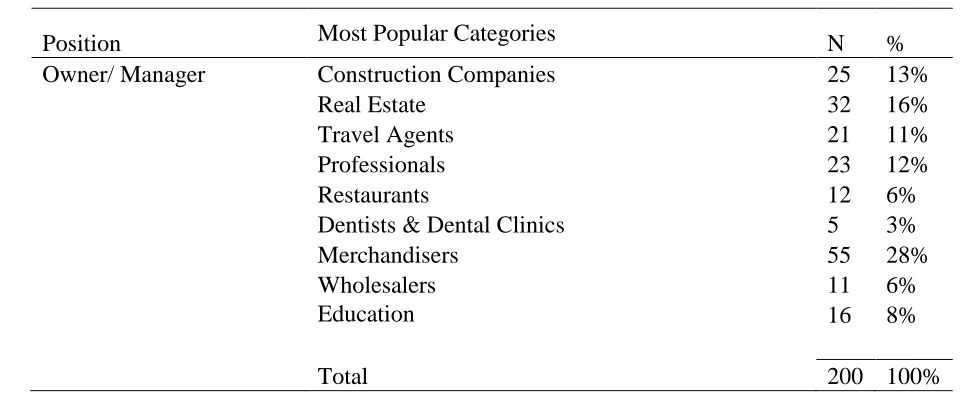
Table 1. Illustrates the respondent’s position and the most popular categories (N= 200)
Position Most Popular Categories N %
Owner/ Manager Construction Companies 25 13%
Real Estate 32 16%
Travel Agents 21 11%
Professionals 23 12%
Restaurants 12 6%
Dentists & Dental Clinics 5 3%
Merchandisers 55 28%
Wholesalers 11 6%
Education 16 8%
Total 200 100%
Figure 1 shows the interviewed results. The respondents were asked to rank in order the importance of the job knowledge requirements for business managers.
Figure1. Illustrates the job knowledge requirements for business managers in all levels
98% of the respondent revealed that knowledge of profession’s work is the most important in the categories of job knowledge requirements for business managers. Many participants commented that” business managers are professionals, they should know about federal labor laws and managerial functions.” 94% of respondents revealed that knowledge of strategic planning is the second in the list. Business managers should acquire the knowledge of strategic planning for their departments to achieve their organizational goals. 87% of the respondents revealed that business managers should have the knowledge of organizing and controlling as part of their managerial duties. Knowledge of office management and office supplies are not very important in the view of respondents with 80% and 60% respectively.
Figure 2 shows the most important skills that business managers should have for an entry-level position in an organization. The respondents were asked to rank each of the following skills in order of importance.
60% 80%
87% 94%
98%
basic knowledge of office supplies knowledge of office management knowledge of organizing and controlling
http://www.ijmsbr.com Page 7 Figure 2. Illustrates the skills required for business managers for entry- level position
The results revealed that communication and interpersonal skills are ranked first, both cited by 95% of respondents. Problem-solving skills are third, cited by 90% of respondents. An analytical skill is fourth, cited by 85% of respondents. Ability to maintain confidentiality is ranked fifth, cited by 80% of respondents. A social skill is ranked sixth, cited by 78%. While the ability to work under pressure and to work in a team is ranked by 75% and 70% respectively.
Figure 3 illustrated the most important skills that business managers should acquire for journey level position in an organization. The respondents were asked to rank each of the following skills in order of importance.
Figure 3 shows the most important skills that business managers should acquire for journey level position in an organization. The respondents were asked to rank each of the following skills in order of importance.
Figure 3. Illustrates the skills required for business managers for journey position
The result shows that supervisory skill is ranked first, cited by 90% of respondents. Decision making skill is ranked second, cited by 89% of respondents. Planning, organizing, leading and controlling skills are ranked third, cited by 88%. Initiative abilities are ranked fourth, cited by 80% of respondents. Finally, the ability to be responsible and accountable and the ability to act ethically are ranked fifth and sixth, cited by 75% and 74% respectively.
Figure 4 shows the most important skills that business managers should acquire for senior level position in an organization. The respondents were asked to rank each of the following skills in order of importance.
70% 75%
78% 80%
85% 90%
95% 95%
Ability to work in a team Ability to work under pressure Social skills Ability to maintain confidentiality Analytical skills Problem solving skills Interpersonal skills Communication skills
74% 75%
80% 88%
89% 90%
Ability to act ethically Ability to be responsible and accountable Initiative abilities Planning, organizing, leading and controlling Decision making skills Supervisory skills
80% 80%
85% 86%
90%
96% 96%
The result indicated that leadership and negotiation skills are ranked first, both cited by 96% of respondents. Strategic, creative and initiative skills are ranked second, cited by 90% of respondents. Goal achievement and self-management skills are ranked third and fourth, cited by 86% and 85% respectively. Team oriented and flexibility skills are ranked fifth, both cited by 80% of respondents.
Figure 5 shows behavioral competencies that business managers should acquire for all managerial levels in an organization. The respondents were asked to rank each of the following behavioral competencies in order of importance.
The result shows that emotional intelligence is ranked first, cited by 91% of respondents. Integrity is second, cited by 85%, ethics and values are third, cited by 84%, self-confidence is ranked fourth, cited by 81% and finally, sense of urgency is ranked fifth, cited by 80% of respondents.
5. DISCUSSION
Business managers play a prominent role in organization development. They should have the competencies needed to transform their organizations from traditional to modern firms. The research results suggest that the development of competencies model or framework will enrich our future research and a better understanding of the most critical knowledge, skills, and behaviors needed in each industry for effective business managers. Moreover, developing new competencies framework will help institutions and universities in developing sound business programs and courses that help students to advance their carriers and respond promptly to the market needs of well-qualified graduates. The competencies framework should consider the type of knowledge and skills needed at every managerial level in the organization. The managerial levels in the study focused on entry-level, journey level and senior level. Moreover, it’s important to consider the type of the specific industry, while developing such model.
6. CONCLUSION
This paper aims to identify the necessary competencies that business managers should exhibit to be effective and efficient in their organizations in a global environment. Competencies are set of knowledge, skills and behavioral related to the performance of a certain job. Business managers are professionals and administrators in their organizations.
The research results indicated that 98 % of the respondent revealed that knowledge of profession’s work is the most important in the categories of job knowledge requirements for business managers. Communication and interpersonal skills in the entry-level position are ranked first, both cited by 95% of respondents. Supervisory skill is ranked first in the journey level position, cited by 90% of respondents. Leadership and negotiation skills are ranked first, both cited by 96% of respondents. Emotional intelligence is ranked first in the behavioral competencies, cited by 91% of respondents.
Many well-known institutions and universities around the world design business programs that have the basic and advanced knowledge, skills and competencies for their students, to help them to advance their future careers. Programs accreditation is a certification of competence and credibility given by various international accreditation bodies. The agencies that provide accreditation ensure quality control and enforce rigorous academic standards.
80% 81%
84% 85%
91%
Sense of urgency Self confidence Ethics and values Integrity Emotional Intelligence
Limitation of the study
The research study is limited to the private sector in the UAE; further research is needed in the public sector. Moreover, this research has been accomplished through limited open-ended questions and a semi-structured interview. This led to a limited research study.
7. REFERENCES
i. Barker, R (2010). The big idea: No, management is not a profession. Harvard Business Review. Retrieved Sep 13, 2016, from: https://hbr.org/2010/07/the-big-idea-no-management-is-not-a-profession
ii. Bowers, Mary Y, Metcalf, Marcia A (2008). What employers want and what students need: Integrating business communication into undergraduate and graduate business courses, Northern Arizona University, Proceedings of the 2008 Association for Business Communication Annual Convention. Retrieved Sep 13, 2016, from: http://businesscommunication.org/wp-content/uploads/2011/04/02ABC2008.pdf
iii. Dvorak, P. (2007). MBA programs hone 'soft skills'. Wall Street Journal, 249(35), B3
iv. Forbes Middle East (2012, February). Top private universities for MBA programs in the MENA region, Forbes Middle East, Feb Issue. Retrieved Sep 13, 2016, from:
v. http://www.forbesmiddleeast.com/english/view.php?list=22
vi. Graduate Management Admission Council (2012). GMAT Handbook. Retrieved Sep 13, 2016, from: http://www.mba.com/~/media/Files/mba/NEWTheGMAT/gmat-handbook.pdf
vii. Human Resources Professional Association (2014). A Competency Framework for the Human Resources Profession. Retrieved Sep 13, 2016, from: http://hrdesignations.ca/HRPA-Professional-HR-Competency-Framework.pdf
viii. Jarocka, M (2012). University Ranking Systems – From League table to Homogeneous Groups of Universities, World Academy of Science, Engineering and Technology 66, 2012, pp.800-805.
ix. Khan, W (2012). Managerial Roles, Skills and Competencies in Business Organizations (1st Ed). Amazon Digital Services LLC.
x. Schatz, Martin (1993). What's Wrong With MBA Ranking Surveys? Management Research News 16(7), 1993, pp. 15-18).
xi. McGraw, Thomas K. (1999). Teaching History Courses to Harvard MBA Students: Building Enrollment from 21 to 1,300, Harvard Business School. Business.4nd Economic History, Volume Twenty-eight, no. 2, winter 1999. Retrieved Sep 13, 2016, from:
http://www.thebhc.org/publications/BEHprint/v028n2/p0153-p0162.pdf
xii. Ulrich, D. Brockbank, W. Younger, J. Ulrich, M (2012). Global HR competencies: Mastering Competitive Value from Outside In (1st Ed). New York: McGraw-Hill Education.