Vol. 4, No. 3 (2016): 842-846 Research Article
Open Access
I
ISSSSNN::22332200--22224466
GC-MS and LC-MS/MS Determination of Tannase
enzyme from food processing wastes by Solid State
fermentation using Aspergillus niger
R. Vidyalakshmi, R. Paranthaman* and S. Kumaravel
Department of Food Safety and Quality Testing (NABL ISO/IEC 17025:2005 Accredited) Indian Institute of Crop Processing Technology (IICPT), Ministry of Food Processing Industries, Thanjavur- 613 005, Tamil Nadu, India
* Corresponding author:R. Paranthaman; e-mail: [email protected]
ABSTRACT
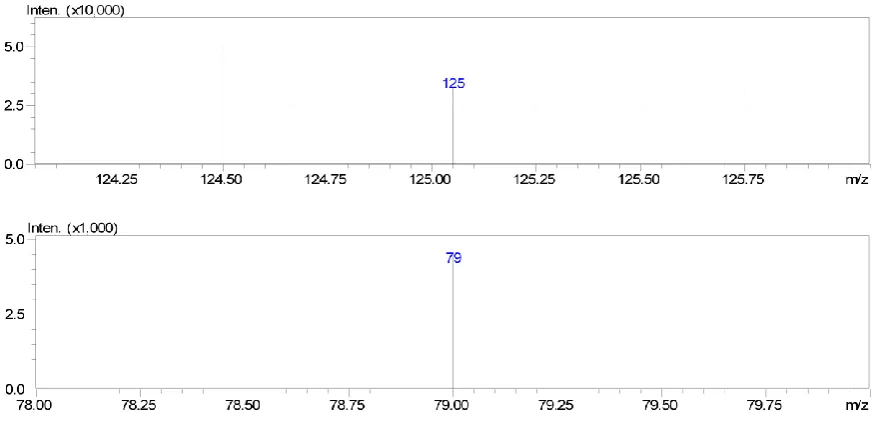
Tannin acyl hydrolase is an industrially important enzyme that is mainly used in the food and pharmaceutical industry. The present work has been taken up with a view of exploring the possibilities of using tea wastes for the production of tannase and determined by using UHPLC method. The molecular structure of Gallic acid was confirmed by using Liquid Chromatography–Mass Spectrometry (LCMSMS)method. The Mass spectrum of gallic acid obtained after isolation and fragmentation of m/z 169.05 and the most abundant ions, 125.05 m/z and 79.00 m/z were identified. LC-MS/MS is a powerful technique used for determination of tannin acyl hydrolase and it was very high sensitivity and selectivity.
Keywords:
Tannase, GC-MS, Tea waste, UHPLC, LC-MS/MS.1. INTRODUCTION
Beverage companies manufacturing various tea drinks produce tons of tea-leaf waste annually, most of which is burned, dumped into landfills or used as compost. Tea waste may be considered a valuable protein source. The current trend is the utilization of food processing waste for production of byproducts which boosts up high economic returns in many industries. Liquid chromatography–mass spectrometry (LC-MS, or alternatively HPLC-MS) is a chemistry technique that combines the physical separation capabilities of liquid chromatography (UHPLC) with the mass analysis capabilities of mass spectrometry.
In this study, Tea waste, a locally available industrial waste, was used as a substrate for the production of Tannase and analysis of gallic acid in fermented Tea waste and Tannase confirmation by using LC-MS/MS.
2. MATERIALS AND METHODS
2.1 Production of tannase under SSFThe enzyme tannase was produced by solid state fermentation, extracted and purified from the fermented Tea waste by using method of Deepa C Philip
et al. [1]. The tannase activity was estimated following the method [2-3]
2.2 Gas Chromatography Mass Chromatography (GC-MS) analysis of fermented substrate
2.2.1 Preparation of extract:
20 g of the fermented substrate was soaked in 95% ethanol for 12 h. The extracts were then filtered through Whatmann filter paper No. 41 along with 2 gm sodium sulfate to remove the sediments and traces of water in the filtrate. Before filtering, the filter paper along with sodium sulfate was wetted with 95% ethanol. The filtrate was then concentrated by bubbling nitrogen gas into the solution. 2 μl of this solution was employed for GC/ MS analysis.
GC-MS analysis was carried out on a GC CLARUS 500 PerkinElmer system, Serial Number (650N3050805) comprising a gas chromatograph interfaced to a mass spectrometer (GC-MS) instrument employing the conditions [4-5]column Elite-1 fused silica capillary column (30×0.25 mm ID×1EM df, composed of 100% Dimethyl poly siloxane), operating in electron impact
mode at 70 eV; helium (99.999%) was used as carrier gas at a constant flow of 1ml/min and an injection volume of 0.5 EI was employed (split ratio of 10:1) injector temperature 250°C; ion-source temperature 280°C. The oven temperature was programmed from 110°C (isothermal for 2 min), with an increase of 10°C/min, to 200°C, then 5°C/min to 280°C, ending with a 9 min isothermal at 280°C. Mass spectra were taken at 70 eV; a scan interval of 0.5 s and fragments from 40 to 550 Da. The following GC-MS conditions were used when carrying out this analysis:GC Programme: Column: Elite-1 (100% Dimethyl poly siloxane), 30 x 0.25mm x 1mdf, Equipment: GC Clarus 500 Perkin Elmer, Carrier gas: 1ml per min, Split: 10:1, Detector: Mass detector: Turbo mass gold-Perkin Elmer, Software: Turbomass 5.4.2, Sample injected: 2l.Oven temperature programme: 110 deg C-2 min hold, Up to 200 deg C at the rate of 10 deg C / min-no hold, Up to 280 deg C at the rate of 5 deg C / min-9 min hold, Injector temperature: 250 deg C, Total GC running time: 36 min. MS Programme: Library used: NIST Version-Year 2005, Inlet line temperature: 200 deg C, Source temperature: 200 deg C, Electron energy: 70 eV, Mass scan: (m/z): 45-450, Total MS running time: 36 min.
2.3 Ultra Liquid Chromatography–Mass Spectrometry (LCMSMS) Determination of Tannase
The extracted sample was performed with the UHPLC system (Shimadzu Corporation, Kyoto, Japan) equipped
with two Shimadzu UHPLC: Nexera UHPLC system Column: Shim-pack XR-ODS III (100 x 2 mm, 2.2 µm particle size) Column temp.: 40° C mobile phase: solvent A [water-acetic acid (25:1, v/v)] to solvent B (methanol). Solvent B was increased to 50% in 4 min and subsequently increased to 80% in 10 min at a flow rate of 1.0 mL/min. Detection wavelength was 280 nm Flow rate: 0.4 mL min-1 Injection volume: 32 µL (stacked injection: 2µL sample + 30µL water) Needle wash: 1000 µL Methanol. Samples were filtered through organic solvent compatible membrane filters (Pore size 0.20 µm, Millipore) prior to injection in sample loop.
2.4 MS/MS Conditions
LC-MS/MS System (Make: Shimadzu Corporation, Kyoto, Japan, Model: LCMS 8040, Triple Quadrupole) Ionization: ESI (Positive / Negative) ,Ion spray voltage: +4.5 kV / −3.5 kV , MRM :: 169.05 MRM transitions (2 MRMs / compound) Dwell time 5 msec. / Pause time 1 msec Ambient CDL Temperature : 250º C Block Temperature : 200º C Detector voltage : 1.3kv Nebulizer Gas flow: 1.5 l/min Drying gas : 10 L/min Detection : Gallic acid – 169.05 Data station : LCMS solution data station Internal Standard: Gallic acid – 169.05. The mobile phase was filtered through a 0.22 µ membrane and degassed using ultrasonicator. The experiments were carried out at room temperature of about 200 ºC [6].
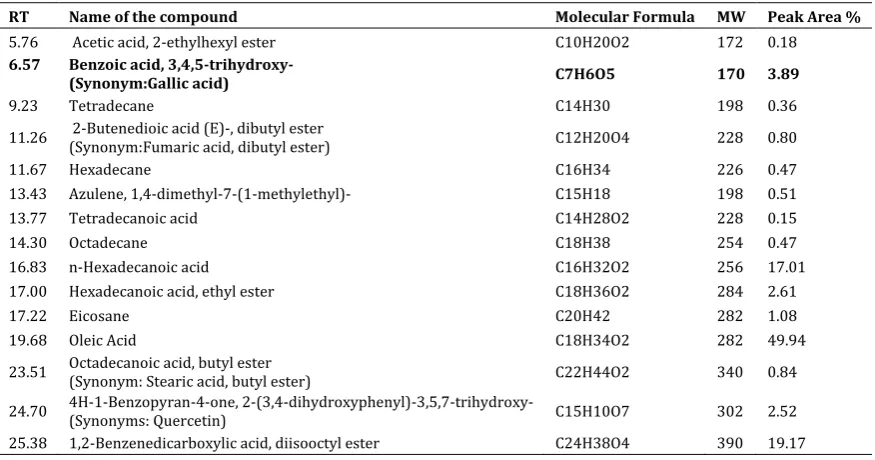
Table 3: GC-MS analysis of Tea wastes fermented with A. niger.
RT Name of the compound Molecular Formula MW Peak Area %
5.76 Acetic acid, 2-ethylhexyl ester C10H20O2 172 0.18
6.57 Benzoic acid, 3,4,5-trihydroxy-
(Synonym:Gallic acid) C7H6O5 170 3.89
9.23 Tetradecane C14H30 198 0.36
11.26 2-Butenedioic acid (E)-, dibutyl ester (Synonym:Fumaric acid, dibutyl ester) C12H20O4 228 0.80
11.67 Hexadecane C16H34 226 0.47
13.43 Azulene, 1,4-dimethyl-7-(1-methylethyl)- C15H18 198 0.51
13.77 Tetradecanoic acid C14H28O2 228 0.15
14.30 Octadecane C18H38 254 0.47
16.83 n-Hexadecanoic acid C16H32O2 256 17.01
17.00 Hexadecanoic acid, ethyl ester C18H36O2 284 2.61
17.22 Eicosane C20H42 282 1.08
19.68 Oleic Acid C18H34O2 282 49.94
23.51 Octadecanoic acid, butyl ester (Synonym: Stearic acid, butyl ester) C22H44O2 340 0.84
24.70 4H-1-Benzopyran-4-one, 2-(3,4-dihydroxyphenyl)-3,5,7-trihydroxy- (Synonyms: Quercetin) C15H10O7 302 2.52
25.38 1,2-Benzenedicarboxylic acid, diisooctyl ester C24H38O4 390 19.17
3. RESULTS AND DISCUSSION
3.1 GC-MS analysis of gallic acid molecular structure
It is evident from the Table 1 and figures 1 and 2, the presence of gallic acid was evident from the GC-MS chromatogram where the gallic acid separated at a
Figure 1: GC-MS Chromatogram of Gallic acid in Aspergillus niger fermented tea wastes.
Figure 2: GC-MS Spectrum of Gallic acid in Aspergillus niger fermented tea wastes.
3.2 LC-MS/MS Determination of Tannase
It is well known that LC/MS/MS detection is a very selective and sensitive analytical technique for quantification of easily ionisable Phenolic compounds. In EIMS technique, the compound is ionized after impact with Determination of gallic acid from Aspergillus niger tannase by LCMSMS energy electrons and the M- ion is first obtained and immediately fragmented into daughter ions. Almost any organic structure can be analyzed in this way. However, in case of ESIMS analysis, the processes are very different. First, only compounds that are ionisable in
Figure 3a: LC-MS Spectrum of Gallic acid Precursor ion 169 m/z
© 2016; AIZEON Publishers; All Rights Reserved
This is an Open Access article distributed under the terms of the Creative Commons Attribution License which permits unrestricted use, distribution, and reproduction in any medium, provided the original work is properly cited.
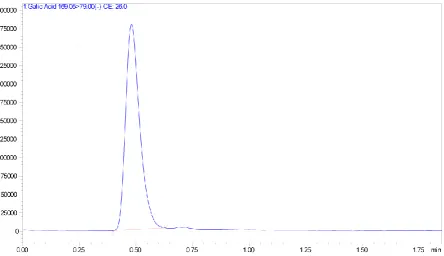
Figure 4: LC-MS/MS Chromatogram of Gallic acid Product ion 169 m/z 125 & 79 m/z
4. CONCLUSION
Solid state fermentation was suitable for tannase production using agricultural by-products. From this study it is concluded that the GC-MS and LC-MS/MS method has been successfully applied to the determination of Gallic acid in Aspergillus niger from tea wastes and confirmed the production of tannase. LC/MS/MS technologies are extremely important for characterization and quantitation of phytochemicals.
5. ACKNOWLEDGEMENTS
The authors would like to thank Dr. M.Loganathan, Director i/C, Indian Institute of Crop Processing Technology, Ministry of Food Processing Industries, Govt of India, Thanjavur-613 005 Tamil Nadu, for their support of this study.
6. REFERENCES
1. Deepa C Philip, Lavanya. B, Latha. S. (2015) Purification of Tannase from Aspergillus Niger under Solid State Fermentation. World Journal of Pharmacy and Pharmaceutical Sciences. 4(2): 993-1001
2. Dhruvil Brahmbhatt, H.A.Modi and N.K.Jain. (2014) Preliminary isolation and screening of tannase producing
bacteria and fungi. International Journal of Current Microbiology and Applied Sciences 3(11): 193-203. 3. Dhruvil Brahmbhatt, H. A. Modi. (2015) Comparative
Studies on Methods of Tannase Assay. International Journal for Research in Applied Science & Engineering Technology 3(III).
4. R. Paranthaman, S.Murugesh and K. Singaravadivel . (2010). Bioprocessing of paddy straw for the production and Purification of gallic acid using penicillium Chrysogenum. Electronic Journal of Environmental, Agricultural and Food Chemistry. 9(9): 1460-1470. 5. R. Paranthaman, P.Praveen kumar, and S.Kumaravel.
(2012). GC-MS Analysis of Phytochemicals and Simultaneous Determination of Flavonoids in Amaranthus caudatus (Sirukeerai) by RP-HPLC. J Anal Bioanal Techniques 3:147.
6. M.P. Venuprasad, Hemanth Kumar Kandikattu, Sakina Razack and Farhath Khanum. (2014). Phytochemical analysis of Ocimum gratissimum by LC-ESI–MS/MS and its antioxidant and anxiolytic effects. South African Journal of Botany92: 151–158.