Partial conversion of elite maintainer genotype mas99 into new male sterile
line suitable for aerobic and drought conditions through backcross
breeding in rice
Raghavendra P, Shailaja Hittalmani *, Pavan M P, Uma M S
Marker Assisted Selection Laboratory, Dept. of Genetics and Plant Breeding, University of Agricultural Sciences, GKVK, Bangalore-560 065, India
* Correspondence: [email protected]
(Received: July 2015; Accepted: January 2016)
Abstract
Two populations were developed and advanced to BC3 generation using IR70369A and KCMS31A CMS lines as donors and
MAS 99 as recurrent parent. In BC3F1 generation, the populations were evaluated with parents for morpho-floral traits under
aerobic field condition. In both crosses, the mean values of number of tillers/plant (22 & 27), plant height at maturity (74 & 73cm), days to 50% flowering (95 & 97 days) were found comparable to the recurrent parent with superior floral traits such as pollen sterility (100%), stigma exertion (30% & 25%) and spikelet sterility (100%). IR70369A × MAS99 cross derived plants, A04, A35, A47, A65, A84 and KCMS31A × MAS99 cross derived plants, B06, B27, B30, B34 and B44 were identified as superior MAS99 converted CMS plants as indicated by morpho-floral traits and advanced to BC4F1. Between
two crosses, IR70369A × MAS99 cross derived population was superior for days to 50% flowering and stigma exertion rate.
Key words: Aerobic rice, backcross, conversion, male sterility, spikelet fertility
Introduction
Rice is a highly researched crop for crop improvement in the areas of biotic and abiotic stress tolerance, nutritional quality and yield. Curtail in rice yields coupled with water scarcity has led to low production and productivity in rice. Alternate crop cultivation is being practiced among the conventional rice growers off-late due to water stress and low yields though Hybrid rice technology is one of the approaches for breaking the yield plateau (Siddiq, 1997). Availability of suitable hybrids for drought or cultivation for aerobic situations are scarce. The development of potential CMS lines is an important step in the production of promising hybrids for adverse situations. Availability of suitable male sterile line, maintainer (B line) and restorer (R line) in three line hybrid rice breeding is essential (Hittalmani and Shivashanker, 1987). The discovery of a wild-abortive cytoplasmic male sterile line (WA-CMS) in rice at Hainan Island in 1973 resulted in the huge success of three-line hybrid rice breeding in China (Hua et al., 2009). However, limited availability of CMS lines has hindered the exploitation of the hybrid rice technology to the maximum in India. Limited resources of cytoplasmic male sterility and lower variation of CMS lines causes genetic vulnerability to biotic and abiotic stresses (Rumanti et al., 2011). Therefore, to diversify CMS lines breeders can transfer male sterile trait to the existing B lines through consecutive backcrosses. Previous work in our research group showed that genotype MAS 99 is a maintainer line for cytoplasmic male sterility of WA type which is promising short duration genotype suitable for
aerobic and drought conditions (Satheesh, 2015). CMS lines developed so far are suitable for
lowland irrigated puddled condition. Hence, we made an attempt to develop CMS lines suitable for aerobic condition. Most of the hybrids in rice were developed using IR58025A and IR62829A CMS lines leading to narrow genetic base hybrids thereby, become vulnerable to biotic and biotic stresses (Hooker 1974). To alleviate these critical situations, we need to diversify CMS lines which are suitable for various conditions by converting identified maintainer lines into CMS line. Therefore, it is necessary to transfer available CMS system into elite breeding lines to develop suitable hybrids for specific situations (Kumar et al., 1996). Similarly, Ali and Khan (1996) successfully transferred CMS genes from IR58025A and IR62829A into Basmati line 47456 in Pakistan.Vasoukolaei et al. (2010) converted Iranian rice cultivars into cytoplasmic male sterile lines through repeated back crossing. Whereas, Ali et al. (2013) evaluated newly developed quasi-CMS lines, forwarded further to use and develop superior aromatic rice hybrids. The present study was undertaken to generate new CMS line in the nuclear background of MAS 99 suitable for aerobic condition which can be further utilized for development of new rice hybrids.
Materials and methods
http://ejplantbreeding.com 49 to intermittent drought developed by MAS lab,
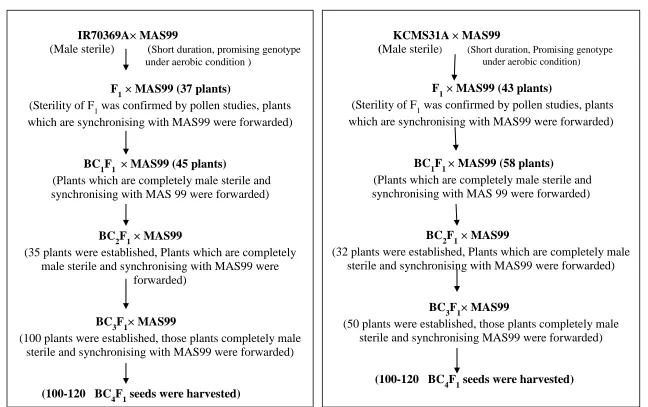
University of agricultural sciences, Bangalore was used as recipient line. During kharif 2012, MAS99 genotype was crossed with IR70369A and KCMS31A male sterile lines and their hybrid combinations were observed for pollen fertility and spikelet fertility during summer 2013. The pollen sterility was examined using acetocarmine stain (2%). The sterile plants were tagged and back crossed with male parent MAS 99 as recurrent parent. Subsequently in every season phenotypic foreground selection was carried out by testing pollen sterility to confirm the donor parent trait introgression, then further backcross was affected. Backcrossing was continued for both seasons in 2013 and 2014. The scheme of back cross followed to develop these quasi- CMS lines was given in Fig. 1. The recommended package of practices was followed during crop growth period under aerobic condition. In BC1F1 and BC2F1 generation plants that synchronised in flowering and were similar in plant height compared to MAS99 (recurrent parent) were selected and forwarded to next generation. In BC3F1 generation, about 100 plants (A1-A100) derived from IR70369A × MAS99 cross and 50 plants (B1-B50) of KCMS31A × MAS 99 cross were evaluated along with their parents for morpho-floral traits. The observations were recorded as per SES (1996) on individual plants for 13 characters viz., Plant height at 45 days, days to fifty percent flowering, pollen sterility (%), style length (mm), stigma length (mm), stigma exertion percentage (%), SPAD reading, plant height at maturity (cm), panicles plant-1, panicle exertion percentage (%), panicle length (cm), number of spikelets panicle-1 and spikelet fertility (%). The pollen and spikelet fertility were determined as the ratio of fertile pollens to the total pollens and as the ratio of filled spikelets to the total spikelets respectively and expressed in percentage. Length of stigma and style were measured using micrometry and expressed in mm. The stigma exsertion was calculated by the ratio of spikelets with exerted stigma to the total number of spikelets and expressed in percentage. The percentage of length of panicle that emerges out from flag leaf to the total length of panicle was considered as panicle exertion percent. Panicles emerging from the sheath were bagged with butter paper bags prior to anthesis to prevent cross pollination. Bagged panicles were harvested to assess spikelet fertility. The trait means of BC3F1 plants of both crosses were compared with parents to analyse the recovery of recurrent parent (MAS 99) genome. Two tail t-test was carried out to compare statistically. The superior CMS plants were identified and advanced to BC4F1.
Results and Discussion
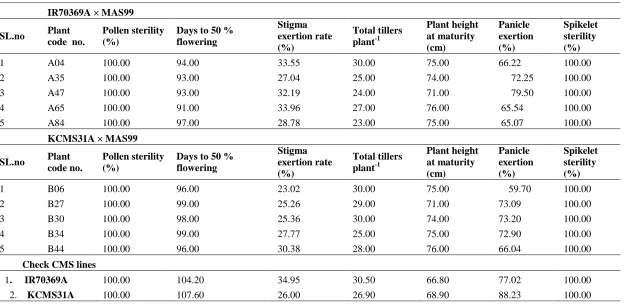
B27, B30, B34 and B44 were identified as superior plants. Stigma exertion and panicle exertion of these plants was comparable to checks besides 100% pollen and spikelet sterility (Table 2). Between the two populations, IR70369A × MAS99 cross derived population was superior for days to 50% flowering and stigma exertion rate.These CMS lines can be used in future for the development of superior hybrids suitable for aerobic and drought condition. Similarly new CMS lines were developed in rice through back crossing
by Dalmacio et al. (1995); Manonmani et al. (2006); Pradhan and Jachuck, (2008); Xian-Hua et al. (2013). The investigation concludes new short duration quasi-CMS lines suitable for aerobic and intermittent drought conditions were developed by converting B-line MAS 99B in to A-line MAS 99A through introgression of male sterility from IR70369A and KCMS31A by consecutive backcrossing.The selected lines need to be further stabilised.
References
Ahmadikhah, A., Mehdi, M., Mohammad, H. P. and Leila, N. 2015. Marker-assisted backcrossing (MABC) using CMS-specific, SSR and ISSR markers to develop an elite CMS line in rice. The Pl. Genome, 31:1-78.
Ali, M., Hossain, M. A., Hasan, M. J. and Kabir, M. E. 2014. Identification of maintainer and restorer lines in local aromatic rice (Oryza sativa L.). Bangladesh J. Agril. Res., 39(1): 1-12. Ali, M., Hossain, M. A., Kulsum, M. U., Sharma, N. and
Mian, M. A. K. 2013. Variability in quasi CMS lines of aromatic rice (Oryza sativa L.) in BC3
generation and their phenotypic acceptability. Eco-friendly Agril. J., 6(05): 78-82.
Ali, S. S. and M. G. Khan. 1996. Development of rice cytoplasmic male sterile line47456A in Kala Shah Kaku, Pakistan. Intl. Rice Res. Notes,
21(2-3): 31.
Dalmacio, R., Brar, D. S., Ishii, T., Sitch, L. A., Virmani, S. S. and Kush, G. S. 1995. Identification and transfer of a new cytoplasmic male sterility source from Oryza perennis into indica rice (O. sativa). Euphytica, 82(3): 221-225.
Hittalmani, S. and Shivashankar, G. 1987. Out crossing on male sterile lines of rice. Mysore J. Agri. Sci., 21:158-160.
Hooker, A.L. 1974. Cytoplasmic susceptibility in plant disease. Ann. Rev. Phytopath., 12: 167–169. Hua C.S., Cao, L., Zhuang, J., Wu, W., Yang, S. and
Zhang, X. 2009. A breeding strategy for hybrid rice in China. In: Xie F, Hardy B, Accelerating hybrid rice development. International Rice Research Institute, Los Banos, pp 25–34. Kumar, R.V., P. V. Satyanarayana and M.S. Rao. 1996.
New cytoplasmic male sterile lines developed in Andhra Pradesh. India. Intl. Rice Res. Notes,
21(2-3): 30.
Manonmani, S., Thiyagarajan, K., Malarvizhi, D. and Deepa Shankar, P. 2006. COMS13 A—a new male sterile line in rice. Inter. J. Agric. Sci.,
2:349-350.
Naresh Babu, N., Shivakumar, N. and Shailaja Hittalmani. 2010. Pollen fertility Vs Spikelet fertility in F2 of a CMS based hybrids in rice
(Oryza sativa L.) under aerobic condition. Electronic J. Pl. Breed., 1(4): 789-793. Pradhan, S. B. and Jachuck, P. J. 2008. Development of
new sources of cytoplasmic male sterile lines in rice. Pl. Breed., 118(5): 459–461.
Rumanti, I. A., Purwoko, B. S., Dewi, I. S. and Aswidinnoor, H. 2011. Improving food, energy and environment with better crops. 7th Asian Crop Science Association Conference, IPB. International Convention Center, Bogor, Indonesia.pp. 39-44.
Satheesh Naik, S. J. 2015. Development and identification of high yielding rice hybrids for aerobic and drought conditions. Ph.D. Thesis, Univ. Agric. Sci., Bangalore.
Siddiq, E. A. 1997. Current status and future outlook for hybrid rice technology in India. In Hybrid Rice a key to success. R Vijaya Kumar and P S Murthy (Eds.). Acharya N. G. Ranga Agricultural University, Agricultural Research Station, Maruteru. pp. 1-34.
Standard Evaluation System for Rice. 1996. Prepared by INGER – Genetic Resources Center, International Rice Research Institute, Manila, and Philippines.Pp1-39.
Vasoukolaei, N. R., Bahamian, J. N. A., Bagheri, N., Hasan, N. E. 2010. Allogamic characteristics of rice cytoplasmic male sterile lines and using STS markers for distinguishing them. Seed and pl. impro. j., 26 (1): 485 - 500.
http://ejplantbreeding.com 51
Fig 1
. Scheme of backcross followed to develop new CMS line from two crosses in rice
IR70369A× MAS99
(Male sterile) (
Short duration, promising genotype under aerobic condition )F
1× MAS99 (37 plants)
(Sterility of F
1was confirmed by pollen studies, plants
which are synchronising with MAS99 were forwarded)
BC
1F
1× MAS99 (45 plants)
(Plants which are completely male sterile and
synchronising with MAS 99 were forwarded)
BC
2F
1× MAS99
(35 plants were established, Plants which are completely
male sterile and synchronising with MAS99 were
forwarded)
BC
3F
1× MAS99
(100 plants were established, those plants completely male
sterile and synchronising with MAS99 were forwarded)
(100-120 BC
4F
1seeds were harvested)
KCMS31A × MAS99
(
Male sterile
) (Short duration, Promising genotype under aerobic condition)F
1× MAS99 (43 plants)
(Sterility of F
1was confirmed by pollen studies, plants
which are synchronising with MAS99 were forwarded)
BC
1F
1× MAS99 (58 plants)
(Plants which are completely male sterile and
synchronising with MAS 99 were forwarded)
BC
2F
1× MAS99
(32 plants were established, Plants which are completely male
sterile and synchronising with MAS99 were forwarded)
BC
3F
1× MAS99
(50 plants were established, those plants completely male
sterile and synchronising MAS99 were forwarded)
(Fig. A)
(Fig. B)
Fig 2.
Comparison of sterile and fertile pollen grains (Fig .A), sterile and fertile spikelets
(Fig. B)
Sterile pollen grains
Fertile pollen grains
http://ejplantbreeding.com
53
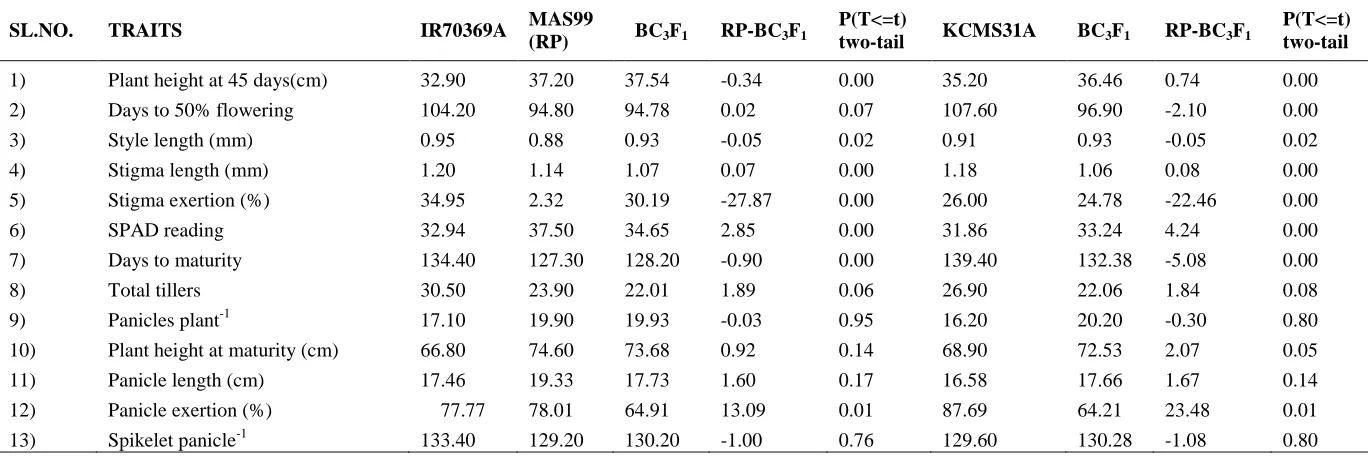
Table 1. Comparison of Parental trait means with BC3F1 populations derived from IR70369A × MAS99 and KCMS31 × MAS99 crosses in rice
SL.NO. TRAITS IR70369A MAS99
(RP) BC3F1 RP-BC3F1
P(T<=t)
two-tail KCMS31A BC3F1 RP-BC3F1
P(T<=t) two-tail
1) Plant height at 45 days(cm) 32.90 37.20 37.54 -0.34 0.00 35.20 36.46 0.74 0.00
2) Days to 50% flowering 104.20 94.80 94.78 0.02 0.07 107.60 96.90 -2.10 0.00
3) Style length (mm) 0.95 0.88 0.93 -0.05 0.02 0.91 0.93 -0.05 0.02
4) Stigma length (mm) 1.20 1.14 1.07 0.07 0.00 1.18 1.06 0.08 0.00
5) Stigma exertion (%) 34.95 2.32 30.19 -27.87 0.00 26.00 24.78 -22.46 0.00
6) SPAD reading 32.94 37.50 34.65 2.85 0.00 31.86 33.24 4.24 0.00
7) Days to maturity 134.40 127.30 128.20 -0.90 0.00 139.40 132.38 -5.08 0.00
8) Total tillers 30.50 23.90 22.01 1.89 0.06 26.90 22.06 1.84 0.08
9) Panicles plant-1 17.10 19.90 19.93 -0.03 0.95 16.20 20.20 -0.30 0.80
10) Plant height at maturity (cm) 66.80 74.60 73.68 0.92 0.14 68.90 72.53 2.07 0.05
11) Panicle length (cm) 17.46 19.33 17.73 1.60 0.17 16.58 17.66 1.67 0.14
12) Panicle exertion (%) 77.77 78.01 64.91 13.09 0.01 87.69 64.21 23.48 0.01
13) Spikelet panicle-1 133.40 129.20 130.20 -1.00 0.76 129.60 130.28 -1.08 0.80
Table 2.
Superior MAS 99 converted CMS plants identified in BC3F1 populations derived from IR70369A × MAS99 and KCMS31A × MAS99 crosses in
rice
IR70369A × MAS99
SL.no Plant code no.
Pollen sterility (%)
Days to 50 % flowering
Stigma exertion rate (%)
Total tillers plant-1
Plant height at maturity (cm)
Panicle exertion (%)
Spikelet sterility (%)
1 A04 100.00 94.00 33.55 30.00 75.00 66.22 100.00
2 A35 100.00 93.00 27.04 25.00 74.00 72.25 100.00
3 A47 100.00 93.00 32.19 24.00 71.00 79.50 100.00
4 A65 100.00 91.00 33.96 27.00 76.00 65.54 100.00
5 A84 100.00 97.00 28.78 23.00 75.00 65.07 100.00
KCMS31A × MAS99
SL.no Plant code no.
Pollen sterility (%)
Days to 50 % flowering
Stigma exertion rate (%)
Total tillers plant-1
Plant height at maturity (cm)
Panicle exertion (%)
Spikelet sterility (%)
1 B06 100.00 96.00 23.02 30.00 75.00 59.70 100.00
2 B27 100.00 99.00 25.26 29.00 71.00 73.09 100.00
3 B30 100.00 98.00 25.36 30.00 74.00 73.20 100.00
4 B34 100.00 99.00 27.77 25.00 75.00 72.90 100.00
5 B44 100.00 96.00 30.38 28.00 76.00 66.04 100.00
Check CMS lines
1. IR70369A 100.00 104.20 34.95 30.50 66.80 77.02 100.00