The Open Journal of Occupational Therapy
The Open Journal of Occupational Therapy
Volume 5
Issue 2 Spring 2017 Article 6
March 2017
Traditional Lectures and Team-Based Learning in an Occupational
Traditional Lectures and Team-Based Learning in an Occupational
Therapy Program: A Survey of Student Perceptions
Therapy Program: A Survey of Student Perceptions
Anne H. Zachry
The University of Tennessee Health Science Center - USA, [email protected]
Brittany H. Nash
The University of Tennessee Health Science Center - USA, [email protected]
Ann Nolen
The University of Tennessee Health Science Center - USA, [email protected]
Follow this and additional works at: https://scholarworks.wmich.edu/ojot
Part of the Occupational Therapy Commons
Recommended Citation Recommended Citation
Zachry, A. H., Nash, B. H., & Nolen, A. (2017). Traditional Lectures and Team-Based Learning in an Occupational Therapy Program: A Survey of Student Perceptions. The Open Journal of Occupational Therapy, 5(2). https://doi.org/10.15453/2168-6408.1313
This document has been accepted for inclusion in The Open Journal of Occupational Therapy by the editors. Free, open access is provided by ScholarWorks at WMU. For more information, please contact
Traditional Lectures and Team-Based Learning in an Occupational Therapy Traditional Lectures and Team-Based Learning in an Occupational Therapy Program: A Survey of Student Perceptions
Program: A Survey of Student Perceptions
Abstract Abstract
Background: Team-Based Learning (TBL) is an active instructional approach used in health care education that incorporates group work.
Methods: Two occupational therapy professors adopted a TBL instructional approach in two courses for first- and second-year occupational therapy master’s degree level students. The investigators
administered a survey to evaluate student perceptions of TBL and lecture-based instruction (LBI). A principal components factor analysis with varimax rotation identified two 5-item factors: “perceptions of LBI” and “perceptions of TBL.” Internal consistency for each factor was strong (Cronbach’s alpha 5 0.856 [preference for LBI]; 0.865 [preference of TBL]). A Wilcoxon matched pairs signed rank test was
conducted to determine whether there was a difference in the ranking of two teaching approaches.
Results: The results indicated a significant difference in how the students ranked the instructional approaches, z = -3.19, p < .05, with the students having more positive perceptions of LBI than TBL.
Conclusion: The implications for occupational therapy educators are discussed.
Keywords Keywords
Active Learning, Team-Based Learning, Lectures, Occupational Therapy, Student Perceptions
Credentials Display
Anne Zachry, PhD, OTR/L; Brittany Nash, PT, DPT, OTR/L, MTC; Ann Nolen, PsyD, FAOTA, OTR
Copyright transfer agreements are not obtained by The Open Journal of Occupational Therapy (OJOT). Reprint permission for this Applied Research should be obtained from the
corresponding author(s). Click here to view our open access statement regarding user rights and distribution of this Applied Research.
DOI: 10.15453/2168-6408.1313
Occupational therapy educators strive to prepare entry-level practitioners who have the skills and expertise to meet the diverse health care needs of society. A variety of instructional methods are used in allied health educational programs, including traditional lecture-based instruction (LBI), case studies, problem-based learning, and other active learning approaches (Dewald, 2010; Russell,
Comello, & Wright, 2007; Seruya, 2007). Case studies are used in the classroom to create a realistic
experience of working with a client by providing information and details about medications, complications, and other data that reflect the complexity of the client in a variety of treatment settings (Trickey-Rokenbrod, 2016). Problem-based learning is an active approach that involves students learning in small groups to problem solve a realistic scenario and develop appropriate treatments for the client (Seruya, 2007). Students’ perceptions vary regarding preference for a specific learning strategy (Lake, 2001; Machemer & Crawford, 2007;
Struyven, Dochy, & Janssens, 2008).
Many educators are proponents of active learning approaches, which require student involvement in the learning process. Research suggests that active learning strategies play a role in the development of critical thinking and problem solving skills necessary for effective clinical
reasoning and decision making abilities (Hill, 2002; Lake, 2001; Schaefer & Zygmont, 2003; Stringer, 2002). Active learning strategies are increasingly being implemented in higher education, yet research is mixed regarding student preference for active learning compared to LBI (Covill, 2011; Lake, 2001; Machemer & Crawford, 2007; Struyven et al.,
2008).
Team-based learning (TBL) is a specific form of active learning that involves students working in small groups or teams (Mennenga & Smyer, 2010; Michaelson, Knight, & Finck, 2002). This instructional strategy has been shown to be feasible and effective in health professions and medical education (Abdelkhalek, Hussein, Gibbs, &
Hamdy, 2010; Dunaway, 2005; Livingston, Lundy, & Harrington, 2014; Nieder, Parmelee, Stolfi, &
Hudes, 2005; Thompson, Schneider, Haidet,
Perkowski, & Richards, 2007). TBL has three main components. The first element requires students to complete a reading assignment prior to class. The second element takes place at the beginning of class, with each individual student taking a quiz on the reading material. The quiz is called a readiness assurance test (RAT). The third element has students collaborate in assigned groups to complete the same RAT together. After the individual and group RATs are complete, the groups apply the course concepts and use critical thinking skills to solve functional application problems (Haidet, O’Malley, & Richards, 2002; Michaelson et al., 2002; Parmelee & Michelsen, 2010; Vasan, DeFouw, & Compton, 2009). For example, the teams of students might work through a case study to come up with a treatment plan for a patient. TBL
seems to have many educational advantages; however, there is limited research related to the implementation of TBL in occupational therapy education.
Literature Review
Lectures are the most common instructional
approach used in classrooms across the country
(Prober & Heath, 2012). Traditional lecture-based instruction is instructor focused and consists of the teacher introducing and explaining course material to the students. In turn, the students are expected to passively take in the information for future
application. Certain educators suggest that LBI does not promote critical thinking and that student
engagement is low with this approach (Bligh, 2000;
Kelly et al., 2005),while others suggest that lecturing can be an effective approach (Matheson,
2008; Richardson, 2007; Wilson & Korn, 2007). Sand-Jecklin (2007) found that nursing students tend to prefer passive learning strategies, such as lectures, while a study by Covill (2011) revealed that students perceive lectures to be an effective teaching method.
Regarding LBI, several researchers suggest that students lose the ability to retain attention after 10 to 15 min of lecture (Bligh, 2000; McKeachie, 1999), yet there is minimal support for this premise (Wilson & Korn, 2007). Other researchers report that lectures are valuable and are a cost-effective way for students to learn a large amount of material, if the material is compact and well-structured (Richardson, 2007; Wilson & Korn, 2007).
Furthermore, lectures allow students to learn how to take notes and summarize key points, provide information that is not in the textbook, clarify
complex topics, and allow the lecturer to relate the material to the profession (Matheson, 2008).
Active learning approaches are also used in higher education, and research suggests that student perceptions of active learning are mixed. For example, Machemer and Crawford (2007) found that students value active learning as well as
lectures, with students placing the most value on
learning approaches that improve exam
performance. Of interest is that the students
reported that they did not value working with
others. A study by Lumpkin, Achen, and Dodd (2015) revealed that students have positive
perceptions of active learning approaches, with the students reporting that engaging learning activities positively influence learning. Another study by Miller, McNear, and Metz (2013) found that
students enjoyed active learning techniques over LBI, and the students demonstrated 22.9% higher average on final exams when compared to LBI.
TBL is an emerging instructional approach that involves active learning. Research examining the effectiveness of TBL is mixed. One study examining the impact of TBL on the academic performance of medical students found that the TBL students performed significantly higher on exam questions compared to those who learned through other instructional approaches (Koles, Stolfi, Borges, Nelson, & Parmelee, 2010). In the same study, the students who benefitted the most from the TBL approach were the ones who
performed in the lowest class quartile (Koles et al., 2010). In 2009, Wiener, Plass, and Marz (2009) found that first-year medical students taught via a TBL approach scored significantly higher on
multiple-choice examination questions than those taught using LBI. In a research review published in 2011, Sisk concluded that the TBL approach is as effective as LBI when short-term outcomes were assessed (2011). A study by Mody, Kiley, Gawron, Garcia, and Hammond (2012) compared LBI to TBL. These researchers found that medical The Open Journal of Occupational Therapy, Vol. 5, Iss. 2 [2017], Art. 6
students scored similarly on general test questions, with the TBL group scoring significantly higher on problem-solving skills compared to the LBI group. More recently, Bleske et al. (2014) reported that students taught via LBI scored significantly higher on recall questions than those taught using a TBL approach, with no significant differences noted on questions that required higher level application
(Bleske et al., 2014). Additional research suggests that using this approach fosters group collaboration
(Hunt, Haidet, Coverdale, & Richards, 2003), engages learners (Searle et al., 2003), and improves knowledge outcomes related to content (Levine et al., 2004).
Research indicates that students in a variety of health education programs generally have positive perceptions of the TBL approach
(Abdelkhalek et al., 2010; Addo-Atuah, 2011; Kim, 2008). Frame et al. (2015) evaluated student perceptions of TBL versus LBI in a pharmacy program. The authors concluded that when TBL is incorporated into the curriculum early, students have more positive perceptions of the approach than when a TBL course follows LBI courses.
Although research has been conducted related to the implementation of TBL in physical therapy, medical, nursing, and pharmacy programs (Abdelkhalek et al., 2010; Addo-Atuah, 2011;
Dunaway, 2005; Haidet et al., 2002), there is no research related to the implementation of TBL in occupational therapy programs. The purpose of the current study was to compare occupational therapy students’ perceptions of TBL and LBI approaches.
The authors sought to answer the following research question: Do occupational therapy students prefer a
TBL approach to traditional LBI? Method Design
This study examined student perceptions of TBL and LBI using survey methodology. The faculty members in the Masters of Occupational Therapy Program at the University of Texas Health Science Center have traditionally used LBI, case
studies, and problem-based learning approaches. Two occupational therapy professors attended a
2-day (16 hr) TBL training workshop that detailed the implementation and benefits of TBL. The
information provided at the TBL workshop suggested that TBL is an appropriate teaching approach for the application of material, such as the use of concepts and problem solving in clinical scenarios.
After reviewing the curriculum and course learning objectives and identifying two courses that require the application of material, the TBL
approach was adopted in two separate courses for first- and second-year occupational therapy master’s degree level students. The courses were Leadership Development I and Occupation-Centered Practice in Community Mental Health. The mental health course requires students to use clinical reasoning in the selection of theoretical approaches, data
gathering, treatment planning, and intervention with
clients presenting with mental illnesses at various stages of recovery and community reintegration. The leadership course requires students to learn the American Occupational Therapy Association’s (AOTA) Occupational TherapyCode of Ethics and Ethics Standards (2010a)andthe AOTA’s
when making decisions during professional situations. In the remainder of the courses, the faculty continued to use LBI, problem-based learning, and case study learning approaches. For example, the material in the Gross Anatomy course has always been presented using traditional LBI, and this instructional approach remained the same.
The Institutional Review Board at the University of
Texas Health Science Center approved this study.
Participants
Parmelee and Michaelsen (2010) recommended that TBL teams be thoughtfully constructed with diversity as an important consideration. Each TBL team consisted of five or six students, and the students were strategically preassigned to diverse groups, taking into
consideration the students’ leadership experience,
self-reported personality type (introvert vs. extrovert), gender, and ethnicity (Parmelee & Michaelsen, 2010). In the two courses in which TBL was incorporated, the students were instructed to complete and study pre-class reading
assignments. At the beginning of each class session, each student took an individual RAT consisting of 10 multiple-choice items. The teams then collaborated to complete the same RAT. All team members had to come to a consensus on the answer to each question. Once the team RATs were
completed, the instructor reviewed the answers, provided immediate feedback, and facilitated class discussion. The teams then completed an application exercise in class followed by a wrap-up discussion. Procedure
Prior to completing the surveys, all of the
students provided consent for the use of their
anonymous responses. At the end of each course, a week after grades were assigned, the investigators administered an online survey using Qualtrics to gather feedback from the students about their perceptions of the two instructional methods. In the introduction to the survey, the students were asked to compare the TBL approach used in the leadership and mental health courses to the traditional LBI approach used in Gross Anatomy.
Survey
The survey questions were modeled after the instrument used by Vasan et al. (2009) in a study evaluating student perceptions of TBL implemented in a medical gross anatomy class to first-year
students. Each question had a 5-point Likert scale response ranging from strongly disagree (5) to
strongly agree (1). The survey for the current study consisted of two categories: attitudes toward TBL (five items) and attitudes toward LBI through traditional lecture instruction (five items). The occupational therapy students received the emailed survey 1 week after receiving each of their course grades in 2014, along with three follow-up reminder emails at 1-week intervals.
Data analysis
To explore the underlying constructs of the survey questions, a principal components factor analysis with varimax rotation was run. The
analysis identified two 5-item factors: “perceptions
of LBI” and “perceptions of TBL.” Internal
consistency for each was strong (Cronbach’s alpha
5 0.856 [preference for LBI]; 0.865 [preference for
TBL]). Mean scores of the 10 items were calculated, and the scores ranged from 0.1 to 0.7. A Wilcoxon matched pairs signed rank test was conducted to The Open Journal of Occupational Therapy, Vol. 5, Iss. 2 [2017], Art. 6
compare perceptions of LBI to perceptions of TBL. Results
Eighty-nine of the 106 first- and second-year master’s level occupational therapy students who
were invited to participate responded to the questionnaire for a response rate of 84%. Seven questionnaires were completed by males and 82 by females. The answers were assigned the following
point values: strongly disagree = -2, strongly agree
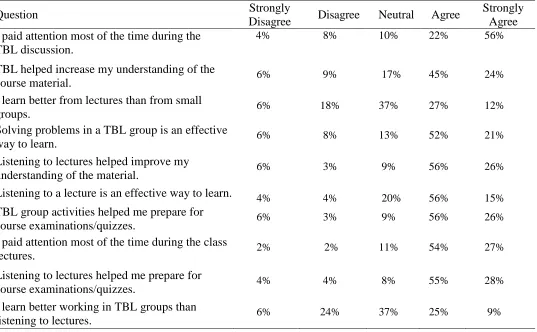
= -1, neutral = 0, agree = 1, strongly agree = 2 (see Table 1). A Wilcoxon matched pairs signed rank test indicated a significant difference in the mean scores of the student perceptions of each approach, z = -3.19, p < .05, with the students having more positive perceptions of LBI compared to TBL.
Table 1
Student Attitudes Toward TBL and LBI Through Traditional Lecture Instruction
Question Strongly
Disagree Disagree Neutral Agree
Strongly Agree I paid attention most of the time during the
TBL discussion.
4% 8% 10% 22% 56%
TBL helped increase my understanding of the
course material. 6% 9% 17% 45% 24%
I learn better from lectures than from small
groups. 6% 18% 37% 27% 12%
Solving problems in a TBL group is an effective
way to learn. 6% 8% 13% 52% 21%
Listening to lectures helped improve my
understanding of the material. 6% 3% 9% 56% 26%
Listening to a lecture is an effective way to learn. 4% 4% 20% 56% 15% TBL group activities helped me prepare for
course examinations/quizzes. 6% 3% 9% 56% 26%
I paid attention most of the time during the class
lectures. 2% 2% 11% 54% 27%
Listening to lectures helped me prepare for
course examinations/quizzes. 4% 4% 8% 55% 28%
I learn better working in TBL groups than
listening to lectures. 6% 24% 37% 25% 9%
Discussion
TBL was implemented in two master’s level occupational therapy courses, and the results of a survey that was administered after the courses ended indicate that the students in the current study
demonstrated more positive perceptions of LBI than TBL. This study is the first to investigate student
perceptions of TBL and LBI in an occupational therapy program.
TBL and active learning involve more effort and require more advance preparation for class, and the students in the current study were not accustomed to this amount of pre-class preparation, which may explain their preference for lectures. In addition, the students may have sensed a direct connection between the LBI approach and the familiar
traditional didactic assessment methods, which may
have influenced them to indicate preference for LBI. Miller et al. (2013) reported that students
who participate in active instruction demonstrate higher grades on final exams compared to students taught by LBI, suggesting that students may better comprehend material after actively engaging in the learning process. However, 82% of the students in the current study believed listening to lectures helped improve their understanding of the material, with 69% reporting that TBL played a role in increasing understanding of the course material. Machemer and Crawford (2007) suggested that
students place the highest value on learning
approaches that improve exam performance, but the
findings in the current study do not fully support
that assertion, with these students reporting that both approaches helped them prepare for course examinations and quizzes, with 83% identifying LBI and 82% identifying TBL.
A number of studies suggest that students’
perceptions of problem solving abilities improve
with the use of the TBL approach (Haidet et al., 2002; Thompson et al., 2007; Vasan et al., 2009). Most of the students in the present study agreed with this assertion, with 73% of occupational therapy students reporting that solving problems during TBL is an effective way to learn. Because problem
solving is a critical skill for health care
professionals, occupational therapy educators may want to consider incorporating this instructional approach into certain courses. For example, several application exercises used in the mental health
course involved providing evaluation information
on a patient case, with the teams then collaborating
to write appropriate, measurable goals and develop
a treatment plan. Class discussion followed, with
the students sharing the rationale for the teams’
responses. An example of a TBL approach used in
the leadership course involved the students
considering a clinical situation that included an
ethical dilemma, and the teams worked together to
apply the AOTA’s Code of Ethics and Ethics
Standards (2010a) to decide on the most appropriate course of action in that situation.
The constant advances in health care and interdisciplinary focus are two additional reasons occupational therapy educators may want to consider using TBL. Working in teams fosters communication skills and increases student
engagement (Levine et al., 2004), and TBL requires collaborative group work with a focus on student learning and problem solving, as opposed to
teaching information that may become outdated with time (Sand-Jecklin, 2007). For example, evidence-based practice related to occupational therapy
practice is constantly evolving as new research findings are published.
It is important to note that the
implementation of an active instructional technique, such as TBL, requires training and a commitment of faculty time and effort; therefore, faculty members must be invested in the use of TBL (Thompson et The Open Journal of Occupational Therapy, Vol. 5, Iss. 2 [2017], Art. 6
al., 2007). The instructors in the current study spent a considerable amount of time learning and studying the TBL approach, developing the RATs, and writing the application scenarios. However, the approach was well received and the instructors will be able to reuse the scenarios with future cohorts with minimal changes (Mennenga & Smyer, 2010). If universities provide TBL instructional training
and support and introduce the approach gradually, the students as well as the faculty may reap the
benefits (Thompson et al., 2007). In addition, it is suggested that the TBL approach be implemented early in the curriculum so that students realize the possible educational advantages (Frame et al., 2015). Instructors should explain to students both why TBL is being used and the benefits of this approach (Parmelee & Michelson, 2010).
Even though TBL has been shown through research to be effective, LBI still has a place in the college classroom. Why? Lectures are an efficient, cost-effective approach to transmitting knowledge (Matheson, 2008). Also, because of the planning and implementation time required, TBL may not be feasible in courses that cover vast amounts of content. If educators continue using LBI, it may be beneficial to adjust traditional lectures. Richardson (2007) suggests the following ways to change LBI and make it more effective: eliminating concepts
that are not necessary to understanding the topic, leaving room for students to take notes, using real-life examples that are current andrelevant, and giving the students breaks approximately every 20 min during the lecture.
Recognizing and meeting students’ individual needs during classroom instruction is
challenging. Students have varied opinions related to certain teaching approaches, and educators should take those opinions and perspectives into
consideration when planning instruction. Using both TBL and LBI throughout the curriculum would provide opportunities to address various student learning styles, therefore enhancing student comprehension of the material. Courses
with content that involves learning facts might be better suited to lectures, whereas courses that
require problem solving might be more suited for a TBL approach. Both instructional techniques may be used to improve the understanding of course material.
As instructors, it is challenging to consistently provide effective instruction for students from diverse backgrounds. Taking
previous research into consideration, along with the findings of the current study, instructors should consider varying their instructional strategies to meet the preferences and needs of individual students. Doing so would likely enhance student engagement with the material and improve learning (Sand-Jecklin, 2007).
Limitations
This study used a convenience sample of occupational therapy students from one university; therefore, the results are not generalizable to various
use of TBL in both types of courses, such as those that primarily addressed clinical reasoning skills and those that covered a vast amount of factual content.
Future Research
Several questions related to occupational therapy education warrant further investigation: Which teaching approach provides the better basis for critical reasoning in clinical situations? Is TBL better suited to certain types of courses over others?
If instructors use different degrees of TBL, does this alter the students’ satisfaction with the learning method?
Based on the literature, the use of TBL in occupational therapy education is limited. This paper compares occupational therapy students’ preferences for TBL and LBI. The results of this survey revealed that students have significantly greater positive perceptions of LBI compared to TBL. Future studies related to the implementation of TBL and LBI in occupational therapy and health care education are recommended.
Dr. Anne Zachry is the Chair of the UTHSC MOT Program. She earned her PhD in Educational Psychology and Research from the University of Memphis in 2009. Her practice experience is primarily in pediatrics. Her research interests include infant and child development and early identification and sensory intervention for children with autism. She is certified to administer the Sensory Integration and Praxis Test. Her book, “Retro Baby: Cut Back on all the Gear and Boost Your Baby’s Development with over 100 Time-Tested Activities” was published by the American Academy of Pediatrics and won the Benjamin Franklin Gold Award in 2014.
Brittany Nash is a graduate from The Ohio State University with a Bachelors degree in Sociology. She has a Master's in Occupational Therapy and a Doctorate in Physical Therapy from the University of St. Augustine. Her professional experience is in outpatient orthopedics and long term acute care. She holds a certification in manual therapy and is pursuing her certification in hand therapy.
Dr. Ann Nolen, former Chair of the UTHSC Department of Occupational Therapy, started with the program in 1992 and retired in 2016. In 2002, Dr. Nolen received the Tennessee Occupational Therapy Association (TNOTA) Service Award and the UT Alumni Service Award in 2005. Dr. Nolen is a past recipient of the UTHSC SGAEC Excellence in Teaching Award. In 2015, Dr. Nolen received the TNOTA Outstanding Achievement Award for the Advancement and Practice of Occupational Therapy. She is also a recipient of the American Occupational Therapy Association (AOTA) Jeanette Bair Writer’s Award. In 2009, Dr. Nolen was appointed an AOTA Fellow.
References
Abdelkhalek, N., Hussein, A., Gibbs, T., & Hamdy, H. (2010). Using team-based learning to prepare medical students for future problem-based learning. Medical Teacher, 32(2), 123-129.
http://dx.doi.org/10.3109/01421590903548539
Addo-Atuah, J. (2011). Performance and perceptions of pharmacy students using team-based learning (TBL) within a Global Health Course. Innovations in Pharmacy, 2(2), 71-75.
American Occupational Therapy Association. (2010a). Occupational therapy code of ethics and ethics standards (2010). American Journal of Occupational Therapy, 64(Suppl. 6), S17- S26.
http://dx.doi.org/10.5014/ajot.2010.64S17
American Occupational Therapy Association. (2010b). Standards of practice for occupational therapy.
American Journal of Occupational Therapy,
64(Suppl. 6), S106-S111.
http://dx.doi.org/10.5014/ajot.2010.64S106
Bleske, B. E., Remington, T. L., Wells, T. D., Dorsch, M. P., Guthrie, S. K., Stumpf, J. L., Alaniz, M. C., . . . Tingen, J. M. (2014). Team-based learning to improve learning outcomes in a therapeutics course sequence. American Journal of Pharmaceutical Education, 78(1), 13.
http://dx.doi.org/10.5688/ajpe78113
Bligh, D. (2000). What’s the use of Lectures? San Francisco, CA: Jossey-Bass.
Covill, A. E. (2011). College students’ perceptions of the traditional lecture method. College Student Journal,
45(1), 92-101.
Dewald, L. (2010). Building pedagogical intelligence in allied health: A primer. The Internet Journal of Allied Health Sciences and Practice, 8(3).
Dunaway, G. (2005). Adaptation of team learning in an introductory graduate pharmacology course.
Teaching and Learning in Medicine, 17(1), 56-62.
http://dx.doi.org/10.1207/s15328015tlm1701_10
Frame, T. R., Cailor, S. M., Gryka, R. J., Chen, A. M., Keirsma, M. E., & Sheppard, L (2015). Student
The Open Journal of Occupational Therapy, Vol. 5, Iss. 2 [2017], Art. 6
perceptions of team-based learning vs. traditional lecture-based learning. American Journal of Pharmaceutical Education, 79(4), 1-11.
http://dx.doi.org/10.5688/ajpe79451
Haidet, P., O'Malley, K. J., & Richards, B. (2002). An initial experience with “team learning” in medical education. Academic Medicine, 77(1), 40-44.
http://dx.doi.org/10.1097/00001888-200201000-00009
Hill, T. V. (2002). The relationship between critical thinking and decision-making in respiratory care students.
Respiratory Care, 47(5), 571-577.
Hunt, D. P., Haidet, P., Coverdale, J. H., & Richards, B. (2003). The effect of using team learning in an evidence-based medicine course for medical students.
Teaching & Learning in Medicine, 15(2), 131-139.
http://dx.doi.org/10.1207/S15328015TLM1502_11
Kelly, P. A., Haidet, P., Schneider, V., Searle, N., Seidel, C. L., & Richards, B. F. (2005). A comparison of in-class learner engagement across lecture, problem-based learning, and team learning using the STROBE classroom observation tool. Teaching & Learning in Medicine, 17(2), 112-118.
http://dx.doi.org/10.1207/s15328015tlm1702_4
Kim, S. Y. (2008). Students’ evaluation of a team-based course on research and publication ethics: Attitude change in medical school graduate students. Journal of Educational Evaluation for Health Professions,
5(3), 3. http://dx.doi.org/10.3352/jeehp.2008.5.3
Koles, P. G., Stolfi, A., Borges, N. J., Nelson, S., & Parmelee, D. X. (2010). The impact of team-based learning on medical student’s academic performance. Academic Medicine, 85(11).
http://dx.doi.org/10.1097/ACM.0b013e3181f52bed
Lake, D. A. (2001). Student performance and perceptions of a lecture-based course compared with the same course utilizing group discussion. Physical Therapy, 81(3), 896-902.
Levine, R. E., O’Boyle, M., Haidet, P., Lynn, D. J., Stone, M. M., Wold, D. V., & Paniagua, F. A. (2004).
Transforming a clinical clerkship with team learning.
Teaching and Learning in Medicine, 16(3), 270-275.
http://dx.doi.org/10.1207/s15328015tlm1603_9
Livingston, B., Lundy, M., & Harrington, S. (2014). Physical therapy students’ perceptions of team-based learning in gross anatomy using the Team-Based Learning Student Assessment Instrument. Journal Educational Evaluation for Health Professions, 11, 1.
http://dx.doi.org/10.3352/jeehp.2014.11.1
Lumpkin, A., Achen, R., & Dodd, R. K. (2015). Student perceptions of active learning. College Student Journal, 49(1), 121-133.
Machemer, P. L., & Crawford, P. (2007). Student Perceptions of active learning in a large cross-disciplinary
classroom. Active Learning in Higher Education, 8, 9-30. http://dx.doi.org/10.1177/1469787407074008
Matheson, C. (2008). The educational value and effectiveness of lectures. The Clinical Teacher, 5(4),218-221.
http://dx.doi.org/10.1111/j.1743-498X.2008.00238.x
McKeachie, W. J. (1999). Teaching tips: Strategies, research, and theory for college and university teachers (10th ed.). Lexington, MA: Heath.
Mennenga, H. A., & Smyer, T. (2010). A model for easily incorporating team-based learning into nursing education. International Journal of Nursing Education Scholarship, 7(4), 1-14.
http://dx.doi.org/10.2202/1548-923x.1924
Michaelson, L. K., Knight, A. B., & Finck, L. D. (2002). Team based learning: A transformative use of small groups in college teaching. Sterling, VA: Stylus Publishing. Miller, C., McNear, J., Metz, M. (2013). A comparison of
traditional and engaging lecture methods in a large, professional-level course. The American
Physiological Society, 37(4), 347-355.
http://dx.doi.org/10.1152/advan.00050.2013
Mody, S. K., Kiley, J., Gawron, L., Garcia, P., & Hammond, C. (2012). Team-based learning: A novel approach to medical student education in family planning.
Contraception, 88(2), 239-242.
http://dx.doi.org/10.1016/j.contraception.2012.07.012
Nieder, G. L., Parmelee, D. X., Stolfi, A., & Hudes, P. D. (2005). Team-based learning in a medical gross anatomy and embryology course. Clinical Anatomy,
18(1), 56-63. http://dx.doi.org/10.1002/ca.20040
Parmelee, D. X., & Michelsen, L. K. (2010). Twelve tips for doing effective team-based learning (TBL). Medical Teacher, 32(2),118-122.
http://dx.doi.org/10.3109/01421590903548562
Prober, C. G., & Heath, C. (2012). Lecture halls without lectures--a proposal for medical education. New England Journal of Medicine, 366(18), 1657-1659.
http://dx.doi.org/10.1056/NEJMp1202451
Richardson, D. (2007). Don’t dump the didactic lecture; fix it.
Advances in Physiological Education, 32(1),23-24.
http://dx.doi.org/10.1152/advan.00048.2007
Russell, A. T., Comello, R. J., & Wright, D. L. (2007). Teaching strategies promoting active learning in healthcare education. Journal of Education and Human Development, 1(1), 1-8.
Sand-Jecklin, K. (2007). The impact of active/cooperative instruction on beginning nursing student learning strategy preference. Nurse Education Today, 27(5), 474-480.
http://dx.doi.org/10.1016/j.nedt.2006.08.006
Schaefer, K. M., & Zygmont, D. (2003). Analyzing the teaching style of nursing faculty. Does it promote a student-centered or teacher-centered learning
environment? Nursing Education Perspectives, 24(5),
238-245.
Searle, N. S., Haidet, P., Kelly, P. A., Schnieder, V. F., Seidel, C. L., & Richards, B. F. (2003). Team learning in medical education: Initial experiences at ten institutions. Academic Medicine, 78(10), S55-S58.
http://dx.doi.org/10.1097/00001888-200310001-00018
Seruya, F. M. (2007). Preparing entry-level occupational therapy students: An examination of current teaching practices. Education Special Interest Quarterly,
17(4), 1-4.
Sisk, R. J. (2011). Team-based learning: Systematic research review. Journal of Nursing Education, 50(12), 665-669. http://dx.doi.org/10.3928/01484834-20111017-01
Stringer, J. (2002). Incorporation of active learning strategies into the classroom: What one person can do.
Physician Assistant Education, 13(2), 98-102.
http://dx.doi.org/10.1097/01367895-200213020-00005
Struyven, K., Dochy, F., & Janssens, S. (2008). Students’ likes and dislikes regarding student-activating and lecture-based educational settings: Consequences for students’ perceptions of the learning environment, student learning, and performance. European Journal of Psychology of Education, 23(3), 295-317.
http://dx.doi.org/10.1007/BF03173001
Thompson, B. M., Schneider, V. F., Haidet, P., Perkowski, L. C., & Richards, B. F. (2007). Factors influencing implementation of team-based learning in health sciences education. Academic Medicine, 82(Suppl. 10), S53-56.
http://dx.doi.org/10.1097/ACM.0b013e3181405f15
Trickey-Rokenbrod, D. M. (2016). Occupational therapy in action: A library of case studies. Lippincott Williams and Wilkins: Philadelphia, PA.
Vasan, N. S., DeFouw, D. O., & Compton, S. (2009). A survey of student perceptions of team-based learning in anatomy curriculum: Favorable views unrelated to grades. Anatomical Science Education, 2(4), 150-155. http://dx.doi.org/10.1002/ase.91
Wiener, H., Plass, H., & Marz, R. (2009). Team-based learning in intensive course format for first-year medical students. Croatian Medical Journal, 50(1), 69-76.
http://dx.doi.org/10.3325/cmj.2009.50.69
Wilson, J., & Korn, K. (2007). Attention during lectures: Beyond ten minutes. Teaching of Psychology, 34(2), 85-89.
http://dx.doi.org/10.1177/009862830703400202
The Open Journal of Occupational Therapy, Vol. 5, Iss. 2 [2017], Art. 6