Journal of
Applied Research on Industrial Engineering
Journal of Applied Research on Industrial Engineering
Vol. 2, No. 1 (2015) 1-14
Prioritizing the Aspects of Project Management Agility Using Contractors’
and Employers' Perceptions and Expectations by DEA Method in a Case
Study in Foolad Technique Co.
Hadi Shirouyehzad
11, Arash Shahin
2, Mina Dayani
3*1Department of industrial engineering, Faculty of Engineering, Najafabad Branch, Islamic Azad University, Najafabad, Isfahan, Iran
2 Department of Management,University of Isfahan,Isfahan, Iran ([email protected])
3Department of industrial engineering, Faculty of Engineering, Najafabad Branch, Islamic Azad University, Najafabad, Isfahan, Iran
A B S T R A C T A R T I C L E I N F O
Agile project management concept was introduced in the 21st century for the first time to provide continuous and timely software to provide value to the shareholders. This method is also useful for a variety of projects to respond to environmental changes. As a dynamic business area, always there is a balance between the current and desired status of project-based organizations for which the study of the agile gap is important. In addition, there is no exact definition for desired status. Therefore, studying perception and expectation of contractors and employers is playing a main role for agile project management analysis. In this paper, data envelopment analysis has been applied to identify the most critical agile project management dimensions, based on the difference between contractors’ and employers’ perceptions and expectations. The case study includes six projects in Foolad technique Co. , the results showed that the following criteria are in critical condition in Foolad Technique Company: "team capabilities", " Customer Involvement", " Delivery Strategy" and "organizational environment"
Article history : Received: 5 December 2014 Received in revised format: 1 February 2015
Accepted: 15 February 2015 Available online: 13 June 2015
Keywords :
Agile Project Management, Data Envelopment Analysis, Expection, Perception, Foolad Technique, Employer, Contractor, Prioritizing
2
1.
Introduction
In recent years, project based orientations is being employed in many organizations as a central viewpoint, so all their activities and measures are done based on their projects. Project management is a useful instrument for the management of such activities. In such a complex organizational environments, project management techniques can be employed (Munns and Bjeirmi1996). One of the most important Technique in Project management is agile project management. APM was born in the twenty first century. Prominent software developers from both IT and software engineering domains, convened to arrive at a consensus on how the software development industry could produce better results (Hass2007). The literature on agile project management is still in its infancy, but much more research should be done in to agile project management outside the scope of software development. Included in this research should be the development of project management patterns extensible into agile projects in general (Fernandez and Fernandez2009). The fundamental principle of APM is, therefore, a shift from the traditional and prescriptive “plan-then execute” project paradigm (Leybourne2009). Agility attitude is focused on the behavior and environment rather than focusing on the process and methodology.
Hallgren and Olhager (2009) and Narasimhan et al (2006) concluded that agile manufacturing has a significant impact on flexibility, delivery, quality and ultimately customer satisfaction. Further studies in agile manufacturing focusing on flexibility, customer satisfaction and quick delivery includes (Zandi and Tavana2011). Since the customer is one of the most important elements of project management, it plays a crucial role in project managers’ decisions (Kenboy and Morgan2011). In agile projects, customer collaboration is essential in all phases of the project, and is one of the important factors which leads to success in these types of projects (Hoda et al2011).
One of the techniques used in management is Data Envelopment Analysis which attracts much attention over the past two decades as a management tool. By considering multiple variables and constraints, this technique can be used in lunching appropriate plans for organizations. DEA is a linear programming method for evaluating the efficiency and effectiveness of decision-making units. This method can also be used to identify the most important aspects of quality of services in any organizations (Shirouyehzad etal2012).
The agility model has been proposed in recent years and some studies are carried in this area. Some findings that somehow related to this subject are as follows:
Sato et al (2006) analyzed seven projects from both academic and governmental environments. From the point of view of tracking an agile process. They classified the projects using the XP-EF framework, and they showed that all projects had a higher desired score for every practice, showing their willingness to improve in all XP practices. The difference between actual and desired scores can point the team to the most important points of improvement. Also they introduced retrospectives and their posters as a complementary tools to tracking, helping the team to understand the project pace. And the team experience and the coach’s influence were introduced factors that can influence the adoption of an agile approach.
3
Management Process, Project Definition Process, Agile Software Techniques, Delivery Strategy, Project Nature, Project Type and Project Schedule. Subsequently, reliability analysis and factor analysis were conducted to consolidate this preliminary list into a final set of 12 possible critical success factors for each of the four project success categories – Quality, Scope, Time, and Cost. After that a survey was conducted among agile professionals. The results revealed that only three critical success factors for Agile software development projects: (a) Delivery Strategy, (b) Agile Software Engineering Techniques, and (c) Team Capability were supported.
Shirouyehzad et al (2012) measured services quality based on customers’ point of view in four-star hotels in Isfahan. In that paper, data envelopment analysis has been applied to identify the most critical service quality dimensions, based on the difference between customers’ perceptions and expectations. The findings implied that price, reliability and tangibles are the most important service quality dimensions.
Stankovic et al (2013) verified the classification of critical success factors previously described in study by Chow and Cao (2008). Their results match with the results from the previous study in suggesting that strong executive support and project type has no influence on the success of agile project. But they introduced Customer involvement, Project management process, agile software engineering techniques and Project nature as the effective factors in agile management.
The literature on agile project management is still in its infancy, but much more research should be done in to agile project management outside the scope of software development. So the purpose of this study is to extract all efficient criteria for the agility of project management in non-software areas. In this paper, data envelopment analysis has been applied to identify the most critical agile project management dimensions, based on the difference between customers’ perceptions and expectations. The case study includes six projects in Foolad Technique Co. To this end, three questionnaires were designed to measure the perceptions and expectations of employers and contractors. The data collected from the questionnaires is considered as an input and output for DEA model. In this case, according to the awareness of the perceptions and expectations, it will be clear that which aspect gains the highest satisfaction in agility and which aspect needs more attention. In addition, it will be clear that which measures of project agility are in critical condition, are in good condition and which needs improvement and enhancement. In the following, a brief introduction of agile project management and DEA approach, new methodology, and findings are proposed and finally results are discussed and conclusions are made.
In the following, a brief introduction of agile project management and DEA approach, new methodology, and findings are proposed and finally results are discussed and conclusions are made.
2.
Agile project management
Undoubtedly, project management is one of the most important and widely used branches of management over the past few decades. Different definitions are expressed in this regard. In 1971, Oisen defined project management as utilizing different tools and techniques for the proper use of resources to meet the project objectives in the determined scope, time, cost and quality (Oisen1971).
4
processes and methods have led to worthwhile improvements in project management, organizational skills, productivity, quality, and business satisfaction (Chen2007).
The official definition of Agile Software Development was contained in a form of ‘‘manifesto’’ in February 2001 by a group of 17 noted software process methodologists, who attended a summit meeting
to advocate for a better way of developing software and then formed the Agile Alliance. The ‘‘Manifesto for Agile Software Development’’ posted on the Agile Alliance website (<http://www.agilemanifesto.org>) (Chow and Cao2008).
3.
DEA
DEA as a mathematical approach is a suitable instrument for measuring efficiency of decision making units with multiple inputs and outputs.Over the past two decades, DEA has attracted much attention as a management tool and is being used for estimating the efficacy of many private and public sector, such as banks, airlines, hospitals, universities, and production (Chee-Cheng 2008). In 1957, Farrell used a method, similar to measuring efficacy in engineering subjects, to measure the performance of a manufacturing unit. In 1978, Charnes et al. developed Farrell’s viewpoint and introduced a model called "Measuring the efficiency of decision-making units". This model is able to assess the relative efficiency of a set of DMU with multiple input and output (Charnes et al. 1978).
As the production function is often unclear, DEA can estimate the frontier of production function by all DMU's . DMU’s are organizational units such as banks, universities and hospitals which typically do the same job. A DMU usually uses a set of inputs (resources) to produce outputs (products) (chee-Cheng, 2008).
The two main types of DEA model includes CCR, which was introduced by Charnes, Cooper and Rhodes in 1978, and BCC, which was introduced in 1985 by Banker, Charnes and Cooper. DEA analysis can be input- or output-oriented (Rassafi and Vaziri, 2007).
Multiple model (primary) of BCC input-oriented is as follows
𝑀𝐴𝑋𝑍0= ∑ 𝑢𝑟𝑖𝑦𝑟.+ w 𝑠
𝑟=1
𝑠𝑡: ∑ 𝑣𝑖𝑥𝑖.= 1 𝑠
𝑖=1
𝑟 = 1,2, … , 𝑠 (1)
∑ 𝑣𝑖𝑥𝑖𝑗− ∑ 𝑢𝑟𝑦𝑟𝑗− 𝑤 𝑠
𝑟=1
≤ 0 𝑚
𝑖=1
𝑗 = 1,2, … , 𝑛
𝑢𝑟, 𝑣𝑖 ≥ 𝜀 w 𝑢𝑛𝑙𝑖𝑚𝑖𝑡𝑒𝑑
In the formula (1) i is the number of input and r is the number of output, j is the number of DMUs (Banker et al. 1985).
yrj is the amount of j output produced by DMUi, and xij is the amount of j input produced by DMUi (Banker et al. 1985).
ur is the given weight to r output and vi is the given weight to the i input (Banker et al. 1985).
5
Benchmark (BM) is one of other available methods to rank. In this technique, DMUBM is made and
this DMU is added to other problem DMUs to solve CCR. Here, this technique is efficient if an appropriate criterion to select DMUBM is found.
4.
Methodology
The purpose of this study is to extract all efficient criteria for the agility of project management in non-software areas through the study on the organizational agility factors and experts survey. Therefore by doing a study in a project-driven organization, the effective criteria in project management agility and perceptions and expectations of contractors and employers of these criteria are explored. Then the criteria are ranked based on the perceptions and expectations of the whole organization. This study plans to present a model by a 5 step process in order to priority the effective criteria in agility project management in non-software industry and then to measure the criteria. In this paper, DEA is used to identify and analyse the most important dimensions based on contractors and employers’ expectations and perceptions in different projects. Based on DEA methodology, a DMU with lower input and higher output will have higher efficiency compared to other units.
The steps of the study are summarized as follows:
Figure 1. Inputs and outputs of the proposed DEA model
1.
Identification of effective criteria in project management agility
2.
The distribution of questionnaire among employers to determine their expectations and
perceptions of desirable and current conditions of factors contributing to the project
management agility
3.
The distribution of questionnaire among contractor to determine their expectations and
perceptions of desirable and current conditions of factors contributing to the project
management agility
4.
The distribution of questionnaire among contractor to determine the contractor's
understanding of employer’s expectations of desirable and current conditions of factors
contributing to the project management agility
5.
Ranking the criteria of project management agility by DEA
Step 1
By doing comparative studies between parameters obtained and all studies done, it seems that the study done by Chow and Cao in 2008 was more comprehensive than other studies, and its indicators encompasses all the criteria for project management agility.
Step1: Identification of effective criteria in project management agility
Step2: The
distribution of questionnaire among
employers to
determine their expectations and perceptions of
Step3: The
distribution of questionnaire among contractor to determine their
Step4: The distribution of questionnaire among contractor to determine the contractor's understanding of
6
Therefore, a questionnaire was distributed among some management students, professors familiar with project management agility topics, and also some managers of organizations run by traditional methods. Values and statements of management of agile project were explained to them. Then, they were asked to identify the criteria contributing to the project management agility in non-software industries or add more criteria to the previous ones.
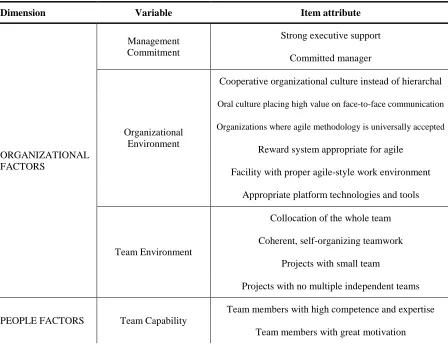
As a result, of 5 aspects, 12 criteria and 39 sub-criteria in Chow and Cao study (2008), 3 sub-criteria were omitted due to incompatibility with the organization under study, namely " Well-defined coding standards up front," " Correct integration testing" and " Project nature being non-life-critical”; and a sub-criteria, "developing short-term timing cycles instead of long-term timing cycle ", was added to a criteria named “Project Schedule” to better measure it. Also, the 2 main criteria “Project Nature” and “Project Type” were omitted, with the former due to incompatibility of the sub-criteria with nature of the organization and the latter due to correlation of the associated sub-criteria with the "Delivery Strategy". On the other hand, one of the key aspects of the project called "Project factors" was eliminated and the criteria related to this aspect were added to "process factors", due to their high correlation. Therefore, 4 key success factors in the project, 10 main criteria and 37 sub-criteria were obtained, as they are shown in Table 1.
Table 1. Critical agile project management dimensions
Dimension Variable Item attribute
ORGANIZATIONAL FACTORS
Management Commitment
Strong executive support
Committed manager
Organizational Environment
Cooperative organizational culture instead of hierarchal
Oral culture placing high value on face-to-face communication
Organizations where agile methodology is universally accepted
Reward system appropriate for agile
Facility with proper agile-style work environment
Appropriate platform technologies and tools
Team Environment
Collocation of the whole team
Coherent, self-organizing teamwork
Projects with small team
Projects with no multiple independent teams
PEOPLE FACTORS Team Capability
Team members with high competence and expertise
7
Table 1. Critical agile project management dimensions
Dimension Variable Item attribute
Managers knowledgeable in agile
Managers who have adaptive management style
Appropriate technical training to team
Customer Involvement
Good relationship between employer and contractor
Strong employer commitment and presence
Employer having full authority
PROCESS FACTORS
Project Management Process
Following agile-oriented requirement management process
Following agile-oriented project management process
Project Management Process
Following agile-oriented configuration management process
Good progress tracking mechanism
Strong communication focus with daily face-to-face meetings
Honoring regular working schedule
Project Definition Process
Project scope well-defined
Assessing the costs
Projects with up-front cost evaluation done
Projects with up-front risk analysis done
Project Schedule
Projects with dynamic, accelerated schedule
developing short-term timing cycles instead of long-term timing cycle
TECHNICAL FACTORS
Agile Techniques
Pursuing simple activity
reviewing and remodeling the plans to achieve the desired results and adjustment of requirements in accordance with changes
Rigorous review and restricts of the programs
Right amount of documentation
Delivery Strategy
timely delivery of stakeholders’ priorities in short time intervals
Regular delivery of software
prioritizing the delivery of requirements set by the employer
8
Table 1. Critical agile project management dimensions
Dimension Variable Item attribute
changeability in project span (considering the basic requirements)
Step2
According to 10 criteria and 37 sub-criteria obtained in the first stage, a questionnaire is distributed among employers to understand their perceptions and expectations. The questionnaire is designed in two sections. The first section includes 7 items, the first 2 items are about project information and the 5 other questions are related to demographic information including gender, position, work experience, age and education. The second section consists of 37 bilateral questions (74 items) to determine employers’ expectations and perceptions of desirable and current conditions of factors contributing to the project management agility. On the right side of the questionnaire the employer should rate the importance of these factors in project management agility, using a 5-point Likert scale. On the left side of the questionnaire the employer should rate the existence of these factors in the contractor’s organization, using a 5-choice Likert scale. Here, the number related to each category and sub-category is obtained by calculating the arithmetic mean of the values of each category obtained by the projects of the organization. The result is a number between 1 and 5, and shows the employer's perceptions and expectations in the related projects.
To assess the validity of the questionnaire, first the indicators in other research were used. Then on several occasions, the pilot questionnaire was distributed among professors and students of management and IT who were familiar with project management agility. After clarifying the objectives and hypothesis of the project, they were asked to declare their opinions with regard to the relevance of the questions with the subject and the research hypotheses, ambiguity in the questions, and the possibility of multiple interpretations of the questions. Thereupon on several occasions, the pilot questionnaire was distributed among the experts familiar with project management agility. This resulted in correction, elimination and addition of some parameters based on the conditions and environment of the research. Finally, the questionnaire was designed in a way that reflects the indicators of project management agility. After doing the revision and verification of content and face validity, the questionnaire was distributed.
To assess the reliability of the questionnaire, Cronbach's alpha coefficient was used. To this end, a bilateral questionnaire was distributed among employers. Using the data obtained from the questionnaire, SPSS software and Cronbach's alpha coefficient, we were able to calculate the reliability for the whole questionnaire, each of the main categories, sub-categories and expectations and perceptions, separately. It should be noted that the Cronbach's alpha coefficient above 7.0 indicates high reliability, between 5.0 and 7/0 indicates acceptable reliability and less than 5.0 indicates poor reliability.
Step3
Such a previous step, a questionnaire is distributed among contractor to understand their perceptions and expectations of desirable and current conditions.
Step4
9
Step5
In this step, DEA is used to identify and analyses the most important APM dimensions based on contractor’s and employer’s expectations and perceptions in different projects. Since perceptions and expectations values are inputs and outputs of DMUs respectively. Each DMU has three inputs and two outputs. The model is demonstrated in Figure 2. In other hands, APMs are considered as DMUs and organizations’ data are considered as inputs and outputs of DEA model. Based on DEA methodology, a DMU with lower input and higher output will have higher efficiency compared to other units.
Figure 1 Inputs and outputs of the proposed DEA model
International Engineering Company of Foolad Technique is one of the largest Engineering companies in Isfahan, which began its activities in 1991. In 2012, the Company, as a leading engineering company in the province which has lots of developmental plans, was recognized as one of the most advanced departments in quality control. Due to the sensitive nature of the projects, the need to present a method for improving the quality of projects is seen. Foolad Technique Company works on many projects, in some of which is an employer and in others a contractor. Due to the importance of projects in which the Company works as a contractor, such projects were chosen as the purpose of the present study. Among all these projects, we were permitted to work on only six. Four out of six projects were related to projects done in Abarkooh Steel Company and two projects were related to the projects in Isfahan Steel Company (Zob Ahan Company).
The sample population of this study consisted of 24 managers of two “Tavazon” projects. Due to the availability of the projects, these six projects were selected. Because of the limitation of sample population sampling was not done and we studied the whole population.
To study the sample population, three questionnaires were distributed among project management experts, contractors (project managers of Foolad Teknik Company) and Employers of Abarkooh steel projects and agglomeration and raw material stock in Zob Ahan Steel Company.
5.
Findings
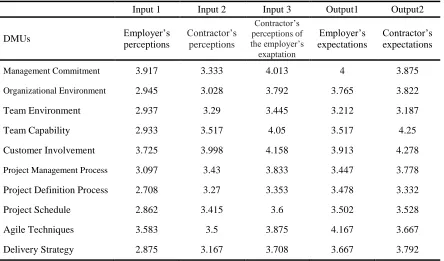
Input and output variables of this model were determined by calculating the arithmetic mean of perceptions and expectations of employers and contractors in all 6 projects done in Foolad Teknik Company.
Based on the questionnaires, the obtained arithmetic means of the studied projects in each of the indicators can be seen in Table 1, separately. As it can be seen, the criterion, namely “Project Definition
Contractor’s perceptions
Agile project management dimension Contractor’s perceptions
of the employer’s
Employer’s perceptions
Contractor’s expectations
10
Process”, received the lowest employers’ perceptions and contractor's understanding of employer’s expectations. The criterion, namely “Organizational Environment”, received the lowest contractor’ perceptions. Also the criterion, namely “Delivery Strategy”, received the highest employer’ expectation and the criterion, namely “Customer Involvement”, received the highest contractor’ expectation.
Table 2. Input and output variablesin 6 projects
Input 1 Input 2 Input 3 Output1 Output2
DMUs Employer’s
perceptions
Contractor’s perceptions
Contractor’s perceptions of the employer’s exaptation
Employer’s expectations
Contractor’s expectations
Management Commitment 3.917 3.333 4.013 4 3.875
Organizational Environment 2.945 3.028 3.792 3.765 3.822
Team Environment 2.937 3.29 3.445 3.212 3.187
Team Capability 2.933 3.517 4.05 3.517 4.25
Customer Involvement 3.725 3.998 4.158 3.913 4.278
Project Management Process 3.097 3.43 3.833 3.447 3.778
Project Definition Process 2.708 3.27 3.353 3.478 3.332
Project Schedule 2.862 3.415 3.6 3.502 3.528
Agile Techniques 3.583 3.5 3.875 4.167 3.667
Delivery Strategy 2.875 3.167 3.708 3.667 3.792
So, because of variable return to scale, the problem must be solved by BCC. Moreover, the purpose of the study is the analysis of input and output variables, the problem will be solved based on input- and oriented mode. Therefore, the model used in this research is modified BCC input- and output-oriented model.
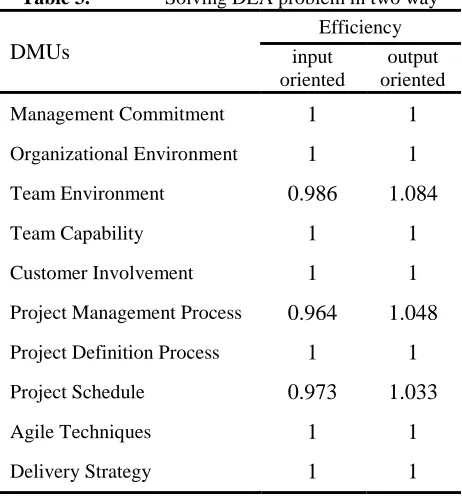
When using the input-oriented mode, efficacy is calculated by assuming the input constant and trying to reduce the output. Therefore, we can clarify the effect of employer’s and the contractor’s perceptions on ranking the agility criteria in Foolad Technique’s projects. When using output-oriented mode, efficiency is calculated assuming output constant and trying to increase the input. Therefore, we can clarify the effect of employer’s and the contractor’s expectation on ranking the agility criteria in Foolad Technique’s projects. The results of ranking the criteria in input- and output-oriented mode are shown in table 3.
Table 3. Solving DEA problem in two way
DMUs
Efficiency
input oriented
11
Table 3. Solving DEA problem in two way
DMUs
Efficiency
input oriented
output oriented
Management Commitment 1 1
Organizational Environment 1 1
Team Environment 0.986 1.084
Team Capability 1 1
Customer Involvement 1 1
Project Management Process 0.964 1.048
Project Definition Process 1 1
Project Schedule 0.973 1.033
Agile Techniques 1 1
Delivery Strategy 1 1
Based on DEA methodology, a DMU with lower input and higher output will have higher efficiency Compared to other units. Lower organization performance and higher importance from Contractors and employers’ point of view in a special dimension may lead to efficiency of the units which shows the weakness of projects in satisfying contractors. Therefore in this methodology, the most critical APMs which may have higher output and lower input value in agile project management have the highest efficiency value compared to other dimensions and to achieve agility, the improvement of this factor is of high importance. So the results shows that criteria’s as Management Commitment, Organizational Environment, Team Capability, Customer Involvement, Project Definition Process, Delivery Strategy and Project Schedule, are prior to other dimensions in managers’ decision making. The lowest comparative values of APMs were also referred to Project Management Process.
Because of non-apex DMUs, the mentioned technique is not able to rank DMUs. Therefore BM is employed to consider DMUBM with the least input value & the most output one. Ranking efficient DMUs
will be:
The results of ranking the criteria in input-oriented mode, with regarding Ɛ=0.0006 are shown in table 4.
Table 4 Ranking by BM method
DMUs
Input 1 Input 2 Input 3 Output1 Output2
E
ff
icien
cy
R
an
k
in
g
Employer’s perceptions
Contractor’s perceptions
Contractor’s perceptions
of the employer’s expectations
Employer’s expectations
Contractor’s expectations
Management Commitment 3.917 3.333 4.013 4 3.875 0.9075 5
Organizational Environment 2.945 3.028 3.792 3.765 3.822 0.9991 1
12
Customer Involvement 3.725 3.998 4.158 3.913 4.278 0.8059 7
Project Definition Process 2.708 3.27 3.353 3.478 3.332 0.9989 2
Agile Techniques 3.583 3.5 3.875 4.167 3.667 0.8647 6
Delivery Strategy 2.875 3.167 3.708 3.667 3.792 0.9554 3
DMUs 2.708 3.028 3.353 4.167 4.278
Table4 shows that “Organizational Environment” critical has the highest ranking and Foolad Technique must be pay attention to improve this critical more than others. It must be enhanced by their sub-criteria.
So Cooperative organizational culture, Oral culture, Accepting agile methodology, Reward system appropriate, Facility with proper agile-style work environment and appropriate platform technologies and tools are the most important criteria in Foolad Technique for accessing agile project management.
6.
Conclusions
An agile organization is a fast, friendly and informed business that has the ability to adapt in response to unexpected and unforeseen events and advancements, market opportunities and customer’s needs. Therefore, because of the changing environment and the inability of traditional project management to move in this environment, the need for agile project management for the survival of the organizations is more urgent. On the other hand, because of the significant role of the employer in this type of management and because all activities carried out in this area are intended to increase customer satisfaction, studying the perceptions and expectations of employers in project-based organizations for the proper use of the criteria in projects is of high importance and can lead to improved performance in the organization.
As a dynamic business area, always there is a balance between the current and desired status of project-based organizations. In addition, there is no exact definition for desired status. Therefore, studying perception and expectation of contractors and employers is playing a main role for agile project management analysis.
The present research is carried out to identify effective criteria in project management agility and prioritize the criteria using Data Envelopment Analysis.
13
words, by keeping the input / output levels constant, these factors gain the highest expectations /lowest perceptions. Among these criteria, paying attention to "team capability", “Customer Involvement ",” Delivery Strategy “and "organizational environment" is more important, as they can be enhanced by their sub-criteria. Contractor’s perceptions of the employer's expectations has the highest impact on ranking the criteria of organizational agility by DEA in Foolad Technique Company.
In the proposed DEA model, employers’ and contractors’ perceptions and expectations are of the same value in Foolad Technique Company and are analyzed in comparison with each other. Easily collected data as well as the ability to solve the model because of infinite DMUs are other advantages of this model. As no project-driven organizations were found which operated in non-software industry and lunched their projects based on the principles and values of project management agility, the present research was carried out in project-based organization which were run in traditional methods. Also, due to the involvement of employers in this study, we were only permitted to distribute our questionnaires for six projects. To measure project management agility definitive data was used in this study. The results obtained from the study are solely based on information obtained from employer’s perceptions and expectations, contractor’s perceptions and expectations and the contractor’s perceptions of the employer’s expectations.
In order to achieve better results, it is suggested that the proposed method is carried out in an agile project-driven organization. Also to present an overview of the overall status of Foolad Technique Company in the criteria of agile project management, it is recommended that the proposed method is carried out in all its projects. Due to uncertainties in the data, using phase spectrum in analyzing the data is recommended. As it may be possible that there are other perceptions and expectations contributing to project management agility, analyzing the results using them is recommended. Finally according to DEA, when the number of DMUs is greater than the number of input and output, better results can be achieved. Therefore, it is suggested that the proposed model is solved by considering 37 sub-criteria.
7.
References
Banker, R.D. Charnes, A. and Cooper, W.W. (1985). “Some models for Estimation Technical and Scale Hnefficiencies in Data Envelopment Analysis”. Management Science,Vol. 30, No.1, pp.1078-1092. Charnes, A., W.W.Cooper. and.Rhodes, E. (1978). “Measuring the efficiency of decision making units”.
European Journal of Operational Research, Vol, 2. No.1, pp. 429-444.
Chow, T., and Cao, D. (2008). ” A survey study of critical success factors in agile software projects”.
The Journal of Systems and Software.Vol. 81, No.1, pp. 961–971.
Chen, Q., Reichard,G. and Beliveau, G. (2007). ” Interface management_a facilitator of lean
construction and agile project management”.Proceedings of the 15th International Conference on Lean Construction Summit,16-22 July, Michigan,USA, pp. 57-66.
Chee-Cheng.C. (2008). ” An objective-oriented and product-line-based manufacturing performance measurement”, International Journal of Production Economic, Vol.112, No.1, pp. 380–390. Fernandez, D.and Fernandez, J. (2009). ”Agile project management agilism versus traditional
14
Hass, K. (2007). ” The Blending of Traditional and Agile Project Management”. PM World Today. Vol. 9, No. 5, pp. 18.
Hoda, R., Noble, J. and Marshall.S. (2011).” The impact of inadequate customer collaboration on self-organizing Agile teams. Information and Software Technology, Vol. 53, No. 1, pp. 521–534. Leybourne,S.(2009).” Improvisation and agile project management: a comparative consideration”.
International Journal of Managing Projects in Business. Vol. 2, No. 4, pp. 519-535.
Munns,A.k. and Bjeirmi, B.F. (1996). ” The role of project management in achieving project success”,
International Journal of Project Management, Vol. 14, No. 2, pp. 81-87.
Oisen, RP. (1971). “Can project management be defined?”, Project Management Quarterly, Vol.2, No.1, pp. 12±14.
Rassafi, A. A. and Vaziri, M., (2007). “Assessment of Modal Transportation Sustainability: Application of Data Envelopment and Concordance Analyses”. Iranian Journal of Science and Technology, Transaction B, Engineering. Vol. 31, No. B2, pp.179-193.
Sato, D., Bassi, D., Bravo, M., Goldman, A. and Kon,F. ( 2006 ). ” Experiences tracking agile projects: an empirical study”. Journal of the Brazilian Computer Society. Vol. 12, No. 3, pp. 45-64.
Shirouyehzad,H., Hosseinzadeh Lotfi,F., Shahin.A., Aryanezhad,B. and Dabestani,R. (2012).”A DEA approach for comparative analysis of service quality dimensions with a case study in hotel industry”. Int. J. Services and Operations Management, Vol. 12, No. 3, pp.289-308.
Stankovica,D., Nikolicb.V., Djordjevicc,M. and Caod,B. (2013). ” A survey study of critical success factors in agile software projects in former Yugoslavia IT companies”. The Journal of Systems and Software, Vol. 86, No.1, pp. 1663– 1678.