IJPAR |Vol.7 | Issue 2 | Apr - Jun -2018
Journal Home page: www.ijpar.com
Research article Open Access
Development and validation of RP-HPLC method for ritonavir in bulk
and pharamceutical dosage forms
CH. Shankar
1, D.V.R.N. Bhikshapathi
2, R. Suthakaran
3, CH. Pavani Padmaja
4, Amtul
Wahab
5Vijaya College of Pharmacy, Hayathnagar, Hyderabad-501511, Telangana, India.
Corresponding Author: CH. Shankar
Email: [email protected]
ABSTRACT
A reverse phase high-performance liquid chromatographic method was developed and validated for the quantitative determination of Ritonavir. Chromatographic method was carried out by isocratic technique using C18 Column, Phenomenex (250 x 4.6 mm, 5 μ), with mobile phase mixture of acetonitrile: methanol 70:30(V/V) and at a flow rate of 1 mL/min. The retention time obtained for Ritonavir at 3.52 min at 239 nm wavelength. The different analytical parameters such as linearity, precision, accuracy, specificity and robustness, limit of detection (LOD) and limit of quantification (LOQ) were determined according to International Conference on Harmonization guidelines. The linearity of the calibration curves for Ritonavir in the desiredconcentration range is good (r2>0.9). The recovery of the method was between 98% and 102% for Ritonavir. Hence the proposed method is highly sensitive, precise and accurate and it successfully applied for the estimation of API content in the commercial formulations of ritonavir.
Keywords:
Ritonavir, Anti HIV drugs, Validation, RP-HPLC, ICH guidelines.INTRODUCTION
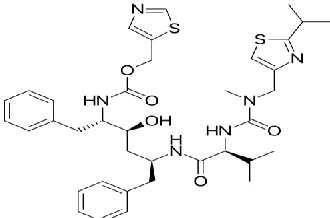
Chromatography is a simple, sensitive and economical tool for the estimation of different kinds of drugs. RP-HPLC a one of the chromatographic method, used in present research work. Ritonavir is chemically designated as 10-Hydroxy-2-methyl-5-(1-methyl ethyl) - 4-thiazolyl]-3, 6-dioxo-8, 11-bis (phenyl methyl)-2, 4, 7, 12-tetraazatridecan- 13-oic acid, 5-thiazolylmethyl ester. Its molecular formula is C37H48N6O5S2 and its molecular weight is 720.95. Ritonavir is an antiretroviral agent which belongs
to class of protease inhibitor used totreat HIV infection and AIDS [1]. Ritonavir is frequently prescribed with HighlyActive Anti-retroviral Therapy [HAART], not only due to its antiretroviral action, but also it inhibitsthe same host enzyme that metabolizes other protease inhibitors. This inhibition leads to higher plasma concentrations of these latter drugs, allowing theclinician to lower their dose and frequency and improving their clinical efficacy. More specifically, ritonavir is used to inhibit a particular liver enzyme that normally metabolizes protease inhibitors, cytochrome P450-3A4 (CYP3A4)
[2]. The molecular structure of drug inhibits CYP3A4, so a low dose can be used to enhance other protease inhibitors.
Literature survey revealed several analytical methods forthe determination of ritonavir in tablets, capsules, and syrups which employ techniques such as high-performance liquid chromatography (HPLC)
[3, 5]. Ultra performance liquid chromatography (UPLC) [6] and high performance thin layer chromatography (HPTLC)[7]. In biological fluids, the active principles as well as their metabolites have been quantitatively determined by HPLC with UV detection, Spectroscopic method [8,9] and Tandem mass spectrometry [10,11].
Fig 1: Structure of Ritonavir
The proposed method was optimized and validated in accordancewith International Conference on Harmonization (ICH) guidelines [12]. The aim of present work is to develop a simple, rapid, precise, accurate and selective reversed phase chromatographic method and toestimate the Ritonavir in bulk and its solid dosage forms.
MATERIALS AND METHODS
Chemicals and reagents
Standard drug sample of Ritonavir was provided by Aurobindo Pharma Ltd, Hyderabad. Tablet (Novir) dosage form procured from the local market. Other reagents used like Acetonitrile, Methanol which are of HPLC grade were purchased from E.Merck, Mumbai, India
Instrumentation and analytical conditions
The analysis of the drug was carried out on Shimadzu HPLC model containing LC-20AD pump, SPD-20A UV/visible detector and Rheodyne injector with 20μl fixedloop. Chromatographic analysis was performed using Phenomenex C18 column with 250 x 4.6mm internal diameter and 5μm particle size. Shimadzu electronic balance was used for weighing. Isocratic elution with acetonitrile: methanol 70:30 (V/V) was selected with a flow rate of 1.0 mL/ min. The detection wavelength was set at 239 nm with a runtime of 6 min. Themobile phase was prepared freshly and it was degassed by sonication for 5 min before use. The column was equilibrated for at least 30min with the mobile phase flowing through the system. The column and the HPLC system were kept at ambient temperature.
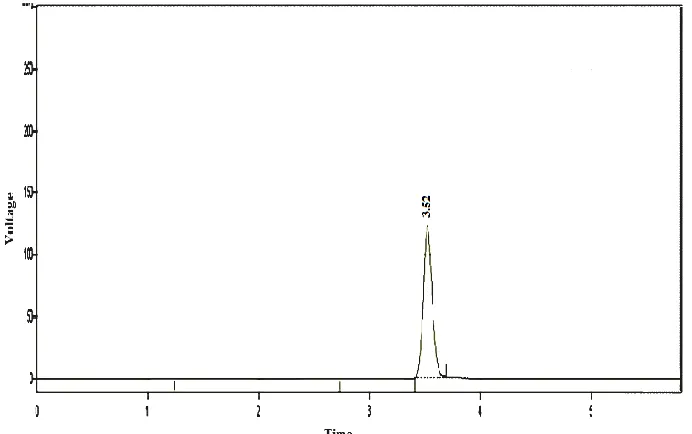
Fig 3: A Typical Chromatogram of Ritonavir Standard
Fig 4: A Typical Chromatogram of Ritonavir Tablet dosage form
PREPARATION OF STOCK
AND
WORKING STANDARD SOLUTIONS
An accurately weighed sample of 100mg of Ritonavir (working standard) was transferred into a 100mL volumetric flask. The solvent mobile phase was added and sonication to dissolve it completely and made up to the mark with the same solvent. 10mL of the above stock solution was pipetted into a 100mL volumetric flask and diluted up to the mark with mobile phase. Further 5mL of the above
Preparation of working sample solutions
Twenty tablets of Novir (containing 100 mg Ritonavir) were crushed to give finely powdered material. Powder equivalent to 10 mg of Ritonavir was taken in 10 mL of volumetric flask containing 0.5 mL of mobile phase and was shaken to dissolve the drug and then diluted to the mark with mobile phase. Above solution filtered through 0.45 μ filter paper and from the filtrate 0.5 mL transferred into a 10mL volumetric flask and diluted the mark with the same solvent to obtain concentration of 50 ppm.
Validation of analytical method
The objective of the method validation is to demonstrate that the method is suitable for its intended purpose as it is stated in ICH guidelines. The method was validated for linearity, precision, accuracy, specificity, limit of detection, limit of quantification, robustness and system suitability.
Specificity
The specificity of the method was determined by comparing test results obtained from analysis of sample solution containing excipients with that of test results those obtained from standard drug.
System suitability parameters
System suitability tests were carried out on freshly prepared standard stock solutions of Ritonavir and it was calculated by determining the standard deviation of Ritonavir standards by injecting standards in six replicates at 6 minutes interval and the values were recorded.
Precision
Repeatability of the method was checked by injecting replicate injections of 50 ppm of the solution for six times on the same day as intraday precision study of Ritonavir
Accuracy
Accuracy for the assay of Ritonavir tablets is determined by applying the method in triplicate samples of mixture of placebo to which known amount of Ritonavir standard is added at different levels (50%, 100%, and 150%).
Linearity
The developed method has been validated as per ICH guidelines. Working standard solutions of
Ritonavir in the mass concentration range of 20 ppm to 100 ppm was injected into the chromatographic system. The chromatograms were developed and the peak area was determined for each concentration of the drug solution. Calibration curve of Ritonavir was obtained by plotting the peak area versus the applied concentrations of Ritonavir.
Robustness
To determine the robustness of the method, flow rate and mobile phase parameters from the optimized chromatographic conditions were varied and percentage relative standard deviation values were calculated.
Ruggedness
Inter day variations were performed by using six replicate injections of standard and sample solutions of concentrations which were prepared and analyzed by different analyst on three different days over a period of one week.
Limit of detection and limit of quantification
The Limit of detection (LOD) and limit of quantification (LOQ) were calculated as a per ICH guidelines.
RESULTS AND DISCUSSION
To optimize the RP-HPLC parameters, several mobile phases of different compositions were tried. A satisfactory separation and good peak symmetry for Ritonavir were obtained with a mobile phase acetonitrile: methanol 70:30(V/V) and at a flow rate of 1 mL/min. The retention time obtained for Ritonavir at 3.52 min at 239 nm wavelength. Complete resolution of the peaks with clear baseline was obtained. System suitability parameters was calculated and compared as per ICH guidelines
METHOD VALIDATION
System suitability parameters
Table 1: System suitability parameters of Ritonavir
S.No Parameters Ritonavir
1 Retention time (min) 3.52 2 Theoretical plates 8549
3 Tailing factor 1.2
4 %RSD 0.24
5 Slope(m) 3934.2
6 Intercept(c) 805.24
7 Correlation Coefficient 0.9995
8 LOD(ppm) 2.5
9 LOQ(ppm) 8
PRECISION
The low % RSD values for Ritonavir reveal that the proposed method is precise. Refer Table 2 for the values.
Table 2: Precision of Ritonavir
S.No Peak area (50ppm) Mean % RSD
1 193587
191025.2 0.665
2 189984
3 190554
4 191587
5 189885
6 190554
ACCURACY
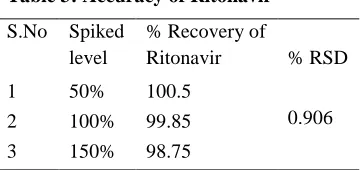
An accuracy experiment for Ritonavir was determined by standard addition method. The recovery values obtained between 98% and 102%. These values indicate that method is accurate as shown in table 3.
Table 3: Accuracy of Ritonavir
S.No Spiked level
% Recovery of
Ritonavir % RSD
1 50% 100.5
0.906 2 100% 99.85
3 150% 98.75
Linearity
Fig 5: Calibration curve of Ritonavir
Table 4: Linearity of Ritonavir
S.No Concentration ppm Peak area
1 0 0
2 20 78235
3 40 154470
4 60 232705
5 80 319850
6 100 390175
ROBUSTNESS AND RUGGEDNESS
The % RSD values of ritonavir for robustness and ruggedness reveals that the propose method is robust and rugged, refer table 5 for results.
Table 5: Robustness and Ruggedness
Parameter Variation % RSD
Robustness i. Change in flow rate (+ 0.1 mL/min) ii. Change in mobile phase (+ 1mL)
0.92 0.45 Ruggedness 1st analyst
2nd analyst
0.67 0.89
Limit of detection and limit of quantification
LOD and LOQ for Ritonavir were found to be 2.5 mg/mL and 8 mg/mL respectively. This method shows that the method is sensitive for the determination of Ritonavir as shown in table 6.
Table 6: LOD and LOQ of Ritonavir
STD solution LOD (μg/mL) LOQ (μg/mL)
CONCLUSION
HPLC at present is one of the analytical tools of analysis for the determination of the drugs. The estimation of Ritonavir is done by reverse phase HPLC. The mobile phase consists of acetonitrile: methanol 70:30 (V/V). The detection is carried out using UV detector set at 239 nm. The solutions were estimated at the constant flow rate of 1.0 mL/min. The Retention time for Ritonavir was around 3.52 minutes. Linearity for Ritonavir is 20 to 100μg/mL. The quantitative results obtained are
subjected to the statistical validation. The %RSD values are less than 2.0 indicating the accuracy and precision of the method and the % recovery is 98 -101% for Ritonavir. The results obtained for the validation parameters were satisfactory according to the requirements. It inferred that the method was found to be simple, specific, precise, and linear i.e. it follows Lambert- Beer’s law. The method was found to have a suitable application in routine laboratory analysis with a high degree of accuracy and precision.
REFERENCES
[1]. Kasper, Braun Wald, Fauci, Hauser, Longo, Jameson. Harrison’s Principles of Internal Medicine, USA, 16th ed., 2004, 1132.
[2]. Zeldin RK, Petruschke RA “Pharmacological and therapeutic properties of ritonavir-boosted protease inhibitor therapy in HIV-infected patients”. Journal of Antimicrobial chemotherapy. 53 (1), 2004, 4-9.
[3]. R. Reddy; N Jeevan; R Nagaraju; E.Venkateshwarlu; A Bharadwaj; P Goverdhan, J of Chemical and Pharmaceutical Sci., 4(3), 2011, 111-113.
[4]. R. Arun; A Smith, Int J of Pharmacy and Pharmaceutical Sci., 4(4), 2012, 173-176.
[5]. R Kumar; AKPatnaik; N Rao; SK Raul; G Padhya, J of Scientific Research in Pharma., 1(4), 2012, 23-25. [6]. Marina VA, Julia P, Jorge PR, Eduardo S, Rafael L Ultra-performance liquid chromatographic method for
simultaneous quantification of HIV nonnucleoside reverse transcriptase inhibitors and protease inhibitors in human plasma. J Braz Chem Soc 22, 2011, 134-141.
[7]. Sulebhavikar AV, Pawar UD, Mangoankar KV, Prabhu NDN HPTLC Method for Simultaneous Determination of Lopinavir and Ritonavir in Capsule Dosage Form. E-J Chem 5, 2008, 706-712.
[8]. Carolina Lupi Dias, Ana Maria Bergold, Pedro Eduardo Froehlich. UV-Derivative Spectrophotometric determination of Ritonavir Capsules and Comparison with LC Method. Anal Letrs 42(12), 2009, 1900-1910. [9]. Vaishali P. Nagulwar, Kishore P. Bhusari. Simultaneous Estimation of Ritonavir and Lopinavir by Absorption
ratio (Q-analysis) UV Spectrophotometric Method in Combined Tablet Dosage Form. Der Pharmacia Lettre, 2 (1), 2010, 196-200.
[10]. Temghare GA, Shetye SS, Joshi SS (2009) Rapid and Sensitive method for Quantitative Determination of Lopinavir and Ritonavir in Human Plasma by Liquid Chromatography- Tandem Mass Spectrometry. E-J Chem 6, 223-230.
[11]. Myasein F, Kim E, Zhang J, Wu H, El-Shourbagy TA Rapid, simultaneous determination of lopinavir and ritonavir in human plasma by stacking protein precipitations and salting-out assisted liquid/liquid extraction, and ultrafast LC– MS/MS. Anal Chim Acta 651, 2009, 112-116.