Volume 6
Article 19
2017
Is There a Relationship Between Mathematics
Background and Conception of Proof ?
Amanda Akin
Lee UniversityElizabeth Rawson
Lee UniversityAllison B. Bernhard
Lee UniversityCasey McGrath
Follow this and additional works at:
https://digitalcommons.northgeorgia.edu/papersandpubs
Part of the
Educational Methods Commons
This Article is brought to you for free and open access by the Center for Undergraduate Research and Creative Activities (CURCA) at Nighthawks Open Institutional Repository. It has been accepted for inclusion in Papers & Publications: Interdisciplinary Journal of Undergraduate Research by an authorized editor of Nighthawks Open Institutional Repository.
Recommended Citation
Conception of Proof ?
Acknowledgments
T
he conceptions and opinions of proof held by individuals vary greatly, perhaps caused by their experiences in the classroom. While some approach problems utilizing the involved theory (“theoretical”), others undertake problems with procedures that are familiar to them (“non-theoretical”). Solution methods become routine and repetitive, monotonously employing certain techniques without considering the purposes of the solution methods. According to mathematics education researchers, one’s method of proof undeni-ably reflects what they believe about proof and its role in mathematics (Harel & Sowder, 1998, p. 242). For some, proof is a concept known and used by mathematicians but is unnecessary for lower-level mathematics classes. For others, proof is something they may repeat after exposure, but it is not something that they can derive on their own. Finally, others recognize proof as an attainable concept that is vital for solutions in mathematics (Harel & Sowder, 1998, p. 245, 252, 258). For instance, consider the following claim:The product of any two consecutive integers is even.
When asking how to prove that this is true, the following response is an example of a non-theoretical approach:
Well 5 x 6 is 30, and 30 is even. Also, 6 x 7 is 42, and 42 is even. So, the claim is true.
We consider this comment to be “non-theoretical,” as the student simply uses a concrete example to arrive at his or her justification. Now, compare a theoretical response:
If you have two consecutive numbers, one must be odd and one must even. Because even numbers are multiples of 2, the product of an odd and even number is also a multiple of 2, so it is even.
Although this second solution does not constitute as a mathematically rigorous proof, it contains a theoretical response that is perhaps appro-priate for someone who has had little-to-no experience in mathematical proof writing. Finally, consider this example of a mathematically rigorous and theoretical proof:
Is There a Relationship between
Mathematics Background and
Conception of Proof?
Amanda Akin, Allison
Bernhard, Elizabeth Rawson,
and Casey McGrath
Lee University
Amanda Akin is a graduate student at Lee University currently pursuing a Masters of Arts in Teaching. She is presently working as a teacher resident with Project Inspire, a teacher residency program based in Chattanooga, TN. Upon completing the program, Amanda will be teaching high school mathematics at a high-need school in Chattanooga. From there, she hopes to continue her research as well as enroll in a PhD program in mathematics education. Allison Bernhard is a fourth-year undergraduate student at Lee University. Currently, she is working to receive a Bachelor’s of Science in Mathematics Education while
fulfilling the requirements for a degree in
Mathematics. She has spent extensive time researching mathematics education with her advisor, Dr. Laura Singletary. Following grad-uation in December of 2017, Allison seeks to teach secondary mathematics at the high school level and obtain her Master’s Degree in Mathematics Education. Elizabeth Rawson
is a fourth-year undergraduate student at Lee University. She is currently pursuing a Bachelor’s of Science in Mathematics while simultaneously working towards meeting all
requirements for a Secondary Mathematics
Teaching License. Upon graduation in May of 2018, Elizabeth plans to obtain a teaching career in secondary education, pursue a Master’s degree in mathematics education,
and further research in the field. Casey McGrath graduated from Lee University with her Bachelor’s of Science in Mathematics in May of 2016. She is currently working towards a M.Ed. in secondary education for mathe-matics at Vanderbilt University while also
working towards her teaching certification.
Consider two consecutive numbers. These numbers can either be of the form even-odd or odd-even.
Case 1: Let the first number be even and the second odd. So for some integer k, the numbers are 2k and 2k + 1, by definition of even and odd. Then, (2k)(2k + 1) = 4k2 + 2k = 2(2k2 + k).
Because the integers are closed under addition and multiplication, 2k2 + k is an integer. Thus,
2(2k2 + k) is even by definition.
Case 2: Let the first number be odd and the second even. So for some integer j, the numbers are 2j – 1 and 2j, by definition of odd and even. Then, (2j – 1)(2j) = 4j2 – 2j = 2(2j2 – j). Because
the integers are closed under addition and mul-tiplication, 2j2 – j is an integer. Thus, 2(j2 – j) is
even by definition.
Therefore, the product of any two consecutive integers is even.
Q.E.D.
This response is expected of someone who has had formal training in proof; moreover, the solutions may vary depending on the math-ematical exposure one has had in his or her background. Researcher Andreas Stylianides’ definition of proof asserts that proof uses “forms of expression… that are appropriate and known to, or within the conceptual reach of, the classroom community” (Stylianides, 2007, p. 291). Furthermore, rigor in proof accordingly increases based on exposure and mathematical background of not only the individual, but also the classroom community. The variation of responses found in the classroom, accordingly, depends on each student’s intellectual need, a concept developed by researcher Orit Zaslavsky. The notion claims that students vary their responses depending on what they personal-ly need to be convinced of a concept (1998, p. 501).
The influence of mathematics teachers on their students is undeniable, as their con-ceptions and opinions of mathematics will undoubtedly be instilled in those they teach. Their students are exposed to the aspects of
mathematics that they value, which perhaps influences their students’ own opinions of mathematics. These experiences compound throughout the students’ time in school; hence it is imperative for mathematics instructors to not only be proficient in their field but to also have developed a mindset that is conducive to critical thinking and proof. Consequently, we desired to see what university students who will teach mathematics believe about proof and its role in mathematics based on their exposure to proof in their classes as students themselves.
Motivation for Study
While many associate mathematics with formulas and procedures, it is important to recognize the profound creativity and reasoning involved in developing a rigorous understanding of the subject. Educators have a responsibility to effec-tively communicate mathematical ideas to their students, which requires them to not merely un-derstand the content at a surface level, but rather to invest in developing the ideas and theory behind what these mathematical ideas mean to students. Recognizing the importance for proper pedagogy inspired curiosity about the preva-lence of analytical thinking among prospective teachers. Our team decided to interview a subset of those attending Lee University to analyze the relationship between their conceptions of proof and the proof schemes they utilize. Mathematics education researchers (Harel & Sowder, 1998) have examined students’ understanding of proof, claiming that, “the proof schemes held by an individual are inseparable from her or his sense of what it means to do mathematics” (p. 242). Thus, the motivation of our study was to investigate if there was a relationship between an individual’s mathematical background and his or her ability to effectively communicate math-ematical ideas, specifically through proof. It is our hope that this study may reveal ways that we can strengthen the understanding of mathemat-ics and analytic thinking skills of mathematical educators.
Literature Review
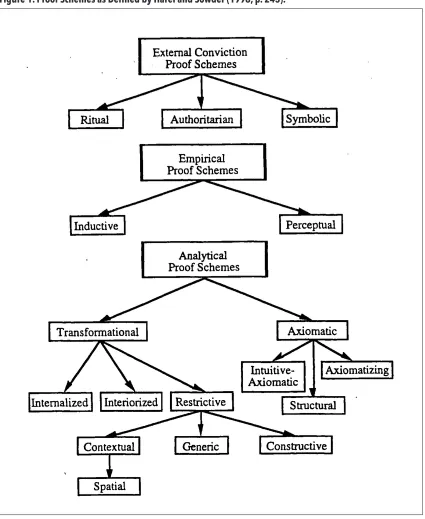
(or a community’s) proof scheme [as] what constitutes ascertaining and persuading for that person (or community)” (2007, p. 7). In their seminal work, “Student’s Proof Schemes: Results from Exploratory Studies” (1998), Harel and Sowder conclude that three primary proof schemes exist among students: external convic-tion, empirical, and analytical proof schemes. Students depending on external conviction proof
schemes are reliant upon a pattern of thinking or the direction of an authority figure in order to arrive at an answer. Those utilizing empirical proof schemes possess a need for physical facts or concrete answers in order to be convinced of an answer. Individuals practicing analytical proof schemes “validate conjectures by means of logical deductions.” By understanding the differences among these techniques when analyzing how
individuals approach problems in mathematics, we are able to examine and classify prospective teachers appropriately.
Additionally, Harel and Sowder’s 2007 work describes a distinction between conjecture and fact—“an assertion can be conceived by an in-dividual either as a conjecture or as a fact.” This discernment influences the concept of proving, which is the “process employed by an individual (or a community) to remove doubts about the truth of an assertion.” Proving depends upon ascertaining and persuading, where ascertaining requires one to “remove her or his (or its) own doubts about the truth of an assertion,” yet per-suading is to “remove others’ doubts about the truth of an assertion” (Harel & Sowder, p. 6). These three layered components – conjecture versus fact, proving, and ascertaining versus persuading – present a uniform approach in the understanding of proof schemes, allowing researchers to further investigate them with confidence.
In “Proof and Proving in School Mathematics” (2007), Andreas Stylianides defines proof as a “mathematical argument, a connected sequence of assertions for or against a mathematical claim” (2007). The manner in which proof manifests in classrooms or among individuals employs three characteristics: it utilizes “statements accepted by the classroom community … that are true and available without further justification”; it uses “forms of reasoning … that are valid and known to, or within the conceptual reach of, the classroom community”; and it communicates the argument with “forms of expression … that are appropriate and known to, or within the conceptual reach of, the classroom community” (Stylianides, p. 291). This definition is useful in that, although these students are unable to produce proofs in a mathematically rigorous sense, they are able to communicate analytical ideas in a manner that is appropriate for their level. As a result, we were careful to analyze students’ problem-solv-ing methods instead of their ability to produce a particular answer.
In their 2009 research, Stylianides and Stylianides worked with future elementary teachers studying at the master’s level. They noted
that future elementary teachers often possess a weak mathematical foundation of proof and consistently operate within an empirical proof scheme. The Stylianides’ goal was to help these individuals develop their mathematical back-grounds in order to better communicate ideas to their students. The researchers studied how to effectively assist these master’s students in for-mulating a system of categorizing proof schemes that extends beyond using empirical evidence.
Further, if students do not consider that proof is an important and necessary component in mathematics, they are unlikely to appreciate it. Thus, Harel proposes the idea of “intellectual need,” an internal desire to satisfy a longing for justification. He describes this on his 1998 work on proof:
‘Intellectual need’ is an expression of a natural human behavior: When we encounter a situation that is incompatible with, or presents a problem that is unsolvable by our existing knowledge, we are likely to search for a resolution or a solution and construct, as a result, new knowledge. Such knowledge is meaningful to the person who con-structs it, because it is a product of a personal need and connects to prior experience (Harel, 1998, p. 501).
Thus, if teachers expose their students to this need of proof in their mathematics classes, the students would likely begin to approach problems with a need for proof in mind. Zaslavsky also states that this introduction of uncertainty can “serve to motivate people to change or expand their existing ways of thinking about a particular concept or learn about the concept in the first place” (Zaslavsky, 2012, p. 223). In this manner, uncertainty is not a step backward but can inspire students toward ana-lytical thinking for proof.
Methods
and four future middle-grades teachers enrolled in Foundations of Geometry. At the time of the study, all ten participants were students of the same mathematics professor who offered her classes the opportunity to volunteer a maximum of one hour as interviewees. Upon agreement to the terms and conditions of the interview, each participant was asked a variety of questions in order to reveal how he or she thought about mathematics and proof. Initially, each individual provided an explanation of his or her concept of proof and how proof works in mathematics. Following, each interviewee completed a set of problems for further observation regarding how a particular view of proof may affect one’s reasoning process.
The first exercise prompted each participant to consider the following claim and explain how he or she might convince someone of its validity: “When you add any two consecutive numbers, the answer is always odd.” The purpose of this question was to observe and analyze the par-ticipant’s reasoning regarding what he or she constituted as an acceptable explanation.
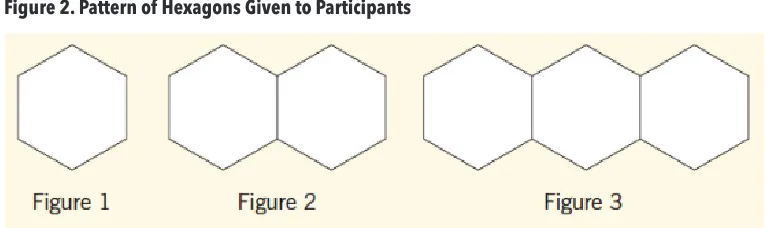
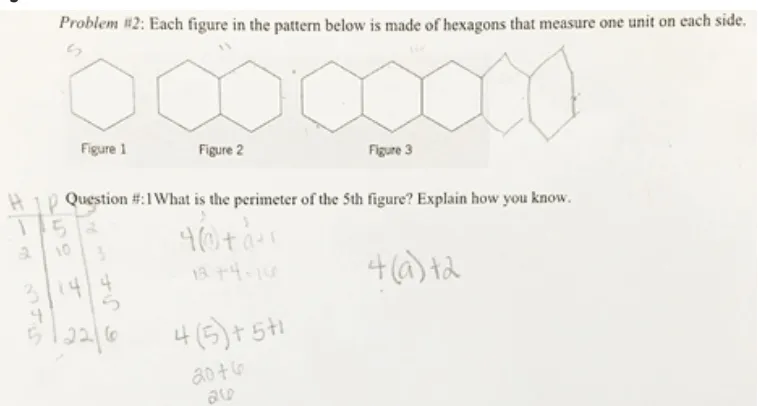
The next problem included Figure 2, in which participants determined the perimeter of
Figure 2. Pattern of Hexagons Given to Participants
the 5th and 25th figures under the assumption that each hexagon had a side length of one unit. This exercise intended to demonstrate how a participant’s skills regarding pattern recognition affected his or her proof schemes and critical thinking.
The last problem posed to the participants provided justifications of four hypothetical students in response to the following claim: “The sum of the first n odd natural numbers is n2. That is more simply put, 1 + 3 + 5 + ...
+ 2n-1 = n2.” The arguments given by Archie,
Bart, Charlie, and Drake as shown in Figures 3-6 were considered by the interviewees individ-ually based on the order of presentation.
After reviewing the first argument, each participant determined whether or not that particular argument was convincing. A repeated process occurred with the remaining three ex-planations before the participants were asked to then rank these arguments from the least con-vincing to the most concon-vincing. The purpose of this problem was to evaluate each participant’s understanding of justification and proof by noting what information he or she viewed as necessary and essential in order to be convinced
Figure 3. Archie’s Explanation
First, think about 1 + 3 = 22
1 and 3 are the first odd numbers, and when you add them together you get 4, which is a perfect square.
Then, think about 1 + 3 + 5 = 32
1 and 3 and 5 are the first three odd numbers, and
when you add them together you get 9, which is a
perfect square.
It worked for each time that I tried it, that is how I know
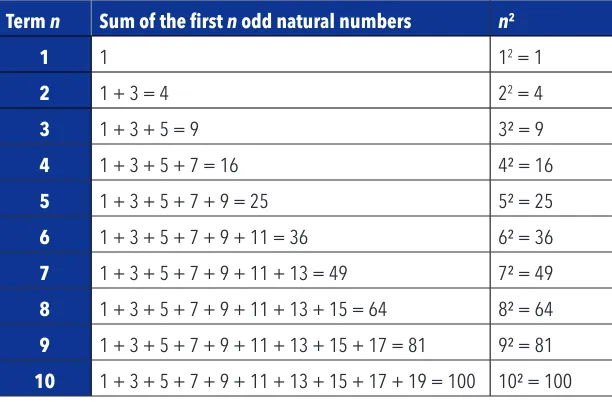
Figure 4. Bart’s Explanation
The table below shows the statement is true for the first ten odd natural numbers.
Term n Sum of the first n odd natural numbers n2
1 1 12 = 1
2 1 + 3 = 4 22 = 4
3 1 + 3 + 5 = 9 3² = 9
4 1 + 3 + 5 + 7 = 16 4² = 16
5 1 + 3 + 5 + 7 + 9 = 25 5² = 25
6 1 + 3 + 5 + 7 + 9 + 11 = 36 6² = 36
7 1 + 3 + 5 + 7 + 9 + 11 + 13 = 49 7² = 49 8 1 + 3 + 5 + 7 + 9 + 11 + 13 + 15 = 64 8² = 64 9 1 + 3 + 5 + 7 + 9 + 11 + 13 + 15 + 17 = 81 9² = 81 10 1 + 3 + 5 + 7 + 9 + 11 + 13 + 15 + 17 + 19 = 100 10² = 100
The sum of any consecutive odd natural numbers can be calculated in a similar way. Therefore, we can conclude that the sum of the first n odd natural numbers is n2.
Figure 5. Charlie’s Explanation
We can represent the sum of the first n odd natural numbers as the number of dots contained in the
squares drawn in the figures below:
1 = 12 1 + 3 = 22 1 + 3 + 5 = 32 1 + 3 + 5 + 7 = 42
The figures illustrate that the number of dots contained in each n by n square represent the sum of the first n odd natural numbers. In the general case (shown below), the number of dots in the square with
side length n is n2.
n
1 + 3 + 5 + 7 ... (2n – 1) = n2
that the claim was in fact true.
After conducting the interviews, our team transcribed and analyzed each dialogue in order to determine each participant’s proof scheme(s), as defined by Harel and Sowder (1998). We developed a coding system that categorized the students’ responses, their confidence levels, and their uses of examples, which allowed our team to better understand the participants’ approach-es to the problems with the given information. For simplification purposes, we ultimately clas-sified according to the three main proof schemes established by Harel and Sowder: external conviction, empirical, and analytical. Through this process, we determined each participant’s dominant proof scheme(s) in order to observe correlations between the concept of proof and
the proof schemes detected. This coding simply aided our understanding during the analyzing process but was not vital to our final results.
Participant Analysis
Amber: A Case of an Empirical Proof Scheme
Conception of Proof. Our first participant, Amber, was a Special Education major aspiring to work with elementary-aged students. It is important to keep this in mind, simply because College Algebra is the highest level of mathematics she will complete for her degree requirements. It was evident that Amber expressed proof in a more tangible sense regarding daily activities rather than as a purely mathematical topic. She viewed proof as something factual, which implied that proof is necessary for validity. However, she did
Figure 7. Amber’s Conception of Proof
65 Interviewer: Awesome. So now that we have that in mind, we are going
66 to talk more about the notion of proof. What does the notion
67 of proof mean to you when you hear the word “proof?”
68 Amber: When I hear proof ... it’s legit. It’s like there, it’s literal. You
69 know, you have all the evidence for it ... for your proof. 70 Interviewer: Okay, so now taking that a step further, how important do
71 you think it is to prove within mathematics, specifically?
72 Amber: Not just within mathematics, you should always prove 73 anything. You know? You should really know what the truth is,
74 as in just guessing. Like, okay we just guess this at any point.
75 No. How do you know it’s the end point? That’s why you have
76 to check your work in math, which I respect [smiles and
77 laughs].
Figure 6. Drake’s Explanation
So, think about the sum. If you have the first 5 odd numbers, n = 5, and the sum is 1 + 3 + 5 + 7 + 9 = 25 = 52. Notice the last term in this sum is 9, which can be thought of as 2n—1, or 2(5) —1.
Now, think about it as just the first n odd numbers,
It is
1 + 3 + 5 + ... + 2n—1 so there are n terms. We can rewrite it like this, and add vertically, 2n—1 + 2n—3 + 2n—5 + ...
1 + 3 + 5 + ...
When we add verticaly, we get 2n + 2n + 2n + ... + 2n, and there are n of these terms.
Now if we add these up we have n terms of value 2n, which is 2n2. But, this amout is double, because we added two sets of the odd numbers. So, we don’t want double, therefore divide 2n2 by 2.
not further her thoughts in stating that a lie is something that is false; rather, she only em-phasized the belief that something not proven cannot be true. Similarly, she held a preference for visual aid when working through problems so that she could see the work step by step.
When asked to further her definition of proof within a mathematical setting, Amber explained that guessing was not satisfactory within math-ematics because a person cannot reach what she referred to as the “end point.” Even though she did not fully develop this idea, it was clear that she recognized the importance and need for all mathematicians to communicate in a common language. She even introduced this idea in her opening statement when asked about the important aspects of mathematics. She stated, “that is how everyone communicates through math, like when it comes to all the countries and stuff.” Interestingly enough, Amber empha-sized the significance of this but did not believe she possessed the abilities to communicate the mathematics she experienced when attempting the problems throughout the interview.
Problem 1: Consecutive Numbers. Once reading through the prompt, Amber seemed confused and decided to ask for reassurance about the definition of consecutive numbers. She did in fact have a firm understanding of the concept, but relied on the instructor’s approval, which
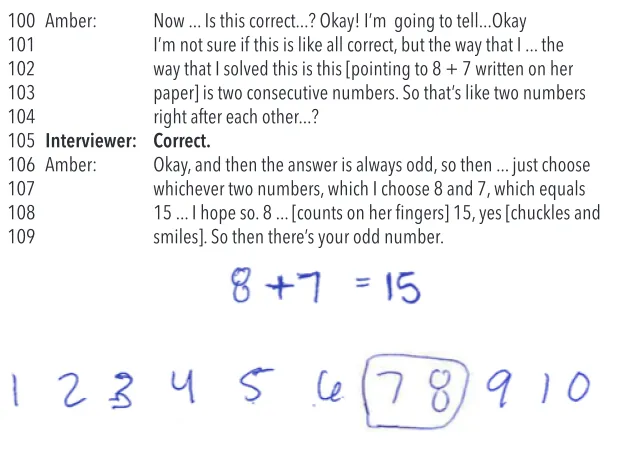
indicated she was possibly practicing an author-itarian proof scheme. The following episode, as shown in Figure 8, gives a brief overview of her thought process.
Amber initially tested the claim by choosing 8 and 7, which allowed her to conclude the sum was odd. When asked how she would convince others the validation of this claim, she created a number line with the numbers 1 through 10. She explained that by choosing any two consec-utive numbers along this number line, the sum would always be odd, which she found when using (8 + 7) as her first example, followed by the examples (5 + 6) and (4 + 5) and explained verbally. Notice that Amber solely relied on the outcome of three examples in order to conclude the statement held for all cases. She lacked the interest for self-discovery and limited her explo-ration by not considering numbers greater than 10 or less than 1. She was unable to use her ob-servations to construct a pattern or general rule to apply her method for all numbers, ultimately demonstrating her use of an empirical proof scheme.
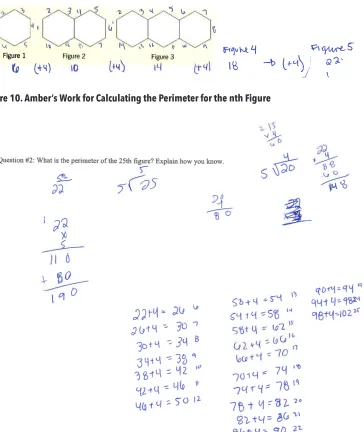
Problem 2: Perimeter of the Hexagons. The episode recorded in Figure 9 demonstrated Amber’s problem-solving techniques utilized to find the perimeter for the 5th figure. Interestingly enough, she again asked for additional assis-tance by requesting a definition for “perimeter”
Figure 8. Amber’s Work for Problem 1
100 Amber: Now ... Is this correct...? Okay! I’m going to tell...Okay
101 I’m not sure if this is like all correct, but the way that I ... the 102 way that I solved this is this [pointing to 8 + 7 written on her 103 paper] is two consecutive numbers. So that’s like two numbers
104 right after each other...?
105 Interviewer: Correct.
106 Amber: Okay, and then the answer is always odd, so then ... just choose 107 whichever two numbers, which I choose 8 and 7, which equals 108 15 ... I hope so. 8 ... [counts on her fingers] 15, yes [chuckles and
as well as clarification about how to account for the shared sides between two adjacent hexagons. After gaining reassurance from the interviewer, she attempted the problem. By counting the edges within each figure, she discovered the pattern of adding 4 sides to the figure for each additional hexagon. She used this pattern to add 4 once for the 4th figure, and then 4 again for the 5th figure. She concluded that the perimeter for the 5th figure was 22, which was in fact the correct answer. However, she did not take this process a step further and attempt to create a
mathematical equation that represented the change indicated by adding 4 each time.
The episode recorded in Figure 10 above provides Amber’s three attempts before con-cluding a final answer of 102 for the perimeter of the 25th figure. Upon this request, she im-mediately commented that she must “make an algebra equation.” However, she was not able to correctly identify a mathematical equation that represented the change she recognized within this pattern.
Amber believed that she needed to find a
Figure 9. Amber’s Work for Calculating the Perimeter for the 4th and 5th Figures
“fast way” to solve for the perimeter so that she did not have to count by 4 each time to reach the 25th figure. She recognized the need for gen-eralization; however, it was evident that she was unable to utilize her mathematical findings to create a general formula. Initially, she attempted to find a relationship between the current figure and the final figure. She thought that since the figure number was increasing by a multiple of 5, she could multiply the perimeter of the 5th figure by 5 in order to find the perimeter for the 25th figure. Thus, her original answer concluded the 25th figure had a perimeter of 110. However, when asked to verify her work, Amber became confused and decided to rework the problem.
In her next attempt, she related the figure numbers by taking the difference. She then remembered she had discovered a pattern of adding 4 each time in the previous example, so she multiplied the difference of 20(25-5) by 4 to account for the change found in the pattern. Yet, her confusion was still evident as she then added this 80 to her original answer of 110 to conclude that the total perimeter was 190 upon her second attempt. Amber admitted that she would not be confident with her first two attempts unless the instructor gave her the correct answer, which exemplified once more that she utilized an authoritarian proof scheme frequently within her learning. In order to be truly satisfied with her answer, Amber decided to find the perimeter the only way she knew how: to add 4 each time until she reached the 25th figure. After complet-ing her work, she was then able to determine 102 as the total perimeter. She claimed that this method was the only way she knew that her answer was correct, even though she recognized there was a faster way to complete the problem. Her inability to deduce a general formula based on the pattern heavily influenced her method towards answering the prompt.
Problem 3: Evaluation and Ranking of Arguments. Initially, Amber believed that since the first two examples held for Archie’s argument and that she could continue the pattern to show that additional examples held, this argument was convincing. However, as she considered Bart’s argument, she stated that she did not think the
table was helpful whatsoever. This was partic-ularly interesting because she had created an informal table in order to organize her thoughts for the Hexagon Perimeter Problem. Further, as she evaluated Charlie’s argument, she reasoned that since the first two examples held from the previous argument with Bart, she could safely assume that this argument was equally as con-vincing. She no longer evaluated the actual argument because the mathematical compre-hension was beyond her reach. Commenting on the artistic and visual aspects of the argument was not enough to conclude validation within the proof. She failed to acknowledge the impor-tance of the dots’ placement in such a way that it created an n-by-n box. However, as she read over both Bart’s and Drake’s explanations, the notation superseded her current mathematical understanding.
Once Amber had evaluated each argument individually, she ranked the arguments from most to least convincing accordingly: Charlie, Archie, Bart, and Drake. Interestingly, she only comprehended the reasoning behind Archie’s and Bart’s explanations, yet she labeled those arguments as only moderately convincing. It was not surprising that she ranked Drake’s argument as least convincing because she lacked the math-ematical knowledge necessary to understand the higher-level notation. However, she ranked Charlie’s argument as the most convincing but did not properly explain why and how the math-ematics worked.
Relationship of Definition and Practice. Amber’s definition of proof was more empirical in nature, emphasizing evidence rather than reasoning, and her problem-solving methods followed a similar pattern. As she explained the Consecutive Numbers Problem, she utilized empirical examples. Further, as she attempted to find the hexagons’ perimeter, she was only certain of an answer if she computed it by brute force. Finally, her rankings of the proofs displayed a ritualistic proof scheme, as she utilized the appearance of the problem to order them. Thus, the manner in which she approached the problem exempli-fied the need for evidence rather than a sense of reasoning behind her explanations, showing that she relied on an explicit, empirical method.
Monica: A Case of an Analytical Proof Scheme
Conception of Proof. Our second interviewee, Monica, was an aspiring middle-grades teacher with a mathematics emphasis. Initially, she stated that proving in mathematics encapsulates the process of reasoning for a concept’s validity, which we considered to be analytical in nature, according to Harel and Sowder’s classifications. Her mindset indicated that claims may only be built upon if one verifies them. In the statement given in Figure 11, she revealed a more analyti-cal approach, utilizing words such as “reasoning on why” and “[having] evidence” to support the systematic approach.
Problem 1: Consecutive Numbers. As she ap-proached the first problem seen in Figure 12, Monica perceived that consecutive numbers alternate between even and odd numbers so the
Figure 11. Monica’s Concept of Proof
59 Monica: (chuckles) Being able ... what does proof mean? That’s an 60 interesting question. I guess being able to explain reasoning on
61 why something is true.
66 Monica: I mean a lot of the formulas and I mean, obviously I’m in the
67 geometry mindset right now too ... theorems and stuff that we 68 learn, you have to have evidence behind them in order to say 69 that they’re true because, if not, then everything like, you know, 70 like everything crumbles (laughs). So I mean I think it’s very 71 important to be able to say, “This is how I got there, and this 72 works for every case.” I don’t know if that answers your
73 question.
76 Monica: Yeah. I mean, being able to prove it is kind of like a foundation
77 for being able to use it in so many different areas. Cause once 78 you prove one formula for slope is true, then you can prove
79 it ... I mean you can use that forever. You know what I’m 80 saying?
Figure 12. Monica’s Work for Problem 1
114 Monica: If any two consecutive numbers ... it’s always going to be odd
115 and even, or even and odd. 116 Interviewer: Ok.
117 Monica: So, but I don’t know how to explain that ... to prove that it
sum of two consecutive numbers always consists of one odd and one even number. She recog-nized that the sum of two consecutive numbers would always be odd. However, she faced dif-ficulty when attempting to prove this claim in a non-empirical manner. Perhaps this deficien-cy is from her lack of experience with formal definitions of odd and even, for the highest level of mathematics she had encountered was Foundations of Geometry. Regardless, she knew that the statement should be proven in order to be true. Thus, we determined her mindset as an internalized proof scheme, which Harel and Sowder classified as analytical (1998, p. 242).
Problem 2: Perimeter of the Hexagons. When approaching the second problem, Monica im-mediately searched for a pattern in the figures, forgoing all empirical methods. She stated that
if she derived a formula identifying the relation-ship between the perimeter and the figure, it would allow her to find the perimeter for any figure number. This moment revealed a depth of understanding beyond the empirical under-standing or external conviction. Ultimately, she deduced the formula to be “4a + 2,” where “a is the number of hexagons,” as displayed in Figure 14.
Monica’s justification for this formula portrayed a depth of understanding and pattern recognition. She perceived the differ-ence between each figure and noted a manner in which to relate these concepts. In our coding system, we determined Monica’s response to be transformational, according to Harel and Sowder’s definitions. According to their study, “transformational observations involve op-erations on objects and anticipations of the
Figure 14. Monica’s Work for Problem 2
Figure 13. Monica’s Derivation of the Perimeter Formula
235 Monica: ... we have, and we know that the top perimeter, or the top part
236 of this perimeter, is going to be 2 times the number of 237 hexagons we have because there are 2 segments for each 238 hexagon, or 2 units.
239 Interviewer: Ok.
240 Monica: Then, we know that that is going to duplicate on the bottom, so
241 that’s where we get 2 times the number of hexagons. 242 Interviewer: Ok.
243 Monica: And then we need for ... we need to account for these two
operations & results [which are] goal oriented.” Students with the transformational mindset are able to “transform” the problem and “anticipate the results of the transformations,” leading to the final deduction of the problem (p. 258-259). Monica followed this approach, demonstrating that she was able to recognize the pattern through the transformations of each problem, which led to determining a mathematical equation that expressed the detected pattern.
Problem 3: Evaluation and Ranking of the Arguments. Monica tended to approach the prompts from a teacher’s perspective. She was not convinced by Archie’s explanation, as it utilized only a few cases. However, she considered that middle school students might find the argument convincing because it utilized examples to show the claim was true. When considering Bart’s ex-planation, she alluded to a student’s propensity to approve a claim due to the examples shown. Monica initially expressed doubt with his argument, but later became convinced by the formula on the page, unaware that Bart himself did not arrive at this conclusion. However, she demonstrated a higher level of understanding by recognizing that the formula represented a general form of the data. With Charlie’s ex-planation, she acknowledged the presence of a consistent pattern as more numbers were in-troduced. She discovered that as the number of dots increased, the area of the square remained n
x n though she noted that she thought that Bart had showed a very similar argument. Perhaps this was due to her misunderstanding of the placement of the formula from Bart’s equation. Further, Drake’s explanation seemed convinc-ing to her, for she stated that Drake provided a formula and portrayed how it operates.
However, when asked to rank these arguments in order of least convincing to most convincing, Monica expressed her thought that each proof held validity, as each could be utilized in the classroom to assist the students’ under-standing of the prompt. Yet, she was not satisfied with the explanations given by Archie and Bart, as recorded in Figure 15. Monica argued that these justifications could serve as a foundation to reach the conclusion, which Drake ultimately achieved. Monica broadened this explanation by expressing the need for a foundational under-standing of how mathematicians arrive at certain formulas in order for others to understand their full implications and intentions. Thus, she demonstrated a developed understanding of proof and its role in the classroom, which must be established in order to gain full comprehen-sion of the claims and manner in which to arrive at a conclusion. This trait was a characteristic of the internalized proof scheme, which utilizes the ability to understand the argument and transfer the knowledge into a mathematical expression.
Relationship of Definition and Practice. Monica’s
Figure 15. Monica’s Explanation of the Arguments’ Importance
425 Monica: So here’s the thing. I feel like none of these are necessarily
426 wrong. I think that they are good teaching tools to get to this 427 point (points to Drake’s explanation).
428 Interviewer: Ok.
429 Monica: So I wouldn’t say that this in and of itself ... {inaudible}. Like
430 neither of these (points to Archie’s and Bart’s explanations) in 431 and of themselves prove that it was right, but it like kind of was 432 a foundation to explain how he got there. So does that make
433 sense?
434 Interviewer: So they sort of maybe build on each other
435 Monica: Mhm ... to kind of give a foundation so that when you get to this
436 point (referring to Drake’s explanation) and you say this is how 437 I formed this formula, you have all this background knowledge 438 to understand instead of giving them the formula and being
definition and application of proof implied an analytical approach, as demonstrated in her work. Though she did not utilize the formal definitions of odd and even when justifying her reasoning, Monica noted that it was possible and identified the pattern that allowed her to conclude that the sum of consecutive numbers would always be odd. As she approached the Perimeter Problem, she never considered employing an empirical method to find the perimeter of further figures. Finally, as she evaluated the arguments, she noted that the empirical arguments were not valid proofs in and of themselves, but could be beneficial for explanations and understanding. Each problem exemplified her analytical thought process and methodology when approaching such problems.
Findings
In our analysis, we made several interesting observations about our participants. Initially, we found a differentiation between the algebra students’ tendency to define proof either empiri-cally or by external conviction and the geometry students’ propensity to define proof using analyt-ical reasoning. We also discovered a correlation between the students’ definitions of proof and their considerations of important concepts within mathematics. That is, students with an empirical or externally convicting definition of proof tended to approach their problems exper-imentally or computationally, whereas students with an analytical definition tended to approach problems logically and systematically.
Of the ten participants, six demonstrated proof schemes that were identical to the proof schemes evident in their conception of proof. For two participants, their conceptions of proof fell under the analytical proof scheme while they practiced both empirical and analytical ideology. One participant had both empirical and analyt-ical proof scheme ideas within her conception
but only expressed empirical ideas within her work. The last participant defined proof with reasoning that fell under the empirical proof scheme; however, she had both empirical and analytical approaches to the given prompts. These findings suggest that each participant’s definition of proof, along with their conceptual-ized understanding, impacted their interactions with the problems posed. It is important to note this correlation, for it suggests that a teacher’s interaction with mathematics may influence his or her instruction with that particular material. Therefore, his or her students’ interactions with mathematics may be influenced by the teacher’s conceptualization and approach to problems within the subject.
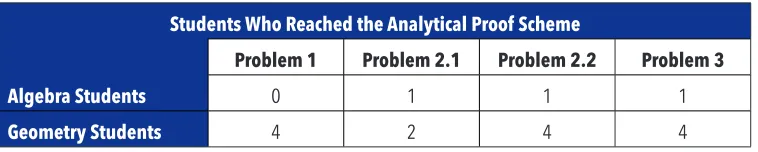
In our analysis, we generally observed how participants from different mathematical backgrounds approached the various problems given throughout this study. We discovered that all four participants currently enrolled in College Algebra thought about the Consecutive Numbers Problem with an empirical proof scheme. Conversely, only two participants in Foundations of Geometry thought about this problem empirically, while the other four ap-proached the prompt with an analytical mindset. When considering the Perimeter of Hexagons Problem, one algebra participant thought an-alytically in order to calculate the perimeter of both the 5th and 25th figures, while the other three students held an empirical proof scheme throughout the problem. Comparatively, two geometry students approached calculating the perimeter of the 5th figure analytically while four participants found the perimeter of the 25th figure in an analytical manner. The remaining two geometry participants thought in an empirical manner throughout the problem.
The Evaluation and Ranking of Arguments Problem required a more complex analysis. For the purpose of this paper, we will only consider
Figure 16. Number of Participants Who Utilized an Analytical Proof Scheme in Each Problem
Students Who Reached the Analytical Proof Scheme
Problem 1 Problem 2.1 Problem 2.2 Problem 3
Algebra Students 0 1 1 1
each participant’s most dominant proof scheme displayed throughout their efforts. Only one of the four algebra participants practiced an analyt-ical proof scheme in this question while four of the six geometry participants practiced an ana-lytical proof scheme. Through the observations of this analysis, those in geometry had a greater tendency to think and interact with mathemat-ics using an analytical and logical mindset.
Within our research, we observed that each participant’s definition of proof influenced the proof schemes used within the various problems. This observation parallels Harel and Sowder’s statement that “the proof schemes held by an individual are inseparable from her or his sense of what it means to do mathematics” (1998, p. 242).
Limitations
Our study has multiple limitations which inhibit our ability to assert claims beyond the scope of our study. Our sample was comprised of ten volunteer participants from only two different classes taught by one professor at one university. The small sample restricted our findings to qual-itative results exclusively, thus narrowing our ability to make generalized claims. Furthermore, our sample was entirely middle-class and female, which is a highly exclusive demographic and leaves many others unrepresented.
Significance
In our study, we purposefully chose to work with future mathematics educators because it was important for us to see how they interacted with the material they hope to one day teach. By examining how they worked through the mathematics and asking them to communicate those ideas to us, it allowed our team to replicate a classroom encounter. Essentially, we were asking them to teach us what they saw. We can imagine that as future teachers, they may com-municate mathematics in a similar manner. This is important to examine because these future educators are primarily responsible for properly communicating and teaching their students mathematics. As Harel and Sowder claim, “The evidence from the status studies of university students’ proof knowledge suggests that some,
if not many, precollege teachers are unlikely to teach proof well, perhaps because their own grasp of proof was probably limited in college and may not have grown since then” (1998, p. 36). A teacher cannot teach beyond his or her own scope of understanding. Consequently, if a teacher is not equipped to teach students to think analytically, then it is significantly less likely for the students to obtain a more critical compre-hension. Given that those in the geometry class appeared to process mathematics more deduc-tively, this may indicate a possible correlation between exposure to a higher level of mathe-matics and the operation of logical faculties. Nevertheless, we are unable to make such a claim based on the findings of our study, but our work charges us as researchers and educators to investigate this theory further.
Conclusion
Based on our research, we have reason to believe that the way individuals think about mathematics and proof ultimately impacts their problem-solv-ing methods. We observed that within our sample, those who had encountered proof in geometry had a greater tendency to approach problems more analytically and generally. By continuing this research and analyzing more par-ticipants, it would be interesting to determine if a trend would arise among those with more exposure to proof having a greater tendency to think analytically. Additionally, further investi-gation may verify these conclusions within our own study, showing that future mathematics educators should encounter more proof-based classes.
References
Harel, G. (1998). Two Dual Assertions: The First on Learning and the Second on Teaching (or Vice Versa). The American Mathematical Monthly, 105, 497-507.
Harel, G., & Sowder, L. (1998). Students’ Proof Schemes: Results from Exploratory Studies.
CBMS Issues in Mathematics Education, 7, 234-283.
Harel, G., & Sowder, L. (2007). Toward Com-prehensive Perspectives on the Learning and Teaching of Proof. Second Handbook of Research on Mathematics Teaching and Learning, National Council of Teachers of Mathematics.
Musser, Gary L., Trimpe, Lynn E., and Maurer, Vikki R. (2006). College Geometry: A Prob-lem-Solving Approach with Applications. Pearson Education, Inc.
Stylianides A.J. (2007). Proof and Proving in School Mathematics. Journal for Research in Mathemat-ics Education, 38(3), 289-321.
Stylianides, G.J., & Stylianides, A.J. (2009). Facili-tating the Transition from Empirical Arguments to Proof. Journal for Research in Mathematics Education, 40(3), 314-352
Zaslavsky, O. (2005). Seizing the Opportunity to Create Uncertainty in Learning Mathematics.
Educational Studies in Mathematics, 60, 297-321.
Faculty mentors