Issue 1Journal of Clinical Art Therapy, 3rd Edition
July 2016
Dialectical Tensions Experienced During Pediatric
Chronic Illness: Analyzing Art Therapy
Conversations from a Relational Dialectics
Perspective
Katherine A. Rafferty
Iowa State University, [email protected]
Erin Parcell
University of Wisconsin-Milwaukee, [email protected]
Follow this and additional works at:http://digitalcommons.lmu.edu/jcat
Part of theArt Practice Commons,Health Communication Commons,Health Psychology
Commons, and theInterpersonal and Small Group Communication Commons
This Peer Reviewed Article is brought to you for free and open access by the Marital and Family Therapy at Digital Commons @ Loyola Marymount University and Loyola Law School. It has been accepted for inclusion in Journal of Clinical Art Therapy by an authorized administrator of Digital
Recommended Citation
Perspective
Cover Page Footnote
Abstract
Relational dialectics theory (RDT) provides a framework for understanding the dialectical
tensions families experience when talking about pediatric chronic illness. One place where
families may express these tensions is during clinical art therapy sessions, where therapists
encourage child patients and their family members to use the creative process of art to tell stories
while engaged in art making. Subsequently, we studied one clinical art therapy program for
families with chronically ill hospitalized children. We examined the naturally occurring
conversations during the art making process. Family members’ talk enumerated three primary
dialectical tensions describing the pediatric illness experience. Findings and implications are
discussed to explain how RDT may inform art therapists’ sensitivity to addressing these specific
dualities verbally expressed by families.
Dialectical Tensions Experienced During Pediatric Chronic Illness: Analyzing Art Therapy
Conversations from a Relational Dialectics Perspective
Chronic illness is a contextual family experience in which one family member’s illness
influences the entire family system (Roy, 2006). The work required of families during the
management of chronic illness is magnified when a child is diagnosed because of the dependent
nature of children on family caregivers and the likelihood of severe illness episodes occurring
that require high-intensity acute care (Darcy, Björk, Enskär, & Knutsson, 2014). The term
“pediatric chronic illness” refers to a medical condition with the following criteria: (a) the onset
occurs between the ages of 0 and 18; (b) the diagnosis is based on medical scientific knowledge;
(c) the illness is not (yet) curable; and (d) the illness exists for a minimum of three months, or
three episodes have occurred within the last year (van der Lee, Mokkink, Grootenhuis, Heymans,
& Offringa, 2007). Common pediatric chronic diagnoses that fit within this definition include
asthma, diabetes mellitus, congenital heart disease, juvenile rheumatoid arthritis, cystic fibrosis,
and mental illness (e.g., eating disorders). Approximately 20% of North American children ages
0 to 17 years live with chronic health conditions; co-morbidity is common, with 29.1% of
children displaying three or more conditions (Children and Adolescent Health Measurement
Initiative, n.d.).
Due to the likelihood of severe illness episodes occurring that require high-intensity acute
care, the management of many pediatric chronic conditions includes frequent hospitalizations
(Darcy et al., 2014). A child’s hospitalization can be traumatic and stressful for the entire family.
Researchers have found that many families must balance maintaining hope for the future while
also accepting the reality of a bleak outcome (Jones, 2012; Roy, 2006). In addition, this period
emotional, behavioral, and developmental issues (Fritsch, Overton, & Robbins, 2011; Mussatto,
2006). Thus, a child’s hospitalization is wrought with tensions due to the need for major life
adjustments that attempt to balance treatment regimens and medical appointments with the rigors
of daily life.
Although limited research exists, therapy sessions are one environment where these
dialectical tensions about pediatric chronic illness are likely to be discussed. For example, Davis,
Mayo, Piecora, and Wimberley (2013) found that case managers, parents, and children often
wrestled with using both strengths language (i.e., acknowledging something positive to move
forward in a positive direction) and deficit language (i.e., stating something negative that hinders
moving forward in a positive direction) when talking about a child’s future with mental illness
during counseling sessions. With a growing number of healthcare institutions in the United
States creating arts programming for patients and their family caregivers, therapeutic art
interventions conducted within clinical settings are another environment where family members
may discuss dialectical tensions. Scholars know that participating in art-making can be
transformative as families tell stories through art, tell stories about art, and tell stories while
engaged in art-making (Harter, Quinlan, & Ruhl, 2013). After recognizing that families naturally
told stories that included dialectical tensions while engaged in art-making at one clinical site, we
selected relational dialectics theory (RDT) (Baxter & Montgomery, 1996) as a sensitizing
framework to inductively analyze the verbal communication occurring during the art making
process. As family health communication scholars, our focus was on families’ conversations
about the dialectical tensions surrounding their children’s chronic illnesses and current
hospitalizations. We describe the presence of three dialectical tensions discussed in this
from including RDT in their interpretive toolkit when working with child patients and their
families.
RDT and Family Health Communication Scholarship
RDT is a communication theory about dialectical tensions, or contradictions, that are
verbally expressed and negotiated within personal relationships such as families (Baxter &
Montgomery, 1996). Dialectical tensions are dynamics between two opposing yet unified forces,
needs, or desires in relationships, such as the need for connection yet also independence. Most
relational partners want and need these aspects in their relationships, but they often experience
them as working against one another (e.g., too much autonomy takes away from feelings of
connectedness) and manage them accordingly (e.g., spending more time together versus apart).
Dialectical tensions may occur across the lifespan of a relationship; however, they are most
evident during moments of heightened awareness such as the management of a family member’s
chronic illness. For example, a chronically ill child and her family may experience a range of
dialectical tensions when navigating the ups and downs of the treatment period. During this time,
the family may struggle between wanting to know more information about the condition and
prognosis while simultaneously desiring uncertainty.
Family health communication scholars have used RDT to study several health contexts
(Baxter, Braithwaite, Golish, & Olson, 2002; Fisher, 2011; Golden, 2010; Kvigne & Kirkevold,
2003; Mirivel & Thombre, 2010) and report family members often frame dialectical tensions as
opposites (e.g., autonomy versus connection) exposing the struggles family members encounter
during the illness experience. However, few scholars have analyzed dialectical tensions when a
child is the patient. Davis et al. (2013) examined children’s mental health team meetings and the
discussed a child’s future prognosis. Other researchers have identified parents’ joy-grief
contradiction due to a premature birth (Golish & Powell, 2003), as well as autonomy-connection
and openness-closedness while grieving the death of a child (Toller & Braithwaite, 2009). Thus,
dialectical tensions are clearly felt and expressed when a child is sick or has passed away, but
how families discuss them during a child’s hospitalization for his or her chronic condition
remains unknown, despite the growing number of North American children living with chronic
illness (Children and Adolescent Health Measurement Initiative, n.d.).
Family Talk during Clinical Art Therapy Sessions
Clinical art therapy is an “intervention based on the belief that the creative process
involved in making the art is healing and life enhancing” (Nainis et al., 2006, p. 162). Therapists
encourage patients and their family members to creatively express their thoughts during
therapeutic art interventions through verbal and nonverbal expression by using various
modalities—pencil and paper, paint, photography, clay, music—for diagnostic, recreational,
and/or palliative purposes (see Malchiodi, 2003). Through the creative use of these different
modalities, art provides a conduit for individual expression (both verbal and nonverbal) of
thoughts and feelings as well as the management of uncertainties, developments, and changes
regarding the illness experience. Thus, art is both a process and product of communication that
facilitates post-traumatic growth (Beebe, Gelfand, & Bender, 2010; Parisian, 2015). Change and
coping occur during art-making as individuals assign meaning to experience, develop a stronger
life purpose, increase self-awareness, and allow themselves to move forward (Mohr, 2014) and
feel hope (Appleton, 2001). In particular, therapeutic art interventions provide an extraordinary
range of clinical possibilities that assist patients and their family caregivers who are affected by a
pediatric oncology, neurological disorders) (State of the Field Committee, 2009). Given these
conclusions it is not surprising that nearly half of the healthcare institutions in the United States
report offering arts programming (Harter et al., 2013).
Most research on these clinical art programs, and in particular those programs within
pediatric medical settings, involves patient case analysis and experimental designs to test the
effectiveness of art in relieving pain (Nainis et al., 2006) or reducing psychological symptoms
(Chapman, Morabito, Ladakakos, Schreier, & Knudson, 2001). This body of research tends to
focus on the examination of the art piece or modality (e.g., photography, painting, pencil and
paper). The focus on the artwork is significant because art is not only a context to be studied but
also a powerful vehicle for self-expression and narrative sense-making where patients and
families not only tell stories through art and about art, but also tell stories while engaged in art
making (Harter et al., 2013). Thus, a significant component to therapeutic art interventions is the
interaction that occurs between the individuals (e.g., patient, family caregivers) and the art
therapist, whether in one-on-one or group art therapy sessions.
Given the absence of research specifically analyzing the stories while engaged in art
making,we decided to focus on how art work serves as an object of dialogue about dialectical
tensions. We believe that focusing on verbal communication during art making is relevant
because within art psychotherapy research art expressions are often used to enhance verbal
exchanges between the therapist and client, particularly when patients cope with difficult illness
experiences (Sholt & Gavron, 2006) such as hospitalizations. Studying talk during the
art-making process may provide additional insight into how conversations serve as an indirect
means for exposing dominant narratives, empowering change, and illuminating channels of
family members utilize clinical art therapy sessions to verbally communicate about the illness
experience. Examining the possible presence of dialectical tensions within art therapy
conversations has practical implications for art therapists because conflict, failed health
messages, and poor health are likely outcomes when family and health professionals (e.g.,
clinical art therapists) fail to recognize the existence of dialectical tensions surrounding the
illness experience (Pecchioni & Keeley, 2011).
Method
Research Design
Over the course of nine months, the first author conducted participant observations at one
clinical art therapy program for families with chronically ill hospitalized children. This program
was affiliated with a non-profit organization in the Midwest United States. We conducted
participant observations because this method allows researchers to examine the content and
process of family communication (du Pré & Crandall, 2011). Across the nine-month period, the
first author observed 24 two-hour sessions of art therapy. The non-profit organization and head
art therapist facilitating the program granted consent to the observations, and verbal assent and
written consent forms were individually administered to child patients, siblings, and their adult
parental caregivers before each session began. Individuals who arrived late completed consent
and assent forms as they entered the room; no one denied assent or consent. During and after
each art making session the first author took extensive field notes. In addition, the first author
regularly met with the two art therapists who facilitated the program to discuss their observations
and obtain additional information based on their professional expertise.
Clinical art therapy sessions were offered to child patients and their families twice a week
for a two-hour time frame. The structure of each session was flexible in nature; child patients and
their family members could attend the session at any time during the two-hour period. Each
session had a predetermined art therapy project selected by the therapists (e.g., drawing, painting,
making worry dolls, collage making, clay-work). Most individuals who attended the sessions
participated in the creation of these directed art projects. However, there were times when
individuals wanted to work independently on completing a previous project or make cards and
write letters to their loved ones in the hospital. Thus, the purpose of the group was to provide a
safe space for child patients and their families to process their hospitalization experiences
through the creation of artwork.
Sessions had no more than ten individuals, with most involving five people. Primarily
parents (mainly mothers) of hospitalized children attended the sessions, followed by siblings
(between 4-12 years old) of the sick child, and then teenagers receiving outpatient treatment for
different mental health diagnoses (e.g., eating disorders, depression, obsessive compulsive
disorder). Most attendees were White/Caucasian, but other race/ethnicities also attended. Based
on the therapists and first author’s observations, common diagnoses of the hospitalized child
patients included cancer, eating disorders, obsessive-compulsive disorder, cerebral palsy,
scoliosis, anxiety disorders, and cystic fibrosis.
Analysis
Observation notes were transcribed immediately after each observed session. The first
author read the field notes several times with the goal of identifying themes that described the
salient dialectical tensions evident in families’ verbal communication to the therapist as well as
verbal communication, as analyzing spoken tensions and discourse is the purpose of RDT
(Baxter & Montgomery, 1996). The first author reviewed each field note at least twice using the
constant comparative method (Glaser & Strauss, 1967). The concept of contradiction as outlined
in RDT served as the sensitizing concept (Blumer, 1954), but we allowed the creation of specific
themes to inductively emerge from the data. After reading through the field notes, the first author
used open coding to generate a list of initial codes for dialectical tensions that the participants
discussed during art making. She then compared this list to her field notes to refine and add new
codes. For codes to emerge as themes, recurrence, repetition, and forcefulness had to occur
(Owen, 1984). She shared these findings with the second author, a family communication expert
in RDT, who then read through the field notes to confirm relevance and saturation of initial
themes. Upon agreement, both authors completed a second-order analysis by reviewing the
emerging themes. At this stage, codes and themes were compared to reduce the data and increase
precision. The first author further confirmed the salience and relevance of the emerging themes
by conducting member checks with eight parents who had participated in the clinical art therapy
program. During the interviews, the first author asked them: (a) if each tension resonated with
their personal experiences, and (b) how they personally experienced each tension. She also used
peer debriefing sessions with the two therapists to confirm the salience and relevance of the
themes. Theoretical saturation was achieved when no new dialectical tensions emerged from the
observations, parents’ interviews, and peer debriefings (Lincoln & Guba, 1985).
Findings
The art therapy room provided a safe and creative space for personal expression that
stimulated conversations about the families’ pediatric chronic illness experiences. Across the
communication. For example, during one of the observed sessions, a mother and her young
daughter created a “get well card” for her other daughter who was receiving chemotherapy. The
creation of this card fostered dialogue between the daughter and mother about the other child’s
prognosis. In other instances no conversations occurred until the art therapist posed direct
questions to the individual about his or her artwork. For instance, during a different clinical
session one of the art therapists had two teenage girls attending a three-month in-patient
treatment program for eating disorders draw pictures of their favorite places. As the girls drew
their pictures, the art therapist asked questions about how the drawings reflected their current
feelings and states in life. Conversations about the creation of art provided a conduit for patients
to share personal narratives and verbally express dialectical tensions (e.g., tensions between
desiring independence but also wanting to feel connected to family and friends) to the art
therapist. During sessions with multiple people in attendance, the art therapist approached
individuals as they worked independently; however, the environment was set up so that
individuals could also talk with other people; group processing occurred between individuals and
the art therapist as well as between attendees. Regardless of the structure or group composition,
the verbal processing of dialectical tensions was evident and was something that was naturally
discussed during the creation of artwork.
Managing Hospital Life – Attending to Life Outside the Hospital
The most prominent tension verbally expressed by family members attending the clinical
art therapy sessions was managing hospital life – attending to life outside the hospital. Parents
and siblings discussed the challenges with balancing their family alongside the demands of a
child’s hospitalization (e.g., extended in-patient treatments). For instance, one mother verbally
the course of several sessions, the creation of the worry dolls fostered multiple conversations
where she described her son’s frequent hospitalizations and the strain placed on her family:
And just like that, we were packing bags, adjusting plans, and calling in family
reinforcements. We know the drill. We've done this before. Today I felt particular
bitterness, however, because today is Ashley's 7th birthday. As if this girl hasn't already
taken the back seat enough times this year, all of a sudden her birthday becomes all about
Dave again. All about Cancer. Stupid Cancer.
Being at the hospital was a difficult experience for many parents. Having the ability to paint,
write, and draw during the art therapy sessions allowed parents to state these tensions as they
worked through feelings of guilt, betrayal, and frustration for not always sitting at their child’s
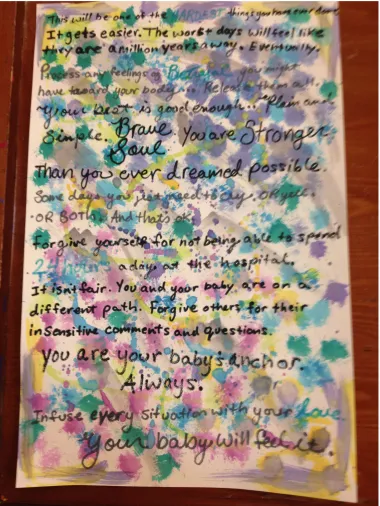
hospital bed. One mother who recently delivered her daughter who had a heart condition that was
diagnosed at 20 weeks gestation used different colors and strokes of paint to form a backdrop to
a personal letter that she painted and wrote. All of the text was written using black and gray
marker, except for the words “hardest,” “betrayal,” “24 hours,” and “love,” which were written
in blue (see Figure 1). Part of her letter denoted this dialectical tension when she wrote: “forgive
yourself for not being able to spend 24 hours a day at the hospital…forgive others for their
insensitive comments and questions.” Artwork such as this illustrated the contradictory feelings
Figure 1. Art serves as a backdrop to a personal letter, holding contradictable feelings.
Other parents discussed this tension when describing how their children’s hospitalizations
required some family members to be displaced from their homes for a period of time. For
seeking medical attention for her daughter in the Midwest while her husband and other children
were at home on the East Coast. She often talked about wanting to “be here” with her
hospitalized daughter while also wanting to be at home caring for her other children and
husband. The art therapist typically had mothers like her create an origami heart where they
wrote about other challenges pertaining to this tension. As the mothers individually constructed
their origami hearts, they discussed the hardships associated with attending to their sick children
while managing other family relationships, long-distances, careers, and finances. During one of
the observed group sessions a mother shared her frustrations with the art therapist and other
mothers present:
And we're trying to maintain careers while we’re dealing with health risks… There have
been several parents walking around with Bluetooth and we are trying to maintain a life
outside of being here. So you have to make sure that life happens outside of here because
this is not supposed to be forever.
Siblings of sick children also talked about experiencing the tension between managing
hospital life – attending to life outside the hospital. For example, a 10-year-old brother to a
hospitalized boy awaiting a kidney transplant described to the art therapist his love of baseball
and not being able to attend summer camp this year. He further stated that although he desired to
be at baseball camp, he also loved his mom and wanted to support her while his brother was in
the hospital. As he talked about this tension with the art therapist, he created a “worry envelope”
where his mother could store all of her worries about his brother. In a different session, another
sibling created an ornament to be displayed on the wish tree outside of the art room. On the
together.” The creation of artwork such as this enumerated the challenges families experienced
with balancing the rigors associated with hospital life and life outside of it.
Maintaining Certainty – Experiencing Constant Uncertainty
A second tension reflected the struggle of maintaining certainty – experiencing constant
uncertainty. When talking about this tension, family members of the hospitalized child discussed
the difficulties with planning for the future and also living in the present moment. Many parents
described living in a constant state of uncertainty where they paradoxically felt they had to make
challenging decisions. During one art therapy session, one mother with a daughter diagnosed
with cancer shared with the art therapist:
You don’t know if you’re going to have to plan for a funeral, or you don’t know if you’re
going to be just dealing with complications the whole way through. And there are a lot of
them. I mean they talk about the heart failure, the liver failure, the kidney failure, the
transplants…I have just come to realize that it’s really just a day by day. And you can’t
worry about the future… But, I still have questions about the future. I don’t know how
are her organs going to hold up, or how are they going to hold up in life?
During art sessions, parents, such as this mother, constantly commented on questioning the
future. Uncertainty about the future left some parents to focus on the day-to-day in an attempt to
maintain some degree of certainty. However, a child’s health setbacks or the delivery of bad
news from medical providers would create additional uncertainties for families that exacerbated
this tension. During one art therapy session, one mother with a daughter who had epilepsy
described the presence of maintaining certainty – experiencing constant uncertainty dialectical
tension because of complications with her daughter’s medications. She shared these feelings with
It had been four months without [a seizure]. I was like, “yes, maybe we’ve finally got
these medications.” And then nope. [She has a seizure] So there’s a lot of uncertainty. It
is trying to stay ahead of the game as she continues to grow and her medications and
dosages change.
Parents attending the clinical art therapy sessions had to adapt to frequent changes with
ongoing treatment programs and extended hospital stays. Continuous fluctuations in their
schedule left parents in a state of constant uncertainty while desiring more certainty with
day-to-day living and the future. For example, during one of the art sessions a mother whose daughter
had been hospitalized for almost a year due to her fatal leukemia diagnosis disclosed to the art
therapist that she was looking for apartments in the area. Her daughter’s prognosis was bleak,
which left her wrestling with how to plan for the future. As she was painting a picture of a giraffe
(her daughter’s favorite animal) to be displayed in her daughter’s hospital room, she posed a
question to the art therapist detailing the existence of this dialectical tension: “Does the entire
family move or just me? What about my other daughter’s school or my husband’s job? We
thought that we had it figured out, but then things got worse. Now we just don’t know.”
Child patients also talked about wrestling with the dialectical tension of maintaining
certainty – experiencing constant uncertainty. For example, one of the female teenagers with an
eating disorder spent several clinical art therapy sessions talking about her imminent transition
out of the treatment program. Over the course of two months she disclosed to the art therapist
that she was feeling safe and certain in the hospital alongside feeling stressed and uncertain from
the simultaneous certainty of having to return home after her treatments ended. Her anxious talk
about this dialectical tension monopolized the art therapist’s time across several sessions. The
work with others in attendance because of this girl’s need for one-on-one processing. The girl
would whine and monopolize the group conversation whenever the therapist would attempt
working with other people. During one session, in particular, the art therapist had to pull the girl
out of the room to talk with her privately about her behaviors. In this conversation, she
acknowledged the hardships that the girl was experiencing and offered reassurance and some
reconciliation of the dialectical tension by encouraging the girl to use her art creations as a means
to express her fears and anxieties. After this incident, the girl spent the course of several weeks
drawing and painting about her feelings. She often painted dark scenes of abstract objects or
drew pictures of places she loved to visit (e.g., sitting on a swing by the water next to a willow
tree).
Maintaining Privacy – Expressing Oneself
A third tension expressed during the art sessions was maintaining privacy – expressing
oneself. One common art project where parents verbally expressed this tension was when
mothers, in particular, weaved their own strings of fabric into the community “Friendly Loom.”
The loom sat in the corner of the art room next to a basket of yarn and strips of fabric where
families could write a message and weave strips of fabric as a way to share their hospitalization
story (see Figure 2). Most of the messages on the fabric were anonymous and did not contain
names or specific information about a child’s condition, thus signifying one’s privacy. However,
the public display of the loom in the art room and the opportunity for individuals to write a
personal message and weave strings of yarn about their own story provided families with the
opportunity to engage in self-expression, even if they did not have the “right words” to say or
Figure 2. Art serves to maintain privacy while expressing intimate feelings.
Another way that this tension was expressed was when siblings acknowledged their sick
brother or sister in conversation but remained silent about their own feelings and emotions as
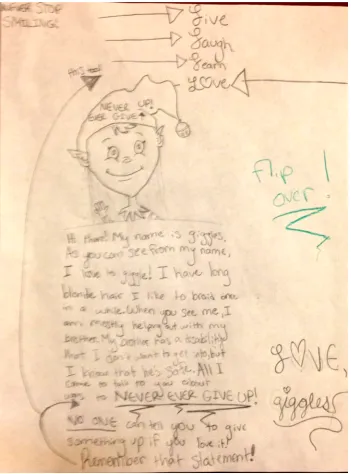
they created artwork. For example, during one session the art therapist asked a girl to talk about
her younger brother who had cancer. Rather than answering the therapist’s questions the girl
When you see me, I am mostly helping out with my brother. My brother has a disability
that I don’t want to get into, but I know that he is safe. All I come to talk to you about
was to NEVER EVER GIVE UP! NO ONE can tell you to give up something if you love
it! Remember that statement! (see Figure 3)
This message conveyed to the art therapist that this girl had a story to share, even if she
wanted to remain private and refrain from verbally expressing it to the art therapist. During a
different therapy session, the art therapist asked a nine-year-old girl about her brother’s health
condition. She responded, “My brother is in the hospital and that is that.” She did not answer any
other questions even though her parents told the therapist that she was aware of her brother’s
cancer prognosis. Instead she silently painted a picture of a rainbow for her brother and wrote, “I
love you. Please get better! I am sad you are sick.” In cases such as these two instances, the
children limited their role in conversations or remained silent. The construction of their artwork
provided an outlet for writing out thoughts and feelings they could not or would not explicitly
discuss. While a child’s developmental status may have hindered conversations (e.g., they are
not old enough to articulate feelings at that level), several parents with multiple children felt that
their other children became the unintentional “forgotten ones” who struggled with the dialectical
tension maintaining privacy – expressing oneself. During an interview about how this tension
was experienced by her “forgotten child,” one mother shared:
[My son] was ignored for a lot of his life in the beginning. And you just don’t even know
you’re doing it because the other [child with cerebral palsy] takes up so much of your
time and attention. It was always like, “Go get this. Do this. Hurry up. Move. Help.
Help.”And then it turned out that he didn’t really want to rock the boat. I think I noticed
it around third, fourth grade when he was completely withdrawn… He felt like he
couldn’t even state an opinion even though he had so much to say.
A final example of this tension was made salient in observing a seven-year-old boy’s
illness despite visiting her every other day and being relocated to the Midwest because of her
in-patient treatment program. Whenever the art therapists directly asked him questions about his
sister, he typically responded with single word answers (e.g., “fine”). However, when
constructing different pieces of artwork, he frequently desired to create dragons, worry dolls, or
space ships. In analyzing his artwork, the art therapists and his mother attributed these creations
as his way of processing his sister’s condition and managing his own concerns about keeping
himself safe. During an interview the mother stated:
His sister is the person that he loves the most, but she is also the person that scares him
the most. He won’t tell you this, but he shows it through his artwork… [The art
therapists] were able to pick up his real need to feel safe just through the art that he made.
All of it had to do with safety, the need for safety guarding, guarding the art room and
keeping it a safe place… And [the art therapists] just let him express himself how he’s
needed to and encouraged his artistic expression.
Like this mother said, dialectical tensions existed because of the burdens placed upon families
from their child’s treatments and hospitalizations for pediatric chronic illness.
Discussion
A child’s hospitalization can be a source of distress to the child and the family as they
negotiate and survive in spatial domains that, by design, are organized around technology and
sterility (Harter et al., 2013). Participating in art-making can transform patients’ and their family
members’ understandings of place and sense of self by helping them express and manage their
dialectical tensions. We used relational dialectics theory (Baxter & Montgomery, 1996) as a
framework to study individuals’ conversations while participating in clinical art therapy sessions.
some individuals prefer to express themselves through nonverbal modalities while others open
up and engage actively in verbal conversation. The focus of this study was on how the
art-making process facilitates conversations about dialectical tensions that are experienced across
the pediatric illness experience. This insight is relevant to clinical art therapists because verbal
communication is one of the therapeutic outcomes produced from art making (Sholt & Gavron,
2006), and verbal communication also exposes personal narratives about the illness experience
(Huss, 2013). Clinical art therapists should consider developing directed and non-directed art
projects that encourage patients and family members to express and manage their dialectical
experiences through the creation of artwork.
Art therapy in medical settings is complementary therapy that relieves pain and suffering
as well as facilitates the emotional health for patients and family caregivers (Beebe et al., 2010;
Chapman et al., 2001; Nainis et al., 2006; Stafstrom, Havlena, & Krezinski, 2012). We observed
many child patients and their families utilizing the art therapy program to process the illness
experience. In fact, one mother stated during an interview:
How could you not be positive coming into this environment? It’s the bright spot amidst
all the darkness. You can get all of the negative energy out and talk about how you’re
feeling.
As this mother verbalized, art making fostered a safe and creative space where families could
discuss the dialectical tensions to the therapists or other individuals present (e.g., other family
members, other parents with sick children) (Stafstrom et al., 2012). For example, during the art
making process mothers discussed the challenges of raising their other healthy children who
were not hospitalized while simultaneously caring for their ill child and attending to his or her
treatment centers and returning home; and siblings of sick children remained silent about their
feelings related to their brother or sister’s future health, while they also expressed their concerns
by creating “get well” cards and personal reminders of comfort (e.g., letters of
self-encouragement, worry dolls) for their brother or sister in the hospital. As these examples
illustrate, art making can open up dialogue that otherwise might remain dormant, and this
environment often fosters a matrix of supportive relationships. Other scholars have referred to
this process as “leading with art,” which is a process where the art materials and the invitation to
be creative creates and sustains an environment that enables conversation but does not demand it
(Harter et al., 2013).
Our findings suggest that the production of art and the concomitant conversations may
provide one avenue for children and their families to talk about their dialectical tensions. For
example, even though the therapy sessions were voluntary, the same individuals would
frequently attend the sessions and share their positive experiences about having this program
amidst the hardships of hospitalizations and pediatric chronic illness. In addition, many of the
publicly displayed art projects contained messages of gratitude to the art therapists for providing
a positive, supportive, and welcoming environment. Other art expressions that were publicly
displayed included letters of advice or words of encouragement to other families going through
similar experiences. The artful expressions created within clinical art therapy settings helped
foster interpersonal relationships and engagement with others at a time when individuals may be
separated physically and/or emotionally from their typical surroundings and primary social
networks. Like Harter et al. (2013) we believe that artful encounters are generative processes that
foster new and enriching potentials through human communication. Art is a way to engage with
acknowledge that not all art needs to be interactive; however, therapeutic interventions that foster
the potential for shared experiences to be verbally expressed may be beneficial for some patients
and their families who feel isolated or muted, and desire a safe space to work through and state
their dialectical tensions.
Limitations and Future Research
As with any research, our study contains some limitations that need to be considered.
First, while we worked with two art therapists to discuss their formal assessments about the art
created during the sessions, it is important to note that we are communication scholars and so our
focus remained on dialogue and conversation about how dialectical tensions were discussed
while engaged in art making. Second, all of the observations and interviews occurred at one
non-profit organization that also provided families with housing and other services (e.g., meals)
during a child’s hospitalization. Families without access to these resources may experience
additional stressors and potentially different dialectical tensions; therefore, scholars should also
study these contexts. We also see potential for the latest iteration of RDT for future research.
While we used the original RDT framework (Baxter & Montgomery, 1996) to examine
dialectical tensions verbally expressed by family members, we could also examine how their talk
reflects dominant discourses (Baxter, 2011). In our study, mothers struggled with being “good
mothers and wives” (i.e., in the home taking care of the family), and children talked about
wanting to feel “normal” (i.e., not have an illness or a sibling with an illness).
Future scholars would make positive contributions to RDT and clinical art therapy
research by attending to the specific ways dialectical tensions are discussed and managed
through the art therapist-patient relationship. In doing so, we acknowledge that art-making often
modalities as avenues for self-expression. Future researchers studying dialectical tensions should
focus on nonverbal behaviors and the created artwork to advance further explanations about why
individuals receive health benefits from art making, which include lowering anxiety as well as
improving quality of life, self-concept, mental health and overall well-being (e.g., Nainis et al.,
2006; Parisian, 2015; Stafstrom et al., 2012). Future scholars might need to incorporate
additional frameworks to examine these health benefits achieved through the art making process.
One way to do this would be to assess how maintaining privacy and expressing oneself could
potentially change over the course of several therapy sessions. The expressive writing paradigm,
which has been found to decrease inhibitions and lead to positive health benefits (e.g., less stress)
(Smyth & Pennebaker, 2001), would be one suitable framework for this examination. Given the
written gratitude expressed by the children and families who wrote letters of advice and words of
encouragement to others using the art room, it is likely that the art making process may be
another avenue for decreasing negative inhibitions. In fact, Pizarro (2004) suggests that a
combined approach of writing and art therapy may produce positive health outcomes, although
his hypotheses have not yet been tested.
The narrative capacity of art is especially significant for patients and families whose lives
have been altered by severe chronic disease and disability. Our study provides an initial set of
dialectical tensions that families with children hospitalized for chronic illness may experience
and discuss during clinical art therapy sessions. Clinical art therapists should consider using RDT
as an entrance point and interpretive tool for assisting families in creatively expressing and
negotiating the dialectical tensions they experience during these challenging life periods. In
making process become objects of dialogue and verbal self-expression about dialectical tensions
References
Appleton, V. (2001). Avenues of hope: Art therapy and the resolution of trauma. Art Therapy:
Journal of the American Art Therapy Association, 18, 6-13. doi:
10.1080/07421656.2001.10129454
Baxter, L. A. (2011). Voicing relationships: A dialogic perspective. Thousand Oaks, CA: Sage.
Baxter, L. A., & Montgomery, B. M. (1996). Relating: Dialogues & dialectics. New York, NY:
Guilford.
Baxter, L. A., Braithwaite, D. O., Golish, T. D., & Olson, L. N. (2002). Contradictions of
interaction for wives of elderly husbands with adult dementia. Journal of Applied
Communication Research, 30, 1-26. doi: http://dx.doi.org/10.1080/00909880216576
Beebe, A., Gelfand, E.W., & Bender, B. (2010). A randomized trial to test the effectiveness of
art therapy for children with asthma. Journal of Allergy Clinical Immunology, 126,
263-266. doi: http://dx.doi.org/10.1016/j.jaci.2010.03.019
Blumer, H. (1954). What is wrong with social theory? American Sociological Review, 19, 3–10.
Chapman, L., Morabito, D., Ladakakos, C., Schreier, H., & Knudson, M. M. (2001). The
effectiveness of art therapy interventions in reducing post traumatic stress disorder
(PTSD) symptoms in pediatric trauma patients. Art Therapy: Journal of the American Art
Therapy Association, 18, 100-104. doi: 10.1080/07421656.2001.10129750
Children and Adolescent Health Measurement Initiative. (n.d.) 2005/2006 National survey of
children with special health care needs. Retrieved from www.cshcndata.org.
Darcy, L., Björk, M., Enskär, K., & Knutsson, S. (2014). The process of striving for an ordinary,
diagnosis. European Journal of Oncology Nursing, 18, 605-612. doi:
10.1016/j.ejon.2014.06.006
Davis, C. S., Mayo, J., Piecora, B., & Wimberley, T. (2013). The social construction of hope
through strengths-based health communication strategies: A children’s mental health
approach. In M. J. Pitts & T. J. Socha (Eds.), Positive communication in health and
wellness (pp. 63-81). New York, NY: Peter Lang.
du Pré, A., & Crandall, S. J. (2011). Qualitative methods: Bridging the gap between research and
daily practice. In T. L. Thompson, R. Parrott, & J. F. Nussbaum, (Eds.), Routledge
handbook of health communication (2nd ed.) (pp. 532-545). New York, NY: Routledge.
Fisher, C. L. (2011). “Her pain was my pain”: Mothers and daughters sharing the breast cancer
journey. In M. Miller-Day (Ed.), Family communication, connections, and health
transitions (pp. 56-76). New York, NY: Peter Lang.
Fritsch, S. L., Overton, M. W., & Robbins, D. R. (2011). The interface of child mental health and
juvenile diabetes mellitus. The Pediatrics Clinic of North America, 58, 937-954. doi:
10.1016/j.pcl.2011.06.008
Glaser, B., & Strauss, A. (1967). The discovery of grounded theory: Strategies for qualitative
research. Chicago, IL: Aldine.
Golden, M. (2010). Dialectical contradictions experienced when a loved one is dying in a
hospital setting. Omega: Journal of Death & Dying, 62, 31-49. doi: 10.2190/OM.62.1.b
Golish, T. D., & Powell, K. A. (2003). ‘Ambiguous loss’: Managing the dialectics of grief
associated with premature birth. Journal of Social and Personal Relationships, 20,
Harter, L. M., Quinlan, M. M., & Ruhl, S. (2013). The storytelling capacities of arts
programming in healthcare contexts. In L. M. Harter & Associates (Ed.), Imagining new
normals (pp. 29-50). Dubuque, IA: Kendall Hunt.
Huss, E. (2013). What we see and what we say: Using images in research, therapy,
empowerment, and social change. New York, NY: Routledge.
Jones, B. L. (2012). The challenge for quality care for family caregivers in pediatric cancer care.
Seminars in Oncology Nursing, 28, 213-220. doi: 10.1016/j.soncn.2012.09.003
Kvigne, K., & Kirkevold, M. (2003). Living with bodily strangeness: Women’s experiences of
their changing and unpredictable body following a stroke. Qualitative Health Research,
13, 1291-1310. doi: 10.1177/1049732303257224
Lincoln, Y., & Guba, E. (1985). Naturalistic inquiry. Thousand Oaks, CA: Sage.
Malchiodi, C. A. (2003). Handbook of art therapy. New York, NY: Guilford.
Mirivel, J., & Thombre, A. (2010). Surviving online: An analysis of how burn survivors recover
from life crises. Southern Communication Journal, 75, 232-254.
doi:10.1080/10417940903377151
Mohr, E. (2014). Post-traumatic growth in youth survivors of a disaster: An arts-based research
project. Art Therapy: Journal of the American Art Therapy Association, 31, 155-162. doi:
10.1080/07421656.2015.963487
Mussatto, K. (2006). Adaptation of the child and family to life with a chronic condition.
Cardiology in the Young, 16, 110-116. doi: 10.1017/S104795110600103X
Nainis, N., Paice, J. A., Ratner, J., Wirth, J. H., Lai, J., & Shott, S. (2006). Relieving symptoms
in cancer: Innovative use of art therapy. Journal of Pain and Symptom Management, 31,
Owen, W. F. (1984). Interpretative themes in relational communication. Quarterly Journal of
Speech, 70, 274–287.
Parisian, K. (2015). Identity formation: Art therapy and an adolescent’s search for self and
belonging. Art Therapy: Journal of the American Art Therapy Association, 32, 130-135.
doi: 10.1080/07421656.2015.1061257
Pecchioni, L. L., & Keeley, M. P. (2011). Insights about health from family communication
theories. In T. L. Thompson, R. Parrott, & J. Nussbaum (Eds.), Routledge handbook of
health communication (2nd ed.) (pp. 363-376). New York, NY: Routledge.
Pizarro, J. (2004). The efficacy of art and writing therapy: Increasing positive mental health
outcomes and participant retention after exposure to traumatic experience. Art Therapy:
Journal of the American Art Therapy Association, 21, 5-12. doi:
10.1080/07421656.2004.10129327
Roy, R. (2006). Chronic pain and family: A clinical perspective. New York, NY: Springer.
Sholt, M., & Gavron, T. (2006). Therapeutic qualities of clay-work in art therapy and
psychotherapy: A review. Art Therapy: Journal of the American Art Therapy
Association, 23, 66-72. doi: 10.1080/07421656.2006.10129647
Smyth, J. M., & Pennebaker, J. W. (2001). What are the health effects of disclosure? In A.
Baum, T. A. Revenson, & J. E. Singer (Eds.), Handbook of health psychology (pp.
339-348). Mahwah, NJ: Erlbaum.
Stafstrom, C. E., Havlena, J., & Krezinski, A. J. (2012). Art therapy focus groups for children
and adolescents with epilepsy. Epilepsy & Behavior, 24(2), 227-233. doi:
State of the Field Committee. (2009). State of the field report: Arts in healthcare 2009.
Washington, DC: Society for the Arts in Healthcare.
Toller, P. W., & Braithwaite, D. O. (2009). Grieving together and apart: Bereaved parents'
contradictions of marital interaction. Journal of Applied Communication Research, 37,
257-277. doi: 10.1080/00909880903025887
van der Lee, J. H., Mokkink, L. B., Grootenhuis, M. A., Heymans, H. S., & Offringa, M. (2007).
Definitions and measurement of chronic health conditions in childhood: A systematic
review. TheJournal of American Medical Association, 297, 2741–2751. doi: