
RP-HPLC method development and validation for the simultaneous estimation of ramipril and losartan in tablet and pharmaceutical dosage form
12
0
0
Full text
(2) Pallavi.K et. al / Int. J. of Pharmacy and Analytical Research Vol-4(3) 2015 [244-255]. LOSARTAN IS CHEMICALLY DESCRIBED AS [2-butyl-4-chloro-1-({4-[2-(2H-1, 2, 3, 4- tetrazol-5-yl) phenyl] phenyl} methyl)-1H-imidazol-5-yl] methanol Uses: It is used as Antihypertensive Agent, AntiArrhythmia Agent, Angiotensin II Type 1 Receptor Blocker. Mechanisam of action: Losartan is an angiotensinreceptor blocker (ARB Losartan competitively inhibits the binding of angiotensin II to AT1 in many tissues including vascular smooth muscle and the adrenal glands. Losartan is metabolized to its active metabolite, E-3174, which is 10 to 40 times more potent than losartan and acts as a non-competitive AT1 antagonist. Inhibition of angiotensin II binding to AT1 inhibits its AT1-mediated vasoconstrictive and aldosteronesecreting effects and results in decreased vascular resistance and blood pressure. Losartan is 1,000 times more selective for AT1 than AT2. Inhibition of aldosterone secretion may increase sodium and water excretion while decreasing potassium excretion. Losartan is effective for reducing blood pressure and. may be used to treat essential hypertension, left ventricular hypertrophy and diabetic nephropathy. Fix dosage combination containing Ramipril (2.5mg) and Losartan (50 mg) available in market. A new combination formulation of Ramipril and Losartan seems to be beneficial in the treatment and management of essential hypertension in terms of its convenience and patient compliance. Literature survey revealed Developed for the simultaneous determination of losartan potassium and ramipril in table dosage forms by Reversed-Phase HPLC.LOSARTAN alone or in combination with other drugs like Amlodipine besylate, Perindpril erbumine, Ramipril with telmisartan, Metolazone etc. However, HPLC Method, has been developed for the simultaneous determination of both the drugs in tablets. The present research work describes the rapid, accurate, sensitive and reproducible RP-HPLC method for simultaneous estimation of RAMIPRIL and LOSARTAN from the tablet formulation.. RAMIPRIL. LOSARTAN. www.ijpar.com. ~ 245~.
(3) Pallavi.K et. al / Int. J. of Pharmacy and Analytical Research Vol-4(3) 2015 [244-255]. MATERIALS AND METHODS CHEMICALS/ REAGENTS AND SOLVENTS Ramipril -2.5mg and Losartan-50mg were obtained from, Carsyon (Micro Labs Ltd) Mumbai. Double Distilled Water (HPLC grade), Methanol (HPLC grade), Acetonitrile (HPLC grade), Sodium acetate, Potassium phosphate, Ammonium acetate, and Triethylamine were of AR grade. The pharmaceutical preparations of combination of Ramipril and Losartan that is SARTACE tablet (Carsyon (Micro Labs Ltd, Mumbai.) INSTRUMENTATION AND EQUIPMENTS The HPLC analysis was accomplished on Shimadzu,high pressure liquid chromatography outfitted with 515 reciprocating dual column HPLC pump, a manually operating Hamilton injector with 20μL sample loop, Inertsil ODS 3V(250x4.6mm) 5µm, C18 analytical column reversed-phase material of 5μ. size and a photodiode array UV-Visible detector. All the parameters of HPLC were controlled by Spinchrome software. Other instruments used were Nicolet evolution UV-Vis spectrophotometer of model 100, Shimadzu electronic balance, global digital pH meter and Citizen, Digital Ultrasonic Cleaner ultrasonic bath sonicator.. ANALYTICAL DEVELOPMENT. METHOD. OPTIMIZATION OF UV CONDITIONS A Intersil ODS,C-18,250×4.6mm ID,5 µm Particle size Column was used for chromatographic separation. Ther mobile phase composed of Pottasium di hydrogen Phosphate buffer (3.0 pH): Acetonitrile (30:70), at flow rate 1.0mL/min with run time 6mins. Mobile phase and sample solution were filtered through a 0.45μm membrane filter and degassed. The detection of both drugs was carried out at 211nm.. Figure-1. Isobestic point of Ramipril And Losartan.. www.ijpar.com. ~ 246~.
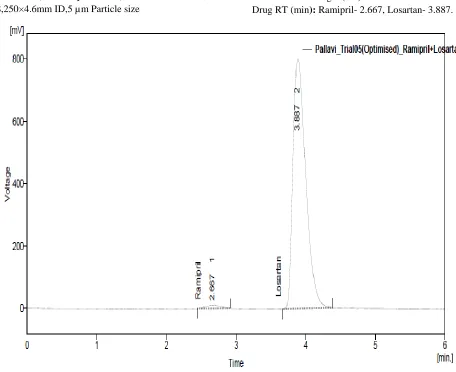
(4) Pallavi.K et. al / Int. J. of Pharmacy and Analytical Research Vol-4(3) 2015 [244-255]. OPTIMIZED METHOD PARAMETERS Mobile Phase :Pottasium di hydrogen Phosphate buffer (3.0 pH): Acetonitrile(30:70) Column (Stationary Phase): Intersil ODS,C18,250×4.6mm ID,5 µm Particle size. Flow rate (ml/min): 1.0 Column temperature (°C): Ambient Volume of injection loop ( l): 20 Detection wavelength (nm):211 Drug RT (min): Ramipril- 2.667, Losartan- 3.887.. Figure 1.1.Optimized chromatogram. PROCEDURE FOR PREPARATION OF SOLUTION PREPARATION OF BUFFER 1.36gm of potassium di hydrogen phosphate (KH2PO4) was weighed and dissolved in 1000ml of water and volume was made up to 1000ml with water. Adjust the pH to 3.0 using ortho phosphoric acid. The buffer was filtered through 0.45µ filters to remove all fine particles and gases. PREPARATION OF MOBILE PHASE A mixture of 30 volumes of 10mM Phosphate Buffer pH 3.0, 70volumes of Acetonitrile was prepared. The mobile phase was sonicated for 10min to remove gases.. Diluent Preparation: Use Mobile phase Diluent Phase. ASSAY PREPARATION OF THE RAMIPRIL AND LOSARTAN STANDARD & SAMPLE SOLUTION PREPARATION OF MIXED STANDARD SOLUTION Weigh accurately 2.5 mg of RAMIPRIL and 50 mg of LOSARTAN and transfer to 100 ml of volumetric flask and dissolve in 10ml of mobile phase and make up the volume with mobile phase. Transfer 1.0 ml from the above stock solutions of RAMIPRIL and LOSARTAN into a 10mL volumetric flask and make up the volume. www.ijpar.com. ~ 247~.
(5) Pallavi.K et. al / Int. J. of Pharmacy and Analytical Research Vol-4(3) 2015 [244-255]. with mobile phase. Above stock solution contains 2.5 µg/ml of RAMIPRIL and 50 µg/ml of LOSARTAN. This solution is used for recording the chromatogram. SAMPLE SOLUTION PREPARATION 20 tablets (each tablet contains 2.5 mg of RAMIPRIL and50 mg of LOSARTAN) were weighed and taken into a mortar and crushed to fine powder and uniformly mixed. Tablet stock solutions of RAMIPRIL and LOSARTAN (μg/ml) were prepared by dissolving weight equivalent to 2.5 mg of RAMIPRIL and 50 mg of LOSARTAN and dissolved in sufficient mobile phase. After that filtered the solution using 0.45-micron syringe filter and Sonicated for 5 min and dilute to 100ml with mobile phase. Further dilutions are prepared in 5 replicates of 5 μg/ml of RAMIPRIL and 100μg/ml of LOSARTAN was made by adding 1 ml of stock solution to 10 ml of mobile phase. PROCEDURE 20 µL of the standard and sample solutions were injected into the chromatographic system and areas for the Ramipril And Losartan peaks were measured. %Assay was calculated by using the formulae. CALCULATION Assay % = AT WS DT P Avg. Wt -------------- x ----------x --------- x ----------x----------------- X 100 AS DS WT 100 Label Claim Where: AT = Average area counts of sample preparation AS = Average area counts of standard preparation. WS = Weight of working standard taken in mg. P = Percentage purity of working standard LC = LABEL CLAIM mg/ml.. ANALYTICAL METHOD VALIDATION The HPLC method was validated in accordance with ICH guidelines. ACCURACY Accuracy was carried out by % recovery studies at three different concentration levels. To the pre-analyzed sample solution of RAM and LOS a known amount of. standard drug powder of RAM and LOS were added at 80, 100 and 120 % level. PRECISION The system precision of the method was verified by five replicate injections of standard solution containing RAM and LOS. The method precision was carried out the analyte five times using the proposed method. Repeatability was measured by multiple injections of a homogenous sample of RAM and LOS. LINEARITY The linearity was determined separately for RAM and LOS Linearity of the method was studied by injecting 5 concentrations of both drugs prepared in methanol and calibration curves were constructed by plotting peak area against the respective concentrations. LIMIT OF DETECTION AND LIMIT OF QUANTITATION Sensitivity of the proposed method was estimated in terms of Limit of Detection (LOD) and Limit of Quantitation (LOQ). LOD = 3.3 x ASD/S and LOQ = 10 x ASD/S, Where, ‘ASD’ is the average standard deviation and ‘S’ is the slope of the line. ROBUSTNESS Robustness was evaluated by making deliberate variations in method parameters such as variation of wave length; flow rate and change in mobile phase composition. The robustness of the method was studied for RAM and LOS. RESULTS SELECTION OF CHROMATOGRAPHIC CONDITIONS AND OPTIMIZATION OF MOBILE PHASE Mobile phase was optimized to separate RAM and LOS using C18 column (Stationary Phase): Intersil ODS,C18,(250×4.6mm ID),5 µm Particle size. Initially, Pottassium di hydrogen phosphate buffer and ACN in the Equal proportions were tried as mobile phase but the splitting of the peaks for both these drugs was observed. Therefore, after adjustment of pH of mixed phosphate buffer to 3.0 with ortho-phosphoric acid, and mobile phase composition (Pottassium di hydrogen phosphate buffer, and ACN and in 30:70 % v/v) was tried for resolution of both drugs. Good resolution and. www.ijpar.com. ~ 248~.
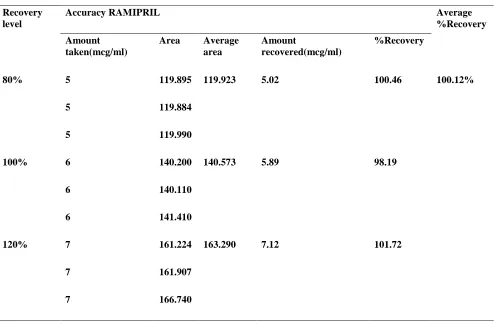
(6) Pallavi.K et. al / Int. J. of Pharmacy and Analytical Research Vol-4(3) 2015 [244-255]. symmetric peaks were obtained for both drugs when the pH of the mobile phase (buffer) was adjusted to 3.0. The flow rate of the mobile phase was 1.0 mL min-1. Under optimum chromatographic conditions, the. retention time for RAM and LOS was found to be 2.667 and 3.887 min, respectively when the detection was carried out at 211nm. A typical chromatogram of two drugs is shown in (Figure 1).. Table-1: ACCURACY DATA Recovery level. 80%. 100%. 120%. Accuracy RAMIPRIL. Average %Recovery. Amount taken(mcg/ml). Area. Average area. Amount recovered(mcg/ml). %Recovery. 5. 119.895. 119.923. 5.02. 100.46. 5. 119.884. 5. 119.990. 6. 140.200. 140.573. 5.89. 98.19. 6. 140.110. 6. 141.410. 7. 161.224. 163.290. 7.12. 101.72. 7. 161.907. 7. 166.740. www.ijpar.com. ~ 249~. 100.12%.
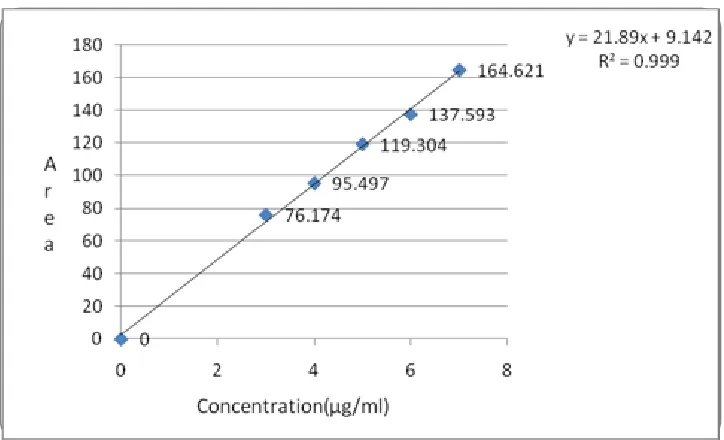
(7) Pallavi.K et. Recovery level. 80%. 100%. 120%. al / Int. J. of Pharmacy and Analytical Research Vol-4(3) 2015 [244-255]. Accuracy LOSARTAN ount Area taken(mcg/ml). Average area. Amount recovered(mcg/ml). %Recovery. Average. 100. 9868.786. 9922.316. 101.62. 101.62. 100. 9917.121. 100. 9981.041. 120. 11790.173 11872.569. 118.19. 98.49. 120. 11971.355. 120. 11856.178. 140. 13716.886 13729.251. 141.65. 101.18. 140. 13735.434. 140. 13735.434. %Recovery. Table-2: PRECISION RAMIPRIL. LOSARTAN. S.No.. Rt. Area. S.No.. Rt. Area. 1. 2.563. 139.547. 1. 3.893. 10085.919. 2. 2.547. 138.050. 2. 3.897. 10241.241. 3. 2.520. 138.093. 3. 3.890. 10135.153. 4. 2.547. 139.825. 4. 3.890. 10250.418. 5. 2.563. 139.547. 5. 3.893. 10085.919. 6. 2.547. 139.050. 6. 3.897. 10241.241. avg. 2.5478. 139.019. avg. 3.893. 10173.315. stdev. 0.0157. 0.775. stdev. 0.003. 79.881. %RSD. 0.62. 0.56. %RSD. 0.08. 0.79. Table-3: LINEARITY RESULTS OF RAMIPRIL AND LOSARTAN Linearity observation of Ramipril S.No Linearity Level 1 I. Concentrationµµ(µg/ml) 3 ppm. Area 76.174. 2. II. 4 ppm. 95.497. 3 4. III IV. 5 ppm 6 ppm. 119.304 137.593. 5. V. 7 ppm. 164.621. www.ijpar.com. ~ 250~. 100.43%.
(8) Pallavi.K et. al / Int. J. of Pharmacy and Analytical Research Vol-4(3) 2015 [244-255]. Correlation Coefficient. 0.999. Linearity observation of Losartan S.No. Linearity Level. Concentration. 1. I. 60 ppm. 2. II. 80 ppm. 3. III. 100 ppm. 4. IV. 120 ppm. 5. V. 140 ppm. Correlation Coefficient. Area 6025.881 7811.081 10045.494 11630.470 13699.397 0.999. y = 21.89x + 9.142 Series1, R² 7, = 0.999 164.621 Series1, 6, Series1,137.593 5, 119.304 Series1, 4, Series1,95.497 3,. A r e a. 76.174. Series1, 0, 0. Concentration(µg/ml) Fig 2: LINEARITY GRAPH OF RAMIPRIL. www.ijpar.com. ~ 251~.
(9) Pallavi.K et. al / Int. J. of Pharmacy and Analytical Research Vol-4(3) 2015 [244-255]. y = 95.83x+ 259.2 R² = 0.999 Series1, 140, 13699 Series1, 120, 11630 Series1, 100, 10045 Series1, 80, 7811 Series1, 60, 6026. A r e a. Series1, 0, 0. Concentration(µg/ml) Fig 3: LINEARITY GRAPH OF LOSARTAN Table-4 LOD AND LOQ RESULTS S.No. Drug name. Standard deviation. Slope. LOD. LOQ. 1. Ramipril. 1.6. 21.89. 0.24. 0.72. 2. Losartan. 31.62. 95.83. 1.09. 3.30. Table-5: ROBUSTNESS RESULTS Parameter. RAMIPRIL. LOSARTAN. Retention time(min). Tailing factor. Retention time(min). Tailing factor. Flow Rate 0.8 ml/min 1.0 ml/min 1.2 ml/min. 3.143 2.563 2.133. 1.230 1.297 1.219. 4.827 3.893 3.267. 1.644 1.681 1.609. Wavelength. 2.523. 1.225. 3.887. 1.626. 209nm. 2.563. 1.297. 3.893. 1.681. 211nm. 2.550. 1.234. 3.887. 1.608. 213nm. RESULTS AND DISCUSSION ACCURACY The accuracy of the method studied at three different concentration levels i.e. 80%, 100 % and 120 % showed. acceptable % recoveries in the range of 100.12%% for RAM and 100.43% for LOS . The results are shown in Table 1.. www.ijpar.com. ~ 252~.
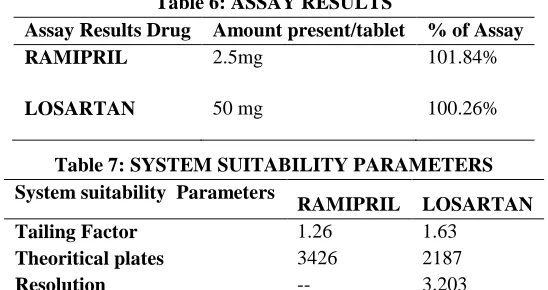
(10) Pallavi.K et. al / Int. J. of Pharmacy and Analytical Research Vol-4(3) 2015 [244-255]. PRECISION The precision study was evaluated on the basis of % RSD value was found to be in the range 0f 0.62% for Ramipril and 0.08 for Losartan %, respectively. As the RSD values were < 2% therefore developed method was precise. Results of precision study are shown in Table 2. LINEARITY The linearity was determined separately for RAM and LOS .Linearity of the method was studied by injecting 5 concentrations of both drugs prepared in methanol and calibration curves were constructed by plotting peak area against the respective concentrations. The RAM and LOS followed linearity in the concentration range of 3– 7μg mL-1 and 60-140μg mL-1; respectively. The results are shown in Table 3.and Fig no 2. LIMIT OF DETECTION AND LIMIT OF QUANTITATION The LOD for RAM and LOS was found to be 0.24 and 1.09 μg, respectively. The LOQ for RAM and LOS was found to be 0.72 and 3.30 μg, respectively. The low values of LOD and LOQ indicates high sensitivity of the method. The results are shown in Table 4.. ROBUSTNESS STUDY Robustness of the method was studied by making deliberate changes in the chromatographic conditions and the effects on the results were examined. The low value changes of theoretical plates, tailing factor indicating robustness of the method. The results are shown in Table 5. ANALYSIS OF MARKETED TABLET FORMULATION 3 replicates of the samples solutions (20 μL) were injected for quantitative analysis. The amounts of RAM and LOS estimated were found to 101.84 % and 100.26 %, respectively. A good separation and resolution of both drugs indicates that there was no interference from the excipients commonly present in pharmaceutical formulations. The results are shown in Table 6. SYSTEM SUITABILITY TEST The system suitability parameters such as resolution, number of theoretical plates and tailing factor were studied and were summarized in Table 7.. Table 6: ASSAY RESULTS Assay Results Drug Amount present/tablet 2.5mg RAMIPRIL LOSARTAN. 50 mg. % of Assay 101.84% 100.26%. Table 7: SYSTEM SUITABILITY PARAMETERS System suitability Parameters RAMIPRIL LOSARTAN 1.26 1.63 Tailing Factor 3426 2187 Theoritical plates -3.203 Resolution. CONCLUSION. ACKNOWLEDGEMENT. The developed RP-HPLC method is simple, precise, accurate, selective and reproducible. The method has been found to be adequately rugged and robust and can be used for simultaneous determination of Ramipril and Loartan in tablet formulation. The method was validated as per ICH guidelines. I like thankful to Chandra labotatories., Hyderabad, India for providing the gift samples of Ramipril and Losartan. And also to the principal Dr.Shiva subramanian Smt. Sarojini Ramulamma College of Pharmacy, Mahabubnagar, Telangana, India and special thanks for Ms.Pranitha as well as my friends who helped during the project work.. www.ijpar.com. ~ 253~.
(11) Pallavi.K et. al / Int. J. of Pharmacy and Analytical Research Vol-4(3) 2015 [244-255]. REFERENCES [1]. Becket and Stenlake, Practical pharmaceutical chemistry, part 24 th edition CBS publications and distributors, 2005. [2]. P.D. Sethi, HPLC quantitative analysis of pharmaceutical formulations CBS publications and distributors, 1 st edition, 2001. [3]. B.K Sharma, instrumental method of chemical analysis, 23 rd edition, goal publishers 2004. [4]. Haller Skoog, Principle of Instrumental Analysis, 5th Edn., 725-728. [5]. E. Heftman, Chromatography, Journal of Chromatography Library 69A, 6th Edn. Elsevier, Amsterdam, (2004) 254260. [6]. L.R. Snyder, J.J.Kirkland, L.J.Glajch, Practical HPLC Method Development, 2nd Edn., John Wiley and Sons, INC., (1997), 2. [7]. G.R. Chatwal, A. K. Sham, Instrumental methods of Chemical Analysis. (2002) 5th Edn.: 256. [8]. A.H. Beckett, J. B. Stenlake, Practical Pharmaceutical Chemistry Part II, 4th Edn., CBS Publishers and Distributors, New Delhi, (2004) 86-100. [9]. P.D. Sethi, HPLC: Quantitative Analysis of Pharmaceutical Formulation, CBS Publications, New Delhi, (1996) 128. [10]. S.Ahuja, S.Scypinski, Handbook of modern pharmaceutical analysis. (2001); Vol. III: 349. [11]. B.K. Sharma, Instrumental method of chemical analysis. (2002); 21st Edn.: 3. [12]. H. Ledwig, G. A. Stephan, Diode Array Detection in HPLC, Marcel Dekker, Inc, (1993) 17 [13]. A Practical Handbook of Preparative HPLC”, Donald A. Wellings, ElsevierLtd. (2006) [14]. Wayne R.P. (1994) Chemical Instrumentation, Oxford Chemistry Primer [15]. In. Billet and Ripper, R. Brown, E. Phyllis, Advances in chromatography: Selectivity optimization in HPLC. 39 (1998) 264 - 265. [16]. Practical HPLC method development Lloyd R.Snyder, Joseph J.Kirkland, Joseph L. Glajch, second edition [17]. L. R. Snyder, Practical HPLC Method Development. (1988); 3rd Edn.: 227 [18]. J. M. Green, A Practical Guide to Analytical Method Validation. Anal Chem. 68 (1996); 305A-309A. [19]. ICH, Q2 (R1). Validation of Analytical Procedures: Text and Methodology: (2005). [20]. US FDA. Technical Review Guide: Validation of Chromatographic Methods. (1993). [21]. ICH Harmonized Tripartite Guideline, Validation of Analytical Procedure Methodology, Q2B, (1996) 1-8. [22]. The United State Pharmacopoeia (USP NF), The Official Compendia of Standards, Asian Edn., (2004) 2622-2224 [23]. P. A. Winslow and R. F. Meyer, Defining a master plan for the validation of analytical methods, J. Validation Technology, pp. 361–367 (1997). [24]. Guideline for Submitting Samples and Analytical Data for Methods Validation, February 1987. [25]. Text on Validation of Analytical Procedures, International Conference on Harmonization, September 1993. [26]. Indian Pharmacopoeia 2010, Governament of India,Ministry Of Health and Welfare. Published by Indian Pharmacopoeia commission, 2010,Ramipril 2038-2041. [27]. British Pharmacopoeia 2011, London-HMSO Publication. Vol II,Ramipril 1865-1869 [28]. Ramipril drug structure, www.wikipedia.com. [29]. Ramipril drug profile , http://www.drugbank.ca/drugs.com. [30]. British Pharmacopoeia 2011,London-HMS Publication. Vol II ,Losartan p.1324-1326. [31]. Indian Pharmacopoeia 2010,Losartan.Vol-III,Pgno,1607-1609 [32]. Drug Bank, Open Data Drug & Drug Target Database: Losartan. [33]. Losartan drug structure , http//www.wikipedia.com. [34]. Losartan drug profile ,http://www.drugbank.ca/drugs.com [35]. M. M. Baing, Developed Simultaneous RP-LC Determination of Losartan Potassium, Ramipril, and Hydrochlorothiazide in Pharmaceutical Preparations. Chromatographia (Impact Factor: 1.44). 08/2006; 64(5):293296. DOI: 10.1365/s10337-006-0008-6. [36]. Chintan patel V, et al, Validated absorption factor spectrophotometric and RP-HPLC methods for the determination of ramipril and olmesartan medoxomil in pharmaceutical formulations. Eurasian J Anal Chem 2007; 2(3):159-171.. www.ijpar.com. ~ 254~.
(12) Pallavi.K et. al / Int. J. of Pharmacy and Analytical Research Vol-4(3) 2015 [244-255]. [37]. Sivakumar T, Development of a HPLC method for the simultaneous determination of losartan and atenolol in tablets. Indian J Pharm Sci 2007;69(1):154-157. [38]. Lincy Joseph, et al, Simultaneous estimation of atrovastatin and ramipril by RP-HPLC and spectroscopy. Pak J Pharm Sci 2008; 21(3):282-284. [39]. Priyanka RP-HPLC Method for simultaneous Estimation of Losartan potassium and Amlodipine besylate in Tablet formulation.International journal of chemtech research,july-sept2009,pp-464-469 [40]. Syed Shaked Ahmed, et al, Visible spectrophotometric methods for the estimation of losartan potassium and omeprazole in single component pharmaceutical formulations. Inter J Pharm Tech Res 2009; 1(4):1247-1250. [41]. Bankey S, et al, Simultaneous determination of ramipril, hydrocholorothiazide and telmisartan by spectrophotometry. Int J Chem Tech Res 2009;1(2):183-188. [42]. Kurade VP Developed RP-HPLC estimation of Ramipril and Telmisartan in tablet dosage form.Indian J Pharm Sci2009; 71(2):148-151. [43]. K Srinivasa Rao, RP-HPLC method for the determination of losartan potassium and ramipril in combined dosage form. Indian J Pharm Sci 2010;72:108-11. [44]. Ankit Developed Determination of Losartan Potassium and Perindopril Erbumine in Tablet Formulations by Reversed-Phase HPLC.International journal of chemtech research.April-June 2010,1141-1146 [45]. Malavika Developed simultaneous estimatio of Amlodipine,Hydrochlo rothiazide and Losartan by RPHPLC.Global journal of analytical chemistry,july 2010 [46]. K.S.Lakshmi Developed Stability Indicating Hptlc Method For Simultaneous Determination Of Telmisartan And Ramipril In Tablets.International journal of pharmacy and pharmaceutical sciences,vol2 127-129,2010 [47]. Devika Developed Rp- Hplc Method For Simultaneous Estimation Of Metolazone And Ramipril In Oral Solid dosage form.International journal of pharm Bio Sciences,oct 2012,P193-200 [48]. Praveen s rajput et al: proposed simultaneous estimation of Ramipril and Amlodipine in bulk and tablet dosage form by RP-HPLC method.Journal of applied pharmaceutical science.2012,160-165 [49]. Megha P Jadhav Developed Development And Validation Of Rp-Hplc Method For Estimation Of Amlodipine Besylate And Losartan Potassium In Multidrug Marketed Formulation.International Journal of Pharmacy and Technology.April 2013 vol-5,5188-5198 [50]. Neela M Bhatia Developed simultaneous Estimation Of Losartan Potassium And Hydrochlorothiazide From Tablets By First Order Derivative Spectroscopy.International of pharmacy and pharmaceutical sciences,2013,Vol5,p.464-466 [51]. S. Ashutosh Kumar et al;(2013)10 Developed Simultaneous Estimation Of Losartan Potassium, Ramipril And Hydrochlorothiazide In Bulk As Well As In Pharmaceutical Formulation By Rp-Hplc.Indo American Jounal of Pharmaceutical Research,2013.Vol-s3,2231-6876 [52]. British Pharmacopoeia 2010, London-HMSO Publication. Vol II p.1419,1042. [53]. Indian Pharmacopoeia 2010, Governament of India,Ministry Of Health and Welfare. Published by Indian Pharmacopoeia commission, 2010, 1681-1682, 2186-2187. [54]. Rang H.P, Dale M.M, Ritter J.N, Moore P.K,pharmacology, 5th edn , Newyork,Churchill ,Livingstone,200. www.ijpar.com. ~ 255~.
(13)
Figure

+2
Related documents
Moreover, the fitting of the radiological guide model, obtained by processing DICOM images on the gypsum cast has been verified (Figure 9A) ( mean value -0.004 mm, SD 0.082 mm)..
In our study, we showed that at 2 weeks after ACLT surgery, rats in the model group had significantly higher serum levels of COMP when compared to rats in the control group
Recent studies have shown conflicting results regard- ing the decision to use reference intervals (RI) of TSH suitable for the elderly or not [7,8]. On studies with re- view of
In fact, all five strains genotyped as SIT149:A were drug resistant according to the line probe assay (Additional file 1 : Table S1), and four of these five strains were
Participants of the present study had to be generally healthy (absence of coronary heart disease, hypertension, diabetes; dyslipide- mia), overweight or obese (defined by a body
The differences of our algorithm are that according to the specific requirements for patients, who already gained osteoporotic fractures of the proximal femur or multiple vertebral
The study ’ s primary objective was to demonstrate the ability of the harmonic scalpel (H) to reduce intra- operative conversion rates compared to the conventional monopolar
The magnesium nitrate and magnesium phosphate which impregnated coir pith showed a gradual increase at the level of the cation, magnesium in all concentrations of
