Engineering and Technology Journal ISSN: 2456-3358
Impact Factor: 4.449
An Efficient Rate Distortion Approach for Video Compression
Manisha Malik
M.Tech Scholar, ECE Department, BPS Khanpur, Sonipat
ARTICLE INFO ABSTRACT
corresponding Author: Manisha Malik
M.Tech Scholar, ECE Dept. BPS Khanpur, Sonipat
Most rate-distortion optimized quantization methods of video coding involve an exhaustive search process to determine the optimal quantized transform coefficients of a coding block and are computationally more expensive than the conventional quantization. In this paper, we present a novel analytical method that directly solves the rate-distortion optimization problem in a closed form by employing a rate model for entropy coding. It has the appealing property of low complexity and is easy to implement. The results show that the proposed method gives global peak signal to noise ratio is 52.665 db.
KEYWORDS: Local Peak signal to noise ratio, global, Rate distortion approach, video decoding.
I. INTRODUCTION
The digital video compression technology has been gaining popularity for many years. Today, when people enjoy HDTV (high definition television), movie broadcasting through Internet or the digital music such as MP3, the convenience that the digital video industry brings to us cannot be forgotten. All of these should attribute to the
advances in compression technology, enhancement on mass storage media or streaming video/audio services.
The core of the MPEG-4 standard was developed early twenty first century, however MPEG-4 is a
existing standard with new parts added
continuously as and when technology exists to address
devolving applications. The significant advances in core video standard were achieved on the capability of coding video objects, while at the
same time, improving coding efficiency at the expense of a modest increase in complexity. The digital video compression technology has been gaining popularity for many years. Today, when people enjoy HDTV (high definition television) [3], movie broadcasting through Internet or the digital music such as MP3, the convenience that the digital video industry brings to us cannot be forgotten. All of these should attribute to the advances in compression technology, enhancement on mass storage media or streaming video/audio services. As the main contributor to all of above, video compression technology is the focus of this paper
II. LITERATURE REVIEW
K. H. Chou 2016 proposed Moving Picture Experts Group-4 part-10 advanced video coding /H.264 standard uses rate distortion optimization (RDO. The experimental results show that the proposed method can reduce the computation by approximately 4.39%–48.51% with −0.003561-dB display distortion and 1.08% bitrate increment.
Yanbo Gao et al2016 describe improving the coding efficiency of High Efficiency Video Coding (HEVC), especially for the hierarchical coding structure defined in the Random-Access. Experimental results show that the proposed method achieves, in average, about 1.4%.BD-rate savings.
Dan Grois et al., 2013described performance comparison of the two latest video coding standards H.264/MPEG-AVC and H.265/MPEG-HEVC. H.265/MPEG-HEVC provides significant average bit-rate savings of 43.3% and 39.3%
relative to VP9 and H.264/MPEG-AVC,
respectively.
Deepak Dembla et al., 2011, proposeddifferent choices during the design of a CODEC and different strategies for coding control can lead to
significant variations in compression and
computational performance between CODEC implementations.
Shiqi Wang et al., 2011, has been found structural similarity (SSIM) index to be a good
indicator of perceived image quality.
Experimental results demonstrate that, compared with conventional rate distortion optimization coding schemes, the proposed scheme can achieve better rate-SSIM performance and provide better visual quality.
TomásBrandão et al., 2011, described a set of no-reference quality assessment algorithms for H.264/AVC encoded video sequences. The performances of the algorithms are evaluated using cross-validation procedures.
H. S.Prasantha et al., 2010, describe H.264/AVC (Advanced Video Coding) is the newest video
coding standard of the moving video coding experts group. The paper also proposes to analyze and compare Video Quality Metrics for different encoded video sequences.
Muhammad Shafique et al., 2010,
describedH.264/AVC video coding standard features diverse computational hot spots that need to be accelerated to cope with the significantly increased complexity compared to previous standards. For a MIPS processor we achieve an average speed up of approximately 60× for Motion Compensated Interpolation.
Xiaoyin Cheng et al., 2009 studied the video CODEC system and H.264 standard, as well as the rate-distortion theory. In consideration of compromising average quality and ringing artifact reduction, the distortion multiplier k between 8 and 16 is preferred. Performance improvement could not been seen when high Ks were applied.
Gary J.Sullivan et al., 2005, describedtechniques for video compression. The paper starts with an explanation of the basic concepts of video codec design and then explains how these various features have been integrated into international standards, up to and including the most recent such standard, known as H.264/AVC.
III. Framework of the Implementation
In the proposed work, there israte distortion approach is applied.
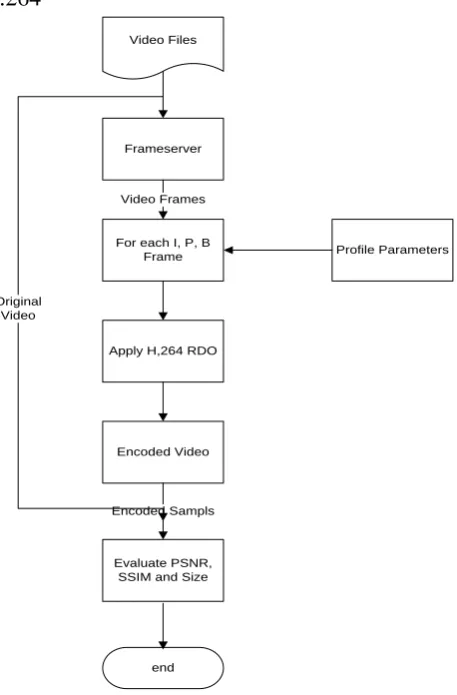
Among them, one crucial problem for mobile video application is how to browse high-resolution (HR) videos on mobile devices with small screens. Like the other video coding standards, H.264/AVC incorporates different profiles and levels. Profiles define sets of bit stream features a H.264 stream can use. Levels define restrictions on the video resolution, frame rate and some stuff called VBV (Video Buffer Verifier). There are up to 16 profiles and 16 levels in the current version. Three most commonly used profiles are baseline profile (BP), main profile (MP), and extended profile (EP), Two of the most commonly used profiles i.e. baseline profile (BP), main profile (MP), will be studied and SSIM (Structural Similarity) and PSNR Matrices will be Analyzed for various input videos samples. Figure below shows the flowchart of the RDO based H.264
Video Files
Frameserver
For each I, P, B Frame Video Frames
Apply H,264 RDO
Encoded Video
Profile Parameters
Evaluate PSNR, SSIM and Size Encoded Sampls Original
Video
end
Fig 1. Proposed Flow chart of RDO enabled H.264 supporting I, P and B frames
A video file normally consists of a container format containing video data in a video coding format alongside audio data in an audio coding format. The container format can also contain synchronization information, subtitles, and metadata such as title etc. A standardized video file type such as baseline is a profile specified by a restriction on which container format and which video and audio compression formats are allowed. The AVIsynth alongside the FFMPEG allows us to use following formats as FFMPEG can import files with the following file name extensions into Windows Movie Maker to use in the script: asf, .avi, .dvr-ms, .m1v, .mp2, .mp2v, .mpe, .mpeg, .mpg, .mpv2, .wm, and .wmv
IV. Result & discussion
The quality the codec can achieve is heavily based on the compression format the codec uses. A codec is not a format, and there may be multiple codecs that implement the same compression There are collection various video samples of different formats with different profiles including codec, Resolution and Bitrate. Some of the samples we collected are described in Table 1. The compression may employ lossy data compression, so that quality-measurement issues become important.
Table 1. Input Video Samples for x264 with profiles.
Video
Sample Format Resolution
Bitrate (Kbps)
grb_1 AVI 640x480 776.15 m84_1 AVI 320x240 365.1 wg_gdo_1 AVI 1280x720 2185.66
wg_gdo_2 AVI 1280x720 2502.45 wg_gdo_3 MP4 560x320 33.91
Table 2. Final File size Video Samples for both Baseline and advanced
Video Sample
Original Size
baseline Profile
RDO
grb_1 3409.92 285 225
m84_1 1587.20 319 278
wg_gdo_1 2027.52 178 152 wg_gdo_2 3041.28 306 239 wg_gdo_3 374.00 28.4 28.7
When comparing compression codecs, PSNR is an
approximation to human perception of
reconstruction quality. Although a higher PSNR generally indicates that the reconstruction is of higher quality, in some cases it may not.
The resultant files size compression of the different technique is given in fig 2
Figure 2. Resultant File Size Comparison H.264 baseline and Advanced profile.
One has to be extremely careful with the range of validity of this metric; it is only conclusively valid when it is used to compare results from the same codec (or codec type) and same content. Table 3 shows the Global PSNR Rate for Video Samples in H.264 baseline and advanced profile.
Table 3. Global PSNR Rate for Video Samples H.264 baseline and advanced profile.
Video Sample
baseline
Profile RDO
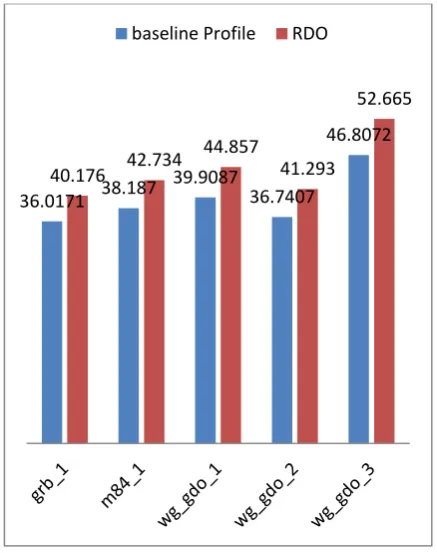
grb_1 36.0171 40.176 m84_1 38.187 42.734 wg_gdo_1 39.9087 44.857 wg_gdo_2 36.7407 41.293 wg_gdo_3 46.8072 52.665
Table 3 gives the Global peak signal to noise ratio for the different video signal. Max PSNR is achieved up to 52.665
Figure.3 Global PSNR Rate for Video Samples Fig 4 represents the graphical representation of the global PSNR.
V. Conclusion
The main focus on the research work to provides gains in compression efficiency of up to 50% over a wide range of bit rates and video resolutions compared to previous standards. Hence H.264 has proven to be successful in compressing already encoded media providing more than 97% of perceived Quality (SSIM). The PSNR profile of
3409.92
1587.2
2027.52
3041.28
374
285 319
178 306
28.4
225 278 152 239
28.7 Original Size baseline Profile RDO
36.0171 38.187
39.9087
36.7407
46.8072
40.176 42.734
44.857
41.293
encoded media is around 40-46db, as PSNR in the range of 40-50 is considered to of high quality (least noisy).Future Work Profiling H.264 over other video codec matrices such as Precise-PSNR, A-PSNR, ST-SSIM, MSSIM, VQM.
References:
1. K.-H. Chou and C.-P. Chung, "Using the Predictive Method of Adaptive 4x4/8x8
Transformations to Reduce the
Computation in Motion Estimation," International Journal of Signal Processing Systems, Vol. 3, No. 2, pp. 112-117, December 2015.
2. Gao, Yanbo, et al. "Layer-based temporal dependent rate-distortion optimization in
Random-Access hierarchical video
coding." IEEE 18th International
Workshop on Multimedia Signal
Processing (MMSP), 2016. IEEE, Dec 2016.
3. P. Yin, H. Y. Cheong, A. M. Tourapis, and J. Boyce, “Fast mode decision and motion estimation for JVT/H.264,”inProc. IEEE ICIP, pp. 853-856 ,Sep. 2003,
4. Y. Cheng, S. Xie, J. Guo, Z. Wang, and M. Xiao, “A fast inter mode selection algorithm for H.264,”inProc.1st Int.
Symp.on Pervasive Computing and
Applications, pp. 821-824 , Aug. 2006. 5. Y. W. Huang, et al., “Analysis and
reduction of reference frames for motion estimation in MPEG-4 AVC/JVT/H.264,” Proc. IEEE Int. Conf. on Multimedia and Expo (ICME '03), pp. 809-812.Jul. 2003. 6. Y. M. Lee, Y. F. Wang, J. R. Wang, and
Y. Lin, “An adaptive and efficient selective multiple reference frames motion
estimation for H.264 video
coding,”Advances in Image and Video Technology, Springer vol. 5414, pp. 509-518, 2009.
7. B. Zhan, B. Hou, and R. Sotudeh,“An efficient fast mode decision algorithm for H.264/AVC intra/inter predictions,” Proc. IEEE Int. Conf. on Acoustics, Speech and Signal Processing (ICASSP ’08), pp. 1057-1060 , Mar 2008
8. K.-H. Chou and C.-P. Chung, "Using the Predictive Method of Adaptive 4x4/8x8
Transformations to Reduce the
Computation in Motion Estimation," International Journal of Signal Processing Systems, Vol. 3, No. 2, pp. 112-117, December 2015.
9. Ismail, M., Hyunho Jo, and DonggyuSim. "Fast intra mode decision for HEVC intra
coding." 18th IEEE International
Symposium on Consumer Electronics (ISCE 2014), 2014.
10.Li, Chenglin, Dapeng Wu, and Hongkai Xiong."Delay Power-rate-distortion model for wireless video communication under delay and energy constraints." IEEE Transactions on Circuits and Systems for Video Technology Vol7 ,pp 1170-1183 , 2014.
11.He, Jing, and Fuzheng Yang. "High-speed
implementation of rate-distortion
optimized quantization for H. 264/AVC." Signal, Image and Video Processing ,Vol 9 , 543-551 , 2015.
12.Pastuszak, Grzegorz."Architecture design of the H. 264/AVC encoder based on
rate-distortion optimization." IEEE
Transactions on Circuits and Systems for Video Technology Vol 11 , 1844-1856 , 2015
13.Ma, Siwei, et al. "Low complexity rate distortion optimization for HEVC." IEEE Data Compression Conference (DCC), pp 525-531 , 2013.
14.Tanaka, Takashi, et al. "Semi definite
programming approach to Gaussian
Transactions on Automatic Control ,pp 431-436 , 2015.
15. Gao, Yanbo, et al. "Layer-based temporal dependent rate-distortion optimization in
Random-Access hierarchical video coding." IEEE 18th International Workshop on Multimedia Signal Processing (MMSP) , 16.Valizadeh, Sima, Panos Nasiopoulos, and
Rabab Ward. "Perceptually-friendly rate distortion optimization in high efficiency
video coding. "Signal Processing
Conference (EUSIPCO), 2015 23rd
European.IEEE, 2015.
17.Ohno, Shuichi, et al. "Rate-Distortion
Analysis of Quantizers with Error
Feedback." arXiv preprint arXiv:
1609.01383 (2016).
18.Schuster, Guido M., and Aggelos
Katsaggelos. Rate-Distortion based video
compression: optimal video frame
compression and object boundary
encoding. Springer Science & Business Media, 2013.
19.A. M. Tourapis, O. C. Au, and M. L. Liou, “Predictive motion vector field adaptive search technique (PMVFAST) - Enhancing block based motion estimation,” in Proc.
Visual Communications and Image
Processing 2001 (VCIP-2001), San Jose, CA, Jan. 2001.
20.K. Cheung and L. M. Po, “A hierarchical block motion estimation algorithm using partial distortion measure,” in Proc.
International Conference on Image