Open Access
Research
Does getting a dog increase recreational walking?
Hayley E Cutt*, Matthew W Knuiman and Billie Giles-Corti
Address: School of Population Health, The University of Western Australia, Crawley, Western Australia
Email: Hayley E Cutt* - [email protected]; Matthew W Knuiman - [email protected]; Billie Giles-Corti - [email protected]
* Corresponding author
Abstract
Background: This study examines changes in socio-demographic, environmental and intrapersonal factors associated with dog acquisition in non-dog owners at baseline to 12-months follow-up and the effect of dog acquisition on minutes per week of recreational walking.
Methods: RESIDE study participants completed self-administered questionnaires (baseline and 12-months follow-up) measuring physical activity, dog ownership, dog walking behavior as well as environmental, intrapersonal and socio-demographic factors. Analysis was restricted to 'Continuing non-owners' (i.e., non-owners at both baseline and follow-up; n = 681) and 'New dog owners' (i.e., non-owners who acquired a dog by follow-up; n = 92).
Results: Overall, 12% of baseline non-owners had acquired a dog at follow-up. Dog acquisition was associated with working and having children at home. Those who changed from single to couple marital status were also more likely to acquire a dog. The increase in minutes of walking for recreation within the neighborhood from baseline to follow-up was 48 minutes/week for new dog owners compared with 12 minutes/week for continuing non-owners (p < 0.05). After adjusting for baseline variables the effect of dog acquisition on the increase in minutes of recreational walking within the neighborhood was 31 minutes (95% CI: 7.39, 54.22; p < 0.01). However, this reduced to 22 minutes (95% CI: -1.53, 45.42; p > 0.05) after further adjustment for change in baseline to follow-up variables. Increase in intention to walk was the main factor contributing to attenuation of the effect of dog acquisition on recreational walking.
Conclusion: This study used a large representative sample of non-owners to examine the relationship between dog acquisition and recreational walking and provides evidence to suggest that dog acquisition leads to an increase in walking. The most likely mechanism through which dog acquisition facilitates increased physical activity is through behavioral intention via the dog's positive effect on owner's cognitive beliefs about walking, and through the provision of motivation and social support for walking. The results suggest that behavioral intention mediates the relationship between dog acquisition and walking and that dogs may have a significant role in the maintenance of owner walking behavior.
Published: 27 March 2008
International Journal of Behavioral Nutrition and Physical Activity 2008, 5:17 doi:10.1186/1479-5868-5-17
Received: 10 September 2007 Accepted: 27 March 2008
This article is available from: http://www.ijbnpa.org/content/5/1/17 © 2008 Cutt et al; licensee BioMed Central Ltd.
Background
Over half of all adults in the United States and Australia do not meet the recommended level of physical activity necessary for health benefit [1,2]. Growing concerns about the level of inactivity has resulted in a recent focus on the effect of the built environment on health [3,4]. However, another new area of physical activity research beginning to leave its paw mark is the association between dog ownership and physical activity. Given the sub-opti-mal participation in physical activity by most adults, and the high level of dog ownership in the community [5] exploring whether responsible dog ownership could be used as a means to promote more walking is worthy of further investigation.
Cross-sectional studies suggest that dog owners are more physically active than non-owners [6,7] and are more likely to achieve the recommended level of activity [8-11], even after adjustment for socio-demographic, intraper-sonal, social environmental and physical environmental confounders [12]. However, some studies have empha-sized that dog ownership does not necessarily equate to dog walking as up to 60% of dog owners do not walk with their dog [8]. We recently showed that owners were less likely to walk with their dog if they did not perceive that their dog provided social support or motivation to walk more [13]. Considering almost 40% of households own a dog, there would be a significant impact on community physical activity levels if all dog owners were physically active.
Evidence of the potential for dog ownership to facilitate higher levels of physical activity has been limited to date because it is mainly cross-sectional. One small study of adults who acquired a pet (dog or cat) from an animal shelter (n = 71) examined whether pet acquisition changed owner's health status, including their physical activity. Compared with cat owners and the control group, dog owners increased and maintained their walking from one hour/week at baseline to five hours/week at 10 months follow-up [14,15]. While these findings are promising, the study had limitations. First, people who acquire a dog from an animal shelter may not be repre-sentative of other dog owners and dogs acquired from ani-mal shelters may not be representative of all dogs. Second, this study had a small sample size and a relatively short follow-up period. Finally, the study did not control for other factors associated with acquiring a dog.
Only two prospective studies have examined the associa-tion between dog ownership and physical activity over time and both of these studies were conducted in an eld-erly population [11,16]. Thorpe and colleagues reported that at three years follow up, dog walkers maintained their initial mobility advantage (i.e. higher walking speed) over
other dog ownership and walking-status groups [11]. These results support the notion that dog walkers main-tain their health advantage over time however causality cannot be implied because change in dog ownership sta-tus was not examined. Importantly, does dog ownership lead to an increase in physical activity or are active indi-viduals more likely to own a dog? Moreover, what factors associated with dog acquisition need to be adjusted for when examining the temporal relationship between dog acquisition and physical activity? Thus, the first aim of this study was to identify baseline socio-demographic, intrapersonal and physical and social environmental fac-tors associated with dog acquisition. The second aim was to examine longitudinal (baseline to follow-up) changes in these factors and their association with dog acquisition. The third aim was to examine the effect of dog acquisition on recreational walking and identify confounders and mediators of the effect of dog acquisition on changes in recreational walking.
Methods
Sample and procedure
The sample included all baseline non-dog owners taking part in the RESIDential Environments (RESIDE) project, a 5-year longitudinal study evaluating the impact of a state-government sub-division code in Perth, Western Australia [17]. Described fully elsewhere [18], RESIDE involves new home owners self-completing a questionnaire before they move into their new home (n = 1813), then 12 (n = 1379) and 36 months later, after moving into their new home. All people building new homes in the study area were invited to participate and those agreeing to take part pro-vided written informed consent (response rate 33.4%). RESIDE participants who completed a baseline question-naire between September 2003-March 2005 completed a second questionnaire approximately 12 months later at first follow-up (October 2005-December 2006). This study was approved by The University of Western Aus-tralia's Human Research Ethics Committee.
Dog acquisition
At both time points participants were asked about the type of pet(s) owned. The responses included dog, cat, bird and other pet. Only baseline non-dog owners who at 12 months follow-up either remained non-owners or had acquired a dog were included in the study (n = 773). Par-ticipants' who did not own a dog at baseline but who had acquired a dog at follow-up were classified as 'New dog owners' while participants who were non-dog owners at baseline and follow-up were classified as 'Continuing non-owners'.
Self-reported physical activity, walking and dog walking
Ques-tionnaire (NPAQ), which differentiates between walking within and outside of the neighborhood and has accepta-ble reliability [17]. NPAQ measures of physical activity included total minutes per usual week of: 1) physical activity; 2) walking; and, 3) walking for recreation in the neighborhood. Minutes of dog walking/usual week were collected using the Dogs and Physical Activity (DAPA) tool [19]. The DAPA tool is reliable and has face and con-struct validity [19].
Covariates
Baseline socio-demographic variables included: gender, age, country of origin, marital status, presence of children <18 years at home, mean age of children <18 years at home, education level attained, work status, number of hours worked/week, occupational status, household income and type of residence. New categorical socio-demographic variables were created to reflect changes in these variables between baseline and follow-up.
A modified version of the Neighborhood Environment Walkability Scale (NEWS) [20] was used to measure per-ceptions of the physical environment. Perper-ceptions of social support from family and friends for walking and other physical activity were measured using modified items of the social support for exercise questions devel-oped by Sallis and others [21]. The Neighborhood Cohe-sion Scale [22] was used to measure community coheCohe-sion. Measures of intention, attitude toward the process of try-ing, perceived behavioral control, self-efficacy and behav-ioral skills were assessed using standard items reported previously [23,24] and the enjoyment of walking variable was adapted from the Physical Activity Enjoyment Scale [25]. Further detail of these scales have been described elsewhere [12,18]. Changes in physical environmental (land use mix, aesthetics, walking facilities, street connec-tivity and safety), social environmental (social support and neighborhood social cohesion) and intrapersonal (intention, enjoyment, attitude, self-efficacy, perceived behavioral control and behavioral skills) scales between baseline and follow-up were calculated.
Most change variables were coded as no change, increase or decrease from baseline to follow-up. Four socio-demo-graphic change variables were coded differently: marital status (no change, couple to single, single to couple); work status (no change, now in workforce, no longer in workforce); children under 18 years at home (no change, children now living at home, children no longer living at home); and type of residence (no change, moved to a sep-arate house). For example, no change in marital status included participants who were the same marital status [either single (separated/divorced, widowed or single/ never married) or couple (married or defacto)] at both time points.
Statistical analysis
Chi square and independent sample t-tests were used to examine the association between dog acquisition and, baseline socio-demographic and change from baseline to follow-up variables. Those variables found to be signifi-cant at p ≤ 0.05 were entered (forced entry) into a linear regression model to investigate the association between dog acquisition and change in minutes of recreational walking in the neighborhood. Three models were con-structed. The first model was unadjusted; the second model adjusted for baseline recreational walking in the neighborhood and significant baseline socio-demo-graphic variables from Table 1 and the third model further adjusted for significant change from baseline to follow-up variables from Tables 2 and 3. Mediation analysis was undertaken on the final model by removing significant variables and observing the change in the effect of dog acquisition on increase in minutes of recreational walk-ing. All models were a complete case analysis (n = 695) with a significance level of p ≤ 0.05.
Results
Characteristics of people who acquire a dog
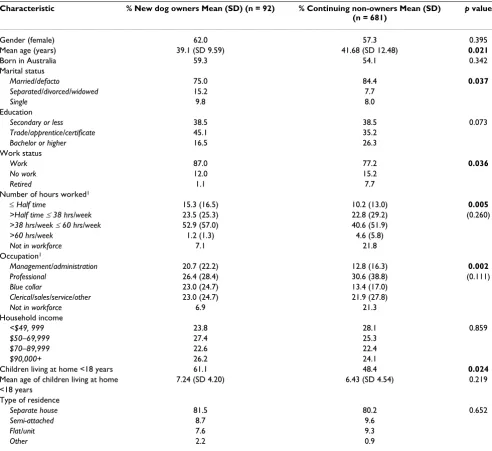
Twelve percent (n = 92) of baseline non-dog owners (n = 773) acquired a dog by follow-up. A number of baseline socio-demographic characteristics were significantly asso-ciated with dog acquisition (Table 1). At baseline, signifi-cantly more non-owners who had acquired a dog by follow-up were separated, divorced or widowed, had chil-dren <18 years living at home, were slightly younger and participated in the workforce than continuing non-own-ers (p < 0.05). No significant differences between new dog owners and continuing non-owners baseline physical or social environments were observed (results not shown).
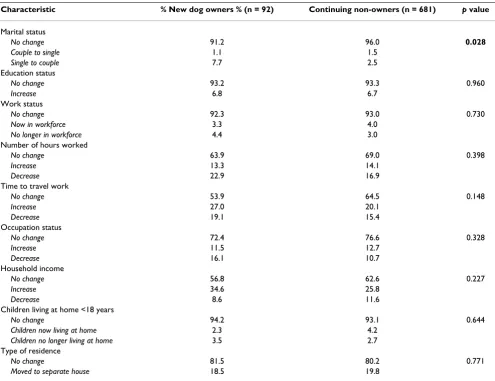
Changes in marital status (Table 2), intention to walk, self-efficacy and behavioral skills (Table 3) significantly differed for new dog owners and continuing non-owners at follow-up. More new dog owners than continuing non-owners moved from a single to couple relationship between baseline and follow-up (p < 0.05). Furthermore, more new dog owners than continuing non-owners reported an increase in their intention, self-efficacy and use of behavioral skills for walking in the next month (p < 0.05). There were no other significant changes in physical and social environments or individual factors by dog acquisition at follow-up.
Physical activity behavior of new dog owners and continuing non-owners at baseline and first follow-up
continuing non-owners at baseline but was not statisti-cally significant.
At follow-up, new dog owners walked with their dog in their neighborhood an average of 130 minutes/week (Table 4). Increase in minutes of walking for recreation within the neighborhood between baseline and follow up totaled 48 minutes/week for new dog owners and 12 min-utes/week for continuing non-owners (p < 0.05). Moreo-ver, new dog owners increased their total walking by 38 minutes/week between baseline and follow-up. In the same period, continuing non-owners decreased their walking by 5 minutes/week (p < 0.05). While new dog
owners reported an increase in their overall physical activ-ity of 32 minutes/week, this was not significantly different to that of continuing non-owners (3 minutes/week).
Does dog acquisition increase recreational walking?
Linear regression models were used to examine the unad-justed and adunad-justed effects of dog acquisition on change in minutes of recreational walking within the neighbor-hood. In the unadjusted model (model 1), the increase in minutes/week of recreational walking within the neigh-borhood was 35.9 minutes (95% CI: 9.65, 62.09; p < 0.01) greater in those who acquired a dog compared with continuing non-owners. After adjusting for baseline walk-Table 1: Baseline socio-demographic characteristics of non-owners at baseline by dog ownership status at one year follow-up
Characteristic % New dog owners Mean (SD) (n = 92) % Continuing non-owners Mean (SD)
(n = 681)
p value
Gender (female) 62.0 57.3 0.395
Mean age (years) 39.1 (SD 9.59) 41.68 (SD 12.48) 0.021
Born in Australia 59.3 54.1 0.342
Marital status
Married/defacto 75.0 84.4 0.037
Separated/divorced/widowed 15.2 7.7
Single 9.8 8.0
Education
Secondary or less 38.5 38.5 0.073
Trade/apprentice/certificate 45.1 35.2
Bachelor or higher 16.5 26.3
Work status
Work 87.0 77.2 0.036
No work 12.0 15.2
Retired 1.1 7.7
Number of hours worked1
≤ Half time 15.3 (16.5) 10.2 (13.0) 0.005
>Half time ≤ 38 hrs/week 23.5 (25.3) 22.8 (29.2) (0.260) >38 hrs/week ≤ 60 hrs/week 52.9 (57.0) 40.6 (51.9)
>60 hrs/week 1.2 (1.3) 4.6 (5.8)
Not in workforce 7.1 21.8
Occupation1
Management/administration 20.7 (22.2) 12.8 (16.3) 0.002
Professional 26.4 (28.4) 30.6 (38.8) (0.111) Blue collar 23.0 (24.7) 13.4 (17.0)
Clerical/sales/service/other 23.0 (24.7) 21.9 (27.8)
Not in workforce 6.9 21.3
Household income
<$49, 999 23.8 28.1 0.859
$50–69,999 27.4 25.3
$70–89,999 22.6 22.4
$90,000+ 26.2 24.1
Children living at home <18 years 61.1 48.4 0.024
Mean age of children living at home 7.24 (SD 4.20) 6.43 (SD 4.54) 0.219 <18 years
Type of residence
Separate house 81.5 80.2 0.652
Semi-attached 8.7 9.6
Flat/unit 7.6 9.3
Other 2.2 0.9
ing for recreation within the neighborhood and signifi-cant baseline socio-demographic variables (model 2), the effect of dog acquisition on the increase in minutes of rec-reational walking within the neighborhood attenuated to 30.8 minutes but remained statistically significant (95% CI: 7.39, 54.22; p < 0.01). Baseline walking for recreation in the neighborhood accounted for almost all of the atten-uation. Nevertheless, when the model was further adjusted for significant change in baseline to follow-up variables (model 3), the effect of dog acquisition on the increase in minutes of recreational walking within the neighborhood was reduced to 21.9 minutes and was no longer statistically significant (95% CI: -1.53, 45.42; p > 0.05). Further modeling revealed that when the variable for change in intention to walk was dropped from model 3, the effect of dog acquisition on the increase in the min-utes of recreational walking within the neighborhood increased to 27.3 minutes and was once again statistically significant (95% CI: 3.71, 50.82; p < 0.05) thus indicating that adjustment for change in intention to walk was the
principal reason for the reduced effect of dog acquisition. The other three change variables (marital status, self-effi-cacy and use of behavioral skills for walking in the next month) collectively were responsible for the remaining difference of 3.5 minutes.
Discussion
The results of this study suggest that dog acquisition leads to a significant increase in recreational walking and the mechanism through which dog ownership increases recre-ational walking is behavioral intention. Non-owners, who acquired a dog by follow-up, increased their recreational walking by 31 minutes/week more than continuing non-owners even after adjustment for baseline factors associ-ated with dog acquisition. This value is considerably less than the 240 minutes/week increase in walking reported by Serpell [14,15] however, Serpell's study did not control for potential confounders and involved a smaller non-representative sample who were followed for a shorter period of time. In contrast, the current study used a large Table 2: Change in socio-demographic characteristics for non-owners at baseline by dog ownership status at one year follow-up
Characteristic % New dog owners % (n = 92) Continuing non-owners (n = 681) p value
Marital status
No change 91.2 96.0 0.028
Couple to single 1.1 1.5
Single to couple 7.7 2.5
Education status
No change 93.2 93.3 0.960
Increase 6.8 6.7
Work status
No change 92.3 93.0 0.730
Now in workforce 3.3 4.0
No longer in workforce 4.4 3.0
Number of hours worked
No change 63.9 69.0 0.398
Increase 13.3 14.1
Decrease 22.9 16.9
Time to travel work
No change 53.9 64.5 0.148
Increase 27.0 20.1
Decrease 19.1 15.4
Occupation status
No change 72.4 76.6 0.328
Increase 11.5 12.7
Decrease 16.1 10.7
Household income
No change 56.8 62.6 0.227
Increase 34.6 25.8
Decrease 8.6 11.6
Children living at home <18 years
No change 94.2 93.1 0.644
Children now living at home 2.3 4.2 Children no longer living at home 3.5 2.7 Type of residence
No change 81.5 80.2 0.771
Table 3: Change in perceived neighborhood characteristics, perceived social support provided in past month, neighborhood cohesion score and intrapersonal factors for non-owners at baseline by dog ownership status at one year follow-up
Physical environmental sub-scales: % New dog owners (n = 92) % Continuing non-owners (n = 681) p value
Land use mix-access
No change 45.7 48.4 0.596
Increase 14.1 10.6
Decrease 40.2 40.9
Aesthetics
No change 53.8 48.3 0.423
Increase 25.3 32.0
Decrease 20.9 19.7
Walking facilities
No change 57.6 54.7 0.810
Increase 22.8 25.9
Decrease 19.6 19.4
Park or nature reserve that's easily accessible
No change 58.7 53.0 0.582
Increase 28.3 31.8
Decrease 13.0 15.2
Street connectivity
No change 56.5 61.9 0.164
Increase 22.8 24.8
Decrease 20.7 13.3
Pedestrian/traffic safety
No change 53.8 47.7 0.200
Increase 24.2 33.5
Decrease 22.0 18.8
Crime safety
No change 50.0 48.7 0.801
Increase 40.2 43.1
Decrease 9.8 8.1
Design of new neighborhood
Conventional 53.3 51.0 0.913
Hybrid 18.5 19.0
Liveable 28.3 30.0
Social environmental sub-scales:
Social support from family for walking
No change 33.3 37.6 0.244
Increase 44.0 34.8
Decrease 22.6 27.6
Social support from friends for walking
No change 57.1 8.8 0.288
Increase 17.9 22.7
Decrease 25.0 18.5
Social support from family for other physical activity
No change 36.6 41.3 0.684
Increase 35.4 33.8
Decrease 28.0 24.8
Social support from friends for other physical activity
No change 51.2 56.4 0.398
Increase 22.0 23.3
Decrease 26.8 20.4
Neighborhood social cohesion
No change 38.5 47.1 0.154
Increase 48.4 44.6
Decrease 13.2 8.3
representative sample of non-owners to examine if dog acquisition leads to an increase in recreational walking and controlled for baseline characteristics.
After adjusting for factors associated with dog acquisition (both baseline and change in baseline to follow-up varia-bles), the increase in minutes of recreational walking reduced from 36 to 22 minutes/week and was no longer
statistically significant. Thus, increase in intention to walk was associated with both dog acquisition and increased recreational walking and explains a large part of the effect of dog acquisition on increased recreational walking. While it appears that change in intention to walk is a sig-nificant mediator of this relationship, the temporal order of dog acquisition and increased intention to walk is unconfirmed. For instance, does interest, capacity or Intention to walk for total 30 mins on ≥ 5 days/week
No change 19.6 31.3 0.001
Increase 58.7 37.7
Decrease 21.7 31.0
Intention to do vigorous leisure time physical activity for total three 20 min sessions/week
No change 28.3 32.6 0.378
Increase 30.4 33.4
Decrease 41.3 34.0
Intention to do other moderate leisure time physical activity for total 30 mins on ≥ 5 days/week
No change 20.7 28.5 0.178
Increase 37.0 37.5
Decrease 42.4 34.0
Enjoyment of walking in neighborhood
No change 60.4 57.6 0.860
Increase 16.5 18.5
Decrease 23.1 23.9
Attitude toward process of trying to walk on most days
No change 40.2 44.6 0.699
Increase 39.1 35.2
Decrease 20.7 20.2
Self-efficacy
No change 40.7 50.2 0.016
Increase 34.1 20.7
Decrease 25.3 29.0
Perceived behavioral control
No change 28.3 36.1 0.089
Increase 47.8 36.1
Decrease 23.9 27.8
Behavioral skills
No change 51.1 46.4 0.049
Increase 30.4 23.3
Decrease 18.5 30.3
Table 3: Change in perceived neighborhood characteristics, perceived social support provided in past month, neighborhood cohesion score and intrapersonal factors for non-owners at baseline by dog ownership status at one year follow-up (Continued)
Table 4: Baseline mean minutes of physical activity and change in mean minutes of physical activity for non-owners at baseline by dog ownership status at one year follow-up
New dog owners: Mean minutes (SEM)
Continuing non-owners: Mean minutes (SEM)
p value
Baseline physical activity 278.37 (35.25) 251.37 (11.94) 0.447
Baseline walking 89.56 (12.16) 117.83 (5.95) 0.039
Baseline walking for recreation in neighborhood
44.87 (8.01) 58.16 (3.72) 0.216
Change in physical activity 32.44 (28.04) 2.75 (11.03) 0.357
Change in walking 38.00 (15.30) -4.75 (6.35) 0.021
Change in walking for recreation in neighborhood
48.00 (10.17) 12.13 (4.63) 0.007
-intention to walk in the next month increase and as a result a dog is acquired to assist in shifting intention to action, or is a dog acquired and through a sense of obliga-tion to care for the dog, intenobliga-tion to walk increases [11]?
Acquiring a dog is coupled with a responsibility to care for the health and well-being of that dog [26]. Basic care for a dog includes the provision of food, water, shelter and exercise [27]. It is likely that through a person's sense of responsibility to care for their dog, cognitive beliefs about providing a safe and healthy environment for a dog may positively influence an individual's intention to walk. Dog owners may feel they have a sense of responsibility to exercise their dog and this increases their own intention to walk. A Canadian study reported that obligation or responsibility to walk a dog mediated the relationship between dog ownership and physical activity and explained 1% of the variance in intention to walk [6]. Moreover, it is also possible that people's intention to walk in the next month increases and they acquire a dog to help turn their intentions into action. However, it seems unlikely that people would acquire a dog purely for the sake of motivating them to exercise [28-31] especially considering that in most instances (85%) the main func-tion of a pet dog is companionship [29,32,33]. Further-more, even if an individual has an intention to walk and acquires a dog to help realize those intentions, sense of responsibility to care for the well-being of their dog is likely to increase recreational walking more than if an individual has an intention to walk but does not acquire a dog.
In this study, the increase in overall walking was greater than the increase in recreational walking in the neighbor-hood (43 vs. 36 minutes). Although the increase in min-utes of recreational walking associated with dog acquisition represented a significant increase, walking for recreation makes up only one component of all walking. Thus, it is possible that new dog owners also increased their time spent walking for recreation outside their neighborhood (for example, walking at a dog beach) as well as transport-related walking (for example, walking to local shop with dog). Moreover, at baseline new dog own-ers did significantly less weekly minutes of overall walking than continuing non-owners. This suggests that new dog owners had greater potential than continuing non-owners to increase their weekly minutes of overall walking and may in part explain why the increase in minutes of overall walking was more than the increase in minutes of recrea-tional walking in the neighborhood.
Furthermore, the increase in minutes of recreational walk-ing and overall walkwalk-ing associated with dog acquisition was not reflected in the increase in total physical activity (36 vs. 30 and 43 vs. 30 minutes respectively), suggesting
that recreational walking was substituted in place of other types of physical activity. It could be that confounding fac-tors influence the relationship between dog acquisition and change in minutes of total physical activity as was shown for recreational walking. However, it is more likely that new dog owners increased their minutes of recrea-tional walking at the expense of other types of physical activity. In this study, baseline levels of total physical activity were well above the recommended level of 150 minutes/week and there was no significant difference in baseline minutes of total physical activity for new dog owners and continuing non-owners. These results suggest that there was little potential for minutes of total physical activity to increase post dog acquisition and it is likely that new dog owners substituted other types of physical activ-ity for more dog walking.
The Marchetti principle [34] applied in the transport liter-ature suggests that people have an average 'travel time budget' allocated for travelling to work. Studies have shown that people are generally unwilling to commit more than 30 minutes to a frequently made travel trip [35,36]. A similar principle may be applied to daily phys-ical activity. Individuals may have a 'physphys-ical activity time budget' not dissimilar to the current physical activity guidelines [37,38]. Thus, those new dog owners who per-ceive that taking their dog for a walk contributes to their daily exercise time may substitute dog walking in place of other types of physical activity. Nevertheless, the overall unadjusted effect of getting a dog on physical activity is positive and future research should explore the substitu-tion effect, if any, of dog walking on other types of physi-cal and sedentary activity.
provides owners with a daily extrinsic and intrinsic cue to be active.
In addition, dog ownership may help with the mainte-nance of physical activity behavior during periods of tran-sition. For example, in this study, dog acquisition was associated with people moving from a single to couple relationship. Previous research has shown that changing from a single lifestyle to cohabitation is associated with changes in health-related behaviors such as decreased physical activity, poorer dietary habits and weight gain [50-52]. People who own a dog during important life transitions may be better equipped to maintain their walking behavior because the dog's enthusiastic wagging tail provides its owner with a positive cue to be active. Moreover, dog ownership may encourage new family members to take up physical activity through dog walk-ing.
Study limitations
This study's large sample size with sufficient power to examine the association between dog acquisition and increased recreational walking is a strength. However, generalizability of the findings may be compromised because RESIDE study participants are moving into new housing developments and may not be representative of all new dog owners and continuing non-owners. Moreo-ver, this study relied on self-reported physical activity and it is possible that new dog owners may have over-esti-mated the minutes spent walking with their dog. Future studies would be strengthened by objectively measuring dog walking behavior. Finally, this study was not able to ascertain the causal pathway between dog acquisition and increase in intention to walk. Reasons for acquiring a dog, type of dog acquired and age of dog at follow-up are rele-vant factors to consider when investigating whether dog acquisition increases walking and should be considered in future prospective studies. Furthermore, it may be useful to examine the effect of long term intention (e.g. inten-tion to walk in the next 6 months or 12 months) on the relationship between dog acquisition and walking.
Conclusion
Our study provides longitudinal evidence to suggest that dog acquisition leads to an increase in walking. Dog acquisition increased recreational walking by 31 minutes/ week and this relationship persisted after adjusting for baseline recreational walking and baseline factors associ-ated with dog acquisition. Moreover, increased intention to walk mediated the relationship between dog acquisi-tion and increased recreaacquisi-tional walking. It is likely that the mechanisms through which dog acquisition facilitates increased physical activity is through behavioral intention via the dog's positive effect on owner's cognitive beliefs about walking and from motivation and social support
for walking. Furthermore, while it appears dog owners may substitute dog walking for other types of physical activity; it is likely that the long-term commitment of dog ownership plays a significant role in assisting owners to maintain their walking behavior. Considering that 40% of households in the United States and Australia own a dog, examination of the effect of dog ownership on physical activity adoption and adherence warrants further investi-gation.
Competing interests
The first author (Hayley Cutt) is supported by an Austral-ian Research Council, AustralAustral-ian Postgraduate Award – Industry which has Petcare Information and Advisory Service as the Industry Partner. The Petcare Information and Advisory Service placed no restrictions on the design, analysis, interpretation or publication of study findings. All other authors declare that they have no competing interests.
Authors' contributions
HC conceived and designed the study and, analyzed and interpreted all data. HC drafted the manuscript revising it critically at each stage. MK advised on the design and anal-ysis of the study, the interpretation of results and provided input at each stage of the manuscript draft. BG-C advised on interpretation and implications of results also provid-ing input at each stage of the manuscript draft. All authors read and approved the final manuscript.
Acknowledgements
This research was funded by an Australian Research Council Linkage grant (Grant No. LPO455453) and the Petcare Information and Advisory Service (Industry Partner). The first author (Hayley Cutt) is supported by an Aus-tralian Research Council, AusAus-tralian Postgraduate Award – Industry. Billie Giles-Corti is supported by a NHMRC/NHF Career Development Award (Grant No. 254688).
References
1. Armstrong T, Bauman A, Davies J: Physical Activity Patterns of Australian Adults. Results of the 1999 National Physical Activity Survey. Canberra, Australia, National Institute of Health and Welfare; 2000.
2. Macera CA, Ham S, Yore MM, Jones DA, Ainsworth BE, Kimsey CD, Kohl HW: Prevalence of physical activity in the United States: Behavioral Risk Factor Surveillance System, 2001. Preventing Chronic Disease Public Health Research, Practice, and Policy 2005,
2(2):A17.
3. Jackson RJ: The impact of the built environment on health: An emerging field. American Journal of Public Health 2003, 93:1382. 4. Humphrey NP: Does the Built Environment Influence Physical
Activity? Examining the Evidence. Washington DC, Transpor-tation Research Board and Institute of Medicine; 2005.
5. BIS Shrapnel Pty Limited, Australian Companion Animal Council:
Contribution of the Pet Care Industry to the Australian Economy. 6th edition edition. North Sydney, Australia, Australian Companion Animal Council (ACAC); 2006.
6. Brown SG, Rhodes RE: Relationship among dog ownership and leisure-time walking in western Canadian adults. American Journal of Preventive Medicine 2006, 30:131-136.
8. Bauman AE, Russell SJ, Furber SE, Dobson AJ: The epidemiology of dog walking: An unmet need for human and canine health. Medical Journal of Australia 2001, 175:632-634.
9. Schofield G, Mummery K, Steele R: Dog ownership and human health-related physical activity: An epidemiological study. Health Promotion Journal of Australia 2005, 16:15-19.
10. Ham SA, Epping J: Dog walking and physical activity in the United States. Preventing Chronic Disease Public Health Research, Practice and Policy 2006, 3(2):A47.
11. Thorpe RJ, Simonsick EM, Brach JS, Ayonayon H, Satterfield S, Harris TB, Garcia M, Kritchevsky SB: Dog ownership, walking behavior, and maintained mobility in late life. Journal of the American Ger-iatrics Society 2006, 54(9):1419-1424.
12. Cutt H, Giles-Corti B, Knuiman M, Timperio A, Bull F: Understand-ing dog owners' increased levels of physical activity: Results from RESIDE. American Journal of Public Health 2008, 98:66-69. 13. Cutt H, Giles-Corti B, Knuiman M: Encouraging physical activity
through dog walking: Why don't some dog owners walk with their dog? Preventive Medicine 2008, 46(2):120-126.
14. Serpell JA: Evidence for long term effects of pet ownership on human health. Pets, Benefits and Practice Waltham Symposium 1990. 15. Serpell J: Beneficial effects of pet ownership on some aspects of human health and behavior. Journal of the Royal Society of Med-icine 1991, 84:717-720.
16. Raina P, Walter-Toews D, Bonnett B, Woodward C, Abernathy T:
Influence of companion animals on the physical and psycho-logical health of older people: An analysis of a one-year lon-gitudinal study. Journal of the American Geriatric Society 1999,
47(3):323-329.
17. Giles-Corti B, Timperio A, Cutt H, Pikora TJ, Bull FCL, Knuiman M, Bulsara M, van Niel K, Shilton T: Development of a reliable meas-ure of walking within and outside the local neighborhood: RESIDE's Neighborhood Physical Activity Questionnaire. Preventive Medicine 2006, 42:455-459.
18. Giles-Corti B, Knuiman M, Timperio A, Kimberly Van Niel, Pikora TJ, Bull FCL, Shilton T, Bulsara M: Evaluation of the implementation of a government community design policy aimed at increas-ing local walkincreas-ing: Design issues and baseline results from RESIDE. Preventive Medicine46(1):46-54.
19. Cutt H, Giles-Corti B, Knuiman M, Pikora T: Physical activity behavior of dog owners: development and reliability of the Dogs and Physical Activity (DAPA) tool. S73-89. J Phys Act Health 2008, 5(Suppl1):73-89.
20. Sallis JF: Neighborhood Environment and Walkability Scale (NEWS). [http://www.drjamessallis.sdsu.edu/].
21. Sallis JF, Grossman RM, Pinski RB, Patterson TL, Nader PR: The development of scales to measure social support for diet and exercise behaviors. Preventive Medicine 1987, 16:825-836. 22. Buckner JC: The development of an instrument to measure
neighborhood cohesion. American Journal of Community Psychology
1988, 16:771-791.
23. Giles-Corti B, Donovan RJ: The relative influence of individual, social and physical environment determinants of physical activity. Social Science and Medicine 2002, 54(12):1793-1812. 24. Giles-Corti B, Donovan RJ: Relative influences of individual,
social-environmental, and physical environmental correlates of walking. American Journal of Public Health 2003, 93:1583-1589. 25. Motl RW, Dishman RK, Saunders R, Dowda M, Felton G, Pate RR:
Measuring enjoyment of physical activity in adolescent girls. American Journal of Preventive Medicine 2001, 21:110-117.
26. Jackson VSS: Domestic pets in new urban areas. Australian Plan-ner 1994, 31:148-152.
27. Selby LA, Rhoades JD, Hewett JE, Irvin JA: A survey of attitudes toward responsible pet ownership. Public Health Reports 1979,
94:380-386.
28. Salmon PW, Salmon IM: Who owns who? Psychological research into the human-pet bond in Australia. In New Per-spectives on Our Lives with Companion Animals Edited by: Katcher AH and Beck A. Philadelphia, University of Pennsylvania Press; 1983:Chapter 22.
29. Kidd AH, Kidd RM: Personality characteristics and preferences in pet ownership. Psychol Rep 1980, 46:939-949.
30. Fox M: Relationships between the human and nonhuman ani-mals. In Interrelations Between People and Pets Edited by: Fogle B. Springfield, U.S.A., Thomas Books (Charles C. Thomas); 1981:23-40.
31. Staats S, Sears K, Pierfelice L: Teachers' pets and why they have them: An investigation of the human animal bond. J App Social Psych 2006, 36(8):1881-1891.
32. McHarg M, Baldock C, Headey B, Robinson A: National People and Pets Survey. Sydney, Australia, Urban Animal Management Coali-tion; 1995.
33. Macdonald A: The pet dog in the home: A study of interac-tions. In Interrelations Between People and Pets Edited by: Fogle B. Springfield, U.S.A., Thomas Books (Charles C. Thomas); 1981:195-206.
34. Marchetti C: Anthropological invariants in travel behaviour. Technical Forecasting and Social Change 1994, 47:75-78.
35. Neff J: Substitution rates between transit and automobile travel: April; Charlotte, North Carolina. ; 1996.
36. Pederson E: Transportation in Cities. New York, Pergamon; 1980.
37. US Department of Health and Human Services: Physical Activity and Health: A Report of the Surgeon General. Atlanta, Ga, US Department of Health and Human Services, Centers for Disease Control and Prevention, National Center for Chronic Disease Pre-vention and Health Promotion; 1996.
38. Commonwealth Department of Health and Aged Care: National Physical Activity Guidelines for Australians. Canberra, Aus-tralia, Commonwealth Department of Health and Aged Care; 1999. 39. Dunn AL, Andersen RE, Jakicic JM: Lifestyle physical activity interventions: History, short- and long-term effects, and rec-ommendations. American Journal of Preventive Medicine 1998,
15:398-412.
40. Goldberg JH, King AC: Physical activity and weight manage-ment across the lifespan. Annual Review of Public Health 2007,
28:145-170.
41. King AC, Kiernan M, Oman RF, Kraemer HC, Hull M, Ahn D: Can we identify who will adhere to long-term physical activity? Signal detection methodology as a potential aid to clinical decision making. Health Psychology 1997, 16:380-389.
42. Thurston M, Green K: Adherence to exercise in later life: How can exercise on prescription programmes be made more effective? Health Promot Int 2004, 19:379-387.
43. Albert A, Bulcroft K: Pets, families, and the life course. Journal of marriage and the family 1988, 50:543-552.
44. Cain AO: Pets as family members. Marriage and family review
1985, 8:5-10.
45. Cutt H, Giles-Corti B, Knuiman M, Burke V: Dog ownership, health and physical activity: A critical review of the litera-ture. Health and Place 2007, 13(1):261-272.
46. Messent PR: Social facilitation of contact with other people by pet dogs. In New Perspectives on Our Lives with Companion Animals
Edited by: Katcher AH and Beck A. Philadelphia, University of Penn-sylvania Press; 1983:Chapter 5.
47. Rogers J, Hart LA, Boltz RP: The role of pet dogs in casual con-versations of elderly adults. The Journal of Social Psychology 1993,
133:265-277.
48. Wells DL: The facilitation of social interactions by domestic dogs. Anthrozoos 2004, 17:340-352.
49. Wood L, Giles-Corti B: The pet connection: Pets as a conduit for social capital? Social Science and Medicine 2005, 61:1159-1173. 50. Burke V, Beilin LJ, Dunbar D, Kevan M: Changes in health-related behaviours and cardiovascular risk factors in young adults: associations with living with a partner. Preventive Medicine 2004,
39:722-730.
51. Burke V, Giangiulio N, Gillam HF, Beilin LJ, Houghton S: Physical activity and nutrition programs for couples: A randomized controlled trial. Journal of Clinical Epidemiology 2003, 56:421-432. 52. Burke V, Giangiulio N, Gillam HF, Beilin LJ, Houghton S, Milligan RAK: