Thismia domei and T. terengganuensis (Thismiaceae), two new species, and T. javanica... 123
Thismia
domei
and
T. terengganuensis
(Thismiaceae),
two new species, and
T. javanica
, a new record from
Terengganu, Peninsular Malaysia
Siti-Munirah Mat Yunoh1, Dome Nikong2
1 Forest Research Institute Malaysia, 52109 Kepong, Selangor, Malaysia 2 DigitalDome Photography, 21500 Permaisuri, Terengganu, Malaysia
Corresponding author:Siti-Munirah Mat Yunoh ([email protected])
Academic editor:Peter de Lange | Received 21 March 2019 | Accepted 28 May 2019 | Published 21 June 2019
Citation: Siti-Munirah MY, Dome N (2019) Thismia domei and T. terengganuensis (Thismiaceae), two new species, and
T. javanica, a new record from Terengganu, Peninsular Malaysia. PhytoKeys 124: 123–137. https://doi.org/10.3897/ phytokeys.124.34728
Abstract
Two new species of the mycoheterotrophic genus Thismia Griff. (Thismiaceae), Thismia domei Siti-Munirah and T. terengganuensis Siti-Munirah from Peninsular Malaysia, are described and illustrated. Thismia domei, characterized by its perianth lobes that are upright and curve inward, but are imperfectly connate, falls within section Odoardoa. Thismia terengganuensis is characterized by its mitre with three appendages on its apex, so falls within section Geomitra. Both new species are unique and totally different from other described species, T. domei by the trichomes on its outer perianth tube surface and T. terengganuensis by its mitre with slender appendages. Thismia javanica J.J.Sm, also from Terengganu, is a new record for Peninsular Malaysia.
Keywords
Thismia, taxonomy, mycoheterotrophy, new species, Telemong Forest Reserve, Terengganu, Peninsular Malaysia
Introduction
Thismia, a genus of small, mycoheterotrophic herbs, currently comprises about 70 accepted species (Hroneš et al. 2018; Suetsugu et al. 2018). In 2018, eight new species were described from East Malaysia (Sabah and Sarawak). We can expect more new species in future. Thismia is poorly known because the above-ground parts are ephemeral
PhytoKeys 124: 123–137 (2019) doi: 10.3897/phytokeys.124.34728 http://phytokeys.pensoft.net
Copyright Siti-Munirah Mat Yunoh, Dome Nikong. This is an open access article distributed under the terms of the Creative Commons Attribution Li-cense (CC BY 4.0), which permits unrestricted use, distribution, and reproduction in any medium, provided the original author and source are credited.
RESEARCH ARTICLE
Launched to accelerate biodiversity research
and are often overlooked due to their small size. Well-preserved herbarium specimens are rare but spirit-preserved material and field images are informative. Currently in Malaysia, including these two new species and the new record, there are 27 species. Thirteen occur in Peninsular Malaysia, namely: Thismia alba Holttum ex Jonker, T. arachnites Ridl., T. aseroe Becc., T. chrysops Ridl., T. clavigera F. Muell., T. crocea (Becc.) J.J.Sm, T. fumida Ridl., T. grandiflora Ridl., T. javanica J.J. Sm., T. kelantanensis Siti-Munirah, T. racemosa Ridl., (Jonker 1948, Siti Munirah 2018) and the two new species described here. However, based on Jonker (1948), T. crocea is considered as highly dubious for Peninsular Malaysia. Its status in Peninsular Malaysia needs to be revisited.
Endemism is high, about half the Peninsular Malaysian species are endemic to Pen-insular Malaysia and T. kelantanensis, T. racemosa, T. grandiflora and T. chrysops have only been collected once. Thismia alba, T. arachnites, T. clavigera and T. javanica also occur in Thailand; and T. fumida and T. aseroe in Singapore. The most common species, which is found from many places in Peninsular Malaysia, is the bright yellow species, T. alba.
In 2018, six new species were described from Sarawak and two from Sabah. Sochor et al. (2018a) recently rediscovered the magnificent Thismia neptunis in Sarawak after 150 years. In total, Sarawak has about 10 species of which 9 are endemic: Thismia acuminata Hroneš, Dančák & Sochor, T. laevis Sochor, Dančák & Hroneš, T. nigra Dančák, Hroneš & Sochor, T. viridistriata Sochor, Hroneš & Dančák, (Sochor et al. 2018b), Thismia cornuta Hroneš, Sochor & Dančák (Hroneš et al. 2018), T. kelabitiana Dančák, Hroneš & Sochor (Dančák et al. 2018), T. bifida M.Hotta, T. clavigera, T. episcopalis (Becc) F.Muell, T. neptunis Becc. (Jonker 1948). Five taxa have been described from Sabah of which three are endemic: Thismia bryndonii Tsukaya, Suetsugu & Suleiman (Tsukaya et al. 2017), T. hexagona var. grandiflora (Tsukaya et al. 2014), T. goodii Kiew (Kiew 1999), T. kinabaluensis Nishioka & Suetsugu (Nishioka et al. 2018) and T. pallida Hroneš, Dančák & Rejžek (Hroneš et al. 2018).
The two new species and Thismia javanica were discovered by the second author, Mr Dome Nikong during a photographic trip in the Hulu Telemong Forest Reserve (FR) area, in the state of Terengganu, Peninsular Malaysia (Map 1). Hulu Telemong FR, located to the north of Kenyir Lake, was previously logged for timber. However, some patches of pristine primary rain forest have survived.
Materials and methods
Thismia domei and T. terengganuensis (Thismiaceae), two new species, and T. javanica... 125
Taxonomic account
Thismia domei M.Y.Siti-Munirah, sp. nov. urn:lsid:ipni.org:names:77198712-1 Figures 1, 2, 3
Diagnosis. The whole plant is completely white translucent and the flower is strigose with white trichomes covering the outer surface of the perianth tube and ovary; the apex of the perianth tube is partially covered by the apical part of flower tube with a ring-like annulus and together with six perianth lobes are upright and curve inwards with a dorsal long appendage on each lobe.
Type. MALAYSIA. Peninsular Malaysia: Terengganu, Kuala Berang District, Hulu Telemong Forest Reserve, ca 207 m alt., 22 Nov 2018, Dome Nikong, FRI 91111 (holotype KEP!).
Description. Terrestrial, achlorophyllous, whitish herb to 9 cm tall. Roots vermi-form brownish with white apices. Stems erect (sometimes curved), unbranched, 0.2 to 2.5 cm long, glabrous with ridges. Leaves scale-like, appressed, 2–7 mm long, 2 mm wide, smaller at the base leaf increasing in size above, alternate, single, triangular to lanceolate, translucent white, apex acute or acuminate, base appressed. Internodes 4–10 mm. Involucral bracts 3, translucent white, ca. 1–1.2 cm long, lanceolate, apex acute to acuminate, margin entire, base appressed, with a central vein. Bud to 7 mm long, pale to dark purple. Pedicel 4–5 mm long. Flowers solitary to 7–8 cm long (in-cluding appendages); perianth lobes 6, each 3 × 2 mm (ex(in-cluding appendage), obovate to spathulate are upright and curve inwards over perianth chamber, apex truncate, with erect subulate appendage abaxially, ca. 3.5–5.5 cm long, ca. 0.5 mm wide, cylindric, apex rounded or falcate; perianth tube bowl-like, 5–5.5 mm long, 3–6 mm wide, nar-rowed just above the ovary, widest just below the lobes, white translucent, outer sur-face with longitudinal ribs covered with numerous white translucent thick trichomes; apical part of perianth tube with annulus and opening circular aperture ca. 2 mm in diameter, from above ring-like, whitish, glabrous, Stamens 6, pendulous attached to the inner wall of perianth tube, ca. 2.5 mm long, apex lobed with 3 apical appendages with glandular tip (visible in fresh plant); filaments short, free, white, each with two rounded oblong thecae facing the inner wall of the perianth tube; anthers oblong, 2 mm long; lateral appendage box-shaped; ovary inferior, cup-shaped, ca. 4 mm long, whitish to brownish, outer surface smooth, without longitudinal ribs, covered with numerous white translucent thick trichomes, unilocular with 3 parietal placentas; style ca. 0.5 mm long; stigmas 3, ca. 0.6 mm long, oblong, papillate, 3-lobed, lobes slightly folded, apex truncate. Fruit cup-shaped, translucent white.
Distribution. Endemic in Peninsular Malaysia, Terengganu. Currently known only from the type collection.
Ecology. In lowland dipterocarp forest on wet, moist soil in shade at an altitude of 207 m. Flowering in November-December. This new species was encountered on bamboo leaf litter near an elephant trail. When mature T. domei produces an unpleas-ant smell like rotting fish.
Etymology. The species is named after Mr Dome Nikong, professional photog-rapher and freelance researcher, who first discovered this species and the other new species described below as well as T. javanica.
Conservation status. Critically Endangered (B2 ab(iii)). Following the 2012 IUCN Red List Categories and Criteria, (IUCN 2012), this species is assessed as criti-cally endangered because it is only known from the type locality. It is very rare. Fewer than 10 individuals were observed, which included both flowering and fruiting indi-viduals. The type locality is within a forest reserve in disturbed forest area near the river bank at an elevation of c. 207 m. The species is under threat because selective logging activities are currently on-going within the forest reserve.
Thismia domei and T. terengganuensis (Thismiaceae), two new species, and T. javanica... 127
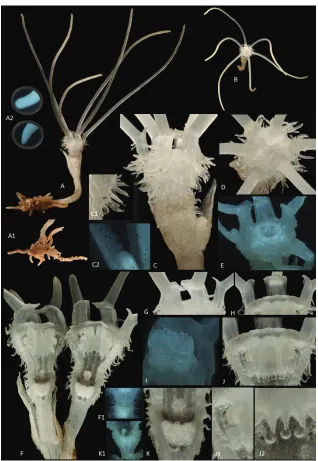
Figure 1.Thismia domei Siti-Munirah A habit (A1 roots A2 tip of filiform appendages), B top view of plant C perianth tube covered with trichomes (C1 trichome C2 white spots D top view of flower show-ing perianth lobes overlappshow-ing and appendages on the each lobes formshow-ing loose mitre E top perianth tube covered with apical part of flower tube and annulus F longitudinal section of flower (F1 base perianth tube and ovary) G perianth lobes from outside H perianth lobes from inside I pendulous stamen attached to the inner wall of perianth tube (abaxial view of stamens) J pendulous stamen attached to the inner wall of perianth tube (adaxial view of stamens) (J1 stamen from side view J2 three appendages at apical margin) K ovary showing stigma (K1 ovary). Photo credit: A, A1, B, C, C1, D, F, G, H, J, J1, J2, K
Figure 2. Thismia domei Siti-Munirah A, B habit of two plants C leaf D bract E perianth lobes from top
F top view of apical part of perianth tube with annulus G inner adaxial view of six pendulous stamens H
Thismia domei and T. terengganuensis (Thismiaceae), two new species, and T. javanica... 129
curved inwards towards the perianth tube with an appendage on each lobe. However, T. domei differs from these species in that its perianth tube is fully covered with thick trichomes and it has six perianth lobes each with an appendage as opposed to being completely glabrous and T. taiwanensis from Taiwan has only three perianth lobes with appendages and the perianth of T. clavarioides forms a mitre from Australia. T. domei is unusual in its conspicuous cell inclusion white spot which appear to be aleurone grains.
Thismia terengganuensis M.Y.Siti-Munirah, sp. nov. urn:lsid:ipni.org:names:77198713-1
Figure 4, 5, 6
Diagnosis.Thismia terengganuensis is unique in its perfect mitre with the long filiform appendages not seen in any other species of Thismia. It has a racemose sessile inflo-rescence with large bracts. Its flower parts are brownish with brown striae with inner perianth lobes forming a dark brown mitre with a white slender appendage attached at apex. The outer perianth lobes at interval appear like a wing. It has creeping vermiform brown roots.
Type. MALAYSIA. Peninsular Malaysia: Terengganu, Kuala Berang District, Hulu Telemong Forest Reserve, ca 227 m alt., 2 Dec 2018, Dome Nikong, FRI 91112 (holo-type KEP!).
Description. Small perennial achlorophyllous herbs. Roots creeping, vermi-form, brown. Stem white, 3–3.5 cm long, ascending, glabrous. Leaves scale-like, triangular, ca. 3 mm long, apex acute, alternate. Bracts many, large, 1–1.5 cm long, crowded. Pedicel short or up to 3–4 cm long. Inflorescence racemose. Flowers ses-sile, perianth tube urceolate, ca. 1 cm long, 5 mm wide in the upper third, brownish-white, with inconspicuous brown longitudinal stripes from upper part to the base. Apex of perianth tube covered with the dark brown apical part of perianth tube, circular, slightly raised annulus with opening aperture ca. 2 mm in diameter. Peri-anth lobes divided into 2 types; inner periPeri-anth lobes 3, erect, convergent to connate at apex, forming a mitre, dark brown, each with long and slender filiform append-ages, 5–7 cm long; outer perianth lobes 3, recurved, all equal in shape and size, long triangular, boat-like, 4–5 mm long, 2 mm wide at base, white, tapering into curved apex. Stamens 6, brownish white; filaments short, free, attached to the mouth of the perianth tube, curved downwards; connectives blunt (tongue-like), without apical appendages; thecae yellow, not connected; lateral appendage skirt-like. Ovary white, cup-shaped, inferior, free central placentation; style short; stigma 3-lobed, papillose. Fruit cup-shaped, brownish.
Distribution. Endemic in Peninsular Malaysia, Terengganu. Currently only known from the type locality.
Ecology. In lowland dipterocarp forest on wet, moist soil in shade at altitude 227 m. Flowering in November-December on forest floor under canopy of dense shrubs.
Etymology. The epithet refers to the state, Terengganu, where it was found.
Thismia domei and T. terengganuensis (Thismiaceae), two new species, and T. javanica... 131
Figure 4.Thismia terengganuensis Siti-Munirah A habit of flowering and fruiting plants B top view of plant
Figure 5. Thismia terengganuensis Siti-Munirah A flower and fruit B habit of fruiting plant C leaf D
bracts E stamens (adaxial view) F stamens (abaxial view) G ovary showing free central placentation H
stigma. All from Dome Nikong FRI 91112. Drawn by M. Aidil.
Thismia domei and T. terengganuensis (Thismiaceae), two new species, and T. javanica... 133
New record
Thismia javanica J.J. Sm., Ann. Jard. Bot. Btzg. 23: 32. 1910
Figure 7
Thismia javanica J.J. Sm., Ann. Jard. Bot. Btzg. 23: 32. 1910; Jonker, Fl. Malesiana 1,4: 23. 1948; Larsen, Fl. Thailand 5,1: 125. 1987. Specimen: Dome Nikong FRI 91114 (KEP!)
Note. Stem erect simple, rarely branched, up to 12 cm tall, 1-few flowered. Leaves scale-like, lanceolate to ovate, 3 mm long. Involucral bracts 3, orange. Perianth-tube urceolate, pale orange with darker stripes, with longitudinal bars inside connected by several transverse bars; outer perianth lobes orange, ovate, inner ones triangular, termi-nated by a 2-3 cm long appendage. Anthers 3-toothed at the apical margin, each tooth terminated by a hair; connective broad with quadrangular appendage. Ovary obovoid; style short; stigma truncate. Fruit orange, 6 mm long.
Distribution. Indonesia, Malaysia and Thailand.
Conservation status. We propose a regional conservation status for T. javanica in Peninsular Malaysia as Critically Endangered (B2 ab(iii)). Following the 2012 IUCN Red List Categories and Criteria, (IUCN 2012), this species is assessed as critically endangered because it is only known from one locality where less than 6 individuals flowering and fruiting individuals were observed. It lies within a forest reserve that is threatened by selective logging activities that are currently on-going.
Notes. The specimens of Thismia javanica were found not far from the T. terengganuensis population. We believe that T. javanica has a wider distribution in Peninsular Malaysia based on photographs of a specimen from Langkawi, Kedah, by late Abd Ghani Hussain. Unfortunately, there are no specimen to verify this.
Thismia domei and T. terengganuensis (Thismiaceae), two new species, and T. javanica... 135
Acknowledgements
This research was carried out as part of the Flora of Peninsular Malaysia Project (FPM) at the Forest Research Institute Malaysia (FRIM), Kepong, funded by the Ministry of Water, Land and Natural Resources (KATS) of Malaysia under the 11th Malaysian Plans (SPPII No. P23085100018003). We would like to thank the State Forestry De-partment of Terengganu, Malaysia. We also thank Mohamad Aidil Noordin for the botanical drawings. We are grateful to Ruth Kiew for discussion, confirming the taxo-nomic status of these new species and for correcting the manuscript, Wendy SY Yong for assisting in assessing the conservation status, Richard CK Chung for his continuous support in FPM and Mohd Faizal Mat Tahir for encouragement and much help during preparation of the manuscript. A special thanks also to Michal Hroneš for his guidance to Dome Nikong while exploring for Thismia. We would like to thank both reviewers for their insightful comments and suggestions.
References
Dančák M, Hroneš M, Sochor M, Sochorová Z (2018) Thismia kelabitiana (Thismiaceae), a new unique fairy lantern from Borneo potentially threatened by commercial logging. PLoS One 13(10): e0203443. https://doi.org/10.1371/journal.pone.0203443 PubMed
Hroneš M, Rejžek M, Sochor M, Svátek M, Kvasnica J, Egertová Z, Pereira JT, Nilus R, Dančák M (2018) Two new species of Thismia subsect. Odoardoa (Thismiaceae) from Borneo. Plant Ecology and Evolution 151(1): 110–118. https://doi.org/10.5091/plecevo.2018.1387 Jonker FP (1948) Burmanniaceae. In: van Steenis C.G.G.J. (ed.) Flora Malesiana, series I/4:
13–26. Noordhoff-Kolf, Leiden.
Kiew R (1999) Thismia goodii (Burmanniaceae), the blue-capped Thismia, a new species from Borneo. Gardens’ Bulletin (Singapore) 51: 179–182.
Kumar P, Gale SW, Li JH, Bouamanivong S, Fischer GA (2017) Thismia nigricoronata, a new species of Burmanniaceae (Thismieae, Dioscoreales) from Vang Vieng, Vientiane Prov-ince, Laos, and a key to subgeneric classification. Phytotaxa 319(3): 225–240. https://doi. org/10.11646/phytotaxa.319.3.2
Larsen K (1965) Studies in the flora of Thailand 27. Thismiaceae. Dansk Bot. Ark. 23: 171–174. Nishioka T, Suetsugu K, Repin R, Kitayama K (2018) Thismia kinabaluensis (Thismiaceae), a
new species from Mt. Kinabalu, Sabah, Borneo. Phytotaxa 360(2): 174–178. https://doi. org/10.11646/phytotaxa.360.2.10
Thismia domei and T. terengganuensis (Thismiaceae), two new species, and T. javanica... 137
Suetsugu K, Tsukaya H, Nurainas N, Okada H (2018) Thismia sumatrana (Thismiaceae), a new species from West Sumatra, Indonesia, with discussions on the taxonomic identity of Thismia clavigera. PhytoKeys 113: 59–67. https://doi.org/10.3897/phytokeys.113.29103 [PubMed] Thiele KR, Jordan P (2002) Thismia clavarioides (Thismiaceae), a new species of fairy lantern
from New South Wales. Telopea 9(4): 765–771. https://doi.org/10.7751/telopea20024015 Tsukaya H, Suleiman M, Okada H (2014) A new variety of Thismia hexagona Dančák, Hroneš,
Koblová et Sochor (Thismiaceae) from Sabah, Borneo, Malaysia. Acta Phytotaxonomica et Geobotanica 65(3): 141–145.
Tsukaya H, Suetsugu K, Suleiman M (2017) Thismia bryndonii (Thismiaceae), a new species from Maliau Basin, Sabah, Borneo. Phytotaxa 312(1): 135–138. https://doi.org/10.11646/ phytotaxa.312.1.13