Open Access
Research article
Effects of resistance and all-round, functional training on quality of
life, vitality and depression of older adults living in long-term care
facilities: a 'randomized' controlled trial [ISRCTN87177281]
Marijke JM Chin A Paw*, Mireille NM van Poppel, Jos WR Twisk and
Willem van Mechelen
Address: Institute for Research in Extramural Medicine & Department of Public and Occupational Health VU University Medical Center Van der Boechorststraat 7 1081 BT Amsterdam, The Netherlands
Email: Marijke JM Chin A Paw* - [email protected]; Mireille NM van Poppel - [email protected]; Jos WR Twisk - [email protected]; Willem van Mechelen - [email protected]
* Corresponding author
frail elderlyexercise programspsychological wellbeingdepressionquality of life
Abstract
Background: Regular physical activity may improve different aspects of wellbeing in older people, such as quality of life, vitality and depression. However, there is little experimental evidence to support this assumption. Therefore, we examined the effect of different training protocols on quality of life, vitality and depression of older adults living in long-term care facilities.
Methods: Subjects (n = 173, aged 64 to 94 years, living in long-term care facilities), were randomized to six months of three different moderate-intensity group exercise training protocols, or to an 'educational' control condition. Exercise consisted of two 45–60-minute training sessions per week of 1) resistance training; 2) all-round, functional training; or 3) a combination of both. Perceived health, the Geriatric Depression Scale (GDS), the Vitality Plus Scale (VPS) and the Dementia Quality of Life questionnaire (DQoL) were administered at baseline and after six months.
Results: In the combined training group a small but significant decline was seen in perceived health, DQoL and VPS score compared to the control group.
Conclusions: We conclude that neither strength training nor all-round, functional training of moderate intensity is effective in improving quality of life, vitality or depression of older people living in long-term care facilities.
Background
Wellbeing consists of many different aspects, such as bod-ily wellbeing (e.g. pain, energy/fatigue, sleep distur-bance), emotional wellbeing (e.g. depression, anxiety, positive affect), self-concept (e.g. self-esteem), and global perceptions of health. It is assumed that habitual exercise
may improve subjective wellbeing in older people. How-ever, there is little experimental evidence to support this assumption. Few randomized controlled trials studied the effects of exercise on wellbeing of older people and results are inconsistent. There is no standardized method to measure wellbeing, and all studies focus on different Published: 02 July 2004
BMC Geriatrics 2004, 4:5 doi:10.1186/1471-2318-4-5
Received: 03 September 2003 Accepted: 02 July 2004
This article is available from: http://www.biomedcentral.com/1471-2318/4/5
aspects of wellbeing. Peel et al. [1] reported a significant improvement in two out of eleven aspects of wellbeing (perceptions of limitations in physical function and emo-tional problems) after 8 weeks brisk walking and resist-ance exercise. Two other recent studies [2,3] found no improvement in their measures of well-being after 8 weeks resistance training or 17 weeks all-round, func-tional training, respectively.
It is also not clear what type and intensity of activity is most effective for wellbeing. Previously, it was believed that psychological change required high-intensity endur-ance training. King et al. [4] observed a significant decline in anxiety, stress and ratings of perceived change but not in depressive symptoms after 12 months higher intensity group endurance training, higher intensity home endur-ance training and lower intensity home endurendur-ance train-ing. Strength training also seems of benefit for certain measures of well-being. Tsutsumi et al. [5] observed that both high and low intensity strength training improved mood and self-efficacy in older adults. However, Penninx et al. [6] found a significant beneficial effect of endurance training on depressive feelings and behavior of older women, but not from resistance training. Fewer research is available on other types of training such as functional training or ADL training.
Well-being is a subjective measure and refers to the way people feel about their life. The question is whether exer-cise and/or physical activity can contribute to an enhanced well-being of older adults, and if so, what type of exercise is most effective. Few studies compared differ-ent exercise formats with a social control program, and even fewer studies involved the less mobile and less healthy older population. Therefore, the aim of the present study was to examine the effectiveness of three dif-ferent group-based moderate-intensity exercise protocols on different aspects of wellbeing, i.e. perceived health, quality of life, vitality and depression of older people, liv-ing in long-term care facilities.
Methods
Study designWe conducted a 6-month randomized controlled trial of three different moderate-intensity training protocols among older adults living in long-term care facilities, i.e. homes for the aged with services ranging from independ-ent living to skilled nursing. The primary objective of the trial was to study the effects of three different exercise pro-tocols on physical functioning, quality of life, vitality, and depression. In this report we describe the effects on qual-ity of life, vitalqual-ity and depression. In each of the six homes, subjects were randomly assigned to one of the three exer-cise conditions or the control condition, an 'educational' program. The random allocation sequence was generated
by computer by two independent students, who also assigned participants to their group. The nine couples were randomized together. Random assignment took place after completion of baseline measurements. After the 6-month trial all study participants were allowed to continue either one of the programs as desired. The VU University medical ethics committee has approved the study protocol.
Study population
Participants of the study were living in six residential and extended care facilities in the North-Western part of The Netherlands (i.e. West-Friesland). In each home all resi-dents were invited to informative meetings organized in the homes. At these informative meetings the design of the study and the interventions were explained in detail. Easy accessibility to the exercise programs and the possi-bility of voluntary withdrawal from the study were emphasized. The information was also available in bro-chures for the people to take home. At the end of the meeting, subjects received a form on which they could assert whether they were interested in the study. Those interested in study participation were screened for eligibil-ity based on the following inclusion criteria: 1) aged 65 or older; 2) living in a nursing home or residential care facil-ity; 3) able to walk six meters or more (with or without a walking aid); 4) able to comprehend the study proce-dures; 5) no medical contraindication for study participa-tion; 6) no rapidly progressive or terminal illness; 7) and not moving away from the home within the six months intervention period (5 and 6 were evaluated by their gen-eral practitioner). Informed consent was obtained from all subjects.
Interventions Strength training
ankle weights). Sessions lasted 45–60 minutes and closed with stretching exercises. The program was designed to improve muscle strength of major muscle groups of both upper and lower body, important for functional perform-ance on common daily activities.
All-round functional training
The all-round, functional training program was per-formed twice a week during 6 months in groups of 7–15 participants, directed by a trained physical therapist and an assistant. The first week was to familiarize participants with the technique of the exercises. All classes started with 5–10 minutes of warm-up activities: walking (whenever possible), exercise-to-music routines, becoming familiar with the equipment. This was followed by 30–35 minutes of skills training in game-like and cooperative activities, such as throwing and catching a ball while standing up and sitting down on a chair, musical chairs and team pur-suit races. The cool-down period (5–10 min) consisted of stretching and relaxation activities (e.g. finger and wrist rolls, shoulder rolls, reaching, leg stretches). All exercises could be adjusted to the individual mobility level. The intensity was gradually increased: the number of repeti-tions increased, exercises were performed more often standing up straight and the use of wrist and ankle weights (1 and 2 kg per pair) was stimulated. The program was designed to improve muscle strength, speed, endurance, coordination and flexibility to improve functional per-formance of common daily activities. An emphasis was placed on skills training, meaning that the specific activi-ties required for independence in daily activiactivi-ties were practiced. The design and theoretical background of the all-round, functional training program are described in detail elsewhere [7].
Combination
Subjects in the combination group performed once weekly a complete strength training session and once weekly a complete functional training session.
All three exercise programs were directed by physical ther-apists who were already working in the homes and thus familiar with working with the study population. The physical therapists were trained by the primary researcher (MCAP). To encourage standardization, the training pro-tocols were extensively described in a manual and the all-round, functional training was illustrated on an instruc-tional videotape. The assistants were either volunteers or students.
Control program
The control program was designed to provide attention, social interaction and was meant to be a 'placebo' inter-vention. Participants were told that they were assigned to an 'educational' program (i.e. group discussions about
topics of interest to older people such as history of the 20th century, music, relaxation etc.). Sessions were organ-ized 2 days of the week during 6 months for 45–60 min-utes in groups of 7–15 participants, supervised by a professional creative therapist.
Measurements
Data were collected at baseline and after 6 months inter-vention by three trained research assistants who were blinded to group assignment, according to a standardized protocol.
Information on demographic characteristics, perceived health, quality of life, vitality and depression was obtained in a personal interview at the homes of the study participants. Quality of life was measured by the Demen-tia Quality of Life Instrument (DQoL)[8]. The DQoL con-sists of 29 items divided in five sub-scales: aesthetics, belonging, negative affect, positive effect and esteem. The respondent was instructed to choose from one of several 5-point response scales placed in front of the respondent on a card. A mean score was calculated for the five sub-scales as well as for the total DQoL ranging from one to five, with a higher score indicating better quality of life. The Vitality Plus Scale (VPS)[9] was specifically designed to measure the accumulated psychological and physical benefits of exercise participation experienced by older adults. The 10-item scale was designed to capture multi-ple, interrelated aspects of 'feeling good' relevant to the exercise experience e.g. sleep, energy, bodily pain, appe-tite, stiffness. The respondent was instructed to choose for each item how they were currently feeling on a 5-point response scale placed in front of the respondent on a card. Depression was assessed with the 30-item version of the Geriatric Depression Scale [10,11].
Furthermore, two single questions 'How would you rate your health' and 'How would you rate your health com-pared to people of your age' were added. Respondents could choose one answer from a five-point and a three-point response scale, respectively. For both scales a higher score indicates better health.
Disability was assessed with questions concerning the dif-ficulty with performing 17 Activities of Daily Living (ADL). For each item, the scores were recalculated ranging from 0 (can perform without difficulty or with difficulty but without help) to 1(can perform only with help or una-ble to perform).
Statistical analysis
Descriptive data are reported for variables of interest (per-centage, mean, SD). Analysis of variance and Chi2-tests
were used to compare groups at baseline. To evaluate the effects of the interventions multilevel analysis was used. Using this technique, regression coefficients can be adjusted for the clustering of observations within one home that leads to dependency of observations of differ-ent subjects within one home. In the multi-level analysis two levels were defined: 1) patient and 2) home. A linear model was used to study the effect of all three interven-tions on the continuous outcome values. The parameters of interest are the regression coefficients (beta) indicating the effect of the intervention of interest, compared to the control group. In the 'crude' model the outcome value at 6 months was only adjusted for the value at baseline. In the secondary analyses, adjustments were made for gen-der, age and class attendance. Regression coefficients and 95% confidence intervals for the basic and the adjusted model are reported.
The trial was designed to randomize 60 subjects to each intervention group, taking into account a dropout per-centage of 25% with an alpha of 5% and a power of 80%. Primary analyses were conducted by intention-to-treat with participants analyzed according to the initial rand-omized assignment. Post-hoc secondary analyses were performed including only those subjects who attended at least 75% of all exercise classes.
Results
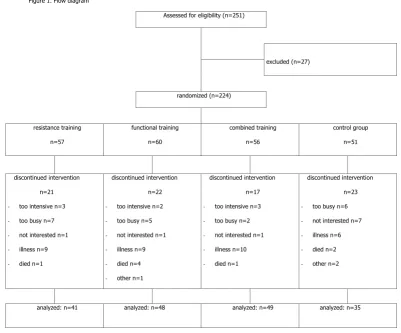
Recruitment of participants and baseline measurements were conducted from August to November 2000. Follow-up measurements were conducted from March to May 2001. A total of 251 subjects were visited at home and screened to determine eligibility. Of these, 17 did not meet the inclusion criteria, five declined to participate and five died or became ill before the baseline measurements were completed. The 224 remaining subjects were ran-domly assigned to the four intervention groups (Figure 1). Mean age of these subjects was 81.7, ranging form 64 to 94. Of the 224 randomized participants, 173 (78%) com-pleted the study (i.e. agreed with the final data collection visit). General characteristics of this group are shown in Table 1. Their mean age was 81 (± 5.4) years old and the majority (86%) lived in a residential care facility. Subjects reported problems with on average three of 17 ADL activ-ities. Dropout of participants was not significantly differ-ent among the four groups (strength training 28%, all-round, functional training 20%, combined training 22% and control group 31%). The study participants who dropped out were slightly older (83 versus 81 years), and were more often male (20 versus 15%) and living in nurs-ing homes (23 versus 14%).
Of the 173 subjects who completed the study, the median attendance to the strength training was 78% (range: 0– 100), to the all-round, functional training 70% (range: 0– 100) and to the combined training 73% (range: 7–100). Attendance to the control program was slightly lower (70%, range: 0–96). No participant was withdrawn for adverse effects, but eight study participants discontinued the intervention because they found that the exercise pro-gram was 'too intensive'. From the exercise logs it appeared that compliance to the strength training proto-col appeared difficult. Subjects often trained at a lower intensity and increased the intensity at a lower rate than prescribed.
Intention-to-treat analysis
Perceived health, quality of life, vitality and depression at baseline and after six months intervention are presented in Table 2. At baseline study participants scored their 'per-ceived health' on average 2.7 on a 5-point scale (1 = bad, 5 = excellent), and their 'perceived health compared to people of the same age' 2.6 on a 3 point scale (1 = worse, 2 = the same, 3 = better). These values did not change after 6 months intervention, except in the combined training group where perceived health decreased with 0.3 points (95% CI:-0.5;-0.1). The mean of the DQoL scores fell above the midpoint of the scale, except for negative affect, which fell below the midpoint. At baseline, the DQoL sumscore and subscores were not significantly different between groups. In all three exercise groups a small but significant decline in DQoL sumscore (-0.1 in all three groups) and aesthetics (-0.5, -0.4 and -0.4 points, respec-tively) was observed. In the combined training group a small but significant decline in positive affect (-0.2, 95% CI:-3.3;-0.4) and esteem (-0.2, 95% CI:-3.3;-0.4) was observed as well.
The mean VPS score at baseline was 36.5 out of 50. After the intervention the combined training group had an average decrease of 1.8 points (95% CI:-3.3;-0.4). The changes in the other groups were small and not signifi-cant. The mean GDS score at baseline was 5.8 and did not change after 24 weeks intervention. A GDS score over 10 denotes depressive symptoms.
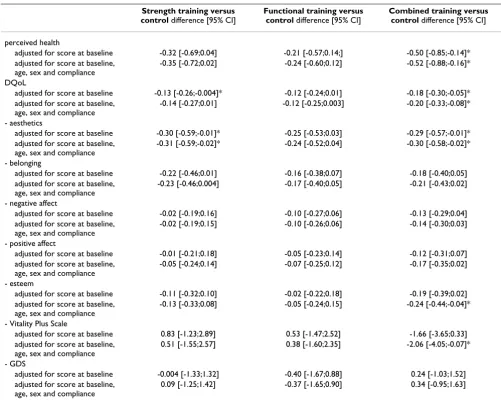
CI:-0.58;-0.02), esteem subscore (adjusted difference:-0.2, 95% CI: -0.44;-0.04) and VPS score (adjusted difference:-0.5, 95% CI: -0.89;-0.2) compared to the control group. No signifi-cant differences between the all-round, functional train-ing group and controls were found.
Subgroup analysis
We performed post-hoc analyses to examine the effect of the interventions including only those subjects who attended at least 75% of the exercise classes (n = 74, i.e. 43%) (see Table 4). After adjustment for baseline score, age and sex, no differences between the exercise groups compared to the control group were observed.
Discussion
Our results suggest that exercise does not affect quality of life, vitality or depression of older adults living in long-term care facilities. After adjustments for baseline score,
age, sex and compliance (class attendance), minimal dif-ferences in perceived health, quality of life, vitality and depression were observed between the strength training and all-round, functional training group and the non-exercise control group. Noticeable is that the combined training group declined slightly in perceived health, qual-ity of life and vitalqual-ity compared to the non-exercise con-trols after 24 weeks. However, in the subgroup that attended at least 75% of all classes no differences between either of the exercise groups and the controls were seen.
Few randomized controlled trials looking at the psycho-logical effects of exercise in older adults have been per-formed and all looked at different measures [1-6]. Even fewer studies compared the psychological effects of differ-ent types of exercise [4,6]. All looked at differdiffer-ent training formats (strength training and endurance training), differ-ent durations, as well as differdiffer-ent aspects of wellbeing
Flow diagram Figure 1
Flow diagram.
Figure 1. Flow diagram
Assessed for eligibility (n=251)
excluded (n=27)
randomized (n=224)
resistance training
n=57
functional training
n=60
combined training
n=56
control group
n=51
discontinued intervention
n=21
- too intensive n=3
- too busy n=7
- not interested n=1
- illness n=9
- died n=1
discontinued intervention
n=22
- too intensive n=2
- too busy n=5
- not interested n=1
- illness n=9
- died n=4
- other n=1
discontinued intervention
n=17
- too intensive n=3
- too busy n=2
- not interested n=1
- illness n=10
- died n=1
discontinued intervention
n=23
- too busy n=6
- not interested n=7
- illness n=6
- died n=2
- other n=2
such as depression, mood and anxiety, stress and self-effi-cacy. Findings on outcome measures were inconsistent.
Most studies used a non-exercise or waiting list control group. To positively rule out social interaction or staff attention as the most important underlying factor of improvement for quality of life, vitality and depression we added a sedentary, social activity control group. This may be one explanation for the lack of effect of the exercise programs in our study. The control program may have lead to improvement. King et al. [4] compared higher intensity group, higher intensity home and lower inten-sity home endurance exercise. Their results suggest that
change in physical fitness and social support from group training was not necessary to achieve psychological change.
Another explanation for the lack of effect may be that some aspects of quality of life, vitality and depression rep-resent stable personality traits rather than modifiable states or that the used measures were insufficiently responsive to change. The quantification of psychological wellbeing is difficult. There are many instruments that measure different aspects of wellbeing, such as bodily wellbeing (e.g. pain, energy/fatigue, sleep disturbance), emotional wellbeing (e.g. depression, anxiety, positive Table 1: General characteristics of elderly living in long-term care facilities (N = 173)
Strength training (n = 41) Functional training (n = 48) Combined training (n = 49) Control (n = 35)
age, mean ± SD, yr 81.0 (± 5.8) 82.1 (± 4.9) 80.9 (± 6.3) 81.3 (± 4.4) sex, No. (%) male/female 11(26)/30(74) 10(21)/38(79) 8(16)/41(84) 6(17)/29(83) marital status, No. (%)
- married 9 (23) 10 (21) 13 (27) 11(31)
- widowed 27 (68) 33 (69) 32 (65) 23 (66)
- never married 1 (3) 3 (6) 3 (6) 1 (3)
- divorced 3 (8) 4 (2) 1(2)
-type of residence, No. (%)
- nursing home 6 (14) 6 (13) 8 (16) 4 (11)
- residential care 35 (86) 42 (87) 41 (84) 31 (90)
subjects with ADL disability, No. (%)
8 (22) 8 (20) 4 (10) 7 (21) no. of ADL disabilities,
mean ± SD (0–17)
3.3 (± 2.7) 2.7 (± 2.3) 3.3 (± 2.1) 3.1 (± 2.9) subjects using a walking
aid indoors, No. (%)
6 (15) 8 (17) 3 (6) 6 (17)
Table 2: Perceived health, quality of life, vitality and depression (mean [95% CI]) of elderly living in long-term care facilities (N = 173)
Strength training (n = 41) Functional training (n = 48) Combined training (n = 49) Control (n = 35)
baseline 6 m change baseline 6 m change baseline 6 m change baseline 6 m change
perceived health
(1–5)a 2.3 [2.0;2.6] -0.1 [-0.4;0.2] 2.1 [1.9;2.3] 0 [-0.2;0.3] 2.4 [2.1;2.6] -0.3 [-0.5;-0.1]* 2.4 [2.1;2.7] 0.1 [-0.2;0.5]
compared health
(1–3)a 2.6 [2.4;2.8] -0.1 [-0.4;0.2] 2.4 [2.2;2.6] 0 [-0.1;0.3] 2.2 [2.0;2.5] 0 [-0.1;0.3] 2.5 [2.3;2.7] 0 [-0.2;0.3]
DqoL (1–5)b 3.6 [3.4;3.7] -0.1 [-0.2;-0]* 3.6 [3.5;3.7] -0.1 [-0.2;-0]* 3.6 [3.4;3.7] -0.1 [-0.2;-0]* 3.6 [3.4;3.7] 0 [-0.1;0.1]
- aesthetics 4.2 [3.9;4.4] -0.5 [-0.7;-0.3]* 4.1 [3.9;4.3] -0.4 [-0.6;-0.2]* 4.0 [3.8;4.2] -0.4 [-0.6;-0.2]* 4.1 [3.9;4.3] -0.2 [-0.5;0] - belonging 3.7 [3.5;3.9] 0 [-0.2;0.1] 3.7 [3.5;3.9] 0 [-0.2;0.2] 3.7 [3.5;3.9] 0 [-0.2;0.2] 3.6 [3.3;3.9] 0.2 [-0;0.4] - negative affect 2.7 [2.5;2.9] 0 [-0;0.2] 2.7 [2.5;2.8] 0 [-0.2;0] 2.6 [2.5;2.8] 0 [-0.2;0] 2.6 [2.4;2.8] 0 [-0;0.2] - positive affect 3.7 [3.5;3.9] 0 [-0.2;0] 3.8 [3.6;4.0] -0.1 [-0.3;0] 3.8 [3.6;3.9] -0.2 [-0.3;-0]* 3.7 [3.5;3.9] 0 [-0.2;0.1] - esteem 3.7 [3.5;3.9] 0 [-0.3;0.1] 3.8 [3.6;4.0] 0 [-0.2;0.1] 3.7 [3.6;3.9] 0.2 [-0.3;-0]* 3.8 [3.6;4.0] 0 [-0.2;0.1] Vitality Plus
Scale (10–50)c 36.4 [34.3;38.5] 0.6 [-0.9;2.0] 36.2 [34.5;37.9] 0.3 [-1.2;1.7] 35.8 [33.8;37.8] -1.8 [-3.3;-0.4]* 38.0 [35.6;40.3] -0.8 [-2.2;0.7]
GDS (0–30)d 6.0 [4.5;7.6] 0.3 [-0.5;1.1] 5.6 [4.3;6.8] -0.3 [-1.0;0.5] 6.1 [4.8;7.5] 0.3 [-0.8;1.4] 5.2 [4.0;6.4] 0.2 [-0.7;1.1]
a higher scores indicate better health b higher scores indicate better QoL c higher scores indicate more vitality d higher scores indicate more
Table 3: Results of Multilevel analyses regarding the effect of strength training, functional training and the combined training on perceived health, quality of life, vitality and depression of elderly living in long-term care facilities (N = 173)
Strength training versus control difference [95% CI]
Functional training versus control difference [95% CI]
Combined training versus control difference [95% CI] perceived health
adjusted for score at baseline -0.32 [-0.69;0.04] -0.21 [-0.57;0.14;] -0.50 [-0.85;-0.14]* adjusted for score at baseline,
age, sex and compliance
-0.35 [-0.72;0.02] -0.24 [-0.60;0.12] -0.52 [-0.88;-0.16]* DQoL
adjusted for score at baseline -0.13 [-0.26;-0.004]* -0.12 [-0.24;0.01] -0.18 [-0.30;-0.05]* adjusted for score at baseline,
age, sex and compliance
-0.14 [-0.27;0.01] -0.12 [-0.25;0.003] -0.20 [-0.33;-0.08]* - aesthetics
adjusted for score at baseline -0.30 [-0.59;-0.01]* -0.25 [-0.53;0.03] -0.29 [-0.57;-0.01]* adjusted for score at baseline,
age, sex and compliance
-0.31 [-0.59;-0.02]* -0.24 [-0.52;0.04] -0.30 [-0.58;-0.02]* - belonging
adjusted for score at baseline -0.22 [-0.46;0.01] -0.16 [-0.38;0.07] -0.18 [-0.40;0.05] adjusted for score at baseline,
age, sex and compliance
-0.23 [-0.46;0.004] -0.17 [-0.40;0.05] -0.21 [-0.43;0.02] - negative affect
adjusted for score at baseline -0.02 [-0.19;0.16] -0.10 [-0.27;0.06] -0.13 [-0.29;0.04] adjusted for score at baseline,
age, sex and compliance
-0.02 [-0.19;0.15] -0.10 [-0.26;0.06] -0.14 [-0.30;0.03] - positive affect
adjusted for score at baseline -0.01 [-0.21;0.18] -0.05 [-0.23;0.14] -0.12 [-0.31;0.07] adjusted for score at baseline,
age, sex and compliance
-0.05 [-0.24;0.14] -0.07 [-0.25;0.12] -0.17 [-0.35;0.02] - esteem
adjusted for score at baseline -0.11 [-0.32;0.10] -0.02 [-0.22;0.18] -0.19 [-0.39;0.02] adjusted for score at baseline,
age, sex and compliance
-0.13 [-0.33;0.08] -0.05 [-0.24;0.15] -0.24 [-0.44;-0.04]* - Vitality Plus Scale
adjusted for score at baseline 0.83 [-1.23;2.89] 0.53 [-1.47;2.52] -1.66 [-3.65;0.33] adjusted for score at baseline,
age, sex and compliance
0.51 [-1.55;2.57] 0.38 [-1.60;2.35] -2.06 [-4.05;-0.07]* - GDS
adjusted for score at baseline -0.004 [-1.33;1.32] -0.40 [-1.67;0.88] 0.24 [-1.03;1.52] adjusted for score at baseline,
age, sex and compliance
0.09 [-1.25;1.42] -0.37 [-1.65;0.90] 0.34 [-0.95;1.63]
* p < 0.05, for exercise versus control group
Table 4: Results of Multilevel analyses regarding the effect of strength training, functional training and the combined training on perceived health, quality of life, vitality and depression of the subgroup who attended at least 75% of all exercise classes (N = 74)
Strength training versus control difference [95% CI]
Functional training versus control difference [95% CI]
Combined training versus control difference [95% CI] perceived health -0.003 [-0.6;0.6] 0.3 [-0.3;0.9] -0.1 [-0.7;0.5] DQoL sumscore -0.2 [-0.4;0.01] -0.1 [-0.3;0.1] -0.2 [-0.4;0.03] - aesthetics -0.4 [-0.8;0.01] -0.2 [-0.7;0.2] -0.2 [-0.7;0.2] - belonging -0.4 [-0.7;0.01] -0.2 [-0.6;0.1] -0.3 [-0.7;0.02] - negative affect 0.1 [-0.2;0.5] 0.1 [-0.2;0.5] 0.04 [-0.3;0.4] - positive affect -0.2 [-0.5;0.2] -0.04 [-0.4;0.3] -0.1 [-0.4;0.2] - esteem -0.2 [-0.6;0.2] -0.1 [-0.4;0.3] -0.3 [-0.7;0.1] Vitality Plus Scale 0.4 [-3.0;3.9] 0.4 [-3.0;3.8] -1.4 [-4.8;2.1] GDS -1.1 [-3.3;1.0] -1.5 [-3.6;0.7] -1.3 [-3.4,0.9]
affect), self-concept (e.g. self-esteem), and global percep-tions of health. Most instruments are not developed for measuring change over time. Thus, it is important to develop useful instruments in these potentially important areas. The Vitality Plus Scale used in our study was specif-ically developed to measure perceived psychophysical benefits of exercise participation, but did not indicate any changes in our trial. The responsiveness to change of this scale has been studied insufficiently up till now.
Our study was conducted in the less mobile and less healthy group of older people living in long-term care facilities. This group is likely to experience lower psycho-logical wellbeing because of problems with health, mobility, and autonomy. Therefore, we expected greater gains in wellbeing from exercise. Still, average scores at baseline were not exceptionally low, leaving little room for improvement (ceiling effect). Because of these health and mobility problems, regular exercising at a considera-ble intensity appeared difficult. Most persons were not used to exercising and afraid to exercise at moderate inten-sity, which was in some people associated with pain. From the exercise logs it appeared that compliance to the strength training protocol appeared difficult.
The exercise programs showed little improvement in fit-ness and function (data not shown). In the subgroup of subjects who attended at least 75% of the classes, improvements in some fitness and function measures were observed (reaction time, eye-hand-coordination, chair rise performance) in the functional training group and the combined training group. No effect of strength training was observed. None of the exercise protocols were effecting ADL-disability (manuscript submitted for publication). Despite the lack of functional improvement subjects may still experience psychological benefit from participating in an exercise program, for instance because of hormonal or metabolic adaptations, alterations in brain monoamines or opioid peptides, the opportunity of socializing, enhanced feelings of competency, or distrac-tion of day-to-day stressors. The studies of King et al. [4] and Tsutsumi et al. [5] suggest that neither high intensi-ties, nor substantial fitness changes are essential to achieve positive mental health effects. Though, both stud-ied healthy community-dwelling older people who were much younger (mean age 57 and 68, respectively).
A limitation of this type of study examining the effect of exercise programs in more real-life circumstances is the difficulty in standardizing and measuring the intensity of the training. Therefore, we cannot say whether the lack of effect is due to the insufficient compliance of the partici-pants or due to the insufficient intensity or frequency of the exercise program.
Another limitation is that we used multilevel analysis. This technique is the state of the art for analyzing discrete variables in this type of trials. However, in our study we used ordinal outcome variables. Therefore, the results have to be interpreted with caution.
We conclude that neither strength training nor all-round, functional training of moderate intensity is effective in improving psychological quality of life, vitality and depression of older people living in long-term care facilities.
Competing interests
None declared.
Authors' contributions
MCAP conceived of the study, participated in its design and coordination and performed the statistical analysis. MvP participated in the coordination of the study. JT par-ticipated in and advised on the statistical analysis of the study. WvM conceived of the study and participated in the design of the study. All authors read and approved the final manuscript.
Acknowledgements
The study was financially supported by the Dutch Health Research Council (grant number 2200.0060), the 'Stichting Ouderen in Beweging West-Fries-land', Regional Health Care Insurance Company Univé, TechnoGym Bene-lux B.V. and Nijha Lochem B.V.
References
1. Peel C, Utsey C, MacGregor J: Exercise Training for Older Adults With Limitations in Physical Function.J Aging Phys Act
1999, 7:62-75.
2. Perrig-Chiello P, Perrig WJ, Ehrsam R, Staehelin HB, Krings F: The effects of resistance training on well-being and memory in elderly volunteers.Age Ageing 1998, 27(4):469-475.
3. Chin A Paw MJM, de Jong N, Schouten EG, van Staveren WA, Kok FJ: Physical exercise or micronutrient supplementation for the wellbeing of the frail elderly? A randomised controlled trial.
Br J Sports Med 2002, 36(2):126-131.
4. King AC, Taylor CB, Haskell WL: Effects of differing intensities and formats of 12 months of exercise training on psycholog-ical outcomes in older adults. Health Psychol 1993, 12(4):292-300.
5. Tsutsumi T, Don BM, Zaichkowsky LD, Delizonna LL: Physical fit-ness and psychological benefits of strength training in com-munity dwelling older adults. Appl Human Sci 1997, 16(6):257-266.
6. Penninx BW, Rejeski WJ, Pandya J, Miller ME, Di Bari M, Applegate WB, Pahor M: Exercise and depressive symptoms: a compari-son of aerobic and resistance exercise effects on emotional and physical function in older persons with high and low depressive symptomatology.J Gerontol B Psychol Sci Soc Sci 2002, 57(2):124-132.
7. Chin A Paw MJM, de Jong N, Stevens M, Bult P, Schouten EG: Devel-opment of an exercise program for frail elderly.J Aging and Physical Activity 2001, 9:476-489.
8. Brod M, Stewart AL, Sands L, Walton P: Conceptualization and measurement of quality of life in dementia: the dementia quality of life instrument (DQoL). Gerontologist 1999, 39(1):25-35.
Publish with BioMed Central and every scientist can read your work free of charge "BioMed Central will be the most significant development for disseminating the results of biomedical researc h in our lifetime."
Sir Paul Nurse, Cancer Research UK
Your research papers will be:
available free of charge to the entire biomedical community
peer reviewed and published immediately upon acceptance
cited in PubMed and archived on PubMed Central
yours — you keep the copyright
Submit your manuscript here:
http://www.biomedcentral.com/info/publishing_adv.asp
BioMedcentral benefits of exercise participation for older adults: the Vitality
Plus Scale.J Gerontol 1999, 54(9):456-66.
10. Yesavage JA, Brink TL, Rose TL, Lum O, Huang V, Adey M, Leirer VO: Development and validation of a geriatric depression screen-ing scale: a preliminary report.J Psychiatr Res 1982, 17(1):37-49. 11. McGivney SA, Mulvihill M, Taylor B: Validating the GDS depres-sion screen in the nursing home. J Am Geriatr Soc 1994, 42(5):490-2.
Pre-publication history
The pre-publication history for this paper can be accessed here:
![Table 2: Perceived health, quality of life, vitality and depression (mean [95% CI]) of elderly living in long-term care facilities (N = 173)](https://thumb-us.123doks.com/thumbv2/123dok_us/457666.1540048/6.612.57.555.99.304/table-perceived-health-quality-vitality-depression-elderly-facilities.webp)