R E S E A R C H
Open Access
Managing daily intensive care activities: An
observational study concerning
ad hoc
decision
making of charge nurses and intensivists
Heljä Lundgrén-Laine
1,2*, Elina Kontio
1,3, Juha Perttilä
4, Heikki Korvenranta
2, Jari Forsström
5and Sanna Salanterä
1,2Abstract
Introduction:Management of daily activities in ICUs is challenging. ICU shift leaders, charge nurses and intensivists have to make several immediatead hocdecisions to enable the fluent flow of ICU activities. Even though the management of ICU activities is quite well delineated by international consensus guidelines, we know only a little about the content of the real clinical decision making of ICU shift leaders.
Methods:We conducted an observational study with the think-aloud technique to describe thead hocdecision making of ICU shift leaders. The study was performed in two university-affiliated hospital ICUs. Twelve charge nurses and eight intensivists were recruited. Observations were recorded and transcribed for qualitative content analysis using the protocol analysis method. The software program NVivo 7 was used to manage the data. The interrater agreement was assessed with percentages and by Cohen’s .
Results:We identified 463ad hocdecisions made by the charge nurses and 444 made by the intensivists. During our data collection time, this breaks down to over 230 immediately made decisions per day (24 hours). We divided thead hoc decision making of ICU shift leaders into two types: process-focused and situation-focused. Process-focused decision making included more permanent information, such as human resources, know-how and material resources, whereas situation-focused decision making included decisions about single events, such as patient admission. We named eight different categories for ICUad hocdecision making: (1) adverse events, (2) diagnostics, (3) human resources and know-how, (4) material resources, (5) patient admission, (6) patient discharge, (7) patient information and vital signs and (8) special treatments.
Conclusions:ICU shift leaders make a great number of complexad hocdecisions throughout the day. Often this decision making involves both intensivists and charge nurses. It forms a bundle that requires versatile, immediate information for a successful outcome. In the future, we need to investigate which information is crucial forad hoc decision making. These challenges should also be emphasised when information technology programs for ICU care management are developed.
Introduction
Many and varied multiprofessional decisions are made when running daily ICU activities. These result in both clinical and managerial orders to support patient care and ICU work flow. Decision making related to immedi-ate care must often be made quickly in response to the changing condition of the patient. This decision making is usually supported by patient information systems that
are designed to provide detailed individual, patient-focused information [1]. However, decision making con-cerning direct patient care is difficult or even impossible to complete if the managerial decisions are made inac-curately and/or with a delay.
Within fast-paced ICU environments, many of these managerial decisions have to be made immediately, ad hoc. By ‘ad hocdecision making’, we mean critical jud-gements that are needed for a specific purpose at a pre-cise moment with the goal of ensuring instant and adequate patient care and a fluent flow of activities in the ICU. Shift leaders, intensivists and charge nurses in * Correspondence: [email protected]
1
Department of Nursing Science, University of Turku, Lemminkäisenkatu 1, FI-20014 Turku, Finland
Full list of author information is available at the end of the article
ICUs are responsible for coordinating, planning and assessing the daily activities of the units and are those who usually make these managerial ad hoc decisions. ICU shift leaders’ duties and tasks are a mixture of direct patient care, supervision of care and administra-tive work. This is why many decisions have to be con-sidered both from the clinical and the managerial points of view.
The decision making of ICU professionals has been the focus of several studies (see, for example, [2-5]). In addition, the need for teamwork, verbal communication and information has been found to be crucial for task coordination and work performance in ICUs [6-8]. However, the focus of previous studies has been mainly on the individual level or on direct patient care.
In recent years, precise guidelines and best practice instructions have been developed to guide the work flow of ICUs and managerial decision making. Despite these efforts, the ad hocdecision making of ICU shift leaders is poorly supported by information systems. It is com-mon for information needed for decision making to be gathered into different information systems and other platforms. In addition, part of the decision making is based solely on the memory and work experience of the ICU shift leader. With a growing information load, it is essential that precise, consistent and timely information be available for accurate and correct decision making exactly when it is needed [9,10]. However, we do not have a clear picture of what decisions the ICU shift lea-ders make.
In this study, we focused on the unit-level decisions which are made ad hocby ICU shift leaders to ensure the fluent flow of activities. The specific purpose of the study was to identify thead hocdecisions of ICU shift leaders by evaluating their cognitive processes during their daily work.
Materials and methods Context and setting
We conducted this study in two university hospital ICUs in Finland from 25 April to 23 June 2007. Both of the ICUs are mixed medical-surgical units with 24 (ICU1) and 22 (ICU2) beds Both units are run by full-time intensivists with 24-hour coverage. Together the units take care of over 4,000 patients annually. In-house intensivists and qualified charge nurses manage the daily activities of the units in both ICUs. The ICUs are closed-model units in which patients are admitted by the ICU physician who specialises in surgery, anaesthe-sia or internal disease. The charge nurses of the units are registered nurses experienced in directing nursing staff. Decisions related to direct patient care are made jointly by the specialist consultants and the ICU team. Decisions concerning ICU work flow are made within
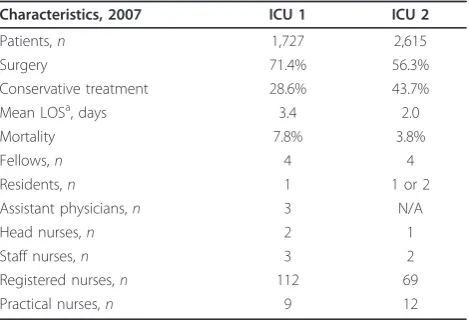
the ICU team. Both of the study units use Centricity™ Critical Care [11] information systems for electronic patient documentation. More detailed characteristics of the ICUs are given in the Table 1.
Study design
We performed an observational study using the think-aloud technique in a real clinical setting. The basis of the think-aloud technique is to ask participants to ver-balise their performance while performing their tasks and duties. Researchers have found this technique to be an appropriate method for investigating and revealing complex cognitive processes in a real-life context [12,13]. Our purposeful sample consisted of 12 charge nurses and 8 intensivists equally at both hospitals. We conducted the collection of data during different shifts: 15 morning shifts, 4 evening shifts and 1 night shift. Data collection was also performed on different days of the week, including three weekend shifts. The data col-lector followed each participant individually from the beginning of the eight-hour work shift. The role of the data collector was to remind participants to talk aloud during the observations. All sessions were recorded using an MP3 player. One researcher (HLL), who was familiar with intensive care, conducted all the sessions.
Data analysis
[image:2.595.305.540.562.722.2]The data were typed out into a .txt file in an authentic form. Since the recorded data included each partici-pant’s speech during his or her shift, irrelevant parts that were not related to the focus of our study’s purpose were omitted. Before the analyses, the text files were read several times and situation-related notes were made. These situation-related notes were made to detect which decision was related to which situation at the time of observations (for example, staff ratios to isola-tion). This supported the final analyses and
Table 1 Characteristics of the participating ICUs
Characteristics, 2007 ICU 1 ICU 2
Patients,n 1,727 2,615
Surgery 71.4% 56.3%
Conservative treatment 28.6% 43.7%
Mean LOSa, days 3.4 2.0
Mortality 7.8% 3.8%
Fellows,n 4 4
Residents,n 1 1 or 2
Assistant physicians,n 3 N/A
Head nurses,n 2 1
Staff nurses,n 3 2
Registered nurses,n 112 69
Practical nurses,n 9 12
a
understanding of the rapidly changing situations and ICU-specific concepts related to the complex thinking of the study participants. Qualitative content analysis was then used to identify each decision made by the participants. Qualitative content analysis is ‘a research method for subjective interpretation of the content of text data through a systematic classification process of coding and identifying themes or patterns’ [14] (p. 1278). Each recording was analysed separately with the aim of detecting the decisions of both professional groups.
Our analysis consisted of three phases: free-model coding, tree-model coding and application of the proto-col analysis. A computer-assisted qualitative software program, NVivo 7 (QSR International, Doncaster, Vic-toria, Australia) [15], was used to support the manage-ment of the coding in our analysis. First, the free-model coding was used to identify decisions made by the parti-cipants. This meant that all utterances which included decision making were coded. Then we continued to organize the decisions hierarchically into clusters (tree-model coding). Some of the hierarchical single codings were still in several categories during this phase.
In the next phase, the hierarchical categories were compared and those with close contents were inte-grated, such as human resources and the know-how of personnel. All the coding phases were first performed by one researcher (HLL). After this, two researchers (HLL and EK) independently analysed all of the pre-coded data. We ensured the reliability with intercoder agreement percentages and the consistency of coding with Cohen’svalues (Table 2).
Finally, we applied protocol analysis and analysed the levels of verbalization in sentences. This was done to identify ad hoc decisions, that is immediately made
decisions. In the protocol analysis, the verbalization of study subjects was classified into three levels. These levels were used to describe the reproduction of infor-mation from the memory of a study subject while he or she was performing a task. First- and second-level ver-balizations were considered reliable because these levels are assumed to reveal the content of the short-term working memory [12]. By applying protocol analysis, we were able to code each decision into a different level. First- and second-level decisions were considered ad hocdecisions. Verbalizations of decisions at levels 1 and 2 were clearly and immediately expressed as well as clearly targeted. These decisions needed to be made rapidly, and the decision maker sought either an immediate solution or more information to be able to conclude his or her decision without delay. For the third-level decisions, participants needed additional information and the solutions required for decision making were not immediately essential. The third-level decisions were notad hocdecisions and included those related to a patient discharge plan, such as, ‘We are going to extubate probably tomorrow, and if all goes okay he will be discharged’.
A study on protocol analysis by Ericsson and Simon [12] and an article by Lundgrén-Laine and Salanterä [16] discussed the methodological bases of protocol ana-lysis and the levels of the anaana-lysis in more detail.
Ethical issues and participants
[image:3.595.59.539.551.722.2]The study was approved by the hospital districts’ autho-rities. In our study, we followed the Finnish national leg-islation and ethical principles [17]. No data are personally identifiable. The inclusion criteria for the study subjects were that the participant had to (1) be able to voluntarily, capably and competently talk aloud
Table 2 Categories, amounts, coding frequencies ofad hocdecisions, number ofad hocdecisions, interrater reliability values and observation times
Categories ofad hocdecisions Shift leaders Intensivists (n= 8) Charge nurses (n= 12)
Process-focused,n(%)
1. Human resources and know-how 291 (32.1%)b 291 (63%)b
2. Material resources 22 (2.4%) 22 (4.8%)
Situation-focused,n(%)
3. Patient admissions 32 (3.5%) 3 (0.7%) 29 (6%)
4. Patient information and vital signs 246 (27%)b 174 (39%)b 72 (16%)b
5. Special treatments 171 (19%)b 147 (33%)b 24 (5%)
6. Diagnostics 86 (9.5%) 86 (19%)b
7. Adverse events 1 (0.1%) 1 (0.2%)
8. Patient discharges 58 (6.4%) 34 (8%) 24 (5%)
IRRa(%)/Cohen
’s 97.0/0.92 to 1.0 91.0/0.90 to 1.0
Totalad hocdecisions,n 907 444 463
Total observation time, hours 92 30 62
a
IRR = interrater reliability;b
during work situations and (2) have current ICU shift leadership experience. A written consent form was obtained from each participant, and each received writ-ten and oral instructions before the observations.
Results
Four of the intensivists were men and four were women, with their ICU work experience ranging from 4 to 22 years. Three of the twelve charge nurses were men, and nine were women. Their ICU work experience ranged from 5 to 32 years. None of the participants withdrew from our study during the observations.
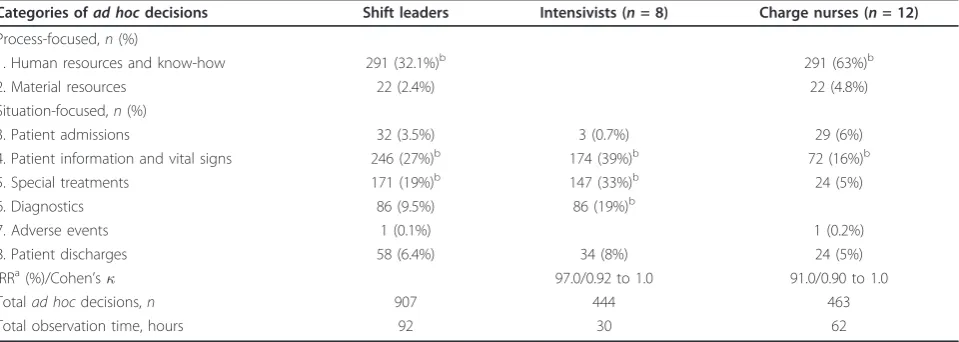
The recordings varied from two to six hours per infor-mant (mean duration 4 hours, 40 minutes), and the length of the recordings depended on the intensity of the shift. Altogether we recorded 92 hours of data. In our analysis, we identified 444ad hocdecisions made by the intensivists and 463 ad hocdecisions made by the charge nurses. This breaks down to nearly 10 ad hoc
decisions per hour or 240 ad hoc decisions per day made by the ICU shift leaders. If we consider the num-ber of decisions per decision maker, these data break down to almost 56ad hoc decisions per intensivist and 39 decisions per charge nurse.
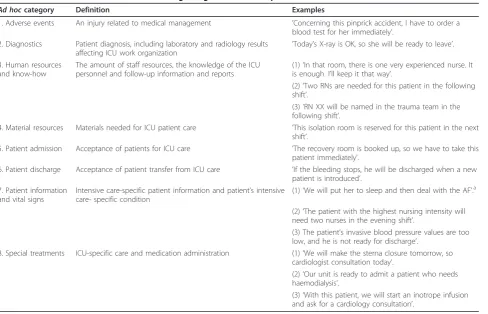
Thead hoc decision making of intensivists and charge nurses covered the entire patient care process from admission to discharge. On the basis of our analysis, we identified eight decision-making categories: (1) adverse events, (2) diagnostics, (3) human resources and know-how, (4) material resources, (5) patient admission, (6) patient discharge, (7) patient information and vital signs and (8) special treatments.
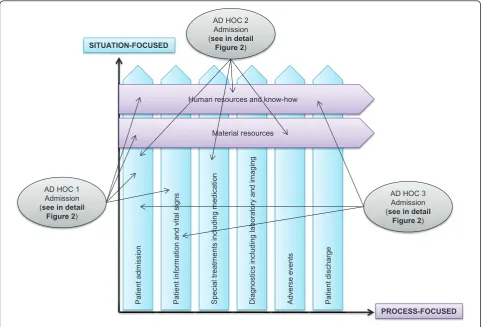
These categories were in turn divided into two differ-ent types of decision making: process-focused and situa-tion-focused (Figure 1). In our data, the process-focused decision making represented ad hocdecision making that was related to permanent events. In addition, the process-focusedad hocdecisions were made concerning the entire unit, and they affected the work flow of the whole ICU. Human resources, know-how and material resources represent process-focused decision making (Figure 1, horizontal type).
The situation-focused ad hocdecision making con-cerned incidents that occurred at a certain moment. Typically they were single incidents or concerned one patient or individual, such as patient admission, adverse events, diagnostics, patient information and vital signs, special treatments and patient discharge (Figure 1, verti-cal type).
Mostad hoc decisions belonged to the categories of human resources and know-how (32.1%), patient infor-mation and vital signs (27%) and special treatments (19%), representing both process-focused and situation-focused decision making. These categories were followed
by diagnostics (9.5%) and patient discharge (6.4%). The fewest ad hoc decisions made were related to patient admission (3.5%), material resources (2.4%) and adverse events (0.1%).
Table 2 summarises the namedad hoc decision-mak-ing categories, the frequencies and percentages of our coding, the participants in the study, the total observa-tion times and intercoder reliability values with Cohen’s
values. In Table 3, we present the definitions for the namedad hocdecision-making categories.
Human resources and know-how
Most of the ad hocdecisions made by ICU shift leaders were about human resources and know-how (32.1%). The main objective of this decision making was to man-age the number of ICU personnel, to ensure sufficient and appropriate resources or to compensate for the know-how levels needed so that patient care could be ensured in all situations around the clock. Remarkably, all the ad hocdecisions in this category were made by the charge nurses; however, they typically made these decisions in coordination with other ICU colleagues or negotiated in multidisciplinary teams before personally making judgments. In addition, many of the ad hoc
decisions identified in this study dealt with a different kind of follow-up data needed for statistics or research. Typical ad hoc decisions under this category are pre-sented in Table 3.
Patient information and vital signs
The second most frequent ad hocdecisions were made concerning patient information and vital signs (27%). This category covered very intensive care, specific patient information and the present condition of a patient fulfilling the criteria for essential ICU care. Thesead hoc decisions dealt, for example, with issues related to the mode of isolation, patient care intensity, critical problems regarding vital functions or changes required immediately for the intensive care plan. Thead hocdecision making in this category was also closely connected to otherad hocdecisions, such as those con-cerning admissions or discharges. For example, high patient care intensity led to the next ad hoc decision: which of the patients would stay and who would be moved to another ward. About 40% of these decisions were made by the intensivists, and these decisions com-prised most of the ad hoc decisions they made (Table 2). The ad hoc decisions under this category are pre-sented in Table 3.
Special treatments
with ICU-specific care and administration of medication. ICU-specific care covered the treatments which were possible to perform only under intensive care circum-stances, such as hyperbaric oxygen therapy, care of patients with intra-aortic balloon pumps or treatments performed by specialised consultants. Under this cate-gory, we also named administration of ICU-specific medication, such as medication that requires intensive monitoring (for example inotropes, vasodilators or seda-tives). Examples of thesead hocdecisions are presented in Table 3.
Diagnostics and patient discharge
Part of the ad hocdecision making of ICU shift leaders was related to diagnostics and patient discharge (9.5% and 6.4%, respectively). Only the intensivists made ad hocdecisions about diagnostics, covering one-fifth of all
ad hocdecisions they made. An example of an ad hoc
decision related to diagnostics is,‘Diagnosis confirmed today induces immediate changes in the patient’s care plan’. The ad hoc decisions concerning patient dis-charge, such as, ‘This patient is ready for discharge’, were made by both the intensivists and the charge nurses (see also Table 3).
Patient admission, material resources and adverse events
Ad hoc decisions about patient admission, material resources and adverse events constituted only a small portion of decisions made by the shift leaders. Intensi-vists and charge nurses made decisions about patient admission. Examples of thesead hocdecisions are‘Four beds should be booked for elective patients during the present shift’ or‘The patient from the ER should be admitted immediately’. Decisions about material resources and adverse events were all identified from the data sets of the charge nurses. Examples of these are ‘A special mattress is needed for the incoming patient’ or ‘The pinprick accident should be managed immedi-ately according to the treatment protocol’ (see also Table 3).
A bundle ofad hocdecisions
Most of thead hocdecisions made by the ICU shift lea-ders were not isolated decisions but event-based, com-plex combinations of several decisions made by both the intensivist and the charge nurse. In addition, thead hoc
decision making of ICU shift leaders did not follow a linear process, and it varied between decision makers as well as in changing situations. The ad hoc decision
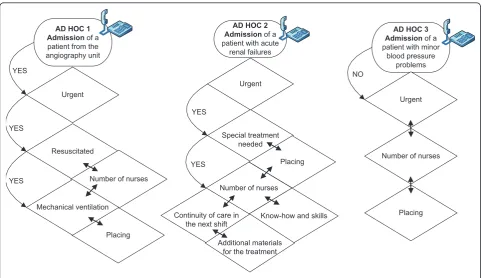
[image:5.595.57.541.89.416.2]AD HOC 1 Admission (see in detail
Figure 2)
AD HOC 2 Admission (see in detail
Figure 2)
AD HOC 3 Admission (see in detail
Figure 2)
SITUATION-FOCUSED
PROCESS-FOCUSED
Pati
ent adm
issi
on
Pati
ent i
nf
orm
ati
on
and
vi
tal
s
igns
Spec
ial treatm
ents
inc
luding m
edic
ation
Diagnos
tic
s i
ncluding
laboratory
and
im
aging
Adv
ers
e ev
ents
P
ati
en
td
isch
arg
e
Human resources and know-how
Material resources
making was a multidisciplinary process in which the roles of ICU shift leaders were not so well-defined. One
ad hocdecision made by either of the shift leaders cre-ated a bundle of ad hocdecisions that were needed to complete the task. Typically, both process-focused and situation-focused ad hoc decision making was then needed. Figure 1 and ad hoc decisions 1, 2 and 3, explained in detail in Figure 2, show some simplified examples of thead hocdecision-making bundles during the daily management of ICU activities. These examples have been extracted from our data. For example, differ-ent kinds of ad hoc decisions have to be made each time a new patient is admitted to the ICU, depending on various factors such as patient condition, urgency level, staffing and patient load.
Discussion
To our knowledge, our study is the first to describe the
ad hocdecision making of ICU shift leaders, including intensivists and charge nurses, during the management of daily ICU activities. Our study shows that ICU shift leaders make numerous ad hocdecisions when mana-ging the daily activities of their units. Our analysis revealed that almost 10 immediately needed ad hoc
decisions per hour are made by the shift leaders, which
presents great challenges for immediate information retrieval.
We identified eightad hocdecision-making categories for ICU shift leaders: (1) adverse events, (2) diagnostics, (3) human resources and know-how, (4) material resources, (5) patient admission, (6) patient discharge, (7) patient information and vital signs and (8) special treatments. These categories covered the whole ICU care process from patient admission to patient dis-charge. Even if thead hoc decisions of the shift leaders differed, the goals and the content underlying their deci-sions were parallel. For example, intensivists made ad hoc decisions about incoming patients and who would be admitted first (patient admission). At the same time, charge nurses, for their part, made ad hoc decisions about the timing and placement of incoming patients (patient admission).
[image:6.595.59.548.97.411.2]Most of the identified ad hoc decisions of the ICU shift leaders were connected to intensive care-specific patient information and the condition of the patient, human resources and know-how of the personnel and special treatments performed in intensive care settings (nearly 80%). This result confirms the basic role of ICU work, in which the most critically ill patients are taken care of by multiprofessional teams and the most Table 3 Definitions ofad hocdecision-making categories and examples
Ad hoccategory Definition Examples
1. Adverse events An injury related to medical management ’Concerning this pinprick accident, I have to order a
blood test for her immediately’.
2. Diagnostics Patient diagnosis, including laboratory and radiology results
affecting ICU work organization ’
Today’s X-ray is OK, so she will be ready to leave’.
3. Human resources and know-how
The amount of staff resources, the knowledge of the ICU personnel and follow-up information and reports
(1)‘In that room, there is one very experienced nurse. It
is enough. I’ll keep it that way’.
(2)‘Two RNs are needed for this patient in the following
shift’.
(3)‘RN XX will be named in the trauma team in the
following shift’.
4. Material resources Materials needed for ICU patient care ’This isolation room is reserved for this patient in the next
shift’.
5. Patient admission Acceptance of patients for ICU care ’The recovery room is booked up, so we have to take this
patient immediately’.
6. Patient discharge Acceptance of patient transfer from ICU care ’If the bleeding stops, he will be discharged when a new
patient is introduced’.
7. Patient information and vital signs
Intensive care-specific patient information and patient’s intensive
care- specific condition
(1)‘We will put her to sleep and then deal with the AF’.a
(2)‘The patient with the highest nursing intensity will
need two nurses in the evening shift’.
(3) The patient’s invasive blood pressure values are too
low, and he is not ready for discharge’.
8. Special treatments ICU-specific care and medication administration (1)‘We will make the sterna closure tomorrow, so
cardiologist consultation today’.
(2)‘Our unit is ready to admit a patient who needs
haemodialysis’.
(3)‘With this patient, we will start an inotrope infusion
and ask for a cardiology consultation’.
a
demanding treatments can be performed by an adequate number of team members and specialised staff. In addi-tion, our study results suggest that thead hocdecision making of ICU shift leaders is complex and overlapping. These findings are supported by previous research on the decision making of ICU personnel [18,19].
Most ad hoc decision making concerns human
resources and know-how. Similar results have been found in previous studies [7,20] in which the informa-tion requirements of the ICU patient care team and multidisciplinary care team in an emergency department have been investigated. Results of previous studies have shown that many clinical questions contain organiza-tional elements which are essential for the coordination of the work.
Both our study and those of Reddy et al. [7,20] showed that clinical decision making is an important part of ad hoc decision making, and it is often con-nected with organizational issues. In our study, the
clini-cal ad hoc decisions were mainly made by the
intensivists, followed by severalad hocdecisions related to organizational issues made by charge nurses. In Reddy and Spence’s study [7], for example, the patients’ conditions were evaluated in relation to the need for beds. Similar aspects were found in our data. Anad hoc
decision made by the intensivist regarding special treat-ment created several ad hocdecisions related to organi-zational issues such as placement of the patient, the
availability and capability of the nurse, the timing of the treatment and ensuring the continuum of care from shift to shift.
In our study the charge nurses made most of the organizational decisions, which mainly concerned human resources and know-how. These organizational elements seem to contribute significantly to the work flow of the ICU. Our results might reflect the organiza-tional culture of the ICUs investigated and how the work was organised and shared by the ICU team. It would be interesting to study this issue further in other ICUs at both the national and international levels.
The amount of different ad hoc decisions gives us information about whichad hocdecisions dominate the ICU shift leaders’work. However, it does not reveal the importance of the ad hocdecisions made. In our analy-sis, we found that the fewest ad hoc decisions made were related to diagnostics, patient discharge, patient admission, material resources and adverse events. How-ever, all of these include extremely important decisions which affect the outcomes of ICU patient care.
Especially in urgent situations, when, for example, patient admission and discharge decisions have to be made immediately, all decisions should be based on accurate, clearly defined information. In previous stu-dies, delays in patient admissions or after-hours dis-charges, for example, have been found to be associated with patient mortality [21,22]. Diagnostics play an
AD HOC 3 Admissionof a patient with minor
blood pressure problems
Urgent
Placing Number of nurses NO
AD HOC 1 Admissionof a patient from the angiography unit
Resuscitated Urgent
Placing Number of nurses
Mechanical ventilation YES
YES
YES
AD HOC 2 Admissionof a patient with acute
renal failures
Special treatment needed
Urgent
Placing
Number of nurses
Know-how and skills Continuity of care in
the next shift YES
YES
[image:7.595.57.540.87.365.2]Additional materials for the treatment
important role in patient care in the ICU, and this cate-gory is closely connected to both admission and dis-charge decisions as well as to immediate changes that are required in care plans. Ad hoc decision making related to adverse events is often vital, since poorly thought out decisions can cause serious complications and even patient mortality [23,24].
ICU care management, coordination and decision-making procedures are strongly supported by the inter-national consensus guidelines [25-27]. These guidelines contain definitions and objectives for the quality of ICU performance. In addition, recommendations for optimal ICU care are provided. However, these guidelines have mainly focused on the material resources needed at cer-tain ICU care levels or in direct patient care, as well as on vital problems of ICU patients. Process-focused deci-sion making has received little attention, and improve-ments in process performance from the multiprofessional point of view are needed [28,29].
Our results reveal that studies concerning only one professional group or one decision-making area are not enough when complex and fast-paced environments such as ICUs are investigated. In our study only very few ad hoc decisions were made by one person. Instead they were a chain of decisions made by several persons. The ad hocdecision making of ICU shift leaders is a team process whereby the final outcome is achieved with the collaboration of charge nurses and intensivists, which requires that severalad hocdecisions be made.
Our study has some strengths and some limitations. One limitation of our study is that we conducted it in only two ICUs and in one country. However, within these two ‘full-service’ICUs, both of which have large ICU patient populations, we managed to obtain rich and saturated data. Our study ICUs were not randomly selected; rather, their selection was purposeful and based on the facts that both units take care of patients with various medical and surgical problems and both have similar operation models in their care organization. A purposeful sample also offered data of good quality. In addition, we did not evaluate the diurnal variation in decision-making frequency, which would be interesting to assess in the future. We hypothesized that more ICU daily activities are performed during morning shifts and created more stress on those choosing the 15 morning shifts to be observed. However, we suggest that the var-iation in decision-making frequency is more dependent on clinical situations than on working shifts. Our study does not provide information about the quality of shift leaders’ decisions (that is, good and bad decisions). To identify the quality of thead hoc decisions made, the whole decision-making process should be followed until the end and the final outcomes related to each decision should then be evaluated. Because of the type of data
we collected, we cannot generalise our resultsper se, but other researchers can utilise the results in future research by testing them in other ICU settings.
A challenge in our study was combining the think-aloud technique with protocol analysis, especially the difficulty of compiling research on decision making in real settings. Think-aloud is used quite often in observa-tional studies in health care [4,30,31]. However, protocol analysis in combination with think-aloud has rarely been used in acute clinical settings in health care. Alterna-tively, we could have used pure observation or intro-spection as a method of investigating the ad hoc
decision making of shift leaders. However, with observa-tion, a researcher might miss or misread a significant part of decision making. On the other hand, introspec-tion involves interpretaintrospec-tions by the participants them-selves, which might affect the results (see, for example, [32]). In our study, we were interested in evaluatingad hocdecisions that had to be made immediately. It is not likely that the Hawthorne effect would play a significant role in this kind of decision-making situation. In our study, the think-aloud technique combined with proto-col analysis functioned well. The participants in our study were capable of verbalizing their thinking. In addi-tion, with protocol analysis, we were able to find and classify thead hocdecision making.
The observational study design itself is a big challenge when complex phenomena are investigated in ICU set-tings. Even the shadowing of one participant whose work is to make many different decisions all the time was demanding. In our study, we used only one observer and recorder with one participant during one shift with the aim of covering the whole ICU situation as well as possible. Many details should be considered carefully when more than one decision maker, or shared decision making, is observed simultaneously. These details are, for example, time labels in starting and ending multiple decisions and differentiatingad hoc decisions aimed at the same targets from other decisions made at the same time. Combining handheld computers with work obser-vations as Westbrook and Ampt tested in their study [33] using our study method could be an entirely novel way to look at this phenomenon in the future.
making of ICU professionals and standardizing the poli-cies of the ICUs. However, different cultures and team functions might have some effect on decision-making processes in different ICUs.
Conclusions
Our study describes thead hocdecision making of ICU charge nurses and intensivists during the daily manage-ment of ICU activities. This study highlights the com-plex and fundamental phenomenon ofad hocdecision making in a real clinical ICU context. We have shown that ICU shift leaders make a vast number of ad hoc
decisions concerning the entire ICU care process. Orga-nizational issues are greatly emphasised. In addition, the
ad hoc decision making of ICU shift leaders appears to be a multiprofessional process in which severalad hoc
decisions are needed to complete one task. By identify-ing ICU shift leaders’ ad hocdecisions and this multi-professional process, we will be able to reveal what kind of information is needed in challenging clinical settings. Further research is required to identify what information needs are fundamental for ICU shift leaders in ad hoc
decision-making situations. In the future, this will help us to develop electronic decision-making support and management systems for ICUs.
Key messages
•ICU shift leaders make numerous immediate decisions during the management of daily activities.
•Thead hocdecision making during the management of daily ICU activities is a multiprofessional process, and the final outcome is usually achieved through multiple immediate decisions, a bundle ofad hocdecisions.
•Thead hocdecision making of ICU shift leaders is not a linear process, and it involves various areas of ICU care. The organizational issues are highly emphasised throughout the daily management of ICU activities.
• In the future, the ad hoc decision making of ICU shift leaders and access to the most crucial information should be confirmed.
Acknowledgements
The authors gratefully thank the participating units for their collaboration and the charge nurses and intensivists who attended the study observations. This study was funded by the Finnish Funding Agency for Technology and Innovation, Tekes (grant 40020/07), the Finnish Cultural Foundation and The Hospital District of Southwest Finland special grant-in-aid (EVO). Part of this study was presented at the 21st Annual Congress of the European Society of Intensive Care Medicine (ESICM) in September 2008 in Lisbon, Portugal.
Author details
1Department of Nursing Science, University of Turku, Lemminkäisenkatu 1,
FI-20014 Turku, Finland.2Bureau of Administration, Turku University Hospital,
PO Box 52, FI-20521 Turku, Finland.3Faculty of Telecommunication and
E-Business, Turku University of Applied Sciences, Joukahaisenkatu 3 A, FI-20520
Turku, Finland.4Department of Anaesthesia and Intensive Care, Turku
University Hospital, PO Box 52, FI-20521 Turku, Finland.5The Finnish Medical
Association (FMA), PO Box 49, FI-00501 Helsinki, Finland.
Authors’contributions
HLL designed the study, performed the observations, analysed the data and drafted the manuscript. EK acted as an intercoder and made comments on the manuscript. HK, JP and JF helped to draft the manuscript. SS supervised the study, assisted in the design of the study and prepared the final manuscript with HLL. All authors read and approved the final manuscript.
Competing interests
The authors declare that they have no competing interests.
Received: 13 April 2011 Revised: 11 July 2011 Accepted: 8 August 2011 Published: 8 August 2011
References
1. Ward NS, Snyder JE, Ross S, Haze D, Levy MM:Comparison of a
commercially available clinical information system with other methods of measuring critical care outcomes data.J Crit Care2004,19:10-15.
2. van Lieshout EJ, de Vos R, Binnekade JM, de Haan R, Schultz MJ, Vroom MB:
Decision making in interhospital transport of critically ill patients: national questionnaire survey among critical care physicians.Intensive Care Med2008,34:1269-1273.
3. Fackler JC, Watts C, Grome A, Miller T, Crandall B, Pronovost P:Critical care
physician cognitive task analysis: an exploratory study.Crit Care2009,13: R33.
4. Aitken LM, Marshall AP, Elliott R, McKinley S:Critical care nurses’decision
making: sedation assessment and management in intensive care.J Clin
Nurs2009,18:36-45.
5. Garg AX, Adhikari NK, McDonald H, Rosas-Arellano MP, Devereaux PJ,
Beyene J, Sam J, Haynes RB:Effects of computerized clinical decision
support systems on practitioner performance and patient outcomes: a systematic review.JAMA2005,293:1223-1238.
6. Reader TW, Flin R, Mearns K, Cuthbertson BH:Developing a team
performance framework for the intensive care unit.Crit Care Med2009,
37:1787-1793.
7. Reddy MC, Spence PR:Collaborative information seeking: a field study of
a multidisciplinary patient care team.Inf Process Manag2008,44:242-255.
8. Aslakson RA, Wyskiel R, Shaeffer D, Zyra M, Ahuja N, Nelson JE,
Pronovost PJ:Surgical intensive care unit clinician estimates of the
adequacy of communication regarding patient prognosis.Crit Care2010,
14:R218.
9. Manor-Shulman O, Beyene J, Frndova H, Parshuram CS:Quantifying the
volume of documented clinical information in critical illness.J Crit Care
2008,23:245-250.
10. Najjar-Pellet J, Jonquet O, Jambou P, Fabry J:Quality assessment in
intensive care units: proposal for a scoring system in terms of structure and process.Intensive Care Med2008,34:278-285.
11. Centricity™Critical Care.[http://www.gehealthcare.com/euen/iis/products/ acute-care/iis_acute_care.html].
12. Ericsson KA, Simon HA:Protocol Analysis: Verbal Reports as Data.Revised
edition edition. Cambridge, MA: MIT Press; 1993.
13. Kushniruk AW:Analysis of complex decision-making processes in health
care: cognitive approaches to health informatics.J Biomed Inform2001,
34:365-376.
14. Hsieh H, Shannon S:Three approaches to qualitative content analysis.
Qual Health Res2005,15:1277-1288.
15. Bazeley P:Qualitative Data Analysis with NVivo.2 edition. London: Sage
Publications; 2007.
16. Ludgrén-Laine H, Salanterä S:Think-aloud technique and protocol
analysis in clinical decision-making research.Qual Health Res2010,
20:565-575.
17. Medical Research Act.[http://www.finlex.fi/fi/laki/kaannokset/1999/ en19990488.pdf].
18. Aitken L:Critical care nurses’use of decision-making strategies.J Clin
Nurs2003,12:476-483.
19. Cooper AB, Joglekar AS, Gibson J, Swota AH, Martin DK:Communication of
20. Reddy MC, Pratt W, Dourish P, Shabot MM:Asking questions: information needs in a surgical intensive care unit.Proc AMIA Symp2002, 647-651.
21. Cardoso LT, Grion CM, Matsuo T, Anami EH, Kauss IA, Seko L,
Bonametti AM:Impact of delayed admission to intensive care units on
mortality of critically ill patients: a cohort study.Crit Care2011,15:R28.
22. Singh M, Nayyar V, Clark P, Kim C:Does after-hours discharge of ICU
patients influence outcome?Crit Care Resusc2010,12:156-161.
23. Flaatten H, Hevrøy O:Errors in the intensive care unit (ICU): experiences
with an anonymous registration.Acta Anaesthesiol Scand1999,43:614.
24. Flaatten H:Self-reporting of errors and adverse events in the intensive
care unit (ICU).InOrganisation and Management of Intensive Care.Edited by: Flaatten H, Putensen C, Moreno RP, Rhodes A. Berlin: MWV Medizinisch Wissenschaftliche Verlag; 2010:369-373.
25. Ferdinande P:Recommendations on minimal requirements for Intensive
Care Departments. Members of the Task Force of the European Society of Intensive Care Medicine.Intensive Care Med1997,23:226-232.
26. Haupt MT, Bekes CE, Brilli RJ, Carl LC, Gray AW, Jastremski MS, Naylor DF,
Rudis M, Spevetz A, Wedel SK, Horst M, Task Force of the American College
of Critical Care Medicine, Society of Critical Care Medicine:Guidelines on
critical care services and personnel: recommendations based on a system of categorization of three levels of care.Crit Care Med2003,
31:2677-2683.
27. Thijs LG:Continuous quality improvement in the ICU: general guidelines.
Task Force European Society of Intensive Care Medicine.Intensive Care
Med1997,23:125-127.
28. Garland A:Improving the ICU: part 1.Chest2005,127:2151-2164.
29. Rothen HU, Stricker K, Einfalt J, Bauer P, Metnitz PG, Moreno RP, Takala J:
Variability in outcome and resource use in intensive care units.Intensive Care Med2007,33:1329-1336.
30. Qiu Y, Yu P:Nursing information systems: applying usability testing to
assess the training needs for nursing students.Methods Inf Med2007,
46:416-419.
31. Johnson C, Zeiger R, Das AK, Goldstein M:Task analysis of writing hospital
admission orders: evidence of a problem-based approach.AMIA Annu Symp Proc.2006, 389-393.
32. McCarney R, Warner J, Iliffe S, van Haselen R, Griffin M, Fisher P:The
Hawthorne Effect: a randomised, controlled trial.BMC Med Res Methodol
2007,7:30.
33. Westbrook JI, Ampt A:Design, application and testing of the work
observation method by activity timing (WOMBAT) to measure clinicians’ patterns of work and communication.Int J Med Inform2009,78S:S25-S33.
34. Lauri S, Salanterä S:Developing an instrument to measure and describe
clinical decision making in different nursing fields.J Prof Nurs2002,
18:93-100.
doi:10.1186/cc10341
Cite this article as:Lundgrén-Laineet al.:Managing daily intensive care
activities: An observational study concerningad hocdecision making of
charge nurses and intensivists.Critical Care201115:R188.
Submit your next manuscript to BioMed Central and take full advantage of:
• Convenient online submission
• Thorough peer review
• No space constraints or color figure charges
• Immediate publication on acceptance
• Inclusion in PubMed, CAS, Scopus and Google Scholar
• Research which is freely available for redistribution