46 | P a g e
Georgian High School Students’ Attitudes towards Classroom Reading
Maia CHKOTUA* Tamar TARASHVILI**
Abstract
Reading is widely accepted as one of the most important second/foreign language skills as it offers language learners the opportunity to acquire a variety of lexical items, grammatical structures, and additional schematic knowledge. It is quite difficult to motivate language learners to read more in the classroom. Many school teachers are unaware of specific ways and strategies to motivate language learners to read. The study aimed to investigate Georgian 10th grade students’ motivation to learn language and their attitudes towards classroom reading. The sample of the study consisted of fifty students. The results of the study indicated that students were more motivated integratively than instrumentally. Classroom reading was less interesting for them because they were less interested in the topics included in their text books. It can be concluded that there is a need for more varied and interesting reading topics to increase students’ motivation towards classroom reading. The goal of the paper is to show to teachers that students, on the one hand, realize the importance of classroom (i.e., intensive) reading, but, on the other hand, are bored with the way it is normally taught. It is teachers’ task to find out the students’ needs and motivation and to take measures to increase the motivation.
Keywords: Instrumental motivation, integrative motivation, language, motivation, reading, teaching.
Introduction
It has always been a major goal in education to encourage motivation and try to make learning interesting for students. The term motivation is derived from the Latin “movere”, meaning “to move”, and is commonly defined as a cluster of factors that energizes behavior and gives it direction. Given the extraordinarily multidimensional nature of motivation, it is difficult to study, but perhaps it can best be analyzed by focusing on what causes people to perform a task (Beck & Jessup, 2004). Words like “choice”, “persistence” and “effort” can be associated with motivation and it is connected to why people decide to do something or for how long and hard they will pursue a task.
* Assoc. Prof. Dr., International Black Sea University, Tbilisi, Georgia. E-mail: [email protected]
47 | P a g e Motivation can affect how students approach school in general, how they relate to teachers, how much time and effort they devote to their studies, how much support they seek when they are struggling, how they perform in tests, and many other aspects of education. If students are not motivated, it is difficult, if not impossible, to improve their academic achievement, no matter how good the teacher, curriculum or school is. Moreover, unmotivated students can disengage other students from learning, which can affect the environment of an entire classroom or school.
According to Gardner and Macintyre (1993), student motivation is the main thing for developing all skills that are necessary for studying a foreign language. There are many ways how to improve students’ motivation:
Giving students a sense of control Defining the objectives
Creating a threat-free environment Offering varied experience Using positive competition Encouraging self-reflection
Helping students to find intrinsic motivation.
Besides, the best lessons, books and materials in the world will get students excited about learning and willing to work hard if they are not motivated. According to our everyday experience, we can draw a conclusion that one of the reasons students’ lack of interest towards reading texts at the lesson is that they do not like the topics that are included in their course books.
The importance of reading in foreign language teaching
Many educators such as Carrell, Devine, & Eskey (1988) believe that reading is the most important foreign language skill. It is very fundamental when high school students have the ability to read in English as a foreign language. As Alderson (2000) stated, the reading skills could assist ESL/EFL learners to achieve success in every field and in other content-based courses where English reading proficiency is essential. Reading has always played a major role in the improvement of other language skills, as well as in academic success. It is one of the most important skills for learners to expand their knowledge of the language, culture, and the world. Learners can get the information they need through reading different materials, such as magazines, newspapers, novels, books, journals, and so on. With strengthening reading skills, EFL readers will make greater progress and attain greater development in all academic areas.
48 | P a g e Developing proper reading skills is a long process which requires interest, motivation and perseverance, because only by practicing continuously can one become a better reader.
Factors demotivating high school language learners in reading
A feature shared in most foreign language classrooms where the language in question is a compulsory school subject is demotivation. Dörnyei (2001) defined demotivation as “specific external forces that decrease or diminish the motivational basis of a behavioral intention or an ongoing action” (p. 142).
It should be noted that not all challenges of reading are necessarily demotivating factors. Dörnyei (2001) names among demotivating factors the gradual loss of interest in a prolonged activity, and the cost-benefit that is too high. Kikuchi (2008) identified five factors of demotivation in high school EFL learners: course content and material; teacher competence and teaching style; inadequate school facilities; lack of intrinsic motivation, and test scores. Except school facilities, all are to a higher or lesser degree, under teacher control. Many researchers found that, beised external factors, internal factors can cause demotiavation, such as lack of self-confidence and negative attitude (Arai, 2004; Falout & Maruyama, 2004; Tsuchiya, 2006).
Muhonen (2004) discovered the main demotivating sources in connection to students’ gender and level of success at school. Through the analysis of ninth-grade students’ papers, the following demotivating sources were discovered: 1) Teacher, 2) Learning material, 3) Learner characteristics, 4) School environment, and 5) Student’s attitude towards English. The discoveries revealed that the most demotivating source was teacher in all grades and the least demotivating factor was attitude towards the language. However, he also found that male students more often attributed demotivation to the teacher, while learning material was thought more demotivating by female students.
A study conducted by Keblawi (2005) in the field of motivation and demotivation found out that the personality of the teacher, teaching methods, learning context in addition to the learners’ attitudes towards target language could play an important role in the learners’ motivation or demotivation toward language learning.
Teaching reading in Georgian high schools
Nowadays teaching English in our country is a priority. As a proof, the knowledge of English is a requirement for being employed at the majority of organizations. Besides, there is great state support for providing foreign (normally, English) language knowledge, and many projects finance free-of-charge language courses.
49 | P a g e what students know on the topic as well as to help them guess what the text is about (based on the title, subtitles and probably some pictures). After that the teacher asks students to read the text aloud (piece by piece, in chain). While one student reads, other students listen to him/her. During reading they underline those phrases or words which hinder the comprehension. This helps students to be involved in reading. Later they elicit the meaning from the teacher, but they mostly expect translation, which is not appropriate. The process of reading aloud is not very communicative either, and it concentrates on language more than on contents. In other cases, teachers use tape recorder and before students read the text silently / aloud themselves, students listen to it and try to understand the main idea of the text. After reading students answer some factual questions (to check the comprehension) and may (depending on the level of their English skills) have a discussion on some topic related to the text. For a more advanced class, questions may not deal with facts, instead, students may answer questions like “Why?”, “How?”, “What are the relations between …”, “What / who did you like / dislike and why?” These are the common activities which normally follow reading texts. And it is the same for the school where the study was held.
Method
Quantitative method was chosen as the method for the research. The reason for this was that it enables one to gather a large amount of data from respondents in relatively little time. A questionnaire was applied as a measurement tool. Analyzing the data gathered from questionnaires is both time efficient and objective (Stewart, 2009. p.25). The questionnaires were anonymous and took only several minutes to complete. The research was conducted during 2014-2015 academic year, spring semester. 50 high school students, from LEPL V. Komarovi Tbilisi Physics and Mathematics N199 Public School, took part in the research.
The questionnaire was divided into two parts: Survey 1 and Survey 2. Survey 1 concerned the students’ reasons for studying the English language, determining whether they were more intergaratively or instrumentally motivated, while Survey 2 concerned the students’ attitudes towards classroom reading. The questionnaire used for the research consisted of different types of questions: Likert scale format for Survey 1 and multiple choice format for Survey 2. Likert scale format required that students indicate how much they agreed with the given statement, on a scale from 1 to 5 (Strongly disagree/Disagree/Neither agree nor disagree/Agree/Strongly agree).
Results of Survey 1
50 | P a g e
# item motivation type mean
results 1 I mainly focus on using English for class assignments and the
exams.
instrumental 2.28
2 I simply quote the textbooks and do not really communicate when speaking or writing in class.
instrumental 2.36
3 I am interested in reading only English textbooks for my study, but not other English texts e.g. newspapers, magazines.
instrumental 2.96
4 I am more interested in earning a university degree and a good job than learning English language itself.
instrumental 3.68
5 I am more interested in furthering my higher education than learning English language itself.
instrumental 3.4
6 Learning English is important for travelling abroad. integrative / instrumental
4.32
7 Learning English is important for making me a knowledgeable and skillful person.
instrumental 3.68
8 Learning English is important for making me an educated person.
instrumental 3.8
9 Being proficient in English can lead to more success and achievements in life.
instrumental 4.08
10 Being proficient in English makes other people respect me. integrative 3.32 11 Studying English enables me to understand English books,
movies, pop music, etc.
integrative / instrumental
4.36
12 Studying English enables me to better understand and appreciate the ways of life of native English speakers.
integrative 3.64
13 Studying English enables me to keep in touch with foreign acquaintances.
integrative 3.56
14 Studying English enables me to discuss interesting topics in English with the people from other national backgrounds.
integrative 4.28
15 Studying English enables me to transfer my knowledge to other people, e.g. giving directions to tourists.
Integrative / instrumental
4.24
16 Studying English enables me to participate freely in academic, social, and professional activities among other cultural groups.
Integrative / instrumental
3.96
17 Studying English enables me to behave like native English speakers: e.g. accent, using English expressions.
51 | P a g e 18 Studying English enables me to appreciate English arts and
literature.
integrative 3.76
19 Studying English helps me to be an open-minded and sociable person like English speaking people.
integrative 2.96
20 I am determined to study English as well as I can to achieve maximum proficiency.
Integrative / instrumental
3.92
We can conclude according to the results summarized in Table 1 that the average points for instrumental motivation are 3.28 (between 2.28 and 4.08), while for integrative – 3.64 (between 2.96 and 4.28), so the levels of the two types of motivation are close enough, however, integrative is viewed by the students as more important. The average results for the items that are linked to simultaneously integrative and instrumental motivation, they are the highest – 4.16 (between 3.92 and 4.36), what supports our idea that both types of motivation matter for the respondents.
Results of Survey 2.
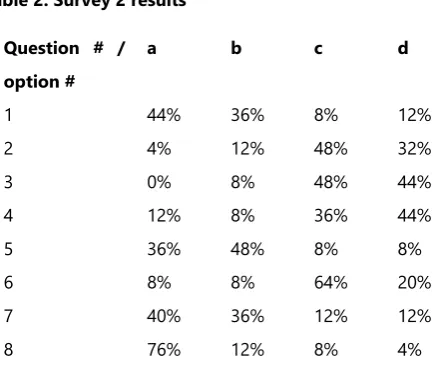
Survey 2, which consisted of 8 questions, was conducted to measure high school students’ attitudes towards classroom reading. The results are shown in Table 2 below (the questions as well as the options are given below, together with the discussion).
Table 2: Survey 2 results Question # / option #
a b c d
1 44% 36% 8% 12%
2 4% 12% 48% 32%
3 0% 8% 48% 44%
4 12% 8% 36% 44%
5 36% 48% 8% 8%
6 8% 8% 64% 20%
7 40% 36% 12% 12%
8 76% 12% 8% 4%
According to the survey 2 results, respondents’ answers to the questions are as follows: Question 1: I think that classroom reading is
52 | P a g e For the majority of the students (44%), classroom reading was a boring way to spend time. Only 36% of the students considered that it was a good way to spend time, for 8% classroom reading was an interesting way to spend time and for 12% students it was the great way to spend time.
Question 2: Classroom reading passages are a. very interesting and up-to-date b. not very interesting and up-to-date c. interesting and up-to-date d. not interesting and up-to-date
For the majority of the respondents classroom reading passages were not very interesting and up-to-date (48%). 32% thought that they were not interesting and up-to-date, only 4% considered them very interesting and up-to-date (4%) and 12% responded that they were interesting and up-do-date.
Question 3: The reading topics generate discussion and argument a. always
b. rarely
c. almost never d. never
The majority (48%) of the students considered that reading topics almost never generated discussion and argument, still many (44%) students considered that they never generated discussion or argument, for 8% reading topics were rarely generating discussion and argument. None of the respondents considered that the suggested topics always generated discussion and argument.
Question 4: Classroom reading activities are a. very interesting for me b. neither interesting nor boring for me c. not interesting for me d. boring for me
As a result, for eleven students (44%) reading activities were boring, for nine students (36%) activities were not interesting. Only for 12% they were very interesting and 8% considered classroom activities neither interesting nor boring.
Question 5: When my teacher asks me a question about what I have read during the lesson, I a. can never think of an answer
b. sometimes think of an answer
53 | P a g e d. always think of an answer
When the teachers ask them a question about what they read during the lesson, the majority of the students (48%) could sometimes think of an answer, whereas 36% could never think of an answer, only 8% could always think of an answer and 8% had trouble thinking of an answer.
Question 6: What genre(s) of texts do you enjoy reading? a. romance
b. c. multicultural c. science fiction d. historical fiction
For eighteen students (64%) multicultural texts were enjoyable to read, only for five students (20%) historical fiction texts were interesting, romance and science fiction were enjoyable for two students (8%) each.
Question 7: When I am talking about a reading passage in a group, I a. never express my ideas
b. seldom express my ideas
c. sometimes express my ideas d. always express my ideas
40% of the students never shared their ideas in class concerning the reading passage. 36% seldom did it, whereas 12% sometimes did it and only 12 % always did it.
Question 8: I would like my teacher to bring the reading tasks a. every day
b. almost every day c. once in a while
d. never
Most of the students would like their teacher to bring extra reading tasks every day (76%), 12% of the students wanted to bring almost every day, 8% would like it once in a while, and only 4% would never like to have extra reading tasks (4%). It means that students realize the importance of classroom reading, but would like it to be different from how it is at the moment.
To summarize survey 1 and survey 2, we can say that the majority of the respondents want to learn English, it is important for them, because this helps them both to become more developed and educated people and integrate into various groups of society that use it for communication. Unfortunately, the reading lessons (texts, topics and activities) are not really motivating, this is why they are hardly engaged in the classroom activities.
54 | P a g e Muftah and Rafik-Galea (2013) in their study held with 182 non-English major prep-school students in one of the Malaysian public universities found that more students had instrumental motivation however, their integrative motivation is high, too. In Lai’s (2013) study a total of 267 undergraduate students from a science and technology university in New Taipei City, Taiwan, participated. They revealed that they approximately equally possess instrumental and integrative motivation. Logically, for a country where English is a foreign and not a second language (a language learned in its environment), it would not have integrative motivation stronger than instrumental one. However, if young people want very much to go abroad for study or work, to feel there at home while travelling, to be part of international professional community, which normally speaks English, then their integrative motivation will also be high. Unfortunately, no publications on the distributions of these types of motivation could be found to compare them to the presented research. However, based on qualified guess, it is possible to say that the situation is similar in Georgia.
Limitations of the study
Of course, a study held with 50 students in one school situated in the capital city cannot describe the whole picture in Georgia, but it does show a typical enough situation.
Conclusions
It is possible to conclude that the process of reading is a highly interactive process between the students and their prior background knowledge, on the one hand, and the text itself, on the other. So a lot depends on what kinds of texts are offered to students and how interesting they are for them.
Being able to motivate students is a crucial skill that high school teachers should aspire to attain; however, teachers often miss opportunities to capitalize on the strengths of their students by not tapping into what excites them. Once teachers understand the benefits of their efforts, both in student performance and attitude, they will be likely motivated to change the culture of their classrooms, to make them exciting places.
High school teachers need to be able to determine what will motivate each of their students to read. The first step in this differentiation of teaching is discovering the perceptions that particular student groups possess in regard to reading. It is good if the teacher finds out the motivation type (integrative, instrumental or mixed) of his/her class and teaches (chooses texts, topics, and activities) accordingly, also does it with more enthusiasm and emotion, in a lively, interactive and creative way.
55 | P a g e The goal of Survey 2 was to reveal the high school students’ attitudes towards classroom reading. The results showed that they had less interest in the classroom reading, as they considered it boring. It could be the foundation for the further research to offer students more interesting reading materials that would increase their motivation.
References
Alderson, J. C. (2000) Assessing Reading. Cambridge: Cambridge University Press.
Arai, K. (2004). What ‘demotivates’ language learners?: Qualitative study on demotivational factors and learners’ reactions. Bulletin of Toyo Gakuen University, 12, 39-47.
Beck, R. & Jessup, R.K. (2004). The multidimensional nature of quest motivation. Journal of Psychology and Theology, 32(4), 283-292.
Carrell, P.L., Devine, J., & Eskey, D.E. (1988). Interactive Approaches to Second Language Reading. Cambridge, England: Cambridge University Press.
Dörnyei, Z. (2001). Motivational Strategies in the Language Classroom. Cambridge: Cambridge University Press. Falout, J. & Maruyama, M. (2004). A comparative study of proficiency and learner demotivation. The Language
Teacher, 28(8), 3-10.
Gardner, R.C. & MacIntyre, P.D. (1993). A student’s contribution to second language learning. Part II: Affective variables. Language Teaching, 26, 1-11.
Keblawi, F. (2005). Demotivation among Arab Learners of English as a Foreign Language. The Reading Matrix, Inc. United States. Retrieved May 3, 2015 from www. Reading matrix.com/ online conference proceedings 2005. Kikuchi, K. (2008). Teachers’ strategies to avoid students’ demotivation: A perspective from survey studies.
Anthology Series, 43, 142-147.
Lai, H.-Y. T. (2013). The motivation of learners of English as a foreign language revisited. International Education Studies, 6, 10, 90-101
Muftah, M. & Rafik-Galea, S. (2013). Language learning motivation among Malaysian pre-university students.
English Language Teaching; 6, 3, 92-103.
Muhonen, J. (2004). Second Language Demotivation: Factors That Discourage Pupils from Learning the English Language (Unpublished Pro Gradu thesis).University of Jyväskylä, Jyväskylä, Finland.
Stewart, A.M. (2009). A Research Guide for Students and Teachers. USA: State University of New York.