www.ijsernet.org Page 70
INTEGRATING NAQLI AND AQLI ELEMENTS IN PROBLEM BASED
LEARNING (PBL) ENVIRONMENT
Syadiyah Abdul Shukor1, Mohammad Noorizzuddin Nooh2, AzrulAzlan Iskandar Mirza3
1Faculty of Economics and Muamalat, Universiti Sains Islam Malaysia (USIM)([email protected])
2Faculty of Economics and Muamalat, Universiti Sains Islam Malaysia (USIM) ([email protected])
3Faculty of Economics and Muamalat, Universiti Sains Islam Malaysia (USIM) ([email protected])
ABSTRACT
Problem Based Learning (PBL) is a student centered approach learning process that gives power to the leaners to explore and connect the dots between theories and practice. This study aims to examine students’ feedback after they have participated in PBL and to identify skills improved by students after they have experienced PBL process using 5 Ladders of Active Learning with the integration of Naqli and Aqli elements in learning Marketing Financial Services course. A total of 232 students enrolled in Marketing Financial Services course participated in the study. Results showed a positive response from the students with regards to their experience in participating in PBL that integrate the Naqli and Aqli elements. Other than that, students felt that through PBL, they have improved thinking skills, problem-solving skills, self-respect and the respect of others, and team working skills.
Keywords: Problem Based Learning (PBL), Naqli and Aqli, skills
1. INTRODUCTION
The 21st century learning environment requires changes to be done to the teaching strategies in which emphasis is being focused on creating a learning environment based on student centered learning. Thus, students are expected to be more active in participating in the learning activities. In this era, lecturers are no longer the center of knowledge and the students are required to seek knowledge through proper facilitation from the lecturers. One of the answer to this new challenge is through problem-based learning approach. PBL is a learning process involving working with problems. It is a student centered approach that gives power to the leaners to explore and connect the dots between theories and practice (Savery, 2006).
www.ijsernet.org Page 71 a) strengthen the skills to learn the principles, concepts and learning to use information in a
variety of situations.
b) develop the skills in giving arguments and opinions, critical thinking, and decision-making skills.
c) integrate knowledge in various disciplines and a good understanding of the role of humanitarian attitude towards the advancement of professionalism.
d) expose students to the concept of lifelong learning.
e) encourage small group learning; the need for effective teamwork and collaborative learning
2. PROBLEM BASED LEARNING (PBL)
The Malaysian primary and secondary education systems have long be exam oriented through compulsory exams starting from Ujian Peperiksaan Sekolah Rendah (UPSR), PT3, Sijil
Peperiksaan Malaysia (SPM) and Siji lPeperiksaan Tinggi Malaysia (STPM). The common
teaching methods in the primary and secondary education systems is focusing on a teacher-centered learning approach. Through this approach, it has been identified that there are difficulties in producing graduates with excellent generic skills even though they excel academically(Othman & Mustafa, 2005). Graduates play major roles in nation building. Changes and restructuring in higher education in Malaysia are currently happening at a rapid phase in order to produce high quality graduates.
According to Montgomery (Montogomery, 2000), one of the benefits of PBL compared to other teaching method proposed by the constructivism theorists is to promote cognitive simulation among students so that they will be more inquisitive towards things that they are learning. Thus, it will increase motivations among the students to learn new subjects thoroughly. A student-centered classroom can be defined as a classroom where the students are actively involved in the learning process(Utecht, 2003).According to Smith(Smith, 1997) and Edward (Edward, 1995), there are five processes in problem solving. These processes are:
a) Problem identification
www.ijsernet.org Page 72 b) Analyze the problem and collect data
Students need to collect data and make analysis, the information obtained. Hamid (Hamid, 2003)states that there are a variety of data collection techniques. For example, bone diagram (analysis: couse and effect), Pareto charts, pie charts, flow charts and others.
The process of analyzing this issue needed to develop thinkin skill by considering all the possibilities vaailable. The objective of this stage is to find the cause of these problems. According to Gary and Goodpaster(Kirby, Goodpaster, & Jeffery, 2002), a problem can not be resolved until the source of the problem is found. Some questions need to be asked such as what, where, when, who and how the problem occurred. The problem is analyzed from various angles as well as the importance of the issue, the personal experience, reactions of others, costs, location, and comparison with other issues(Hamid, 2003).
At this stage, students can validate the authenticity of the information obtained and identify lecturers that can be consulted to solve the problem. In addition, students are able to find the cause of the problem. Students also need to discuss and share information with other group members as well as the need to make sure whether the information collected is sufficient.
c) Decision making
Students need to make a selection with the proper solution and ensure that progress is made based on the best solution. In addition, students must have strong reasons to support the completion of the acquisition. The selection of this solution is generated by using a variety of methods to ensure the quality of ideas obtained. Hamid(Hamid, 2003) states that one method is brainstorming in order to find solutions. De Janasz (De Janasz, 2002)argues that this method will promote many ideas to solve the problem because this method is a technique in which a lot of people from one group sharing ideas on a particular matter without criticizing. This open discussion within the group are encouraged to generate creative ideas. This method is suitable for working in a dynamic group.
d) Identify the best solution
www.ijsernet.org Page 73 e) Implement the decision
Mohd Azhar Abdul Hamid(Hamid, 2003) states that all four levels above contained only in the planning stage. After determination of alternative solutions, it should be implemented with the right technique and the right. It also helps solve the problem of organizing the implementation process and test whether the results are expected to be generated or not.
In PBL session the trigger materials are the key that generate the learning issues pertaining to the learning objectives of a particular problem (Arzuman, 2010
Specifically, PBL was introduced to this classroom in order to:
1. Stimulate students’ thinking ability. 2. Promote group work.
3. Reduce the dependency of students to PowerPoint presentation slides normally given by the lecturers at the beginning of the semester.
4. Enhance students’ critical thinking ability. 5. Challenge the students to think outside the box. 6. Give the students the ability to reflect on their work.
1. INTEGRATION OF NAQLI AND AQLI IN PBL
Islam has established a fundamental to be followed, namely the Holy Quran and the teaching of Prophet Muhammad PBUH. It includes the whole life process including teaching and learning. Moreover, Allah has been a best and great teacher and its teaching method to the Prophet Muhammad PBUH. Allah said Allâh has sent down to you the Book (The Qur'ân), and Al-Hikmah (Islâmic laws, knowledge of legal and illegal things i.e. the Prophet's Sunnah - legal ways), and taught you that which you knew not. And Ever Great is the Grace of Allâh unto you (O Muhammad SAW). – Holy Quran 4:113
www.ijsernet.org Page 74 PBUH, as the best example for human being, provided his life as sunnah (traditions), to be followed by fellow Muslims.
In teaching, PBL is not new. It has been cited in the sunnah of prophet PBUH. For example, Abu Umamah reported, “A young man came to the Prophet, peace and blessings be upon him, and he said, “O Messenger of Allah, give me permission to commit adultery.” The people turned to rebuke him, saying, “Quiet! Quiet!” The Prophet said, “Come here.” The young man came close and he told him to sit down. The Prophet said, “Would you like that for your mother?” The man said, “No, by Allah, may I be sacrificed for you. People would not like it for their mothers.” The Prophet said, “Would you like that for your daughter?” The man said, “No, by Allah, may I be sacrificed for you. People would not like it for their daughters.” The Prophet said, “Would you like that for your sister?” The man said, “No, by Allah, may I be sacrificed for you. People would not like it for their sisters.” The Prophet said, “Would you like that for your aunts?” The man said, “No, by Allah, may I be sacrificed for you. People would not like it for their aunts.” The Prophet placed his hand on him and he said, “O Allah, forgive his sins, purify his heart, and guard his chastity.” After that, the young man never again turned to anything sinful. In another narration, the Prophet said to him, “Then hate what Allah has hated, and love for your brother what you love for yourself.” – Musnad Imam Ahmad, no 21708
In teaching perspective, this hadith shows that the prophet PBUH provides answer to the question by only throwing a question. This young man could understand the root problem and therefore could solve his problem by himself. In this case, it should be enough if the prophet PBUH just only ask a question, but it has been repeated on another perspective so that enhance his confidence to develop his foundation of knowledge.
www.ijsernet.org Page 75 The prophet PBUH in this hadith clearly ask Mu’adh to use his best effort to solve the problem of people. Early, he confirmed the methodology that will be used to determine the judgment.
2. METHODOLOGY
PBL was implemented in tutorial classes starting from the second week of semester. Every tutorial was assigned with a tutor who assumed the roles as a facilitator. The trigger was introduced in the tutorial session which normally ended between one and half hour to two hours. Students were divided in groups of eight. Students were organized in groups that represent different skills in order to achieve team dynamics(Faculty of Development and Instructional Design Center, Northern Illinois University, NA). During the first session, most of the students are confused and puzzled because this was the first time they were introduced to PBL formally. The tutors were using the 5 Ladders of Active Learning Methods as learning steps in the PBL process (Othman, Salleh, & Sulaiman, 5 Ladders of Active Learning: An Innovative Learning Steps in PBL Process, 2013). In these 5 ladders, students will be exposed to the identification of learning issues (Ladder 1), self-directed learning (Ladder 2), group reporting (Ladder 3), presentation (Ladder 4) and overall reflection (Ladder 5)(Othman, Salleh, & Abdullah , An Innovative Learning Cycle in Problem-Based Learning, 2014).
During the proses of identifying the learning issue (Ladder 1), the student will use the FILA table(Suvannatsiri & Santichaianant, 2013). During this process, the students are required to write down the fact (F), ideas (I), learning issue (L) and actions (A) required in exploring the issues. In preparing the FILA table, students were asked to explore the learning issues from Naqli and Aqli perspective. Students have to assume several roles during the PBL sessions and these roles changes every week(Nooh, 2014). The roles assumed by the students throughout the semester include group leader, secretary, scriber, and observers. The advantages of the rotating roles are that this exercise can promote group’s cohesiveness, improve listening and thinking skill, stimulates idea generation process, and uplift the team spirit.
www.ijsernet.org Page 76 possible to reach to the students due to the fact that most of the course contents were made available online by the lecturer.
3. RESULTS AND FINDINGS
Profile of Students
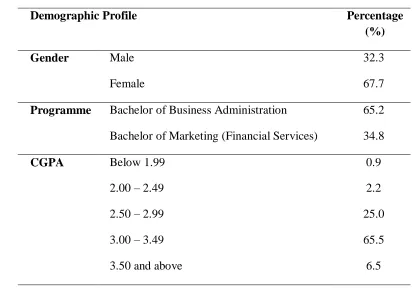
As shown in Table 1, the profile of the students showed that 32.3% of the students were male while 67.7% were female. More than half (65.2%) of the students were students from Bachelor Degree of Business Administration Program while 34.8% were Bachelor Degree of Marketing (Financial Services) Program. In terms of the students CGPA, 72% of the students obtained CGPA of 3.00 and above, while 28% obtained CGPA of less than 3.00.
Table 1: Profile of Students
Demographic Profile Percentage
(%)
Gender Male 32.3
Female 67.7
Programme Bachelor of Business Administration 65.2
Bachelor of Marketing (Financial Services) 34.8
CGPA Below 1.99 0.9
2.00 – 2.49 2.2
2.50 – 2.99 25.0
3.00 – 3.49 65.5
www.ijsernet.org Page 77 Students’ Feedback on Integration of Naqli and Aqli Elements in PBL
Students were asked on their feedback in terms of integration of Naqli and Aqli elements in PBL. As shown in Figure 1, 60% of the students strongly agreed or agreed that they had no difficulty in questioning the tutor and/or seeking clarification from the tutor regarding issues that arise relating to the PBL process. 49% of the students strongly disagreed or disagreed that there was not enough opportunities to discuss, and provide feedback, on how the students’ group functions during PBL tutorials. 78% of the students strongly agreed or agreed that they were able to evaluate their own, and, their group’s learning outcomes at the end of the PBL tutorial. 81% of the students were able to evaluate their own, and their group’s participation in PBL activities. 87% of the students strongly agreed or agreed that they were happy with the amount and type of feedback provided by the tutors regarding the learning outcomes. 83% of the students strongly agreed or agreed that they were happy with the amount and type of feedback provided by the groups’ participation in PBL activities. 70% of the students have the opportunity to evaluate the tutor’s performance within the PBL process.
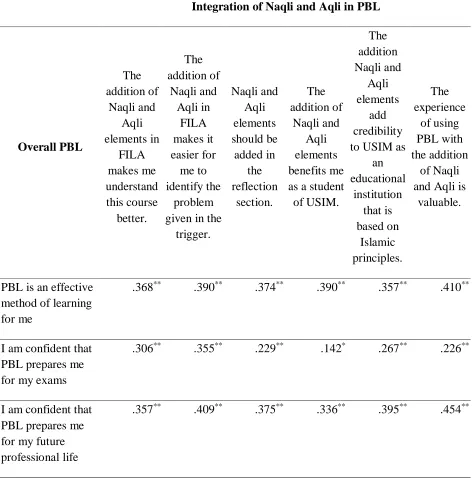
89.6% agreed and strongly agreed that the addition of Naqli and Aqli elements in FILA made the students understand the course better while 87% agreed and strongly agreed that the addition of Naqli and Aqli in FILA made it easier for the students to identify problem given in the trigger.
95.3% strongly agreed The addition Naqli and Aqli elements added credibility to USIM as an educational institution that is based on Islamic principles. 91.7% of students agreed and strongly agreed that the experience of using PBL with the addition of Naqli and Aqli is valuable.
www.ijsernet.org Page 78 PBL Overall
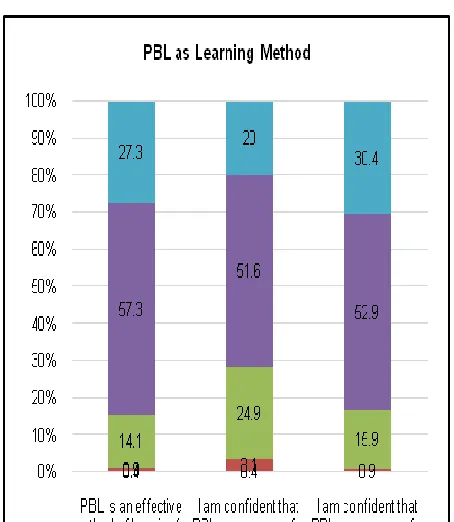
Overall, as shown in Figure 2, 84.6% of the students strongly agreed or agreed that that PBL was an effective method of learning for them. 71.6% of the students strongly agreed or agreed that they were confident that PBL prepared them for their exams and 83.3% of the students strongly agreed or agreed that they were confident that PBL prepared them for their future professional life
Figure 2: PBL as Learning Method
www.ijsernet.org Page 79
Table 2: Correlation between Integration of Naqli and Aqli and PBL Overall
Integration of Naqli and Aqli in PBL
Overall PBL The addition of Naqli and Aqli elements in FILA makes me understand this course better. The addition of Naqli and Aqli in FILA makes it easier for me to identify the problem given in the
trigger. Naqli and Aqli elements should be added in the reflection section. The addition of Naqli and Aqli elements benefits me as a student of USIM. The addition Naqli and Aqli elements add credibility to USIM as
an educational institution that is based on Islamic principles. The experience of using PBL with the addition of Naqli and Aqli is
valuable.
PBL is an effective method of learning for me
.368** .390** .374** .390** .357** .410**
I am confident that PBL prepares me for my exams
.306** .355** .229** .142* .267** .226**
I am confident that PBL prepares me for my future professional life
.357** .409** .375** .336** .395** .454**
**. Correlation is significant at the 0.01 level (2-tailed).
www.ijsernet.org Page 80 Skills Improved
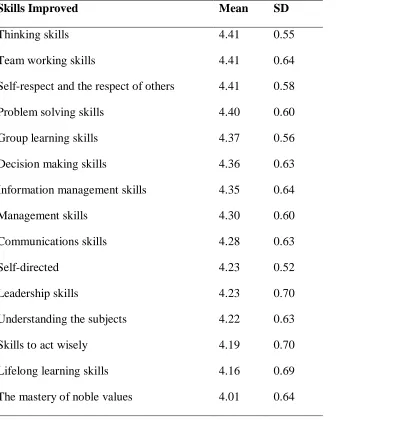
14 items related to skill were listed and students were asked to state the degree of agreement for each skill listed on a five point Likert scale ranging from ‘1’ (strongly disagree) to ‘5’ (strongly agree). Skills listed were adopted from Othman, Salleh, and Sulaiman [18]. As shown in Table 3, all skills scores a high mean (i.e. above 4.0). From the list of skills, students scored high for skills (mean=4.41), team working skills (mean=4.41), self-respect and the respect of others (mean=4.41), problem solving skill (mean=4.40), and group learning skills (mean=4.37).
Table 3: Mean Score and Standard Deviation of Students’ Skills Improved from PBL
Skills Improved Mean SD
Thinking skills 4.41 0.55
Team working skills 4.41 0.64
Self-respect and the respect of others 4.41 0.58
Problem solving skills 4.40 0.60
Group learning skills 4.37 0.56
Decision making skills 4.36 0.63
Information management skills 4.35 0.64
Management skills 4.30 0.60
Communications skills 4.28 0.63
Self-directed 4.23 0.52
Leadership skills 4.23 0.70
Understanding the subjects 4.22 0.63
Skills to act wisely 4.19 0.70
Lifelong learning skills 4.16 0.69
www.ijsernet.org Page 81
Discussion and Conclusion
This study examined students’ feedback after they have participated in PBL learning process and identified skills improved by students after they have participated in PBL learning process using 5 Ladders of Active Learning. Findings from this study showed a positive response from the students with regards to their experience in participating in PBL. Students had more opportunities to discuss and provide feedback on the subject learnt. Also, students received sufficient feedback from the instructors and they were happy with other group members’ participation in PBL. Other than that, students felt that through PBL, they have improved thinking skills, problem-solving skills, self-respect and the respect of others, and team working skills. Future studies may compare performance of students using PBL method and traditional teaching and learning method.
References
Arzuman, H. (2010). Experience and outcome of a PBL trigger material development workshop. Education in Medicine Journal, 2(1), 36.
De Janasz, S. C. (2002). Interpersonal Skill in Organization. USA: Mc Graw Hill.
Edward, L. M. (1995). Creative Problem Solving: Thinking Skill for A Changing Wold”. USA: Mc Graw Hill.
Faculty of Development and Instructional Design Center, Northern Illinois University. (NA). Problem Based Learning (PBL).
Hamid, M. A. (2003). Meningkatkan Daya Berfikir. Bentong: PTS Publication and Distribution Sdn Bhd.
Kirby, G., Goodpaster, R. &., & Jeffery, R. (2002). Thinking. USA: Prentice Hall.
Makminin, S. (2005). Kertas Kerja Pembentangan “Pembelajaran berasaskan Masalah dalam Kursus Kimia Diploma: Pengelaman Pertama di KUiTTHO”. Batu Pahat.
Montogomery, D. C. (2000). Rekabentuk dan Analisis Ujikaji. Kuala Lumpur: Dewan Bahasa dan Pustaka.
Nooh, M. N. (2014). Problem Based Learning Handbook and Exercise: Financial Services Marketing. 8-9. Nilai, Negeri Sembilan.
Othman, H., & Mustafa, R. (2005). Kemahiran Generik dalam Kelas Bercirikan Pembelajaran Berasaskan-Masalah (PBL) di Kalangan Pelajar Kolej Universiti Teknologi Tun Hussein ONN (KUiTTHO). Batu Pahat.
Othman, H., Salleh, B. M., & Abdullah , S. (2014). An Innovative Learning Cycle in Problem-Based Learning. International Journal of Enhanced Research in Educational
www.ijsernet.org Page 82 Othman, H., Salleh, B. M., & Sulaiman, A. (2013). 5 Ladders of Active Learning: An Innovative
Learning Steps in PBL Process. The 4th International Research Symposium on Problem Based Learning (IRSPBL), 245-253.
Savery, J. R. (2006). Overview of Problem-based Learning: Definitions and Distinctions. Interdisciplinary Journal of Problem-based Learnin, 1(1).
Smith, S. (1997). Solve That Problem: Readymade Tools for Continuous Improvement. London: Kogen Page Limited.
Suvannatsiri, R., & Santichaianant, K. (2013). A Development of Learning Innovation "Debris Flow Monitoring" with Problem Based Learning Approach: A Case Study at the Amphur Khao Phanom, Thailand. International Proceeding of Economics Development, 60, 49-54.
Utecht, J. R. (2003). Problem-Based Learning in the Student Centered Classroom. 1-16. Wood, D. F. (2003). ABC of learning and teaching in medicine. BMJ, 326(8 February 2003),