A Diagnostic Approach to Acute Headache
ALAN 8. GRINDAL, M.D.
Assistant Professor, Department of Neurology, Medical College of Virginia, H ea/th Sciences Division of Virginia Commonwealth University, Richmond, Virginia
Headache is one of the most common symptom-atic ailments encountered by the physician. Accord-ing to one estimate, headache constitutes the major complaint in more than 50% of patients seen in office practice.1 This figure refers to patients with chronic recurring headache, many of whom are seen elec-tively when they are asymptomatic, and may not accurately reflect the frequency with which patients present, during the acute phase, complaining of head pain. The term acute headache refers to those epi-sodes of cephalgia which lead the patient to seek immediate rne~ical care.
Headache must of course be regarded as a symp-tom and not a disease. Almost everyone suffers an occasional headache, be it from psychologic stress or excessive indulgence. Fortunately the vast majority of head discomforts stern from minor and reversible conditions which do not pose a threat to health. On the other hana, headache secondary to a bacterial meningitis or subdural hernatorna calls for prorngt and often heroic measures. Referring to head~che, Wolff states in ,·the preface to his text, "Failure to separate the ominous from the trivial may cost life or create paralyzing fear."2 Therefore, the evaluation of the patient with· acute headache must avoid the ex-tremes of passing the symptom off as a minor con° di-tion with only a haphazard evaluation, on the one hand, and of subjecting the patient to an unnecessar~ ily expensive ~nd extensive evaluation, on the' other.
It i~ the purpose of this report to describe the evaluation of the patient who suffers from the onset of acute headache. The most important decision to be made in this setting is whether one is dealing with a
Correspondence and reprint requests to Dr. Alan B. Grindal,
Department of Neurology, Box 698, Medical College of Virginia,
Richmond, Virginia 23298.
MCV QUARTERLY 13(3): 107-111, 1977
benign or malignant illness. By malignant, I am re-ferring to disorders in which early intervention is necessary to prevent death or disability. The symp-toms and signs which may aid in this distinction will be presented as well as a sequential diagnostic a p-proach which, one hopes, will insure as complete an evaluation as is necessary and at the same time cause no harm or undue discomfort.
History
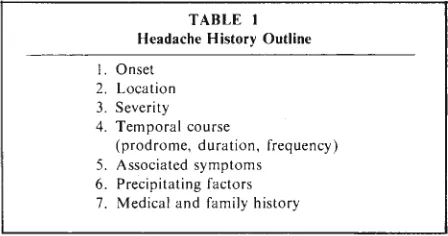
A detailed history is usually the clinician's most valuable tool in evaluating the patient with acute headache. The basic headache history should be con-cise and organized so that relevant facts are not over-looked. A simple outline of the important areas to be covered is in Table 1.
Onset. It is particularly helpful to establish the time and mode of onset. Headaches which begin in the second and third decades of life are commonly of vascular origin and migraine rarely makes its first appearance after the age of 50. On the other hand, t'ernporal arteritis and glaucoma must be considered when headache has its onset in the fifth decade or later. Headaches secondary to cervical spondylosis or depression are also more likely to occur among older patients.
The time of day at which the headache begins may also be helpful. Pain due to space-occupying intracranial disease is notoriously worse on waking in the rnoq1ing. Head pain, or the other hand, due to rn uscle tension or cervical osteoarthritis usually is worse in the late afternoon, and cluster headaches typically awaken the patient in the middle of the night.
Also under the heading of onset, one should establish the rapidity of onset. An abrupt severe
108
TABLE I Headache History Outline
I. Onset 2. Location 3. Severity 4. Temporal course
(prodrome, duration, frequency) 5. Associated symptoms
6. Precipitating factors 7. Medical and family history
headache should make one suspicious of sub-arachnoid hemorrhage particularly if there is asso-ciated alteration of consciousness.
Location. The location of the headache may pro-vide a diagnostic clue. In this regard, it is useful to have the patient point to the precise area of pain, and the region of radiation if one exists. Relying on the patient's anatomic knowledge may be dangerous, and indeed a "sinus heachache" may be located over the occiput.3 The site of pathology may be clearly
delin-eated in patients with dental and sinus disease. Pain localized to one eye should raise the suspicion of cluster headache or ocular pathology. Occipital and nuchal pain are often seen with chronic tension and with cervical osteoarthritis. Unilateral headaches typ-ically occur in migraine but can also occur in more serious diseases such as temporal arteritis and sub-dural hematoma.
Severity. Pain itself cannot be measured by the observer and the headache may be equally intense whether its implications are benign or malignant. According to Wolff, "there are few instances in hu-man experience where so much pain may mean so little in terms of tissue injury. "2 ·severity of pain may,
however, be estimated by asking such questions as, Did the pain awaken you from a sound sleep? Did it compel immediate rest and cessation of all activity? Severe pain is worrisome particularly if it comes on suddenly or if it represents the result of progressive increase in intensity.
Temporal Course. Prodromal, or premonitory, symptoms, such as scotomata and hemianopia, pre-ceding the headache suggest migraine. Similar visual symptoms may uncommonly occur with angiomas and tumors.
Vascular headaches such as migraine and cluster are throbbing in character, usually last from minutes to hours, but tend to be episodic and recurrent. Ten-sion headaches, on the other hand, are dull and nag-ging ·and characteristically are persistent, often
last-ing weeks and even months without a pain-free interval. Headache in the patient with a space-oc-cupying lesion may be intermittent at first but gener-ally becomes progressively more constant and severe. Associated Symptoms. Nausea and vomiting are commonly associated with migraine. Vomiting, how-ever, may also occur with increased intracranial pres-sure and frequently is unaccompanied by nausea. Patients with cluster often exhibit nasal congestion,
unilateral redness of the eye, and lacrimation. Sim-ilar symptoms may be seen in the patient with upper respiratory infection (URI) or sinusitis, but these are generally more prolonged. Disturbance of vegetative functions such as sleep, bowel function, and appetite may suggest underlying depression. Associated con-vulsions or disturbance in consciousness should al-ways raise concern of serious underlying disease. Focal neurologic symptoms and disturbances of vi-sion, although commonly associated with migraine, should be carefully investigated. ·
Precipitating Factors. A variety of precipitants have been implicated in initiating a migraine attack.
These include fatigue, menstruation, bright sunlight, alcohol, and tyramine-containing foods. Emotional factors, which so frequently precipitate headache, should be sought with careful questioning regard-ing recent marital, occupational, or financial diffi-culties. The exertional headache should always arouse suspicion of an intracranial lesion. This is a headache which comes on from complete comfort following activities such as running, coitus, and Val-salva maneuver. Although the pain is often quite severe, it usually is of brief duration. Also of concern are headaches which are precipitated by changes in posture or head position. Such headaches could rep-resent a ball-valve effect produced by an intra-ventricular tumor.
individual might provoke a depressive episode which is manifested by headache.
Examination
After obtaining the history the physician gener-ally has a fairly good idea of the type of headache he is dealing with. A complete and careful physical and neurologic examination, however, provides an addi-tional screen for underlying serious disease and helps in deciding what further diagnostic studies are neces-sary. Rather than reviewing the entire examination, this discussion will be limited to those aspects of the physical and neurologic examinations which are par-ticularly relevant to the headache patient.
Observation. The appearance and activity of the patient during the initial interview often provides valuable information. Individuals with severe head pain have a characteristic facial expression and tend to move slowly and deliberately; the patient with psychogenic disease, on the other hand, often appears relaxed while complaining bitterly of severe
dis-comfort.• Gait and station should also be observed;
ataxic gait associated with the recent onset of head-ache is alarming and should be expeditiously pursued diagnostically.
Physical Examination. The vital signs, partic-ularly temperature and blood pressure, should be routinely recorded. Fever and its resultant
vasodila-tion may be responsible for headache; however, its
presence should prompt a search for infection. A
central nervous system infection such as meningitis or
brain abcsess must be considered. It should be
re-membered that fever may also be present in some
systemic illnesses such as temporal arteritis.
Head-ache can be the earliest symptom in the patient with malignant hypertension. The headache associated
with hypertension is usually generalized, throbbing,
and often increased in the supine position.
A careful examination of the head and neck is
essential in evaluating the patient with head pain.
Inspection may reveal a tortuous and prominent su-perficial temporal artery in the patient with temporal arteritis, or facial erythema and lacrimation in the
individual suffering an acute cluster attack.
Fun-doscopy is a 'must' in any patient presenting with acute headache. Visual fields should be checked by confrontation. Any patient with a disturbance of
vi-sion or visual field defect which is not transient, or
clearly associated with a migraine attack, must be
investigated further. One can also grossly evaluate intraocular pressure by palpating the eye through the
closed lid. Glaucoma may present initially with hea
d-ache, and careful tonometry needs to be performed if
this diagnosis is suspected. Finally the nose, ears, and
mouth should be examined for evidence of
in-flammation. Patients with URI and flu-like
syn-dromes often list headache as their primary com-plaint.
Limitation of movement or spasm on exam-ination of the neck would suggest cervical spondy-losis or chronic tension. Stiffness, however, with lim-ited neck flexion is usually noted in the presence of
meningeal irritation, and meningitis or subarachnoid
hemorrhage should be suspected.
Neurologic Examination. A complete neurologic
examination of the headache patient is very
impor-tant. Perhaps the most important part of this
exam-ination is the assessment of mental status. Altered
consciousness in a patient presenting with headache
should always be regarded with concern. An eva
l-uation of the cranial nerves should also be carried
out. The first cranial nerve is often neglected and may be easily tested by having the patient identify com-mon odors, such as tobacco, through each nostril.
Anosmia may be the only sign of olfactory groove
meningioma.
Motor and sensory function as well as reflexes and coordination should be systematically tested. Any abnormality on neurologic examination which cannot be confidently explained on the basis of a previous illness or injury requires further diagnostic study.
Diagnostic Studies
The diagnostic evaluation of the headache
pa-tient should proceed in a logical sequential manner to
insure a complete investigation when necessary and
to prevent costly and potentially harmful studies
when these are not indicated. To conceive of the
acute headache evaluation occurring in stages is a
useful approach5 ; however, .certain circumstances
may require a more expedient evaluation and there-fore this approach is intended to be a guide rather than a cookbook to testing patients complaining of
acute headache (Table 2).
The first and probably the most important stage consists of a detailed history and thorough exam-ination as outlined earlier in this paper. All patients except those requiring urgent therapeutic procedures should pass through this phase. Unless there has been a recent evaluation or the diagnosis of a benign entity
GRINDAL: DIAGNOSTIC APPROACH TO ACUTE HEADACHE
Stage 1 Stage 2
Stage 3
Stage 4
TABLE 2
Approach to Diagnostic Evaluation
History and physical Routine screening
(eg. CBC, ESR, skull x-rays) Extensive systemic and neurologic evaluation
(eg. CT scan, EEG, lumbar puncture) Invasive diagnostic studies
(eg. angiography, ventriculography)
tests. The procedures which constitute Stage 2 not
only provide information which cannot be obtained on examination but also serve to reassure the patient that a complete evaluation is being carried out.
Stage 2 at a minimum should include a complete blood count (CBC), erythrocyte sedimentation rate (ESR), and skull x-rays. Other studies such as urinal-ysis, chest x-ray, and blood sugar might also be in-cluded. An elevated ESR is a sign of chronic inflam-mation and primarily serves as a screen for cranial arteritis.
A !though the skull x-ray is frequently normal in the headache patient, exceptions must not be forgot-ten. When least expected, the skull x-ray may reveal signs of raised intracranial pressure, deviation of the pineal, or metastatic lesions. Because of the widely
held belief in the infallibility of x-rays, a normal skull series may take on prophylactic and therapeutic prop-erties.6 An acute tension headache may become
chronic through the fear of an underlying tumor.
If, following the completion of Stage 2, one is
convinced that the headache is secondary to tension,
migraine, URI, or other benign entity, the initial
evaluation should be completed. It is probably wise,
however, in most cases to arrange for a follow-up visit within a couple of weeks.
TABLE 4
Examination Findings Suggesting Serious Underlying Disease
I. Disturbed level of consciousness 2. Difficulty walking or sitting
3. Disturbance of vision or visual field that is not clearly migrainous
4. Hypertension 5. Stiff neck
6. Any unexplained abnormality on neurologic
ex-amination
TABLE 3
Historical Features Suggesting Serious Underlying Disease
1. Abrupt onset
2. Persistent unilateral pain 3. Progressive course
4. Disturbance of consciousness 5. Convulsions
6. Focal neurologic symptoms 7. Headache precipitated by:
a. exertion
b. change in posture
8. History or symptoms suggestive of systemic illness
Patients should advance to the third stage of
testing when disturbing information is obtained on
history, abnormalities are found on examination, or
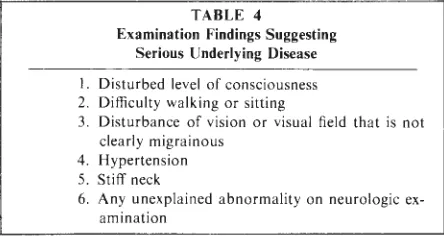
routine screening studies are abnormal (Tables 3 and 4 ). Some but not all patients who reach this stage
require hospitalization. Included at this level would
be electroencephalogram (EEG), brain scan,
comput-erized tomography (CT) scan, and lumbar puncture.
Depending on suspicions, cervical spine x-rays, sinus films, or other special studies might be indicated.
Stage 4 consists of the use of invasive techniques
such as angiography and ventriculography. On
occa-sion it may be necessary to employ these studies after
a brief history and examination. However, most often
they should be performed after screening procedures
have been completed and careful consideration has
been given. The studies at this level require hospital-ization.
The Acute Headache Problem
In an attempt to put the acute headache problem
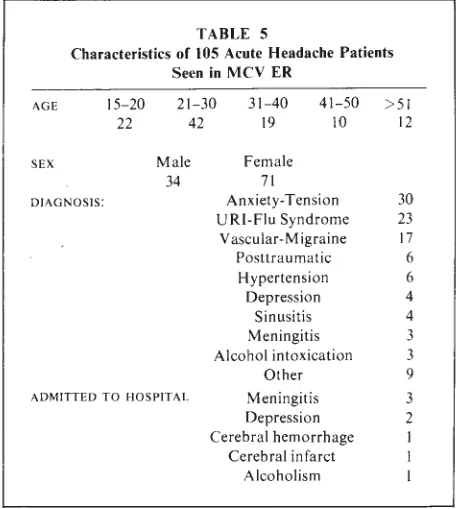
into some perspective, the emergency room admis -sion records of patients seen in the Medical Emer-gency Room at the Medical College of Virginia dur-ing the month of March, 1977, were reviewed. Of the
1998 visits that month, I 05 or 5% listed headache as
one of the major complaints. Sixty-one percent of
these I 05 patients were under the age of 30 despite the
fact that no pati"ents under 15 are seen in the Medical
Emergency Room. Better than two thirds of the
pa-tients were female.
According to the emergency room records, the
majority of patients suffered either from tension,
URI, or migraine, in that order. A complete
break-down of diagnosis is presented in Table 5.
Only eight patients were admitted to the
admit-TABLE 5
Characteristics of 105 Acute Headache Patients Seen in MCV ER
AGE 15-20
22
21-30 42
31-40 19
41-50 >51
10 12
SEX Male Female
34 71
DIAGNOSIS: Anxiety-Tension 30
URI-Flu Syndrome 23
Vascular-Migraine 17
Posttraumatic 6
Hypertension 6
Depression 4
Sinusitis 4
Meningitis 3
Alcohol intoxication 3
Other 9
ADMITTED TO HOSPITAL Meningitis 3
Depression 2
Cerebral hemorrhage Cerebral infarct
Alcoholism
ted to the psychiatry service because of depression.
Based on this somewhat superficial review of a
selected population, it would appear that the patient
seeking acute care for headache is usually young,
female, and suffers from a benign entity. However,
one cannot be complacent. As is demonstrated, head-ache is a symptom of a wide variety of disorders, some of which are life-threatening. In order to arrive at a correct diagnos!s, an organized approach based on a careful history, complete examination, and se-quential testing is essential.
REFERENCES
I. FRIEDMAN AP, MERRITT HH: Headache: Diagnosis and Treat-ment. Philadelphia, F A Davis Co, 1959.
2. WOLFF H: Headache and Other Head Pain. New York, Oxford University Press, 1963.
3. YOUNG AK: The clinical approach to the evaluation of head pain. Headache 6:66-72, 1966.
4. KUNKEL RS: Examining the headache patient. Postgrad Med
56:81-85, 1974.
5. SHERRILL RG JR: Sequential testing for headache complaints.
Postgrad Med 56:93-98, 1974.