http://dx.doi.org/10.9717/JMIS.2017.4.3.151
151
I. INTRODUCTION
The basic needs of human beings are food, clothing, and shelter, and among them, the shelter plays the role of a base of life and activities as well as satisfying a basic need of human beings and has significant implications not only as a physical place but also as a psychological environment [1] [2]. Therefore, securing a residential space considering individuals’ economic situation and preferences is an important element for rest and social life.
As the major media to use Internet services has been converted from PC to mobile devices and spreading, many services in everyday life have become mobile. Consequently, the Internet has become an important medium in the real estate market too, and diverse mobile real estate apps provided by public and private institutions are being used [3]. However, the information provided by such mobile real estate apps has side effects such as posting other photographs on false offerings for bait, which do not actually exist, and hiding shortcomings and highlighting only advantages to inducing quick contracts [4]. Especially, most pieces of the offerings information on studios in university towns are not very much reliable as images are
rarely provided and even the provided images are false ones in many cases. Therefore, the Korea Fair Trade Commission (KFTC) recently announced that it examined the service use agreements and offerings registration agreements of Jikbang, Dabang, and Callbang operated by three mobile brokers and corrected unfair agreement clauses [5]. To remedy the shortcomings of real estate apps, measures to minimize damage such as linking O2O (Online to Offline) services to real estate mobile apps have been studied [4].
Virtual Reality (VR) technology is technology that makes interactions between 3D virtual spaces created by a computer system and the user and is a convergence technology that provides users with the same sense of reality as that they would feel when they are actually present in the spaces. Virtual reality [6], which has been focused on games and entertainment thus far, is now applied to diverse fields such as education, travel, and shopping.
Therefore, in the present study, an application that provides the user with a better sense of reality by providing the offerings information of mobile real estate apps as VR was designed and implemented. The application designed and developed in the present study was implemented for studios around Andong National University, which are
Design and Implementation of Room Finding Application using VR
Eunju Park
1,
Juryeong Kim
1, Hankyu Lim
1,*Abstract
As Internet services have spread centering on mobiles, diverse services used in everyday life have become mobile services. For humans, residential spaces have significant implications as physical and psychological environments. Therefore, being provided with accurate information on the room that must be sought to find out the residential space wanted by the user can be said to be an important element of real estate apps. However, when buying real estate, people prefer searching for information using mobiles and verifying the information by visiting the real estate firsthand due to increases in damage due to false offerings. This way approaches as inconvenience in cases where the buyer lives far away or if the conditions are not suitable. Therefore, in the present study, a ‘room finding application using VR’ was designed and implemented using virtual reality (VR) used for diverse purposes. VR is a technology that provides the user with the sense of presence as if the user is actually present in the space. It was used in the present study as a means to provide more accurate information. The use of the application designed and implemented in the present study is expected to reduce false offerings information at least slightly so that users can be provided with more accurate information on the real estate of interest.
Key Words: Mobile Application, Virtual Reality, Mixed Reality, Virtual Reality Content.
Manuscript received September 29, 2017; Revised September 13, 2017; Accepted September 21, 2017 (ID No. JMIS-2017-0026)
Corresponding Author (*): Hankyu Lim, 1375, Gyeongdong-ro, Andong-si, Gyeongsangbuk-do, Republic of Korea, [email protected].
152 especially poor in the provision of information. The ‘room
finding application using VR’ developed in the present study is expected to minimize false offerings information and wander around firsthand to verify offerings information. The composition of this paper is as follows. In Chapter 2, related works and needs analyses details were described. Chapter 3 is a part for design where the DFD and functional design, etc. were described. Chapter 4 is a part for implementation where the implemented application was described, and Chapter 5 is a part for the conclusion.
II. RELATED RESEARCH AND
REQUIREMENT ANALYSIS
VR is a convergence technology intended to enable humans to feel the senses of immersion and realism through their five senses. Now, many companies such as Apple, Google, and Samsung are preparing the VR technology [6].
2.1. VR
Mark Zuckerberg said, ‘The way people communicate has evolved from text, to photography and video, and it will evolve to VR / AR thereafter.’ VR is ‘experiencing virtual instead of actual reality’ and has the advantage of providing excellent senses of immersion and realism thanks to its 3D spatiality [7].
The methods of providing virtual reality can be largely divided into those based on images and those based on modeling. Image-based virtual reality can be implemented by mixing existing videos and the virtual reality technology without any separate hardware [8]. Image-based virtual reality can be interconnected and moved because its technical origins are in the general video and picture formats. Therefore, an image taken from a certain space can be clicked by the user to see the object or the background three-dimensionally while rotating it.
Image-based virtual reality is advantageous in that the information it can provide to users is not limited because the images are taken while being rotated 360 degrees. VR 360-degree content can be produced by using 3DMax or Maya SW so that the entire images are made into 3D graphics or by live-action imaging [9]. In the case of imaging the entire directions of 360 degrees, the camera size and viewing angle should be considered as blind spots may occur.
Figure 1 below shows the range of VR that can be seen in the user's visual angle and the blind spots that can occur when the image has been attached.
Fig. 1. Camera Blind Spots and Offset
2.2. Survey
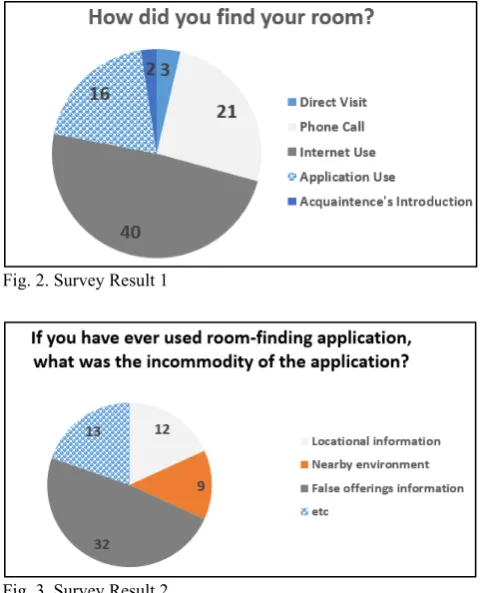
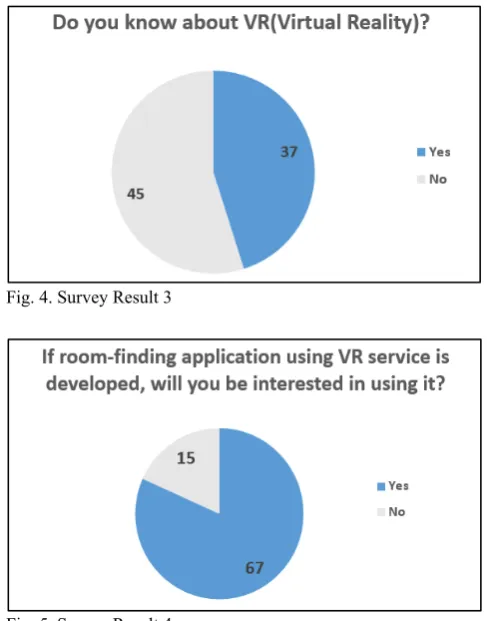
A questionnaire survey was conducted to examine the feasibility of development of the ‘room finding application using VR’ developed in the present study and necessary functions. The survey was conducted from April 8 to April 14, 2017 as an Internet survey using the Naver form. The total number of respondents was 82, and the respondents were in their late teens and twenties. Figure 2 through Figure 5 below show significant ones out of the results of the questionnaire survey as charts.
Fig. 2. Survey Result 1
http://dx.doi.org/10.9717/JMIS.2017.4.3.151
153
Fig. 4. Survey Result 3
Fig. 5. Survey Result 4
Based on the results of the questionnaire survey, when searching for rooms, the respondents used the Internet the most commonly followed by phone call and apps in order of precedence. The most frequent inconvenience when searching for rooms was the provision of false offerings information followed by no provision of location information. The majority of the respondents did not know about VR the intention and many of the respondents were shown to have the intention to use room finding applications that provide information with VR.
From the results the questionnaire survey mentioned above, it could be seen that although the respondents frequently used the Internet or apps when they were searching for rooms, the reliability of the information provided was low. Therefore, it could be seen that highly reliable information should be provided by ‘room finding applications.’
2.3. Benchmarking
Applications that provide mobile real estate information can largely divided into those provided by public institutions and those provided by private institutions [4]. Public mobile real estate apps include ‘Smart Territorial Information’, ‘Onnara Real Estate Portal’, ‘Real Estate Price Information’, and ‘Real Estate Electronic Contract.’ There are diverse apps provided by private institutions such as ‘Zigbang’ ‘Dabang’ and ‘Hanbang.’
The apps provided by public institutions mainly provide prices for and information on real estate at the level of providing the information provided on the webs to mobiles and these apps have a disadvantage of poor download records compared to the huge development costs. The apps provided by private institutions provide offerings information for officetels, studios, and two-room houses. However, it has a disadvantage that compulsory regulations against false offerings are insufficient.
The following table 1 shows benchmarked private mobile real estate apps.
Table 1. Benchmarking Application
Zigbang Dabang
‘Zigbang’ is the first app among domestic ‘room finding’ applications. It has an advantage of good evaluation and feedback through marketing, SNS management, and community functions. On the other hand, it has disadvantages of frequent advertisement appearances, payment inducement, the UI, which is not detailed and hard to understand, and low reliability of information reliability due to false offerings.
‘Dabang’ is an application used by many people, which provides a convenient inquiry function and a function that enables users to see all the rooms they want to see at once. However, this application has disadvantages of an inconvenient option selection function and very little information provided in the case of some areas.
Based on the results of the benchmarking, it could be seen that the application that must be implemented in this study should have an easy and simple UI and minimized false offerings information.
III. DESIGN
154
3.1. Flowchart
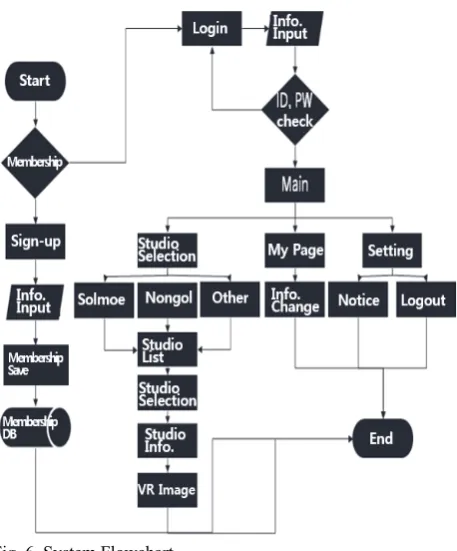
Figure 6 shows an overall flow chart for the ‘room finding application using VR.’
Fig. 6. System Flowchart
After ‘login’, the ‘room finding application using VR’ provides three functions; ‘Studio Selection’, ‘My Page’, and ‘View Setting.’
3.2. DFD and Function Design
Figure 7 shows the top level of the DFD of the application implemented in the present study.
Fig. 7. DFD Scheme
The ‘Login’ function is executed immediately after the application is executed. This function has been designed to have a ‘sign-up’ function, and a ‘login’ function. Even those that have not signed up can view the information provided by the application.
Figure 8 shows the DFD for the ‘Studio selection' function.
Fig. 8. DFD of ‘Studio Selecton’ function
The ‘Studio selection’ function has been currently implemented for only the surroundings of Andong University so that ‘Solmoe’, ‘Nongol’, and ‘Other’ areas can be selected. Studio information for the area selected by the user will be retrieved from the DB and output as a list. When the user has selected a desired studio from the output studio list, information on the studio such as the name and address of the studio, the phone number of the owner, the monthly rent, and the security deposit will be output and the VR image of the relevant studio will be also provided. The VR image provided as such is expected to block the provision of false information to some extent.
Figure 9 shows the DFD for the ‘My Page’ function.
Fig. 9. DFD of ‘My Page’ function
The ‘My Page’ function is a page that outputs only the list of the studios selected by the user to provide access to information of interest. It was designed to enable the user to add or delete information to/from the studio list when the information has been revised.
http://dx.doi.org/10.9717/JMIS.2017.4.3.151
155
IV. IMPLEMENTATION
The application presented in this paper was implemented reflecting the results needs analyses and the design part. The application was implemented using Android Studio. When the application was implemented, maximally simple and intuitive UI (User Interface) was designed so that the application could be used easily by anybody. Figure 10 through Figure 12 show the implemented screens of the ‘room finding application using VR’. Figure 10 shows the implemented ‘main screen’ and ‘area selection’ screen.
Fig. 10. Implementation of ‘Main Screen’ and ‘Area Selection’
The ‘main screen’ appears when the ‘room finding application using VR’ has been executed and it was implemented simply so that it can be intuitively understood. The ‘area selection’ screen appears after ‘login’ and provides information divided by area so that the user can quickly select the room he/she want to find. In the present study, the application was implemented considering only studios and two room houses in the surroundings of Andong National University and classified the area into only
‘Solmoe’, ‘Nongol’, and ‘Other’ areas. When the functions of the application are expanded later, many areas will be added.
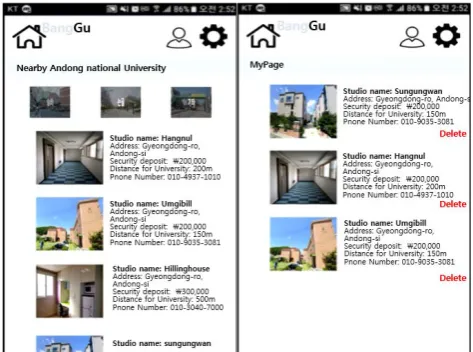
Figure 11 shows the screens implemented for selected areas and the ‘My Page’ function. The screen implemented for selected areas is for the function to provide only the information on the selected area when the user has selected a desired area. The screen implemented for the ‘My Page’ function is for separate management of only the pages visited by the user as the user was interested in the pages. These functions can reduce the time and effort required for information retrieval.
Fig. 11 Implementation of ‘Area Information’ and ‘My Page’
Figure 12 shows a screen that provides information on the selected studio in the text format and VR when the user has selected a desired studio in the ‘Studio Selection’ function. The owner of the studio can be contacted with the registered phone number by clicking the ‘Phone Call’ function.
Fig. 12. Implementation of Providing Information using VR
V. CONCLUSION
156 Therefore, in the present study, to reduce the damage due
to false offerings occurring when real estate is transacted, a ‘room finding application using VR’ that provides ‘VR’ information together with text information and image information when providing information on real estate was designed and implemented. The purpose of the application implemented in the present study is to provide users with information closer to the reality by providing more accurate information together with text and image information. However, the application has a shortcoming that the VR information on rooms is also provided by the information provider. In addition, the present paper has a shortcoming that no image actually taken by the VR technique was provided.
Hereafter, based on the design of the present study, studies will be continued to add the GPS function and to investigate techniques that can provide more accurate information from the position of users.
Acknowledgement
"This research was supported by the MSIP (Ministry of Science, ICT and Future Planning), Korea, under the Seoul Accord Vitalization Program (IITP-2017-2011 0 00559) supervised by the IITP (Institute for Information & communications Technology Promotion)"
REFERENCES
[1] Yeungkyu Hwang, “A Study on Environment Factors of Residential Satisfaction”, Ph.D. dissertation, Department of Real Estate Science, Pusan National University, Busan, Republic of Korea, 2014.
[2] Sangyeul Lee, “A Study of Housing-Satisfaction Determinants in the Motives of Moving into Apartments”, M.S. thesis, Department of public administration, Konkuk University, Seoul, Republic of Korea, pp. 10-12, 2014.
[3] Meae Jung, Jin Kim, and Han Park, “The study of the real estate transaction systems on the internet-based,”
Journal of the Korea Institute of Electronic Communication Science, vol. 8, no. 3, pp. 479-486,
2013.
[4] Jaewon Jeong, “A Study on the Revitalization Plan of the Mobile Real Estate Apps using O2O Service”, Ph.D. dissertation, Department of Real Estate, Kangnam University, Youngin, Republic of Korea, 2017. [5] Korea Fair Trade Commission (KFTC) report,
https://www.ftc.go.kr/news/ftc/reportboView.jsp?repor t_data_no=7286, May. 2017.
[6] Ikjae Kim, “Trend of Virtual Reality Technology,”
Journal of Broadcast and Media, Vol. 21, No.2, pp.
51-60, 2016
[7] Buyon Jeong, “Virtual reality ecosystem and implication,” Korea Information Society Development Institute Issue, Vol. 28, No. 7, pp. 1-23, 2016.
[8] Taehyun Kim, “A Comparative Study on the Image Based Virtual Reality and the Modeling Based Virtual Reality”, Research of Communication Visual Design,
Vol. 13, pp. 34-43, 2003
[9] Yangmi Lim, “Trend of Virtual Reality Contents and Technology,” Journal of the Korean Institute of Communication Sciences, Vol. 33. No. 12, pp. 49-55,
2016.
Authors
Eunju Park received her B.S. degree in Computational Statistics from Andong National University in 1993. She received her M.S. degree in Computer Engineering from Andong National University in 2001. She received her Ph. D. degree in Information Communication Engineering from Andong National University in 2015. She is currently full-time lecturer at Andong National University.
Jooryeong Kim took up Multimedia Engineering from Andong National University in 2011. He is currently student of Multimedia Engineering from Andong National University.