Case Report
Versatility of the estlander flap: upper lip, lower lip and comissure
reconstruction due to a dog bite
Natalia Haro Alvarez, Jose de Jesus Orozco Grados, Enrique Chávez Serna*,
Alejandro Lopez Garibay, David Navarro Barquin, Andrea Romero Carrillo,
Laura Andrade Delgado
INTRODUCTION
Dog bites continue to represent one of the most common causes in reconstructive emergency services.1,2 Often, these injuries are located in the head and neck area, requiring intrinsical surgical management.3 Unfortunately the aftermath of a lower, yet still significant, percentage of patients will require a second reconstructive procedure
or more.4 Resulting in an extremely invasive surgical process for patients that is hard to ignore.
In developing countries, dog bites represent a public health problem; Mexico, being one of the affected countries. In 2017, according to health agencies’ records, there was an incidence of 96.38 cases per 100,000 inhabitants.5 The General Hospital “Dr. Manuel Gea Gonzalez” is considered one of the most innovative and Department of Plastic and Reconstructive Surgery, General Hospital Dr. Manuel Gea Gonzalez, México City, México
Received: 10 April 2019
Accepted: 04 May 2019
*Correspondence:
Dr. Enrique Chávez Serna,
E-mail: [email protected]
Copyright: © the author(s), publisher and licensee Medip Academy. This is an open-access article distributed under the terms of the Creative Commons Attribution Non-Commercial License, which permits unrestricted non-commercial use, distribution, and reproduction in any medium, provided the original work is properly cited.
ABSTRACT
Background: Dog bites continue to be a frequent cause for plastic and reconstructive services in the world. The grand majority of these cases affect the head and neck area; and more often than not they involve the commissure and the lips. The latter leading to an increased level of difficulty and a substantial decrease on the posibilities for a successful reconstruction. This case report focuses on the exploration of the Abbe-Estlander flap as an efficient alternative in most of these cases.
Methods: We present two clinical cases involving dog bites where the affected area of both patients was estimated to be one third of the total volume of the lip. Both patients required emergency reconstructive surgery. An Estlander flap was successfully performed in both instances. The purpose of the article is to share the results and motivate the medical community to continue to use this method as a strong avenue for an effective recovery.
Results: After two months of the surgery, the team followed up with both patients and they were satisfied with the results. Patient A presented adequate healing of the wound; a lack of alignment of the mucocutaneous rim and rounding of the commissure was observed. Phonation, oral continence without any leakage and complete closure of the lip were also part of the recovery assessment. Patient B presented adequate healing of the wound, phonation and medium oral continence with occasional leakage of liquids and incomplete closure.
Conclusions: The Abbe-Estlander flap is still an excellent reconstructive alternative for upper and lower lip reconstruction where the affected area is up to one third of the total volume. As long as the commissure involvement represents minimum difficulty, both aesthetic and functional objectives can be successfully attained using this flap.
Keywords: Dog bites, Estlander flap, Lip reconstruction, Reconstruction of oral commissure, Surgical flaps
referenced medical centers in plastic and reconstructive
surgery. With specialized areas such as microsurgery, craniofacial surgery, and nerve surgery, we continue to lead and influence other hospitals in the country and hopefully the world. Every year, approximately 200 cases are received due to dog bites.6 Of those 200 cases, 60% of the lesions are located on the face, and 24% will affect the lip alone or in conjunction with another facial subunit (oral commissure, nose, cheek). In our experience, at least 20% of all dog bites will require reconstructive surgery in addition to primary close.
According to the American Society of Plastic Surgeons, about 28,000 patients require reconstructive surgery due to dog bites on a yearly basis.7 The objectives of lip reconstruction are both functional and aesthetic; the aim is to preserve oral continence, muscle integrity, adequate opening while maintaining the qualities of the aesthetic subunits.8
There are a great number of lip reconstruction techniques; the majority of them were introduced in the 19th century.9 The use of local flaps as an alternative method is the modern surgical boom. Reconstruction alternatives are diverse, and must comply with depth, size, affected percentage and involvement of the mucocutaneous rim and commissure; adhering to the principle of reconstruction by subunits. While there are several options for full-thickness defects that involve over one third of the total volume of the lip; Abbe Flap, Gillies, Webster, Karapandzic, to name a few. In instances where the commissure is affected, the Abee–Estlander flap is still considered the preferred technique.3 Estlander first described a flap for lateral defects in 1872; Nomenclature was then unified.10,11 A few decades later, the use of a flap to raise skin, muscle and mucous in the lip branches of the facial artery was made popular in 1898 by Dr. Abbe, and was primarily used for medial defects. The main difference with the Abbe flap is that it is performed all at once and feeding may be immediately re-established. The principal objective of this article is to describe the versatility of surgical reconstruction using the Estlander flap technique.
CLINICAL REPORT
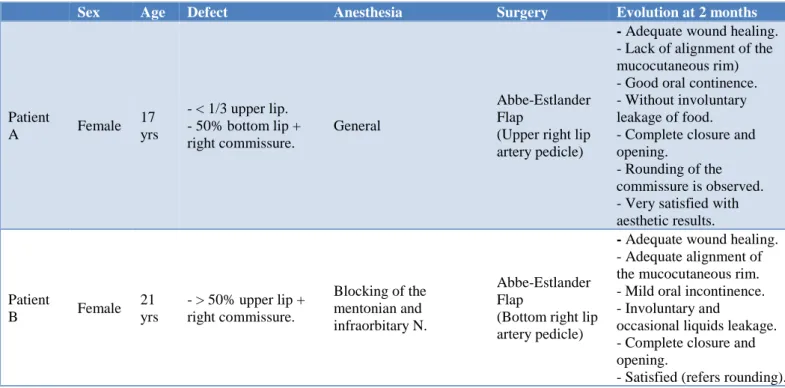
In continuation, we will describe two clinical cases of wounds caused by dog bites where one third of the lip and the commissure were involved, main outcomes are described and can be referenced in Table 1. A follow up with both patients was conducted after 2 months of the initial and one-time reconstructive surgical procedure. A global objective assessment and subjective satisfaction assessment were performed.
Patient A
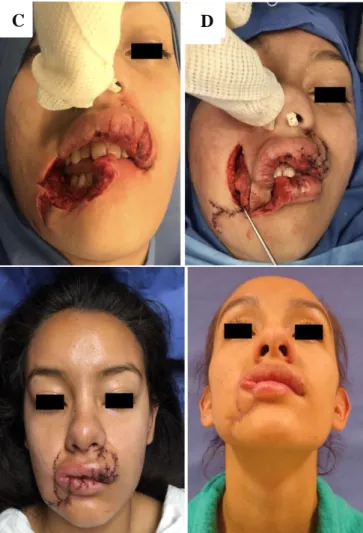
Female patient, 17 years old, presenting dog bite wound with three hours of evolution. Less than one third of the full thickness of the white and red upper left lip was
affected. Bite extended to the right cheek and presented approximately a 50% loss of skin coverage in the lower right lip, involving the vermilion and the central subunit with extension to the commissure (Figure 1A).
After aseptic and antiseptic measures were taken and patient was infiltrated with lidocaine and epinephrine, a myorrhaphy of the orbicularis muscle and a primary closure of the wound was performed in the upper lip and cheek. The marking of the Estlander flap was done for half of the width of the defect, based on the superior right labial artery (Figure 1B). The dissection was done in planes until full thickness was liberated; viability was verified. It was then rotated 180º and sutured in planes (Figure 1C).
The patient in the first case expressed a high level of satisfaction. She experienced adequate wound healing, phonation, good oral continence without any leakage of liquids or food and complete closure of the lips (Figure 1D).
Figure 1: Clinical case 1.
(
A): Loss of skin coverage from dog bite in lower lip involving commissure. (B):Transoperative picture of flap rotation. (C): Immediate postoperative, (D): Follow up at two months (lack of alignment of the mucocutaneous rim
and expected rounding of the commissure).
A
C
B
D
Table 1. Description of clinical cases and results at the two months follow up.
Sex Age Defect Anesthesia Surgery Evolution at 2 months
Patient
A Female
17 yrs
- < 1/3 upper lip. - 50% bottom lip + right commissure.
General
Abbe-Estlander Flap
(Upper right lip artery pedicle)
- Adequate wound healing. - Lack of alignment of the mucocutaneous rim) - Good oral continence. - Without involuntary leakage of food. - Complete closure and opening.
- Rounding of the commissure is observed. - Very satisfied with aesthetic results.
Patient
B Female
21 yrs
- > 50% upper lip + right commissure.
Blocking of the mentonian and infraorbitary N.
Abbe-Estlander Flap
(Bottom right lip artery pedicle)
- Adequate wound healing. - Adequate alignment of the mucocutaneous rim. - Mild oral incontinence. - Involuntary and
occasional liquids leakage. - Complete closure and opening.
- Satisfied (refers rounding).
PATIENT B
Figure 2: Clinical case 2. (A): loss of skin coverage due to dog bite that involves commissure of upper lip.
(B): immediate postoperative. (C): Follow up at two months (incomplete closure and expected rounding of
the commissure).
Female patient, 21 years old, presenting dog bite wound with five hours of evolution. Loss of skin coverage was of over 50% of the upper right lip, involving the philtrum, the vermillion and lateral subunit, and extending to the commissure. Patient also presented evidence of skeletonized labial artery (Figure 2A).
A pre-surgical protocol was carried out and blockage of the infraorbital and mentonian nerve was performed; The marking of the Estlander flap was done for half of the width of the defect, based on the lower right labial artery. The dissection was done in planes until full thickness was liberated; viability was verified. It was then rotated 180º and sutured in planes (Figure 2B).
The patient in the second case expressed she was moderately satisfied, not entirely pleased with the rounding of the commissure. She presented adequate wound healing and good phonation, medium oral continence due to an involuntary and occasional leakage of liquids and incomplete closure of the lips (Figure 2C).
DISCUSSION
Lip reconstruction due to dog bites is a frequent procedure in the daily practice of plastic surgeons. For this reason, it is crucial to possess vast knowledge of the anatomy and reconstructive methods available in order to take the best approach on a case by case basis. It is important to exhaust local options before considering a free flap, as well as keeping in mind the cost-benefit and final outcome each option presents. It is imperative to
A
B
acknowledge that the decision will have a key effect on
the reintegration of the patient to society. As surgeons, we must maintain the primary goal of lip and oral commissure reconstruction; To recover functionality. The main 4 goals of adequate oral function are, oral competence, muscle function, lip sensation, and oral gape.12 The cosmetic objectives of lip reconstruction include restoring labial symmetry, adequate oral opening and avoid poor scarring.13 While cosmetic objectives are key, it is important to remember that no matter how good a lip reconstruction looks, lip function and oral competence are the key determinants of a successful reconstruction.14
The literature describes several local flaps for full thickness defects involving more than 1/3 of overall volume. Although none of them provides ideal results, general consensus is that if the commissure is involved, then the Abbe-Estlander flap is the most reliable technique due to its results in functionality (closure, opening, phonation and continence).15 Its main disadvantages are microstomia and commissure disappearance.16
Although different authors have proposed modifications or variations of the original technique with good results for specific cases (large skin tumors), there is still no consensus that defines the use of any of these variants. That is why the plastic surgeon must know the anatomy and the original technique and use their criteria to define if it is necessary to make any modifications in order to obtain an optimal result. Keeping in mind each patient is a unique case.17,18
The need of a second surgical procedure is common, and it should be performed at 12 weeks in order to improve certain aspects involving the outcome.19 However, in the study done by Kumar et al. out of 10 patients, adequate results were achieved in 9 of these patients with just one single procedure.6 Zhai et al. use the Abbe-Estlander flap alone for reconstruction of defects up to 50%. Proving that this flap is a useful alternative in large volume defects, due to its vascularity.20 Ali Ebrahimi et al. established the flap benefits in defects of up to 80% of the lip.21 Just as it happened in both cases, the Estlander flap shows superiority in comparison to other techniques due to the wide margin of rotation it has, its wide vascularity, and the advantage that if done properly, it manages to cover the defect with a single procedure. Although a large proportion will require a comisuroplasty, the functional and aesthetic benefit remains superior in the long term spectrum.
CONCLUSION
In addition to its long-term aesthetic and functional results. Due to the Estlander flap’s versatility, its blood flow, simple technique, and the possibility of performing it under local anaesthesia, it is still an ideal option for treating this type of defects.
Funding: No funding sources Conflict of interest: None declared Ethical approval: Not required
REFERENCES
1. Gilchrist J. Sacks JJ. White D. Kresnow MJ. Dog bites: still a problem? Inj Prev. 2008;14:296-301. 2. Weiss H. Friedman D, Coben J. Incidence of dog
bite injuries treated in emergency departments. JAMA. 1998;279:51Y53.
3. Alizadeh K. Shayesteh A. Li Xu M. An algorithmic approach to operative management of complex pediatric dog bites: 3-year review of a level I regional referral pediatric trauma hospital. Plastic Reconstructive Surg Global Open. 2017;1-6. 4. Chen HH. Neumeier AT. Davies BW. Durairaj VD.
Analysis of pediatric facial dog bites. Craniomaxillofac Trauma Reconstruction Craneomaxilo. 2013 Dec;6(4):225-32.
5. General Directorate of Epidemiology. Morbidity Yearbooks 2014-2017. Unique Information System for Epidemiological surveillance. DGAE/SSA.
Available at:
http://www.epidemiologia.salud.gob.mx/anuario/ht ml/anuarios.html. Accessed on 22 March 2019. 6. Telich-Tarriba JE, Velazquez E, Theurel-Cuevas A,
Shinji-Perez K, Anaya-Ayala JE, Jimenez-Murat Y, et al. Upper extremity patterns of injury and management at a plastic and reconstructive surgery referral center in Mexico City. Ann Plastic Surg. 2018 Jan 1;80(1):23-6.
7. American Society of Plastic Surgeons. Fact sheet: Plastic surgery statistic report, 2014. Available at: www.plasticsurgery.org. Accessed on 3 March 2019.
8. Nyame TT. Pathak A. Talbot SG. The abbe flap for upper lip reconstruction. Eplasty. 2014;14.
9. Williams EF, Setzen G. Mulvaney MJ. Modified Bernard Burow cheek advancement and cross-lip flap for total lip reconstruction. Arch Otolaryngol Head Neck Surg. 1996 Nov;122:1253-8.
10. Abbe R. A new plastic operation for the relief of deformity due to double harelip. Plast Reconstr Surg. 1968 Nov;42(5):481.
11. Estlander JA. A method of reconstructing loss of substance in one lip from the other lip. Plast Reconstr Surg. 1968;42:361.
12. Turgut G, Ozkaya O, Kayali MU, Tatlidede S, Hüthüt I, Bas L. Lower lip reconstruction with local neuromusculocutaneous advancement flap. J Plast Reconstr Aesthet Surg. 2009 Sep 1;62(9):1196-201. 13. Robotti E, Righi B, Carminati M, Ortelli L,
Bonfirraro PP, Devalle L, et al. Oral commissure reconstruction with orbicularis oris elastic musculomucosal flaps. J Plast Reconstr Aesth Surg. 2010;63:431-9.
15. Kumar A, Shetty PM, Bhambar RS, Gattumeedhi
SR, Kumar RM, Kumar H. Versatility of abbe-estlander flap in lip reconstruction a prospective clinical study. J Clin Diagn Res. 2014 Oct;8(10):NC18-21.
16. Rivas O, Alonso-Alonso T, Pérez-Bustillo A, Rodriguez-Prieto M. Reconstruction of Surgical Defects of the Labial Commissure. Actas Dermosifiliogr. 2015;106(9):e49-e54
17. Alvarez GS, Siqueira EJ, de Oliveira MP. A new technique for reconstruction of lower-lip and labial commissure defects: a proposal for the association of Abbe-Estlander and vermilion myomucosal flap techniques. Oral Surg Oral Med Oral Pathol Oral Radiol. 2013 Jun;115(6):724-30.
18. Yamauchi M, Yotsuyanagi T, Ezoe K, Saito T, Yokoi K, Urushidate S. Estlander flap combined with an extended upper lip flap technique for large
defects of lower lip with oral commissure. J Plast Reconstr Aesthet Surg. 2009 Aug;62(8):997-1003. 19. Ducic Y, Athre R, Cochran CS. The split orbicularis
myomucosal flap for lower lip reconstruction. Arch Facial Plast Surg. 2005;7:347-52.
20. Zhai QK, Tan XX, Jin ZL, Wang XK, Sun CF. Reconstruction for defects of the lower lip after tumor ablation. J Craniofac Surg. 2012;23:552. 21. Ebrahimi A, Maghsoudnia GR, Arshadi AA.
Prospective comparative study of lower lip defects reconstruction with different local flaps. J Craniofac Surg. 2011 Nov;22(6):2255-9.