
Estimation of Periodate Ion Based on its Reduction with
p
-bromoaniline by Kinetic Spectrophotometric Method
Jaspal Singh1*, Kavita Rawat1, Ekata Kumari2 and R. D. Kaushik1
1Department of Chemistry,
Gurukula Kangri Vishwavidyalaya, Haridwar (Uttarakhand) INDIA.
2Uttaranchal College of Science and Technology,
Dehradun (Uttarakhand), INDIA.
*Author for correspondenceemail: [email protected].
(Received on: April 25, 2018)
ABSTRACT
The determination of periodate by kinetic spectrophotometric method has been a practical and simple method for the rapid determination of trace amounts of periodate in aqueous mixed medium using its reduction by p-bromoaniline. Periodate was determined with linear calibration graphs in the range of 0.72 to 50.22 μg/mL. The detection limits in terms of Sandell’s sensitivity for periodate in aqueous solutions at pH 5.5 are in the range of 0.12 to 1.19 μgcm-2 at optimized conditions. The RSD
for six replicate determinations were 0.27% to 1.82% for the linear range of concentration 0.72 to 50.22 μg/mL. The absorbance maximum of the reaction mixture was recorded spectrophotometrically at 456nm. The method used for the determination of periodate in aqueous solutions was compared with the reported spectrophotometric methods. Various parameters related to the trace amount determination of periodate as molar absorptivity, Sandell’s sensitivity, initial rates of the reaction, percentage recovery and effect of interferrants etc. are being presented in this article.
Keywords: Microgram determination, Sodium metaperiodate, MnII catalyzed,
Spectrophotometry.
INTRODUCTION
periodate and iodate is required for environmental protection and important in biology, organic chemistry and life science. Extensive survey of literature reveals that several methods has been reported for the simultaneous determination of iodate ion (IO3-) and periodate ion (IO4-) in
various media including complexation, masking agents and pre-treatment of samples, different reaction systems, include those based on the consecutive titration, spectrophotometric, electrosorption, chromatography, polarography, capillary electrophoresis, potentiometric titration against Hg(II), pulse polarography, spectro- electrochemical method, kinetic-spectrophotometric methods, sequential flow injection kinetic-spectrophotometric determination, and capillary zone electrophoresis2-18.
Many methods have been reported for the determination of periodate ion in various media including IR spectroscopy, flow injection analysis coupled with chemiluminiscence measurement, kinetic spectrophotometric methods, spectrophotometry, flow injection voltammetry, volumetric methods, static and spectroflorimetric, SDME (single drop micro extraction under solution immersion) or HS-SDME (head space SDME) methods18-31. Most of
these methods for the determination of periodate in various media tended to be expensive and complicated to be applying, and preliminary investigations revealed that the reported methods show much scope for the improvement in detection limits as well as the sensitivity32-36.
Therefore, there is always a need to develop newer, simpler and cost effective techniques in this regard and determination of periodate was carried out on the basis of detailed kinetic study of the MnII catalyzed periodate oxidation of p-bromoaniline37.
MATERIALS AND METHODS
All chemicals were of analytical-reagent grade, Sodium metaperiodate (Loba Chemie), p-bromoaniline (Loba Chemie), acetone (E. Merck), manganese sulphate monohydrate (Aldrich) used after redistillation/ recrystallization and the solutions were prepared with triply distilled water. Thiel, Schultz and Koch buffer38 was used for maintaining
the pH of the reaction mixture.
GENERAL PROCEDURE FOR PERIODATE DETERMINATION
Reaction mixture shows the development of light yellow color changing into wine red color and then orange followed by precipitation in about 24 hours. The reaction was studied in a spectrophotometric cell and all the solutions were equilibrated at 35 ±0.10C before the
beginning of the reaction. The determination of [NaIO4] was carried out by using Shimadzu
double beam spectrophotometer (UV-2550). The reaction mixture was thoroughly mixed and quickly transferred to an absorption cell which is also equilibrated at 35 ±0.10C with the help
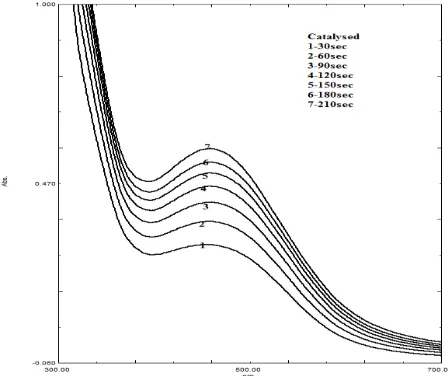
Fig 1: Wavelength maxima for PBA-NaIO4 reaction mixture catalyzed by MnII
[PBA] × 105= 2.0 mol dm-3, [NaIO
4] × 104 = 2.0 mol dm-3, λmax = 456 nm, [MnII] × 106=7.28
mol dm-3, Acetone = 5.0% (v/v), Temp. = 35 + 0.1̊ C, pH = 5.5
The conditions worked out for running the kinetic sets for the purpose of trace amount spectrophotometric determination of [NaIO4] in mixed (acetone-water) medium based on its
reduction with PBA: [PBA] × 105 = 2.0 moldm-3, [MnII] × 106 = 7.28 moldm-3 , Acetone = 5.0
% (v/v), pH = 5.5, λmax = 456 nm, Temp.= 35.0 ± 0.1oC, [NaIO4] = Unknown in the range of
0.72-50.22µg/mL.
PREPARATION OF CALIBRATION CURVES
For the determination of [NaIO4] in trace amounts, a definite volume of PBA, MnII
and acetone was mixed with the calculated volume of buffer (pH 5.5) and stirred a little. This reaction mixture and periodate solution (oxidant) were separately clamped in a thermostat at 35± 0.1oC in order to maintain the desired temperature of the reaction mixture. Definite volume
of periodate solution was added to the reaction mixture after 10 minutes. All additions were made in amounts calculated for maintaining the concentrations of different reagents as mentioned above. Different sets were prepared in a similar manner varying the [NaIO4]. A
portion of the reaction mixture was immediately transferred into the cuvette of Shimadzu double beam spectrophotometer (UV-2550) within few seconds and the temperature of spectrophotometer cell was also maintained at 35±0.10C. After recording the absorbance of
the reaction mixture in repeated time intervals of 30 seconds, the absorbance vs. time plots were made for different sets, which are given in fig.2. The pseudo first order rate constants (kobs) were found by Guggenheim’s method39 and initial rates for the reaction were evaluated
Fig 2: Absorbance vs time plots at different concentration of [NaIO4]
[PBA] × 105= 2.0 mol dm-3, [MnII] × 106 = 7.28mol dm-3, Acetone = 5.0 % (v/v),
Temp. = 35 + 0.1ᵒC, pH = 5.5, λmax = 456 nm, [NaIO4] = in the range of 0.72-50.22µg/mL.
Fig 3: Calibration curve in terms of absorbance vs. [NaIO4] plots
[PBA] ×105 = 2.0 × mol dm-3, [MnII] × 106 = 7.28mol dm-3, Acetone = 5.0 % (v/v), Temp. =
35 + 0.1ᵒC, pH = 5.5, λmax = 456 nm, [NaIO4] = in the range of 0.72-50.22µg/mL.
Fig. 4: Calibration curve in terms of initial rate or pseudo first order rate constant vs [NaIO4] plots
50 100 150 200 250
0.00 0.05 0.10 0.15 0.20 0.25 0.30 0.35 0.40 0.45 0.50 0.55 0.60 A b so rb an ce Time(sec)
[NaIO4](µg/ml) 0.72 4.02 7.32 10.62 13.92 17.22 20.52 23.82 27.12 30.42 33.72 37.02 40.32 43.62 46.92 50.22
0 10 20 30 40 50
0.00 0.05 0.10 0.15 0.20 0.25 0.30 0.35 0.40 0.45 0.50 A bs or ba nc e
[NaIO4] (µg/ml)
A30 vs [NaIO4]
A60 vs [NaIO4]
A90 vs [NaIO4]
A120 vs [NaIO4]
0 10 20 30 40 50
0 2 4 6 8 10 12 14 16 18 20 22 24 26 28 30 32 (d A /d T )30 × 10
4 a
[PBA] × 105 = 2.0 mol dm-3, [MnII] × 106mol dm-3 = 7.28, Acetone = 5.0 % (v/v), Temp. = 35
+ 0.1ᵒC, pH = 5.5, λmax = 456 nm, [NaIO4] = in the range of 0.72-50.22µg/mL. Validity of beer’s law and other characteristics of the method
The range of [NaIO4] in which the Beer’s law is obeyed, molar absorptivity, Sandell’s
sensitivity, correlation coefficient of determination, value of ‘t’ (at 0.05 significance level) and relative standard deviation for various calibration curves are given in table-1. Following are the characteristics of various calibration curves in the form of equations of straight line: A30 = 3.77 × 10⁻³ + 5.28 × 10⁻³ [IO4-] (1)
A60= 7.68 × 10⁻³ + 6.78 × 10⁻³ [IO4-] (2)
A90 = 2.038 × 10⁻² + 7.74 × 10⁻³ [IO4-] (3)
A120 = 3.27 × 10⁻² + 8.58 × 10⁻³ [IO4-] (4)
(dA/dt)30 = 25.39 ×10⁻¹ + 5.12 × 10⁻¹ [IO4-] (5)
kobs = 12.07 × 10⁻¹ + 2.37 × 10⁻¹ [IO4-] (6)
In equation 1-4, the values of intercept and slope are in absorbance units and absorbance units μg-1 mL respectively while these are absorbance units s-1 and mL μg-1 s-1 in
equation 5-6. The [IO4-] are in μg/mL. Effect of interferrants
Some interferring ions like cations and anions do not interfere in the reaction system for the estimation of [NaIO4] in trace amounts, so this method may be used in the presence of
these ions. However, in some cases where some metals like p-block elements and transition metal elements are expected to interfere in the reaction system, therefore a pre-treatment is required for the elimination of these metals from the reaction under consideration. For the elimination of these interferrants from the reaction system Hydrogen sulphide gas should be passed in the presence of 0.3 M solution of H+. After filtration and boiling of H
2S, a dilute
alkaline solution of α-nitroso-β-naphthol should be added for the neutralization of the solution and all the metals are removed by filteration40. Now, proposed method may be applied for the
determination of [NaIO4] in trace amounts in water samples. If ‘Fe’ metal present in the
reaction system as an interferrant, it may be removed by precipitation using basic formate method41, 42.
Procedure for estimation of [NaIO4]
Determination of periodate ion in water samples and aqueous solutions was carried out by mixing the calculated quantity of PBA in acetone, MnII in water and acetone in a buffer
solution of pH 5.5 and clamped this reaction mixture in a thermostat at 35 ± 0.1oC to
maintained the reaction temperature. After maintaining the temperature, the calculated quantity of NaIO4 solution was added in the reaction mixture to start the reaction followed by
recording the absorbance of the reaction mixture for different sets at definite time interval. Plane mirror method and Guggenheim’s method were used for the evaluation of kobs and initial
rates in terms of (dA/dt)30 as discussed earlier and different calibration curves under optimum
RESULTS AND DISCUSSION
The results obtained from the proposed method were found to be reproducible within the range of the [IO4-] limits with reasonable standard deviation, sandell’s sensitivity and
results lies within the experimental error as calculated from the six determinations and reported in table-1. Various parameters as molar absorptivity, percentage recovery, and correlation coefficient were evaluated from the characteristics of the calibration curves in the range of [IO4-] i.e. 0.72-50.22 μg/mL (table-1). The detection limits for various calibration curves are
in the range of 0.12-0.19 μgcm-2 and high value of molar extinction coefficient indicates good
correlation with the developed methods. Further most of these methods require rarely available facilities like GC-ECD, GC-MS, solid phase extraction coupled with HPLC, differential pulse voltammetry and adsorptive stripping voltammetry, flow injection method etc. hence, from the above discussion it is clear that the proposed method for the determination of [NaIO4] is
characterized by a higher selectivity and sensitivity compared to other photometric methods (Table-2).
Table 1: Parameters of calibration curves: for the determination of [NaIO4] in aqueous mixed media
[PBA]×105 = 2.0 mol dm-3, [MnII] ×106 = 7.28 mol dm-3, Acetone = 5.0 % (v/v),
Temp. = 35 + 0.1̊C, pH = 5.5, λmax = 456 nm.
Parameters A plot (30 s)
B plot (60 s)
C plot (90 s)
D plot (120 s)
E plot (kobs)
F plot (rate)
Linear range of [NaIO4] (µg/ml)
0.72-50.22
0.72-50.22
0.72-50.22
0.72-50.22
0.72-50.22
0.72-50.22
Molar absorptivity(Lmol-1 cm-1) 1129.35 1450.187 1655.523 1835.192 --- ---
Sandells sensitivity(µg.cm-2) 0.1894 0.1475 0.1292 0.1166 --- ---
Slope ×103 absorbance units.
µg1cm3(from regression equation) 5.28 6.78 7.74 8.58 236.84 511.85
Intercept ×102 (abs. units)
(from regression equation)
0.905 1.446 2.811 4.124 144.38 305.06
Correlation coefficient(r) 0.9997 0.99911 0.9993 0.9993 0.9981 0.9995
Coefficient of determination (r2) 0.9994 0.9982 0.9986 0.9985 0.9961 0.9990
‘t’(at 0.05 significance level) 6.9190 7.02139 7.40456 7.70286 8.02097 7.9979
Relative standard Deviation (%) 0.4028 0.3869 0.4310 0.6094 0.2698 1.8220
Recovery (%)
Table 2: Comparision of the proposed method with other reported methods for the determination of Periodate
S.N. Linear range of determination of
periodate (µg/mL)
Detection Limit/Sensitivity
Technique used for the determination of periodate
Complex Pre- treatment-Yes(Y) or No(N) Reference no.
1. Macrograms Not available Volumetric titration N 14
2. 0.4-45 Not available ---do--- Y 17
3. 1-10 Not available ---do--- Y 18
4. 10-60 Not available ---do--- Y 15
5. Less than 95.5 µg Accuracy 0.4% Potentiometric titration Y 14 6. Not available Not available IR Spectroscopy Y 15 7. 0.0382-3.82 Not available Spectrophotometry Y 16 8. 0.4-5.0 Not available Kinetic
Spectrophotometric
Y 23
9. Not available 0.35 µg Flow injection analysis & Chemiluminiscene
Y 19
10. 0.191-47.75 Not available Chemiluminiscene Y 20 11. 1.91-19.1 Not available Static & Flow injection
Voltammetry
Y 21
12. 0.25-0.50 0.08 µg/mL Spectrofluorometric flow injection
Y 24
13. 0.09-1.07 0.0764 µg/mL Fluorometry Y 16
14. 0.764-1.91 0.0191 µg/mL Fluoroscence quenching Y 17 15. 0.01-10 Better Detection limit
and sensitivity for HS-SDME method
HS-SDME (Head space single drop micro extraction under solution
immersion)
Y 25
16. 0.05-50 Compare to SDME method
SDME (single drop micro extraction under solution
immersion)
Y 25
17. 0.0096-0.516 0.00069 µg/mL Using L- cystine-CdTe/ZnAs quantum dots
as selective fluorescent probes
Y 18
18. 1.53-27.3 0.037-0.052 µg/mL Kinetic- Spectrophotometric
N 29
19. 3.82-101.72 0.17-0.24 µg/mL Kinetic- Spetcrophotometric
N 30
20. 1.93-22.67 0.072-0.127 µg/mL Kinetic- Spetcrophotometric
N 31
21. 0.72-50.22 0.12-0.19 µg.cm-2
Kinetic-Spectrophotometric
N $
$=Present method
The methods developed by us for the determination of NaIO4 are cost effective and
concentration in which Beer’s law is being obeyed; detection limits in terms of Sandell’s sensitivity, reproducibility of results and % recovery are good enough to make these methods competent for general analysis. These methods are better than some of the previously reported methods in terms of the ease of the procedure involved. Further these methods are better than some of the previously reported methods in terms of the ease of the procedure involved and are less time consuming in comparison to the other available methods for estimation of NaIO4
in aqueous/ mixed media, as no pretreatment of the samples etc are involved in the proposed method except in cases where some rare interferrants are present as already discussed.
ACKNOWLEDGEMENT
All authors equally contributed in this article. The authors are thankful to Prof. R. D. Kaushik, Head, Department of Chemistry, Gurukula Kangri Vishwavidyalaya for providing laboratory facilities and cooperation.
REFERENCES
1. Afkhami, A. and Zarei, A.R. Simultaneous kinetic spectrophotometric determination of periodate-bromate and iodate-bromate mixtures using the H-point standard addition method: Talanta, 60: 63-71 (2003).
2. Belsher, R. and Townshend, A. The consecutive titration of iodate and periodate:
Analytica Chimica Acta, 41: 395-397 (1968).
3. Khalifa, H. and Ateya, B. Application involving the iodide ion (II). Microdetermination of oxidizing agents use of potassium iodate and periodate as primary standards for Mercury(II): Microchemical J., 13: 147-154 (1968).
4. Nisli, G. and Townshend, A. Spot test for the detection of iodate in the presence of periodate; Application to the detection of vic-dihydroxy compounds: Talanta, 15: 411-413 (1968). 5. Garrido, A., Silva, M. and Perez-Bendito, D. Determination of iodate and periodate at the
microgram level by a kinetic method: Analytica Chimica Acta, 184: 227-234 (1986). 6. Honda, S., Suzuki, K. and Kakehi, K. Simultaneous determination of iodate and periodate
by capillary zone electrophoresis: Application to carbohydrate analysis: Analyt. Biochem., 177: 62-66 (1989).
7. Sentana, H.D. and Temperini, M.L.A. Spectroelectrochemical Study of iodide, Iodate and periodate on a silver electrode in alkaline aqueous solution: J. Electroanalyt. Chem., 316: 93-105 (1991).
8. Ni, Y. and Wang, Y. Application of chemometric methods to the simultaneous kinetic spectrophotometric determination of iodate and periodate based on consecutive reactions:
Microchemical J., 86: 216-226 (2007).
9. Kamburova, M. Triphenyltetrazolium Chloride for determination of iodate and periodate:
Talanta, 39: 997-1000 (1992).
11. Ensafi, A.A. and Chamjangali, M.A. Flow- injection spectrophotometric determination of periodate and iodate by their reaction with pyrogallol red in acidic media: Spectrochimica Acta, 58(A): 2835-2839 (2002).
12. Ghasemi, J., Saaidpour, S. and Ensafi, A.A. Simultaneous kinetic spectrophotometric determination of periodate and iodate based on their reaction with pyrogallol red in acidic media by chemometrics methods: Analytica Chimica Acta, 508: 119-126 (2004). 13. Mary, G., Balasubramanian, N. and Nagaraja, K.S. Spectrophotometric determination of
iodine species in table salt and pharmaceutical preparations: Chem. Pharm. Bull., 56(7): 888-893 (2008).
14. Fleury, P. F. and Lange, J. Determination of periodic acid in the presence of iodic acid: J.
Pharm. Chim., 17: 196 (1933).
15. Verma, K.K., Gupta, D., Sanghi, S.K. and Jain, A. Spectrophotometric determination of periodate with amodiaquine dihydrochloride and its application to the indirect determination of some organic compounds via the malaprade reaction: The Analyst, 112: 1519-1522 (1987). 16. Jie, N., Sun, X., Yang, J., Zhang, Q., liu, Z. and Song, Z. A Study on the Reaction of
Periodate with Paracetamol and Its Application: Anal. Lett., 30 (13): 2441-2450 (1997). 17. Jie, N., Sun, X., Zhang, Q., Li, N., Eao, G. and Zhang, Q. Determination of Periodate by
Fluorescence Quenching of Tetraiodofluorescein: Microchim. Acta, 140: 45-49 (2002). 18. Sui, C.X., Liu, Y., Li, P., Zhang, D. and Xia, F. Determination of IO4− and Ni2+ ions using
L-cysteine-CdTe/ZnS quantum dots as pH-dependent fluorescent probes: Anal. Methods, 5: 1695 (2013).
19. Reid, A.F. Micro-potenteometric determination of periodate by arsenic-iodine titration:
Microchimica Acta, 46(2): 236-240 (1958).
20. Al-Kayssi, M. and Magee, R.J. The determination of periodate by Infrared Spectroscopy:
Analytica Chimica Acta, 28:176-178 (1963).
21. Fields, R. and Dixon, H.B.F. A Spectrophotometric method for the microdetermination of periodate: Biochem. J. 108: 883-887 (1968).
22. Sierra, F., Pedreno, C.S., Ruiz, T.P. and Lozano, C.M. Determination of periodate with photoreduced thionine: Analytica Chimica Acta, 94: 129-133 (1977).
23. Mochon, M.C. and Leyva, J.A.M. Spectrophotometric determination of periodate and glycerol with 5,5-dimethyl-1,3-cyclohexanedione bisthiosemicarbazone monohydrochloride:
Analytica Chimica Acta, 140 : 271-280 (1982).
24. Evmiridis, N.P. Periodate determination by FIA with chemiluminescence emission detection, and its application to the ethylene glycol: Talanta, 36: 357-362 (1989).
28. Afkhami, A. and Mosaed, F. Kinetic determination of periodate based on its reaction with ferroin and its application to the indirect determination of ethylene glyocol and glycerol:
Microchemical J., 68: 35-40 (2001).
29. Ensafi, A.A. and Dehahgi, G.B. Spectrofluorimetric flow injection determination of trace amounts of periodate: Spectrochimica Acta, 57(A): 1739-1743 (2001).
30. Gupta, M., Jain, A. and Verma, K.K. Optimization of experimental parameters in single-drop microextraction- gas chromatography- mass spectrometry for the determination of periodate by the malaprade reaction and its application to ethylene glycol: Talanta, 71: 1039-1046 (2007).
31. Kaushik, R.D., Kumar, A., Kumar, T. and Singh, P. Manganese (II) catalyzed periodate oxidation of p-toluidine: a kinetic and mechanistic study: React. Kinet. Mech. Cat., 101(1): 13-23 (2010).
32. Kaushik, R.D., Malik, R., Kumar, T. and Singh, P. Manganese (II) catalysed periodate oxidation of 2-amino-m-xylene. A kinetic-mechanistic study: Oxid. Commun., 35 (2): 316-326 (2012).
33. Kaushik, R.D., Singh, O., Tyagi, P., Yadav, R. and Singh, J. Free Energy relationship for the reaction series- MnII catalyzed periodate oxidation of aromatic amines: J. Indian
Chem. Soc., 91(10): 1959-1966 (2014).
34. Singh, J. Microgram determination of periodate-ion based on its reduction by N-N-dimethylaniline: J Nat Phys Sci., 25: 92-100 (2015).
35. Singh, J., Kaushik, R.D., Khandelwal, N. and Kumari,E. Reduction of Periodate ion by o-anisidine- Application for microgram determination of priodate: J. Indian Chem. Soc., 93: 93-98 (2016).
36. Kaushik, R.D., Singh, J., Chawla, M., Saini, R. and Kumari, E. Microgram Determination of Periodate: Application of its reduction by p-Phenetidine. Res. J. Pharma. Bio. Chem Sci., 8: 1474 (2017).
37. Kaushik, R.D., Singh, J., Saini, R., Rawat, K. and Kumari, E.MnII catalyzed oxidation of
p-bromoaniline by periodate ion – A kinetic and mechanistic study. Res. J. Pharma. Bio.
Chem Sci., 8: 1264 (2017).
38. Britton H.T.S., “Hydrogen Ions”, Vol. I 4th edn., Chapman and Hall, London, 354 (1955).
39. Guggenheim, E.A. On the determination of the velocity constant of a uni-molecular reaction. Phil. Mag., 2(9): 538-543 (1926).
40. Meites, L., Handbook of Analytical Chemistry, W-Hill book Co., INC, New York, 3-4 (1963).
41. Biswas, P.D. and De, K. Extractive spectophotometric determination of manganese (II) using 4-(methylphenyl)-3-oxobutanamide. J. Indian Chem. Soc., 80: 195 (2003).
![Fig 3: Calibration curve in terms of absorbance vs. [NaIO 4] plots](https://thumb-us.123doks.com/thumbv2/123dok_us/8806550.1774874/4.612.217.400.317.448/fig-calibration-curve-terms-absorbance-vs-naio-plots.webp)
![Table 1: Parameters of calibration curves: for the determination of [NaIO] in aqueous mixed media [PBA]×105 = 2.0 mol dm-3, [MnII] ×106 = 7.28 mol dm-3, Acetone = 5.0 % (v/v), Temp](https://thumb-us.123doks.com/thumbv2/123dok_us/8806550.1774874/6.612.98.515.396.647/table-parameters-calibration-curves-determination-aqueous-mnii-acetone.webp)
