Prevention of Attacks and Mitigates the Packet
Drop in Wireless Adhoc Networks
1
R.Sethulakshimi, 2Dr.S. Kumaravel., 3N.Suresh
1
Research Scholar, Mahendra Arts and Science College, Kalipatti, Namakkal (Dt), Tamilnadu.
2
Head of the Department (DCS), Mahendra Arts and Science College, Kalipatti, Namakkal (Dt), Tamilnadu.
3
Asst. Professor in Computer Science, Mahendra Arts and Science College, Kalipatti, Namakkal (Dt),
ABSTRACT:
A Mobile Ad hoc Network (MANET) is free to move independently in any directions that are powered by rechargeable batteries. Consumption of energy is the major problem in a wireless network. This paper presents a new algorithm called Energy-Aware Span Routing Protocol (EASRP) that is one kind of energy-saving approaches such as Span and the Adaptive Fidelity Energy Conservation Algorithm (AFECA). These energy-saving approaches are well-established in the reactive protocols. However, there are certain problems to be addressed when using EASRP in a hybrid protocol, especially a proactive protocol. Simulation results for the EASRP show an rise in residual battery capacity of 8.2% and 13.45% compared with EAZRP and ZRP, respectively. The EASRP also proves to be successfully in by producing a better throughput for a networks as measured by the qualnet simulation tool.
Keywords: MANET Energy conservation Span AFECA Remote Activated Switch Zone Routing Protocol.
I. INTRODUCTION
MANET [1] is a collection of nodes that act alone but depend on each other for their working in the network. The process of route discovery, route maintenance and mistake reporting happens collectively rather than centrally. The importance of MANET is rise with the increased dependence on personal devices, such as Personal Digital Assistants (PDAs), mobile phones and lap for information exchange. These devices can be communicate into a network at any time without any infrastructure using MANET. They are mainly being used in the guarding field, where the possibility of setting up infrastructure in hostile areas is not viable. However, MANET is also used for non-combatant applications, such as for transferring data during a meeting that was arranged in a little time[2]. MANET has some unique features: (1) no centralized control, (2) time-change wireless link characteristics, (3) path changes occur due to moving, (4) the limited range of wireless communication and (5) packet losses occur in hidden terminal problem [3]. In addition to these special features, they have the common features of wireless communication systems, such as untrue links and compact bandwidth resources.
The process of routing is complex in MANET due to its especial features. Thus, the routing protocol of MANET plays a testing role in finding the performance of the network. It controls the path start time, throughput, Packet Delivery Ratio (PDR) and the energy consumption of the whole network. Energy is consumed
due to the route discovery process, which involves the communication of overheads. The number of overheads is proportional to the rate of change of the network topology Rest on the route discovery process, the routing protocols [4,5] are classific into three types:
1.Reactive protocol (else ‘‘on demand’’), where the route discovery is carried out when the node has some data to communicate. The nodes do not frequently update the topology information. Thus, the route establishment time is more, but the overheads are less. Examples are Ad hoc On-Demand Distance Vector (AODV) and Dynamic Source Routing (DSR).
2. Proactive protocols (else ‘‘table driven’’), in which the nodes from time to time update the changes in network topology, notwithstanding of whether they have data to send. At any moment, each node knows the path to all other nodes in the network. Thus, the route discovery time is less, but high overheads are want. Examples of proactive protocols are Destination Sequenced Distance Vector (DSDV).
1.The Power Save Approach – The nodes are planed to sleep for a particular time by use of an good scheduling technique.
2.The Power Control Approach – communication power is manage and the minimum energy is used to route the data packets. It use the power based ondistance rule that rule state that: a little distance passing on [8] the less energy for a lengthly distance reporting.
3.The Power Management Control Approach – In the ad hoc power saving approach of IEEE 802.11 [9], nodes are put into sleep state using the Adaptive Ad-hoc Traffic Indication Message (ATIM) window and beacon meantime at the Medium Access Control (MAC) layer. Thus, they grow the network lifetime [10].
This paper focus on the first problem, namely, an energy useful scheduling technique. In this paper, we join the energysaving methodology of AFECA and Span with Zone Routing Protocol . The EASRP is a hopeful solution for the energy efficiency of the network and for rising the network’s lifetime. It is feasible to lower energy consumption and growing the residual battery capacity by optimizing the Span coordination algorithm for a highdegree network.
The rest of the paper is manage the as follows. In part 2, we present modern developments in routing protocol systems. In part3, we explain the proposed protocol. In part 4 and 5, the simulation arrangement and results are discussed with supporting graphs. In the last part, the pro of EASRP are open, and the choice for additional research to enchance its performance is put forth.
II. RELATED WORKS
AFECA [11] is a powersave method used with the routing protocols. It provides a route to pick the lazy nodes and spin nodes into the sleep, listen and active states. AFECA is the better form of Basic Energy-Conserving Algorithm (BECA) with a fresh sleep interval based on neighbours. Energy saving is achieve by altering the states of the nodes regularly.
Span [12] adaptively selects coordinators from the network from between all nodes. It rotates the coordinator part amongst nodes to remain the energy savings. Thus, coordinators act as main routers for the total network and offer certain connectivity by ensure
that at smallest amount one active node is in the coordinator’s range. The coordinators are selected based on their remaining residual battery capacity and the use of the node [13]. If two nodes cannot make each other, those nodes become a coordinator node, which produce better throughput and energy efficiency
An algorithm name as the Energy-Aware Geo-location-aided Routing (EAGER) [14] EAGER is the fusion routing protocol, it is topology depended system. The routing protocol classific the network into multiple proactive cells based on nature-location information. It decrease the no.of nodes participating in the route discovery process and broadcast range [15]. The implementation of EAGER shows improvedenergy better than that of ZRP.
Gossip-based Sleep Protocol (GSP) is proposed for synchronous and asynchronous networks. Each node changes its state into the sleep state for a random time interval based on the gossip probability P, which in turn reduces its energy consumption [20].
In [21], AFECA/Span with AODV resulted in very low energy consumption, but with some drawbacks. AODV is a reactive routing protocol: a node starts searching for a route to the destination when it has data for that node. Hence, the time needed to establish the route is long; it increases the end-to-end delay. In addition, Span makes the idle nodes sleep for a certain period of time. During this time interval, the node cannot transmit any data packets; hence, the packets may drop. To avoid this, the source node depends on retransmission of data to the sleeping node until there is an acknowledgement. This repeated transmission of data leads to more energy consumption. Further, in the case of a route request or reply, the time to establish the route is increased.
III. ENERGY-AWARE SPAN ROUTING
PROTOCOL
In this approach, Span is combined with the existing combination of ZRP and AFECA [22] to increase the energy efficiency; this is more efficient than AFECA alone. The methodology adopted to merge Span/AFECA with ZRP is discussed in the following section.
A. EAZRP
radius 2. The nodes within the zone use Intra Routing Protocol (IARP) [24], i.e., a proactive routing protocol. If the nodes outside the zone use Inter Routing Protocol (IERP) [25], this is equivalent to using a reactive protocol. The zone is formed based on the number of hops to reach a node instead of the transmission range. The number of hops is known as the radius of the zone. Each node has a separate zone of its own and all of the zones overlap with each other. Once a node receives a data packet for transmission, it checks whether the destination node is inside or outside of its zone. If it is inside the zone, the packet is transmitted through proac-tive routing; otherwise, the path discovery process is started, and the route request is sent to all nodes.
Bordercasting is used for spreading the route discovery request to all of the peripheral nodes. It removes the repeated transmission of the request to the same node. The Bordercast Resolution Protocol [26] forms a tree structure that comes under the IERP of the ZRP. In IARP, the node has to be periodically updated with its neighbour information. Neighbour Discovery Protocol (NDP) is used to find the neighbours and uses the ‘‘HELLO’’ message to update the neighbour node information.
In EAZRP, ZRP was combined with AFECA and RAS and the results proved that EAZRP performed well with respect to net-work size. AFECA is an enhanced technique based on the BECA. The sleep time is constant in BECA, whereas in AFECA, the time varies according to the network density. AFECA has three states, called active, listen and sleep. The sleep interval is changed depending on the number of neighbours in the network. The nodes switch between the various states depending upon route establishment. If a node is idle for a certain time interval, it enters sleep mode. Ta,
Tl and Ts values represent active, listen and sleep times.
AFECA has the advantage that the sleep time can increase with an increase in the number of neighbours. The sleep time of AFECA is Tsa = Ts ⁄ Random (1, N),
where Tsa is the adaptive sleep time and N is the number
of neighbours. Due to this variation of the sleep time, more energy is saved than with BECA. In AFECA, latency occurs due to more retransmissions between a source and a sleeping node participating in the transmission of packets. It reduces the energy consumed by the network by 34.78% [22]
B. SPAN
Span is a well-known reactive protocol, but for it to be usable in hybrid protocols, certain modifications are required. In Span, energy saving is achieved by choosing coordinators, which serve as a backbone in the routing process of the entire net-work. Thus, energy is saved by placing the remaining nodes in sleep mode. The coordinators act analogously to a router and all other nodes can be reached from one of these coordinator nodes. The role of coordinator is distributed amongst all nodes to provide equal opportunity to every node. This is implemented to overcome the undue power advantage that non-coordinator nodes have over coordinator nodes. The coordinator selection and coordinator withdrawal processes are used in distributing the role of coordinator.
Fig. 2 shows an example of a connected backbone network. Nodes are connected with dotted or solid lines depending onwhether they are outside or within radio range. In this picture, black nodes act as coordinators, and the others are non-coordinators. Packet transmissions between nodes 3 and 1 and 4 and 5 are forwarded by the coordinators. If node 2 were elected as a coordinator, it would mean that the bandwidth of nodes 3 and 1 would not with the bandwidth of nodes 4 and 5.
node needs all neighbour information and the utility of the nodes, regardless of whether they are coordinators. Along with this information, the remaining energy of that node is also considered in the selection process. This information is piggybacked with the ‘‘HELLO’’ messages, which contain all of the necessary information. Using this information, a delay period is calculated for each of the nodes before announcing a coordinator. The delay period is indirectly proportional to the remaining energy and number of neighbours and is given By
In Eq. (1), Enr is the remaining energy, Enm is the
maximum energy, Ni is the number of neighbours, R is a
random number between 0 and 1, Cai is the number of
additional new connections if i selected and T is the packet round-trip delay
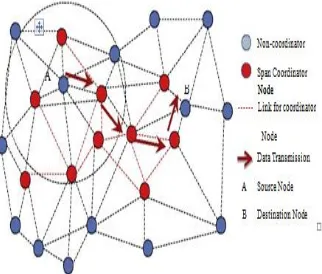
The Route Discovery of EASRP appears in Fig. 3. In this schema, the red1colour represents the Span backbone coordinator nodes and the blue colour represents the non-coordinator nodes. Node A is sending data to node B via the Span backbone coordinator AFECA procedures are implemented in all of the nodes. The coordinator role is periodically rotated by the coordinator selection/withdrawal algorithm to ensure equal participation by all nodes in the network
Fig. 3. Route Discovery of EASRP
Placing Span on top of ZRP is quite insignificant. Span exchanges the hello message periodically to update the coordinator changes and neighbouring information. In general, IARP uses the hello message to update all the information required for routing. In EASRP, hello messages are extended to include information about coordinators and neighbour nodes. In IERP the route requests are sent out by the peripheral nodes to find
routes. The next extension of Span is to construct the back-bone coordinator nodes. Here, the peripheral nodes are selected as the coordinators for sending the route request. Span makes the node sleep when it is idle. In addition to this modification, the Remote Activate Switch (RAS) based on RF tagging [27,28] is incorporated in all nodes to wake up the sleeping nodes remotely. Thus, it decreases the number of retransmission Node by waking up the sleeping node. Additionally, the modification reduces the latency and increases the performance of the routing protocol Fig. 4 shows the layered architecture of this novel protocol designed to reduce energy consumption. However, to validatethe actual performance of this novel protocol the energy consumption should be reduced without a drastic reduction in the throughput or increase in the overhead.
C. PROPOSED ALGORITHM
The EASRP is represented by the algorithm as shown in Table 1, which gives detailed steps of the protocol i.e., NDP, bor-dercasting, IERP, IARP. The step numbers in the algorithm are used to indicate the looping of the functions. Step 2 describes the Span, and step 15 is used for the waking up of the sleeping node
Table1: Simulation setup
The simulations are performed with thequalnet software [29], and protocols ZRP, EAZRP and EASRP are compared. The parameters used for comparison are average consumed energy, PDR, throughput and normalized overhead.
IV. RESULTS AND DISCUSSION
The key parameters examined for evaluating a routing protocol are energy efficiency and packet delivery ratio. These two parameters have opposite effects; an increase in energy efficiency pulls down the PDR value and vice versa. The throughput and overhead are also analysed
Routing Protocol ZRP
Simulation Time 60s
Packet Size 256 bytes
Number of Packets Transmitted
100
Propagation Model Two-ray model
Traffic Type CBR
Antenna Type Omni-directional
Simulation Area 1000*1000
and compared
Algorthim:
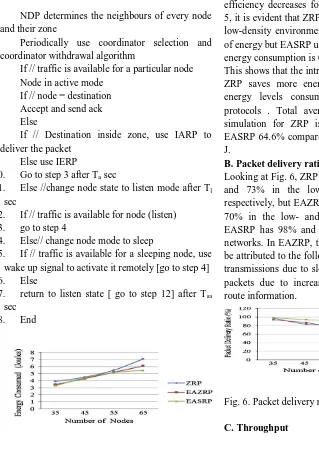
1. NDP determines the neighbours of every node and their zone
2. Periodically use coordinator selection and coordinator withdrawal algorithm
3. If // traffic is available for a particular node 4. Node in active mode
5. If // node = destination 6. Accept and send ack
7. Else
8. If // Destination inside zone, use IARP to deliver the packet
9. Else use IERP
10. Go to step 3 after Ta sec
11. Else //change node state to listen mode after Tl
sec
12. If // traffic is available for node (listen) 13. go to step 4
14. Else// change node mode to sleep
15. If // traffic is available for a sleeping node, use wake up signal to activate it remotely [go to step 4] 16. Else
17. return to listen state [ go to step 12] after Tsa
sec
18. End
Fig. 5. Average consumed energy
A. Energy efficiency
Fig. 5 shows that the average energy consumed by EASRP is lower than ZRP alone. The use of Span usually reduces energyconsumption by 5% compared with EAZRP. The topological changes should be updates periodically to network, and the nodes cannot spend more time in sleep mode. This can be proved by analysing the energy values for various simulations
taken for number of nodes from 35 to 65. If the number of nodes increases, the energy differences increase. The number of idle nodes increases; therefore, the energy efficiency decreases for high-density nodes. From Fig. 5, it is evident that ZRP consumes 3.9 J of energy in the low-density environment, whereas EAZRP uses 3.45 J of energy but EASRP uses only 3.28 J. The difference in energy consumption is 0.62 J less for EASRP than ZRP. This shows that the introduction of AFECA and Span in ZRP saves more energy than ZRP alone. Different energy levels consumed by nodes 35–65 for all protocols . Total average energy consumed by this simulation for ZRP is 82.05%, EAZRP 76.8% and EASRP 64.6% compared with the initial energy of 100 J.
B. Packet delivery ratio
Looking at Fig. 6, ZRP maintains delivery ratios of 96% and 73% in the low- and high-density networks, respectively, but EAZRP has delivery ratios of 92% and 70% in the low- and high-density simulations. The EASRP has 98% and 95% for low- and high-density networks. In EAZRP, the decrease in delivery ratio can be attributed to the following reasons: (1) number of re-transmissions due to sleeping node, (2) collision of the packets due to increased overhead during update of route information.
Fig. 6. Packet delivery ratio
C. Throughput
Fig. 7. Throughput
D. Normalized overhead
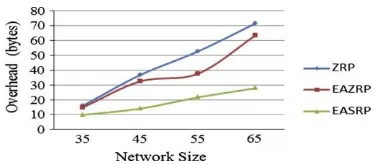
Fig. 8 represents the normalized overhead values for the different number of nodes. In ZRP the overhead is larger, com-pared with EAZRP and EASRP. As the number of nodes increases the overhead also increases. In EASRP, the values drop off less than that of ZRP. For low density nodes, the difference is low, whereas it is high for high density nodes.
Fig. 8. Normalized overhead
E. Performance measure
Performance measure is a new factor proposed in this paper to compare protocols on the basis of energy consumption and PDR. It is defined as the product of the remaining energy and the PDR and is expressed as a percentage. From Fig. 9, it is clear that the performance measure for EASRP is greater than that for ZRP. The performance measures for EASRP are 85.48% and 88.36%If number of nodes is higher, the maximum traf-fic flowing through the network will be higher. It can be seen that the EASRP routing protocol outperforms ZRP.
Fig. 9. Performance measure
V. CONCLUSION AND FUTURE WORK
In the proposed Energy-Aware Span Routing Protocol resulted in lower energy consumption with a better throughput compared with the Zone Routing Protocol and the Energy-Aware Zone Routing Protocol. In EASRP, coordinator nodes can construct the network backbone through which the information is forwarded with less energy, and non-coordinator nodes can save their energy. This protocol substantially reduced the overhead compared with ZRP. It also achieved good throughput compared with ZRP. For the experiments conducted for 35–65 nodes there are 15–30 coordinators and the remaining are non-coordinator nodes; the ratio of coordinators chosen is 3:7. The energy saving is achieved by maintaining the ratio of coordinators and rotating the Span coordinator role amongst all of the nodes. Extensive simulations show that EASRP provides better test results than the other protocols.
REFERENCES
[1] Haas ZJ, Deng J, Liang B, Papadimitratos P, Sajama S. Wireless ad-hoc networks. Encyclopedia Telecommun 2002.
[2] Stefano Basagni, Conti Marco, Giordano Silvia, Stojmenovic Ivan. Mobile ad hoc networking. John Wiley & Sons; 2004. [3] SarkarSubir Kumar, Basavaraju TG, Puttamadappa C. Ad hoc
mobile wireless networks: principles. Auerbach Publications; 2007.
[4] Royer EM, Toh Chai Keong. A review of current routing protocols for ad hoc mobile wireless networks. IEEE PersCommun 1999;6(2):45–56.
[5] Taneja Sunil, Kush Ashwini. A survey of routing protocols in mobile ad hoc networks. Int J Innov Manage Technol 2010;1(3):279–85.
[6] Yu C, Lee B, Youn H. Energy efficient routing protocols for mobile ad hoc networks. WirelCommun Mobile Comput 2003;3(8):959–73.
[7] Li Jiageng, Cordes David, Zhang Jingyuan. Power-aware routing protocols in ad hoc wireless networks. IEEE WirelCommun 2005;12(6):69–81.
[8] Gomez J, Campbell AT. Variable range transmission power control in wireless ad hoc networks. IEEE Trans Mob Comput 2007;6(1):87–99.
[9] Ray Niranjan Kumar, Turuk Ashok Kumar. Energy efficient techniques for wireless ad hoc network. In: Proceedings of first international conference on information & communication technology; 2011. p. 105–11.
[10] Wang Yu. Study on energy conservation in MANET. J Netw 2010;5(6):708–15.
[11] YaXu, John Heidemann, Deborah Estrin. Adaptive energy-conserving routing for multi-hop ad hoc networks. Technical Report 527. USC/Information Sciences Institute; 2000. [12] Chen Benjie, Jamieson Kyle, BalakrishnanHari, Morris Robert.
Span: an energy-efficient coordination algorithm for topology maintenance in ad hoc wireless networks. ACM WirelNetw J 2002;8(5):481
[13] Saravanan K, Velmurugan T, Bagubali A. Increasing the lifetime of MANETs by power aware protocol – Span. J TheorAppl Inform Technol 2013;54(2):287–93.
[15] Qing Zhao, Lang Tong. Energy-efficient adaptive routing for ad hoc networks with time-varying heterogeneous traffic. In: IEEE international conference on acoustics, speech, and signal processing, 2005. Proceedings. (ICASSP ‘05), vol. 5; 2005. p. 801–4.
[16] Saleem Muhammad, Di Caro Gianni A, FarooqMuddassar. Swarm intelligence based routing protocol for wireless sensor networks: survey and future directions. InfSci 2010;181(2011):4597–624.
[17] YaXu, John Heidemann, Deborah Estrin. Geography informed energy conservation for ad hoc routing. In: Proceedings of the ACM international conference on mobile computing and networking; 2001. p. 70–84.
[18] Guodong Wang, Gang Wang, Jun Zhang. ELGR: an energy-efficiency and load-balanced geographic routing algorithm for lossy mobile ad hoc networks. Chin J Aeronaut 2010;23:334–40. [19] Srisathapornphat C, Shen CC. Coordinated power conservation
for ad hoc networks. Proc IEEE ICC 2002;5:3330–5.
[20] HouXiaobing, Tipper David. Gossip based sleep protocol (GSP) for energy efficient routing in wireless ad hoc networks. IEEE ConfWirelCommunNetw 2004;3(3):1305–10.
[21] Kristensen M, Bouvin N. Energy efficient MANET routing using a combination of Span and BECA/AFECA. J Netw 2008;3(3):49–56.
[22] Ravi G, Kashwan KR. Energy aware zone routing protocol using power save technique AFECA. Int Rev ComputSoftw 2013;8(10):2373–8.
[23] Beijar N. Zone Routing Protocol (ZRP) <http://citeseer.ist.psu.edu/538611.html> [08.05.02].
[24] Haas Zygmunt J, Pearlman Marc R, Samar P. Intra Zone Routing Protocol (IARP). IETF Internet Draft, draft-ietf-manet-iarp-01.txt; June 2001.
[25] Haas Zygmunt J, Pearlman Marc R, Samar P. Inter Zone Routing Protocol (IERP). IETF Internet Draft, draft-ietf-manet-ierp-01.txt; June 2001.
[25] Haas Zygmunt J, Pearlman Marc R, Samar P. The Bordercast Resolution Protocol (BRP) for ad hoc networks. IETF Internet Draft, draft-ietf-manet-brp-01.txt; June 2001.
[26] Chiasserini CF, Rao RR. A distributed power management policy for wireless ad hoc networks. In: IEEE wireless communication and networking conference; 2000. p. 1209–13. [27] Rajeswari S, Venkataramani Y. Adaptive energy conserve
routing protocol for mobile ad hoc networks. WSEAS Trans Commun 2012;11(12):464–75.