R E S E A R C H
Open Access
Method for creating location-specific audio
textures
Toni Heittola
1*, Annamaria Mesaros
1,2, Dani Korpi
1, Antti Eronen
3and Tuomas Virtanen
1Abstract
An approach is proposed for creating location-specific audio textures for virtual location-exploration services. The presented approach creates audio textures by processing a small amount of audio recorded at a given location, providing a cost-effective way to produce a versatile audio signal that characterizes the location. The resulting texture is non-repetitive and conserves the location-specific characteristics of the audio scene, without the need of collecting large amount of audio from each location. The method consists of two stages: analysis and synthesis. In the analysis stage, the source audio recording is segmented into homogeneous segments. In the synthesis stage, the audio texture is created by randomly drawing segments from the source audio so that the consecutive segments will have timbral similarity near the segment boundaries. Results obtained in listening experiments show that there is no statistically significant difference in the audio quality or location-specificity of audio when the created audio textures are compared to excerpts of the original recordings. Therefore, the proposed audio textures could be utilized in virtual location-exploration services. Examples of source signals and audio textures created from them are available at www.cs.tut.fi/~heittolt/audiotexture.
1 Introduction
Virtual location-exploration services, such as Here Maps 3D [1], Google Street View [2], and Microsoft Streetside [3], provide ways to virtually explore different locations on the globe. In these services, a user is able to see a 360-degree view at various locations. The image material is typically collected using video cameras mounted on cars which drive around the streets of a city. Using an audio ambiance in conjunction with visual information would provide additional information and give the service a more ‘real’ feeling. In addition, audio ambiance would provide a rich source of information characterizing a location. A location could be, e.g., a busy street corner in New York or a quiet back alley in Tokyo. Users of such an exploration service may be interested in how crowded a certain loca-tion is at a certain time of the day, whether there is a lot of traffic noise on the adjacent street when choosing a hotel or in which parks around the potential hotels one can hear birds singing.
*Correspondence: [email protected]
1Department of Signal Processing, Tampere University of Technology, P.O. Box 553, Tampere 33101, Finland
Full list of author information is available at the end of the article
Currently, all the available location-exploration services provide only visual description of the location, and no location-specific audio ambiances are used. One of the reasons may be the cost of collecting a comprehensive audio database: to record audio for such a service, one would need to stay at each location for a certain period of time in order to collect enough audio data for non-repeating audio ambiance. Current data collection meth-ods involve driving by with a car while recording images and other type of information. Such method is not suitable for collecting audio material, as the sound produced by the car would interfere with the audio content. As crowd-sourced data is a feasible solution to data collection, it is attractive to be able to create location-specific audio ambiances in a cost-effective way, using a small amount of audio. In addition to the virtual location-exploration ser-vices, location-specific audio ambiances could be used in applications such as computer games to enhance the user experience.
Studies show that presenting visual and audio infor-mation together enhances perception in comparison to presenting only visual information [4,5]. Adding audio ambiance for the specific location, even having differ-ent ambiances depending on the time of the day, would
enhance the user experience in the virtual location-exploration services. A few works that combine visual and audio representations for a location suggest using abstract or natural sounds for representing additional information [6,7] or using characteristic audio sequence for map-ping environmental noise into city models [8]. However, none of these prior works use specific audio ambiances recorded at the location of interest.
According to listening tests, humans are able to discrim-inate everyday audio ambiances [9,10]. The listening test conducted in [9] showed a recognition performance of 69% with 24 everyday environments such as street, nature, restaurant, or cafeteria. In [10], same type of test was conducted with more descriptive audio categories. Some of the categories included in the test were representing different situations within the same environment, such as nature during daytime or during nighttime and street with traffic or with police car. The experiment reports a recognition performance of 82% with 15 categories.
A more detailed listening test, presented in [11], shows that humans are able to discriminate even specific loca-tions based on the audio, such as different streets of the same urban area. This test was conducted as a prelim-inary study for developing location-based systems aug-mented with audio ambiances. The results indicate that audio ambiances from similar urban areas of the same city (e.g., different streets, different parks) differ enough to make them recognizable. Thus, location-specific audio ambiances should use audio recorded at the location of interest.
Our work proposes a method to create a new arbitrary long and representative audio ambiance for a location by using a small amount of audio recorded at the exact location. The method aims to retain the location-specific characteristics of the auditory scene while providing a new and versatile audio signal to represent the location. The steps involved in the method are the segmentation of the source audio signal into homogeneous segments, finding a new segment sequence with smooth timbral transitions, and creation of a new signal by concatenating segments in such a way that the segment boundaries do not cre-ate perceivable cuts. This new genercre-ated signal is an audio texture. The audio texture is constructed from the seg-ments of the source audio signal by repeating them from time to time but never in their original order, result-ing in a continuous, infinitely varyresult-ing stream of audio. Despite the repeated segments, the audio texture should have a non-repetitive feel to the listener. In order to create location-specific audio texture, the source signal has to be recorded at the given location.
Previous studies for audio texture creation have been mostly concentrating on producing textures which are perceived as homogeneous in an interval of few seconds [12-15]. In these studies, textures are composed of small
sound elements, which are occurring according to a spec-ified higher level pattern. Typical target sounds for this type of audio textures are background sounds, e.g., rain, wind, and crowds. We use the term audio texture in our approach even though our goal is to synthesize a signal to represent the whole acoustic scene, not only background sounds. Our method aims to produce more heteroge-neous audio textures than the ones typically targeted with audio texture synthesis methods, better suited for real-istic auditory scenes. Therefore, longer sound elements and longer pattern intervals than in typical audio tex-ture approaches are considered in our work. The reason for this is to keep homogeneous segments of the audi-tory scene intact (i.e., segments containing similar sound events) and produce a versatile but realistic representation of the source auditory scene.
Previous work in automatic generation of soundscapes used isolated sound event samples together with audio textures as components to create auditory scenes [16]. Our method avoids explicit usage of sound event samples when creating a synthesized representation of an auditory scene, as it is complicated to automatically find samples with unique content and acoustic properties that match a target scene.
The paper is organized as follows. Section 2 dis-cusses related previous work, and Section 3 presents a detailed description of the audio texture creation method. Section 4 presents the details of a listening test created for the evaluation of the obtained audio textures, and Section 5 presents and discusses the results of the listen-ing test. Finally, Section 6 presents conclusions and ideas for future work.
2 Related work
Previous work on synthesis of audio textures has concen-trated on producing sounds with temporal homogeneity [12-14,16]. On the broader scope, the idea of audio tex-tures is shared in many other domains, such as music textures [17] and musical mosaicing [18].
the database according to the specified descriptors and concatenated to form a texture.
Audio texture synthesis method for signals with sim-ple structures is proposed in [12] for background sound creation and audio restoration. The main objective of the work is to produce a continuous and perceptually simi-lar texture to the source signal. Segmentation of original audio is done using novelty detection method applied on the similarity matrix; sequencing of segments is based on transition probabilities.
Soundscape synthesis combining audio textural ele-ments and sound object eleele-ments for virtual environele-ments is proposed in [16]. The synthesis elements were retrieved from user-contributed unstructured audio corpus, cate-gorized into these two layers, sound objects being the sounds meant to draw attention and textures being the sounds that form the ambiance. For obtaining elements for textures, segmentation is based on Bayesian informa-tion criterion with a minimum segment length separately chosen to three categories (natural, human, mechanical). The texture was created using concatenative synthesis, and sound objects were mixed at the final stage to form the soundscape. A subjective evaluation of the immer-sive properties of the synthesized soundscapes in virtual environments showed soundscapes to be acceptable in comparison to the original recording.
Music textures are a special case of audio textures, where the underlying musical structure is utilized in the segmentation process. The work in [17] describes various ways to create music textures, by using an onset detection method for selecting segments of audio. The segments between two onsets are the units to be rearranged. The work demonstrates recreating music pieces by selecting similar segments from other pieces and concatenating the segments. Applications include, e.g., creating audio textures, music remixing, and replacing corrupted seg-ments in an encoded audio file with synthesized ones. Another example on creating new musical audio signals is the musical mosaicing presented in [18]. The input of this method is a sequence of higher level constraints, for example pitch. Based on this sequence, samples are retrieved from a large database and joined to create the mosaic.
The main difference between methods for creating music textures and methods which operate on more gen-eral signals like everyday audio ambiances is that music rearranging methods can utilize the metrical structure in selecting the segment positions. For example, [17] applies a similarity measure based on the metrical location of a segment. Everyday audio ambiances contain a lot of over-lapping sound events, and usually, there is not a clear structure between events which could be utilized in the audio texture creation. In this case, the methods operate on more local constraints trying to ensure, for example,
that there are no abrupt changes in the timbre of two adjacent segments.
The concatenation of different segments in creation of an audio texture can in fact be considered similar to the concatenative speech synthesis [21], where units repre-senting phonemes are concatenated in a desired order. Unit selection rules are employed so that the best chain of candidate units is chosen from the database to obtain smooth and natural transitions from one to another. Unit selection is done based on acoustic parameters like the fundamental frequency (pitch), duration, position in the syllable, and neighboring phones, with as little as possible processing at the point of concatenation [21]. The con-catenation of music segments in [17] does not deal with inconsistencies at segment boundaries. The boundaries are at onsets and this tends to mask the cuts.
There are multiple services available to collect geo-tagged sound samples, as part of acoustic ecology and soundscape evaluation. The Sound Around You [22] Project [23] collected audio data uploaded by participants using mobile devices. For each uploaded recording, the participants subjectively rated the soundscape in terms of, e.g, quality, pleasantness, and tranquility. The scope of the project was to study the perception of sound-scapes and their link to human activities. A collaborative artistic project called the Urban Remix project also col-lected sounds recorded using mobile devices along with geotagged information [24]. These web-based services allow users to open a map view and listen to the sounds recorded at various locations. In Urban Remix, the user can also create new soundscapes by drawing a path on the map, which will create a mix of the sounds encountered along this path. Practically, these services offer the possi-bility of listening to the samples, usually of short duration, that other users recorded at specific locations.
Audio synthesis techniques would provide the possibil-ity of creating longer and more versatile audio content to characterize a location. A method for generating location-specific audio is presented in [25] as an environmental sound synthesis for location-based sound search system. Their method uses spatial audio mixing based on geo-graphical features and dynamic situations, requiring addi-tional knowledge about the location (e.g., listener position, position of obstacles such as buildings). Our work has similar goal of creating location-specific audio, and using audio textures synthesis based on short original record-ing from a location avoids the collection of any additional location-specific information.
3 Audio texture creation
comes from by having the same generic acoustic proper-ties and types of sound events that are characteristic to the location.
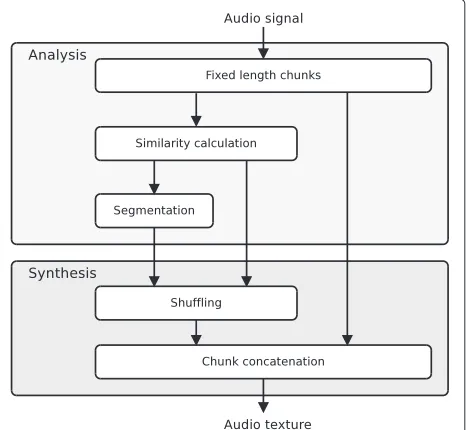
The proposed audio texture creation method consists of two stages: analysis of the source audio signal and synthe-sis of the audio texture. The main steps are illustrated in Figure 1. The analysis stage performs clustering and seg-mentation of the source audio in an unsupervised manner. The goal of the clustering analysis is to automatically find homogeneous audio segments from the source signal. Ide-ally, the segments would be representative of individual sound events from the auditory scene. In the synthesis stage, an audio texture is constructed by shuffling and concatenating these segments. The shuffling will be done in a way that takes into account the timbral continuity at the segment boundaries.
3.1 Similarity-based segmentation
The segmentation is performed in an unsupervised way by using the self-similarity of the source audio. The source audio is split into non-overlapping 4-s chunks. This means that the system is looking for homogeneous regions that are at least 4 s long. Mel-frequency cep-stral coefficients (MFCCs) calculated in short frames are used to represent the rough spectral shape inside the chunks. The MFCCs have been successfully applied in speech and speaker recognition, various music sig-nal classification tasks (artist, genre, song structure), environmental audio classification, audio event detec-tion, and audio context classification [9,26]. For the pro-posed system, the 16 lower order static MFCCs and their delta coefficients are extracted in 20-ms frames with
Figure 1Main steps of the audio texture creation application.
50% overlapping. The feature vector also includes the zeroth order MFCC coefficient, which corresponds to the energy of the frame. This is done so that the seg-mentation process would react also to changes in signal energy.
Gaussian mixture models (GMMs) are trained for each chunk. Since the chunks have varying complexity, the agglomerative EM algorithm [27] is used to train GMM with the best amount of Gaussian components individu-ally for each chunk. The used training algorithm is based on an information theoretic criterion for choosing the number of components. In this work, the maximum pos-sible number of Gaussians is fixed to eight.
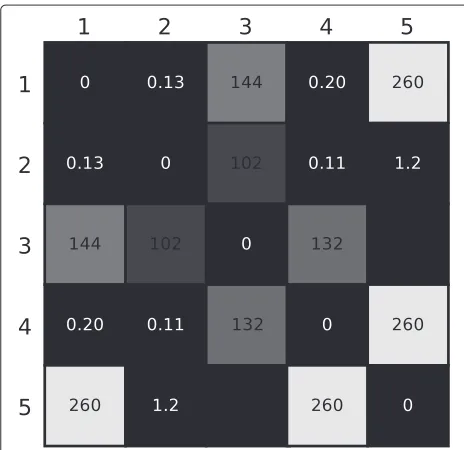
A distance matrix is formed by calculating the distance from each of the chunk-based GMMs to every other. The smaller the distance, the more similar the chunks are. Distances between two distributions, GMMs, are cal-culated using the empirical symmetric Kullback-Leibler divergence [28]. The distances between all the GMMs are collected into a matrix, as a representation related to the similarity between the 4-s chunks. Each row is a feature vector representative of the dissimilarity of one chunk to every other. The matrix reveals patterns in the source audio, and the acoustically homogeneous segments will appear as rectangular regions on the diagonal of the matrix [12,29].
Various methods exist for extracting the segment boundaries from a similarity matrix or a distance matrix. A common method, used for example in song structure segmentation, is to calculate a novelty curve, and its max-ima are considered segment boundaries [12,29]. We will use a method based on clustering of the matrix rows [30]. The reasoning behind this is that a row of this matrix describes how close one chunk is to every other chunk, and this can be considered as a feature vector for that specific chunk.
Ak-means algorithm is used to cluster the rows [30]. In this process, similar chunks of the source audio are clus-tered together. The number of clusters should ideally be related to the expected complexity of the auditory scene. Since we do not have reliable ways to estimate scene com-plexity, in this study, the number of clusters is fixed to 20. A chunk merging step assigns to the same segment the consecutive chunks (in time) that belong to the same cluster.
Figure 2Exaggerated example of distance matrix between chunks.
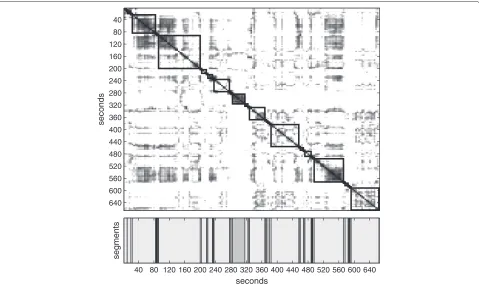
Figure 3 presents a segmentation example. The upper panel shows the distance matrix, in which the darker color corresponds to smaller distance between chunks. The lower panel shows the outcome of the segmenta-tion process. Each color in the lower panel corresponds to a specific cluster, and adjacent chunks belonging to the same cluster form a segment. The resulting segments are indicated also in the distance matrix by the rectangles on the diagonal. Their lengths are multiples of chunk length.
The outcome of these steps is a collection of segments of audio that are timbrally homogeneous, spanning all the source audio data. These segments will be used to create the texture by concatenating them as it will be explained in the following section.
3.2 Shuffling and concatenation
The synthesis stage of the system consists of a shuffling controlled by the similarity of the segments and their con-catenation for obtaining the audio texture. As illustrated in Figure 1, the synthesis stage uses the segments obtained after the analysis stage and the similarity information that was also calculated during analysis.
A straightforward method to obtain a new signal based on segments is simply randomly shuffling them. How-ever, this would most likely produce audible artifacts on the segment boundaries. In order to avoid the arti-facts, we devise segment selection rules that will take into account timbre continuity at the boundaries of consec-utive segments. We guide the segment selection using the similarity between the end chunk of the current seg-ment and the start chunks of possible following segseg-ments.
The synthesis quality difference between random segment shuffling and similarity-controlled segment shuffling was evaluated with a listening test presented in Section 4.
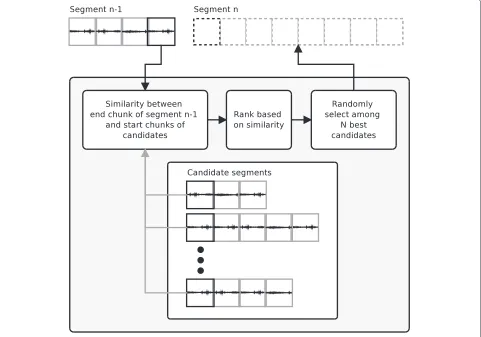
The first segment of the texture is selected randomly from the collection of all available segments. Distances between the last chunk of the selected segment and start chunks of all segments available are extracted from the similarity matrix calculated in the analysis stage. Can-didate segments are ranked by the similarity (minimum distance), and the next segment is randomly selected
from the top N candidates. The parameter N controls
the change rate of auditory scene, and in this work, it is fixed to 10. The procedure is shown in Figure 4. This segment-order-randomization approach will gen-erate a homogeneous and timbrally slowly changing auditory scene, where transitions between segments are indistinguishable.
The amount of audio data per location will most likely be small due to the cost of data collection. Thus, the system has to be able to utilize a low amount of source audio efficiently and have a sensible approach for reusing the segments while avoiding noticeable repetitions. Some constraints are set for the segment selection: at each time, it is not allowed that the next segment is a repetition of the current segment (avoids stuttering) or the segment which was originally following the current segment in the source signal (forces shuffling). A time constraint is also imposed so that re-usage of a segment is allowed only after a cer-tain waiting period. We decided on waiting period of 20 s. This controls how repetitive the resulting audio texture will be. The diversity of audio texture will depend on the length and the complexity of source signal.
The chosen segments are concatenated one after another based on the order determined by the pre-sented segment selection rules. The segments are linearly cross-faded within 2 s, outside of their boundaries, for smooth transitions. The cross-fading process is illustrated in Figure 5.
Example of source signals and synthesized audio textures are available at www.cs.tut.fi/~heittolt/audiotexture/.
4 Subjective evaluation
seconds 40
80 120 160
200 240 280
320 360 400 440
480 520 560
600 640
seconds
segments
40 80 120 160 200 240 280 320 360 400 440 480 520 560 600 640
Figure 3Example of a distance matrix (upper panel) and corresponding segmentation (lower panel).In the lower panel, the segments belonging to the same cluster are marked with the same color. The corresponding segmentation is marked on the distance matrix by the rectangles.
denoted by experiment 3). This test was conducted in an absolute rating test setup.
The tests had two goals. The first goal was to study the quality of the textures: can people notice a degradation in audio quality when they are played an automatically cre-ated texture of an environmental recording? The second goal was to study the representativeness of the auto-matically created textures: can an autoauto-matically created texture credibly represent a location, such as a street, even if it had some noticeable audio quality problems? These experiments studied the audio textures from two perspectives: on one hand, the audio textures were com-pared directly to reference samples in a forced choice test, and on the other hand, the audio textures were pre-sented without a reference asking subjects to rate the representativeness for a certain location. The later setup is more close to the target application of virtual location-exploration services, where audio textures are used to represent certain locations without direct reference to real recordings.
In order to allow flexibility, the listening tests were car-ried out in a web browser via the Internet. This allowed subjects to do the test effortlessly when they had time for it. There was no requirement for the used equip-ments; however, the subjects were encouraged to listen to the audio samples with high-quality headphones. At the
start of the experiment, they were given details about the experiments and put through a familiarization stage.
The experiment consisted of task pages presented sequentially to the test subject, each page containing one pair of samples or an individual sample depending on the test setup. The subjects controlled the playback of the audio sample with the playback button on the task page. It was emphasized to the subjects that it is important to lis-ten through the whole audio samples before answering the questions. After answering the given question, the subject could proceed to the next task page by clicking a button. The order of the task pages was random for all subjects.
4.1 Audio samples
Figure 4Similarity-controlled shuffling, finding candidate segments for the randomization.
44.1 kHz and 24-bit resolution. The stereo signals were averaged into single-channel signals for the experiments.
The amount of locations used in the listening tests was limited to four. This allowed to include sufficient amount of recordings per location to get statistically reli-able results while keeping the length of the listening test per test subject reasonable. Selected locations were a pub, a restaurant, a street, and a track and field stadium during an athletics competition. These locations were selected considering that such public locations would be interesting for a virtual location-exploration service. From
each of the selected locations, four audio recordings which durations ranged from 3 to 10 min were included in the listening tests, considering that this would be the typi-cal length in crowdsourced material. The audio ambiance for the pub location contains mostly music and speech babble background, with occasional conversation in fore-ground. The restaurant location is a self-service type of student restaurant, located in a noisy hallway, ambiance composed mostly of background sounds like speech bab-ble and sounds of cutlery and trays. The audio ambiance of the street location contains sound of cars passing by
and footstep sounds of pedestrians, with general distant traffic noise in the background. Track and field recordings were collected during the athletics competition. The audio ambiance of this location includes foreground events such as announcements and sound from the competitions on foreground and sounds of audience in the background.
4.2 Pair comparison tests
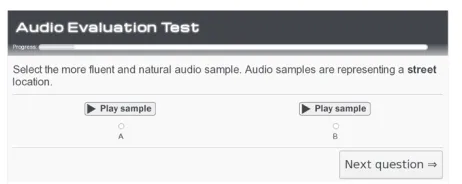
Experiments 1 and 2 used a forced choice setup, where test subjects were asked to select the more fluent and natural audio sample out of two presented samples. An example of a task page used in the tests can be seen in Figure 6. Test subjects were asked to select one sample out of a pair, based on the statement: ‘Select the more fluent and natural audio sample. Audio samples are representing X location.’ Before the listening test, the test subjects were guided to evaluate samples according to following cues: ‘Is the order and continuity of the events in the sample natural? (fluent and natural sample), Or are there audi-ble abrupt changes in the sound which break the fluent structure?’
The test setup for the experiments was chosen to force the test subjects to mark the preference even when there is no obvious difference between the samples. The sim-ilar setup of the two experiments allowed them to be implemented as a single test session. Pairs of samples for experiments 1 and 2 were presented in random order. This also prevents the subjects to adapt their choices during the test. The results of the two experiments were analyzed independently.
In experiment 1, a pair of samples included audio tex-tures synthesized with two different methods, based on the same original recording. One of the samples was synthesized using the proposed similarity-controlled seg-ment shuffling, and the other one was synthesized using a random segment shuffling approach. A 30-s excerpt was randomly selected from each audio texture. In order to ensure a fair comparison of the methods, only excerpts having at least three transitions between audio seg-ments were selected. In experiment 2, a pair of sam-ples included one audio texture synthesized using the proposed similarity-controlled segment shuffling and one
Figure 6Caption of the experiments 1 and 2 as presented to the subjects.
real audio sample. A real audio sample with a length of 30 s was randomly selected from an original recording, and an audio texture was created based on the same record-ing. A 30-s excerpt was selected from the texture the same way as in experiment 1. The total length of test session (experiments 1 and 2) was approximately 40 min per sub-ject, containing a total of 32 sample pairs, 16 pairs for each experiment. In total, 27 voluntary test subjects par-ticipated in the experiments 1 and 2. There were 22 male and 5 female test subjects aged between 20 and 40. Peo-ple with audio research background and peoPeo-ple without any special knowledge about audio signal processing were included in the listening tests. However, we consider these aspects of the test subjects as not having any influence on the results of the listening tests.
4.3 Absolute rating test
The absolute quality and representativeness of the synthe-sized audio textures were studied in experiment 3. Real audio samples and synthesized audio textures produced by the proposed method were presented in random order to test subjects.
The listening test included four original recordings from each of the four selected locations. One audio texture was created based on each original audio recording, resulting in four audio textures available for each of the four loca-tions. For each test subject, a 30-s excerpt was randomly extracted from each of the above audio signals. The length of the listening test was approximately 40 min per subject, containing a total of 32 excerpts (four textures and four original samples per each of the four locations). In order to ensure a fair rating, audio texture excerpts having at least three transitions between audio segments were selected, like in experiments 1 and 2.
The test consisted of several task pages, which were sequentially presented to the subject. An example of a task page can be seen in Figure 7, consisting of a single audio sample accompanied by the rating tickers for two statements:
• The audio quality of this audio sample is good.
• This audio sample sounds like it has been recorded at location X.
The ratings of the first statement provided information regarding the audio quality of the textures. The second statement simply asked how well the audio sample repre-sents a certain type of location according to the subjects. This was used to reveal how realistic the audio textures were. The answers were given on a discrete 9-point scale, where 1 means disagree and 9 means agree.
Figure 7Caption of experiment 3 as presented to the subjects.
with no similarity-based segment selection or cross-fading while concatenating the segments. The segment transitions were easily audible in the example. The subject was informed that the example audio sample is such that it would receive the lowest ratings in terms of audio quality. A second sample was presented, this time a fragment of a real recording, and the subject was told that this example is such that it would receive the highest ratings in terms of audio quality.
The representativeness of an audio sample was ex-plained textually: an audio sample represents a certain type of location well if it sounds as if it has been actu-ally recorded there. It was also emphasized that an audio sample may have bad audio quality but still good repre-sentativeness for a certain location, so the two aspects of the evaluation should be kept separate.
In total, 21 voluntary test subjects participated in the lis-tening experiment 3. Test subjects were different than in experiments 1 and 2, preventing test subjects from using prior knowledge of the signals. There were 13 male and 8 female test subjects aged between 17 and 40. As in experi-ments 1 and 2, both audio researchers and people without any special knowledge about audio signal processing were included in the listening test. However, we consider these aspects of the test subjects as not having any influence on the results of the listening tests.
5 Results and discussion
The results and statistical analysis of the implemented listening tests are presented in this section. Pair com-parison tests, experiments 1 and 2, were implemented as one listening test session, but their results are analyzed separately.
5.1 Experiment 1
Experiment 1 studied the effect of segment shuffling method to the perceived fluency and naturalness of the
synthesized audio texture. In the test, two samples were presented to test subjects: a reference sample synthesized by random segment shuffling and a sample synthesized by similarity-controlled segment shuffling. The expected outcome of this experiment was that the similarity-based segment shuffling is preferred because the transitions between segments should be concealed by similar audio content on either side of the cuts.
The results were analyzed using binomial test with a significance level of 5%, under the null hypothesis that the two options are equally likely to be selected. If the
p-value is below the chosen significance level, this null hypothesis is rejected. This means that the choice is biased, so one option is more likely to be selected by the test subjects. The results are given in Table 1. There are 108 data points for each location, totaling 432 data points for the whole experiment. The 95% confidence interval andp-values resulted from the binomial test for each case are given in the table. The results indicate that the proposed method - the similarity-controlled segment shuffling-based synthesis - is able to outperform purely random segment shuffling in three out of four locations. The proposed method was preferred over the reference method in 61.1% of the overall cases, which is statistically significant.
There is significant difference in user preference for the track and field, street, and pub locations. In these locations, there are distinct foreground events - such as announcements, crowd sounds, cars passing by, conver-sation, which when segmented and randomly shuffled can result in very abrupt changes between adjacent seg-ments. The restaurant location in the experiments is a self-service restaurant located in a noisy hallway with indistinguishable sounds of cutlery, trays, and speech bab-ble forming seemingly static background ambiance, so it is understandable that timbre similarity does not offer much advantage. Based on the outcome of this test, we consider that for most locations, the similarity-controlled segment shuffling results in a more fluent and natural audio texture than a random shuffling of the segments.
Table 1 Average preference percentage and 95% confidence intervals for binomial test for experiment 1
Location Reference Proposed p-value
preferred (%) preferred (%)
Pub 39.8±9.6 60.2±9.6 0.0214
Restaurant 41.7±9.6 58.3±9.6 0.0507
Street 38.9±9.5 61.1±9.5 0.0132
Track and field 35.2±9.4 64.8±9.4 0.0013
Overall 38.9±4.7 61.1±4.7 0.0000
5.2 Experiment 2
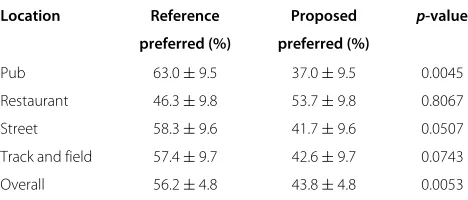
Experiment 2 presented test subjects with a forced choice between an original audio sample and a synthesized one. Similar to experiment 1, the subjects were asked to choose the more fluent and natural sample. The results of the lis-tening test are given in Table 2, together with p-values resulted from a binomial test with a significance level of 5%, under the null hypothesis that the two options are equally likely to be selected.
Overall test result for all cases shows that the null hypothesis must be rejected, and the test subjects are biased towards selecting the real recording. On smaller sets corresponding to individual locations, however, the user preference for the real recording is highlighted only for the pub location, while for restaurant, street, and track and field, the resulting p-values do not allow rejection of the null hypothesis. For the pub location, the pres-ence of music might cause the differpres-ence in preferpres-ences as our method does not consider in any way musical struc-ture, and while timbre might be similar between adjacent segments, music will certainly get fragmented. In other situations, it seems that the similarity-controlled shuffling is able to create sequences of segments that are realistic.
5.3 Experiment 3
In experiment 3, we presented the test subjects with an audio sample and an associated location. In this case, there was no given audio reference, therefore, no compar-ison to be made. The only thing the subjects had to take into account is how well the given audio characterizes the given location, from two points of view: audio quality and representativeness, scored on a scale from 1 to 9. This test refines the findings from experiment 2, by allowing sub-jects to rate audio quality and representativeness of a given audio for a given location based on personal experience from similar locations. The mean values of both measured aspects are listed in Table 3.
The ratings were analyzed using the statistical t-test with a 5% significance level. The null hypothesis for the t-test is that the two sets of ratings (audio sample or audio texture) have the same mean. Separate tests
Table 2 Average preference percentage and 95% confidence intervals for binomial test for experiment 2
Location Reference Proposed p-value
preferred (%) preferred (%)
Pub 63.0±9.5 37.0±9.5 0.0045
Restaurant 46.3±9.8 53.7±9.8 0.8067
Street 58.3±9.6 41.7±9.6 0.0507
Track and field 57.4±9.7 42.6±9.7 0.0743
Overall 56.2±4.8 43.8±4.8 0.0053
Reference method is original recording, and proposed method is similarity-controlled segment shuffling.
were performed for audio quality and representativeness. According to the results presented in Tables 4 and 5,
p-values are higher than the chosen significance level. As consequence, the null hypothesis cannot be rejected.
In this case, the result means that there is no statistically significant difference between the two sets. We cannot conclude that they are equal; however, we can perform an equivalence test to check if they are equivalent to a certain acceptable threshold. To test for equivalence, we perform two one-sidedt-test (TOST) [31].
TOST has been designed specifically for bioequivalence testing of pharmaceutical products [32] and has been expanded into broader applications [33]. TOST has as null hypothesis that the difference of the two means is out-side an interval. This interval is defined by the equivalence thresholdθ, such that when the difference of means of the two sets is within [−θ,+θ], the two sets are considered equivalent. The null hypothesesH01andH02considered
in TOST are the following:
H01: μ1−μ2> θ
H02: μ1−μ2< −θ
(1)
The choice of the equivalence thresholdθis well defined in bioequivalence testing, but for other disciplines, there are no guidelines for choosing it. The real recordings rep-resent a control set, and in our analysis, we consider a threshold around the mean of scores given for the control set by the subjects. We performed two one-sidedt-tests according to the two null hypotheses in Equation 1, for an equivalence thresholdθ10 which is 10% of the mean
of scores of the control set. The equivalence threshold is selected so that the equivalence interval at the middle of the grading scale equals to one unit.
The p-values resulted from this test, and the corre-sponding equivalence thresholds for each performed test are presented in Tables 4 and 5.
Table 3 The mean values along with standard error of the ratings of audio quality and representativeness in experiment 3
Audio quality Representativeness
Location Audio texture Audio sample Audio texture Audio sample
Pub 5.54±0.24 5.93±0.24 6.48±0.24 6.57±0.24
Restaurant 5.90±0.22 5.83±0.27 6.83±0.21 6.86±0.23
Street 5.73±0.26 5.54±0.25 6.87±0.24 7.08±0.23
Track and field 5.82±0.27 6.12±0.24 6.70±0.27 6.57±0.27
Average 5.75±0.12 5.85±0.13 6.72±0.12 6.77±0.12
not. For a complete analysis of our results, we determined at what thresholdθcwe would be able to conclude equiv-alence in each separate case, based on the criticalt-value for a significance level of 5%. The obtained values are also presented in Tables 4 and 5.
5.4 Discussion
Based on the result of experiments 1 and 2, it seems that the similarity-controlled segment shuffling produces more fluent and natural audio texture than random shuffling; however, when given a choice, subjects selected the real recording over the audio texture. An equivalence between quality and representativeness grades for audio texture and audio samples can be concluded to certain degree.
For representativeness, the equivalence can be con-cluded for smaller threshold than for audio quality, as shown in experiment 3. This is understandable, since an audio texture is based on a real recording from the given location. Audio quality is of course affected by the per-ceived continuity of the auditory scene. In some cases, the sequentiality of events is broken by the shuffling, even if timbre continuity is considered: announcements in track and field and speech and music in pub. In such cases, for equivalence, we need to tolerate a larger threshold.
The restaurant location has overall the smallest equiv-alence threshold - we also noticed from experiments 1 and 2 that for this location, there was no obvious user preference for either option (random or similarity-based shuffling, method, or real recording). On the other hand,
Table 4 Thep-values obtained from performing location-wiset-tests and TOST with a 10% equivalence thresholdθ10for audio quality results from experiment 3
Location t-test TOST θ10 Equivalence
with threshold
Pub 0.2359 0.5456 0.59 θc≤1.04
Restaurant 0.8351 0.1372 0.58 θc≤0.75
Street 0.5976 0.3152 0.55 θc≤0.90
Track and field 0.4268 0.4014 0.61 θc≤1.04
Overall 0.5425 0.0067 0.59 θc≤0.45
According to thet-test, none of the cases has statistically significant difference. According to TOST, equivalence cannot be concluded for any location withθ10.
the track and field and the street locations have clear fore-ground sounds, and we can demonstrate equivalence only if we tolerate a one-unit threshold.
The problem of selecting an equivalence threshold beforehand for listening tests is difficult since there are no intuitive values when dealing with opinion scales. By using multiple types of experiments, we could however make some observations.
According to the results, the generated audio has com-parable representativeness to real recording and a satis-factory quality. As a method for creating location-based audio ambiance, it is certainly a viable option, as it will avoid recording of large amounts of data or perceived repetitions if using smaller amount of audio. The audio texture has satisfactory properties for the proposed loca-tion, and users are likely to accept it as an audio ambiance for the location. The results showed that when facing a forced choice, in most cases, people prefer the real record-ing, but for the envisioned application, this is not the case. When a user is presented with audio ambiance of a loca-tion, he or she should not be bothered by artifacts or notice that it is artificially created audio, and our method was shown to fulfill these requirements.
6 Conclusions
We presented a method for audio texture creation for vir-tual location-exploration services. A short audio signal recorded at the given location is used to synthesize a
Table 5 Thep-values obtained from performing location-wiset-tests and TOST with a 10% equivalence threshold
θ10for representativeness results from experiment 3
Location t-test TOST θ10 Equivalence
with threshold
Pub 0.7756 0.0939 0.66 θc≤0.75
Restaurant 0.9385 0.0332 0.69 θc≤0.63
Street 0.5161 0.1354 0.71 θc≤0.86
Track and field 0.7325 0.1708 0.66 θc≤0.89
Overall 0.7655 0.0002 0.68 θc≤0.38
new arbitrary-length signal, while conserving location-specific characteristics of the source audio. The proposed audio texture creation method consists of two main steps: analysis and synthesis. In the analysis stage, the source audio recording is segmented into homogeneous seg-ments. In the synthesis stage, the segments are rearranged and concatenated to create the audio texture. The seg-ment sequence is created by selecting next segseg-ment to the end of sequence randomly among timbrally most similar segments.
Three listening experiments were conducted to assess audio quality of the created audio textures. Forced choice experiments showed that the proposed method is better than random shuffling of segments, but user preference is biased toward the real recordings. With the absolute rat-ing experiment, we showed that representativeness and audio quality of the created audio textures are compara-ble within certain threshold to real recordings. This means that automatically created audio textures could be used in a virtual location-exploration service in a credible way instead of original audio recordings. If the events in the source auditory scene are sequential, the resulting audio texture will most likely break the order of events and fail in being realistic. This should not be a problem for out-door environments but can be annoying in sport events or music concerts where sound events might happen in a specific order.
There are several directions for future work. To increase the quality of the created audio textures for ambiances containing music, a music detector front-end could be used to detect sections containing music and perform the rearranging of the audio segments by following music-specific rules such as rhythm and structural continuity in addition to general timbral similarity. In addition, esti-mation of the auditory scene complexity could help in determining the number of clusters which should be used in the modeling of segments.
In addition, methods for creating audio textures from more than one recording should be studied. Nowadays, it is easy to obtain crowdsourced data; this would be an excellent source of audio content for such a system. A larger set of source recordings would allow creat-ing more versatile content compared to rearrangcreat-ing seg-ments from a single recording. However, this would also need paying attention to possible acoustical mismatches between recordings, e.g., recorded at different time of the day.
Competing interests
The authors declare that they have no competing interests.
Acknowledgements
This work was financially supported by the Academy of Finland under the grant 265024 (Heittola and Virtanen). This work was partially supported from the grant 251170 (Mesaros) Finnish Centre of Excellence Program (2012-2017).
Author details
1Department of Signal Processing, Tampere University of Technology, P.O. Box
553, Tampere 33101, Finland.2Department of Signal Processing and Acoustics,
Aalto University, P.O. Box 13000, Aalto 00076, Finland.3Nokia Research Center,
Visiokatu 3, Tampere 33720, Finland.
Received: 14 December 2012 Accepted: 4 March 2014 Published: 11 March 2014
References
1. Nokia, Here Maps 3D (2013). http://here.com/3D, Accessed 15 November 2013
2. Google, Google Maps with Street View (2013). http://www.google.com/ streetview, Accessed 15 November 2013
3. Microsoft, Microsoft Streetside (2013). http://www.microsoft.com/maps/ streetside.aspx, Accessed 15 November 2013
4. J Vroomen, Bd Gelder, Sound enhances visual perception: cross-modal effects of auditory organization on vision. J. Exp. Psychol.: Human Perception and Performance.26(5), 1583–1590 (2000)
5. F Frassinetti, N Bolognini, E Ladavas, Enhancement of visual perception by crossmodal visuo-auditory interaction. Exp. Brain Res.147(3), 332–343 (2002)
6. JB Krygier, Visualization in modern cartography, inSound and Geographic Visualization(Pergamon Press, London, UK, 1994), pp. 149–166 7. R MacVeigh, RD Jacobson, Increasing the dimensionality of a geographic
information system (GIS) using auditory display, inProceedings of the 13th International Conference on Auditory Display(McGill University, Montreal, Canada, 2007), pp. 530–535
8. J Schiewe, AL Kornfeld, Framework and potential implementations of urban sound cartography, in12th AGILE International Conference on Geographic Information Science(AGILE, Hannover, Germany, 2009) 9. A Eronen, V Peltonen, J Tuomi, A Klapuri, S Fagerlund, T Sorsa, G Lorho,
J Huopaniemi, Audio-based context recognition. IEEE Trans. Audio, Speech, and Language Process.14, 321–329 (2006) 10. S Chu, S Narayanan, CC Kuo, Environmental sound recognition with
time-frequency audio features. IEEE Trans. Audio, Speech, and Language Process.17(6), 1142–1158 (2009)
11. D Korpi, T Heittola, T Partala, A Eronen, A Mesaros, T Virtanen, On the human ability to discriminate audio ambiances from similar locations of an urban environment. Personal and Ubiquitous Comput.17(4), 761–769 (2013)
12. L Lu, L Wenyin, HJ Zhang, Audio textures: theory and applications. IEEE Trans. Speech and Audio Process.12(2), 156–167 (2004)
13. D Menzies, Physically motivated environmental sound synthesis for virtual worlds. EURASIP J. Audio, Speech, and Music Process.2010, 1–11 (2010) 14. S Kersten, P Purwins, Sound texture synthesis with hidden Markov tree
models in the wavelet domain, inSound and Music Computing Conference
(SMC, Barcelona, Spain, 2010)
15. D Schwarz, ed. by G Peeters, State of the art in sound texture synthesis, in
Proceedings of the 14th International Conference on Digital Audio Effects (DaFx-11)(IRCAM–Centre Pompidou, IRCAM, Paris, France, 2011), pp. 221–231
16. N Finney, J Janer, Soundscape generation for virtual environments using community-provided audio databases, inW3C Workshop: Augmented Reality on the Web(Barcelona, Spain, 2010)
17. T Jehan, Creating music by listening. PhD thesis, Massachusetts Institute of Technology, Cambridge, MA, USA, 2005
18. A Zils, F Pachet, Musical mosaicing, inProceedings of the COST G-6 Conference on Digital Audio Effects (DaFx-01), Volume 2(University of Limerick, Limerick, Ireland, 2001), pp. 39–44
19. McJ Dermott, A Oxenham, E Simoncelli, Sound texture synthesis via filter statistics, inIEEE Workshop on Applications of Signal Processing to Audio and Acoustics(IEEE Signal Processing Society, New Paltz, NY, USA, 2009), pp. 297–300
20. D Schwarz, Corpus-based concatenative synthesis. IEEE Signal Process. Mag.24(2), 92–104 (2007)
22. Sound Around You (2013). http://www.soundaroundyou.com, Accessed 15 November 2013
23. C Mydlarz, I Drumm, T Cox, Application of novel techniques for the investigation of human relationships with soundscapes, inINTER-NOISE and NOISE-CON Congress and Conference Proceedings, Volume 2011
(Institute of Noise Control Engineering, Osaka, Japan, 2011), pp. 738–744 24. J Freeman, DiC Salvo, M Nitsche, S Garrett, Soundscape composition and field recording as a platform for collaborative creativity. Organised Sound. 16(3), 272–281 (2011)
25. S Innami, H Kasai, Super-realistic environmental sound synthesizer for location-based sound search system. IEEE Trans. Consumer Electron. 57(4), 1891–1898 (2011)
26. T Heittola, A Mesaros, A Eronen, T Virtanen, Context-dependent sound event detection. EURASIP J. Audio, Speech, and Music Process. 2013(1-13), 1 (2013)
27. M Figueiredo, J Leitão, A Jain, ed. by E Hancock, M Pelillo, Berlin on fitting mixture models, inEnergy Minimization Methods in Computer Vision and Pattern Recognition, Volume 1654 of Lecture Notes in Computer Science
(Springer Berlin Heidelberg, Germany, 1999), pp. 54–69
28. T Virtanen, M Helen, Probabilistic model based similarity measures for audio query-by-example, inIEEE Workshop on Applications of Signal Processing to Audio and Acoustics(IEEE Signal Processing Society, New Paltz, NY, USA, 2007), pp. 82–85
29. J Foote, Automatic audio segmentation using a measure of audio novelty, inIEEE International Conference on Multimedia and Expo, Volume 1
(IEEE Computer Society, New York, NY, USA, 2000)
30. A Jacobs, ed. by G Antoniou, G Potamias, C Spyropoulos, and D Plexousakis, Using self-similarity matrices for structure mining on news video, inAdvances in Artificial Intelligence, Volume 3955 of Lecture Notes in Computer Science(Springer Berlin Heidelberg, Berlin, Germany, 2006), pp. 87–94
31. DJ Schuirmann, A comparison of the two one-sided tests procedure and the power approach for assessing the equivalence of average
bioavailability. J. Pharmacokinetics and Biopharmaceutics.15(6), 657–680 (1987)
32. GB Limentani, MC Ringo, F Ye, ML Bergquist, EO McSorley, Beyond the
t-test: statistical equivalence testing. Analytical Chem.77(11), 221–226 (2005)
33. BL Stegner, AG Bostrom, TK Greenfield, Equivalence testing for use in psychosocial and services research: an introduction with examples. Evaluation and Program Plann.19(3), 193–198 (1996)
doi:10.1186/1687-4722-2014-9
Cite this article as:Heittolaet al.:Method for creating location-specific audio textures. EURASIP Journal on Audio, Speech, and Music Processing 20142014:9.
Submit your manuscript to a
journal and benefi t from:
7Convenient online submission 7Rigorous peer review
7Immediate publication on acceptance 7Open access: articles freely available online 7High visibility within the fi eld
7Retaining the copyright to your article