A quantification of the preferred ease
allowance for the men’s formal jacket patterns
In Hwa Kim
1*, Yun Ja Nam
2and Hyunsook Han
3Introduction
Ease allowance is an additional space inserted between the body and the garment to facilitate body movement, regulate micro climate and express designer’s intention. The required ease allowance can vary even with the same garment type according to the pur-pose of wearing, which affects the needed level of range of motion, air ventilation and thermal insulation. Assuming that the elasticities of the fabric are similar, a formal suit requires less ease allowance than a sportswear, which generally requires greater motion adaptability. Meanwhile, if the elasticity of fabric increases, the garment has greater motion adaptability even if the same size of pattern is used (Geršak 2014). The compres-sion wear which has negative value of ease allowance also shows a similar level of motion adaptability to the garment with sufficient ease allowance because it is made of the mate-rial with excellent elasticity (Bernhardt and Anderson 2005; Brandon et al. 2003).
The aesthetic focus of the men’s formal suit is to express the ideal shape of a men’s nude body through clothing, excluding the exaggeration or distortion (Hollander 2016).
Abstract
The purpose of this study is to provide a quantitative reference required for the deci-sion of ease allowance to draft men’s formal jacket patterns by quantifying the cus-tomers’ actual tendency regarding the preferred fit. The ease allowances of 62 male customers were investigated through the sensory evaluations, once in the initial fitting jackets which were designed using the graded sizing chart of ready-to-wear, and once again in the custom-made jacket customers ordered. The 5-point Likert scale was used for the sensory evaluation and the preferred ease allowance was defined as the ease allowance of respondents who responded “3_Suitable”. The regression equations were developed to estimate preferred ease allowance by inputting body size measurements which showed the highest correlation with the preferred ease allowances. The esti-mated ease allowance ranges by inputting the 5th to 95th percentile of the body sizes were 5.17–8.25 cm for the chest circumference, 6.90–2.09 cm for chest–waist circumfer-ence on the jacket, − 3.82 to 1.34 cm for the chest–hip circumference on the jacket, 1.58–5.86 cm for the upper arm circumference, − 1.80 to 1.95 cm for the bi-shoulder length, and 0.406–0.425 for the ratio of jacket length to stature. The actual tendency of the jacket consumers can be estimated by result of this study, which make the jacket pattern which conforms to current fashion trends can be produced minimizing the potential fit problems.
Keywords: Ease allowance, Formal jacket, Fit, Consumer preferences, Men’s wear
Open Access
© The Author(s) 2019. This article is distributed under the terms of the Creative Commons Attribution 4.0 International License (http://creat iveco mmons .org/licen ses/by/4.0/), which permits unrestricted use, distribution, and reproduction in any medium, provided you give appropriate credit to the original author(s) and the source, provide a link to the Creative Commons license, and indicate if changes were made.
RESEARCH
*Correspondence: [email protected]
1 Visiting Professor,
Department of Fashion Design, The University of Suwon, Suwon, Republic of Korea
Therefore, the appearance of men’s formal suit is evaluated mainly by the silhouette on the wearer’s body, and it is needed to remove the unintended wrinkles caused by the excessive ease allowance. Therefore, the men’s formal jacket patterns should show decent level of motion adaptability for daily life within the minimized level of ease allowance that will not generate any wrinkles on the garment. Then it becomes critical to find the adequate balance between the motion adaptability and the good appearance.
Currently, the custom-made clothing market is expanding to accommodate the vari-ous needs of consumers and online orders of custom-made jackets are also increasing. In traditional custom tailoring, the tailors produced garment patterns by measuring the body size of the customers. Such custom-tailoring processes always include a fitting and pattern correction steps, and tailoring experts reflected the wearer’s responses to the pattern to obtain an excellent final fit. However, if the custom jacket is ordered online, tailoring experts cannot participate in the fitting and pattern correction processes and thus it becomes difficult to achieve an excellent fit. To solve this problem, online virtual fitting rooms have been developed (Protopsaltou et al. 2002; Liu and Wu 2009; Pereira et al. 2011); however, the primary purpose of such a system was to provide the custom-ers with the quick checking of the garment silhouette virtually to facilitate their quick purchase decision, not to actualize elaborate fitting and pattern correction processes online. Thus, it is very difficult to determine the adequate ease allowance that individual consumers want if the order is made online, and such a difficulty makes the men’s cus-tom jacket cannot achieve good fit on online order.
When the fit problem occurred in the online order of a custom jacket, it can cause more problems than a ready-to-wear jacket. If the customized jacket is returned, it can-not be resold to other customers because it had been already customized to the size of original orderer, and it cause the increment of production costs and inventory manage-ment problems. Therefore, the research on the fit preference collected from actual con-sumers is very necessary in order to activate online market of custom jackets.
The purpose of this study is to provide a quantitative reference required for the deci-sion of ease allowance to draft men’s formal jacket patterns, even in the circumstance that the actual fitting process is not allowed. To achieve this purpose, the actual ten-dency regarding the preferred fit for the men’s formal jackets were investigated by wear-ing evaluations, and the predictwear-ing formulae were developed to estimate the optimal preferred ease allowances.
Literature review
Categorization of the ease allowance
Otieno (2008) defined ease allowance as an “extra measurement added to the body meas-urement for movement and expansion”. Keeble et al. (1992), Petrova (2007), and Daanen and Reffeltrath (2007) described it as “the difference between body measurement and garment measurement”. Ease allowances are usually categorized into two or three types, which differ slightly according to the researchers. Rasband (as cited in Branson and Nam
considering the style or fashion, which is similar to the above classification of Rasband (as cited in Branson and Nam 2007). Petrova and Ashdown (2008) defined wearing ease as “the amount of extra fabric needed to ensure a level of comfort and mobility”, which is partially different from the aforementioned concept adding the concept of comfort. Gill (2011) presented five factors of ease allowance: “function”, “comfort”, “oversize”, “fabric”, and “styling”. “Function” has the same concept as wearing ease or wearer ease. “Com-fort” refers to the additional space required for the regulation of microclimate such as air circulation and ventilation, or for the prevention of friction between skin and garment. “Style” is the identical concept as style ease or styling ease. “Fabric” and “oversize” are close to the factors affecting the function, rather than independent ease allowance type.
When considering the influence of the tensile properties of the fabric on the ease allowance, the compression wear which has ease allowance of a negative value should be discussed also. Under ordinary situations, an ease allowance with a negative value acts as an inhibitor for motor function of the wearer, but when applied to the compression wear made from fabrics with high elasticity, it improves the velocity of venous blood flow by assisting the calf muscle pump (Joanna Briggs Institute 2006; Lawrence and Kakkar
1980), or improves the motor function of the wearer by facilitating the removal of blood lactate (Rimaud et al. 2007).
Based on the literatures above, the ease allowance can be categorized into three types: “motor functional ease”, which is expressed as wearing ease or wearer ease required for the body movement; “comfort ease” for the microclimate regulation in the clothing and the prevention of friction between the body and the fabric; and “styling ease” to express the design intension. These ease allowance types are affected by such factors as the ten-sile property, coefficient of friction of the fabric, and garment layering.
When a wearer wants to maximize his fit satisfaction in a formal jacket, a conflict may occur between motional satisfaction through motor functional ease and aesthetic sat-isfaction through styling ease. To maximize the aesthetic satsat-isfaction on a slim fit, the motional satisfaction must be sacrificed to a certain degree. On the other hand, when the ease allowance is increased to the maximal point of motional satisfaction, the aes-thetic satisfaction is decreased in inverse proportion. Therefore, there always exists a certain gap between the maximal points of the motional satisfaction and the aesthetic satisfaction. The aesthetic satisfaction can be achieved in a specific ease allowance if the wearer and garment design are specified. However, the motional satisfaction can vary in accordance with the elasticity of the fabric even though the wearer and garment design are specified. The ease allowance to reach the maximal motional satisfaction decreases as the elasticity of the fabric increases. Figure 1 shows the schematization proposed in this study, describing the relationship between the ease allowance and wearer’s satisfac-tion as well as the difference in optimal size between the mosatisfac-tional satisfacsatisfac-tion and the aesthetic satisfaction on wearing slim fit jackets.
Quantification of the ease allowance
circumference is divided into several segments, and the difference between the gar-ment size and human body size is measured separately for each seggar-ment (Wang et al.
2006; Kim 2008). This approach allows the more specific setting of ease allowance for each body part. The quantification method most frequently used by the researchers is to determine the linear distance between the human body and the garment as measured along a reference line (Choi and Kim 2004; Wang et al. 2007; Kim et al. 2011; Su et al.
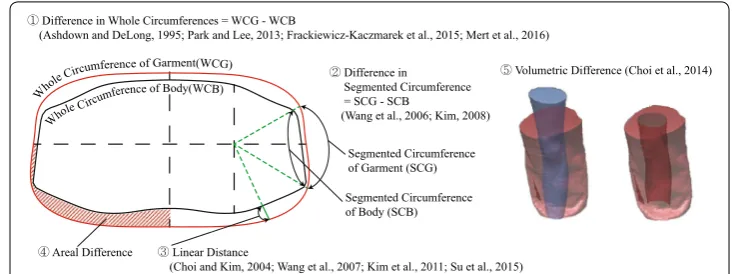
2015), which allows to quantify the distance between the human body and the garment in various locations. The difference in two-dimensional area between the human body and the garment may be directly calculated along the cross-sectional plane; however, few researchers seem to be studying this. Lastly, the difference in three-dimensional volume between the garment and the human body can be measured as an ease allowance (Choi et al. 2014). This method can be useful for researching the thermal comfort and insula-tion of clothing because it can quantify the volume of the still air layer formed in the gar-ment. Figure 2 shows the quantification methods of the ease allowance.
Ease allowance optimization
The most basic method for determining the optimal ease allowance is to measure the change in body surface length which is caused by the joint movement or respiration. Kirk and Ibrahim (1966) measured the variation of surface length during joint move-ment after making gradation marks on the body surface then proposed a stretch level of 20–30% in the horizontal direction as ease allowance required for men’s suits or tailored
Increase in Ease Allowance
Wearer’s Satisfactio
n
Motional Satisfaction
Aesthetic Satisfaction Low Elasticity
Difference in optimal ease allowance
Medium Elasticity High Elasticity
Fig. 1 Relationship between the ease allowance and the wearer’s satisfaction on wearing slim fit jackets. This
clothing. Gill and Hayes (2012) set the maximum increase in body surface length during lower body movement as the optimal ease allowance required for the pants pattern.
The optimal ease allowance can also be determined based on the subjective satis-faction of the actual wearer on the garment fit. Kang and Choi (2005) investigated the ease allowance preference for actual consumers of custom-made jacket and ready-to-wear men’s jacket. They regarded the optimal ease allowance as the ease from which the actual purchase of a jacket was made, and proposed 20.6 cm and 20.8 cm as the opti-mal ease allowances on the chest circumference of the men’s custom-made jacket and ready-to-wear jacket respectively. Park and Lee (2013) investigated the ease allowances of men’s formal jackets by comparing seven pattern drafting methods for men’s wear through sensory evaluations. The pattern drafting method that obtained the best result in the motion adaptability evaluation had 13.2 cm of ease allowance for the chest cir-cumference, while the pattern drafting method that obtained the best result in appear-ance evaluation had 9.5 cm of ease allowappear-ance at the same part of the jacket. Thus, this study showed that the motion adaptability tend to be sacrificed to achieve the optimal appearance of a men’s formal jacket.
Methods
Definition of the terms
The specific terms used for this study were presented in Table 1.
Data collection
Ease allowance of the initial fitting jackets
The ease allowances of 62 male subjects who ordered the custom-made jackets were investigated at three tailor shops located in Seoul and Incheon between January 2014 and April 2014. The whole data collection process from the subjects were reviewed and approved by the Institutional Review Board. All subjects were consented to participate in the study and signed on the consent form, and no compensation was
Segmented Circumference of Garment (SCG)
Segmented Circumference of Body (SCB) ② Difference in Segmented Circumference = SCG - SCB
(Wang et al., 2006; Kim, 2008)
③ Linear Distance
(Choi and Kim, 2004; Wang et al., 2007; Kim et al., 2011; Su et al., 2015)
Whol
e Circumference of Garment(WCG)
Whole C
ircumference of Body(WCB)
① Difference in Whole Circumferences = WCG - WCB
(Ashdown and DeLong, 1995; Park and Lee, 2013; Frackiewicz-Kaczmarek et al., 2015; Mert et al., 2016)
④ Areal Difference
⑤ Volumetric Difference (Choi et al., 2014)
Fig. 2 Quantification methods of the ease allowance. Figure shows the ease allowance quantification
provided. The ease allowance was measured twice: once in the “initial fitting jackets” and once again in the “custom-made jacket”.
The initial fitting jacket, that is so called “gauge garment” in the Korean custom-made clothing market, is the specially designed clothing to anticipate the preferred fit and design of the customer on the first step in the ordering process. It is similar to the ready-to-wear jackets in the aspect that it uses the graded sizing chart. The initial fit-ting jackets used in this study were classified into two styles of “classic” and “trendy”. The trendy style jackets had less ease allowances on the waist circumference and hip circumference, while had more ease allowance on bi-shoulder length, sleeve length, and jacket length than the classic style jackets. This difference made the trendy style jackets look long and have an inverted triangle shape.
The styles of initial fitting jackets offered to the customers were determined first by their fit preference, asking whether they prefer a slim fit or a loose fit at the waist circumference, then a trendy style was provided for customers who want a slim fit, while a classic style was provided for customers who want a loose fit. However, if the customers were not satisfied with the style offered, the other style was also provided, allowing them to proceed with the fitting process in the more preferred style. Finally 54 subjects were carried out their initial fitting process wearing the trendy style jack-ets, and the remaining six subjects selected classic style jackets for their initial fitting. The classic style provided 8 sizes which covered 100.0–132.2 cm on the chest cir-cumference of the jackets, and the trendy style provided 7 sizes which had the range of
Table 1 Definition of the terms
Name of the terms Definition
Jackets used in the evaluations
Initial fitting jacket The initial fitting jacket is the specially designed clothing used to investigate the preferred fit of the subjects in the 1st ease allow-ance evaluation. It uses the graded sizing chart similar to the ready-to-wear
Custom-made jacket The custom-made jacket is the modified clothing from the initial fitting jacket, and it used to investigate the preferred fit of the subjects in the 2nd ease allowance evaluation. The correction details collected in the initial fitting process were fully reflected to the patterns of custom-made jackets to achieve better fit Calculated body size variables
Chest–waist circumference “Chest–waist circumference” is the difference between the chest cir-cumference and waist circir-cumference of the human body. It can be calculated by the formula below: chest circumference measured on the body − waist circumference measured on the body Chest–hip circumference “Chest–hip circumference” is the difference between the chest
cir-cumference and hip circir-cumference of the human body. It can be calculated by the formula below: chest circumference measured on the body − hip circumference measured on the body Calculated jacket size variables
Chest–waist circumference on the jacket “Chest–waist circumference on the jacket” is the difference between the chest circumference and waist circumference of the jacket. It can be calculated by the formula below: chest circumference measured on the jacket − waist circumference measured on the jacket
97.0–115.0 cm on the chest circumference of the jackets. The size of each part of initial fitting jacket was measured before the fitting process. The seven parts measured on the jacket were chest circumference, waist circumference, hip circumference, upper arm cir-cumference, bi-shoulder length, sleeve length, and jacket length.
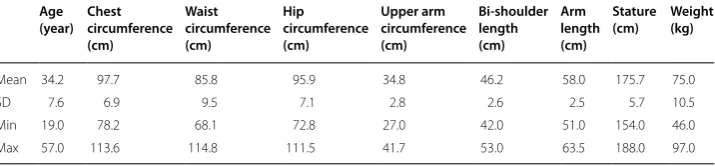
When the customers visit the shop for the first time, the body sizes were measured to select the adequate size of initial fitting jacket. The measured body parts were chest circumference, waist circumference, hip circumference, upper arm circumference, bi-shoulder length, arm length, stature, and weight (presented in Table 2). The jacket size was selected first to be 5 cm larger than the body size on the chest circumference, and if the customer were not satisfied with the first size, a jacket with slimmer or looser fit than the first was provided so that fitting process was done in the most satisfactory size. Table 2 shows the age and body size measurements of the subjects.
The ease allowances of initial fitting jacket were calculated based on the formula of “garment measurement − body measurement”, with the exception of jacket length. The ease allowance on jacket length was quantified based on the formula of “jacket length/ stature”, which was termed “a ratio of jacket length to stature” because the stature is more than twice as long as the jacket length showing great difference and it becomes hard to easily recognize the practical ease allowance when the “garment measurement − body measurement” formula is applied.
The first sensory evaluation on the ease allowance was conducted by the customers wearing initial fitting jackets by evaluating their own fit in a mirror during the fitting pro-cess. The evaluation parts were identical to the ease allowance calculation parts. A 5-point Likert scale consisting of “1_Tight—2_Slightly Tight—3_Suitable—4_Slightly Loose—5_ Loose” was used in the evaluation of the horizontal circumferences and lengths such as chest circumference and bi-shoulder length, while a 5-point Likert scale consisting of “1_Short—2_Slightly Short—3_Suitable—4_Slightly Long—5_Long” was used in the evaluation of vertical lengths such as jacket length and sleeve length. These scales were the modified forms from the Song and Ashdown’s 5-point scales: “1_Tight—2–3_Good Fit—4–5_Loose” and “1_Long—2–3_Good Fit—4–5_Short” (Song and Ashdown 2010). After the first sensory evaluation, the pin basting was conducted to obtain the optimal fit and the details required to modify the initial fitting jacket patterns into the custom-made jacket patterns were extracted and transmitted to the pattern makers and sewing experts.
Ease allowance of the custom‑made jackets
The basic shapes of the custom-made jackets were formed by adjusting patterns of the initial fitting jackets and the additional design alterations were also applied to
Table 2 Age and body size measurements of the subjects
N = 62 Age (year)
Chest circumference (cm)
Waist circumference (cm)
Hip circumference (cm)
Upper arm circumference (cm)
Bi-shoulder length (cm)
Arm length (cm)
Stature (cm)
Weight (kg)
Mean 34.2 97.7 85.8 95.9 34.8 46.2 58.0 175.7 75.0
SD 7.6 6.9 9.5 7.1 2.8 2.6 2.5 5.7 10.5
Min 19.0 78.2 68.1 72.8 27.0 42.0 51.0 154.0 46.0
the jackets. Then the sewn completed custom-made jackets were delivered to the shop again for the second fitting process. The ease allowances of custom-made jack-ets were calculated and the second sensory evaluation was conducted following the identical process of the initial fitting.
If the customer was satisfied at the second fitting process, the purchase was made, but if the customer was not satisfied, the details to adjust jacket sizes were extracted and delivered to the factory with the jacket, and there the minor size adjustment were conducted on the jacket. The corrected jacket was delivered again to the shop to conduct the final fitting process. This final fitting and size adjustment could be repeated several times until the satisfactory fit is achieved. The ease allowance cal-culation and sensory evaluation were not conducted in the final fitting process. Fig-ure 3 shows the fitting processes for calculating and evaluating the ease allowance of the initial fitting jackets and the custom-made jackets used for this study.
Quantification of the preferred ease allowance
The preferred ease allowance was defined as the ease allowance of the respondents who responded “3_Suitable” in the sensory evaluation. For the waist circumference and hip circumference, the balance of the torso silhouette of the jacket can be bro-ken if the preferred ease allowances are applied to the circumferences respectively. Therefore, the “preferred chest–waist circumference on the jacket” and “preferred chest–hip circumference on the jacket” were calculated using the respondents who responded “3_Suitable” on the chest, waist and hip circumference simultaneously. The style of initial fitting jacket was not considered when quantifying the preferred ease allowance because the pattern modification had already been conducted to make the custom-made jackets that the silhouette of the initial fitting jacket was not maintained when the ease allowance quantifying was carried out.
The paired sample t-test was conducted to compare the first sensory evaluation result on the initial fitting jackets with the second sensory evaluation result on the custom-made jackets.
The optimized ease allowances were estimated using the linear regression analysis, which the body measurements were entered as independent variables and the pre-ferred ease allowances were entered as dependent variables, because the prepre-ferred ease allowance values can vary widely even within the subjects who marked “3_Suit-able”. The calculated body size variables such as “chest–waist circumference”, “chest– hip circumference” and “body mass index (BMI)” were entered in addition into the analysis. The independent variable entered into each analysis was limited to only one which showed the highest correlation with the dependent variable to achieve the conciseness of regression equation (Additional file 1).
The statistical program used in the correlation analysis was PASW Statistics 18.
Results and discussions Sensory evaluation
Select of the Initial Fittin g Jacket gni tti F dn oc eS gni tti Fl aiti nI
Initial Fitting Jackets
which have the Graded Sizes
Production of Custom-Made Jacket Minor Size Adjustment Purchas e
Report Details for the Jacket Pattern Making (If the Customer is not Satisfie
d
at the second Fitting,
)
Report Detail
s
for the Minor Size Adjustmen
t
(If the Customer is Satisfied at the Second Fitting,)
Bypass the Minor Size Adjustment and the Final Fitting
Delivery of the Jacket to the Shop Delivery of the Jacket to the Shop
Final Fitting
Sensory Evaluation an
d
Calculation of Ease Allowanc
e
Sensory Evaluation an
d
Calculation of Ease Allowanc
e Fig . 3 F itting pr ocesses f
or the ease allo
wance e
valuations
. F
igur
e sho
ws the fitting pr
ocesses f
or e
valuating the ease allo
wance of the jack
ets used f
or this study
. T
he first sensor
y e
valuation
was conduc
ted b
y the cust
omers w
ear
ing initial fitting jack
ets
. T
he details needed t
o pr
oduce a cust
om-made jack ets w er e ex trac ted dur
ing the fitting pr
ocess and these w
er e transmitt ed t o the patt er n mak
ers and se
wing exper
ts
. T
he basic shapes of the cust
om-made jack ets w er e f or med b
y adjusting patt
er
ns of the initial fitting jack
ets and the additional desig
n alt
erations w
er
e
also applied t
o the jack
ets
. T
hen the se
wn complet ed cust om-made jack ets w er e deliv er ed t
o the shop again and the ease allo
wances w
er
e calculat
ed and the second sensor
y e
valuation was
conduc
ted
. I
f the cust
omer was satisfied at this fitting pr
ocess
, the pur
chase was made
, but if the cust
omer was not satisfied
, the details t
o adjust jack
et siz
es w
er
e ex
trac
ted and deliv
er
ed t
o the
fac
tor
y with the jack
et, and ther
e the minor siz
e adjustment w
er
e conduc
ted on the jack
et.
The cor
rec
ted jack
et was deliv
er
ed again t
o the shop t
o conduc
t the final fitting pr
ocess
. T
his final fitting
and siz
e adjustment could be r
epeat
ed se
veral times until the satisfac
tor
y fit is achie
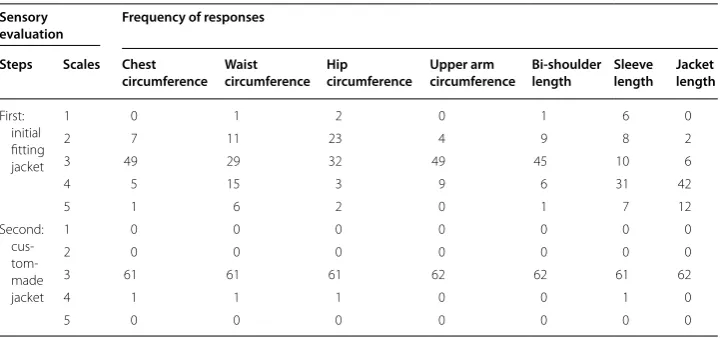
two vertical length variables such as sleeve length and jacket length. The responses on scale level 4 “slightly long” showed the highest frequency for the sleeve length and the jacket length. The scale level 2 “slightly tight” showed the second highest frequency on the waist circumference and the hip circumference, and it means that the waist dart and hip dart amount of the jackets were too much for a considerable number of subjects (presented in Table 3).
In the 2nd sensory evaluation which used the custom-made jackets, 61 of 62 sub-jects marked scale level 3 “suitable” for all evaluation items (presented in Table 3). Therefore, the custom-made jackets used in this study can be regarded as having pre-ferred ease allowances. Table 3 shows the frequency of responses by scales of 1st and 2nd sensory evaluations.
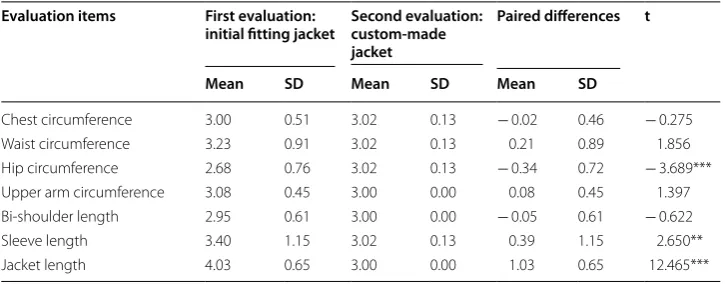
According to the result of the paired sample t-test to compare the result of 1st and 2nd sensory evaluations, the significant differences were found on hip circumference, sleeve length, and jacket length (presented in Table 4). It signifies that the custom made jackets certainly had more preferable fit on those three areas than initial fitting jackets. The evaluation item with the least mean difference was chest circumference, which showed mean values very close to “3_suitable” both in the 1st and 2nd evalu-ations (presented in Table 4). The reason why this result was found even in the 1st evaluation which used graded sized jackets similar to ready-to-wear is that the initial fitting jackets were selected based on the chest circumference size of the subjects, and the fit preference were already reflected on that area. Table 4 shows the paired sample t-test result between the 1st and 2nd responses of sensory evaluation.
Estimation of the preferred ease allowance based on the body sizes Selection of the independent variables for the linear regression analysis
The result of correlation analysis between the ease allowances of those who marked “3_ suitable” in the 2nd sensory evaluation, i.e. the “preferred ease allowance” and the “body size measurements” was as follows:
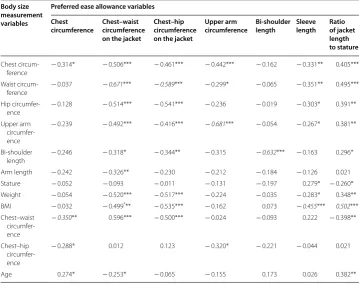
For the “preferred ease allowance on the chest circumference”, body size measure-ments of chest circumference, chest–waist circumference, and chest–hip circumference showed the significant correlations in negative direction (presented in Table 5). It means
Table 3 Frequency of responses by scales of sensory evaluations
Sensory evaluation
Frequency of responses
Steps Scales Chest circumference
Waist circumference
Hip circumference
Upper arm circumference
Bi-shoulder length
Sleeve length
Jacket length
First: initial fitting jacket
1 0 1 2 0 1 6 0
2 7 11 23 4 9 8 2
3 49 29 32 49 45 10 6
4 5 15 3 9 6 31 42
5 1 6 2 0 1 7 12
Second: cus- tom-made jacket
1 0 0 0 0 0 0 0
2 0 0 0 0 0 0 0
3 61 61 61 62 62 61 62
4 1 1 1 0 0 1 0
that the less ease allowances were preferred as the circumference differences between the chest and waist, and between the chest and hip became larger, and as the body shapes went closer to inverted triangle shape. The body size measurement variables that showed significant correlation in positive direction was age (presented in Table 5), and it means that the more ease allowances were preferred on the chest circumference as the subjects became older.
In regard to the “preferred chest–waist circumference on the jacket”, the strongest correlation was found on the waist circumference in negative direction and the second strongest correlation was found on the chest–waist circumference in positive direction (presented in Table 5). It indicates that the less ease allowance on the waist ence which makes loose torso silhouette were preferred as the subjects’ waist circumfer-ence became larger, and as the body shapes went closer to the obese type.
For the “preferred chest–hip circumference on the jacket”, the strongest correlation was found on the waist circumference and the second strongest correlation was found on BMI, both in the negative directions (presented in Table 5). It means that the less ease allowances were preferred on the hip circumference as the subjects’ waist circumference and BMI became larger going close to the abdominal obese type.
In regard to the “preferred ease allowance on the upper arm circumference”, the strongest correlation was found on the upper arm circumference in negative direction (presented in Table 5), and it signifies that less ease allowance was preferred on the upper arm circumference as the upper arm size on the body became larger. This result may be influenced by the tendency of assigning less ease allowance on the upper arm for the wearers with equivalent chest circumferences but with larger upper arm sizes, because the upper arm circumference of the jacket tend to be determined under the influence of the torso pattern sizes, connected by the armhole.
For the “preferred ease allowance on the bi-shoulder length”, only the bi-shoulder length had the significant correlation in negative direction (presented in Table 5). This negative correlation makes those who have wide shoulder receive less ease allowance on their shoulder, and on the contrary, makes those who have small shoulder sizes receive more ease allowance.
Regarding the “preferred ease allowance on the sleeve length” and “preferred ratio of jacket length to stature”, BMI showed the strongest correlations with both variables
Table 4 Paired sample t-test result between the responses of sensory evaluations
** p ≤ 0.01, *** p ≤ 0.001
Evaluation items First evaluation:
initial fitting jacket Second evaluation: custom-made
jacket
Paired differences t
Mean SD Mean SD Mean SD
Chest circumference 3.00 0.51 3.02 0.13 − 0.02 0.46 − 0.275
Waist circumference 3.23 0.91 3.02 0.13 0.21 0.89 1.856
Hip circumference 2.68 0.76 3.02 0.13 − 0.34 0.72 − 3.689***
Upper arm circumference 3.08 0.45 3.00 0.00 0.08 0.45 1.397
Bi-shoulder length 2.95 0.61 3.00 0.00 − 0.05 0.61 − 0.622
Sleeve length 3.40 1.15 3.02 0.13 0.39 1.15 2.650**
in negative direction (presented in Table 5). These results imply that the shorter sleeve length and shorter jacket lengths were preferred as BMI became higher going close to the obese type. Table 5 shows the correlation coefficients between the body size meas-urements and preferred ease allowances.
The body size measurement items selected as independent variables for the linear regression analysis were as follows.
The “chest–waist circumference” was selected for the “preferred ease allowance on the chest circumference”, and the correlation coefficient was − 0.350. For the
“pre-ferred chest–waist circumference on the jacket” and “pre“pre-ferred chest–hip circum-ference on the jacket”, the “waist circumcircum-ference” was selected which showed the correlation coefficients of − 0.671 and − 0.589 respectively. The “upper arm circum-ference” was selected to estimate the “preferred ease allowance on the upper arm cir-cumference” and the “bi-shoulder length” was selected to estimate the “preferred ease allowance on the bi-shoulder length”. In those two items, the preferred ease allowance areas were in agreements with those of body size measurements showing the strong-est correlation, and the correlation coefficients were − 0.681 and − 0.632 respectively. For the “preferred ease allowance on the sleeve length” and “preferred ratio of jacket length to stature”, BMI was selected showing the correlation coefficients of − 0.455 and 0.522 respectively (presented in Table 5).
Table 5 Correlation coefficients between the body size measurements and preferred ease allowances
The italic value is the correlation coefficient of the independent variable showing the strongest correlation with each dependent variable
* p ≤ 0.05, ** p ≤ 0.01, *** p ≤ 0.001 Body size
measurement variables
Preferred ease allowance variables
Chest circumference
Chest–waist circumference on the jacket
Chest–hip circumference on the jacket
Upper arm circumference
Bi-shoulder length
Sleeve length
Ratio of jacket length to stature
Chest
circum-ference −
0.314* − 0.506*** − 0.461*** − 0.442*** − 0.162 − 0.331** 0.405***
Waist
circum-ference −
0.037 − 0.671*** − 0.589*** − 0.299* − 0.065 − 0.351** 0.495***
Hip
circumfer-ence − 0.128 − 0.514*** − 0.541*** − 0.236 − 0.019 − 0.303* 0.391**
Upper arm circumfer-ence
− 0.239 − 0.492*** − 0.416*** − 0.681*** − 0.054 − 0.267* 0.381**
Bi-shoulder
length −
0.246 − 0.318* − 0.344** − 0.315 − 0.632*** − 0.163 0.296*
Arm length − 0.242 − 0.326** − 0.230 − 0.212 − 0.184 − 0.126 0.021
Stature − 0.052 − 0.093 − 0.011 − 0.131 − 0.197 0.279* − 0.260*
Weight − 0.054 − 0.520*** − 0.517*** − 0.224 − 0.035 − 0.283* 0.348**
BMI − 0.032 − 0.499***
− 0.535*** − 0.162 0.073 − 0.455*** 0.502***
Chest–waist circumfer-ence
− 0.350** 0.596*** − 0.500*** − 0.024 − 0.093 0.222 − 0.398**
Chest–hip circumfer-ence
− 0.288* 0.012 0.123 − 0.320* − 0.221 − 0.044 0.021
Estimation of the preferred ease allowance using regression equations
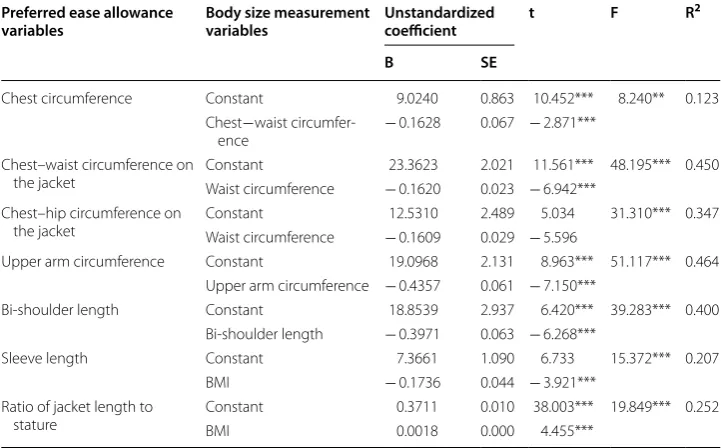
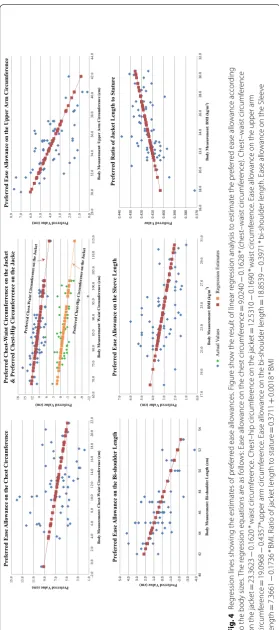
Table 6 and Fig. 4 show the result of linear regression analysis to estimate the pre-ferred ease allowance according to the body sizes, and the regression equations are shown in legends of Fig. 4.
The estimated ease allowance ranges calculated by inputting the 5th to 95th percen-tile of the body sizes were 5.17–8.25 cm for the chest circumference, 6.90–12.09 cm for chest–waist circumference on the jacket, − 3.82 to 1.34 cm for the chest–hip cir-cumference on the jacket, 1.58–5.86 cm for the upper arm circir-cumference, − 1.80 to 1.95 cm for the bi-shoulder length, and 0.406–0.425 for the ratio of jacket length to stature (presented in Table 7). The ease allowances collected in this study were much less than those in Kang and Choi’s study on the optimal ease of the men’s business jackets for the Korean consumers in 2003. It proposed 20.6–20.8 cm on the chest circumference, 8.5–11.7 cm on the arm circumference and 4.1–4.2 cm on bi-shoul-der length as optimal ease allowance (Kang and Choi 2005), and these mean that the preferred ease allowances for the formal jacket of Korean male consumers have decreased significantly in about 10 years. The preferred ease allowance estimates by the percentiles of body size measurements are shown in Table 7.
Conclusion and implications
This study was conducted to present the ease allowance needed to draft jacket pat-terns by quantifying the customers’ tendency regarding the preferred fit for the men’s formal jacket. The ease allowances were investigated through the sensory evaluations from 62 male customers of the tailor shops, and a total of seven regression equations were proposed for the estimation of preferred ease allowance on the jacket areas such as “chest circumference”, “chest–waist circumference on the jacket”, “chest–hip
Table 6 Results of linear regression analysis to estimate the preferred ease allowance
* p ≤ 0.05, ** p ≤ 0.01, *** p ≤ 0.001 Preferred ease allowance
variables Body size measurement variables Unstandardized coefficient t F R
2
B SE
Chest circumference Constant 9.0240 0.863 10.452*** 8.240** 0.123 Chest−waist
circumfer-ence − 0.1628 0.067 − 2.871***
Chest–waist circumference on
the jacket ConstantWaist circumference −23.3623 0.1620 2.0210.023 −11.561*** 48.195*** 0.450 6.942*** Chest–hip circumference on
the jacket ConstantWaist circumference −12.5310 0.1609 2.4890.029 −5.034 5.596 31.310*** 0.347 Upper arm circumference Constant 19.0968 2.131 8.963*** 51.117*** 0.464
Upper arm circumference − 0.4357 0.061 − 7.150***
Bi-shoulder length Constant 18.8539 2.937 6.420*** 39.283*** 0.400 Bi-shoulder length − 0.3971 0.063 − 6.268***
Sleeve length Constant 7.3661 1.090 6.733 15.372*** 0.207
BMI − 0.1736 0.044 − 3.921***
Ratio of jacket length to
Regression Estimates Actual Va lues 1. 0 3. 0 5. 0 7. 0 9. 0 11.0 13.0 15.0 Preferred Value (cm) Body Measurement: Chest-Waist Circumf erence (cm) Pr efer re d Ease Allo wa
nce on the Chest Ci
rc um fe re nc e -4.0 -3.0 -2.0 -1.0 0.0 1.0 2.0 3.0 4.0 5.0 -2.0 0. 02 .0 4. 06 .0 8. 01 0. 01 2. 01 4. 01 6. 01 8. 02 0. 02 2. 0 40 42 44 46 48 50 52 54 Preferred Value (cm) Body Measurement: Bi-shoulde
r Length (cm)
Pr efer re d Ease Allo wa
nce on the Bi-shoulder
Length -1 2 -9 -6 -3 0 3 6 9 12 15 18 65.0 70.0 75.0 80.0 85.0 90.0 95.0 100.0 105.0 110.0 115.0 Preferred Value (cm) Body Measurement: Waist Circumf erence (cm) Pr efer re d Chest-W aist Ci rc um ferr ence
on the Jacket
& Pr efer re d Chest-Hip Ci rc um ferr ence
on the Jacke
Prefer red Chest-Hip Circumfer
ence on the Jacket
Preferred Chest-Waist Circumference on the Jacke
t 0. 0 1. 0 2. 0 3. 0 4. 0 5. 0 6. 0 7. 0 8. 0 Preferred Value (cm) Body Measurement:
Upper Arm Circum
fe
rence
(cm)
Preferred Ease Allowance on the Upper Arm Circumference
0.0 1.0 2.0 3.0 4.0 5.0 6.0 7.0 17.0 19.0 21.0 23.0 25.0 27.0 29.0 31.0 Preferred Value (cm) Body Measurement: BMI (kg/ m 2) Pr efer re d Ease Allo wa
nce on the Sleeve Lengt
h 0.37 0 0.38 0 0.39 0 0.40 0 0.41 0 0.42 0 0.43 0 0.44 0 28.0 30.0 32.0 34.0 36.0 38.0 40.0 42.0 44.0 16 .0 18 .0 20 .0 22.0 24.0 26 .0 28 .0 30 .0 32.0 Preferred Value Body Measurement: BMI (kg/ m 2) Pr eferr ed
Ratio of Jacket
Length to Statu
re
Fig
. 4
R
eg
ression lines sho
wing the estimat
es of pr
ef
er
red ease allo
wances
. F
igur
e sho
w the r
esult of linear r
eg
ression analysis t
o estimat
e the pr
ef
er
red ease allo
wance accor
ding
to the body siz
es
. T
he r
eg
ression equations ar
e as f
ollo
ws: Ease allo
wance on the chest cir
cumf er ence = 9.0240 − 0.1628 * (chest –waist cir cumf er ence). Chest –waist cir cumf er ence
on the jack
et = 23.3623 − 0.1620 * waist cir cumf er ence . Chest –hip cir cumf er
ence on the jack
et = 12.5310 − 0.1690 * waist cir cumf er ence
. Ease allo
wance on the upper ar
m cir cumf er ence = 19.0968 − 0.4357*upper ar m cir cumf er ence
. Ease allo
wance on the bi-shoulder length
=
18.8539
−
0.3971
*
bi-shoulder length. Ease allo
wance on the Slee
ve length = 7.3661 − 0.1736 * BMI. R
atio of jack
et length t
circumference on the jacket”, “upper arm circumference”, “bi-shoulder length”, “sleeve length” and “ratio of jacket length to stature”.
The preferred ease allowances presented in this study were extracted from an investi-gation on actual consumers who purchased their custom-made jackets, thus it has the advantage of reflecting real trends in men’s wear market. Comparing the result of this study with the previous studies on ease allowance of men’s formal jacket (Kang and Choi
2005; Park and Lee 2013), it could be analogized that the preferred ease allowance of Korean male consumers for the formal jacket have gradually decreased over time.
The optimized ease allowances can be estimated using the regression equations pro-posed in this study by simply inputting the body sizes of the customers, so that the jacket pattern which conforms to current trends can be produced easily. This approach is suit-able for online market because it uses body measurement items that the customers can measure by themselves, minimize the fit problems caused by the omission of the actual fitting process in the online orders. However, this study only considered the ease allow-ances that were popular among male adults in South Korea as of 2014. Therefore, the additional experiments and verification are required if the tighter or looser fit become popular owing to a change in fashion trend, and a different preference may appear among consumers in the regions outside the metropolitan area of South Korea.
Additional file
Additional file 1. Raw data for the statistical analysis and contains the body measurements, jacket measurements, ease allowances and sensory test responses.
Table 7 Preferred ease allowance estimates by the percentiles of body size measurements
Preferred ease allowance variables (body size measurements variables)
Preferred ease allowance estimates by the percentiles of the body size measurements (cm)
5th 25th 50th 75th 95th
Preferred ease allowance on the chest circumference (chest–waist circumference)
8.26 (4.01) 7.47 (8.60) 6.75 (11.85) 6.13 (15.08) 5.17 (20.11)
Preferred chest–waist circum-ference on the jacket (waist circumference)
12.09 (69.58) 10.53 (79.20) 9.74 (84.10) 8.48 (91.85) 6.90 (101.60)
Preferred chest–hip circumfer-ence on the jacket (waist circumference)
1.34 (69.58) − 0.21 (79.20) − 1.00 (84.10) − 2.25 (91.85) − 3.82 (101.60)
Preferred ease allowance on the upper arm circumference (upper arm circumference)
5.86 (30.39) 4.73 (32.98) 4.00 (34.65) 3.26 (36.35) 1.58 (40.21)
Preferred ease allowance on the bi-shoulder length (bi-shoulder length)
1.95 (42.58) 1.03 (44.88) 0.59 (46.00) 0.19 (47.00) − 1.80 (52.00)
Preferred ease allowance on
the sleeve length (BMI) 3.98 (19.32) 3.50 (22.10) 3.18 (23.95) 2.70 (26.73) 2.14 (29.96) Preferred ratio of jacket length
Authors’ contributions
All authors were involved in the design of experiments and result discussion. All authors read and approved the final manuscript.
Author details
1 Visiting Professor, Department of Fashion Design, The University of Suwon, Suwon, Republic of Korea. 2 Professor,
Department of Textiles, Merchandising and Fashion Design, Seoul National University, Seoul, Republic of Korea. 3
Profes-sor, Department of Fashion Design Information, Chungbuk National University, Cheongju, Republic of Korea.
Acknowledgements
Not applicable.
Competing interests
The authors declare that they have no competing interests.
Availability of data and materials
The dataset used to conduct this study was attached as a Additional file 1 Funding
The authors received no specific funding for this study.
Publisher’s Note
Springer Nature remains neutral with regard to jurisdictional claims in published maps and institutional affiliations.
Received: 27 February 2018 Accepted: 20 November 2018
References
Ashdown, S. P., & DeLong, M. (1995). Perception testing of apparel ease variation. Applied Ergonomics,26(1), 47–54. Bernhardt, T., & Anderson, G. S. (2005). Influence of moderate prophylactic compression on sport performance. Journal of
Strength and Conditioning Research,19(2), 292–297.
Brandon, K. D., Kwon, Y. H., Newton, R. U., Shim, J., Popper, E. M., Rogers, R. A., et al. (2003). Evaluation of a lower-body compression garment. Journal of Sports Sciences,21(8), 601–610.
Branson, D. H., & Nam, J. (2007). Materials and sizing. In S. P. Ashdown (Ed.), Sizing in clothing: Developing effective sizing systems for ready-to-wear clothing (pp. 264–276). Cambridge: Woodhead Publishing.
Choi, J., Kim, H., Kang, B., Nam, N., Chung, M. K., Jung, H., et al. (2014). Analysis of clothing air gap in a protective suit according to the body postures. Journal of Fiber Bioengineering and Informatics,7(4), 573–581.
Choi, Y. L., & Kim, H. E. (2004). A comparison of women’s basic pattern using 3D scanner: Between the Bunka and the Secoli pattern. Fashion & Textile Research Journal,6(6), 749–755.
Daanen, H. A. M., & Reffeltrath, P. A. (2007). Function, fit and sizing. In S. P. Ashdown (Ed.), Sizing in clothing: Developing effective sizing systems for ready-to-wear clothing (pp. 202–219). Cambridge: Woodhead Publishing.
Frackiewicz-Kaczmarek, J., Psikuta, A., Bueno, M. A., & Rossi, R. M. (2015). Effect of garment properties on air gap thickness and the contact area distribution. Textile Research Journal,85(18), 1907–1918.
Geršak, J. (2014). Wearing comfort using body motion analysis. In D. Gupta & N. Zakaria (Eds.), Anthropometry, apparel sizing and design (pp. 320–333). Cambridge: Woodhead Publishing.
Gill, S. (2011). Improving garment fit and function through ease quantification. Journal of Fashion Marketing and Manage-ment,15(2), 228–241.
Gill, S., & Hayes, S. (2012). Lower body functional ease requirements in the garment pattern. International Journal of Fash-ion Design, Technology and EducatFash-ion,5(1), 13–23.
Hollander, A. (2016). Sex and suits: The evolution of modern dress. London: Bloomsbury Academic.
Joanna Briggs Institute. (2006). Graduated compression stockings: Prevention of postoperative venous thromboembo-lism is crucia. American Journal of Nursing,106(2), 72AA–72DD.
Kang, Y., & Choi, H. S. (2005). Characteristics to ensure optimum ease in men’s business jacket. Journal of the Korean Society of Clothing and Textiles,29(1), 91–102.
Keeble, V. B., Prevatt, M. B., & Mellian, S. A. (1992). An evaluation of fit of protective coveralls manufactured to a proposed revision of ANSI/ISEA 101. In J. P. McBriarty & N. W. Henry (Eds.), Performance of protective clothing (Vol. 4, pp. 675–691). ASTM: West Conshohocken, PA.
Kim, J. S. (2008). A study for establishing the proper ease amount of men’s bodice basic Pattern. Fashion & Textile Research Journal,10(5), 636–643.
Kim, M. K., Nam, Y. J., Han, H. S., & Choi, Y. L. (2011). Improvement of cross sectional distance measurement method of 3D human body. Fashion & Textile Research Journal,13(6), 966–971.
Kirk, W. J., & Ibrahim, S. M. (1966). Fundamental relationship of fabric extensibility to anthropometric requirements and garment performance. Textile Research Journal,36(1), 37–47.
Lawrence, D., & Kakkar, V. V. (1980). Graduated, static, external compression of the lower limb: A physiological assessment.
British Journal of Surgery,67(2), 119–121.
Mert, E., Psikuta, A., Bueno, M. A., & Rossi, R. M. (2016). The effect of body postures on the distribution of air gap thickness and contact area. International Journal of Biometeorology,61(2), 363–375.
Otieno, R. B. (2008). Improving apparel sizing and fit. In C. Fairhurst (Ed.), Advances in apparel production (pp. 73–93). Cambridge: Woodhead Publishing.
Park, S. H., & Lee, E. H. (2013). A comparative study on the ease of men’s jackets according to the pattern draft. Journal of the Korean Society of Design Culture,19(2), 112–127.
Pereira, F., Silva, C., & Alves, M. (2011). Virtual fitting room augmented reality techniques for e-commerce. In Cruz-Cunha, M. M., Varajão, J., Powell, P., & Martinho, R. (Eds.), ENTERprise information systems: Communications in computer and information science. Proceedings of international conference of CENTERIS 2011 (pp. 62–71). Vilamoura, Portugal. Petrova, A. (2007). Creating sizing systems. In S. P. Ashdown (Ed.), Sizing in clothing: Developing effective sizing systems for
ready-to-wear clothing (pp. 57–87). Cambridge: Woodhead Publishing.
Petrova, A., & Ashdown, S. P. (2008). Three-dimensional body scan data analysis: body size and shape dependence of ease values for pants’ fit. Clothing & Textiles Research Journal,26(3), 227–252.
Protopsaltou, D., Luible, C., Arevalo, M., & Magnenat-Thalmann, N. (2002). A body and garment creation method for an internet based virtual fitting room. In J. Vince & R. Earnshaw (Eds.), Advances in modelling, animation and rendering
(pp. 105–122). London: Springer.
Rimaud, D., Calmels, P., Roche, F., Mongold, J. J., Trudeau, F., & Devillard, X. (2007). Effects of graduated compression stock-ings on cardiovascular and metabolic responses to exercise and exercise recovery in persons with spinal cord injury.
Archives of Physical Medicine and Rehabilitation,88(6), 703–709.
Song, H. K., & Ashdown, S. P. (2010). An exploratory study of the validity of visual fit assessment from three-dimensional scans. Clothing & Textiles Research Journal,28(4), 263–278.
Su, J., Gu, B., Liu, G., & Xu, B. (2015). Determination of distance ease of pants using 3D scanning data. International Journal of Clothing Science and Technology,27(1), 47–59.
Wang, Z., Newton, E., Ng, R., & Zhang, W. (2006). Ease distribution in relation to the X-line style jacket. Part 1: Development of a mathematical model. The Journal of the Textile Institute,97(3), 247–256.