'^w^g^lf-ALLEN MARTIN MABRY. Radon-222 Concentrations in North Carolina
Household Groundwater Supplies (Under the direction of JAMES E.
WATSON, JR.)
A survey of randomly selected households served by
groundwater was conducted to characterize radon-222 concentrations
in groundwater-derived drinking water supplies in North Carolina.
Groundwater sources in North Carolina had previously been analyzed
for radon-222 by other researchers, but a random survey had never
been attempted. The investigation included regional comparisons of
radon-222 concentrations, characterization of the distribution of
concentrations, and a comparison of the indoor airborne
concentration to the waterborne concentration for each household.One hundred and seventy-four homes were successfully
surveyed. The statewide average concentration was 2,229 pCi/1.
The eastern region of the state had a markedly lower average
concentration of 337 pCi/1. Sixty-eight percent of the measured
concentrations were above the U.S. Environmental Protection
Agency's proposed maximum contaminant level of 300 pCi/1. The
comparison of indoor airborne concentrations to waterborne
ill
Table of Contents
Page
I. INTRODUCTION... 1
Physical Properties of Radon-222... 1
Occurrence of Radon in Drinking Water... 1
North Carolina Data... 4
Health Risks... 4
Proposed Regulation... 7
II. MATERIALS AND METHODS... 9
Participant Selection... 9
Sampling Procedure... 10
Sample Analysis... 10
Determination of State and Regional Averages... 15
III. RESULTS... 18
Distribution of Results... 19
Regional Comparisons... 25
Comparison with the EPA's MCL... 27
Air Concentration Versus Water Concentration... 28
Comparison of Duplicate Samples... 28
Discussion... 31
Conclusions... 33
REFERENCES... 34
APPENDIXES... 36
A. Instructions... 36
B. Packard Tri-Carb 300 LSC Program Settings... 37
C. Background Values... 38
D. Standard Counts and Calibration Factors... 40
iv
List of Tables
Page
1. Principal Decays from U-238 to Pb-206... 2
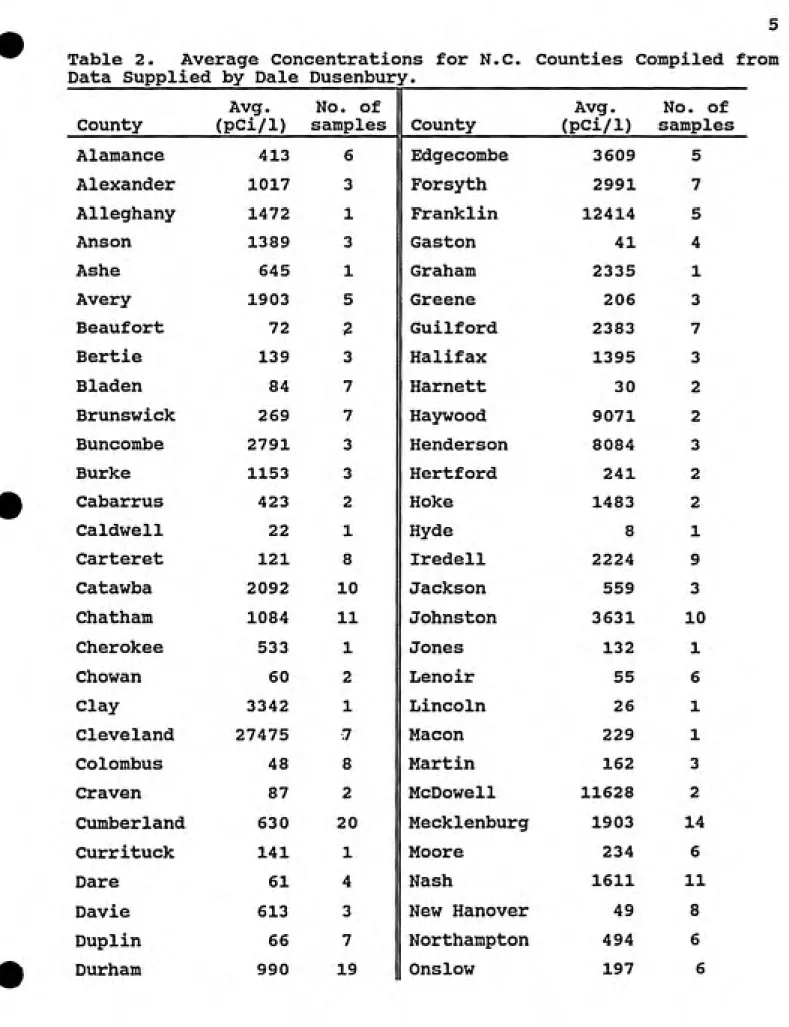
2. Average Concentrations for N.C. Counties Compiled
from Data Supplied by Dale Dusenbury... 5
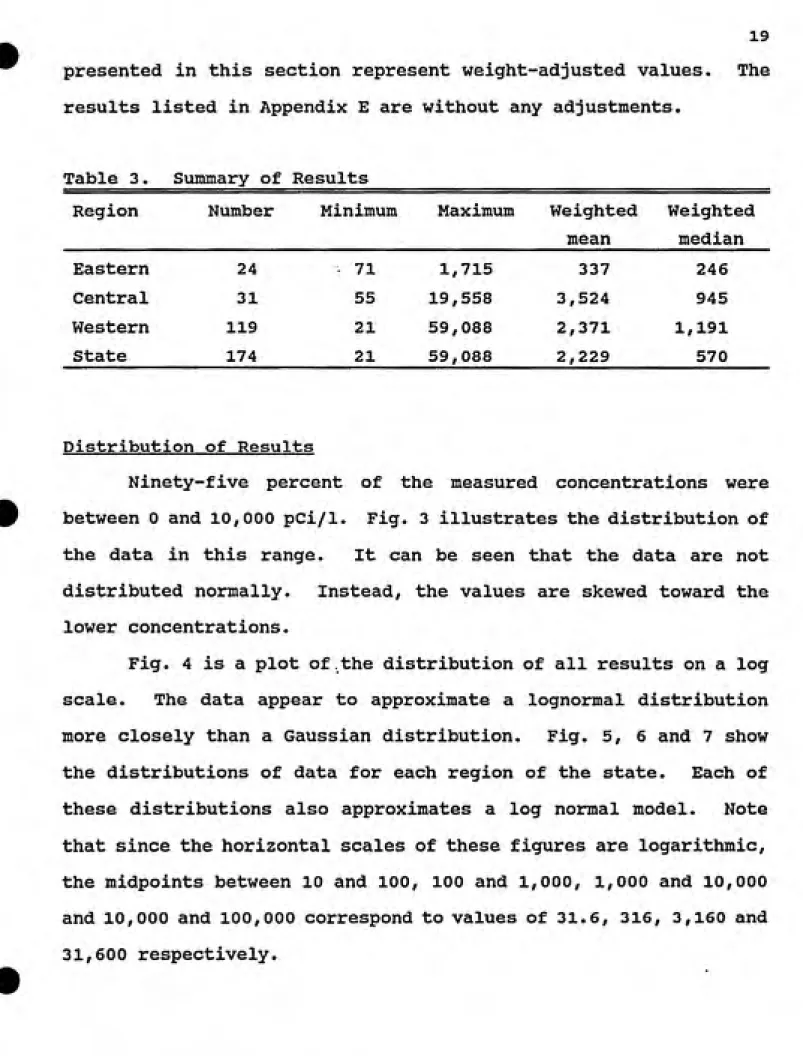
3 . Summary of Results... 19
List of Figures
Page
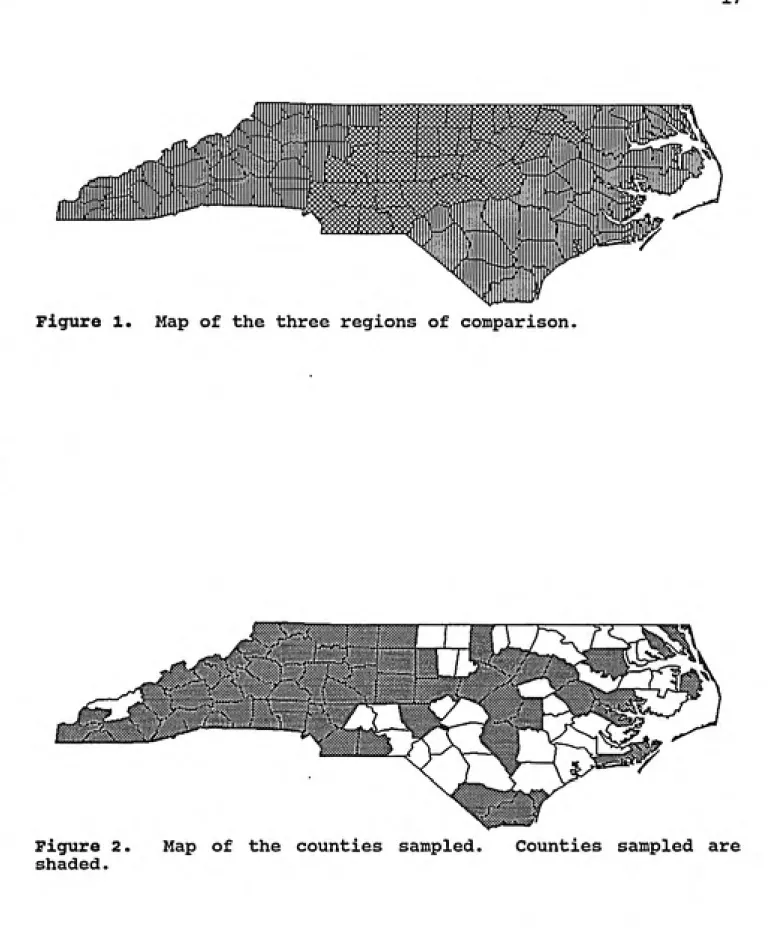
1. Map of the three regions of comparison... 17
2 . Map of the counties sampled... 17
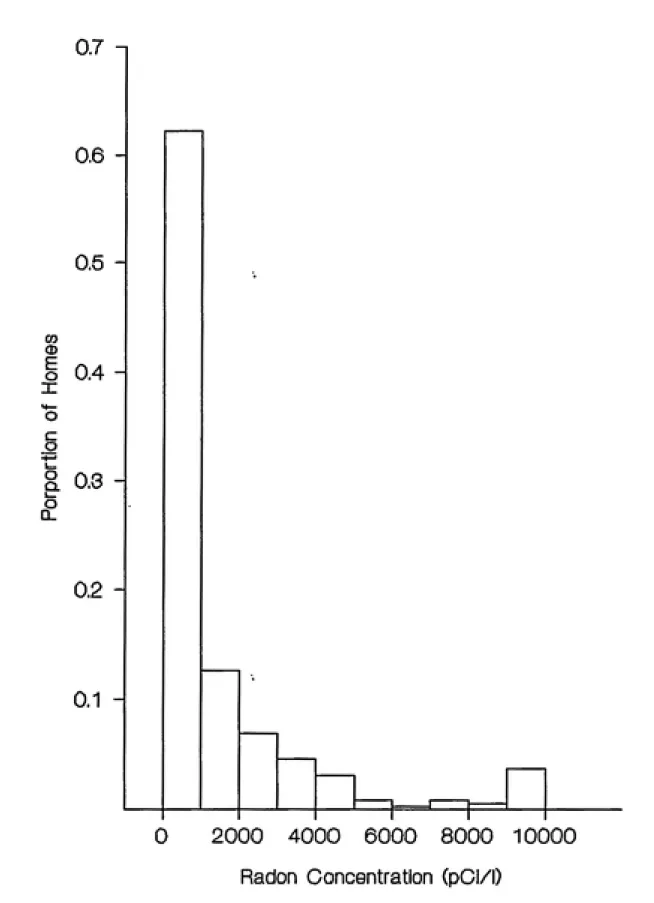
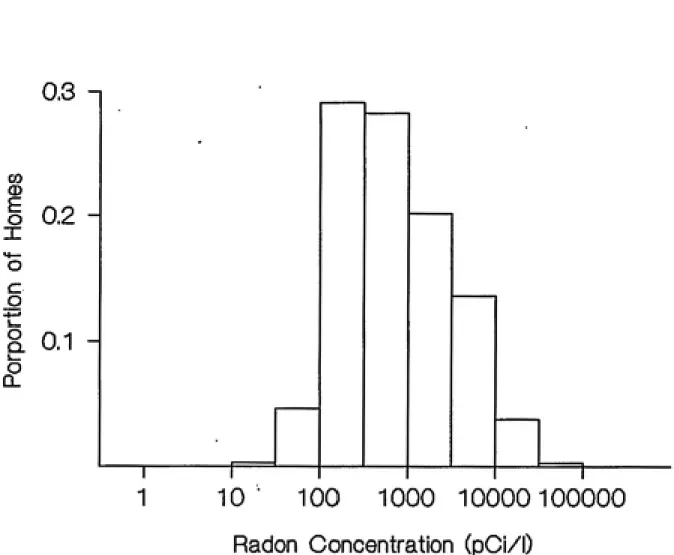
3. Frequency distribution of the concentrations
between 0 and 10,000 pCi/1... 20
4. Frequency distribution of concentrations on a log
scale... 21
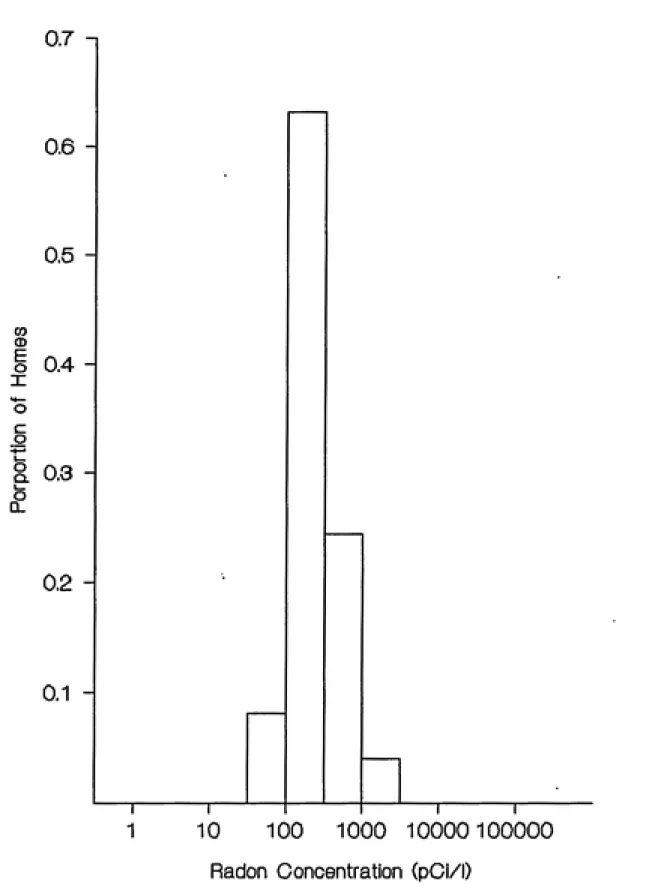
5. Frequency distribution of concentrations in the
eastern region on a log scale... 22
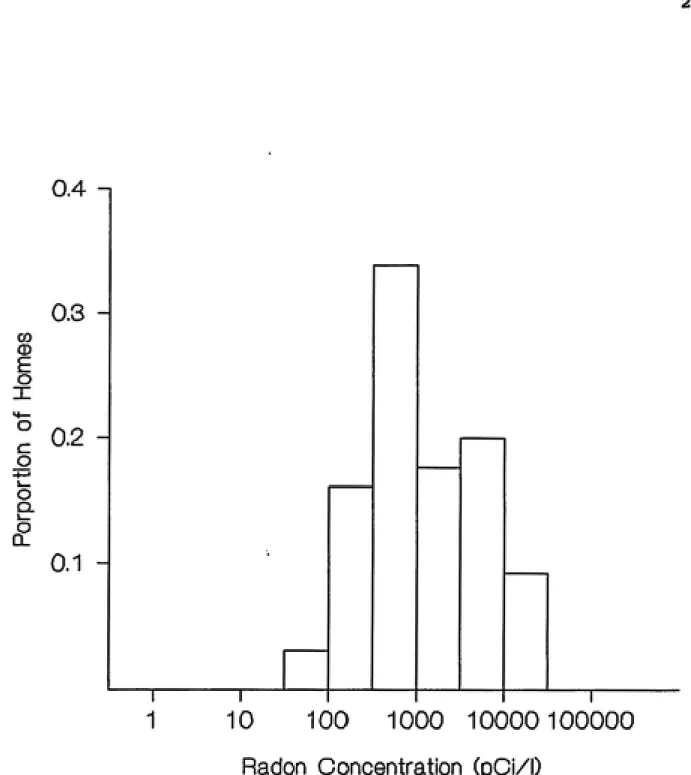
6. Frequency distribution of concentrations in the
central region on a log scale... 23
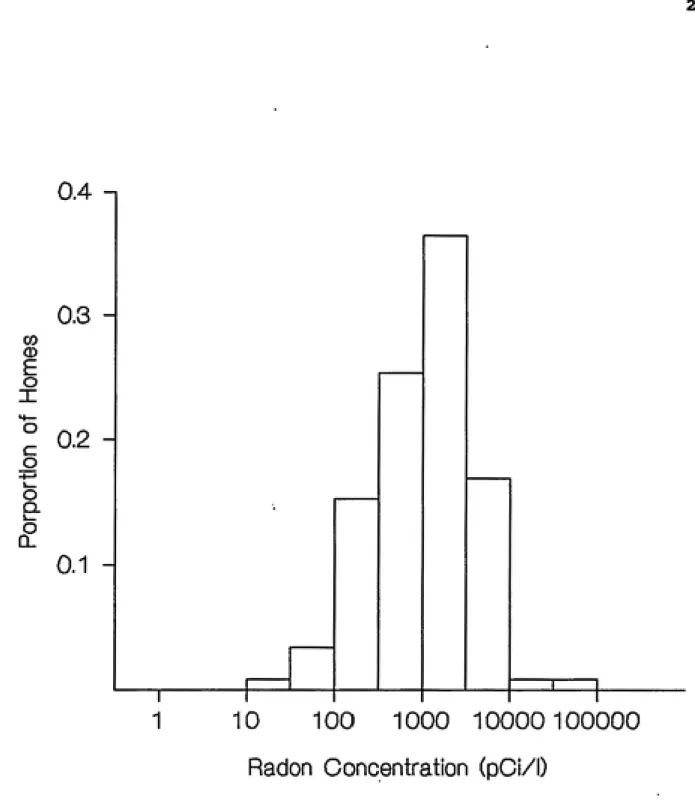
7. Frequency distribution of concentrations in thewestern region on a log scale... 24
8. Box plots for the three regions... 26
9. Scatter plot of air concentration versus waterconcentration with a linear regression overlaid.... 29
10. Frequency distribution of the percent
INTRODUCTION
This project was undertaken to achieve two objectives: (1) to
obtain a representative characterization of radon-222 concentra¬
tions of North Carolina groundwater sources used for drinking
water, and (2) to compare radon-222 concentrations in groundwater
sources to the airborne radon-222 concentrations in the homes
served by them.
Physical Properties of Radon-222
Radon-222 (henceforth radon) is a radioactive noble gas that
occurs naturally as a product of the decay of radium, a member of
the uranium series of radionuclides, which is present in most soils
(BEIR 1988). Radon decays by alpha particle emission with a
half-life of 3.82 days to the solid daughter Po-218. Po-218 decays to
Pb-214 by alpha emission; Pb-214 decays to Bi-214 by beta emission.
Bi-214 then decays to Po-214 by beta emission; Po-214 decays almost
instantaneously by alpha emission to the long-lived daughter
Pb-210. This decay series is shown in Table 1. Eguilibrium of the
short-lived daughters with the parent is reached in about 3 hours
(Evans 1969).
Occurrence of Radon in Drinking Water
Table 1. Principal Decays from U-238 to Pb-206 (ICRP 1983) Isotope Half-life Principal radiation Principal alpha energies (MeV) Principal gamma energies (MeV)
U-238 4.5x10^ y alpha 4.198 4.149
(77%)
(23%) Th-234 24.1 d beta
Pa-234m 1.17 min beta
U-234 244,500 y alpha 4.773 4.721
(72%) (27%)
Th-230 77,000 y alpha 4.688 4.621
(76%) (23%)
Ra-226 1,600 y alpha 4.785
4.602
(94%)
(6%) Rn-222 3.82 d alpha 5.490 (100%) Po-218 3.05 min alpha 6.003 (100%)
Pb-214 26.8 min beta gamma
0.2952 (19%)
0.3519 (37%)
Bi-214 19.9 min beta gamma
0.6093 (46%) 1.120 (15%) 1.765 (16%)
Po-214 1.6x10"^ s alpha 7.687 (100%)
Pb-210 22.3 y beta
Bi-210 5.01 d beta
Po-210 138 d alpha 5.297 (100%)
3
varying amounts (EPA 1984). The U.S. Environmental Protection
Agency (EPA) estimates an average U.S. drinking water radon
concentration in the range of 200 to 600 pCi/1 for groundwater
sources. The EPA estimates that the majority of water supplies
served by groundwater have concentrations less than 2,000 pCi/1
(Milvy and Cothern 1990). Radon is not typically found in surface
water sources, and larger public groundwater systems usually have
lower concentrations of radon than smaller systems and private
wells (Milvy and Cothern 90) . A concentration of 750,000 pCi/1 has
been measured in one public water supply (Milvy and Cothern 1990),
and a concentration of 3x10* pCi/1 has been measured in a private
well in Colorado (Lawrence et al. 1992).
An analysis of available radon concentration data performed
by C.T. Hess et al. combined the results from 6,298 samples taken
from U.S. public groundwater supplies and calculated a geometric
mean of 130 pCi/1. In the same study, the results from 454 samples
taken from private wells in the United States had a geometric mean
of 920 pCi/1 (Hess et al. 1985) . The National Inorganics and
Radionuclides Survey (NIRS) randomly surveyed 978 U.S. community
groundwater supplies. Of the systems surveyed, 48% had radon
concentrations greater than 200 pCi/1. Population-weighted
averages of 249 and 2,277 pCi/1 for the United States and North
Carolina, respectively, were obtained from the survey. The smaller
systems that were surveyed averaged higher radon concentrations.
The population-weighted average for U.S. systems serving fewer than
4
North Carolina Data
Radon concentrations in N.C. groundwater sources have been
reported by the EPA, the N.C. Division of Radiation Protection, and
the University of North Carolina. A compilation of 437 sample
results obtained from those sources has been prepared by Dale
Dusenbury (Dusenbury 1992). Concentrations range from 0 to 55,900
pCi/1, with an average of 2,430 pCi/1. County averages computed
from those concentrations are shown in Table 2. A high degree of
variability throughout the state is evident. These samples were
not randomly obtained, and not all of them were from drinking water
sources.
Regional variations in average radon concentrations in water
associated with different rock types have been reported (Loomis
1987) . It has also been shown that geologic region is a good
predictor of radon concentration in North Carolina (Loomis et al.
1987).
Health Risks
The presence of radon in groundwater presents a health risk
to the public. Compared with all other naturally occurring
radionuclides present in drinking water, radon presents the
greatest health risk (Milvy and Cothern 1990). Two routes of
exposure are possible from waterborne radon: ingestion of the
Table 2. Average Concentrations for N.C.
Data Supplied by Dale Dusenbury.
Counties Compiled from
County
Avg.
(pCi/1)
No. of
samples
1 County
Avg.
(pCi/1)
No. of
samples
Alamance 413 6 Edgecombe 3609 5
Alexander 1017 3 Forsyth 2991 7
Alleghany 1472 1 Franklin 12414 5
Anson 1389 3 Gaston 41 4
Ashe 645 1 Graham 2335 1
Avery 1903 5 Greene 206 3
Beaufort 72 2 Guilford 2383 7
Bertie 139 3 Halifax 1395 3
Bladen 84 7 Harnett 30 2
Brunswick 269 7 Haywood 9071 2
Buncombe 2791 3 Henderson 8084 3
Burke 1153 3 Hertford 241 2
Cabarrus 423 2 Hoke 1483 2
Caldwell 22 1 Hyde 8 1
Carteret 121 8 Iredell 2224 9
Catawba 2092 10 Jackson 559 3
Chatham 1084 11 Johnston 3631 10
Cherokee 533 1 Jones 132 1
Chowan 60 2 Lenoir 55 6
Clay 3342 1 Lincoln 26 1
Cleveland 27475 7 Macon 229 1
Colombus 48 8 Martin 162 3
Craven 87 2 McDowell 11628 2
Cumberland 630 20 Mecklenburg 1903 14
Currituck 141 1 Moore 234 6
Dare 61 4 Nash 1611 11
Davie 613 3 New Hanover 49 8
Duplin 66 7 Northampton 494 6
Table 2 (continued)
County
Avg.
(pCi/1)
No. of
samples County
Avg.
(pCi/1)
No. of
samples
Orange 1118 8 Stanly 1198 5
Pamlico 40 3 Stokes 2264 4
Pasquotank 27 1 Surry 2067 16
Fender 29 2 Transylvania 8377 2
Perquimans 120 2 Tyrrell 95 2
Pitt 89 5 Union 1755 1
Polk 11 2 Vance 6797 2
Randolph 278 4 Wake 6540 30
Robeson 50 6 Warren 9580 6
Rockingham 4126 12 Watauga 1296 3
Rowan 1670 8 Wayne 610 10
Rutherford 5350 5 Wilkes 946 2
Sampson 71 3 Wilson 1310 6
Scotland 343 1 Yadkin 1167 2
lung cancer risk due to inhalation because of the experiences of
uranium miners (NCRP 1984).
7
inhaled under typical conditions (Cross et al. 1985). However, risk comparisons based on calculations of absorbed dose vary, and it has been suggested that ingestion may be a significant exposure
pathway for waterborne radon (Crawford-Brown 1990).
Proposed Regulation
Currently, the radon concentration of drinking water is not
regulated. The EPA has proposed a maximum contaminant level (MCL)
of 300 pCi/1 based primarily on the inhalation risk from the
contribution of the waterborne radon to the airborne radon
concentration (EPA 1991). Previous studies indicate a waterborne
concentration of 10,000 pCi/1 would contribute an additional
1 pCi/1 to the indoor air concentration of a typical household
(Hess and Beasley 1990). The proposed MCL would affect an
estimated 26,000 public water supply systems in the United States
(EPA 1991). Private wells are not regulated by EPA drinking water
regulations, but it is possible that the nation's estimated 13 million private wells will be affected by the regulation if publicconcern prompts the mortgage industry to adopt the MCL as a
standard (Barren 1990) . Removal of radon from water is achievable
with currently available processess. Granular activated carbon
(GAC) adsorption, diffused-bubble aeration and packed-tower aeration each have demonstrated the potential to remove 99% of theradon in water processed (Lowry 1988).
A radon concentration of 300 pCi/1 in a household water
8
of the household based on a water-to-air transfer factor of 10^.
Lifetime continuous exposure to this concentration yields an
additional lifetime risk of lung cancer mortality of 1.8 x 10"*
based on a risk factor of 350 cancer deaths per 10* Person Working
Level Months, assuming 50% equilibrium of the radon daughters with
the radon and 70 years of exposure (BEIR 1988). A Working Level is
a radon concentration unit equal to 100 pCi/1 of radon in air at
100% equilibrium with the daughters.
By randomly surveying groundwater supplies, it was intended
to investigate the scope and magnitude of radon contamination in
N.C. drinking water supplies derived from groundwater. It was also
intended to determine what percentage of households might be
affected by the EPA's proposed MCL of 300 pCi/1. The comparison of
airborne radon concentrations to waterborne concentrations was not
intended to determine the rate of transfer of radon from water to
air since there are overshadowing contributions to indoor air
concentrations. Instead, the comparison was undertaken to
investigate the possibility of an association between airborne and
MATERIALS AND METHODS
Participant Selection
An address list of participants in the State/EPA survey of
residential indoor air radon concentrations in North Carolina was
obtained from Dr. Felix Fong of the N.C. Division of Radiation
Protection. The State/EPA survey, completed in 1990, randomly
sampled 1,290 residences throughout North Carolina. As part of the
survey those homes served by well water were identified. Five
hundred and eighty-four homes that used well water were included in
the survey.
It was not certain at the beginning of the project whether it
would be feasible to survey all 584 homes with well water.
Therefore, an approach was employed in selecting participants from
the list to preserve the randomness of the survey. Numbers
representing a random ordering of the participants had been
assigned to each participant of the State/EPA survey during the
random selection process. Therefore, participants were chosen in
ascending order according to these numbers.
Sampling was performed in groups of 25 homes each to keep the
processing of samples manageable. Home owners were mailed letters asking them to participate in the survey. If they did not refuse the request, they were mailed a sampling kit. From November 1990 through February 1991, 250 home owners were surveyed in this
10
Sampling Procedure
The sampling kit consisted of a cardboard mailing tube
containing two 20-ml scintillation vials containing 10 ml each of
liquid scintillation counting (LSC) cocktail, instructions for
collecting samples (see Appendix A) , packing material, and a return
address label with postage affixed.
The scintillation vials with LSC solution were preweighed and
marked with unique identification numbers. The scintillation vial
used was a polyethylene cone-capped, glass vial, available from
Fisher Scientific (part no. VWR 66022-128), that had been found to
be a suitable vial for containing radon gas (Hess and Beasley
1990). The scintillation cocktail used was a mineral oil-based
cocktail available from E. I. du Pont NEN (High Efficiency Mineral
Oil Scintillator part no. NEF 957A).
The participants were instructed to choose a faucet in the
home that did not have any attachments, like an aerator, or to
remove the attachment from a faucet if necessary. They were to let
the cold water run for 5 minutes, reduce the flow, then fill each
vial to the neck, capping it immediately. They were instructed to
record the date and time the samples were taken on the instruction
sheet and to return the samples and sheet promptly.
Sample Analysis
When samples were received at XJNC, the volume of water
collected was determined by weighing the samples and then
11
assuming a density of water equal to 1 gram/ml. The dates and
times of sample collections provided by participants were recorded.
Each vial was shaken vigorously for 15 seconds to extract the radon
from the aqueous phase into the organic scintillator phase of the
mixture. After the extraction process, counting was delayed for at
least 4 hours to allow the radon daughters to reach equilibrium
with the radon. Counting was performed with a Packard Tri-Carb 300
liquid scintillation counter. The counter was programmed to count
each vial for either 50 minutes or until 2 standard deviations of
the gross count equaled 2% of the gross count, whichever came
first. See Appendix B for details of the counting procedure.
Two background vials, each containing 10 ml of scintillator
fluid and 10 ml of distilled water, were counted with each batch of
samples. The two background count rates thus obtained were
averaged for each batch of samples. The background values for the
39 batches counted during the survey are presented in Appendix C.
The background values ranged from 29.83 to 32.50 cpm with an
average value of 31.19 cpm and a standard deviation of 0.79 cpm
(2.5%).
Two standard activity vials were counted with each batch of
samples; they were sealed aqueous radium-226 standards of 714 and
952 pCi (Ladrach 1987). Before counting, the standards were shaken
and allowed approximately 4 hours to reach equilibrium in the same
manner as described above for samples. The 4-hour delay was
!^^^»^^B?apsiaM^*i^^
12
and three additional empty vials, which totalled 250 minutes. The
two standard count rates thus obtained were used to determine an
average calibration factor for each batch of samples. A decay
correction was not necessary for this calculation because the
standards were counted about 4 hours from the time they were
shaken. Additionally, it was observed that the measured count
rates of the standards did not decrease with time, suggesting that
the transfer of the radon to the scintillation cocktail was
continuous and independent of the shaking process previously
described. For example, on one occasion the counter malfunctioned
and counted the standards and samples for 13 repetitions over a
54-hour period, and no significant change in the count rates of the
standards occurred. This phenomenon was also observed by EPA
researchers (EPA 1990). The calibration factors for the 39 batches
of samples processed during the survey are presented in Appendix D.
The average calibration factor was 10.0 cpm/pCi, with a standard
deviation of 0.14 cpm (1.4%). The calibration factors ranged from
9.68 to 10.26 cpm/pCi.
Radon concentrations in pCi/1 were calculated from the net
count rates by applying the calibration factor and correcting the
results for decay. The following relationship was used:
13
where:
K = calibration factor (cpm/pCi) V = sample volume (ml)
X = physical decay constant for radon (0.18 days"^)
t = elapsed time between sample collection and analysis
(days)
The concentrations of the two samples obtained from each home were
averaged to determine the concentration for each home. These
average concentrations were reported to the participants by mail.
The standard deviation of the count rate (a) for each result was
calculated based on the standard deviations of the sample and
background count rates using error propagation formulae.
It was necessary to determine the level below which a result
was more likely to be due to statistical fluctuation of the
background than to true radioactivity in the sample. The decision
limit for nondetection was calculated using the relationship given
in NCRP Report No. 58:
Lc = K yf2 ^/B = l.SA. y/2 yfB = 2.32 y/B
where:
Lc= decision limit, net counts
(95% confidence level)
K = 1.64
14
The decision limit is the net number of counts at which there
is 95% probability that any signal below it is false detection.
The complement to the decision limit is the detection limit given
in NCRP Report No. 58:
Ln = K^ + 2 L^ = 2.71 + 4.65 /S
where:
Li,= detection limit, net counts (95% confidence level)
K = 1.64
B = background counts Lc= decision limit
The detection limit is the net number of counts at which there is
95% confidence that a signal above it will be detected.
The decision limit was calculated for each batch of samples
using the background count for that day. For example, a background
count rate of 32.0 cpm obtained over a 50-minute count (1,600 total
counts) would yield:
r = 2.32 y/^'^P^ =1.86 cpm
^ 50 min.For a typical 10 ml sample taken 4 days prior to counting and
ͣ 'yy^s=
15
concentration would be determined using the previously given
relationship for calculating concentration as follows:
Lc = (1.856 cpm) ^ / . ^°°° ^y-^ e-'2 = 34 ci/1
^ '^ 10 cpm/pCi 10 ml '^ 'Results below the decision limit were so noted, but not discarded.
Discarding values would introduce bias into calculated averages.
Determination of State and Regional Averages
State, regional, and county averages were determined after
applying weighting factors to all results based on infoirmation
supplied with the State/EPA survey data base. The weighting
factors were necessary because the State/EPA survey used different
sampling rates across the state to favor areas of greater interest.
The weighting factors also incorporated other minor adjustments
that resulted from the participant selection process (personal
communication with Dr. Jane W. Bergsten of Research Triangle
Institute).
The division of the state into the three regions used in this
study is shown in Fig. 1. The counties that were sampled are shown
in Fig. 2. The division of the state was based on geologic regions
which have been shown to be predictors of radon concentration
(Loomis et al. 1987). The eastern region represents the Coastal
16
Belt, and Raleigh Belt, and the western region is composed of the
17
Figure 1. Map of the three regions of comparison.
A
Figure 2
shaded.
18
RESULTS
Two hundred and fifty homes were originally selected for
sampling. Ten of those were eventually determined to be ineligible
for the study. Ineligible homes included those that responded back
that groundwater was not used and those for which the sample
mailers were returned by the post office as undeliverable. At the
conclusion of the sampling phase, 174 residential groundwater
samples had been collected and analyzed. The collection success
rate was 73% for eligible homes. Samples not collected from
eligible homes were a result of no response by the home owner.
Duplicate samples were requested from each home owner. Of
the 174 homes surveyed, 162 were successfully sampled in duplicate.
Sample pairs received that had one broken vial resulted in singular
samples for 12 of the homes surveyed. The concentration for each
dually sampled home was determined by averaging the concentrations
of the two samples.
The results are listed in Appendix E. The unweighted average
concentration for all samples was 2,298 pCi/1. The weight-adjusted
average concentration for the state was 2,228 pCi/1. The eastern
region of the state had the lowest weight-adjusted average
concentration, 337 pCi/1; the central and western regions had
higher weight-adjusted average concentrations of 3,524 and 2,371
pCi/1, respectively.
A summary of the results is presented in Table 3. Measured
19
presented in this section represent weight-adjusted values. The
results listed in Appendix E are without any adjustments.
Table 3. Summary of Results
Region Number Minimum Maximum Weighted
mean
Weighted
median
Eastern 24 71 1,715 337 246
Central 31 55 19,558 3,524 945
Western 119 21 59,088 2,371 1,191
State 174 21 59,088 2,229 570
Distribution of Results
Ninety-five percent of the measured concentrations were
between 0 and 10,000 pCi/1. Fig. 3 illustrates the distribution of
the data in this range. It can be seen that the data are not
distributed normally. Instead, the values are skewed toward the
lower concentrations.
Fig. 4 is a plot of the distribution of all results on a log
scale. The data appear to approximate a lognormal distribution
more closely than a Gaussian distribution. Fig. 5, 6 and 7 show
the distributions of data for each region of the state. Each of
these distributions also approximates a log normal model. Note
that since the horizontal scales of these figures are logarithmic,
the midpoints between 10 and 100, 100 and 1,000, 1,000 and 10,000
and 10,000 and 100,000 correspond to values of 31.6, 316, 3,160 and
20
0.7 n
0.6
-0.5
to
I 0.4
X
c
o
a 0,3
0.2
-0,1
0 2000 4000 6000 8000 10000
Radon Concentration (pCi/l)
21
0,3
CO
Q
o 0.2 X
o c
g
-1—>
a 0,1
o
a.
10 ͣ 100 1000 10000 100000
Radon Conoentration (pCi/l)
0.7 n
22
0.6
0.5
-CO
CD
o 0.4 H
X
R 0.3
0.2
0.1
-T 10 100 1000 10000 100000
Radon Concentration (pCi/l)
23
0.4 -1
0,3
CD
E
o
X
g
o ci
i_
o
0.2
0.1
-10 100 1000 10000 100000
Radon Conoentration (pCi/l)
24
CO
O
E
o
X
4—
o
c
o
o o
CL
0.4
0.3
0.2
-0.1
10 100 1000 10000 100000
Radon Conoentration (pCi/l)
25
Regional Comparisons
For the purpose of comparing the results by region, the
medians in Table 3 are more useful than the means owing to the
non-Gaussian distributions. The median value for the eastern region,
246 pCi/1, was significantly lower than the median values of the
central and western regions (945 and 1,191 pCi/1 respectively).
However, the median values of the central and western regions were
similar.
Fig. 8 illustrates the differences and similarities between
the observations for the three regions. The horizontal boundaries
of each box represent the range of the middle 50% of the results,
or midrange, for its region. The horizontal line inside each box
is at the sample median. Vertical lines attached to each end of
each box model the normal range of the data. Each vertical line
reaches to the most extreme result within a range defined as 1.5
midrange widths from the edge of the box. Results that fall
outside this range are considered outliers. Outliers are
represented by asterisks. The midrange for the eastern region lies
below the midranges of the central and western regions with no
overlap, signifying a meaningful difference between the eastern
region and the remainder of the state. The results for central and
western regions, however, appear quite similar.
A statistical analysis of variance between the log-transformed
results for the regions confirms the preceding exploratory
analysis. A comparison between results for the eastern region and
26
100000
10000
b
Q
"S
-t—'
c
CD o
c
o
o
d
o
CO
1000
100
10
*
-•ͣ
CENTRAL EASTERN WESTERN
Region
Figure 8. Box plots for the three regions. Each box shows the
range of the middle 50% of the results, the sample median, and the
27
101, which is well above the critical value of 3.8 for the 95%
confidence level, indicating a significant difference at the 95%
confidence level. The F statistic for the comparison between
results for the central and western regions is 1.4, which is below
the critical value of 3.8 for the 95 % confidence level.
Comparison with the EPA's MCL
The eastern region also differed from the central and western
regions in the percentage of observations above the EPA's proposed
MCL of 3 00 pCi/1. Table 4 shows the percentages of results above
cut points of 300; 1,000; 5,000; and 10,000 pCi/1 for each region
and the state as a whole. Thirty-three percent of the results in
the eastern region were greater than the MCL, while in the central
and western regions 84% and 81%, respectively, exceeded it.
Table 4. Distribution of Results (pCi./I)
Region >300 >1,000 >5,000 >10,000
(%) (%) (%) (%)
Eastern 33 4 0 0
Central 84 47 20 12
Western 81 55 9 2
State 68 38 10 4
Also of interest is the percentage of observations greater
than 10,000 pCi/1, the waterborne concentration that will
28
a home. Statewide, 4% of the results exceeded this level. The
highest regional percentage was 12% in the central region.
Air Concentration Versus Water Concentration
The measured water concentrations were compared with the
available air concentration data from the State/EPA survey. Air
concentration data were available for 164 of the 174 homes
surveyed. Fig. 9 shows a semilog scatter plot of air concentration
versus water concentration for all observations overlaid with a
least-squares linear regression line. The least-squares line has
a positive slope, indicating an increase in air concentration with
water concentration. However, the coefficient of determination ip-,
or model r-square, for the linear regression on the log-transformed
data is 0.195, indicating a weak linear relationship between air
concentrations and water concentrations.
Comparison of Duplicate Samples
Samples were collected in pairs for comparison as a measure
of the precision of the water analysis technique employed. In 12
cases samples were received that had one broken vial. A total of
162 duplicates were compared.
The frequency distribution of percent difference between
results for duplicate samples shown in Fig. 10 best summarizes the
comparison of the duplicates. It can be seen that pairs differing
29
20 r
15
b
c
g
^—'
cd
i_ -1—1
c
o
o c
o
o
<
10
0
-5 J____I___I I I I I II_______I____I___I MINI_______I____I___I I r I I il_______I____I I I I I 1 il 10 100 1000 10000 100000
Water Concentration (pCi/l)
30
0.8
0,7
0.6
0,5
-00
CD
°- 0.4 A
O
C o o
Q. O
1__
CL
0,3
-0,2
0.1
-0 ,2-0 4-0 6-0 8-0
Percent Difference
Figure 10. Frequency distribution of the percent differences of
31
Approximately 75% of the pairs differed by less than 10%. The
proportion of pairs differing by 20% or less, determined by adding
the first two bars, was 0.9, or 90%.
Discussion
It is estimated that 55% of North Carolinians live in homes
served by groundwater (personal communication with William C.
Jeter, Groundwater Section, N.C. Division of Environmental
Management). Therefore, based on the U.S. Census of 1990 which
recorded over 6.5 million residents; approximately 3.8 million
North Carolinians live in homes served by groundwater. The average
radon concentration for groundwater of approximately 2,000 pCi/1
found in this survey translates into a continuous radon inhalation
exposure of 0.2 pCi/1. This waterborne radon contributes an
additional 2 x 10* Person Working Level Months of exposure in the
state each year. Based on the risk estimate of 350 cancer deaths
per 10* Person Working Level Months, 70 additional cancer deaths per
year would be estimated for this level of exposure. It should be
noted that several variables can greatly influence this estimate,
such as the time a person actually spends in the home, the transfer
ratio of radon from water to air, and the degree to which the home
retains radon.
The exposure to airborne radon originating in groundwater
does not appear to present as great a risk as the exposure to radon
32
airborne radon concentration is approximately 0.2 pCi/1, and the
State/EPA survey of North Carolina homes found an average indoor
concentration of 1.4 pCi/1.
It is not surprising that a strong association between
airborne and waterborne radon concentrations was not observed in
this investigation. Indoor air concentrations of radon are
influenced by many factors that could not be controlled or
accounted for by this survey. Waterborne radon contributes to
indoor air concentrations, but the main source of airborne radon is
soil emissions. There are also variables unique to each home that
affect the indoor air concentration, such as the permeability of
the ground floor to soil gases and the rate of air exchange. Even
in the case where waterborne radon is the sole or main contributor,
water usage activities such as showering, clothes washing, dish
washing and the amount of hot water used are variables unique to
each house that affect the rate of transfer of radon from water to
air.
The observation that the eastern region of the state has
lower groundwater concentrations of radon agrees with previous
measurements in North Carolina. Loomis et al. (1987) observed that
the geologic region known as the coastal plain, which comprises the
eastern region delineated in this survey, had significantly lower
radon concentrations in groundwater than the other geologic regions
of the state. Also, the measurements compiled by Dusenbury (1992)
show lower concentrations for most of the eastern counties when
33
Conclusions
One hundred seventy-four homes were successfully surveyed for
groundwater radon concentrations. The statewide average
concentration was 2,229 pCi/1. The eastern region of the state had
a markedly lower average concentration of 337 pCi/1. Sixty-eight
percent of the measured concentrations were above the U.S.
Environmental Protection Agency's proposed maximum contaminant
level of 3 00 pCi/1. The comparison of indoor airborne
concentrations to waterborne concentrations revealed a weak linear
34
REFERENCES
Barren, T. 1990. EPA proposes waterborne radon MCL standard of 300 pCi/1. Radon Industry Review October:3.
Advisory Committee on the Biological Effects of Ionizing Radiation. 1988. Health risks of radon and other internally deposited alpha-emitters. Washington, D.C.: National Academy Press.
Crawford-Brown, D. 1990. Analysis of the health risk from ingested radon. Radon, Radium and Uranium in Drinking Water. Chelsea, Michigan: Lewis Publishers, Inc.
Dusenbury, B. D. 1992. MSPH Technical Report, University of North
Carolina at Chapel Hill.
Environmental Protection Agency. 1984. Evaluation of waterborne radon impact on indoor air quality and assessment of control
options. Washington, D.C: U.S. Government Printing Office;
EPA/600/S7-84-093.
Environmental Protection Agency. 1990. Radon removal techniques for small community public water suplies. Washington, D.C: U.S.
Government Printing Office; EPA/600/S2-90/036.
Environmental Protection Agency. 1991. National primary drinking water regulations for radionuclides. U.S. Government Printing
Office; EPA/570/9-91/700.
Evans, R. D. 1969. Engineers guide to elementary behavior of radon daughters. Health Phys. 17:229.
Groves, B. 1987. Radon in drinking water. Proceedings of the National Water Works Association Conference, April 7-9, 1987.
Chelsea, Mich.: Lewis Publishers, Inc.
Hess, C T., J. Michel, T. R. Horton, H. M. Prichard, and W. A.
Coniglio. 1985. The occurrence of radioactivity in public water
supplies in the United States. Health Phys. 48:553-586.
Hess, C T. and S. M. Beasley. 1990. Setting up a laboratory for
radon in water measurements. Radon. Radium and Uranium in Drinking Water. Chelsea, Michigan: Lewis Publishers, Inc.
Ladrach, K. 1987. The occurrence of radon in some North Carolina
groundwater supplies. MSPH Technical Report, University of North Carolina at Chapel Hill.
Lawrence, E. P., R. B. Wanty and P. Nyberg. 1992. Contribution of
35
Longtin, J. 1990. Occurrence of radionuclides in drinking water, a national study. Radon. Radium and Uranium in Drinking Water. Chelsea, Mich.: Lewis Publishers, Inc.
Loomis, D. P. 1987. Radon-222 concentration and aquifer lithology in N.C. Groundwater Monitoring Review 7.
Loomis, D. P., J. E. Watson, Jr., and D. J. Crawford-Brown. 1987. Predicting the occurrence of radon-222 in North Carolina
groundwater. Water Resources Research Institute Report No. 230.
Lowry, J. D. 1988. Management and operations. Jounal of the
American Water Works Association 80:51-64.
Milvy, P. and C. R. Cothern. 1990. Scientific background for the development of regulations for radionuclides in drinking water. Radon. Radium and Uranium in Drinking Water. Chelsea, Michigan: Lewis Publishers, Inc.
National Council on Radiation Protection and Measurements. 1985.
A Handbook of Radioactivity Measurements Procedures Second Edition. Bethesda: NCRP; NCRP Report No. 58.
National Council on Radiation Protection and Measurements. 1984.
Evaluation of Occupational and Environmental Exposures to Radon and Radon Daughters in the United States. Bethesda: NCRP; NCRP Report
36
APPENDIX A INSTRUCTIONS
1. Preparation
- Check the contents of the mailing tube. DO NOT THROW AWAY THE TUBE. You should have the following items:
Reusable mailing tube Reusable packing material
Return address label and postage
2 glass vials with plastic caps (note: the liquid in the vials is mineral oil and is not hazardous)
- You also need a pencil or pen and a clock.
- Choose a faucet in your house that does not have an aerator or any other attachments. If this is not possible, then remove the
aerator or attachment from a faucet.
2. Taking the samples
- Turn the COLD water on all the way and let it run for five (5)
minutes.
- After five (5) minutes turn the water flow down to a slow
stream.
- Carefully fill each vial to the neck; try not to overfill the
vials.
- Immediately put the cap on each vial. Make sure the caps are
tight.
- Record the date & time below
Date______________ Month/Day/Year
Time________ AM PM (circle one)
ID#_______________
3. Returning the samples
- Carefully wrap the vials in the packing material and place them in the mailing tube.
- Place these instructions in the tube (be sure you recorded the date and time above).
- Attach the return label to the tube.
37
APPENDIX B
PACKARD TRI-CARB 300 LSC PROGRAM SETTINGS
Terminators: minutes=50, 2a % deviation=2
Radionuclide=manual
Windows: A: LL=0 KeV UL=2000 KeV
B: LL=5 KeV UL=1850 KeV C: LL=0 KeV UL=5 KeV
QIP=yes AEC=no
SCR=A/B
# vials/std=l, #vials/sample=l, #counts/vial=l
BKG=manual: A=0, B=0, C=0
% of standard=no
low cpm reject: A=0, B=0, C=0
Divide factor K=l Data mode=cpm
38
APPENDIX C BACKGROUND VALUES
Background
1 no.l (cpm)
Background no.2 (cpm)
Average (cpm)
30.04 29.62 29.83
31.00 28.72 29.86
1 29.04
30.88 29.9629.80. 30.32 30.06
31.50 28.90 30.20
30.82 29.62 30.22
30.70 30.02 30.36
30.70 30.16 30.43
31.06 29.80 30.43
1 30.86
30.20 30.5331.42 29.66 30.54
30.50 30.74 30.62
30.92 30.34 30.63
30.90 30.38 30.64
31.56 30.18 30.87
31.16 30.70 30.93
30.90 31.14 31.02
32.28 29.78 31.03
31.50 30.70 31.10
31.26 31.02 31.14
32.20 30.26 31.23
31.60 31.12 31.36
32.28 30.56 31.42
32.14 30.86 31.50
32.98 30.10 31.54
39
Background
1 no.l (cpm)
Background no.2 (cpm)
Average (cpm)
30.04 29.62 29.83
1 31.88
31.46 31.671 30.68
32.74 31.7132.66 30.86 31.76
32.50 31.10 31.80
32.40 31.50 31.95
32.76 31.26 32.01
31.12 33.16 32.14
32.54 31.96 32.25
31.88 32.72 32.30
33.00 31.64 32.32
32.30 32.48 32.39
32.38 32.56 32.47
40
APPENDIX D
STANDARD COUNTS AND CALIBRATION FACTORS
714 pCi
Standard 1 (cpm)
952 pCi
Standard (cpm)
Calibration Factor
(cpm/pCi) 1
1 7058.39
9067.29 9.687045.25 9081.31 9.68
7147.41 9261.91 9.85
7227.61 9191.51 9.86
7091.18 9398.06 9.90
7239.55 9269.52 9.91
7170.37 9339.42 9.91
7203.70 9321.15 9.92
7070.80 9481.55 9.94
7367.67 9190.57 9.94
7239.85 9324.04 9.94
7301.50 9335.24 9.99
7211.94 9433.98 9.99
1 7182.96
9481.55 10.007261.94 9444.66 10.03
7327.07 9385.58 10.03 7307.52 9406.80
10.03 1
1 7292.48
9427.18 10.047384.85 9375.96 10.06
7231.34 9552.94 10.07
1 7318.04
9488.35 10.097283.58 9529.41 10.09
7261.19 9560.78 10.10
7255.97 9582.35 10.11
1 7332.58,
9515.69 10.1141
714 pCi
Standard 1 (cpm)
952 pCi
Standard
(cpm)
Calibration
Factor
(cpm/pCi)
7058.39 9067.29 9.68
7348.48 9508.74 10.12
7355.30 9510.78 10.12
7244.03 9630.69 10.13
7349.24 9529.41 10.13
1 7334.85
9561.76 10.147383.21 9516.67 10.14
7397.71 9524.51 10.16
7493.80 9431.07 10.16
1 7428.24
9535.29 10.187280.60 9726.00 10.21
7462.60 9550.98 10.21
7423.26 9639.60 10.24
42
APPENDIX E
INDIVIDUAL SAMPLE RESULTS
EPA Case no. Result no. 1 (pCi/1) Result no. 2 (pCi/1) Average (pCi/1) Standard Deviation a
NC00163 N/A 377 377 18
NC00166 964 1001 983 17
NC00175 273 197 235 14
NC00176 486 535 510 31
NC00180 1454 1523 1489 22
NC00188 207 215 211 13
NC00198 554 643 598 19
NC00199 849 883 866 18
NC00203 193 209 201 11
NC00204 301 323 312 14
NC00207 587 528 558 16
NC00208 452 420 436 15
NC00228 356 402 379 27
NC00229 120 130 125 10
NC00231 125 85 105 15
NC00236 1553 1609 1581 33
NC00240 513 609 561 14
NC00250 1664 1691 1678 37
NC00254 296 191 243 60
NC00255 416' 111' 263 188
NC00257 225 273 249 10
NC00261 4795 4723 4759 212
NC00269 2109 2117 2113 23
NC00276 4026 4152 4089 32
43 EPA Case no. Result no. 1 (pCi/1) Result no. 2 (pCi/1) Average (pCi/1) Standard Deviation a
NC00281 236 251 243 12
NC00282 22* 21' 21 14
NC00283 14193 13551 13872 100
NC00286 1809 1745 1777 "
NC00316 553 574 563 82
NC00329 241 172 207 23
NC00330 N/A 268 268 14
NC00333 537 558 548 15
NC00341 2349 2158 2298 19
NC00359 19450 19453 19451 156
NC00383 7099 8225 7662 57
NC00404 293 296 295 21
NC00418 536 500 518 17
NC00422 240 263 251 18
NC00423 3908 3349 3628 53
NC00428 1471 1576 1523 30
NC00439 1148 1089 1119 26
NC00441 498 480 489 12
NC00454 498 N/A 498 21
NC00465 496 N/A 497 20
NC00465 1728 1663 1695 17
1 NC00467
12937 13276 1310696 1
1 NC00475
360 341 351 18NC00485 1513 1529 1520 18
NC00492 900 872 886 21
NC00495 1111 1270 1191 45
NC00509 355 218 287 14
44 EPA Case no. Result no. 1 (pCi/1) Result no. 2 (pCi/1) Average (pCi/1) Standard Deviation a
NC00521 247 228 237 23
NC00522 5592 N/A 5592 97
NC00533 97 109 103 11
NC00536 2616 2494 2555 21
NC00542 1431 1560 1496 64
NC00549 5583 5994 5789 50
NC00550 735 682 708 12
NC00556 201 192 197 22
NC00575 2360 2387 2374 23
NC00578 2393 2424 2408 20
NC00586 1610 1596 1603 26
NC00591 7806 N/A 7806 132
NC00600 963 943 953 30
1 NC00608
861 844 853 17NC00618 268 334 301 10
1 NC00631
784 842 813 19 1NC00636 681 673 677
20 1
NC00663 596 544 570 15
1 NC00668
1568 1571 1569 18NC00670 740 670 705 14
NC00674 927 926 926 18
NC00676 1854 N/A 1854 90
1 NC00679
454 514 484 161 NC00680
1396 1332 1364 18NC00683 754 740 747
71 1
NC00686 2875 2817 2846
31 1
NC00693 4643 4728 4685 41
45 EPA Case no. Result no. 1 (pCi/1) Result no. 2 (pCi/l) Average (pCi/1) Standard Deviation a
NC00704 396 240 318 52
1 NC00738
1796 1770 1783 26NC00739 40,3 405 404 17
NC00742 3118 2954 3036 31
1 NC00745
1297 1269 1283 16NC00752 204 224 214 17
NC00760 3358 3360 3359 44
NC00780 617 N/A 617 75
1 NC00790
2000 2043 2021 221 NC00798
858 1022 940 22NCOOBOO 79 63 71 9
NC00802 84 68 76 9
NC00808 40 70 55 12
NC00821 6270 5429 5850 46
NC00823 1196 1133 1164 21
NC00825 1751 1628 1690 17
NC00835 8538 8737 8637 66
NC00838 3597 3507 3552 29
NC00845 1189 N/A 1189 40
1 NC00877
58843 59333 59088 4211 NC00880
3414 3464 3439 271 NC00892
354 377 365 26NC00895 152 117 134 12
NC00900 1519 1443 1481 20
NC00907 81 62 71 10
NC00921 249 211 230 14
NC00923 915 899 907 25
46 EPA Case no. II Result no. 1 (pCi/1) Result no. 2 (pCi/1) Average (pCi/l) Standard Deviation a
NC00931 150 164 157 12
NC00934 516 507 511 14
NC00936 2511 2509 2510 21
NC00945 3263 3209 3236 26
NC00948 2180 N/A 2180 26
NC00953 141 124 133 11
NC00963 167 172 169 19
NC00973 594 666 630 17
NC00975 1162 1199 1181 28
NC00977 634 555 595 22
NC00978 208 205 206 10
NC00989 1796 1692 1744 18
NC00996 1787 2060 1923 21
NC01004 894 825 859 16
NC01007 190 257 224 18
NC01022 92 88 90 10
NC01025 98 90 94 10
NC01051 291 275 283 19
NC01057 19664 19452 19558 142
NC01083 1860 1846 1853 23
1 NC01084
1654 1578 1616 27NC01095 4004 3940 3971 32
NC01098 2536 2347 2442 28
NC01104 174 157 166 12
NC01120 892 919 906 13
NC01135 280 247 264 21
NC01136 157 105 131 15
47 EPA Case no. Result no. 1 (pCi/1) Result no. 2 (pCi/1) Average (pCi/1) Standard Deviation a
NC01141 428 463 445 17
NC01147 8242 8724 8483 64
NC01157 14.1 141 141 11
NC01175 241 165 203 IS
1 NC01181
280 303 292 11NC01187 68 73 70 8
NC01211 2039 1986 2012 25
NC01212 156 137 146 14
NC01229 4277 4148 4212 35
NC01232 4560 4801 4680 39
NC01235 7107 7071 7089 53
NC01238 1265 1366 1316 30
NC01241 3537 3207 3372 27
NC01250 1065 983 1024 23
NC01251 1735 1694 1715 22
1 NC01254
194 187 191 12NC01267 2465 2410 2438 21
NC01279 407 315 361 13
NC01289 4333 4318 4325 35
NC01293 1382 1223 1302 23
NC01297 178 180 179 11
NC01304 161 189 175 19
NC01308 9197 N/A 9197 96
NC01312 9007 9231 9119 67
NC01325 1193 1258 1225 19
NC01326 1257 1214 1236 21
NC01329 762 721 741 16
48
EPA Case
no.
Result
no. 1
(pCi/1)
Result no. 2
(pCi/1)
Average
(pCi/1)
Standard Deviation
a
NC01340 1283 1352 1317 21
NC01343 2747 2695 2721 25
NC01352 717 778 748 24
NC01362 9352 9429 9391 73
NC01388 1198 1166 1182 26
NC01389 4575 4539 4557 36
NC01396 3122 3058 3090 33
NC01399 6305 5997 6151 47