Evidence Sources, Methods and Use Cases for
Learning Lightweight Domain Ontologies
Albert Weichselbraun
∗, Gerhard Wohlgenannt
∗and Arno Scharl
†Abstract
By providing interoperability and shared meaning across actors and domains, lightweight domain ontologies are a cornerstone technology of the Semantic Web. This chapter investigates evidence sources for ontol-ogy learning and describes a generic and extensible approach to ontolontol-ogy learning that combines such evidence sources to extract domain concepts, identify relations between the ontology’s concepts, and detect relation la-bels automatically. An implementation illustrates the presented ontology learning and relation labeling framework and serves as the basis for dis-cussing possible pitfalls in ontology learning. Afterwards, three use cases demonstrate the usefulness of the presented framework and its application to real-world problems.
1
Introduction
Ontologies, which are commonly defined as explicit specifications of shared con-ceptualizations (Gruber, 1995), provide a reusable domain model which allows for many applications in the areas of knowledge engineering, natural language processing, e-commerce, intelligent information integration, bio-informatics etc. Not all ontologies share the same amount of formal explicitness (Corcho, 2006), nor do they include all the components that can be expressed in a for-mal language, such as concept taxonomies and various types of forfor-mal axioms. Therefore, ontology research distinguishes lightweight and heavyweight ontolo-gies (Studer et al., 1998). The creation of such conceptualizations for non-trivial domains is an expensive and cumbersome task, which requires highly specialized human effort (Cimiano, 2006). Furthermore the evolution of domains results in a constant need for refinement of domain ontologies to ensure their usefulness.
Automated approaches to learning ontologies from existing data aim at im-proving the productivity of ontology engineers. Buitelaar et al. (2005) organize the tasks in ontology learning in a set of layers. Especially in ontology learn-ing from text, lexical entriesLC are needed to link single words or phrases to
1Institute for Information Business, Vienna University of Economics and Business, Vienna,
Austria, e-mail:{aweichse,wohlg}@ai.wu.ac.at
2Department of New Media Technology, MODUL University Vienna, Austria, e-mail:
conceptsC. Synonym extraction helps to connect similar terms to a concept.
Taxonomies HC provide the ontology’s backbone. Non-taxonomic relations R
supply arbitrary links between concepts. Finally, axioms are defined or acquired to derive additional facts.
Data sources for ontology learning typically include unstructured, semi-structured and semi-structured data (Cimiano, 2006). Ontology learning from struc-tured data consumes information sources such as database schemas or existing ontologies – it is also calledlifting as it lifts or maps parts of existing schemas to new logical definitions. Since most of the available data is unstructured or semi-structured, a major research focus over the last two decades has been the extraction of domain models from natural language text through a variety of methods. Cimiano (2006) presents an extensive overview of ontology learning methods from unstructured data. Many of the methods involve corpus statistics, such as co-occurrence analysis (Liu et al., 2005), association rules (Maedche et al., 2002), latent semantic analysis based techniques for the detection of syn-onyms and concepts (Landauer & Dumais, 1997), or the application of kernel methods for example to classify semantic relations (Giuliano et al., 2007).
A lot of work in the field, especially for tasks that involve term cluster-ing, exploits Harris’ distributional hypothesis (Harris, 1968), which states that terms or words are similar to the extend that they occur in syntactically sim-ilar contexts. Besides corpus statistics, many authors apply linguistic parsing and linguistic patterns in ontology learning. Building on the seminal work of Hearst (Hearst, 1992), patterns support taxonomy extraction (Liu et al., 2005), the detection of concepts and labeled relations in combination with the applica-tion of Web statistics (S´anchez-Alonso & Garc´ıa, 2006), or Web-scale extraction of unnamed relations (Etzioni et al., 2008).
The integration of Semantic Web resources has become quite popular in ontology learning in the recent years. In the presented modular and extensi-ble framework, we use structured information to apply semantic constraints on learned ontological elements, for example in the task of detecting non-taxonomic relations where the system penalizes suggested relation label candidates conflict-ing with the constraints defined. Gracia et al. (2006) describe an unsupervised approach that dynamically uses online ontologies for word-sense disambigua-tion. d’Aquin, Motta, et al. (2008) provide the Scarlet service for discovering relations between two concepts by harvesting the Semantic Web. Similarly, Aleksovski et al. (2006) extract relations between terms in background knowl-edge. Alani (2006) proposes a method for ontology construction by cutting and pasting ontology modules from online ontologies.
The presented architecture uses data from social sources together with other evidence with the intention to capture the latest terminology of evolving do-mains (Angeletou et al., 2007) and to integrate background knowledge about the domain from external data sources.
The remainder of this chapter is structured as follows: Section 2 introduces the three evidence sources utilized in the presented ontology learning framework. Section 3 presents the major steps and methods applied in the ontology building process for (i) extracting terms, relations, and relation labels as well as (ii) applying ontological constraints. Section 4 demonstrates the potential of the ontology learning architecture by means of real-world use cases in three different domains (tourism, waste management, climate change). The chapter closes with an outlook and conclusions in Section 5.
2
Data Sources
Methods for ontology construction rely on evidences gathered from relevant data sources such as domain documents, online communities and ontology reposito-ries. Generally speaking, one can distinguish between (i) in-corpus evidence sources which mostly rely on unstructured data such as domain relevant text and Web documents (Section 2.1) and (ii) external sources which provide an outside view of the domain by including social (Section 2.2) and structured (Section 2.3) data in the ontology learning process.
2.1
Unstructured Evidence Sources
From unstructured evidence sources (e.g. relevant Web documents), automated ontology learning systems can extract candidate terms by means of information extraction and text mining techniques - e.g., significant phrase detection, co-occurrence analysis and trigger phrases.
2.2
Social Evidence Sources
Social evidence sources query Web 2.0 applications such as tagging systems, social networking and micro-blogging services to retrieve candidate concepts for the extended ontology based on a set of given seed ontology terms.
Delicious1 and Flickr2, for example, provide an API to retrieve the number
of entities which have been labeled with a specific tag (= tag popularity) and to determine related tags. Technorati3 does not offer such an API. Therefore, we
had to implement a method to compute related tags based on the tags in the top 100 blogs returned for a target tag. The same strategy has been applied to Twitter4.
Comparing tag popularities by applying similarity measures such as the dice coefficient or pointwise mutual information yields suggestions for relations be-tween tags.
2.3
Structured Evidence Sources
Structured evidence sources include repositories such as DBpedia (Bizer et al., 2009), Freebase5 and OpenCyc6, which provide ontological data including
con-cepts, relations and instance data; their integration is the goal of the Linking Open Data7 initiative. Several search engines such as Swoogle8 specialize in
sharing ontologies via standardized formats, others like Sindice9concentrate on providing triple-based instance data from RDF and microformats. Many en-gines offer both conceptual data as well as instances; e.g., Watson (d’Aquin, Sabou, et al., 2008), Falcons10, and SWSE11.
3
Method
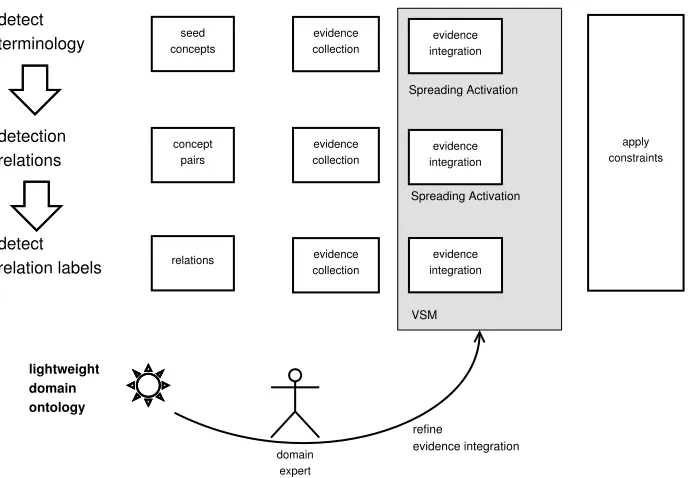
Figure 1 outlines the process of constructing lightweight ontologies. In the initial step, domain exoerts identify seed terms or a seed ontology. The system then detects relations between these terms, and identifies labels for these relations. These steps are independent of each other and can be performed using different extension frameworks that use the process outlined in Figure 1 to learn concepts, relations and relation labels.
Evidences from unstructured, structured and social sources help identify pos-sible candidates for integration in the domain ontology. Methods such as
spread-1www.delicious.com
2www.flickr.com
3www.technorati.com
4www.twitter.com
5www.freebase.com
6www.opencyc.org
7esw.w3.org/topic/sweoig/taskforces/communityprojects/linkingopendata
8swoogle.umbc.edu
9www.sindice.com
seed concepts
evidence collection
apply constraints
relations evidence collection
detection relations detect terminology
detect relation labels
concept pairs
evidence collection
lightweight domain ontology
domain expert
refine
evidence integration evidence integration Spreading Activation
VSM evidence integration Spreading Activation
evidence integration
Figure 1: A generic ontology learning process
ing activation (Crestani, 1997) or the vector space model (Salton et al., 1975) integrate these evidences and provide a ranked list of candidates. Applying domain constraints on the collected data penalizes entries violating ontological constraints. Domain experts help to refine and optimize the ontology learning process by providing feedback on the suggested concepts, relations, and relation labels (Figure 1). The following section will outline each step of the learning process in more detail and describe our implementation of the proposed ontol-ogy building methdo, which comprises (i) the framework introduced in Liu et al. (2005) for term extraction and relation detection, and (ii) the relation labeling component presented in Weichselbraun et al. (2010), which applies constraints to ensure that its suggestions are consistent with the domain model.
3.1
Term Extraction
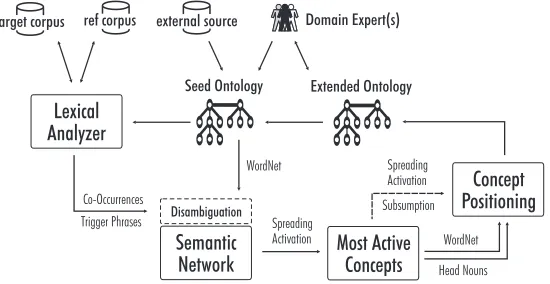
Figure 2 presents an implementation of the first two steps in the ontology con-struction process outlined above which follows Liu et al. (2005).
Figure 2: Ontology learning framework using spreading activation for evidence integration (Liu et al., 2005)
seed term evidence candidate term
climate change wl:coOccurs carbon dioxide
energy sources wl:meronym oil
energy wl:hyperonym renewable energy
climate change wl:delicious gas
Table 1: Example evidences collected by the ontology learning framework
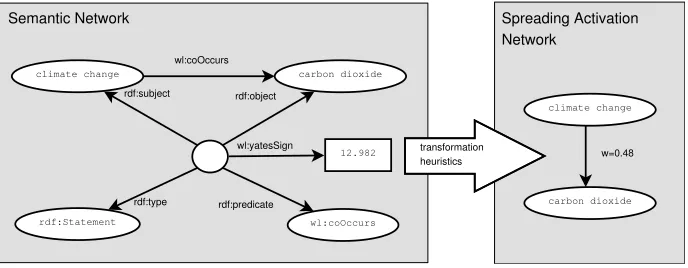
The system then collects all evidences as RDF statements in a semantic network as illustrated in Table 1. Reification adds relation meta data such as significance values, number of occurrences and weights to the suggested con-cepts.
The left site of Figure 3 shows an example entry for the termclimate change, which co-occurs withcarbon dioxide with a significance of 12.982 according to a Chi-squared test with Yates correction.
Liu et al. (2005) use spreading activation to transform the data collected in the semantic network into a ranked list of candidate terms for integration in the domain ontology. Per evidence source heuristics translate evidences into spreading activation weights and build a spreading activation network which will be used for the ranking process. The subjects of the statements collected in the semantic network are transformed into sources, the objects into sinks and evidence type and annotations into the appropriate weights (Figure 3, for details see Liu et al. (2005)). Activating the source nodes yields activation energy levels for the collected evidences which correspond to their ranking resulting from the evidence integration step.
climate change carbon dioxide
wl:coOccurs
rdf:Statement wl:coOccurs
12.982
rdf:subject rdf:object
rdf:predicate rdf:type
wl:yatesSign
Semantic Network
climate change
carbon dioxide
w=0.48
Spreading Activation Network
transformation heuristics
Figure 3: Transformation of RDF statements to spreading activation weights.
example. Terms which are connected with bold lines to other concepts have been determined by a social source (Delicious). Most of the included vocabulary such as methane, environment, greenhouse, etc. is intuitive, but the relationscooling
→overclocking andice →machine clearly introduce terms that are irrelevant in this particular context. One potential strategy to prevent the inclusion of such concepts is the use of a disambiguation process, which includes additional context terms for ambiguous seed terms. The importance of a proper selection of social and structured evidence sources should not be underestimated. For instance, including Flickr into the extension process of an ontology which focuses on abstract concepts would probably not be an excellent choice, although the impact of a single source might be reduced by combining multiple social and structured sources.
Another risk of external sources is that they might lead to shifts in the
ontology’s focus. Therefore, it is extremely important to balance in-corpus
sources and external sources and to include safeguards, such as rules which enforce a certain relationship between external and internal concepts, which ensure a proper focus of the extended ontology.
3.2
Relation Detection
The relation detection process (step 2 in Figure 1) takes concept pairs and pop-ulates a semantic network with evidences such as relation types suggested by certain patterns (Hearst, 1992; Joho et al., 2004), subsumption analysis (Sander-son & Croft, 1999) and grammatical relationships between the terms. It is even possible to use the semantic network from the concept detection step for this process.
r m
r
m r
r
r r
atmosphere carbon dioxide energy
states
greenhouse copenhagen
machines ice
environment
cooling
forest kyoto protocol
scientists
greenhouse gas emissions congress
fossil fuel kyoto
tool
gas greenhouse gas
action
levels global warming
carbon change
overclocking
climate
science
nations planet
matter summit threat
climate change
problem
epa cap-and-trade
globalwarming
Figure 4: Extended ontology based on new terms from Delicious as an example of social evidence sources.
might be limited to seed ontology concepts, or links between new terms might be promoted.
Currently, the relation detection component only detects the strongest re-lation between the candidate term and the other terms in the ontology. Using cut-off levels and additional heuristics will allow the detection of multiple rela-tions and provide a more fine-grained control over the relation detection process.
3.3
Relation Labeling
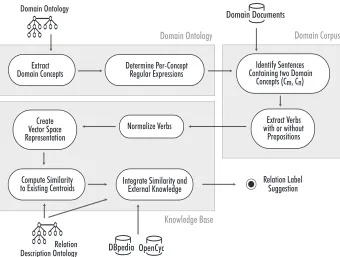
Figure 5 presents the relation labeling approach (step 3 in Figure 1) introduced in Weichselbraun et al. (2010) which follows the generic process illustrated in Figure 1.
rela-tion descriprela-tion ontology, the method starts extracting evidences from domain relevant documents which contain the subject and the object participating in the relation. The relation labeling prototype introduced in Weichselbraun et al. (2010) only considers verbs or verbs together with prepositions as evidences. Fu-ture versions might consider other part-of-speech tags in the evaluation as well. A vector space model is used to integrate the data – every evidence collected corresponds to a position in the vector space model (Figure 5).
Figure 5: Learning relation labels (Weichselbraun et al., 2010).
Applying the evidence collection process to known relations defined in the relation description ontology yields vector space representations (centroids) for those known relation labels. The label of newly acquired and therefore unlabeled relations is determined by choosing the label of the semantically closest centroid based on the vector space model with the cosine similarity measure.
3.4
Constraints
In a final step, the proposed process uses constraints to ensure the consistency of the generated ontology, and to refine the ranking of choices based on their conformance with these constraints.
ontology such as OpenCyc has proven to be beneficial as it allows constraints based on more general concepts such as organization, person, etc. Currently we verify domain, range and property restrictions by enforcing relation label sugges-tions which fulfill these constraints and penalizing elements violating them. The refined ranking is the base for deciding on the concepts, relations and relation labels to include in the domain ontology.
4
Use Cases
This chapter presents three real-world use cases which successfully applied the ontology learning framework introduced in this chapter. The use cases gener-ate ontologies that reflect the knowledge contained in a given corpus. Since knowledge representation experts are not the primary target audience for the resulting structures, the ontologies only contain taxonomic relations indicated by arrows as well as an abstract “related” (r) type to indicate non-taxonomic relationships between terms.
4.1
Tourism Destinations
Dickinger et al. (2008) analyze news media coverage to acquire and structure tourism knowledge using ontology learning. They apply contextual filtering to differentiate between general and tourism-specific news media coverage.
Our ontology learning process extends an ontology of six seed concepts (the black terms in Figure 6) to a lightweight domain ontology which comprises 30 concepts, which were extracted from the input corpus (Figure 6).
Most of the terms and relations included by ontology learning are straightfor-ward to interpret. Nevertheless, there are also a number of unexpected relations
such asculture tourism →handcart,air travel →snowcam which where added
due to a special coverage of certain Web pages (e.g. the CNN and USA Today coverage on “Mormon Hand Track” referring to a cultural tourism attraction). From the ontology engineering point of view, the inclusion of such relations is not necessarily a good thing and might be avoided by (i) using a larger input corpus which reduces the impact of singular events, or (ii) by adding additional evidence sources such as the ones suggested in Section 2.2 and Section 2.3.
4.2
Communication in Waste Management
27
travel
touris m bus ines s travel
commute air travel
flight trek
cruis e
eco touris m culture touris m
travel bus ines s
r4.9
touris m indus try r4.6 airline r4.3 travel agency r4.8 travel health r5.1 des tination r4.8 metro r2.9
rus h hour r8.0
hotel r3.8 firm
r3.0
bus ines s
rail
trip
art fes tival
r8.0 audio tour r8.0 airport r3.2 s nowcam r8.0 company r3.3 handcart r8.0 nation culture r8.0
Figure 4. Hierarchy of tourism concepts after two iterations Figure 6: Tourism ontology (Dickinger et al., 2008).
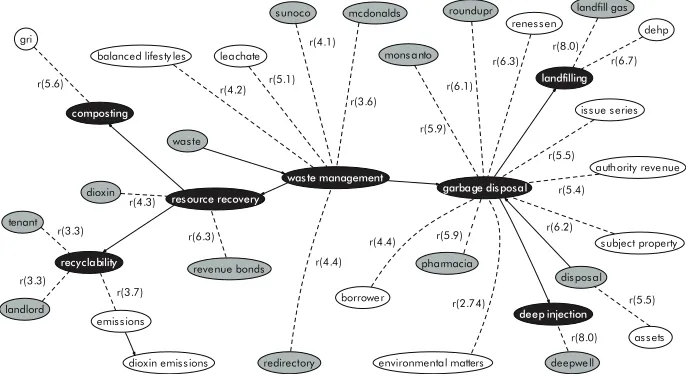
sites, NGOs and companies. Figure 7 visualizes the domain ontology obtained from the ontology extension process. Black terms indicate the seed ontology, gray terms were added in the first iteration of ontology extension, white con-cepts in the second iteration. The method extracted terms such as “landfill gas”, “emissions”, “dioxin emissions” which are clearly relevant to the domain. Companies addressing environmental issues (McDonalds, Monsanto, Pharmacia, Renessen, Sunoco) got included, as well as environmental programs (Balanced Lifestile, GRI, Redirectory) and chemical substances (DEHP, RoundupR). The usefulness of terms such as “borrower”, “issue series” and “assets” is less clear, but were included since they co-occur quite frequently with some of the seed terms. Including external evidence sources into the ontology learning process (Section 2) would reduce the impact of such relations derived from in-corpus evidence sources.
4.3
Media Watch on Climate Change
was te management
garbage dis posal landfilling deep injection was te mcdonalds r(3.6) mons anto r(5.9) deepwe ll r(8.0) dis posal landfill gas r(8.0) pharmacia r(5.9) roundupr r(6.1) s unoco r(4.1) redirectory r(4.4)
as s ets r(5.5) is s ue s eries
r(5.5) leachate
r(5.1)
renes s en
r(6.3) balanced lifes ty les
r(4.2) borrowe r r(4.4) dehp r(6.7) authority revenue r(5.4) environmental matters r(2.74)
s ubject property r(6.2)
res ource recovery
revenue bonds r(6.3)
dioxin emis s ions r(4.3) s recyclability tenant r(3.3) landlord r(3.3) dioxin composting gri r(5.6)
emis s ion r(3.7)
Figure 7: Solid waste disposal ontology (Pollach et al., 2009).
As in the previous use cases, the authors only consider taxonomic relations and a general non-taxonomicrelated type in the ontologies to prevent them of getting too complicated for (non-expert) users to read and understand. Geo-graphic maps, semantic maps and tag clouds complement the ontology view and provide context information on documents and search queries.
5
Outlook and Conclusions
This chapter presented a blueprint for a generic ontology extension framework, together with a number of real-world applications. It sheds light on the differ-ent aspects of such a framework by (i) suggesting data sources which contain domain knowledge and might act as input for the ontology learning process, (ii) presenting a set of techniques to assemble the necessary components and achieve useful results for different application domains, (iii) stressing the balance nec-essary between in-corpus evidence and evidence from external sources to ensure a proper focus of the extended ontology, (iv) discussing actual implementations of these techniques and finally, (v) presenting use cases where these techniques have already been applied successfully.
Figure 8: Media Watch on Climate Change (Hubmann-Haidvogel et al., 2009).
the balance between external and in-corpus evidences, and the integration of user feedback into this process.
References
Alani, H. (2006, May 23-26). Position paper: ontology construction from online ontologies. In L. Carr, D. D. Roure, A. Iyengar, C. A. Goble, & M. Dahlin
(Eds.), Proceedings of the 15th international conference on world wide web
(www 2006)(pp. 491–495). Edinburgh, Scotland, UK: ACM.
Aleksovski, Z., Kate, W. ten, & Harmelen, F. van. (2006). Ontology matching using comprehensive ontology as background knowledge. In P. S. et al. (Ed.),
Proceedings of the international workshop on ontology matching at ISWC 2006
(pp. 13–24). Athens, GA, USA: CEUR.
Angeletou, S., Sabou, M., Specia, L., & Motta, E. (2007). Bridging the gap between folksonomies and the semantic web: An experience report (Vol. 2).
Web Semantics: Science, Services and Agents on the World Wide Web,7(3), 154–165.
Buitelaar, P., Cimiano, P., & Magnini, B. (2005, 7). Ontology learning from
text: An overview. InOntology learning from text: Methods, evaluation and
applications/ frontiers in artificial intelligence and applications(Vol. 123, pp. 3–12). Amsterdam: IOS Press.
Cimiano, P. (2006). Ontology learning and population from text: Algorithms,
evaluation and applications. Springer.
Corcho, O. (2006). Ontology based document annotation: trends and open research problems. IJMSO,1(1), 47–57.
Crestani, F. (1997). Application of spreading activation techniques in informa-tion retrieval. Artificial Intelligence Review,11, 453–482.
d’Aquin, M., Motta, E., Sabou, M., Angeletou, S., Gridinoc, L., Lopez, V., et
al. (2008). Toward a new generation of semantic web applications. IEEE
Intelligent Systems,23(3), 20–28.
d’Aquin, M., Sabou, M., Motta, E., Angeletou, S., Gridinoc, L., Lopez, V., et al. (2008, December 15-17). What can be done with the semantic web? an overview of watson-based applications. In A. Gangemi, J. Keizer, V. Presutti, & H. Stoermer (Eds.),Proceedings of the 5th workshop on semantic web appli-cations and perspectives (swap2008)(Vol. 426). Rome, Italy: CEUR-WS.org.
Dickinger, A., Scharl, A., Stern, H., Weichselbraun, A., & W¨ober, K. (2008). Applying optimal stopping for optimizing queries to external semantic web resources. In P. O’Connor, H. Wolfram, & G. Ulrike (Eds.),Information and communication technologies in tourism 2008, proceedings of the international conference in innsbruck, austria, 2008 (pp. 545–555). Vienna-New York: Springer.
Etzioni, O., Banko, M., Soderland, S., & Weld, D. S. (2008). Open information
extraction from the web. Commun. ACM,51(12), 68–74.
Giuliano, C., Lavelli, A., & Romano, L. (2007). Relation extraction and the
in-fluence of automatic named-entity recognition. ACM Transactions on Speech
and Language Processing,5(1), 1–26.
Gracia, J., Trillo, R., Espinoza, M., & Mena, E. (2006, July 11-14). Querying the web: a multiontology disambiguation method. In D. Wolber, N. Calder, C. Brooks, & A. Ginige (Eds.),Proceedings of the 6th international conference on web engineering (ICWE 2006)(pp. 241–248). Palo Alto, California, USA: ACM.
Gruber, T. R. (1995). Toward principles for the design of ontologies used
for knowledge sharing? International Journal of Human-Computer Studies,
43(5-6), 907–928.
Harris, Z. (1968). Mathematical structures of language. John Wiley & Sons.
Hearst, M. A. (1992). Automatic acquisition of hyponyms from large text corpora. InColing (p. 539-545). Nantes, France.
Heymann, P., & Garcia-Molina, H. (2006, April). Collaborative creation of communal hierarchical taxonomies in social tagging systems (Technical Re-port No. 2006-10). Computer Science Department.
Hubmann-Haidvogel, A., Scharl, A., & Weichselbraun, A. (2009). Multiple coordinated views for searching and navigating web content repositories. In-formation Sciences, 179(12), 1813–1821.
Joho, H., Sanderson, M., & Beaulieu, M. (2004, April 5-7). A study of user interaction with a concept-based interactive query expansion support tool. In S. McDonald & J. Tait (Eds.),Advances in information retrieval, 26th euro-pean conference on ir research (ECIR 2004)(Vol. 2997, p. 42-56). Sunderland, UK: Springer.
Landauer, T., & Dumais, S. (1997). A solution to plato’s problem: The la-tent semantic analysis theory of acquisition, induction and representation of knowledge. Psychological Review,104(2), 211-240.
Liu, W., Weichselbraun, A., Scharl, A., & Chang, E. (2005). Semi-automatic on-tology extension using spreading activation. Journal of Universal Knowledge Management,0(1), 50–58.
Maedche, A., Pekar, V., & Staab, S. (2002). Ontology learning part one - on discovering taxonomic relations from the web. In N. Zhong, J. Liu, & Y. Yao (Eds.),Web intelligence (p. 301-322). Springer.
Mika, P. (2007). Ontologies are us: A unified model of social networks and semantics. Journal of Web Semantics,5(1), 5–15.
Pollach, I., Scharl, A., & Weichselbraun, A. (2009). Web content mining for comparing corporate and third party online reporting: a case study on solid waste management.Business Strategy and the Environment,18(3), 137-148.
Salton, G., Wong, A., & Yang, C. S. (1975, November). A vector space model for information retrieval. Communications of the ACM,18(11), 613-620.
S´anchez-Alonso, S., & Garc´ıa, E. (2006). Making use of upper ontologies to
foster interoperability between skos concept schemes. Online Information
Sanderson, M., & Croft, W. B. (1999). Deriving concept hierarchies from text. In
22nd annual international acm sigir conference on research and development in information retrieval (pp. 206–213). Berkeley, USA.
Schmitz, P. (2006). Inducing ontology from flickr tags. In Collaborative web
tagging workshop at www2006. Edinburgh, Scotland.
Specia, L., & Motta, E. (2007). Integrating folksonomies with the semantic
web. InThe semantic web: Research and applications, 4th european semantic
web conference (eswc-2007)(Vol. 4519, p. 624-639). Berlin: Springer.
Studer, R. R., Benjamins, R., & Fensel, D. (1998). Knowledge engineering: principles and methods. Data and knowledge engineering,25(1-2), 161–197.
Tang, J., Leung, H. fung, Luo, Q., Chen, D., & Gong, J. (2009). Towards
ontology learning from folksonomies. In Ijcai’09: Proceedings of the 21st
international jont conference on artifical intelligence (pp. 2089–2094). San Francisco, CA, USA: Morgan Kaufmann Publishers Inc.
Weichselbraun, A., Wohlgenannt, G., & Scharl, A. (2010). Refining
non-taxonomic relation labels with external structured data to support ontology learning. Data & Knowledge Engineering,69(8), 763–778.
Yates, F. (1934). Contingency table involving small numbers and theχ2 test.
Supplement to the Journal of the Royal Statistical Society,1(2), 217–235.
Related Reading
Fellbaum, C. (1998). Wordnet - an electronic lexical database. Computational
Linguistics,25(2), 292–296.
Jurafsky, D., & Martin, J. H. (2000). Speech and language processing: An
introduction to natural language processing, computational linguistics, and speech recognition. Prentice Hall.
Powers, S. (2003).Practical RDF. Sebastopol, CA, USA: O’Reilly & Associates, Inc.
Ruiz-Casado, M., Alfonseca, E., & Castells, P. (2007). Automatising the learn-ing of lexical patterns: An application to the enrichment of wordnet by ex-tracting semantic relationships from wikipedia.Data & Knowledge Engineer-ing,61(3), 484 - 499.
Segaran, T. (2007).Collective intelligence - building smart web 2.0 applications. O’Reilly.
Shadbolt, N., Berners-Lee, T., & Hall, W. (2006). The semantic web revisited.
Tao, C., & Embley, D. W. (2009). Automatic hidden-web table interpretation, conceptualization, and semantic annotation.Data & Knowledge Engineering,
68(7), 683 - 703. (Special Issue: 26th International Conference on Conceptual Modeling (ER 2007))
Glossary
Co-occurrence Analysis. Co-occurrence analysis determines whether terms are significantly over-represented in designated spans of text. The calculation of statistical significance compares the distribution of terms in a domain-specific target corpus with their distribution in a generic reference corpus to identify candidate terms of inclusion in the extended ontology.
Evidence. Evidence represents the input data for the ontology learning pro-cess. The presented framework relies on evidences from unstructured sources (domain text), social sources (for example APIs of Web 2.0 applications and tagging systems) and structured sources (online Semantic Web data and on-tologies).
Evidence Integration. Integration of evidences from heterogeneous sources supports the ontology learning process. Combining in-corpus data with social sources, for example, will include an outside view of the domain into the learned ontology.
Sentiment. Sentiment is the emotional attitude towards abstract or real objects of their environment. Measures of individual or organizational bias that distinguish between positive, negative and neutral media coverage are impor-tant indicators for investigating trends and differing perceptions of stakeholder groups.
Spreading Activation. Spreading activation is a graph-based, interative search technique inspired by cognitive models of the human brain. It is typi-cally applied to various types of networks (e.g., associative, semantic or neural networks).
Trigger phrases. Trigger phrases rely on the heuristic that certain phrases (e.g., “renewable energy, especially solar energy ...”) often indicate hyponym, hypernym, and meronym relations. Trigger phrase analysis detects these con-structs by using pattern matching via regular expressions combined with part-of-speech tags.