UNIVERSITY OF TRENTO
Department of Computer Science and Information Engineering
International ICT Doctoral School
PhD Dissertation
Coactive Learning Algorithms
for
Constructive Preference Elicitation
Paolo DRAGONE
Advisors
Andrea PASSERINI
Michele VESCOVI
University of Trento TIM - Telecom Italia
Preference-based decision problems often involve choosing one among a large set of options, making common tasks like buying a car or a domestic appliance very challenging for a cus-tomer to handle on her own. This is especially true when buying online, where the amount of available options is humongous, and expert advice is yet limited. Recommender systems
have become essential computational tools for aiding users in this endeavor. Recommender systems represent one of the most successful applications of artificial intelligence. In the last decades, several recommendation approaches have been proposed for different types of ap-plications, from assisted browsing of product catalogs to personalization of results in search engines. Depending on the application, the job of the recommender system may be to recom-mend a satisfying option for the given context, as in finding the next best song to play, as op-posed to helping the user in finding anoptimalinstance, e.g. when looking for an apartment. The former is generally handled by data-driven approaches, such as collaborative filtering and contextual bandits, while in the latter case data is usually scarce, making it necessary to employ specialized algorithms forpreference elicitation. Preference elicitation algorithms interactively build autilitymodel of the user preferences and then recommend the instances with the highest utility. Preference elicitation is especially effective when recommending infrequently purchased items, such as professional work tools, electronic devices and other products that can be explicitly stored e.g. in the database of an e-commerce website. Standard preference elicitation algorithms, however, struggle when the options are so numerous that cannot even be explicitly enumerated, and instead need to be represented implicitly as a col-lection of variables and constraints. Indeed, when a customer wants to configure a product by putting several components together, e.g. for a custom personal computer, the option space is combinatorial and grows exponentially with the number of components, making it imprac-tical to store every single feasible combination explicitly. This is an example ofconstructive
We propose a generic framework for preference elicitation in constructive domains, that is able to scale to large combinatorial problems better than existing techniques. Our con-structive preference elicitation framework is based ononline structured prediction, a machine learning technique that deals with sequential decision problems over structured objects. By combining online structured prediction and state-of-the-art constraint solvers we can effi-ciently learn user utility models and make increasingly better recommendations for complex preference-based constructive problems such as product configuration. In particular, we fa-vor the use ofcoactive learning, an online structured prediction framework for preference learning. Coactive learning is particularly well suited for constructive preference elicitation as it may be seen as a cooperation between the user and the system. The user and the sys-tems interact through “coactive” feedback: after each recommendation, the user provides a modification that makes it slightly better for her preferences. This type of feedback is very flexible and can be acquired both explicitly and implicitly from the user actions. Coactive learning also comes with theoretical convergence guarantees and a set of ready-made exten-sions for many related problems such as learning in a multi-user setting and learning with approximate constraint solvers.
My deepest gratitude goes to my advisor Andrea Passerini, who tirelessly supported me throughout my whole PhD and single-handedly made me the researcher that I am today. I feel extremely privileged to have had Andrea as my advisor and I will always be indebted to him for his insightful guidance and dedication. The time spent working with Andrea has been invaluable and has helped me grow both as a researcher and as a person.
I also want to thank my colleagues at the TIM SKIL group, and in particular Michele Vescovi, who co-supervised my PhD work and provided important advice about the possible industrial applications of my thesis work. This thesis would not have been possible without the financial support of TIM.
A special thanks goes to my friend and colleague Stefano Teso. Stefano and I co-authored most of the publications that make up this thesis. I can honestly say that I would not have achieved half of what I did without his help. It has only been after meeting Stefano that I truly started to grasp what being a researcher really means.
These years in Trento have been full of intense work and memorable events. I cannot over-state how happy I feel about sharing this experience with the wonderful people of the SML research group: Gianni Pellegrini, Luca Erculiani and Paolo Morettin. Thanks for the many interesting discussions and all the cheerful moments of daily PhD life. I have no words to express my gratitude to them and to all my fellow PhD students at the DISI, who made my time in Trento the very best of my life.
I also wish to thank Paolo Viappiani and Kristian Kersting for hosting me for some time in Paris and Darmstadt respectively. The time with them allowed me to deepen my knowledge and broaden my research interests.
Last but definitely not least, a grateful thought goes to my parents and my family, for their constant trust and support, and especially to my nephews Giorgia, Giulia and Francesco, for whom I hope this thesis may be an inspiration to always pursue their passions in life.
Paolo Dragone
1 Introduction 1
1.1 Motivation . . . 2
1.2 Contributions . . . 3
1.3 Thesis outline . . . 8
1.4 Remarks on notation . . . 11
I
Background
13
2 Preferences and recommendations 15 2.1 Preference handling . . . 162.1.1 Preference modeling . . . 17
2.1.2 Multi-attribute utility theory . . . 18
2.1.3 Classical preference elicitation . . . 19
2.1.4 Regret-based and Bayesian elicitation . . . 22
2.2 Recommendation systems . . . 24
2.2.1 Constraint-based recommendation . . . 25
2.2.2 Product configuration . . . 26
2.3 Summary . . . 27
3 Online and structured learning 29 3.1 Online learning . . . 30
3.1.1 Online convex optimization . . . 31
3.1.2 Online perceptron . . . 33
3.2 Structured-output prediction . . . 36
3.2.1 Large-margin structured classifiers . . . 37
3.2.2 Structured perceptron . . . 38
3.3 Coactive learning . . . 40
3.3.1 Preference perceptron . . . 41
II
Methods
47
4 Constructive recommendation 49
4.1 Constrained structured prediction . . . 50
4.2 Constructive preference elicitation . . . 51
4.2.1 Contextual preference elicitation . . . 53
4.2.2 Evaluation . . . 54
4.3 Detailed related work . . . 56
4.3.1 Standard preference elicitation . . . 56
4.3.2 Constraint-based recommenders . . . 57
4.3.3 Online learning . . . 58
4.4 Research problems . . . 59
4.4.1 Decomposition of the learning task . . . 59
4.4.2 Expressiveness of the utility . . . 60
4.5 Applications . . . 61
4.6 Summary . . . 63
5 Part-wise domain decomposition 65 5.1 Partitioning the decision problem . . . 66
5.1.1 Parts and partial configurations . . . 66
5.1.2 Utility decomposition . . . 67
5.2 Part-wise coactive learning . . . 71
5.2.1 Part-wise preference perceptron . . . 71
5.2.2 Handling variable contexts . . . 73
5.3 Analysis . . . 74
5.3.1 Realizability and local optimality . . . 75
5.3.2 Conditional regret bound . . . 77
5.3.3 Local optimality convergence . . . 82
5.3.4 Approximation error . . . 83
5.3.5 Remarks . . . 87
5.4 Experiments . . . 88
5.5 Summary . . . 91
6 Critiquing and feature elicitation 93 6.1 Critiques . . . 94
6.2 Coactive critiquing . . . 96
6.2.1 Critiquing preference perceptron . . . 96
6.2.2 When to ask for critiques . . . 97
6.2.3 How to acquire critiquing feedback . . . 98
6.3 Analysis . . . 98
6.4 Experiments . . . 101
III
Applications
105
7 Automated layout synthesis 107
7.1 Design aiding systems . . . 108
7.2 Constructive layout synthesis . . . 110
7.3 Experiments . . . 112
7.3.1 Furniture arrangement . . . 112
7.3.2 Floor planning . . . 116
7.4 Summary . . . 119
8 Product and service bundling 121 8.1 The Smart Plan system . . . 123
8.1.1 The user interface . . . 124
8.1.2 The learning subsystem . . . 126
8.2 Empirical validation . . . 129
8.3 Summary . . . 133
9 Conclusion 135 9.1 Summary of contributions . . . 135
Introduction
In this thesis, we are interested in preference-based decision problems, and the algorithmic processes to solve them, with the aim of developing efficient and reliable decision support systems. In particular, we will focus on a certain type of decision problems, for which an object does not just have to be chosen among a set of available options, but has instead to be “built” from scratch, assembling its components while maximizing the utility for the user and satisfying a set of feasibility constraints. We call theseconstructivedecision problems and the process for solving themconstructive preference elicitation[85]. Constructive problems arise e.g. inproduct configuration[100], in which a customer wishes to customize a certain type of product by setting up its components one by one. This category also includes preference-based design tasks, such as shaping 3D printed objects, and other combinatorial tasks with unknown objectives to be estimated from the interaction with a user.
1.1
Motivation
With the growing availability of mass produced products, evaluating more and more choices has become increasingly harder for human decision makers. This phenomenon is often re-ferred to as theparadox of choiceorproduct variety paradox. While theoretically more choice should lead to products of higher quality and higher customer satisfaction, in practice this is not the case due to the greater effort the customer has to put into making a choice over the vast variety of available goods [74, 239]. This problem is exacerbated in the context ofmass customization, in which products can technically be highly customized through specialized
configuration systems, yet users are often paralyzed by the amount of available choices, lead-ing to so calledmass confusion[139]. The development of decision support systems capable of aiding users in making good choices in very complex scenarios is therefore becoming ever more important.
Despite having been theorized decades ago [155, 207], mass customization has yet to be fully realized in practice. Much progress has been made on the industrial side, as well as on the product configuration technology between the customers and the production process. How-ever, less attention has been given to the development of effective user interfaces, which should help users throughout the decision process by providing recommendations and ex-planations, in order to mitigate the negative effects of the product variety paradox [267]. This lack of awareness in regard to the user needs explains the lag in adoption of mass cus-tomization technology.
In the past decade, product configuration systems have seen an increasing blend with rec-ommendation technologies [94, 264]. Constraint-based recommenders, in particular, can be used to assemble and recommend configurable products [97, 287]. Typically, these systems also allow the user to interact and state preferences through preference elicitation or exam-ple critiquing, i.e. stating what should the system do to improve the currently recommended configurations [29, 211, 275]. Critiquing systems based onsoft constraints[211], in particular, permit the user to state expressive trade-offs over the products attributes.
maxi-mization paradigm, which is necessary to guarantee the eventual convergence to an optimal solution. Also, many existing systems require the direct manipulation of the trade-off objec-tives, which is impractical for more than a few preference criteria. State-of-the-art preference elicitation techniques, includingregret-based andBayesianpreference elicitation [272, 274], could be integrated into constraint-based configuration systems, to provide a sound way to collect preference information and guarantee the user to reach an optimal solution. These techniques, however, come with their own set of shortcomings, mostly regarding noise re-silience and scalability [86].
All the above issues, in one way or another, obstruct the wide spread adoption of mass cus-tomization, and have prevented the implementation of fully functional decision support sys-tems to help users in making optimal choices when dealing with complex decision problems. Notwithstanding the plentiful research in this field, not a single method capable of addressing all the above issues at once has been proposed. In this thesis, we aim at filling this gap and develop a complete, reliable and efficient methodology for preference elicitation in complex, constraint-based, combinatorial domains.
1.2
Contributions
In order to overcome the issues exposed in the previous section, a preference elicitation sys-tem should exhibit certain properties. Guo and Sanner [128] provided a thorough list of principles that modern preference elicitation techniques should abide to:
1. Real-time interaction
A preference elicitation system should be reactive to the user input and provide rec-ommendations within a few seconds or less, in order to ensure a smooth interaction. 2. Multi-attribute domains
The utility model should adhere to the principles ofmulti-attribute utility theory, which establishes the concept of evaluating feasible choices along several attributes and en-ables efficient preference elicitation by decomposing the utility over these components. 3. Low cognitive load
The system should provide an interaction method and a type of feedback that is not overwhelmingly difficult for the user to provide. In general, requiring the user to di-rectly manipulate utility values, trade-offs weights, probabilities or anycardinalvalue has been proven to be too cognitively difficult. More suiting types of interactions in-clude pair-wise and set-wise comparisons, or other types ofordinaljudgment. 4. Robustness to noise
5. Scalability (domain size w.r.t. amount of feedback)
A preference elicitation algorithm should be able to find a good solution with little user feedback despite a large number of possible choices. Expanding the decision space should not drastically increase the amount of feedback required from the user. The previous five properties are indeed required by any preference elicitation algorithm able to deal with large catalogs of products. We propose to complement the above list with seven additional properties. While these properties are beneficial for all decision support systems, even non-constructive ones, their simultaneous satisfaction is a necessary condition for the successful implementation of a constructive preference elicitation system. The following is our complementary list of properties:
6. Constrained combinatorial spaces
As for constraint-based recommenders, in a constructive scenario such as product con-figuration, the preference elicitation algorithm should be able to reason over intention-ally specified option spaces, whose instances are made up as combinations of various attributes and are subject to several feasibility constraints.
7. Hybrid domains
Many existing preference elicitation algorithms deal exclusively with categorical at-tributes. In a constructive scenario, we also require the algorithm to deal with numer-ical attributes in conjunction to categornumer-ical ones. This is needed to ensure full repre-sentability of constructive problems, and to allow more complex numerical trade-offs. 8. Explicit and implicit feedback
In a constructive problem feedback might be scarce and hard to acquire, hence prefer-ence elicitation algorithms need to be able to adapt to any kind of feedback available, being it explicit or implicit, or even combinations of both.
9. Contextual information
Preference elicitation algorithms should formally take into account contextual mation. Besides being helpful for single runs, a preference model with contextual infor-mation would be able togeneralizeto similar contexts and would be reusable to similar tasks. By encoding user features as contextual information, for instance, a contextual preference model would be able to exploit previously acquired information from sim-ilar users to make good recommendations right from the beginning of the elicitation process, thereby making it easier and quicker to reach satisfactory solutions.
10. Optimality guarantees
11. Scalability (domain size w.r.t. inference time)
As mentioned, constructive domains are combinatorial, and as such they grow exponen-tiallywith the number of attributes. Allowing numerical variables can even potentially make the domain infinitely large. While research on constraint solvers has made com-binatorial problems more practical, scaling up to a large number of attributes is still a challenge for a preference elicitation system, especially in relation to the requirement of real time interaction. Nevertheless, to solve constructive decision problems, a pref-erence elicitation needs to be able to scale up to a quite large number of attributes, which is not doable with existing techniques.
12. Expressive trade-offs
Preference elicitation techniques should permit the formulation of more complex trade-offs than just a weighted sum of the attribute values. Also, it is important to adapt the set of preference criteria used by the utility model with respect to the particular user needs [211]. Critiquing systems based on soft constraints provide such functionality, yet soft constraints are no longer sufficient when the choice domain includes numerical attributes. Greater expressive power is guaranteed by techniques working with gener-alized additive independent (GAI) models (see Section 2.1.2), which can be formulated over numerical attributes too, but they are usually assumed fixed and the user cannot expand the set of preference criteria as doable in critiquing recommenders. A combi-nation of the expressiveness of GAI models with the flexibility of critiquing systems is needed in the constructive preference elicitation setting.
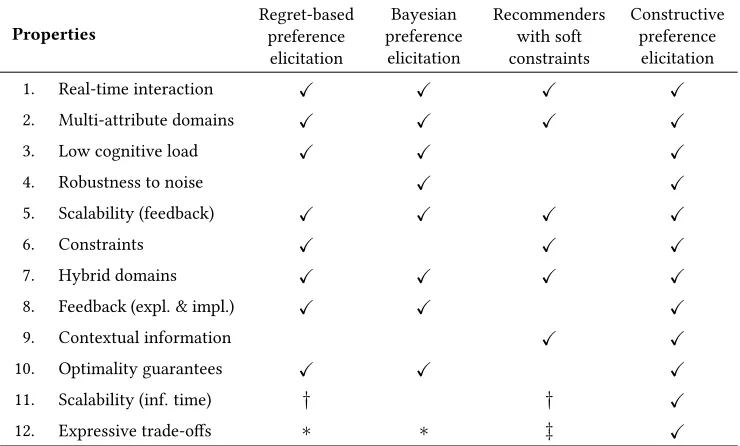
A constructive recommender system is expected to satisfy all the above desiderata. To the best of our knowledge, no preference elicitation nor recommendation technique has been proposed so to satisfy these twelve properties all together. Table 1.1 provides an overview of the properties satisfied by state-of-the-art techniques. Regret-based approaches utilize a multi-attribute representation in conjunction with a constraint solvers, but do not directly model noise in the user feedback. Bayesian approaches do model noisy feedback but do not deal well with constrained domains and are more susceptible to increasing domain size (see e.g. [86, 257]). Constraint-based recommenders are typically combined with critiquing inter-faces and soft constraint solvers, which can enlarge the set of relevant preference criteria, but are limited to Boolean criteria and typically do not provide optimality guarantees. We will review in detail all the aforementioned techniques in Chapter 2.
recom-Properties
Regret-based preference
elicitation
Bayesian preference
elicitation
Recommenders with soft constraints
Constructive preference
elicitation 1. Real-time interaction X X X X 2. Multi-attribute domains X X X X
3. Low cognitive load X X X
4. Robustness to noise X X
5. Scalability (feedback) X X X X
6. Constraints X X X
7. Hybrid domains X X X X
8. Feedback (expl. & impl.) X X X
9. Contextual information X X
10. Optimality guarantees X X X
11. Scalability (inf. time) † † X
12. Expressive trade-offs ∗ ∗ ‡ X
Table 1.1: Overview of our desired properties among different techniques in the literature compared to constructive preference elicitation. (X): property satisfied; (†): depends on the underlying constraint solver; (∗): only with GAI models (see Section 2.1.2); (‡): only with Boolean criteria.
to larger constructive domains is therefore still a research problem, which we aim to ad-dress in this thesis. One possible approach is to use local search solvers or other heuristics to approximate the utility maximization procedure [82, 93]. This comes at the price of a possible degradation of the recommendation quality and more feedback needed to reach an optimal solution. We will explore this possibility in Chapter 7. In Chapter 5 we will discuss an alternative approach that may, in principle, be able to scale to arbitrarily large spaces by decomposing the constructive problem into “parts” and solve sub-utility maximization one part at the time [84]. This could potentially attain an exponential speedup per iteration with respect to standard constructive preference elicitation, allowing us to scale to much larger constructive problems. Besides the increase in the amount of feedback needed, a drawback of this approach is that it is only able to reach a “local” optimum with respect to the user utility. Nevertheless, the local optimum found by this technique has bounded approximation error, and provides a good trade-off between domain scalability and risk of sub-optimality. In our constructive preference elicitation framework based on coactive learning, the expres-siveness of the utility function is on par with state-of-the-art preference techniques using GAI models and recommenders using soft constraints. As it is, though, coactive learning assumes the utility of the user to be fixed and cannot be extended with more informed pref-erence criteria during the elicitation process. This remains a research problem that needs to be addressed. We aim at doing so in Chapter 6, in which we introduce an extension to coactive learning, combining it with example critiquing [255]. This technique progressively enlarges the feature space that the algorithm works with, thereby making the utility model more expressive. Using this technique, we can personalize the preference criteria of each user utility model, without the need of stating them beforehand, which is advantageous for both generalization and computational speed. This approach might require more effort from the user, yet with clever selection criteria we can ask the user to state a critique only when strictly necessary. We will show how this method is capable of reaching an optimal solution while requiring far fewer features than standard coactive learning.
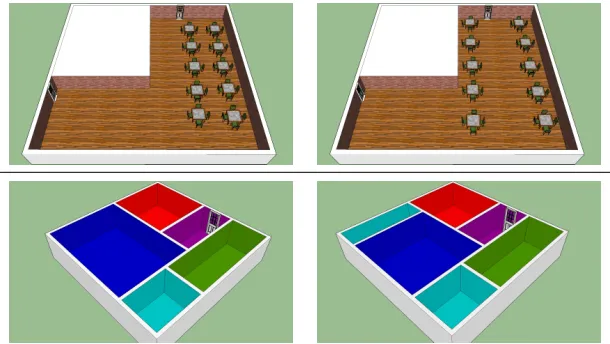
Further contributions of this thesis consist in extensively testing our technique on several dif-ferent constructive scenarios, as well as the implementation of a number of applications. In this thesis we present two applications of particular interest, namely automated layout syn-thesis, a kind of design process, and bundling of products and services, respectively treated in Chapter 7 and 8. The latter has also served as a test bed for an empirical study with real participants, whose results highlight the practical benefits of our framework [83].
This thesis is the result of the following peer-reviewed publications (in chronological order): [256] “Structured Feedback for Preference Elicitation in Complex Domains”. Teso, S.;
Dragone, P.; Passerini, A. InBeyondLabeler Workshop at IJCAI, 2016.
[82] “Constructive Layout Synthesis via Coactive Learning”. Dragone, P.; Erculiani, L.; Chietera, M. T.; Teso, S.; and Passerini, A. InConstructive Machine Learning Workshop at NIPS, 2016.
[81] “Constructive Recommendation”. Dragone, P. InACM Conference on Recommender Systems (RecSys), 2017.
[85] “Constructive Preference Elicitation”. Dragone, P.; Teso, S.; and Passerini, A. In
Frontiers in Robotics and AI, vol. 4. 2018.
[86] “Constructive Preference Elicitation over Hybrid Combinatorial Spaces”. Dragone, P.; Teso, S.; and Passerini, A. InAAAI Conference on Artificial Intelligence, 2018. [84] “Decomposition Strategies for Constructive Preference Elicitation”. Dragone, P.;
Teso, S.; Kumar, M.; and Passerini, A. InAAAI Conference on Artificial Intelligence, 2018.
[87] “Pyconstruct: Constraint Programming meets Structured Prediction”. Dragone, P.; Teso, S.; and Passerini, A. InInternational Joint Conference on Artificial Intelligence (IJCAI), 2018.
[93] “Automating Layout Synthesis with Constructive Preference Elicitation”. Ercu-liani, L.; Dragone, P.; Teso, S.; and Passerini, A. InEuropean Conference on Machine Learning and Principles and Practice of Knowledge Discovery in Databases (ECML-PKDD), 2018.
[83] “No More Ready-made Deals: Constructive Recommendation for Telco Service Bundling”. Dragone, P.; Giovanni, P.; Vescovi, M.; Tentori, K.; and Passerini, A. In
ACM Conference on Recommender Systems (RecSys), 2018.
1.3
Thesis outline
The following is an overview of the thesis structure and a brief summary of each chapter.
Chapter 2: Preferences and recommendations
This is the first of the two chapters discussing the background knowledge needed for veloping our constructive preference elicitation framework. This chapter, in particular, de-tails the topics of preference elicitation and recommendation systems. In the first part, the decision-theoretic treatment of preferences is introduced, together with its application to util-ity elicitation algorithms. The state-of-the-art approaches for preference elicitation are also reviewed. In the second part, the literature on recommendation systems is reviewed, focusing on constraint-based techniques and their application to product configuration.
Chapter 3: Online and structured learning
optimization framework, which provides a simple yet powerful method for devising learning algorithms in all three those scenarios. Online convex optimization also provides the proof techniques used to analyze those algorithms.
Chapter 4: Constructive recommendation
In this chapter, we will formally introduce our constructive recommendation technique. We will detail the components of constructive recommenders, their characteristics, and their evaluation. We will also compare the constructive recommendation framework to the alter-native techniques introduced in the previous chapters. We will then highlight the research problems that we ought to solve, which will then be addressed in the next two chapters. Fi-nally, we point out several applications of the constructive recommendation framework. This chapter is based on the work published in [256, 81, 86, 85].
Chapter 5: Part-wise domain decomposition
This chapter details our methodology for partitioning the domain of a constructive decision problem with the aim of reducing inference overhead and cognitive effort for the user. We first introduce the formal framework for decomposing the domain and the utility function. Next, we propose and analyze a coactive learning algorithm relying only on partial interac-tion. The analysis will result in a convergence guarantee to a local optimum with bounded approximation error. Experiments are also presented to validate the algorithm performance. The technique and the results presented in this chapter are based on [84].
Chapter 6: Critiquing and feature elicitation
In this chapter, we introduce a method for augmenting coactive learning with example cri-tiquing to personalize the features used in the utility model and solve the issue of learning with a combinatorial explosion of possibly relevant features. We first review the literature on critiquing systems and then propose a “coactive critiquing” approach, which elicits both preferences and features through coactive learning and example critiquing respectively. We analyze the proposed algorithm showing its eventual convergence to optimality. Finally, we report experimental evidence of the performance of our algorithm compared to more in-formed baselines. The coactive critiquing method and the experimental results exposed in the chapter are based on [255].
Chapter 7: Automated layout synthesis
Symbol Meaning
x Input object / contextual information y Output object / recommendation
X Input space / set of contexts
Y Output space / set of feasible objects φ(x, y) Feature map
u(x, y) Generic utility function w Generic parameter vector
y∗ True label / best object
w∗ Best hypothesis / true weight vector
u∗(x, y) True utility function
T Time horizon t∈[T] Iteration index
xt Input at iterationt
yt Prediction / recommendation at iterationt
ut(x, y) Utility function at iterationt
wt Estimate of parameter vector at iterationt
reg(xt, yt) Instantaneous regret at iterationt
regT Average regret up to iterationT
α Informativeness parameter (coactive learning)
ξt Slack variables / violations to theα-informative feedback
ζt Utility leak / utility mismatch
Table 1.2: List of symbols and their meaning.
layout synthesis tasks, reporting our findings. The content of this chapter is based on the work from [82, 93].
Chapter 8: Product and service bundling
This chapter describes the application of constructive recommendation to product and service bundling, and, in particular, to the recommendation of telecom service bundles. In this work we implemented a full constructive recommendation system as a web application and tested it with the help of real users. In the chapter we first describe the system structure and detail its components. We then describe the experimental setting and the evaluation protocol. Finally, we present our results and draw interesting conclusions. This chapter is based on the results published in [83].
Chapter 9: Conclusions
1.4
Remarks on notation
Throughout this thesis, we will attempt to maintain a common underlying notation, despite the vast heterogeneity of exposed concepts. The aim is to make it simpler to relate the many, seemingly unconnected, components that make up the background knowledge that the thesis work is based on. For this reason, in many sections, the notation used in this thesis may differ significantly from the one of the original works.
Throughout the thesis, we will indicate recommended objects as well as predicted outputs with the lettery, while reservingxfor input objects and contextual information. Bold letters
indicate vectors and vector-valued functions. Sometimes we will employ the notationyto
explicitly point out that the object is represented as a vector, while the notationyimplies that
the representation of the object is underspecified. Calligraphic letters such asX andY are generally reserved for vector spaces or other sets with an underspecified structure. In many situations we will use abbreviations:[n] ={1, . . . , n},{i:j}={i, i+1, . . . , j−1, j}, as well asSA=S
a∈Aaand
TB=T
b∈Bb. Throughout all the chapters, we will denote the usual
dot product inRnasha,bi=Pni=1aibi, and the Euclidean norm askak=
p
ha,ai. Other norms that we will use will be always explicitly denoted, such ask·k0andk·k1for the`0and
Preferences and recommendations
Understanding preferences has long been a topic of interest in several academic fields, such as psychology [147, 249], statistics [104, 233] and economics [170, 186]. Modeling and reasoning about preferences has also been a great interest of researchers in artificial intelligence [80, 206], who aim at developing decision support systems capable of aiding users in making op-timal choices when facing complex decision problems. Such systems aid the user by building amodelof their preferences, which can then be used to infer the most preferred outcome. To build such a preference model, decision support systems need to collect information about the user preferences, typically by interacting with and asking questions to the user, a process commonly known aspreference elicitation[35, 37, 56, 119]. Preference elicitation systems use specialized algorithms to estimate a preference model and search for the best option for the user among a large set of candidates, while minimizing the amount of questions asked to the user [52]. In Section 2.1 we will survey the topic of preference handling in AI and describe the most well known preference elicitation algorithms in the literature.
In the following sections we will describe the most important aspects of preference elicitation algorithms and constraint-based recommendation systems, highlighting their properties and use cases, and finally pointing out their differences and historical connections.
2.1
Preference handling
The formal treatment of preferences has its roots in decision theory [234] and neighbor-ing branches of economics [186] and statistics [233]. The development of the mathematical framework for describing and manipulating preferences still used today is primarily due to the work of von Neumann and Morgenstern [186], Keeney and Raiffa [150], and Fishburn [103, 104]. In their work, preference elicitation [150] was primarily seen as the process of gather-ing preference information prior to the construction of apreference model, which could then be used to make informed decisions. This process was once carried out by a decision analyst interacting with thedecision maker (DM). This process was, however, error prone and only viable for small decision problems, due to the inherent difficulty for human decision makers, as well as decision analysts, to handle large preference models. For this reason, preference elicitation has caused much interest in the artificial intelligence community [76, 206], which aimed at developing computational models and preference elicitation algorithms to handle complex decision problems.
One important distinction to be made in preference handling is between decision making
under certaintyand decision makingunder uncertainty. In the former case, the choices of the DM lead to certain outcomes, whereas in the latter the consequences of the DM choices are uncertain. In this thesis, we will be exclusively interested in decision theory under certainty, which encompasses decision problems like purchasing a product, choosing a movie to watch, and other tasks that do not involve uncertain outcomes.
For a preference model to be useful, it needs to be built in agreement with a certain notion of
rationalityof the DM’s choices, which also drives the subsequent inference process. The stan-dard definition of rationality in decision theory is based on thevon Neumann–Morgenstern
rationality axioms [186]. The von Neumann-Morgenstern theory assumes economic agents to behave in agreement to the goal of utility maximization. This definition is however by no means universally accepted (see e.g. [229, 170, 36]). Much work in behavioral economics and psychology has addressed this issue, highlighting the fact that the choices of human decision makers are actually better described by abounded rationalitymodel. The bounded rationality model implies that human decision makers are not able to accurately articulate their prefer-ences considering more than a handful of variables at the time [169]. Another problem with the standard notion of rationality is that it assumes the preferences of a DM to beinvariant, static and revealed through interaction. Many argue, instead, that preferences areconstructed
techniques deal with this problem by accounting for uncertainty over feasible models and by devising elicitation algorithms robust tonoisein the user response [26, 52, 129, 272]. Despite the criticisms, the von Neumann–Morgenstern utility theory is by far the most used in AI. In this thesis, we will use a subset of the von Neumann–Morgenstern axioms (sufficient for the treatment of decision making under certainty), and we will comply with the standard notion of rationality while allowing a boundedly rational user behavior through noisy feedback. In the following, we will briefly describe the formal framework for modeling and eliciting preferences typically used in AI. In Section 2.1.1 we will introduce the decision-theoretic formulation of preference relations and utility functions, which are the basic tools to describe and reason about preferences. In Section 2.1.2 we will detail themulti-attribute utility theory, which is the most common formulation used by preference elicitation techniques in AI. Next, in Section 2.1.3, we will introduce the classical preference elicitation procedure, pointing out its limitations, and then, in Section 2.1.4, we will review the state-of-the-art techniques for preference elicitation in the literature.
2.1.1
Preference modeling
In the classic decision-theoretic view, the preferences of an individual are represented by a
preference relation<over a setYof outcomes. Fory, y0 ∈ Y, the notationy<y0intuitively
means thatyis at least as good asy0. Arationalagent is expected to maintain a preference
relation satisfying the following axioms [186]:
1. Comparability: ∀y, y0∈ Y y<y0 ∨ y0<y
2. Transitivity: ∀y, y0, y00∈ Y y<y0 ∧ y0<y00 =⇒ y<y00
A binary relation with the above properties corresponds to atotal preorder over the setY. The total preorder induces a complete directed graph over the elements ofY, whose edges connectyandy0 if and only ify <y0. Cycles are admissible in a total preorder, in which
case we have thaty <y0 ∧ y0 <y, which is usually abbreviated by anindifference relation y∼y0, meaning that neither object is preferred to the other. Wheny<y0 ∧y0 6<y, instead,
we use astrictpreference relationyy0, meaning thatyis strictly preferred toy0.
Under the above comparability and transitivity conditions, when the set of outcomesY is finite or countably infinite, it is possible to define anordinal utility functionu:Y →Rsuch
that:
y<y0 ⇐⇒ u(y)≥u(y0)
The same holds for uncountably infinite outcome sets, provided the preference relation<is continuousover the setY. Continuity of a preference relation over a compact setYis achieved if “small” variations toyandy0do not change their order of preference. More formally, for
a continuous preference relation, ify y0, there exist two ballsBandB0, aroundyandy0
respectively, such that for every elementz ∈Bandz0 ∈B0,zz0. It can be shown that a
Every utility functionurepresents a unique preference relation<. The opposite is however
not true, since the same preference relation can be represented by any utility function that is a monotonically increasing transformation ofu. That is, iffis a monotonically increasing
function,f(u(y))represents the same preference relation ofu(y). In other words, ordinal utility functions are unique up to monotonically increasing transformations.
2.1.2
Multi-attribute utility theory
Outcomes of complex decision problems can typically be evaluated along different directions. For instance, when buying a house one needs to look at several aspects, such as the square footage, the number of rooms, the proximity to work and schools, the neighborhood, and the cost. These are usually calledattributes(or features) of the objects one is making the decision over. More formally,multi-attribute utility theory(MAUT) [150] describes outcomes as vectorsyofmvariables (a.k.a. attributes) taking values from domainsY1, . . . ,Ym. The
space of possible outcomes is the Cartesian product of the variables domainsY =Y1× · · · ×
Ym. Given an index setI ⊆ [m]1, we can define apartial outcomeyI ∈ YI = ×i∈IYi.
We denote the complement ofI asI– = [m]\I. Given a partial assignment yI and its
complementyI–, we define acompletiony= (yI,yI–)∈ Y.
If preferences over multi-attribute domains exhibit sufficient structure, preference models can be compactly encoded and efficiently queried. In a multi-attribute setting, structure is often determined by some kind of independence between attributes. The most basic is the
preferential independencebetween a subsetIof attributes and its complement:
∀ yI,y0I ∈ YI, y˜I–,y˜0I–∈ YI– (yI,y˜I–)<(y0I,y˜I–) ⇐⇒ (yI,y˜0I–)<(y0I,y˜0I–)
This means that if a subset of attributesI is preferentially independent of the remaining
attributesI–, then the preferences over attributesI do not depend on the attributesI–, as
long as they are kept fixed. The statement(yI,y˜I–) < (y0I,y˜I–)is usually abbreviated as
yI <yI0 ceteris paribus(all else being equal).
If preferential independence holds forevery subset of attributes with respect to its comple-ment we say that they areadditively independent. If additive independence holds, the utility function can be decomposed intomsubutilitiesui, each dependent on a single attributeyi,
for1≤i≤m:
u(y) =
m
X
i=1
ui(yi)
We call the latter anadditiveutility. While the assumption leading to a utility in additive form are rather strong, it is often used in practice thanks to the marked simplification it endows on the elicitation process. Elicitation of an additive utility only involves finding the utility value of the best and the worst value of each attribute separately, which can then be scaled and straightforwardly combined thanks to their mutual preferential independence.
Algorithm 1 Classical preference elicitation procedure 1: Select a query
2: Ask query to the DM
3: Receive response from the DM 4: Update preference model
5: Repeat steps 1 – 4 until the preference model is complete 6: Recommend best outcome based on preference model
A more relaxed independence condition is theconditional preferential independence. Let[m] be partitioned into three non-overlapping setsI, I0, I00. The setsI, I0areconditionally
pref-erential independent givenz∈ YI00if and only if:
∀yI,yI0 ∈ YI, ˜yI0,y˜0I0 ∈ YI0 (yI,y˜I0,z)<(yI0,y˜I0,z) ⇐⇒ (yI,y˜I00,z)<(yI0,y˜0I0,z)
The above condition induces aconditionalpreference relation<zfor allzover whichIand
I0are preferential independent, thus we can writeyI <zy0Iceteris paribus. When this
inde-pendence condition holds for some attribute sets, the preference relation can be represented by aconditional preference network(CP-net) [28]. CP-nets are directed graphs in which each node represents an attribute, whose incident edges represent its preferential dependencies with other attributes. For each node, aconditional preference tablecompletely specifies the conditional preference relation<zof the node given every assignmentzto the values of its
parent nodes.
Another form of relaxed independence is thegeneralized additive independence(GAI) [12, 103] assumption, under which a utility function can be decomposed into independent subutilities over a collection ofK(possibly overlapping) subsets of attributes:
u(y) =
K
X
k=1
ui(yIk)
This condition is much more general than additive independence and it has been shown that anyacyclicCP-net admits a GAI utility function over the collection of attribute sets defined by all attributes with their respective parent nodes [34]. By merging acyclic CP-nets with GAI decomposition it is possible to devise elicitation strategies employing theminimax regret
criterion (see below) [27]. Other strategies have been developed later on [34, 154].
In Chapter 5 we will employ some of the results in the literature on GAI utilities to develop a part-based elicitation process for constructive preference elicitation.
2.1.3
Classical preference elicitation
static objects that, once obtained, could be used to infer the answer to different types of queries, similarly to other types of graphical models like Bayesian networks [205]. Querying a preference model might be useful to assess e.g.dominanceorindifferencebetween an object
yovery0, i.e. whetheryy0ory∼y0, or it could be used to performoutcome optimization,
i.e. finding out the outcome with the highest utility, perhaps given some partial assignment of the attributes. The optimal outcome could then berecommendedto the decision maker. In order to attain an optimal decision, it was implicitly assumed that the preference model should be elicitedcompletely, i.e. finding the true preference relationy <y0for each pair of
items(y, y0), or equivalently finding the true utility valueu(y)for each objecty.
Preference (or utility) elicitation was an interactive process, between a decision analyst and a decision maker, aimed at constructing a preference model. This process usually consisted in a sequence of “queries” asked to the decision maker in order to gather information about his or her preferences. A typical preference elicitation loop would progress as shown in Algorithm 1. Common types of queries used in the literature include:
• Pair-wise comparison: the DM is asked to state her preference between two objects
yandy0. This query conveys the informationy y0 or vice versa. Sometimes, an
indifference answery∼y0is also allowed.
• Set-wise comparison: the DM is asked to pick the most preferred outcome among a setQ of alternatives. Given an answery, then we can implicitly deduce that y < y0 fory,y0 ∈ Q, y 6= y0. Sometimes set-wise queries require the DM to order the
objects according to her preferences, in which case the answer to the query provides a much more accurate preference information, resulting in all combinations of pair-wise preference rankings.
• Gambles: the DM is asked whether she would prefer an objectyfor sure, or a gamble
betweeny0with probabilitypandy00with probability1−p. A gamble is usually
de-noted ashy0, p;y00i, and the result of a choice between a gamble and a certain outcome determinesy hy0, p;y00ior vice versa. Ify0 is the best possible objecty>andy00
is the worst possible objecty⊥, thenhy>, p;y⊥iis called astandard gambleand we have that the result of query betweenyand a standard gamble equates tou(y)> por
vice versa, assumingu(y⊥) = 0andu(y>) = 1. If the DM is indifferent between the gamble and the certain outcome,y∼ hy>, p;y⊥ithenu(y) =p.
Many approaches to preference elicitation have been proposed over the years, most relying on some assumption about the structural independence of the attributes to simplify the elic-itation process and using different types of queries to optimize the amount of information gained per query.
For additive independent utility functions, for instance, the elicitation process is rather simple and straightforward [150]. An additive utility function can be described usingmlocal value
functionsviandmscaling factorsλi:
u(y) = X
i∈[m]
ui(y) =
X
i∈[m]
Algorithm 2 Modern preference elicitation procedure 1: whileUser is not satisfieddo
2: Select a recommendation based on partial preference model 3: Make recommendation to the DM
4: Receive feedback (implicit or explicit) from the DM 5: Update preference model
Since the subutilies are all independent of each other, one can proceed in eliciting each at-tribute separately. Once a ranking for each atat-tribute has been established, e.g. by local pair-wise or set-pair-wise comparisons over the attributes values, letyi>andy⊥i be the best and worst
attribute values for each attributei ∈ [m], and setvi(y>i ) = 1andyi(y⊥i ) = 0. The value
functionvi(yi)can now be determinedlocallyfor each value of the attribute, using standard
gambles with increasing probabilities. Once the local value functions have been determined, one only needs to elicit the true utility of the best values of each attribute in order to assign the right value to the scaling factorsλi. Lety⊥ = (y1⊥, . . . , ym⊥)and u(y⊥) = 0, as well
asy> = (y1>, . . . , ym>)andu(y>) = 1. We can use standard gambles over full objects to determine the true utility ofu(y>
i ,y⊥i–)2: if(y>i ,y⊥i–) ∼ hy>, p;y⊥ithenu(y>i ,y⊥i–) = p.
The scaling factors can then be set to:
λi=
u(y>i ,y⊥i–)
P
j∈[m]u(yj>,y⊥j–)
This ensures that the subutilities functions are properly scaled and that the full utility is defined in the[0,1]range. Similar elicitation procedures based on local elicitation and global scaling can be devised for GAI models as well [39].
The classical paradigm for preference elicitation has fallen out of fashion over the years due to several practical problems [52]. First and foremost, gathering complete preference infor-mation is unattainable for decision problems with more than a handful of attributes. Additive utility functions are often not descriptive enough, resulting in erroneous models that do not really represent the user preferences, thereby leading to suboptimal decisions. Another im-portant factor to take into account is the cognitive effort of decision makers, especially non-expert ones. Queries involving cardinal utility values and probabilities are too difficult for non-expert decision makers. Also, in general, the number of queries asked to the DM should be minimized to reduce the cognitive burden. These problems lead to a shift in perspective in preference elicitation, which now is mostly based on the assumption that algorithms should help the user in finding optimal decisions with onlypartialpreference information. Also, a partially elicited preference model could be used to select themost informativequery to ask to the DM, in order to minimize the number of queries. To further reduce cognitive effort for the user, most recent preference elicitation systems adopt comparison queries, which are deemed to require low cognitive effort [64, 128, 129, 173]. Another advantage of compari-son preference feedback is that it can often be inferredimplicitlyfrom the behavior of a user on an online system. Viappiani and Boutilier [272, 273, 274] showed that, in the context of
preference elicitation with set-wise preference queries, the optimal recommendation set my-opically coincides with the optimal query set, thereby merging the querying phase and the recommendation phase into one single process. The new paradigm for preference elicitation and decision making proceeds as in Algorithm 2. The preference elicitation process now rec-ommends the best item according to the current partial preference model and stops only when the user is satisfied with the recommendation. Modern preference elicitation algorithms are designed along these lines [18, 31, 129, 272, 274, 278]. In the next section we will describe two of these state-of-the-art algorithms forregret-based andBayesianpreference elicitation.
2.1.4
Regret-based and Bayesian elicitation
To make optimal recommendations with only partial preference information, one needs to take into account theuncertaintyresulting from the lack of a full preference knowledge. The two most used paradigms for handling uncertainty in utility models are based on theminimax regretprinciple andBayesian statistics.
Within astrictuncertainty scenario, i.e. without any distributional information about the pos-sible utility functions, a well known decision criterion is theminimax regret[234]. Descrip-tively, minimax regret suggests to choose the possibilityywhich minimizes the maximum
regret over bothU andY, i.e. the worst-case loss one would suffer by choosingy. Formally,
given a set of utilitiesU over a choice spaceY, the minimax regret principle imposes:
y∗= argmin
y∈Y max
u∈U ymax0∈Y u(y
0)−u(y)
In practice, the calculation of the above optimization problem depends on the structure of the utility modelsu∈ U (often GAI models are used) and the type of interaction with the user. In general, the minimax regret problem can be cast as amixed integer programand can be solved through constrained optimization [201, 238]. This has the side benefit of allowing us to impose arbitrary constraints on the decision space in order to limit the feasible area. As more preference information is acquired throughout the elicitation process, more constraints are imposed on the spaceU, shrinking the space of feasible utility functions and thus reducing the uncertainty about the decision. The minimax regret has been applied to many elicitation scenarios, with different utility models and types of feedback. One major drawback of this approach that has emerged over the years, is that it fails to take into account uncertainty in the user feedback. Indeed, user feedback is inherently noisy, as human decision makers make mistakes and inaccuracies due to lack of focus and other factors extraneous to the decision process. Noisy feedback leads to inconsistencies, which can make a regret-based system never reach an optimal solution. Assuming noiseless responses is unrealistic, especially for systems involving interaction with non-expert users, who do not fully understand the constraints of the problem and the consequences of their choices.
be the one maximizing theexpected utilityEπ[u(y)]with respect to the priorπ:
y∗= argmax
y∈Y E
π[u(y)] = argmax y∈Y
Z
u∈U
u(y)π(u)du
However, throughout the elicitation, one would rather select the query yielding the most preference information. One popular approach is maximizing theexpected value of informa-tion(EVOI) [26, 52]. The EVOI is the difference between theexpected posterior utility(EPU) and the maximal expected utility over the current belief. The EPU is the maximal utility in expectation over theposterior distribution according to the response model of the selected query. A user response model is a distributionP(r|q, u)over the possible responsesr∈Rq
to a queryq ∈ Qgiven utilityu ∈ U. The response model used depends on the type of queries the elicitation process employs. Typical response models for e.g. comparison queries are the Bradley-Terry or Plackett-Luce models [33, 175, 208], which are logistic models of the type:
P(r|q, u) = P exp(γ u(r))
s∈Rqexp(γ u(s))
For a responser∈Rqto queryq∈ Q, Bayes rule yields the posterior probabilityπˆoverU:
ˆ
πr,q(u) =
P(r|q, u)π(u)
P(r|q) whereP(r|q) = R
u∈UP(r|q, u)π(u)duis the marginal probability of responsergivenq. The expected posterior utility of a queryq∈ Qis:
EPU(q) = X
r∈Rq
P(r|q)
max
y∈Y Eˆπr,q[u(y)]
The EVOI of a queryq∈ Qis the difference between EPU and the maximal expected utility according to the current beliefπ; the best queryq∗is the one maximizing the EVOI:
q∗= argmax
q∈Q
EVOI(q) = argmax
q∈Q
EPU(q)−max
y∈Y Eπ[u(y)]
2.2
Recommendation systems
Recommender systems are computational tools providing suggestions in regard to a decision task the user is faced with. Typical scenarios in which a recommender system is used include buying a product, choosing which movie to stream, listening to a playlist while traveling, reading a news article online. In all these tasks, the choice is among a set ofitems, and the job of the recommender system is to pick a few items from the bunch that are likely to be of interest to the current user. This implies that the recommender system has to provide
personalizedsuggestions to each user separately, based on different criteria such as demo-graphics, location, browsing and purchase history, likes, ratings and reviews. It is usually the case that a recommender system gathers all this information into auser profile, which is then matched to the features of the items in search of promising recommendations. Indeed, this is a form ofcontent-based recommendation[172], in which learning algorithms and similarity measures are used to determine how “similar” an item is to a user profile or to the items the user has liked in the past. Other content-based techniques treat the recommendation task as a
multi-armed banditproblem [41, 160], in which the recommender system has tochoosewhich item to display to the current user, balancing betweenexplorationandexploitation, in order to maximize some overall expected reward, e.g. click-through rate. Another data-driven ap-proach to recommendation iscollaborative filtering[92, 153], in which the recommendations for a user are determined on the basis of her behavior with respect to other users’ behavior. The standard approach to determine how much a user liked a given item is throughratings. The assumption in collaborative filtering is that users rating items in the same way will likely rate other items similarly too. In this way, recommendations are simply based on how other users with similar ratings to the current user have rated items that the current user has not yet rated. This avoids the need for extracting item features entirely, yet requiring much more data from a large number of users in order to make good quality recommendations. Collab-orative filtering also suffers from thecold startproblem for new users [164, 236], as no data is available for them to provide meaningful recommendations. As such, often hybrid tech-niques are used to address this problem [43, 288]. A radically different approach is taken by
2.2.1
Constraint-based recommendation
Constraint-based recommenders [97, 99, 266] are a kind of knowledge-based systems in which domain knowledge as well as user preferences are represented asconstraints. This formalism is particularly beneficial in recommending complex objects like cars, financial services and insurance policies, bundles, and configurable products such as PC configurations and trips. In all these scenarios, items are infrequently purchased objects, for which it is difficult to maintain a sizable and updated set of ratings for each user, making data-driven approaches ineffective.
In constraint-based recommendation, the problem of selecting a recommendation is cast as a
constraint satisfaction problem(CSP) [268]. Given a set ofmvariablesY ={y1, . . . , ym}with domainsY1, . . . ,Ymand a set ofconstraintsC, a constraint satisfaction problem consists in
finding one or moreassignmentsto all variablesY, i.e. instantiations of the variablesyi∈ Yi
from their respective domains, that also satisfy all the constraintsC. Formally, a possible
assignment is a tupley = (y1, . . . , ym)∈ Y =Y1× · · · × Ymand a constraintc ∈Cis a
set of valid assignments3. Asolutionof the CSP is a feasible assignmenty ∈ Y ∩ C, where C=TCis the set of feasible assignments. In a constraint-based recommender, the variables
Y encode the attributes of the recommended objects. Another set of variablesX may
en-code given contextual information, e.g. user attributes, which can be used in the definition of constraints. Constraints in constraint-based recommenders can mainly be of three kinds: [i] feasibility constraints, i.e. constraints encoding the realizability of configurations based on the available domain knowledge, business-driven restrictions and compatibility between components; [ii] user requirements, i.e. user-specified constraints that filter the configura-tions to comply with his or her preferences; [iii] catalog constrains, i.e. constraints encoding the available configurations in the item database. When a constraint-based recommender is used for product configuration (discussed in the next section), the last type of constraints is missing entirely. Solutions to the CSP are valid recommendations. Off-the-shelf CSP solvers are widely available, so the system designer is only concerned with describing the full domain knowledge and translating the specified user requirements into valid constraints.
Most constraint-based systems in the literature also incorporate methods for rankingthe solutions found by the CSP solver [98, 101]. Multi-attribute utility theory (Section 2.1.2) has often been used for this purpose [102, 101, 142]. Usually, a linear additive utility model would be used, and the weights for each attribute would be set by the designer of system or could be modified manually by the user. Later on, systems based onsoft constraints[183] for ranking were introduced, which allow to articulate more expressive preference trade-off rules and providing a clearer semantics to the interaction with the system [24, 211, 289]. Soft CSPs are generally understood as standard CSPs with an attachedsemiringwhose elements can be assigned to the problem constraints [23]. Instantiation of this paradigm include fuzzy CSPs, probabilistic CSPs and weighted CSPs. While some work uses fuzzy and probabilistic CSPs
3Technically, each constraint is defined over a subset of variablesYc ⊆ Y and determines a set of the valid
partialassignments, i.e. assignments to the variablesYconly. For simplicity, we consider constraints as sets of full
assignments containing all the combinations of feasible assignments to the variablesYcwith all the values in the
for recommendation and preference elicitation [113, 275], most works focus on weighted CSPs [211], in which each constraint is assigned a weight and the objective is to maximize the cumulative weight of the satisfied constraints.
Constraint-based recommender systems typically incorporate a way of collecting user re-quirements through interaction [97]. A natural way of modeling the interaction with the user in a constraint-based system is through adialog, i.e. a sequence of refinement steps in which the user would assess the available options andtweak some of the options, pro-viding additional requirements [165]. This type of systems are often calledconversational
recommender systems [118, 165, 279]. The refinement steps are carried out through so-called
critiques[47, 55, 181]. Critiques may be either user initiated or elicited by the system [54]. Either way, they are statements of the type “I would like a similar product, but cheaper”, i.e. statements providing additional information on the preference of the user, in order to improve the search of a satisfying option. In systems using soft constraints, critiques are usually interpreted as either additional soft constraints or a (manual) changes to the weights of the soft constraint [211, 277]. To the best of our knowledge, the first constraint-based sys-tem that combined acquiring soft constraints andlearningthe weights of the soft constraints from user feedback is the work of Rossi and Sperduti [22, 225, 227, 226]. They proposed to ac-quire ratings as user feedback and learn weights for the soft constraints with an incremental strategy [227]. Later, [110] usedranking SVMs[144] to learn from critiques, though they did not use constraint solvers to generate recommendations. In [48], the authors propose for the first time a recommendation system based on soft constraint, while learning a utility function from pair-wise preference feedback with ranking SVMs.
A constraint-based system using regret-based elicitation was proposed by Boutilier et al. [29, 274], acquiring critiques in the form of comparison feedback. Their decision problem did not employ soft constraints, but their approach encompasses GAI models, which have the same expressive power of soft constraints [29, 40]. They were the first to apply a provably optimal decision theoretic criterion for eliciting preferences in a constraint-based recommender.
2.2.2
Product configuration
Product configuration is a long standing research area in artificial intelligence [100, 126]. Product configuration is the task of combining the components of an object in such a way that the final object satisfies a set of constraints. Components can be instantiated in several different ways, and their combination form a full configuration that is subject to feasibility constraints, e.g. compatibility constraints between the components, and user requirements, i.e. based on the user needs and preferences. Due to the combinatorial explosion of the so-lution space, product configuration tasks are often computer-aided byconfiguration systems, whose job is to help users defining their requirements and finding feasible solutions. Con-figurator systems have been the main technology to enable and drive the adoption of amass customizationparadigm in industrial production [5].
of the user requirements and satisfiability of the overall constraint problem. Most often con-figuration systems assume to get the user requirements in one go, regardless of how they are obtained [5]. An alternative way to acquire user constraints is, instead, through a step-by-step process in which a user specifies the value (or range of values) for each variable one by one, and at each step the solver uses constraints propagation to check and update the current solution [5, 100]. Since product configuration is mainly used at industrial level, re-search in this area is mainly focused on the issues of creating, employing and maintaining CSP models for configuration tasks. Only a small subset of works in this field addresses the problem of how to drive the users towards a good solution and improve the interaction with the configuration system [98, 178, 232]. The majority of these works propose some way to combine recommendation techniques to configuration systems, in order to ease the choice of attribute values to the user. Among the others, [98] proposes several methods to address cases in which the problem constraints, together with the user requirements, yield no feasible solutions. In [178], the authors propose to use recommendation techniques to suggest which variable to fill next and with which value. Another work in this direction proposes to pro-ceed with a guided search, aided by content-based filtering techniques, through progressively more constrained partial configuration problems [232]. In general, however, configuration systems are more used in an industrial setting or other areas in which the computer-aided configuration task is handled by a domain expert [123, 263].
Constraint-based recommenders are generally more concerned with providing the user with refined interaction protocols and more robust utility models than product configuration sys-tems [99]. This is especially important for non-expert users, who do not have full information about the domain and do not fully understand the consequences of their choices. As men-tioned in the previous section, configuration problems can be handled through a constraint-based system as well. The potential application of constraint-constraint-based recommendation to prod-uct configuration has long been acknowledged [97, 99, 287]. While the original approaches of constraint-based recommenders and configuration systems were rather different, they are now progressively converging [94, 95, 99, 96, 235, 264, 265].
2.3
Summary
In this section we surveyed two areas in the field of artificial intelligence that deal with the issue of designing computational decision support systems, namelypreference elicitationand
Online and structured learning
Recommendation systems often rely on algorithms that learn to predict which, among the cat-alog of available items, are interesting suggestions for the users. As such, machine learning techniques are widely used in recommendation. For instance,matrix factorizationis com-monly used in collaborative filtering, whilek-nearest neighbor and deep learning are often
used in content-based recommendation [204, 271]. Learning-to-rank algorithms [168] learn ranking models to optimize e.g. the click-through rate of search engines and top-k
recom-mendation systems [144, 148]. The same objective can be achieved byonline learning algo-rithms such as multi-armed bandit and contextual bandit algoalgo-rithms [50, 160]. Indeed, online learning algorithms are extensively used in recommendation [2] and beyond [50]. Online learning algorithms operate in a somewhat similar setting to the preference elicitation al-gorithms seen in Chapter 2. Both run in an iterative fashion, making recommendations (or generally predictions) sequentially and obtaining feedback only after the prediction is made. Their objective are, however, different: while preference elicitation algorithms construct a preference model to find theoptimalobject for a user in a combinatorial space of options, online learning algorithms learn to choose actions in such a way to maximize thecumulative gain(e.g. clicks) of the player (e.g. a recommender system). Despite their differences, they are not incompatible, as we will argue in Chapter 4.
Another machine learning topic that is related to ranking [53] isstructured-output predic-tion[14]. Structured prediction techniques are used in contexts in which the outputs of the algorithm are objects that exhibit some level ofstructure, such as sets, sequences, matrices, trees or graphs. These tasks are more complex than standard binary classification and regres-sion, so specialized learning algorithms are needed. Interestingly, though, these algorithms have been developed in such a way to actually beindependentof the particular structure of any given prediction problem. The only requirement for using these algorithms is to have access to an oraclecapable of making predictions with the particular structure by solving certain optimization problems. We will discuss in Chapter 4 how this mechanism can be exploited in a constructive scenario as well.
a powerful tool for deriving online learning algorithms to solve many different prediction tasks. Lastly, we will detail thecoactive learningframework, which is the technique our work on constructive preference elicitation is based on. Coactive learning is an online structured prediction framework that is used for personalizing search engine results and recommenda-tions. We will argue in Chapter 4 that it may also constitute an effective preference elicitation method for constructive problems.
3.1
Online learning
Online learning [50] deals with sequential decision problems, in which predictions are made in a sequence of consecutive rounds, while information about the quality of a prediction (feedback) is revealed only after the prediction has been made. In this setting, learning occurs between two consecutive predictions, and typically involves updating the parameters of a decision model utilizing the feedback received after the prediction. The most well known online learning problems are themulti-armed bandit model and the problem ofprediction with expert advice. In the multi-armed bandit problem an agent has to iteratively choose which “arm” to pull (i.e. which action to play) based on the information she has about the distribution of the reward of that arm. After the agent plays an action, only the reward of the played actions is revealed and not that of the other actions. As such, an agent has to trade-offexplorationand exploitation, in order to maximize the cumulative reward. In the problem of prediction with expert advice, an agent has to choose a prediction based on the recommendations of several experts, and, once the choice is made, the reward of each expert’s recommendation is revealed, but the agent only retains the one from the chosen expert. Also in this case the goal of the agent is to maximize the cumulative reward, though she has full information on the rewards of the other actions so exploration is not an issue.
An important extension to the experts problem is the prediction withside information[50]. This model is the most closely related to typical machine learning problems like classification and regression. Algorithm 3 shows the typical schema of an online prediction algorithm [242]. At each time stept ∈ [T], the learner receives an objectxtfrom an input domainX. The
input objectxtrepresents the side information the learner has access to before making its
prediction. After receiving the inputxt, the learner has to make a predictionyt∈ Y.