Published online July July, 2015 (http://www.sciencepublishinggroup.com/j/ijmfs) doi: 10.11648/j.ijmfs.20150102.11
A Novel Strategy for Comparative Points in Facility Layout
Problem with Fuzzy Logic
Erfan Ghasem Khani
1, *, Mostafa Ali Beigi
21
Department of Industrial Engineering, Faculty of Industrial and Mechanical Engineering, Islamic Azad University, Qazvin, Iran 2
Young Researchers and Elite Club, Islamic Azad University, Firoozkooh, Iran
Email address:
[email protected] (E. Ghasem Khani), [email protected] (M. Ali Beigi)
To cite this article:
Erfan Ghasem Khani, Mostafa Ali Beigi. A Novel Strategy for Comparative Points in Facility Layout Problem with Fuzzy Logic. International Journal of Management and Fuzzy Systems. Vol. 1, No. 2, 2015, pp. 15-20. doi: 10.11648/j.ijmfs.20150102.11
Abstract:
Distance measure is one of the most important component in facility layout problems. Many distance approaches have been proposed so far. However, there is no method that can always give a satisfactory solution to every situation. In this paper, first we review on some distance methods, then we present a new strategy for comparative points in facility layout with fuzzy logic, which it is very useable, specifically when it is hard (or impossible) to use other methods to solve uncertain points. Finally, some numerical examples illustrate the presented method as well as comparing it with other various ones.Keywords:
Multi Attribute Decision Making (MADM), Facility Layout (FL), Distance Measure, Fuzzy Logic, Uncertain Points, MOER Method, Decision Making (DM)1. Introduction
Nowadays the concept of Facility Layout (FL) is acquiring more and more attention in the representation of intelligent automation. In many cases it is necessary to known in what manner which method selecting for distance measure, how various data differ or agree with each other, and what the measure of their comparison is. A good placement of facilities is dependent on data in problem and selecting method of measure distance.
Facility Layout (FL) Problem is one of the classical problems in which the planning for the placement of different types of facilities such as machines, employee workstations, utilities, customer service areas, restrooms, material storage areas, lunchrooms, drinking fountains, offices, and internal walls is discussed [Francis, White and McGinnis, 1992].
Many distance method for facility plant have been proposed, such as Euclidean distance, Squared Euclidean distance, Chebyshev distance, rectilinear distance. Sometimes we receive lots of information from factories and most of them are approximate. FL sometimes occurs in a fuzzy environment where the available information is imprecise/uncertain which may confuse the designer in the FL problem. There are many misconceptions about fuzzy logic. To begin with, fuzzy logic is not fuzzy. Basically, fuzzy logic is a precise logic of imprecision and approximate reasoning [Zade, 1975- Zade, 1979].
More specifically, fuzzy logic may be viewed as an attempt at formalization/mechanization of two remarkable human capabilities. First, the capability to converse, reason and make rational decisions in an environment of imprecision, uncertainty, incompleteness of information, conflicting information, partiality of truth and partiality of possibility – in short, in an environment of imperfect information. And second, the capability to perform a wide variety of physical and mental tasks without any measurements and any computations [Zade, 2008].
for normal fuzzy numbers.
In this paper, first we review on some distance methods, then we present a new strategy for comparative points in facility layout with fuzzy logic, which it is very useable, specifically when it is hard (or impossible) to use other methods to solve uncertain points. Finally, some numerical examples illustrate the presented method as well as comparing it with other various ones. New method named MOER distance (MOER abbreviation of authors name).
The rest of the paper is organized as follows:
Section 2 contains the basic definitions and notations that will be used in the remaining parts of the paper. In Section 3, we review some distance methods. Section 4 includes a new Approach to determine fuzzy distance measure for distance between several points. Some numerical examples demonstrate the advantages of the reviewed methods and compared results in section 5. The paper is concluded in Section 6.
2. Basic Concepts and Notations
Definition 1 (Distance): [Deza and Deza, Encyclopedia of Distances]
A distance space ( , )X d is a set X (carrier) equipped with a distanced .
A function d X: × →X R is called a distance (or dissimilarity) on X if, for all x y, ∈X, it holds:
( , ) 0
Dist x y ≥ (nonnegativity)
( , ) ( , )
Dist x y =Dist y x (symmetry) ( , ) 0
Dist x x = (reflexivity)
In Topology, a distance with Dist x x( , )=0 implying x= y is call a symmetric.
For any distance d , the function Dist1 defined for x≠ y by Dist x y1( , )=d x y( , )+c, where
, ,
maxx y z X( ( , ) ( , ), ( , )),
c= ∈ d x y −d x z d y z and Dist x x( , )=0, is a metric. Also, 2( , ) ( , )
c
Dist x y =d x y is a metric for sufficiently small c≥0.
Definition 2 (Metric): [Deza and Deza, Encyclopedia of Distances]
Let X be a set. A function d X: × →X R is called a metric on X if, for all x y z, , ∈X, it holds:
( , ) 0
Dist x y ≥ (nonnegativity);
( , ) 0
Dist x y = if and only if x= y(identity of indiscernibles);
( , ) ( , )
Dist x y =Dist y x (symmetry); ( , ) ( , ) ( , )
Dist x x ≤Dist x z +Dist z y (triangle inequality)
In general, a generalized fuzzy number Aɶ is described as
any fuzzy subset of real lineR, whose membership µAɶ( )x can be defined as [Dubios and Prade, 1978]:
( )
( )
( )
0 ,
A
A
A
L x a x b
b x c x
R x c x b
otherwise
ω µ
≤ ≤
≤ ≤
=
≤ ≤
ɶ (1)
Where 0≤ ≤ω 1 is a constant, and LAɶ:
[ ] [ ]
a b, → 0,ω
and[ ] [ ]
: , 0,
A
Rɶ c d →
ω
are two strictly monotonical and continuous mapping from R to closed interval[ ]
0,ω
. If1
ω= , then Aɶ is a normal fuzzy number; otherwise, it is a trapezoidal fuzzy number and is usually denoted by
( , , , , )
Aɶ= a b c d
ω
or Aɶ=( , , , )a b c d if ω=1.In particular, whenb=c, the trapezoidal fuzzy number is reduced to a triangular fuzzy number denoted by
( , , , )
Aɶ= a b d
ω
or Aɶ=( , , )a b d ifω=1. Therefore, triangular fuzzy numbers are special cases of trapezoidal fuzzy numbers.Since ( ) A
L xɶ and ( ) A
Rɶ x are both strictly monotonical and continuous functions, their inverse functions exist and should be continuous and strictly monotonical. Let
[ ] [ ]
1
: 0, ,
A
L− ɶ
ω
→ a b and R−1Aɶ: 0,[ ] [ ]
ω
→ c d, be the inverse functions of ( )A
L xɶ and ( ) A
Rɶ x , respectively. Then L−1Aɶ( )r
and R−1Aɶ( )r should be integrable on the close interval
[ ]
0,ω
. In other words, both 10 LA( )r dr ω −
∫
ɶ and1 0 RA ( )r dr
ω −
∫
ɶ should exist. In the case of trapezoidal fuzzy number, the inverse functions L−1Aɶ( )r and R−1Aɶ( )r can be analytically expressed as1
( ) ( ) /
A
L−ɶ r = + −a b a r
ω
, 0≤ ≤ω 1 (2)1
( ) ( ) /
A
R−ɶ r = − −d d c r
ω
0≤ ≤ω 1 (3)The set of all elements that have a nonzero degree of membership inAɶ, it is called the support ofAɶ, i.e.
Supp( )Aɶ = ∈
{
x X|µ
Aɶ( )x ≻0}
(4)The set of elements having the largest degree of membership inAɶ, it is called the core ofAɶ, i.e.
Core( ) | A( ) sup A( ) x X
A x X µ x L A
∈
= ∈ =
ɶ ɶ
ɶ ɶ (5)
In the following, we will always assume that Aɶ is continuous and bounded support Supp ( )Aɶ . The strong support of A should be Supp( )Aɶ =
[ ]
a d, .that s is a regular function if 1 0
1 ( )
2 s r dr=
∫
.Definition 4: If Aɶ is a fuzzy number with r-cut representation,
(
L−Aɶ1( ),r RA−ɶ1( )r)
and s is a reducing function, then the value of Aɶ (with respect to s); it is defined by1 1 1
0
( ) ( )[ A( ) A ( )]
Val Aɶ =
∫
s r L−ɶ r +R−ɶ r dr (6)Definition 5: If Aɶ is a fuzzy number with r-cut representation
(
L−Aɶ1( ),r RA−ɶ1( )r)
, and s is a reducing function then the ambiguity of Aɶ (with respect to s) is defined by1
1 1
0
( ) ( )[ A ( ) A( )]
Amb Aɶ =
∫
s r R−ɶ r −L−ɶ r dr (7)Definition 6: Let Aɶ is a fuzzy number. The absolute value of the fuzzy number Aɶ is denoted by |Aɶ| and defined as follows [13]:
0 0
( ) ,
( ) ( ) 0
x A x
A x A x x
=
∨ − ≥
≺ ɶ
ɶ ɶ (8)
And for all r∈[0,1],
1
1 1 1 1
1 1 1 1
[ ] ( ) 0
| | 0,| ( ) | ( ) ( ) 0 ( )
( ), ( ) ( ) ( ) 0
r A
A A A A
r
A A A A
A L r
A L r R r L r R r
R r L r L r R r
−
− − − −
− − − −
≥
= ∨ ≤ ≤
− − ≤ ≤
ɶ
ɶ ɶ ɶ ɶ
ɶ ɶ ɶ ɶ
ɶ
ɶ
where [ ]Ar LA1( ),r RA1( )r
− −
= ɶ ɶ
ɶ is the rcut representation ofAɶ
and [|Aɶ|]r is the r−cut representation of |Aɶ|,respectively. Fuzzy Distance Measure [Ali Beigi, Hajjari and Ghasem Khani, 2015]
In this subsection, we describe “M. Ali Beigi, T. Hajjari, E. Ghasem Khani” fuzzy distance measure [Ali Beigi et al., 2015], which use in this paper.
Let Aɶ=( ,x x x1 2, 3) and Bɶ=( ,y y y1 2, 3) are two triangular fuzzy numbers and distance between Aɶ and Bɶ is denoted by
( , )
Dist A Bɶ ɶ where Dist A B( , )ɶ ɶ =( ,d d d1 2, 3) . We calculate 1, 2
d d and d3 as follows:
If x1= y1 then d1 =0, otherwise
1 3 2 2
1
1 3 2 2
, x y x y d
y x x y
− ≥
=
−
≺ (9)
{
}
2 max 2 2 , 1
d = x −y d (10)
and
{
}
3 33
3 1 3 1 3 3
0 ,
max ,
x y d
y x x y x y
=
=
− − ≠
(11)
Remark 1: The proposed method is a metric.
( , ) 0
Dist A Bɶ ɶ ≥
( , ) ( , )
Dist A Bɶ ɶ =Dist B Aɶ ɶ
( , ) ( , ) ( , ).
Dist A Cɶ ɶ ≤Dist A Bɶ ɶ +Dist B Cɶ ɶ
The proposed method can be developed in n-demotion. Let Aɶand Bɶ are two points in
n
-Dimensional space with triangular fuzzy number values in each dimensions.The points Aɶand Bɶcan be shown as:
(
)
(
1, 2, 3 , 1,...,)
n n nA= x x x n= k
(
)
(
1, 2, 3 , 1,...,)
n n nB= y y y n= k
1 2 3
( , ) ( , , )
n n n n
Dist A Bɶ ɶ = d d d Is the distance of the nth component of Aɶ from the nthcomponent of Bɶ and 1
n d , 2
n d and 3
n
d are related to from the left point, the centre and the right point of this distance respectively. The distance between each component can be calculated by the same method.
Then we define the total fuzzy distance between Aɶand Bɶ
as following:
1 2 1 2 1 2 1 2
1 1 1 2 2 2 3 3 3
( , ) ( , ) ( , ) ... k( , ) ... k, ... k, ... k
Dist A Bɶ ɶ =Dist A Bɶ ɶ +Dist A Bɶ ɶ + +Dist A Bɶ ɶ =d +d + +d d +d + +d d +d + +d (12)
3. Some Existing Distance Methods
In this section, we briefly review some existing distance measure.
Different authors have constructed different distance measure. Some of them are discussed here.
3.1. Rectilinear Distance
The rectilinear distance [Floudas and Pardalos, 2009] ( , )
R i
d X P between two points X and Pi is defined as following (see Fig. 1):
( , )
R i i i
d X P = − + −x a y b (13)
Where X =( , )x y and Pi =( ,a bi i).
3.2. Euclidean Distance or Straight Line
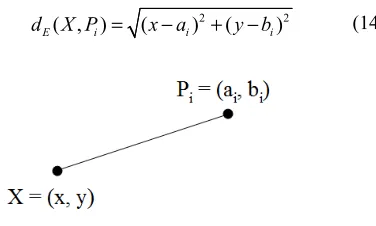
In order to determine the Euclidean distance between [Floudas and Pardalos, 2009] X =( , )x y and Pi =( ,a bi i)is given by (see Fig. 2):
2 2
( , ) ( ) ( )
E i i i
d X P = x a− + −y b (14)
Fig. 2. Euclidean distance dE( , )X Pi .
3.3. Squared Euclidean Distance
The Square Euclidean distance between X =( , )x y and ( , )
i i i
P = a b is calculated as:
2 2
( , ) ( ) ( )
SE i i i
d X P = x−a + y−b (15)
3.4. Manhattan Distance [Grabusts, 2011]
Manhattan distance or city block distance represents distance between points in a city road grid. It computes the absolute differences between coordinates of a pair of objects:
( , )
man i i i
d X P = − + −x a y b (16)
3.5. Chebyshev Distance [Grabusts, 2011]
Chebyshev distance is also called Maximum value distance. It computes the absolute magnitude of the differences between coordinates of a pair of objects(seeFig.3):
{
}
( , ) max ,
ch i i i
d X P = x a− y b− (17)
Fig. 3. Chebyshev distance dch( , )X P . i
4. New Method to Determine Fuzzy
Distance Measure for Distance
Between Several Points
In this section, we present a new method for distance measure between several points.
This method include three parts. Part One:
One of the most important steps for using fuzzy
applications is converting crisp data to fuzzy. In order to convert ( ,x yi i) to triangular fuzzy number shown as following (see Fig. 4):
( 1, , 1)
( 1, , 1)
i i i i
i i i i
x x x x
y y y y
= − + = − +
Fig. 4. Convert ( ,x y to triangular fuzzy number. i i)
Part Two:
Applying fuzzy distance measure [Ali Beigi et al., 2015] (definition 5) to converted known points, in other word, we calculate the fuzzy distance measure between point that converted in part one.
For using this method, first we calculate distance between i
xandxj, then calculate distance between yi and yj. Finally, we should calculate distance between result from
x
andy, which it is total distance that named MOER distance (MOER abbreviation of authors name, in other hand the final answer formulized as following:( ) ( ,i j) Dist x =Dist x x
( ) ( ,i j) Dist y =Dist y y
( ) ( )
total MOER
Dist =Dist =Dist x +Dist y (18) One of the important advantage of MOER distance is far simple and give a better result when points are uncertain and vague.
Part Three: In this part, we will present defuzzify of our method. In order to comparative proposed method with crisp method, we should be defuzzify MOER distance.
Defuuzify of proposed method shown as following:
2 MOERDist
Defuzzify =d
Which d2 is the mean of Disttotal=( ,d d d1 2, 3).
result.
Extension Proposed Method
If the points were approximately and we have the maximum distance between certain point and approximate point (MCP) we define Fuzzy number as following:
( , , )
i i i i
xɶ = x −MCP x x +MCP
( , , )
i i i i
yɶ = y −MCP y y +MCP
5. Numerical Examples
This section uses several numerical examples to compare the distance results of proposed method with some other existing distance methods.
Example 5.1. Consider coordinate of two point X1=(1, 2) and X2 =(3, 4). We compare the new distance with five methods as following:
The rectilinear distance, the Euclidean distance, The Square Euclidean distance, Manhattan distance, Chebyshev distance.
Comparison between the results of the proposed similarity measure and other methods are shown in Table 1.
According to our proposed method, we have: (0, 2, 4) , (0, 2, 4)
(0, 4,8)
x y
MOER x y
Dist Dist
Dist Dist Dist
= =
⇒ = + =
ɶ ɶ
ɶ ɶ
One of the interesting advantages of presented method that is mean of DistMOER is similar rectilinear distance result, in most cases.
Example 5.2. Let X1 =(3, 7) and X2 = − −( 2, 5) are two point in coordinate.
By rectilinear distanceDistR =17 . From the proposed Method, the result is
(13,17, 21)
MOER x y
Dist =Distɶ+Distɶ =
We can see the distance results by rectilinear approach is
same with our method.
Example 5.3. Suppose X1=(1, 2) and X2 =(5, 6). The results obtained by the proposed method and some others methods are calculate as following:
R
E
SE
CH 8 4 16
4
(4,8,12) MOER
Dist Dist Dist Dist Dist
= = =
= =
Example 5.4. Considered we have two approximate points. The problem is distance between “approximately two” and “approximately four”.
From the previous methods we cannot get a result, in other word, when we have approximate point, we cannot calculate distance by other methods, which is not a satisfactory result for managers, but our method can solve this problem and calculate above distance.
By proposed method, we have: 2 (1, 2,3) 4 (3, 4, 5) (0, 2, 4)
MOER
Approximately A
Approximately B
Dist
= =
= =
⇒ =
ɶ
ɶ
Example 5.5. Consider two approximate point X1=(3, 7) and X2 =(4, 5), MCP =2 By presented method, we have:
1
1
(1, 3,5) (5, 7, 9)
x y
= =
ɶ ɶ
2
2
(2, 4, 6) (3, 5, 7)
x y
= =
ɶ ɶ
(3,3, 5) , (2, 2, 6)
(5,5,11)
x y
MOER x y
Dist Dist
Dist Dist Dist
= =
⇒ = + =
ɶ ɶ
ɶ ɶ
And this is one of the other advantage of proposed method.
Table 1. Comparison of the proposed method with some other methods (Example 5.1.).
Points X1 X2 Result
Rectilinear (1, 2) (3, 4) 4
Euclidean (1, 2) (3, 4) 8
Square Euclidean (1, 2) (3, 4) 8
Manhattan (1, 2) (3, 4) 4
Chebyshev (1, 2) (3, 4) 2
Proposed Method 1
1
(0,1, 2) (1, 2, 3)
x y
= =
ɶ ɶ
2 2
(2, 3, 4) (3, 4, 5)
x y
= =
ɶ
ɶ DistMOER=(0, 4,8)
6. Conclusion
Distance measure play an important role in facility layout. Many methods have been proposed for distance between points. Each of these techniques has been shown to produce nonintuitive results in certain cases.
called MOER distance.
References
[1] Agarwal C. C., and. Yu, P. S., (2008), editors. Privacy Preserving Data Mining: Models and Algorithms. Springer. [2] Agarwal, P. K., Cheng, S.-W., Tao, Y., and Yi K., (2009),
Indexing uncertain data. Proceedings of ACM Principals of Database Systems.
[3] Agarwal, P. K., Har-Peled, S., and Varadarajan, K. R., (2004), Approximating extent measure of points. Journal of ACM 51(4).
[4] Agarwal, P. K., Har-Peled, S., and Varadarajan, K., (2007), Geometric approximations via coresets. C. Trends Comb. and Comp. Geom. (E. Welzl).
[5] Agarwal, P. K., Procopiuc, C. M., and Varadarajan. K. R., (2002), Approximation algorithms for k-line center. Proceedings European Symposium on Algorithms, pp. 54-63. [6] Agarwal, R., and Srikant, R., (2000), Privacy-preserving data
mining. ACM SIGMOD Record 29:439-450.
[7] Agrawal, P., Benjelloun, O., Sarma, A. D., Hayworth, C., Nabar, S., Sugihara, T., and Widom, J., (2006), Trio: A system for data, uncertainty, and lineage. Proceedings ACM Principals of Database Systems.
[8] Ali Beigi, M., Hajjari, T., Ghasem Khani, E., (2015), A New Index For Fuzzy Distance Measure, Appl. Math. Inf. Sci. 9, No. 6, 1-9.
[9] Bloch, I., (1999), On fuzzy distances and their use in image processing under imprecision, Pattern Recognition, vol.32, pp.1873-1895.
[10] Cha, S., and Srihari, S. N., (2002), On Measuring the Distance between Histograms, in Pattern Recognition, Vol 35/6, pp 1355-1370.
[11] Deza E. and Deza M.M., (2006), Dictionary of Distances, Elsevier.
[12] Deza, M-M., and Deza, E., Encyclopedia of Distances, (online http://www.sciencedirect.com/science/book/9780444520876) by Elsevier.
[13] Dubois, D., and Prade, H., (1978), Operation on fuzzy numbers, International Journal of Systems Science, vol.9, pp.613-626.
[14] Fachao, L., Lianqing, S., Xiangdong, Y.,and Jiqing, Q., (2001), The absolute value of fuzzy number and its basic properties, The Journal of Fuzzy Mathematics 9, pp403-412.
[15] Floudas, CH-A., Pardalos, P-M., (2009), Optimizing Facility Location with Euclidean and Rectilinear Distances, Springer US, Online ISBN 978-0-387-74759-0.
[16] Francis, R.L., White, J.A., McGinnis, F., (1992) , Facility Layout and Location: an Analytical Approach, Prentic-Hall. [17] Gavin D.G., Oswald W.W., Wahl, E.R., and Williams J.W.,
(2003), A statistical approach to evaluating distance metrics
and analog assignments for pollen records, Quaternary Research 60, pp 356–367.
[18] Gilbert, E. N., and Pollak, H. 0., (1968), Steiner minimal tree, this Journal, 16, pp. 1-29.
[19] Grabusts, P., (2011), THE CHOICE OF METRICS FOR CLUSTERING ALGORITHMS, Environment. Technology. Resources Proceedings of the 8th International Scientific and Practical Conference. Volume I1.
[20] HANAN, M., (1966), On Steiner's problem with rectilineardistance, this Journal, 14, pp. 255-265.
[21] Jahantigh, M. A., and Hajighasemi, S., (2012), Ranking of generalized fuzzy numbers using distance measure and similarity measure, International Journal of Industrial Mathematics, 4, 405-416.
[22] Jamshidi, M., Titli, A., Zadeh, L.A, Boverie, S., (Eds.), (1997), Applications of Fuzzy Logic – Towards High Machine Intelligence Quotient Systems, Environmental and Intelligent Manufacturing Systems Series, vol. 9, Prentice Hall, Upper Saddle River, NJ.
[23] Kailath, T., (1967), The divergence and bhattacharyya distance measures in signal selection, IEEE Trans. Commun. Technol. COM-15 (1) 52–60.
[24] KRUSKAL, J. B., (1956), On the shortest spanning subtree of a graph, Proc. Amer. Math. Soc., 7, pp. 48-50.
[25] MELZAK, Z. A., (1961), On the problem of Steiner, Canad. Math. Bull., 4, pp. 143-148.
[26] Monev V., (2004), Introduction to Similarity Searching in Chemistry, MATCH Commun. Math. Comput. Chem. 51 pp. 7-38.
[27] Pedrycz, W., (2007), Collaborative and knowledge-based fuzzy clustering, International journal of Innovating computing, Information and Control, Vol.3, no.1, pp.1-12. [28] PRIM, R. C., (1957), Shortest connecting networks, Bell
System Tech. J., 31, pp. 1398-1401.
[29] Saha, P.K., Wehrli, F.W., and Gomberg, B. R., (2001), Fuzzy Distance Transform: Theory, Algorithms and Applications, Computer Vision and Image Understanding, vol. 86, pp.171-190.
[30] Voxman, W., (1998), Some remarks on distances between fuzzy numbers, Fuzzy Sets and Systems, vol.100, pp.353-365. [31] Yang, Y. Y., and Wing, O., (1972), Optimal and suboptimal
solution algorithms for the wiring problem, Proc. IEEE Internat. Symp. Circuit Theory, pp. 154-158.
[32] Zadeh, L.A., (1975), Fuzzy logic and approximate reasoning, Synthese 30, 407–428.
[33] Zadeh, L.A., (1979), A theory of approximate reasoning, in: J. Hayes, D. Michie, L.I. Mikulich (Eds.), Machine Intelligence 9, Halstead Press, New York, pp. 149–194.
[34] Zadeh, L.A., (2008), Is there a need for fuzzy logic?, Information Sciences 178, 2751–2779.