
Available Online at www.ijpret.com 30
INTERNATIONAL JOURNAL OF PURE AND
APPLIED RESEARCH IN ENGINEERING AND
TECHNOLOGY
A PATH FOR HORIZING YOUR INNOVATIVE WORKDESIGN AND DEVELOPMENT OF THE HUMAN ENERGIZED OIL EXPELLER
SIRAJ MOHAMADALI SHEIKH1, ZAKIUDDIN SYED KAZI 2, JAYANT P.MODAK 2
1. G. H. Raisoni Academy of Engineering & Technology, Nagpur-44001, India. 2. Priyadarshini College of Engineering, Nagpur-44001, India.
Accepted Date: 26/06/2016; Published Date: 01/07/2016
\
Abstract: - The pedal powered flywheel motor has been adopted for many designs of rural
applications in the last two decades. In the recent past a pedal powered process machine has been developed for brick making, chaff cutter, water pump, blender, wood turning, clothes washing and drying and earthen pot making etc . The machine consist of human powered flywheel motor using a bicycle drive mechanism with speed increasing gearing and a flywheel, which drive the process unit through a spiral jaw clutch and torque increasing gearing [Gupta, J. K 1997]. The operator puts energy into the flywheel at a convenient power level for about one minute. After enough energy is stored, pedaling is stopped and the energy in the flywheel is made available to the process unit. Pedal power is the transfer of energy from a human source through the use of a foot pedal and crank system. Pedal powered machines could be a valuable backup solution to intermittent renewable energy sources like solar and wind. Human power is available 24 hours per day, is not affected by changes in the weather, is portable and can easily be stored for later use. This paper discusses about the simplistic design and development of pedal energized oil expeller machine. 'Human-scale' technology involved in these applications could be of great benefit to developing countries.
Keywords: Flywheel, Spiral Jaw clutch, Oil Expeller
Corresponding Author: MR. SIRAJ MOHAMADALI SHEIKH
Access Online On:
www.ijpret.com
How to Cite This Article:
Available Online at www.ijpret.com 31
INTRODUCTION
India is one of the largest producers of oil seeds in the world and Maharashtra is one of the major oil seed producing and edible oil producing state in India [3]. The oil expeller can produce oils extracted from a number of fruits, nuts and seeds for use in cooking and soap making or as an ingredient in other foods such as baked or fried goods. Extraction of oil from oil-bearing products could be done in two major ways a) Traditional Method b) Improved Methods. The traditional method is usually a manual process and involves preliminary processing and hand pressing. The improved method consists of chemical extraction and mechanical extrusion. Traditional oil expellers are simple mechanical devices that are hand/animal operated. Chemical extraction requires more capital expenditure, and refining the oil before use. There is also possibilities of toxicity from the solvent used and danger of fire explosion from the use of volatile organic solvent [4]. Although processing of oil-seeds, nuts, and fruits for oil production is achieved by mechanical extrusion method but the modern equipment and spare parts, degree of complexity of the equipment, maintenance, and the availability of power source constitute other major setbacks occur into it. Here the purpose of this research is to design and manufacture a suitable oil expeller’s machine for all kind of seeds, energized by human powered flywheel motor as an energy source and consisting of a tandem drive mechanism for small scale industry.
2. Need For Manually Energized Oil Expeller:
Available Online at www.ijpret.com 32 electric energy is much low also encourage animal husbandry by making oilcake available as best cattle feed. It increases milk production considerably.
3. Concept of Manually Energized Oil Expeller.
The average work rate of a man working continuously is equivalent to 0.13hp [6] .Therefore only continuous manufacturing process requiring less than 0.13 hp can be man powered. Any manufacturing process requiring more than 0.13 hp and which can be operated intermittently without affecting end product can also be human powered. Such human powered manufacturing process can be based on the following concept. In this processes a flywheel is used as a source of power. Manpower is used to energize the flywheel at an energy input rate, which is convenient for a man. After maximum possible energy is stored in flywheel it is supplied through suitable clutch and gearing system to a shaft, which operates process unit [7]; The flywheel will decelerate at a rate depends on load torque. Larger the resisting torque larger will be the deceleration. Thus theoretical a load torque of even infinite magnitude could be overturn by this man flywheel system. Oil Expeller Powered by Human Powered Flywheel Motor operates on the basic of above principle.
Available Online at www.ijpret.com 33
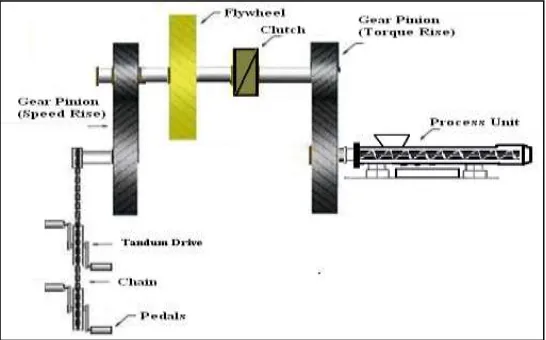
Figure No.2 Oil Expeller Powered By Human Powered Flywheel Motor.
4. Working
Essentially, the machine consists of three sub-systems: (1) the energy unit (2) transmission mechanism (3) the processing unit. The energy unit consists of a conventional bicycle mechanism, the transmission unit consists of a drive train; a chain drive mechanism running over a pair of speed-increasing gears and the process unit. The schematic arrangement of a human energized oil expeller machine is shown in Figure 1& 2.
Available Online at www.ijpret.com 34 The process unit consists of the gear pair G2 which is connected to the convener. The process unit consists of the gear pair G2 which is connected to power screw (i.e. screw shape tool used for crushing and squeezing of seeds). Because of which the power screw rotate in the drum and provide crushing and squeezing action take place.
5. Dimensional Analysis.
Dimensional analysis is the method of dimensions. [8] It is a mathematical technique used in research work for design and for conducting model tests. It deals with the dimensions of the physical quantities involved in the phenomenon. All physical values are measured by comparison, which is made fixed to an arbitrarily fixed value. Dimensional analysis can be used primarily as experimental tool to combine many experimental variables into one. The main purpose of this technique of is making experimentation shorter without the loss of control. Applying Releigh’s method the dimensional equation for Extrusion Processing Time, Resistive Torque, Quantity of Oil Yield, and Speed of Extruder Shaft are formulated. [9]
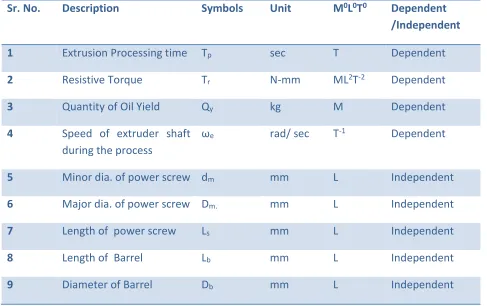
Table 1: Identification of Variables for Oil Expeller.
Sr. No. Description Symbols Unit M0L0T0 Dependent
/Independent
1 Extrusion Processing time Tp sec T Dependent
2 Resistive Torque Tr N-mm ML2T-2 Dependent
3 Quantity of Oil Yield Qy kg M Dependent
4 Speed of extruder shaft
during the process
ωe rad/ sec T-1 Dependent
5 Minor dia. of power screw dm mm L Independent
6 Major dia. of power screw Dm. mm L Independent
7 Length of power screw Ls mm L Independent
8 Length of Barrel Lb mm L Independent
Available Online at www.ijpret.com 35
10 Pitch of Helix P mm L Independent
11 Thickness of screw ts mm L Independent
12 Helix angle Ѳ Degree M0L0T0 Independent
13 Average diameter of oil
seed
Ds mm L Independent
14 Volume of the hopper Vh mm3 L3 Independent
15 Young modulus of
elasticity of Material
(seeds)
Es N/mm2 ML-1T-2 Independent
16 Young modulus of
elasticity of power screw shaft
Ep N/mm2 ML-1T-2 Independent
17 Quantity of seeds
admitted
Qs kg M Independent
18 Kinetic Energy of flywheel Kf N-mm ML2T-2 Independent
19 Angular speed of flywheel ωf rad/ sec T-1 Independent
20 Acceleration due to
gravity
g mm/sec2 LT-2 Independent
21 No. of screw shaft n M0L0T0 Independent
22 Gear ratio G M0L0T0 Independent
23 Time required to speed
up the flywheel
Available Online at www.ijpret.com 36 M, L and T are the symbols for mass, length and time respectively. Applying Buckingham π theorem the dimensional equations for Extrusion Processing Time, Resistive Torque, Quantity of Oil Yield and Speed of Extruder Shaft during the process are formulated as under [10].
Extrusion Processing Time (Tp)
Tp√ g
Ds=
f1{(dm
Ds) (
Dm
Ds) (
LS
Ds) (
Lb
Ds) (
Db
Ds) (
P Ds) (
ts
Ds) (Ѳ) (
Vh
Ds3) (
Es
Ep) (
g.Qm
Ep.Ds2) (
Kf
Ep.Ds3) (ωf√
Ds
𝑔) (n)(G) (tf√ g Ds)}
Tp√ g
Ds= f1{[(
dm .Dm.LS.Lb.Db.P.ts
Ds7 ) θ] (
Vh
Ds3) (
Es
Ep) (
g.Qm
Ep.Ds2) (
Kf
Ep.Ds3) (ωf√
Ds
𝑔) (n)(G) (tf√ g Ds)}
..(5.21)
Resistive Torque (Tr)
Tr
Ep.Ds3 =
f1{(dm
Ds) (
Dm
Ds) (
LS
Ds) (
Lb
Ds) (
Db
Ds) (
P Ds) (
ts
Ds) (Ѳ) (
Vh
Ds3) (
Es
Ep) (
g.Qm
Ep.Ds2) (
Kf
Ep.Ds3) (ωf√
Ds
𝑔) (n)(G) (tf√ g Ds)}
Tr
Ep.Ds3 = f1{[(
dm .Dm.LS.Lb.Db.P.ts
Ds7 ) θ] (
Vh
Ds3) (
Es
Ep) (
g.Qm
Ep.Ds2) (
Kf
Ep.Ds3) (ωf√
Ds
𝑔) (n)(G) (tf√ g Ds)}
..(5.22)
Quantity of Oil Yield (Qy)
g.Qy
Ep.Ds2 =
f1{( dm
Ds) (
Dm
Ds) (
LS
Ds) (
Lb
Ds) (
Db
Ds) (
P Ds) (
ts
Ds) (Ѳ) (
Vh
Ds3) (
Es
Ep) (
g.Qm
Ep.Ds2) (
Kf
Ep.Ds3) (ωf√
Ds
𝑔) (n)(G) (tf√ g Ds)}
g.Qy
Ep.Ds2 = f1{[(
dm .Dm.LS.Lb.Db.P.ts
Ds7 ) θ] (
Vh
Ds3) (
Es
Ep) (
g.Qm
Ep.Ds2) (
Kf
Ep.Ds3) (ωf√
Ds
𝑔) (n)(G) (tf√ g Ds)}
Available Online at www.ijpret.com 37
Speed of extruder during the process (ωe)
ωe√Dgs=
f1{(dm
Ds) (
Dm
Ds) (
LS
Ds) (
Lb
Ds) (
Db
Ds) (
P Ds) (
ts
Ds) (Ѳ) (
Vh
Ds3) (
Es
Ep) (
g.Qm
Ep.Ds2) (
Kf
Ep.Ds3) (ωf√
Ds
𝑔) (n)(G) (tf√ g Ds)}
ωe√ Ds
g = f1{[(
dm .Dm.LS.Lb.Db.P.ts
Ds7 ) θ] (
Vh
Ds3) (
Es
Ep) (
g.Qm
Ep.Ds2) (
Kf
Ep.Ds3) (ωf√
Ds
𝑔) (n)(G) (tf√ g Ds)}
..(5.24)
6. RESULT AND DISCUSSIONS
Empirical models to predict the performance of the manually driven oil expeller machine to extrude the oil were established and optimum values of various parameters were arrived at on the basis of experiments involving the human energized oil expeller machine system. A new theory of oil expeller powered by human powered flywheel motor is proposed. Extrusion Processing time (Tp), Resistive Torque (Tr), Quantity of oil yield (Qy), Speed of extruder during
the process (ωe) are the function of all independent parameters.
This Flywheel motor is applied to brick making, low head water pumping and wood turning the performance is found to be functionally satisfactory and economically viable the wheel motor can be used as an energy source for process unit that need have continuous operation and have a upper limit of about 3h.p.
The pedal energized oil expeller machine was developed. The development of the Oil Expeller we can say that the design must be efficient and low in cost. The efficient use of human muscle power through pedal drive systems constitutes a useful alternative to other power sources for oil extrusion process. Future consideration of the 'human-scale' technology involved in these applications could be of great benefit to developing countries.
Available Online at www.ijpret.com 38
6. REFERENCES
1. Zakiuddin Syed Kazi1, Jayant P.Modak2, Design and Development of the Human Energized
Chaff Cutter, New York Science Journal, 2010, (104-108).
2. Gupta, J. K. and others. 1997, Design proposals for a new type of clutches essential for process machines with manually energized flywheel motor as an energy source , Proceedings, Mechanic Transmission and Mechanisms (MTM 97) organized by University of Tianjin, China. July1–4, pp. 383–388.
3. Oil World 31 August, 2001 as quoted in http:www.fcamin.nic.in/sugar.edbl.htm
4. Mrema G C, McNulty P B. 1985,Mathematical model of mechanical oil expression from oilseeds, Journal Agricultural Engineering Research, 31(5):361-370
5. Modak J, Bapat A., Design of experimentation for establishing generalized experimental model for a manually driven flywheel motor, Proc. International Conference on Modeling and Simulation. New Delhi, India. 1987 8(2): 127-140.
6. Modak J, Bapat A, Formulation of Generalized Experimental Model for a Manually Driven Flywheel Motor and its Optimization, Applied Ergonomics. 1994 25 (2): 119-122.
7. Modak J, Moghe S, Comparison of some bicycle drive mechanisms designed in the light of transmission angle optimization and J. Papadopoulos Hypothesis, Part II., International Symposium on Machines and Mechanisms (ISMM '97), September 2-5, 1997.
8. Schenck H. Reduction of variables Dimensional analysis. Theories of Engineering Experimentation Publisher Mc Graw Hill Book Co., New York, USA. 1961:60-64.
9. Schenck H. Experimentation as subject of study. Theories of Engineering Experimentation. Publisher Mc Graw Hill Book Co., New York, USA. 1961:6
10. Modak J, Tatwawadi V, Modelling of an industrial enterprise using a feedback control system’s approach, Modelling, Measurement and Control Series, D. 2006; 27(1):35-36

![SORPTION STUDY OF URANIUM (VI) IN ALANINE MEDIUM USING POLY [DIBENZO 18 CROWN 6] AND COLUMN CHROMATOGRAPHY](data:image/gif;base64,R0lGODlhAQABAIAAAP///wAAACH5BAEAAAAALAAAAAABAAEAAAICRAEAOw==)