ISSN:2278 7496
NEW ANALYTICAL METHOD DEVELOPMENT AND VALIDATION FOR
ESTIMATION OF DOLUTEGRAVIR SODIUM IN SYNTHETIC MIXTURE BY
USING RP-HPLC
Shalini*, Pushpendra Soni, Lavakesh Kumar Omray Radharaman Institute of Pharmaceutical Sciences, Bhopal *Corresponding Author’s E mail: [email protected]
Received 21 August 2012; Revised 27 August 2018; Accepted 12 Sept. 2018, Available online 15 October 2018
ABSTRACT
A novel isocratic reversed phase high performance liquid chromatographic method was developed and validated for the determination of human immune deficiency virus drug Dolutegravir (DGV) present in formulation known as Instgra which consists 50 mg of DGV. Chromatographic separation achieved isocratically on thermo C18 column (5μm, 150mm x 4.60mm) and acetonitrile: methanol in the ratio of 50:50 (v/v) as the mobile phase, at a flow rate of 1 ml/min. Detection was carried out at 264 nm. The retention times for DGV was found to be 4.274 ± 0.3 min. Parameters such as linearity, precision, accuracy, recovery, specificity and ruggedness are studied as reported in the ICH guidelines. The method was linear in the concentration range of 5-25 μg/ml with correlation coefficient of 0.999. The mean recoveries obtained for DGV 99.71% and RSD was less than 2. The correlation coefficients for all components are close to 1. Developed method was found to be novel, accurate, precise, selective and rapid for estimation of DGV.
Keywords: RP-HPLC, Dolutegravi, Method development, Validation.
INTRODUCTION
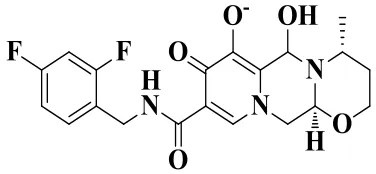
Dolutegravir (DGV, S/GSK-1349572, Fig. 1) chemically known as (4R,12aS)-9-{[(2,4-difluorophenyl)
methyl] carbamoyl}-4-methyl-6,8-dioxo-3,4,6,8,12,12ahexahydro-2H- pyrido [1`,2`:4,5] pyrazino [2,1-
b][1,3]oxazol-7-olate. Its molecular formula is C20H18F2N3O5 and molecular weight is 441.36. DGV is a
newly developed human immunodeficiency virus (HIV) integrase inhibitor from ViiV Healthcare
(Research Triangle Park, NC, USA). DGV is an integrase strand transfer inhibitor (INSTI) that does not
require ritonavir for cytochrome P450 3A4 inhibition and preferentially blocks the strand transfer step
of integration of the viral genome into the host cell’s DNA1, which is a two-step process mediated by the
viral integrase enzyme. Like the other approved INSTIs raltegravir (RAL) and elvitegravir (EVG), DGV
inhibits the binding of the integrase-viral DNA complex to host cell DNA by chelating Mg2+ions in the
active site 2. Once integration is blocked, HIV-1 cans no longer replicate, and the viral replication cycle
is interrupted. In phase II trials, DGV has been shown to be highly effective at rapidly decreasing viral
burden, with a concomitant increase in CD4+ cell count, in treatment-naïve patients receiving 10, 25 or
50 mg once-daily along with a nucleoside reverse transcriptase inhibitor (NRTI) background 3. Moreover,
when the DGV dosing groups were compared to the 600 mg efavirenz (EFV) dose group, the response
was more rapid for all DTG groups. Phase III studies in treatment-naïve subjects demonstrate that DTG
has sustained antiviral activity comparable to standard of care in combination with dual NRTIs 4,5. DGV
was also shown to be superior to RAL as part of a combination regimen in treatment-experienced,
integrase inhibitor-naïve subjects 6. In addition, DGV has been shown to retain in vitro activity against a
large variety of viral phenol types no longer susceptible to RAL7. This translates into in clinical data
demonstrating DGV’s activity in subjects with resistance to RAL 8.DGV has been well tolerated in Phase
III studies with a low incidence of discontinuation due to adverse events 4-6. The most common adverse
events of moderate to severe intensity in these trials were insomnia and headache. Additional studies to
investigate the metabolism and disposition of DGV indicate the primary route of metabolism is
glucuronidation via UDP-glucuronosyl transferase1A1 (UGT1A1), without induction or inhibition of
cytochromeP450 enzymes 9, 10. Since DGV will be administered as part of a multi-drug regimen, the lack
of significant interactions with other antiretroviral agents is clinically advantageous. INSTIs are the
newest class of anti retrovirals (ARVs) demonstrating potent anti-HIV activity. With DGV retaining
activity in a variety of INSTI resistant phenotypes, having an excellent safety and tolerability profile and
predictable pharmacokinetic (PK) profile with low to moderate inter-subject variability, it has the
potential for treatment-experienced patients, but also holds promise to become a first-line antiretroviral
agent, and will likely become a commonly used component of antiviral regimens.
Figure 1 Chemical structure of Dolutegravir
In literature, various methods are available for determination of DGV in human plasma by HPLC 11, for
combined formulated dosage form quantification HPLC methods 12-13, for pure dosage form by HPTLC
and HPLC 14, Bhavar et al. published in 2015, UV Spectroscopic method for tablets forms 15. In the
present work, we are therefore focused on to achieve the optimum chromatographic conditions for the
determination of DGV in a formulation. The developed method could be applied to quality control of the
tablet dosage form. To access the reproducibility and wide applicability of the developed method, it was
MATERIALS AND METHODS
Instrument
Liquid chromatographic system from Waters model no 784 comprising of manual injector, water 515
binary pump for constant flow and constant pressure delivery and UV-Visible detector connected to
software Data Ace for controlling the instrumentation as well as processing the generated data.
Reagents and chemicals
Dolutegravir were obtained as pure sample from Emcure Pharmaceutical Industries Ltd. Pune, as gift
samples along with their analytical reports. HPLC grade methanol and acetonitrile was obtained from
Merck (India) limited. All other chemical used were of analytical grade. Triple distilled water was used
for whole experiment was generated in house. Tablet Instgra 50mg Emcure Pvt. Ltd. Pune, India was
purchased from local market.
Chromatographic conditions
The isocratic mobile phase consisted of methanol: acetonitrile in the ratio of (50:50 v/v), flowing through
the column at a constant flow rate of 1.0 ml/ min. The mobile phase was filtered through nylon 0.22 µm
membrane filters and was degassed before use (30 min).A Thermo (C-18) Column (5 µm, 250mm x
4.60mm) was used as the stationary phase. By considering the chromatographic parameter, sensitivity
and selectivity of method for drugs, 256 nm was selected as the detection wavelength for UV-Visible
detector.
Standard preparation
Standard stock solution
Accurately weighed 10 mg of DGV was transferred into 10 ml volumetric flask, dissolved in 5ml of
methanol and volume was made up to 10ml with methanol to get concentration of solution 1000 g/ml
(Stock-A), 5ml of stock-A was taken and diluted up to 50ml to get concentration of 100g/ml (Stock-B).
Working standard solution
Sample preparation
Commercial formulations dolutegravir of Instgra was selected for analysis. Twenty tablets of instgra
were weighed and powdered separately. Weight equivalent to 50 mg dolutegravir was dissolved in 50 ml
diluents and then sonicated for 15min. and filtered through watmann paper no. 41. Then different
concentration of solution were prepared by serial dilution technique, as per standard and each dilution
was analyzed.
Results and discussion
Chromatography
The mobile phase was chosen after several trials with methanol, isopropyl alcohol, acetonitrile, water,
and buffer solutions in various proportions and at different pH values. A mobile phase consisting of
acetonitrile/ methanol (50:50, v/v) was selected to achieve maximum separation and sensitivity. Flow
rates between 0.5 and 1.5 min were studied. A flow rate of 1 ml/min gave an optimal signal-to-noise ratio
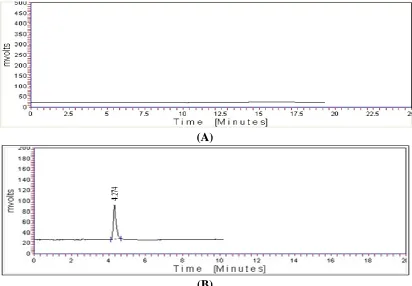
with a reasonable separation time. Using a reversed-phase C18 column, the retention times for DGV was
observed to be 4.274± 0.03 min. Total time of analysis was less than 6 min. The maximum absorption of
DGV was detected at 264 nm, and this wavelength was chosen for the analysis Fig. 2.
(A)
(B)
System suitability
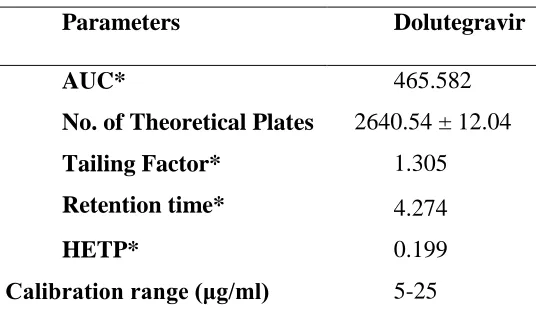
System suitability parameters such as number of theoretical plates, HETP, and peak tailing are
determined. The results obtained are shown in Table 1. The number of theoretical plates for DGV was
2640.54.
Table 1 Results of system suitability parameters
Parameters Dolutegravir
AUC* 465.582
No. of Theoretical Plates 2640.54 ± 12.04
Tailing Factor* 1.305
Retention time* 4.274
HETP* 0.199
Calibration range (μg/ml) 5-25
*Each value is the mean ± SD of six determinations
Linearity
The calibration curve was linear over the concentration range of 5-25 μg/ml for DGV. The linearity was
represented by a linear regression equation as follows:
Y (TRZ) = 42.73 conc. + 14.01(r2 = 0.999)
Detection Limit and Quantitation Limit
The LOD and LOQ of developed method were calculated based on the standard deviation of response
and slope of the linearity curve table 2.
Table 2 LOD and LOQ
Name LOD
(g/ml)
LOQ (g/ml)
Accuracy
Method accuracy was performed by adding known amounts of DGV to the preanalysed synthetic mixture
solution and then comparing the added concentration with the found concentration. Three levels of
solutions were made which correspond to 80%, 100%, and 120% of the nominal analytical concentration
(10μg/ml for DGV). Each level was made in triplicate table 2. The mean percentage recoveries obtained
for DGV was 99.78%, respectively, and RSD was less than 3.
Table 3: Results of recovery study
Statistical data Dolutegravir
80% 100% 120%
% Mean* 98.77 99.71 98.90
SD* 0.29 0.091 0.174
%R.S.D*. 0.29 0.092 0.176
*Mean of nine determinations (three replicates at three concentration level)
Precision
Repeatability
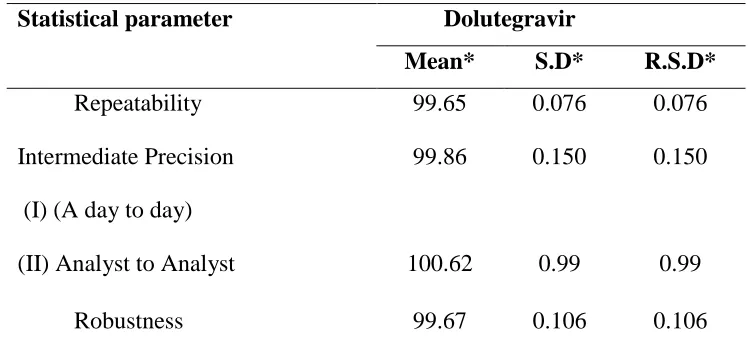
Five dilutions in three replicates were analyzed in the same day for repeatability and results were found
within acceptable limits (RSD < 2) as shown in table 3.
Intermediate precision
Five dilutions in three replicates were analyzed on two different days and by two analysts for day-to-day
and analyst-to-analyst variations, and results were found within acceptable limits (RSD < 2) as shown in
Table4 Statistical data for precision
Statistical parameter Dolutegravir
Mean* S.D* R.S.D*
Repeatability 99.65 0.076 0.076
Intermediate Precision
(I) (A day to day)
99.86 0.150 0.150
(II) Analyst to Analyst 100.62 0.99 0.99
Robustness 99.67 0.106 0.106
*Mean of 15 determinations (three replicates at five concentration level)
Robustness
As per ICH norms, small, but deliberate variations in concentration of the mobile phase were made to
check the method’s capacity to remain unaffected. The ratio of mobile phase was chain from, Methanol:
ACN (50:50% V/V), to (55: 45% V/V) and method is found robust as RSD is again found < 2.0 table 4.
Specificity and selectivity
Commonly used excipients were spiked in to a preweighed quantity of drugs. The chromatogram was
taken by appropriate dilution and the quantities of drug were determined. The specificity of the HPLC
method is illustrated in Fig. 3. Where complete separation of DGV in presence of tablet excipients.
Analysis of Tablets
The concentration of DGV in the tablet formulation was found to be 99.95%. The low values of % RSD
indicate that the method is precise and accurate in table 5.
Table 5 Results of tablet analysis
S.NO. Parameter Sample
Dolutegravir
1 % Found 99.95
2 S.D. 0.123
3 % R.S.D. 0.256
4 SE* 0.230
* Mean of nine determinations
Conclusion
The proposed HPLC method was validated as per the International Conference on Harmonisation (ICH)
Q2B Guidelines, and was found to be applicable for routine quantitative analysis of Dolutegravir by
HPLC in pharmaceutical dosage form. The results of linearity, precision, accuracy and specificity, were
proved to be within the limits. The method provides selective quantification of trazodone hydrochloride
with no interference from other formulation excipients. The proposed method was highly reproducible,
reliable, rapid, robust and specific. Therefore, a high percentage of recovery and the run time of less than
six minutes allow its application for the routine determination of DGV in the tablet dosage form.
References
1. Pommier Y, Johnson A and Marchland C. Nat. Rev. Drug Discov. 2005; 4: 236.
2. Katlama C and Murphy R. Opin. Investig. Drugs. 2012; 21: 523.
3. van Lunzen J, Maggiolo F, Arribas R, Rakhmanova A, Yeni P, Young B, Rockstroh J, Almond S,
Song I, Brothers C and Min S. Lancet Infect. Dis. 2012; 12: 111.
5. Walmsley S et al., Dolutegravir abacavir/lamivudineonce daily statistically superior to
tenofovir/emtricitabine/efavirenz: 52nd Interscience Conference on AntimicrobialAgents and
Chemotherapy, San Francisco, 2012 (abstract H-556b).
6. Cahn P, Pozniak AL, Mingrone H, Khuldyakov A, Brites C, Andrade-Villanueva JF, Richmond G,
Buendia CB, Fourie J, Ramgopal M, Hagins D, Felizarta F, Madruga J, Reuter T, Newman T, Small
CB, Lombaard J, Grinsztejn B, Dorey D, Underwood M, Griffith S and Min S. on behalf of the
extended SAILING Study Team, Lancet. 2013.
7. Underwood R, Johns B, Sato A, Martin J, Deeks S, Fujiwara T and Acquir J. Immune Defic. Syndr.
2012; 61 297.
8. Eron JJ, Clotet B, Durant J, Katlama C, Kumar P, Lazzarin A, Poizot-Martin I, Richmond G,
Soriano V, Ait-Khaled M, Fujiwara T, Huang J, Min S, Vavro C and Yeo J. J. Infect. Dis. 2013;
207: 740.
9. Reese MJ, Savina PM, Generaux GT, Tracy, Humphreys JE, Kanaoka E, Webster LO, Harmon KA,
Clarke JD and Polli JW. Drug Metab. Dispos. 2013; 41: 353.
10.Castellino S, Moss L, Wagner D, Borland J, Song I, Shuguang C, Lou Y, Min SS, Goljer I, Culp A,
Piscitelli SC and Savina PM. Antimicrob Agents Chemother. 2013.
11.Satyadev T NVSS, Bhargavi Ch and Syam Sundar B. Development and validation of high
performance liquid chromatographic method for the determination of Dolutegravir in human
plasma. Der Pharmacia Sinica. 2015; 6 (4): 65 -72.
12.MallikarjunaRao N and Gowrisankar D. Development and validation of stability-indicating HPLC
method for simultaneous determination of Lamivudine, Tenofovir and Dolutegravir in bulk and
their tablet dosage form.Future Journal of Pharmaceutical Sciences. 2015; 1 (2): 73-77.
13.Khaleel N, Abdulrahaman SK and Gowrisankar D. A validated stability indicating RP-HPLC
Method for simultaneous determination of abacavir, lamivudine and dolutegravir in bulk and
pharmaceutical dosage form. World Journal of Pharmaceutical Research. 2015; 4(7): 1453-1476.
14.Girija BB, Sanjay SP, Kiran BA, Ravindra ST and Sanjay RC. High-Performance Liquid
Chromatographic and High-Performance Thin-Layer Chromatographic Method for the Quantitative
Estimation of Dolutegravir Sodium in Bulk Drug and Pharmaceutical Dosage Form. Sci Pharm.
15.Girija BB, Kiran BA, Ravindra ST, Kakadsachin J and Sanjay SP. Development and validation of
UV spectrophotometric method for estimation of dolutegravir sodium in tablet dosage form. Sci
Pharm. 2015; 19(6): 1156-1163.
16.Code Q2 (R1) -Text on Validation of Analytical Procedures: Text and Methodology Current Step