Nuclear contribution into single-event
upset in 3D on-board electronics at
moderate energy cosmic proton impact
N. G. Chechenin, T. V. Chuvilskaya and A. A. Shirokova
Skobeltsyn Institute of Nuclear Physics, Moscow State University, Moscow, 119991 Russia
Abstract
In continuation and development of our previous works where nu-clear reactions of moderate energy (10 – 400 MeV) protons with Si, Al and W have been investigated, the results of reactions with Cu are re-ported in this paper. Cu is a most important component in composition of materials in contact pads and pathways of modern and perspective ultra large-scale integration circuitry, especially in 3D topology.
It is impossible to imagine a modern spacecraft without electronic in-tegrated schemes with connecting and contact paths and areas, inter-layer conducting connections, and other metallic components. Such interior com-ponents normally have a high concentration of Al, Fe, Ni, Cu, Mo, Ta, W, Pt, Au, and other chemical elements.
them, which make it possible to compensate for missing nuclear data. Unfortunately, the presence of heavy elements is disregarded in the majority of the calculations, and this of course impairs the reliability of the respective forecasts. The results of our present calculations make it possible to fill this gap.
Special features of silicon fragmentation induced by high-energy cosmic-ray protons were explored in previous studies of our group [3–6]. In [5], it was shown that the results of the calculations performed on the basis of the reaction model according to the EMPIRE code are sensitive to the choice of values for the parameters of the optical-model potential. In the present article, the results obtained by calculating for the28Si + p, 27Al + p and183W + p nuclear reactions, the cross-sections for elastic and inelastic scattering and the charge, mass, and energy distributions of heavy reaction products according to the TALYS [7] codes are supplemented with the results of the calculations for the same features of the63Cu + p reaction.
The idea to create computer codes that would provide a simultaneous description of many nuclear reaction channels as precise as the most de-tailed description of only one or several reaction channels is not new. Such codes known to date include the GNASH [8], ALICE [9], STAPRE [10] and EMPIRE [11] ones.
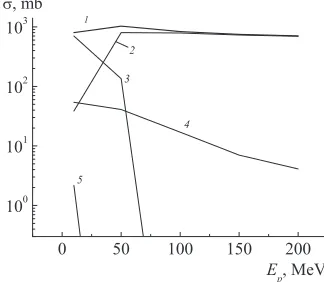
Figure 1: Cross-sections for nuclear processes,σ(Ep), in the interaction of protons with a63Cu nucleus. The curves represent the contributions of (1) inelastic nuclear processes, (2) pre-equilibrium processes, (3) processes leading to compound-nucleus formation, (4) direct nuclear reactions and (5) elastic nuclear processes.
Elastic scattering of protons from a target nucleus with a transfer of a re-coil energy to this nucleus is not the most probable mechanism of formation of recoil nuclei. Fig. 1 shows the calculated contributions of the dominant nuclear mechanisms, σ(Ep), in the p+63Cu reaction at proton energies be-tween 10 and 200 MeV. The flux of space protons is strongest in this energy region [12]. The TALYS code package was used in this calculation. Without going into details of the formalism used, we note only that elastic proton scattering from 63Cu nucleus is severely suppressed by competing inelastic nuclear processes (curve 1). The degree of suppression is such that we can disregard elastic scattering. The probability of direct nuclear reactions is somewhat higher (curve 4). They include the direct knockout and pickup of nucleons from the target nucleus without excitation of the residual nu-cleus. Fig. 1 shows that, in the region of proton energies below 100 MeV, a significant contribution comes from reactions involving the production of a compound nucleus (curve 3); at energies below 50 MeV, these reactions are dominant. As the proton energy becomes higher, the compound-nucleus mechanism gives way to the competing mechanism of pre-equilibrium pro-cesses (curve 2).
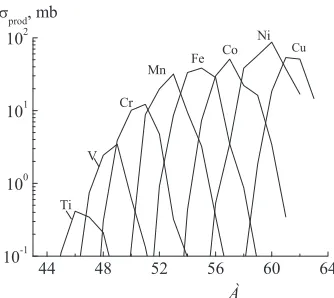
Figure 2: Cross-section for the production of residual nuclei,σprod(A) (mass spec-trum), in the interaction of protons with a 63Cu nucleus at the proton energy of
Ep= 150 MeV.
the production of electron-hole pairs upon medium-atom ionization induced by nuclear fragments is of many orders of magnitude more vigorous than that in the case of primary protons.
Figure 3: Recoil-energy spectraσr(Er) of the isotope53Mn produced in the63Cu(p, 5p6n)53Mn reaction versus the product energy at the proton-energy values ofEp= 100 (dashed curves), 150 (thin solid curves), and 240 MeV (thick solid curves).
several neutrons. The lower isotope Z-value, the larger number of protons is to be emitted and, hence, the lower cross-section, because of lower pene-trability of the Coulomb barrier with de-excitation of the emitting nucleus. The neutron emission becomes dominating in the pre-equilibrium processes. Thus, V and Ti isotopes are produced with sharply smaller cross-sections.
The kinetic energy distribution of residual nuclei is also of great im-portance for possible radiation effects in the onboard spacecraft electronics. In Fig. 3 the energy spectra σr(Er) are shown of 53Mn residual nucleus produced in the p+63Cu nuclear reaction for the incident proton energy
Ep = 100 (dashed curve), 150 (thin solid curve), and 240 MeV (thick solid
curve). This figure shows that the region of kinetic energies of residual nu-cleus depends both on the incident proton energy and on the mass of the target nucleus. The maximum kinetic energy is observed for the residual nucleus 53Mn at Ep = 240 MeV. Our calculations have revealed that the recoil energy of residual nuclei may be as high as 1 to 3 MeV, depending on the projectile-proton energy.
[5] Chechenin N. G., Chuvilskaya T. V., Shirokova A. A., Kadmenskii A. G.,Bull. Russ. Acad. Sci. Phys.,74(2010) 1595.
[6] Chechenin N.G., Chuvilskaya T. V., Shirokova A. A., Kadmenskii A. G.,Phys. Atom. Nucl.,78 (2015) 159.
[7] Koning A. J., Hilaire S. et al.,TALYS-1.2: A nuclear reaction program
(User manual, Netherlands, NRG, 2009).
[8] Young P. G., Arthur E. D. and Chadwick M. B., in Proceedings of the Workshop on Computation and Analysis of Nuclear Data Relevant to Nuclear Energy and Safety, edited by Mehta M. K. and Schmidt J. J., Trieste, Italy, 1993 p. 662.
[9] Blann M., in Proceedings of the Workshop on Computation and Anal-ysis of Nuclear Data Relevant to Nuclear Energy and Safety, edited by Mehta M. K. and Schmidt J. J., Trieste, Italy, 1993 p. 622.
[10] Uhl M. and Strohmaier B., IRK report No. 76/01 Vienna, 1976.
[11] Herman M., inProceedings of the Workshop on Nuclear Reaction Data and Nuclear Reactors: Physics, Design and Safety, edited by Paver N., Herman M. and Gandini A., Triest, Italy, 2001 p. 137.