Available Online at www.ijpret.com 814
INTERNATIONAL JOURNAL OF PURE AND
APPLIED RESEARCH IN ENGINEERING AND
TECHNOLOGY
A PATH FOR HORIZING YOUR INNOVATIVE WORK
LOW COST WIRELESS HOME SECURITY SYSTEM USING RASPBERRY PI
ADARSH SAWANT1, DATTARAJ NAIK1, VANDYK AMSDEN FERNANDES1, VIREN PEREIRA2
1.Dept. of Electronics & Telecommunication Engineering, , Shree Rayeshwar Institute of Engineering & Information Technology, Shiroda – Goa, India.
2.Dept. of General Engineering, Shree Rayeshwar Institute of Engineering & Information Technology, Shiroda - Goa – India.
Accepted Date: 05/03/2015; Published Date: 01/05/2015
\
Abstract: Home security is the most debated issue in recent times maybe from fire, Gas leakage or burglary to name a few. There are many things an average homeowner could do to prevent this but most of this precautions can become pricey. There are various systems that are available in the market today but for an average human it does not provide a cost effective solution. While providing a cost effective solution one should also provide an effective system. Use of wireless technology also increases the costs. Our system makes use of RF (Radio Frequency) communication technique which is mostly preferred and low cost solution. Our system also includes Raspberry Pi as server around which the security network is built. The user entry is controlled by the code locked attached to the Raspberry Pi on entering the Pass code. It also gathers data from various sensors like LPG gas, PIR, vibration and a smoke sensor connected around the house and depending on whether there is an intruder or gas leakage or fire, and sends an alarm to the user via email or android app and SMS via SMS gateway. It also sends the picture of the area during the alarm via email. It also gives the user to view the visitors through spy camera attached to the Raspberry Pi. The proposed system provides high end security against theft and helps distant user to communicate with the visitor at the door. This is the key feature of the system that is it can be controlled remotely through an android application or web interface. In the second option visitors can make a request to the user to open the door for him, the user upon receiving the notification through email and app and also by receiving a call via VoIP from the visitor will decide remotely whether or not to open the door using the camera feed on web interface or android app. The app and web interface also bears the user name and password without which the access to the system is denied thus making it secure. Also Raspberry Pi is Linux based as a result highly free from viruses and attacks compared to other systems.
Keywords: Raspberry Pi; Radio Frequency; Wireless; Open source; Automation; Home Security; Internet of Things
Corresponding Author: MR. ADARSH SAWANT
Access Online On:
www.ijpret.com
How to Cite This Article:
Adarsh Sawant, IJPRET, 2015; Volume 3 (9): 814-821
Available Online at www.ijpret.com 815
INTRODUCTION
Nowadays theft is on rise. So there is an endeavor to build a security system which will effectively manage this issue keeping user away from fear about his home security in all cases. The security of one's belongings when a person leaves his/her house is always a concern with increasing number of incidents of theft, robbery etc. Many automated systems has been developed which informs the owner in a remote location about any intrusion or attempt to intrude in the house. 8051 has been extensively used in past projects [3]. Whenever the user is away from his home for some reason, it happens sometimes that he is left unconnected with people who visit his place. These visitors may be known or unknown to user. If known, the visitor must be allowed to enter the home. For this the proposed security system consists of a sensor such as the “PIR sensor” which detects the presence of human appearance which will notify the user and will lead to blinking of two different options on code lock module interfaced to an 20 x 4 LCD for the user to select option 1 or 2.
1. To enter the home by entering the password on the code lock module.
2. Request the user to grant access to his house.
When user enters password using code lock system and if it is correct he will be allowed to enter the home. For other visitors to enter they should choose the second option which will notify the user via email, app and SMS and also make a call to the user’s phone via VoIP, here we use application called XLITE. The user can view the visitor through the camera feed and decide upon whether or not to grant access to the visitor to his house.
Available Online at www.ijpret.com 816 Project Descriptiion
o Raspberry Pi
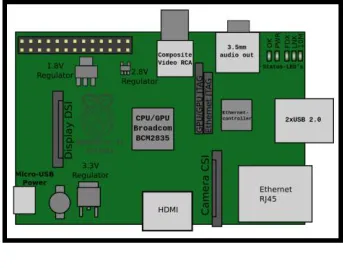
Lots of components are available in the market today. Use of Raspberry Pi in our project has made it more cost effective solution. Raspberry Pi is a small device, is an open source and is flexible platform for experimentation and fun. Since it is an open source, changes can be made to it as and when required. It is a Linux based board. One can install various different free software’s for different purposes.
Figure 1. Overview of Raspberry Pi
The board has Broadcom BCM2835 on chip which includes an ARM1176JZF-S. This chip is 32 bit, 700 MHz System on a Chip which is built on the ARM11 architecture. It has Video Core IV GPU, and was originally shipped with 256 megabytes of RAM, later upgraded to 512 MB [1]. It does not have storage drive but uses SD card for booting and long term storage, external storage devices can be added through the USB ports. The Raspberry Pi runs on Raspbian OS and is programmed using C Programming language and Python 2.7.6, which is an open source [2].
Raspberry Pi is also connected to an USB camera which is used as a spy camera. raspistill- o image.jpg
Available Online at www.ijpret.com 817
o Code Lock
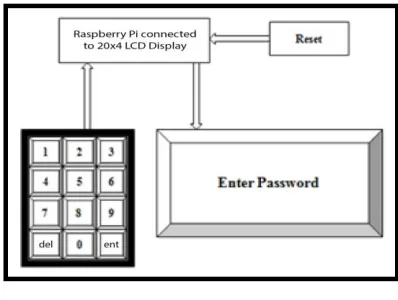
The code lock module consists of Raspberry Pi connected to LCD Display 20x4 in size and 4x3 matrix keypad. The code lock module will ask for password when first option is selected. The code will be an eight digit number which can be reset by the user whenever obligate. The matrix keypad is used to enter the password and the LCD is used to evince the requisite information. Here the keypad and a LCD code are used as input & output devices, respectively. An eight digit predefined password needs to be specified by the user and stored in the system. While unlocking if the entered password from keypad matches with the stored password, then the lock opens and a message is displayed on LCD.
As the program starts, string ‘Enter Password’ is displayed on LCD .The keypad is scanned for pressed digits one by one. Every time, row and column of the key pressed is detected and a ‘particular number’ is displayed on LCD corresponding to the entered number. After the four digits are entered, they are compared with the pre-set password. If all the eight digits match with set password, LCD displays ‘Lock Open’ and opens the door. If the security code is wrong, ‘Wrong Password’ is sent to be displayed on LCD. The system gets locked if more than three attempts are made with wrong password to open the electronic lock.
Figure 2. Code Lock Module
o RF Transmitter and Receiver Module
Available Online at www.ijpret.com 818
Transmitter and Receiver modules. In these modules digital data is represented by different amplitudes of the carrier wave, hence this modulation is known as Amplitude Shift Keying (ASK). The sensor data will be transmitted using these RF Transmitter to the receiver connected to the Raspberry Pi.
Working
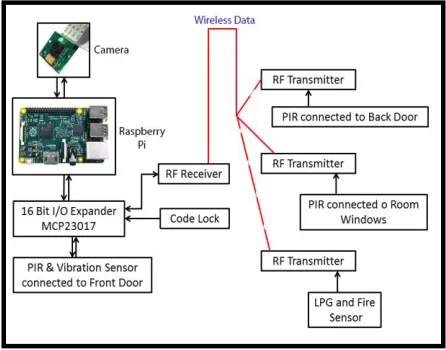
Figure 3. Block Diagram
The block diagram shown in Figure consists of Raspberry Pi which is used as web server and connected to it via 16bit I/O Expander MCP23017 are the code lock module, the 20x4 LCD display, RF Receiver connected to serial UART pins, PIR and vibration sensor of the main door and the control pin of doors stepper motor via the L293D motor driver IC and also a camera is interfaced with the system. The other wireless sensors are connected in kitchen and the windows and back door using the RF transmitter and send data serially to the raspberry Pi along with its ID which will trigger the Alarm or take desired decision depending on the input it receives from the sensors. The raspberry pi must be connected to internet for remote application.
Available Online at www.ijpret.com 819
along with timestamp. The user on his app also has the option to view the live video feed so after recognizing the visitor he can choose whether or not to open the lock for him. If an intruder tries to break in the door the vibration sensor will be activated, and go high and send an alarm to the user via email, app and SMS notification. It will also send email and SMS to the Police station. Similarly, In case of fire detection, it will send user a notification and also to the fire station.
RESULTS & DISCUSSION
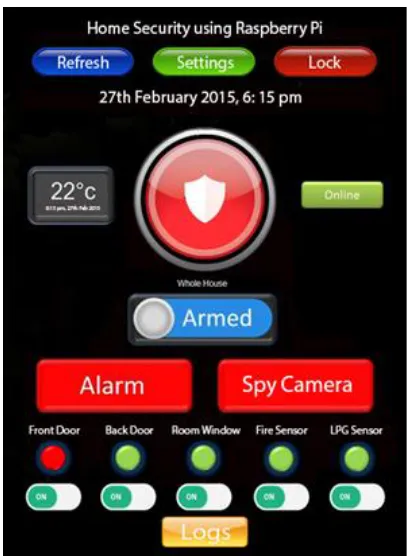
Above figure shows the snapshot of the Android application developed for wireless control of the home security network. Similar web interface was also developed. The user having the permissions to the app can manually arm or disarm the home security remotely.
Also provided are the individual controls for each sensor in the network through which one can
turn on or off a particular sensor.
Figure 4. Snapshot of Android App
Available Online at www.ijpret.com 820
which he can access through the Logs button. The app is password protected and thus provides security. The above snapshot was taken when there was a breach in the front door thus at the bottom displaying the red icon notification for front door and also and alarm rings and turns security icon red. So one can easily identify where exactly there is a breach in security.
The range of the RF modules although is 100 meters, it provided best results till 80 meters range. The 16 bit I/O Expansion to the Raspberry Pi allowed us to interface more hardware to the Raspberry Pi module. To configure dynamic IP address for PI over the network, application called No-IP was used as public IP tends to change every now and then on account of restart or at particular amount of time which was taken care by No-IP. The security system compared to others in the market is quite cheap and secured. Also provided with the app is a manual Alarm button for the user through which he will get 2 options to either notify the Police or Fire Alarm within the app on account of any suspicion. The user could add more sensors through the settings option and can also change passwords and modes of security. Thus the system is highly controlled and customizable according to the needs of the user.
CONCLUSION
The main intention of this project was to provide a low cost home security system. This was achieved using Raspberry Pi a Linux based open source device which is still new in the market and provides hope for future advanced development. Also the use of RF technology for wireless communication cuts down on cost quite drastically. The system is also quite compact, mobile and easy to use and configure for the normal user. The web user interface and Android mobile application also provide a wireless control over the system. People today want a customizable system according to their needs which this system provides and is highly controllable. The system does not compromise on speed and is highly efficient. A raspberry Pi and Open source application with its ever growing community and development provides great hope in the near future.
REFERENCES
1. Getting started with Raspberry Pi by Matt Richardson & Shawn Wallace, Published by O’Reilly Media, Inc; December 2012, Page 2.
Available Online at www.ijpret.com 821
3. R.K. Sharma, A. Mohammad, H. Kalita, & Kalita D “Android interface based GSM home security system”, In Proceeding of 2014 International Conference on Issues and Challenges in Intelligent Computing Techniques (ICICT), pp. 196-201, 7-8 Feb 2014, Ghaziabad, India.