Enabling Process Practice in Reading & Writing
Class
Haiyan Kong
Shandong University of Technology, Zibo City, Shandong Province (255049), China [email protected]
Abstract— Guided by the production-oriented approach (POA), enabling activities are designed to facilitate students to achieve successful language production. This article shows the whole process of the design, analyzed the effectiveness of the language activities. These language activities are proved efficient and beneficial to the language learning; and these activities are appreciated by the students as well.
Keywords— enabling, language activities, production-oriented approach, step-by-step design.
I. INTRODUCTION
Reading and writing in English are great challenge for Chinese college students, which are the things they can’t avoid to do. They have to read and write for the national College English Test (the CET-4/6) for better career, and some students have to do the same for the IELTS or TOEFL if they choose to further their education in a university outside China. Besides the examinations, reading and writing are among the essential skills that students need to master. They are effective measures to develop thinking abilities and enhance their comprehensive qualities. Therefore, the ability to read and write well in English is becoming more essential to success both in university and in further career. But unfortunately, the reading and writing capacity of many students are far more satisfied. How to make effective study is becoming a great concern of the teacher as well as students. In this paper, the author designed step⁃by⁃step language activities to enable students to achieve successful language production.
II. LITERATURE REVIEW
The production-oriented approach (POA) has been developed over ten years to overcome the weaknesses in English instruction in tertiary education in Mainland China. Among the weaknesses, “learning-using divide”(WEN, 2015) is one of the significant problem. The POA tries to solve the problem by integrating the strengths of Western instructional approaches with Chinese contextual features.
It consists of three components: (a) teaching principles; (b) teaching hypotheses; and (c)teacher-mediated teaching processes. The teaching processes contain three phases-- motivating, enabling, and assessing. Each mediated by the teacher (WEN,2015). This paper focus on the enabling phase of the teaching process.
Enabling involves three aspects: content, language, and structure. The effectiveness of enabling directly determines the quality of students' output. According to POA, students are required to choose the needed language form for output task from input materials and apply them to output task by practicing (WEN, 2016). language enabling process follows 3 principles. 1) The targets should have "selectivity" and "functional relevance"]. That
is, language expressions (including words, phrases and sentence patterns) contributed to the output tasks should be taught specially.2) Enabling types focus on procedural knowledge, and practice places emphasis on output. 3) Enabling process should be carried out “step by step”, from easier to the harder (QIU Lin,2017). All in all, the criterion of language enabling are progressiveness, accuracy and diversity.
experimental study. This approach was used in different classes for different students, such as in writing class(ZHANG Wenjuan ,2017, CHANG Xiaoling,2017), some are in Listening & Speaking class. (Qi & Shi, 2016). These experimental teaching had very positive feedback towards POA, which motivated them greatly in English learning. WEN, Q. F.(2016) put forward new assessment system--Teacher-Student Collaborative Assessment(TSCA). According to the experiment of Sun Shuguang (2017,2019), all the students spoke highly of TSCA and agreed that this method was a good way to pinpoint their weaknesses and help them learn how to revise their essay better. Some teacher began to make studies on actual procedures, YANG Lifang (2015,4) explored how motivating students in a micro lecture. Qiu Lin (2017) designed step-by-step language activities. She believed that it was an important part to select and transform teaching materials into effective enabling activities and presented some precise strategies for design. Despite studies on actual procedures appeared, further studies are still needed, especially the enabling process, which places great important role on the efficiency of POA. This paper intends to make some study on this process.
III. INSTRUCTIONAL DESIGN GUIDED BY
POA
1. Subjects
The subjects are 95 freshmen (boys 36, girls 59) of 2018 who come from Business and Chinese school. These students are divided into 10 groups. The average score of
college entrance examination is 123, most of them are among 110—130 (the total score is 150).
2. Purpose
After learning this unit, students can get to know the identity theft in daily life and take precautions. They can write on the topic and make a speech on how to protect oneself from identity theft.
3. Teaching procedure
Teaching contents come from New Standard College English book 2, unit 4, Stolen Identity.
The unit is planned to take 8 hours and follow the teaching process of motivating, enabling,
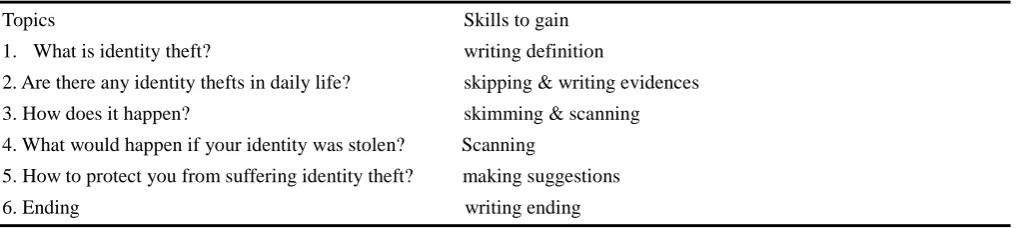
and assessing. The enabling process takes account for 5 hours, besides 1hour for motivating and 2 hours for accessing and remedy teaching. The whole process follows the principle of step by step under the scaffolding of the teacher. That is, the instruction is carried out from easy to hard. Contents of enabling are shown in table 1.
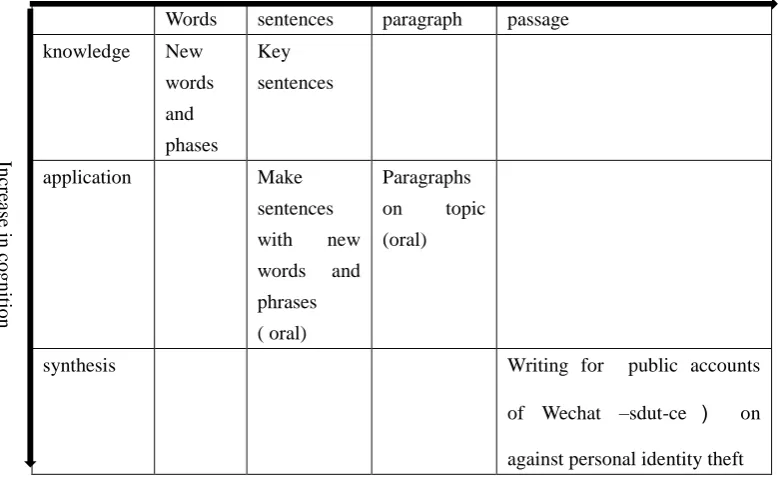
Differential processing and division attention may well affect task effectiveness (Gui Bao 2019). Instead of following the text, the whole teaching procedure is guided by 6 topics which are arranged in the logic of writing. Different topics have different stresses on reading and writing skills, for example, by discussing the first topic” What is identity theft”, students will learn how to write definition. After reading several definitions of “identity theft”, students will learn to use the expressions such as “refer to”, ”involve”, ”including” or “occurs when” to write definition. All these 6 topics are imputed on the Language enabling path shown in table 2.
Table 1 Enabling Contents
Topics Skills to gain 1. What is identity theft? writing definition
2. Are there any identity thefts in daily life? skipping & writing evidences 3. How does it happen? skimming & scanning
4. What would happen if your identity was stolen? Scanning
5. How to protect you from suffering identity theft? making suggestions 6. Ending writing ending
4. Language enabling path
Under the guidance of the teacher, the students complete the language exercises in turn (independently or
stages and the enabling path. It borrows the form of coordinate. Horizontal ordinate refers to increasing output units and the longitudinal coordinate indicates increasing cognition. It’s easily to spot from the horizontal ordinate that output unit starts from words and keeps increasing to sentences, paragraphs, at last, reaches to the final goal
–passage. The horizontal ordinate shows the cognition process from knowledge to application and then to synthesis, which are 3 types among the 6 types of Bloom's taxonomy of educational objectives in the cognitive domain.
Table 2 Language enabling path (Qiu lin, 2017)
1) Examples of Language enabling path
In order to illustrate the language enabling path clearly, the author takes “crime-related words” as example. Since the passage is about “stolen identity”, there are many related words and expressions in each paragraph. So task 1 is to locate crime-related words in the text. Many words are found in each paragraph such as “master of deception, impersonate, forge checks, most-wanted list for forgery, white-collar crime, identity theft; life-changing crime, fraudster, custody” etc.
Task 2 is basic exercise -getting to know: answer the question about the words (only shows 2 of them).
1) Is fraudster (a) a violent, dangerous criminal, or (b) a criminal who deceives people?
2) Is someone in custody (a) held by the police, or (b) committing a crime?
Keys: 1) b, 2) a
In task 3, activity of “brief introduction on Frank Abagnale, the hero of movie Catch Me if you Can” is
designed to practice these words: complete the following sentences with appropriate words in the box below.
Impersonated deception, forging ,fraudster , forgery ,custody , ,white-collar crime ,fraud
After finding these words, practicing activities are followed ,such as filling the words into blanks.
Frank Abagnale, Jr. (Leonardo DiCaprio), a brilliant young master of _1___ who at different times ___2___ a doctor, a lawyer, and an airplane pilot, __3___checks worth more than six million dollars in 26 countries. He became the youngest man to ever make the FBI's most-wanted list for ___4__. whose career as a _5___ lasted about six years before he was caught, who escaped from _6___three
times….He now runs a consultancy advising the world of
business how to avoid __7_, especially __8___ .
Keys: 1. Deception 2. impersonated , 3. Forging 4. forgery, 5. fraudster
6. custody , 7. fraud , 8. white-collar crime
Task 4 is on sentence level. Activity of inventing (Increase in language output unit)
Words sentences paragraph passage knowledge New
words and phases
Key sentences
In
cr
ea
se
in
co
g
n
itio
n
application Make
sentences with new words and phrases ( oral)
Paragraphs on topic (oral)
synthesis Writing for public accounts
of Wechat –sdut-ce ) on
sentences is designed to help students put these words into practice. First, pick 3-5 words and then let students make meaningful sentences by putting them together. For example, make sentence with those words and phrases: white-collar crimes, forge, precaution. Each student makes different sentences. The following is one example.
Nowadays, white-collar crimes such as forging checks, ID cards and credit cards have become very common. You need to take precautions. Practice makes perfect. When learn new words, application is the best way to master.
Task 5 is on paragraph level. By discussing the topic in table 1, students are required to put forth a complete paragraph, including topic sentence, developing sentences and concluding sentence. Take topic 3 as an example: Are there any identity thefts in daily life? After discussing, all the students have to write their own paragraph. The following is one of the students’ work.
Identity theft has become increasingly common. More and more people are becoming of anonymous victims. The number associated with itis adding up fast these days. A recent General Accounting Office report estimates that as many as 750,000 Americans are victims of identity theft every year. Besides, more than 1.2million bad checks are issued every day, more than 13per second. What’s more, it keeps growing by 25per cent every year. Obviously, identity theft has been a very serious problem.
Task 6 is on passage level. When finished all the topics in table 1, students have to finish a writing task by writing topublic accounts –sdut-ce, wechat of college English of SDUT on against personal identity theft to remind all the students keeping alert.
By keeping scaffolding, a learning process from words to sentences to passage finished. Students have experienced step by step output training in which both language output and cognitive difficulty increases gradually. And it also should be noted that the author has adopted a more
conservative program to facilitate students' language processing and production. The path is designed according to the students’ language output ability.
IV. EFFECTIVE ASSESSMENT ON ENABLING
PROCESS
“Peer-assisted learning (PAL) is a form of collaborative learning which is an effective method of helping learners to
give feedback in Second Language (L2)Academic Writing (Tanya&Matthew,2019).In the teaching experiment The author traced one learning group (8 students) to gain learning process and effect. These 8 students are the natural group in the class, their score in the college entrance examination ranged from 100 to 138, and the average score is 118, slightly lower than the overall average score of the whole class (123Points). Effectiveness was checked by combining the process assessment and the result assessment. The datum were collected from questionnaire before and after the experiment, group video and interviews.
1. The effectiveness of language enabling:process perspective
In the impromptu interview after class, the author asked: "In the process of speech practice, which parts are more difficult and which parts are easier? "Students 2 (S2), S4 and S9 have the following feedback:
S2: Ifind the words and expressions related with crime are quiet hard. Some words are completely new; some are at the tip of my tongue but I can’t speak. After practicing, I feel better.
S4: After the practice of words, I’ve picked up the meaning and the usage of the these new words, and then when making sentences and paragraphs, I feel they are all too easy, not only the words appeared in my mind, but also the meaning and usages.
S9: After sentences and paragraphs practice, the passage writing is easier. Everything seems popping into my mind automatically. Obviously, the step by step practice helps me make it.
2. The effectiveness of language enabling: result perspective
1) Questionnaire and interview
Compared with the previous writing, how do you feel about the writing of this time? This is one question on questionnaire. On this question, almost all students expressed affirmation on their language progress. The followings are some of them.
S2 I accumulate many ideas and words in the class and I use all of them in the final output task.
S3:I can use the advanced vocabulary I learned in class this time instead of the simple words as usual.
learned in the text.
S9:I used to learn text from top to the bottom, but we break the order and learn in topic this time , which makes me feel totally different. The logic is so clear; the words are rooted in my mind because many exercises are designed to "use the language to express idea”.
The feedbacks prove that the participants are satisfied with the teaching process. They are satisfied about their improvement and they are very happy since they can put what they just learnt in writing. Those progresses give them a sense of achievement.
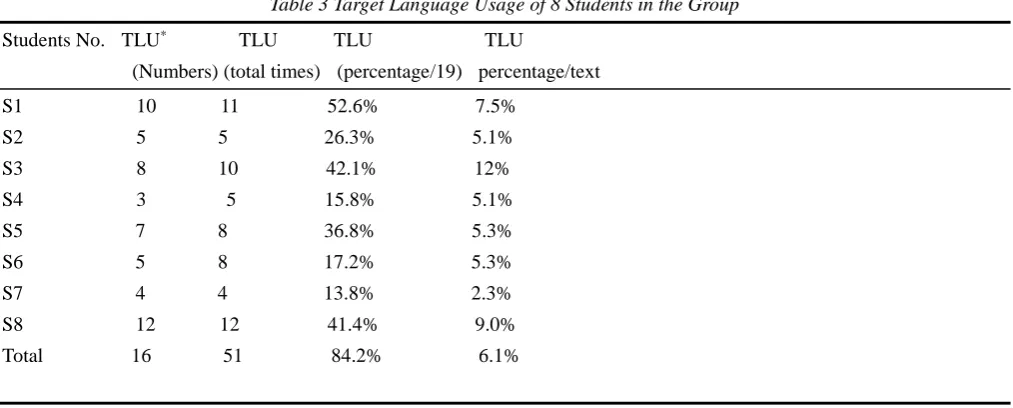
2)Statistics and analyses of "target language" in output texts
Table 3 demonstrates the target language usage of 8 students in the group. Among the 29 target words, phrases and structures, 23 targeted language were used, accounting for 79.3%.Targeted language was totally used for 59 times, about 5.8% of the total text. It means that there were almost 6 target language in every 100 words. That is, almost one or two sentences has at least 1 new words, suppose one sentence has 13-16 words. The datum analyses of process and result show that enabling instruction of POA is effective. Sufficient facility materials, diversified trainings aimed at output task combined with careful design of learning path contribute a lot to the realization of the teaching goal.
Table 3 Target Language Usage of 8 Students in the Group
Students No. TLU* TLU TLU TLU
(Numbers) (total times) (percentage/19) percentage/text
S1 10 11 52.6% 7.5% S2 5 5 26.3% 5.1% S3 8 10 42.1% 12% S4 3 5 15.8% 5.1% S5 7 8 36.8% 5.3% S6 5 8 17.2% 5.3% S7 4 4 13.8% 2.3% S8 12 12 41.4% 9.0% Total 16 51 84.2% 6.1%
*TLU (target language using)
V. CONCLUSIONS AND LIMITATIONS
The findings of this study provided positive evidence to the feasibility and efficiency of the enabling process in POA, which can significantly enhance students’ output ability both in speaking and writing. The “hungry state”(WEN, 2015) of motivating process arouses students’ learning interests, so they show great enthusiasm to input materials provided by the teacher and those found by themselves online. The step by step inputs and outputs accelerate the conversion from memorizing knowledge to output competence, thereby enhances students’ writing skills.
Despite the students have made certain progress in this study, there are still some limitations.(1) This is only a study in one unit. It needs to make further experiment on different units and different courses to testify the effectiveness. (2)
The experiment time is not long enough. It could be better if experiment time could be expanded and participants enlarged. High-intensity output training can help students use the language effectively, but what’s the effect after a period of time? Could it be “soon learn, soon forgotten”? All this problems require follow-up research.
REFERENCES
[1] Wen, Q. F. Developing a theoretical system of
production⁃oriented approach in language teaching.[J]
Foreign language teaching and research, 2015,2,547-557.
[2] Wen, Q. F. The production⁃oriented approach to teaching
university students English in China [J]. Language Teaching.
Available on CJO 2016 doi:10.1017/S026144481600001X.
[3] QIU Lin. The step ⁃by ⁃step design of language activities in
Languages,2017,3, 386-397.
[4] ZHANG Wenjuan.“Enabling” students’ production to
enable students’ language development: Applying
production-oriented approach to TEFL classroom. [J]
Foreign Language Education in China, 2015,5,10-17.
[5] ZHANG Wenjuan. Applying Production-oriented Approach
to College English Classrooms: A Teaching Experiment.[J]
Foreign Languages and their teaching,2016,5,106-114.
[6] ZHANG Lingli. An experimental study on the effectiveness
of the production⁃oriented approach,[J] Modern Foreign
Languages,2017,3, 369-376.
[7] ZHANG Wenjuan. An experimental study on the effect of
the production⁃oriented approach on college students’
English writing quality, [J] Modern Foreign
languages,2017,3,377-385.
[8] CHANG Xiaoling. Textbook writing based on the
production⁃oriented approach, [J] Modern Foreign
Languages,2017,3,359-368.
[9] Qi Pin, Shi Xiaochun.Designing and Effects of
Viewing-Listening-Speaking English Course Based on
POA,[J]Jiangxi Educational Research,2016,8,106-111. [10] Wen, Q. F. The production⁃oriented approach: A
pedagogical innovation in university English teaching in
China [A]. In L. Wong & K. Hyland (eds.). Faces of English:
Students, Teachers, and Pedagogy [C]. London & New York:
Routledge, 2017,91⁃106.
[11] SUN Suguang. Teacher-student collaborative assessment in
classroom teaching: A reflective practice.[J] Modern
Foreign Languages,2017,3, 397-405.
[12] SUN Suguang. Optimizing Teacher⁃Student Collaborative
Assessment: Dialectical Research. Modern Foreign
Languages, [J] Modern Foreign Languages,2019,5,419-430.
[13] YANG Lifang. Designing a micro lecture for the motivating
phase of POA teaching process.[J] Foreign Language
Education in China,2015,4,3-9.
[14] Gui Bao.Comparing Input and Output Tasks in EFL
Learners’ Vocabulary Acquisition, [J]. TESOL
International Journal Volume 14 Issue 1 2019,7-17.
[15] Tanya M. McCarthy and Matthew I. Armstrong.
Peer-Assisted Learning: Revisiting the Dyadic Interaction
Process in L2 Academic Writing [J] Asian EFL Journal