Available Online at www.ijpret.com 1534
INTERNATIONAL JOURNAL OF PURE AND
APPLIED RESEARCH IN ENGINEERING AND
TECHNOLOGY
A PATH FOR HORIZING YOUR INNOVATIVE WORK
VIDEO OBJECT TRACKING BASED ON AUTOMATIC BACKGROUND
SEGMENTATION USING RBF NEURAL NETWORK
MR. RAVIKIRAN G. BANARASE1, MR. VAIBHAV K. LIKHITKAR2
1.M.Tech Scholar, Patel Institute of Technology, Rajiv Gandhi Tech. University, Bhopal. 2.M.Tech Scholar, Yashvantrao Chavan College of Engg, Nagpur
Accepted Date: 05/03/2015; Published Date: 01/05/2015
Abstract: Video segmentation is the definitive purpose of many video processing systems. Higher level analysis and understanding of events require certain low level computer vision tasks to be performed. In this paper only on these low-level features are focus, whose achievement in turn determine the success of high-level tasks. The two critical, low-high-level computer vision tasks that have been undertaken in this work are: Foreground-Background Segmentation and Object Tracking. We extend the basic philosophy of Background Subtraction used extensively for foreground-background segmentation. This involves the subtraction of the current image from a reference or estimated background image. The error image is then threshold to detect the foreground pixels. We use a stochastic model of the background and also adapt the model through time. This adaptive nature is essential for long-term surveillance applications, particularly when the background composition or intensity distribution changes with time. We proposed a novel method for video segmentation and background removal for video object tracking. The proposed method is very efficient in compression of frame loss and segmentation area for video object tracking. The proposed method comes along with wavelet filter and RBF neural network. So the complexity of method is increase in terms of segmented area and frame loss minimisation.
Keywords: Video Segmentation, Foreground Segmentation, Background Segmentation, Object Tracking, Frame Loss, Segmentation Area & RBF Neural Network.
Corresponding Author: MR. RAVIKIRAN G. BANARASE
Access Online On:
www.ijpret.com
How to Cite This Article:
Ravikiran G. Banarase, IJPRET, 2015; Volume 3 (9): 1534-1540
Available Online at www.ijpret.com 1535 INTRODUCTION
Segmentation means partitioning the image to a number of arbitrarily shaped regions, each of them typically being assumed to constitute a meaningful part of the image, i.e. to correspond to one of the objects depicted in it or to a part of one such object. Considering moving images, i.e. video, the term segmentation is used to describe a range of different processes for partitioning the video to meaningful parts at different granularities. Segmentation of video can thus be temporal, aiming to break down the video to scenes or shots, spatial, addressing the problem of independently segmenting each video frame to arbitrarily shaped regions, or spatio-temporal, extending the previous case to the generation of temporal sequences of arbitrarily shaped spatial regions. The term segmentation is also frequently used to describe foreground/background separation in video, which can be seen as a special case of spatio-temporal segmentation.
Segmentation of images and video is generally an ill-posed problem, i.e. for a given natural image or image sequence, there exists no unique solution to the segmentation problem; the spatial, temporal or spatio-temporal segments that should ideally be formed as a result of segmentation largely depend on the application under consideration and most frequently on the subjective view of each human observer.
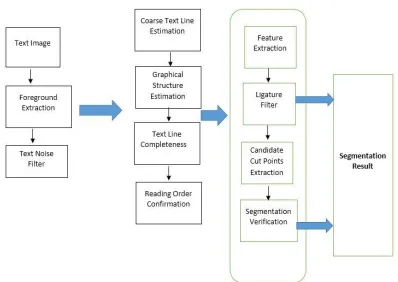
Figure 1.1: Online object segmentation for live video and movies.
WORKING PROCESS OF VIDEO PROCESSING
Available Online at www.ijpret.com 1536
background subtraction, statistical models, temporal differencing and optical flow. Measuring speed of vehicles Detecting red light crossings and unnecessary lane
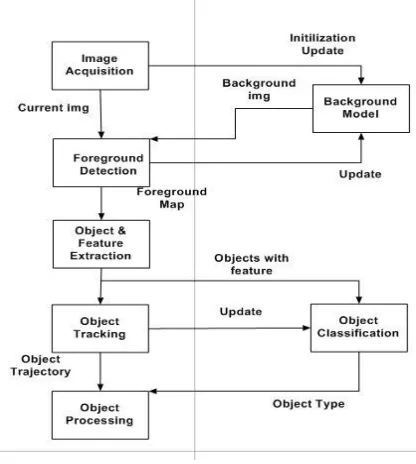
Figure 1.2: Show that process of video pre-processing and indexing.
Detecting regions that correspond to/ moving objects such as people and vehicles in video is the first basic step of almost every vision system since it provides a focus of attention and simples the processing on subsequent analysis steps. Due to dynamic changes in natural scenes such as sudden illumination and weather changes, repetitive motions that cause clutter (tree leaves moving in blowing wind), motion detection is a difficult problem to process reliably. Frequently used techniques for moving object detection are background subtraction, statistical methods, temporal differencing and optical flow whose descriptions are given below. Background subtraction is particularly a commonly used technique for motion segmentation in static scenes.
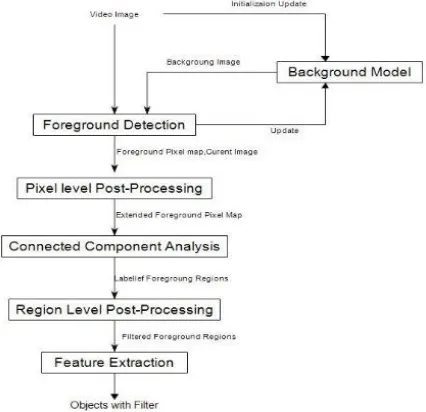
Available Online at www.ijpret.com 1537 Figure 1.3: object detection system.
When object detection system is concerned with low-level visual processing and high-level image analysis, and is widely used in image understanding, human-computer interaction, surveillance, and robotics, to name a few. To tackle these challenges, this paper presents a tracking method that learns a robust object representation by partial least squares analysis and adapts to appearance change of the target and background while reducing drift. Many classes of objects can now be successfully detected with machine learning techniques. Face, cars, pedestrians and hands, has all been detected with low error rates by learning their appearance in a highly generic manner from extensive training sets. These recent advances have enabled the use of reliable object detection components in real systems, such as automatic face focusing functions on digital cameras. One key drawback of these methods, and the issue addressed here, is the prohibitive requirement that training sets contain thousands of manually annotated examples. We propose to reduce the requirement for such an extensive labeling by exploiting the temporal consistency occurring in a training video. The performance of this approach is evaluated on pedestrian detection in a surveillance camera setting, and on cell detection in microscopy data.
LITERATURESURVEY AND BACKGROUND
Available Online at www.ijpret.com 1538
using color video histograms are better efficiency, and insensitivity to small changes in camera view-point i.e. translation and rotation. There are two types of background that have different search strategies and refreshing mechanisms. The stochastic ants identify new categories, construct the category tables and determine the clustering center of each category. Object tracking and video segmentation of large number of color videos; object tracking plays an important and challenging role.
PREVIOUS WORK DONE
1. “OBJECT TRACKING VIA PARTIAL LEAST SQUARES ANALYSIS”
In this title author explained a novel approach for background segmentation colorvideo object tracking using partial least squares. Experiments on numerous challenging sequences and comparisons to state-of-the-art methods demonstrate favorable performance of the proposed tracking algorithm. The proposed algorithm utilizes an adaptive discriminative representation to account for the nonlinear appearance change of an object over time. To reduce tracking drift, a two-stage article filtering method is presented which makes use of both the static appearance information obtained at the outset and image observations acquired online. Compared with state-of-the-art tracking methods, the proposed algorithm achieves favorable performance with higher success rates and lower tracking errors.
Proposed Methodology:
Available Online at www.ijpret.com 1539 PROPOSED ALGORITHM
The proposed algorithm is a combination of RBF kernel for feature separation of video feature fused technique. GMM weight key is a vector value given by the data set. The GMM value passes as a vector for finding a near distance between superior video feature separations. After finding a superior video feature separation the nearest distance divide into two classes, one class take a higher odder value and another class gain lower value for feature selection process. The process of selection of class also reduces the passes of data set. Dividing. After finding a class of lower and higher of given GMM value, compare the value of distance wet vector. Here distance weight vector work as a fitness function for selection process of genetic algorithm. Here we present steps of process of algorithm step by step and finally draw a flow chart of complete process.
EXPERIMENTAL RESULT
The experimental result partitioned by two methods one is GMM another is our proposed technique GMM-RBF. In GMM-RBF we changed the filter function of GMM with Gaussian kernel of GMM and here we used the number of neurons 400. For dedicated dataset of image and Feature Matrix of dataset used 3×3 Feature Matrix Vector. One time input of vector is 9 vectors. In this vector contents DCD and TXD features for classification of image. In this experimental set up we used 3 classes of data. Now we design frame level segmentation. Here we find the accuracy of classification according to given formula,
𝑓𝑟𝑎𝑚𝑒𝑙𝑜𝑠𝑠𝑠 = 𝑑𝑒𝑡𝑒𝑐𝑡𝑒𝑑𝑛𝑢𝑚𝑏𝑒𝑟𝑜𝑓 𝑓𝑟𝑎𝑚𝑒
𝑡𝑜𝑡𝑎𝑙𝑛𝑢𝑚𝑏𝑒𝑟𝑜𝑓𝑓𝑎𝑚𝑒× 100……….. (1)
In segmentation the mean absolute error (MAE) is a quantity used to measure how close real or predictions are to the eventual outcomes. The mean absolute error is given by
………. (2)
As the name suggests, the mean absolute error is an average of the absolute errors
Available Online at www.ijpret.com 1540 CONCLUSIONS
In this dissertation proposed a novel method for video segmentation and background removal for video object tracking. The proposed method is very efficient in compression of frame loss and segmentation area for video object tracking. The proposed method comes along with wavelet filter and RBF neural network. So the complexity of method is increase in terms of segmented area and frame loss minimisation. The performance can be further improved by fusing multi-modal information such as by applying the vehicle classification result to constraining the size of the object and vice versa. Future work will include applying the algorithm to a larger number of data and performing comparative studies on various applications with various vision- and other sensor
REFERENCES:
1. Yi We i1, ,Zhao Long, “Robust objects tracking algorithm based on adaptive Background updating” IEEE TRANSACTIONS ON IMAGE PROCESSING, VOL. 24, NO. 2, JANUARY 2014
2. Bin Zhu, WenLiu, Gang Wei and Lin Yuan “A Method for Video Synopsis Based on Multiple Object Tracking” 978-1-4799-3279-5 /14/$31.00 ©2014 IEEE
3. Tahir Nawaz, Fabio Poiesi, and Andrea Cavallaro Measures of Effective Video Tracking IEEE TRANSACTIONS ON IMAGE PROCESSING, VOL. 23, NO. 1, JANUARY 2014
4. Chad Aeschliman, Johnny Park, Avinash C. Kak, “Tracking Vehicles through Shadows and Occlusions in Wide-Area Aerial Video” IEEE TRANSACTIONS ON AEROSPACE AND ELECTRONIC SYSTEMS VOL. 50, NO. 1 JANUARY 2014