Organized by C.O.E.T, Akola. Available Online at www.ijpret.com
401
INTERNATIONAL JOURNAL OF PURE AND
APPLIED RESEARCH IN ENGINEERING AND
TECHNOLOGY
A PATH FOR HORIZING YOUR INNOVATIVE WORK
COMPARATIVE STUDY OF POND ASH AND FINE GRAINED SOIL MIX
M. D. KULKARNI, R R GADPAL
Department of Applied Mechanics, Govt. Polytechnic, Arvi , Dist.(Wardha).
Accepted Date: 05/09/2017; Published Date: 10/10/2017
Abstract:
At present there are about 85 thermal power plants operating in India. As the coal normally used in Indian power plants are of poor quality with about 40% ash content, the process has resulted in production of huge quantity of ash as waste by-product. The current rate of production of coal ash in the country has reached 100 million tons per year posing serious disposal problems and environmental concerns. The main object of the study is to make utilization of the pond ash in construction of roads by improving its compaction characteristics by mixing it with different fine grained soils viz, black cotton soil, silty sand and fine sand.Keywords
: Pond ash, Black cotton soil, Silty Sand, Fine Sand, Optimum Moisture content, Maximum Dry Density and C.B.R..
Corresponding Author: M. D. KULKARNI
Co Author: - R R GADPAL
Access Online On:
www.ijpret.com
How to Cite This Article:
M. D. Kulkarni, IJPRET, 2017; Volume 6 (2): 401-407
PAPER-QR CODE
SPECIAL ISSUE FOR
INTERNATIONAL LEVEL CONFERENCE
"ADVANCES IN SCIENCE,
Organized by C.O.E.T, Akola. Available Online at www.ijpret.com
402
INTRODUCTIONAsh disposal involves design and installation of ash ponds, which is in addition to covering quite large area at each plant site and creates aesthetic as well as hygienic environmental impacts. This has warranted the scientific and industrial community to initiate research and development work for finding avenues for the innovative use and safe disposal of the pond ash so that instead of a waste product, the pond ash can be considered as a usable by-product.
Actually there are three types of ash produced by thermal power plants, viz, fly ash, bottom ash and pond ash. Fly ash is collected by mechanical or electrostatic precipitators from the flue gases of power plant whereas bottom ash is collected from the bottom of the boilers. When these two types of ash mixed together are transported in the form of slurry and stored in the lagoons, the deposit is called pond ash. The volume of pond ash produced by thermal power plants is very large as compared to that of the other two ashes, viz, fly ash and bottom ash. The task to utilize the pond ash to the maximum possible extent is still a major problem throughout the world. As the deposits in the ash ponds are characterized by very low density and poor bearing capacity, these sites are usually considered unsuitable for any construction activity. Pond ash if improved in its compaction characteristics by addition of different fine grained soil, it is possible to find suitable percentage of fine soil to improve C.B.R. so that it can be used in highway embankment and as structural fill material in civil engineering construction.
I. LITERATURE REVIEW
Dr. Virendra kumar [1], fellow associated with NIT, Harimpur, carried out work on compaction and permeability study of pond ash amended with locally available soil and hardening agent in which they have adopted the following procedure. Disturbed samples of pond ash were collected from disturbed samples of local fine soil from Sirsa region of Ropar district of Punjab (India). Standard compaction test was performed on these samples in the laboratory and the maximum dry density (MDD) and optimum moisture content (OMC) were obtained for both soil and pond ash as well as their mixtures. The pond ash was mixed with locally available soil and tested for OMC, MDD and permeability with different mix proportions of pond ash and soil. Then pond ash, soil and hardening agents with certain percentages were added and tested for above tests. As per results of the test and study it is possible to reduce the permeability of pond ash with the addition of locally available fine size soil by compacting the mixed material at their optimum moisture content. To serve as liners for landfills, this combination requires the addition of hardening agents which reduces permeability by an order of two and reduces the quantity of soil to be used in the pond ash soil matrix.
Dr A K Choudhary and Dr B P Verma [2] have carried out work on behaviour of reinforced flyash subgrades, in which the fly ash used in the investigation was procured in dry state from the electrostatic precipitators of the Tata Steel, Jamshedpur.
S.A. Naeini and R Ziaie Moayed [3] have carried out research work on “Effect of plasticity index and reinforcement on the CBR value on soft clay, in which soft clay soil specimen were collected locally and different percentages by weight of bentonite were used as a material for changing plasticity index of clay soil samples.
Organized by C.O.E.T, Akola. Available Online at www.ijpret.com
403
unreinforced specimens, but fibre reinforcement, particularly at 0.3 to 0.4%, does significantly increase compressive strength and failure strain. Similarly, in the range of 0.3 to 0.4%, fibre reinforcement significantly increases peak friction angle, cohesion, and CBR values.Pradip D. Jadhao and P.B. Nagarnaik [5] carried out research work on influence of polypropylene fibers on engineering behavior of soil−fly ash mixtures for road construction. In this work, locally available soil used in the soil fly ash mixtures was silt. Fresh fly ash samples were collected from Nashik Thermal Power Station, Eklahare, Nashik (Maharahtra), India. The polypropylene fibers RP6, RP12 and RP24 were used. The compaction test, unconfined compressive strength test and CBR test were performed on homogeneous sample and following results were obtained. The inclusion of fibers had a significant influence on the engineering behavior of soil-fly ash mixtures. The MDD increases and OMC decreases in fly ash and soil- fly ash mixtures. Whereas, the soil shows reverse trend but less noticeably. Inclusion of fibers increased the peak compressive strength and ductility of soil-fly ash specimens. The results of study of a randomly oriented fiber reinforced soil- soil-fly ash mixtures indicted that a maximum performance was achieved with 12 mm fibers in optimum dosage of 1.00 % by dry weight of soil- fly ash mixtures.
Murty Ramana V. et. al [6] have investigated on cyclic load testing on stabilized model pond ash embankments. The methodology they adopted consists of construction of model ash embankment using pond ash after stabilizing / strengthening it with black cotton soil and geosynthetic materials. Cyclic load tests were carried out on these embankments till failure. It is revealed from this study that the stabilisation of pond ash even with 30% black cotton soil increased the load carrying capacity of ash embankment by more than 1.8 times compared of that constructed with pond ash alone.
Review of literature discussed above shows that lot of experimental investigations are available on study of fly ash mixed with soil, reinforced with fibres and also addition of hardening agent. However, here the study on pond ash is undertaken to study compaction and CBR value and its comparison with mix of different fine grained soil viz, black cotton soil, silty sand and fine sand in different proportions.
III. METHODOLOGY
The samples for this study were collected from the following sites for laboratory investigation
1. Pond ash was collected from Koradi Thermal Power Station, Nagpur.
2. Black cotton soil and fine sand was collected from Ramdeo Baba Kamla Nehru Engineering College,
Nagpur.
3. Silty sand was collected from the bank of Kanhan River.
The different mix proportions were made in the laboratory as per the following table..
Sr. No. Different mix proportions of pond ash and fine grained soils 1 80% pond ash and 20% black cotton soil
2 60% pond ash and 40% black cotton soil 3 40% pond ash and 60% black cotton soil 4 80% pond ash and 20% silty sand 5 60% pond ash and 40% silty sand 6 40% pond ash and 60% silty sand 7 80% pond ash and 20% fine sand 8 60% pond ash and 40% fine sand 9 40% pond ash and 60% fine sand
Organized by C.O.E.T, Akola. Available Online at www.ijpret.com
404
The sample collected was tested independently for OMC & MDD by performing Standard Proctor test and CBR test. For all the mix proportions the Proctor test and CBR test were performed.2. Laboratory Determination :-
The following standard tests were carried out on different samples.
1. Standard Proctor test to determine OMC and MDD as per IS : 2720 (Part 7) -1965.
2. California Bearing Ratio (CBR) test as per IS:2720 (Part 16)-1979
The tests were carried out in College laboratory of RKNEC, Nagpur and Quality control laboratory of B & C, Nagpur. After collecting samples in the laboratory, the samples were oven dried and mixed in mix proportions as specified above by weighing. The samples were kept in polythene bags.
3. Experimental Procedure:-
Standard Proctor Test:-
This test was performed according to specification of BIS code IS :2720 (Part 7) - 1965. It was initially carried out on pond ash, black cotton soil, fine sand and silty sand. Thereafter the Proctor test was carried out on different mix proportions of pond ash and fine grained soil mix.
California Bearing Ratio (CBR) Test:-
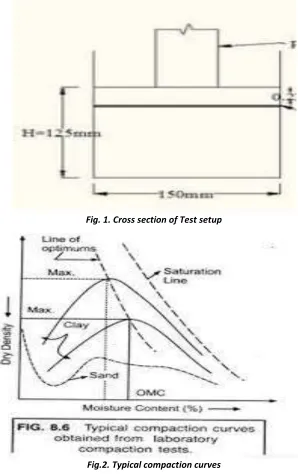
Strength of each soil layer of a pavement is evaluated using CBR tests. The CBR tests were performed on all samples. Detailed procedure of the experimental study conducted is described below. California Bearing Ratio test is a penetration test developed by the California division of highways as a method for evaluating the stability of soil subgrade and other flexible pavement materials. The test is performed as per IS: 2720 (part16) - 1979. The mould with the compacted soil is weighed and then subjected to four days soaking with the surcharge weight over the soil. After soaking the specimen it is placed under the plunger of the loading frame. The dial gauges for measuring the load values and the penetration are set in position. Then the loading is done at a strain rate of 1.25 mm/min and the proving ring readings are taken for the penetrations corresponding to 0.0, 0.5, 1.0, 1.5, 2.0, 2.5, 3.0, 4.0, 5.0, 7.5, 10.0 and 12.5 mm. A load- penetration graph is plotted and loads corresponding to 2.5 mm and 5 mm penetrations are noted and compared with standard load values obtained for crushed stone(1370 kg and 2055kg corresponding to 2.5mm and 5mm respectively). Then the California Bearing Ratio (CBR) is calculated using the relation.
CBR(%) =
Organized by C.O.E.T, Akola. Available Online at www.ijpret.com
405
Fig. 1. Cross section of Test setupFig.2. Typical compaction curves
IV RESULTS:
Organized by C.O.E.T, Akola. Available Online at www.ijpret.com
406
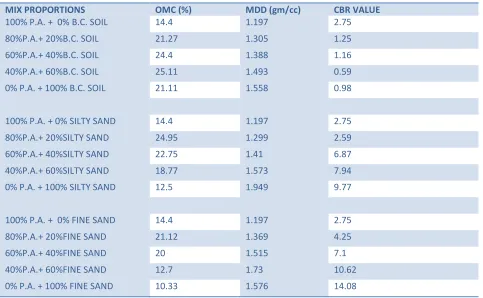
Table 1.COMPARISON OF OMC, MDD & CBR VALUE FOR DIFFERENT MIX PROPORTIONSV. CONCLUSIONS:
1. The maximum dry density for every mix proportion of pond ash and fine sand is greater than the respective mix proportion of (pond ash + silty sand) and (pond ash + B.C. soil).
2. It is observed that maximum dry density increases in the mix of pond ash and B.C. soil with increase of percentage of B.C. soil in the mix. At the same time the OMC also increases.
3. The comparison of OMC & MDD for the mix of 60% pond ash with 40% each of fine grained soil shows that MDD is maximum for pond ash & fine sand mix with least OMC. Whereas, MDD is minimum for pond ash & B.C. soil mix and maximum OMC. Same results are obtained for 40% of pond ash with 60% each of fine grained soil.
4. The comparison of CBR shows that it increases in case of mix of pond ash & fine sand and mix of pond ash & silty sand with increase in percentage of fine grained soil in a mix. Whereas the CBR decreases in the mix of pond ash & B.C. soil with increase in percentage of B.C. soil in a mix.
5. It is observed that the CBR for every mix proportion of pond ash and fine sand is greater than the respective mix proportion of (pond ash + silty sand) and (pond ash + B.C. soil).
6. Pond ash can be effectively utilized in the sub grade of road and embankment after suitably mixing it with different fine grained soil.
REFERENCES:
1. Dr. Virendrakumar, “Compaction and permeability study of pod ash amended with locally available soil and hardening agent”, IE(I) Journal - CV, Vol 85 (2004)
2. Dr. A.K. Choudhari and Dr. B.P. Verma, “Behaviour of reinforced fly ash subgrades”, IE(I) Journal-CV, Vol 85 (2005)
MIX PROPORTIONS OMC (%) MDD (gm/cc) CBR VALUE
100% P.A. + 0% B.C. SOIL 14.4 1.197 2.75
80%P.A.+ 20%B.C. SOIL 21.27 1.305 1.25
60%P.A.+ 40%B.C. SOIL 24.4 1.388 1.16
40%P.A.+ 60%B.C. SOIL 25.11 1.493 0.59
0% P.A. + 100% B.C. SOIL 21.11 1.558 0.98
100% P.A. + 0% SILTY SAND 14.4 1.197 2.75
80%P.A.+ 20%SILTY SAND 24.95 1.299 2.59
60%P.A.+ 40%SILTY SAND 22.75 1.41 6.87
40%P.A.+ 60%SILTY SAND 18.77 1.573 7.94
0% P.A. + 100% SILTY SAND 12.5 1.949 9.77
100% P.A. + 0% FINE SAND 14.4 1.197 2.75
80%P.A.+ 20%FINE SAND 21.12 1.369 4.25
60%P.A.+ 40%FINE SAND 20 1.515 7.1
40%P.A.+ 60%FINE SAND 12.7 1.73 10.62
Organized by C.O.E.T, Akola. Available Online at www.ijpret.com
407
3. S.A. Naeini and R. Ziaie Moayed, “Effect of plasticity index and reinforcement on the CBR value of soft clay”, International Journal of Civil Engineering, Vol. 7, No.2 (2009)4. R. Kumar, et.al. Technical note on, “Engineering behaviour of fibre reinforced pond ash and silt sand”, Geo synthetics International Journal, Vol.6, No.6.(1999)
5. P.D. Jadhao and P.B. Nagarnaik, “Influence of polypropylene fibres on engineering behaviour of soil-fly ash mixtures for road construction”, Electronics Journal for Geotechnical Engineering, Vol.13, Bundle C.(2008)
6. Murty Ramana V. et.al., “ Investigation on cyclic load testing ofn stabilized model pond ash embankments” Indian Geotechnical Conference, Ahmedabad.(2005)
7. T.K. Rao and B.C. Chattopadhyay, “ Behaviour of sandy soil strengthened with pond ash and rice husk ash in
presence of cement”, Indian Geotechnical Conference, Banglore.(2008)
8. N.H. Desai and M.D. Desai, “ Use clay stabilized fly ash for raising ash pond”, Indian Geotechnical Conference, Ahmedabad.(2005)
9. Padam Raj, “ Compaction characteristics and shear parameters of pond ash”, Thesis of B Tech, Department of
Civil Engineering, National Institute of Technology, Rourkela.(2010)
10.G. Venkatappa Rao and Goutam K. Pothal, “ Geo synthetic reinforced pond ash subgrade for rural roads”, Proceedings of the Fourth Asian Regional Conference on Geo synthetics , Shanghai,(2008)