Available Online At www.ijpret.com
INTERNATIONAL JOURNAL OF PURE AND
APPLIED RESEARCH IN ENGINEERING AND
UART SERIAL COMMUNICATION MODULE BASED ON VHDL
1. Student at Amrita Sai Institute of Science & Technology, Vijayawada, India. 2. Asso. Professor & Head of The Department
Technology, Vijayawada, India. 3. Asst. Professor at RVR Institute
Accepted Date:
19/01/2012
Publish Date:
01/02/2012
Keywords UART,
Asynchronous serial
communication,
VHDL,
Quartus II,
Simulation
Corresponding Author
Ms. Masanam. Rekha
IJPRET-QR CODE
Available Online At www.ijpret.com
INTERNATIONAL JOURNAL OF PURE AND
APPLIED RESEARCH IN ENGINEERING AND
TECHNOLOGY
A PATH FOR HORIZING YOUR INNOVATIVE WORK
UART SERIAL COMMUNICATION MODULE BASED ON VHDL
MASANAM REKHA1, B. RAMA RAO 2,
KESHAMONI KUMAR3,
at Amrita Sai Institute of Science & Technology, Vijayawada, India.
& Head of The Department at Amrita Sai Institute of Science & , Vijayawada, India.
at RVR Institute of Engineering & Technology, Andhrapradesh, India
Abstract
UART (Universal Asynchronous Receiver Transmitter) is a kind
of serial communication protocol; mostly used for short
distance, low speed, low-cost data exchange between
computer and peripherals. During the actual industrial
production, sometimes we do not need the full functionality of
UART, but simply integrate its core part. UART includes three
kernel modules which are the baud rate generator, receiver
and transmitter. The UART implemented with
can be integrated into the FPGA to achieve compact, stable
and reliable data transmission. It’s significant for the design of
SOC. The simulation results with Quartus II are completely
consistent with the UART protocol.
INTERNATIONAL JOURNAL OF PURE AND
APPLIED RESEARCH IN ENGINEERING AND
A PATH FOR HORIZING YOUR INNOVATIVE WORK
UART SERIAL COMMUNICATION MODULE BASED ON VHDL
at Amrita Sai Institute of Science & Technology, Vijayawada, India.
at Amrita Sai Institute of Science &
of Engineering & Technology, Andhrapradesh, India.
UART (Universal Asynchronous Receiver Transmitter) is a kind
of serial communication protocol; mostly used for
short-cost data exchange between
During the actual industrial
production, sometimes we do not need the full functionality of
UART, but simply integrate its core part. UART includes three
kernel modules which are the baud rate generator, receiver
and transmitter. The UART implemented with VHDL language
can be integrated into the FPGA to achieve compact, stable
and reliable data transmission. It’s significant for the design of
SOC. The simulation results with Quartus II are completely
Available Online At www.ijpret.com INTRODUCTION
Asynchronous serial communication has
advantages of less transmission line, high
reliability, and long transmission distance,
therefore is widely used in data exchange
between computer and peripherals.
Asynchronous serial communication is
usually implemented by Universal
Asynchronous Receiver Transmitter
(UART)1. UART allows full-duplex
communication in serial link, thus has been
widely used in the data communications
and control system. In actual applications,
usually only a few key features of UART are
needed. Specific interface chip will cause
waste of resources and increased cost.
Particularly in the field of electronic design,
SOC technology is recently becoming
increasingly mature. This situation results in
the requirement of realizing the whole
system function in a single or a very few
chips. Designers must integrate the similar
function module into FPGA. This paper uses
VHDL to implement the UART core
functions and integrate them into a FPGA
chip to achieve compact, stable and reliable
data transmission, which effectively solves
the above problem2, 3.
Basic UART communication needs only two
signal lines (RXD, TXD) to complete
full-duplex data communication. TXD is the
transmit side, the output of UART; RXD is
the receiver, the input of UART. UART’s
basic features are: There are two states in
the signal line, using logic 1 (high) and logic
0 (low) to distinguish respectively. For
example, when the transmitter is idle, the
data line is in the high logic state. Otherwise
when a word is given to the UART for
asynchronous transmissions, a bit called the
"Start Bit" is added to the beginning of each
word that is to be transmitted. The Start Bit
is used to alert the receiver that a word of
data is about to be sent, and to force the
clock in the receiver into synchronization
with the clock in the transmitter. These two
clocks must be accurate enough to not have
the frequency drift by more than 10%
during the transmission of the remaining
bits in the word4.
After the Start Bit, the individual data bits of
the word are sent, with the Least Significant
Bit (LSB) being sent first. Each bit in the
transmission is transmitted for exactly the
same amount of time as all of the other
Available Online At www.ijpret.com
approximately halfway through the period
assigned to each bit to determine if the bit
is a 1 or a 0. For example, if it takes two
seconds to send each bit, the receiver will
examine the signal to determine if it is a 1
or a 0 after one second has passed, then it
will wait two seconds and then examine the
value of the next bit, and so on. When the
entire data word has been sent, the
transmitter may add a Parity Bit that the
transmitter generates. The Parity Bit may
be used by the receiver to perform simple
error checking. Then at least one Stop Bit is
sent by the transmitter. When the receiver
has received all of the bits in the data word,
it may check for the Parity Bits (both sender
and receiver must agree on whether a
Parity Bit is to be used), and then the
receiver looks for a Stop Bit. If the Stop Bit
does not appear when it is supposed to, the
UART considers the entire word to be
garbled and will report a Framing Error to
the host processor when the data word is
read. The usual cause of a Framing Error is
that the sender and receiver clocks were
not running at the same speed, or that the
signal was interrupted.
Regardless of whether the data was
received correctly or not, the UART
automatically discards the Start, Parity and
Stop bits. If the sender and receiver are
configured identically, these bits are not
passed to the host.
If another word is ready for transmission,
the Start Bit for the new word can be sent
as soon as the Stop Bit for the previous
word has been sent. Because asynchronous
data are “self-synchronizing”, if there are
no data to transmit, the transmission line
can be idle. The UART frame format is
shown in Figure 1.
IMPLEMENTATION OF UART
In this paper, the top to bottom (Top to
Down) design method is used. The UART
serial communication module is divided into
three sub-modules: the baud rate
generator, receiver module and transmitter
Available Online At www.ijpret.com
implementation of the UART
communication module is actually the
realization of the three sub-modules. The
baud rate generator is used to produce a
local clock signal which is much higher than
the baud rate to control the UART receive
and transmit; The UART receiver module is
used to receive the serial signals at RXD,
and convert them into parallel data; The
UART transmit module converts the bytes
into serial bits according to the basic frame
format and transmits those bits through
TXD.
A. Baud Rate Generator
Baud Rate Generator is actually a frequency
divider. The baud rate frequency factor can
be calculated according to a given system
clock frequency (oscillator clock) and the
requested baud rate. The calculated baud
rate frequency factor is used as the divider
factor. In this design, the frequency clock
produced by the baud rate generator is not
the baud rate clock, but 16 times the baud
rate clock. The purpose is to precisely
sample the asynchronous serial data at the
receiver. Assume that the system clock is
32MHz, baud rate is 9600bps, and then the
output clock frequency of baud rate
generator should be 16 * 9600Hz. Therefore
the frequency coefficient (M) of the baud
rate generator is:
M =32MHz/16*9600Hz=208
When the UART receives serial data, it is
very critical to determine where to sample
the data information. The ideal time for
sampling is at the middle point of each
serial data bit. In this design, the receive
clock frequency is designed to be 16 times
the baud rate, therefore, each data width
received by UART is 16 times the receive
clock cycle.
B. Receiver Module
During the UART reception, the serial data
and the receiving clock are asynchronous,
so it is very important to correctly
determine the start bit of a frame data. The
receiver module receives data from RXD
pin. RXD jumps into logic 0 from logic 1 can
be regarded as the beginning of a data
frame. When the UART receiver module is
Available Online At www.ijpret.com
jump. The start bit is identified by detecting
RXD level changes from high to low. In
order to avoid the misjudgment of the start
bit caused by noise, a start bit error detect
function is added in this design, which
requires the received low level in RXD at
least over 50% of the baud rate to be able
to determine the start bit arrives. Since the
receive clock frequency is 16 times the baud
rate in the design, the RXD low level lasts at
least 8 receiving clock cycles is considered
start bit arrives. Once the start bit been
identified, from the next bit, begin to count
the rising edge of the baud clock, and
sample RXD when counting. Each sampled
value of the logic level is deposited in the
register rbuf [7, 0] by order. When the
count equals 8, all the data bits are surely
received, also the 8 serial bits are converted
into a byte parallel data.
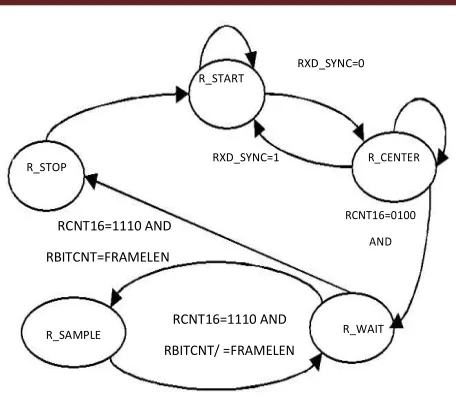
The serial receiver module includes
receiving, serial and parallel transform, and
receive caching, etc. In this paper we use
finite state machine to design, shown in
Figure 3.
Figure 3. UART Receiver State Machine
The state machine includes five states:
R_START (waiting for the start bit),
R_CENTER (find midpoint), R_WAIT (waiting
for the sampling), R_SAMPLE (sampling),
and R_STOP (receiving stop bit). R_START
Status: When the UART receiver is reset,
the receiver state machine will be in this
state. In this state, the state machine has
been waiting for the RXD level to jump over
from logic 1 to logic 0, i.e. the start bit. This
alerts the beginning of a new data frame.
Once the start bit is identified, the state
machine will be transferred to R_CENTER
state. In Figure 3, RXD_SYNC is a
synchronization signal of RXD. Because
when sampling logic 1 or logic 0, we do not
want the detected signal to be unstable. So
we do not directly detect RXD signal, but
R_START
RXD_SYNC=0
R_STOP RXD_SYNC=1 R_CENTER
RCNT16=1110 AND RCNT16=0100
AND
RBITCNT=FRAMELEN
R_SAMPLE
RCNT16=1110 AND
R_WAIT
Available Online At www.ijpret.com
detect the synchronization signal
RXD_SYNC. R_CENTER Status: For
asynchronous serial signal, in order to
detect the correct signal each time, and
minimize the total error in the later data
bits detection. Obviously, it is the most
ideal to detect at the middle of each bit. In
this state, the task is to find the midpoint of
each bit through the start bit. The method
is by counting the number of bclkr (the
receiving clock frequency generated by the
baud rate generator) (RCNT16 is the
counter of bclkr). In addition, the start bit
detected in the R_START may not be a
really start bit, it may be an occasional
interference sharp pulse (negative pulse).
This interference pulse cycle is very short.
Therefore, the signal that maintains logic 0
over 1 / 4 bit time must be a start bit.
R_WAIT Status: When the state machine is
in this state, waiting for counting bclkr to
15, then entering into R_SAMPLE to sample
the data bits at the 16th bclkr. At the same
time determining whether the collected
data bit length has reached the data frame
length (FRAMELEN). If reaches, it means the
stop bits arrives. The FRAMELEN is
modifiable in the design (using the Generic).
In this design it is 8, which corresponds to
the 8-bit data format of UART. R_SAMPLE
Status: Data bit sampling. After sampling
the state machine transfers to R_WAIT
state unconditionally, waits for the arrival
of the next start bit. R_STOP Status: Stop bit
is either 1 or 1.5, or 2. State machine
doesn’t detect RXD in R_STOP, but output
frame receiving done signal (REC_DONE <=
'1 '). After the stop bit, state machine turns
back to R_START state, waiting for the next
frame start bit.
C. Transmit Module
The function of transmit module is to
convert the sending 8-bit parallel data into
serial data, adds start bit at the head of the
data as well as the parity and stop bits at
the end of the data. When the UART
transmit module is reset by the reset signal,
the transmit module immediately enters
the ready state to send. In this state, the
8-bit parallel data is read into the register
txdbuf [7: 0]. The transmitter only needs to
output 1 bit every 16 bclkt (the transmitting
clock frequency generated by the baud rate
generator) cycles. The order follows 1 start
bit, 8 data bits, 1 parity bit and 1 stop bit.
Available Online At www.ijpret.com
the number of logic 1 in 8 data bits. Then
the parity bit is output. Finally, logic 1 is
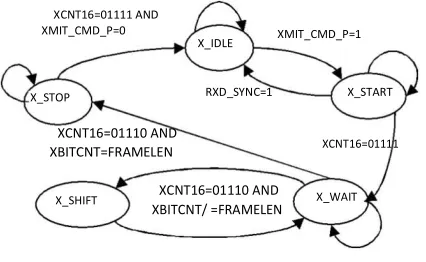
output as the stop bit. Figure 4 shows the
transmit module state diagram.
This state machine has 5 states: X_IDLE
(free), X_START (start bit), X_WAIT (shift to
wait), X_SHIFT (shift), X_STOP (stop bit).
X_IDLE Status: When the UART is reset, the
state machine will be in this state. In this
state, the UART transmitter has been
waiting a data frame sending command
XMIT_CMD. XMIT_CMD_P is a processed
signal of XMIT_CMD, which is a short pulse
signal. Since XMIT_CMD is an external
signal, outside FPGA, its pulse width is
unable to be limited. If XMIT_CMD is valid,
it is still valid after sending one UART data
frame. Then the UART transmitter will think
by mistake that a new data transmit
command has arrived, and once again start
the frame transmit. Obviously the frame
transmit is wrong. Here we limit the pulse
width of XMIT_CMD. XMIT_CMD_P is its
processed signal. When XMIT_CMD_P = '1 ',
the state machine transferred to X_START,
get ready to send a start bit.
X_START Status: In this state, sends a logic 0
signal to the TXD for one bit time width, the
start bit. Then the state machine
transferred to X_WAIT state. XCNT16 is the
counter of bclkt. X_WAIT Status: Similar
with the R_WAIT of UART receive state
machine. X_SHIFT Status: In this state, the
state machine realizes the parallel to serial
conversion of outgoing data. Then
immediately return to X_WAIT state.
X_STOP Status: Stop bit transmit state.
When the data frame transmit is
completed, the state machine transferred
to this state, and sends 16 bclkt cycle logic 1
signal, that is, 1 stop bit. The state machine
turns back to X_IDLE state after sending the
stop bit, and waits for another data frame
transmit command.
III. SIMULATION OF MODULES
XCNT16=01111 AND XMIT_CMD_P=0
X_IDLE XMIT_CMD_P=1
X_STOP RXD_SYNC=1 X_START
XCNT16=01110 AND
XCNT16=01111
XBITCNT=FRAMELEN
X_SHIFT XCNT16=01110 AND X_WAIT
XBITCNT/ =FRAMELEN
Available Online At www.ijpret.com
The simulation software is Quartus II. And
the selected device is Altera’s Cyclone II
FPGA: EP2C5F256C6.
A. Baud Rate Generator Simulation
During simulation, the system clock
frequency is set to 32MHz, and baud rate is
set to 9600bps. Therefore the receiving
sampling clock frequency generated by the
baud rate generator is 153600Hz, which is
16 times of the baud rate. Thus the
frequency coefficient of baud rate
generator can be calculated, which equals
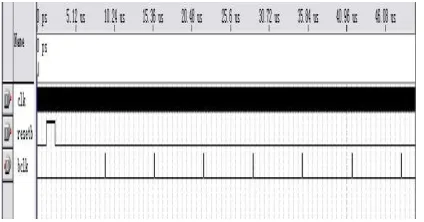
208. Figure 5 shows the simulation result of
baud rate generator. The simulation report
shows that this module uses 42 logic
elements (<1% ), 33 registers (2%), and
meets timing requirement.
Figure 5 Simulation Result of Baud Rate
Generator
B. Receiver Simulation
During receiver simulation, the receiving
sampling clock frequency generated by the
baud rate generator is set to 153600 Hz,
UART receiving baud rate is set to 9600bps.
The input sequence is: 00110110001,
including the start bit 0, parity bit 0 and 1
stop bit. The received data is stored into the
register rbuf. Figure 6 shows the receiver
module simulation diagram. The figure
shows that the data in rbuf from high to low
is 00110110, which is just the part of data
bits of UART frame.
Figure 6 Receiver Simulation Diagram
C. Transmitter Simulation
During transmitter simulation, the sending
clock frequency generated by the baud rate
generator is set to 153600 Hz, and UART
transmitting baud rate is set to 9600bps.
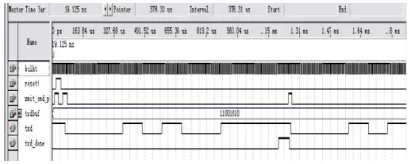
Figure 7 shows the transmitter module
simulation diagram. The simulation report
Available Online At www.ijpret.com
elements(<1%, 13 pins (4%), and meets
timing requirement.
Figure 7 Transmitter Simulation Diagram
D. RTL of Top File
Figure 8 shows the RTL of UART Top File. It
includes the baud rate generator, receiver,
and transmitter modules.
Figure 8 RTL of Top File
CONCLUSION
This design uses VHDL as design language to
achieve the modules of UART. Using
Quartus II software, Altera's Cyclone series
FPGA chip EP2C5F256C6 to complete
simulation and test. The results are stable
and reliable. The design has great flexibility,
high integration, with some reference
value. Especially in the field of electronic
design, where SOC technology has recently
become increasingly mature, this design
shows great significance.
REFERENCES
1. Zou, Jie Yang, Design and Realization of
UART Controller Based on FPGA.
2. Liakot Ali, Roslina Sidek, Ishak Aris,
Alauddin Mohd. Ali,Bambang Sunaryo
Suparjo: Design of a micro - UART for SoC
application [J].In: Computers and Electrical
Engineering 2004; 30: 257–268.
3. HU Hua, BAI Fenge. Design and
Simulation of UART Serial Communication
Module Based on Verilog -HDL [J]. J ISUANJ
I YU XIANDA IHUA 2008; 8.
4. Frank Durda Serial and UART Tutorial.