Available Online at www.ijpret.com
457
APPLIED RESEARCH IN ENGINEERING AND
TECHNOLOGY
A PATH FOR HORIZING YOUR INNOVATIVE WORK
FRAMEWORK OF DATA INTEGRITY VERIFICATION FOR MULTI CLOUDS
USING CPDP SCHEME
KRUNAL N. CHANDEWAR, SHAILESH T. KHANDARE
Master of Engg. in Computer Science & Engg., Sgbau Amravati University BNCOE, Pusad, Yavatmal India.
Accepted Date: 15/02/2014 ; Published Date: 01/04/2014
\
Abstract: Cloud computing has become increasingly popular as it offers users the illusion of
having unlimited computing resources. It also provides greater scalability, availability, and reliability than users could achieve with their own resources. So, Security in terms of integrity is most important aspects in cloud computing environment. In this paper, we address the construction of an efficient PDP scheme for distributed cloud storage to support the scalability of service and data migration, in which we consider the existence of multiple cloud service providers to cooperatively store and maintain the clients’ data.
Keywords: Provable Data Possession, Interactive Protocol, Multiple Cloud, Cooperative, Storage Security, Provable Data Possession
Corresponding Author: MR. KRUNAL N. CHANDEWAR
Access Online On:
www.ijpret.com
How to Cite This Article:
Krunal Chandewar, IJPRET, 2014; Volume 2 (8): 457-464
Available Online at www.ijpret.com
458 INTRODUCTION
Cloud Computing is the internet based storage for files and applications. It is faster profit growth by providing scalability, low cost, pay as much as used at anywhere and any place. Security & integrity of data is most important aspect during data storage in clouds [1].
Cloud computing refers to the delivery of computing resources over the Internet. Instead of keeping data on your own hard drive or updating applications for your needs, you use a service over the Internet, at another location, to store your information or use its applications Doing so may give rise to certain privacy implications. Cloud computing is the delivery of computing services over the Internet. Cloud services allow individuals and businesses to use software and hardware that are managed by third parties at remote locations [3].
Examples of cloud services include online file storage, social networking sites, webmail, and online business applications. The cloud computing model allows access to information and computer resources from anywhere that a network connection is available. Cloud computing provides a shared pool of resources, including data storage space, networks, computer processing power, and specialized corporate and user applications [5].
MOTIVATION
The security of our data is most important aspect and to provide security firstly PDP scheme is proposed. Secondly SPDP scheme is proposed then DPDP scheme is proposed after then CPOR Scheme is proposed and the Limitation of this CPOR scheme is a Lack of some security issues for large files which are removed by our proposed CPDP scheme.
RELATED WORK
1) PROPOSED SYSTEM
In proposed system for integrity verification CPDP Scheme shall be used which will be used for verifying integrity of data in multi cloud using cryptosystem at TTP. For cloud formation, Windows Azure Services Platform Framework shall be used. With the help of Azure emulator, Multi cloud will be formed. Databases will be in MS-SQL.
Available Online at www.ijpret.com
459 integrity and without communication and computation overhead. The final module shall be based on results to show experimental results where encrypted and decrypted data is shown.
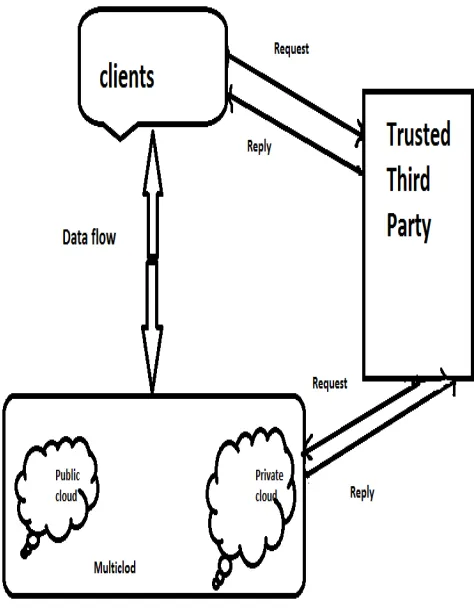
2) SYSTEM ARCHITECTURE
In this architecture, a data storage service involves three different entities:
1. Clients who have a large amount of data to be stored in multiple clouds and have the permissions to access and manipulate stored data .
2. Cloud service providers who work together to provide data storage services and have enough storages.
3. Trusted Third Party who is trusted to store verification parameters.
Available Online at www.ijpret.com
460
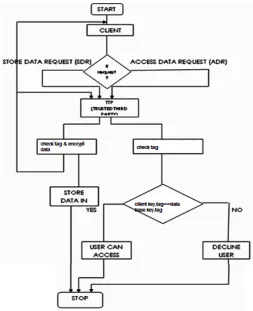
3) FLOW CHART
Fig. 2 Flow of working system
4) WORKING OF ALGORITHM AT TTP
CPDP in Cloud is S = (KeyGen, TagGen, Proof )
KeyGen, (1 ): Takes a security parameter as input, and returns a secret key or a public-secret key pair ( , ).
TagGen ( , ,P): Takes inputs a secret key , a file , and a set of cloud storage providers P = { }, and returns the triples (st,vp,at).
Available Online at www.ijpret.com
Available Online at www.ijpret.com
462
5) SNAP SHOT
Available Online at www.ijpret.com
463 Conclusions
Available Online at www.ijpret.com
464 REFERENCES
1. G. Ateniese et.al., “Provable Data Possession at Untrusted Stores”, 14th ACM Conference on Computer and Communications Security,2007
2. R.D. Pietro et.al.,", Scalable and Efficient Provable Data Possession”,2008
3. C.C. Erway et.al.," Dynamic Provable Data Possession", November 29, 2009
4. A. Juels et.al.,“ Pors: proofs of retrievability for large files”, ACM Conference on Computer and Communications Security, 2007, pp. 584–597.
5. Y. Zhu et.al.“Cooperative Provable Data Possession for Integrity Verification in Multi-Cloud Storage” ,IEEE Transactions On Parallel And Distributed Systems, Digital Object Indentifier 10.1109/TPDS 2012.66 April 2012.
6. Armbrust, et.al.,“Above the clouds: A berkeley view of cloud com-puting,” EECS Department, University of California, Berkeley, Tech. Rep., Feb 2009
7. Bialecki et. al., “Hadoop: A framework for running applications on large clusters built of commodity hardware,”2005
8. Borja et.al., “An Open Source Solution for Virtual Infrastructure Management in Private and Hybrid Clouds”,2009