Chandrabala Kathirvel et al, International Journal of Computer Science and Mobile Applications, Vol.2 Issue. 3, March- 2014, pg. 117-123 ISSN: 2321-8363
©2014, IJCSMA All Rights Reserved, www.ijcsma.com 117
OPTIMIZED HYBRID WIRELESS MESH
PROTOCOL USING ESTIMATION OF PACKET
LOSS RATE ALGORITHM FOR VANET
Chandrabala Kathirvel
1, Dojohn Loyd
21
M.Tech final year, Dept. of CSE, SRM University Ramapuram, [email protected]
2
A.P, Dept. of CSE, SRM University, Ramapuram, [email protected]
Abstract
Vehicular Ad hoc Network (VANET), a new technology, which is a sub class of Mobile Ad hoc network leverages new paradigm in Vehicle to vehicle communication. VANET forms the communication between vehicles with high mobility and dynamic topology through wireless mesh network. While the dynamic topology architecture of VANET affects the communication between nodes, by losing the data packets without reaching to destination node, it turns out to be an important issue. In this paper the link reliability is established in VANET to reduce the packet loss rate. The combination of VANET and Universal Mobile Telecommunication System (UMTS) gives the longer connectivity between vehicles. This research helps in improving the reliability of the Gateway node in VANET – UMTS, increasing the packet delivery ratio and decreasing packet drop ratio. An optimized HWMP, a combination of IEEE802.11p and IEEE802.11s is used as a routing protocol. Real Time Packet Loss Estimation (RPLE) algorithm is used to estimate the packet loss rate, in identifying the gateway node by sending few probe packets. By simulating VANET in NS2, packet loss rate is obtained based on distance. And packet loss rate probability density is found using Gaussian Mixture Model. Experiment results show that an accurate gateway node is identified based on real time packet loss estimation algorithm.
Keywords: Vehicular Ad hoc Network ; UMTS; HWMP; packet loss rate
1. Introduction
Chandrabala Kathirvel et al, International Journal of Computer Science and Mobile Applications, Vol.2 Issue. 3, March- 2014, pg. 117-123 ISSN: 2321-8363
©2014, IJCSMA All Rights Reserved, www.ijcsma.com 118
2. Problem Overview
The existing VANET routing protocols have many disadvantages like
a) The False selection of the node when forwarding a packet to the destination node b) Unused paths when routing which occupies unnecessary bandwidth of the network c) Time to identify the node is high which increases the delay in forming the ad hoc network
d) Flooding up the network by sending many probe packets to identify the relay node and sending the information to the non-efficient node
e) Poor network link quality which leads to the loss of data when transferring f) If traffic density is less the formation of vehicular ad hoc network cannot happen g) High packet loss rate increases the inaccuracy in packet delivery ratio
The issue is to identify gateway node which helps communicating vehicles to UMTS. So this can be achieved based on cluster approach. Each cluster should have cluster header in terms cluster head can be chosen as gateway. Because of the false node selection, the link reliability deteriorates in VANET.
3. Related Works
In a road having two lanes, cars are moving in two different directions, shown in figure 1. It is obvious that connection between vehicles may loss. To resume the communication between vehicles, connectivity to UMTS signal is established through a gateway node. Universal Mobile Telecommunications System (UMTS), is a 3G networking standard which helps VANET to be a connected always when there is no intermediate vehicle by estimation of packet loss rate using Real Time Packet Loss Estimation algorithm.
The VANET – UMTS architecture is established based on the clustering method. Each moving vehicles participates in a cluster. Though VANET has highly dynamic topology forming a cluster should be less dynamic so that overhead on selecting another cluster is reduced. Having a minimal number of clusters reduces the complexity of the network and maintaining the same cluster for some time reduces the overhead. In each cluster, Cluster Header (CH) is identified. Hence we can use cluster head as a gateway node. But there is a chance that Cluster Head does not have privilege to access the network. So the selection of gateway vehicle is important to maintain the link stability.
A study has been done on mobile selection with simple adaptive weighting (SAW) method [2].The metrics such as mobility speed, Received signal strength and link reliability were used in selecting mobile gateway. But the cluster formation becomes overhead in this method. Figure1 VANET – UMTS architecture.
Chandrabala Kathirvel et al, International Journal of Computer Science and Mobile Applications, Vol.2 Issue. 3, March- 2014, pg. 117-123 ISSN: 2321-8363
©2014, IJCSMA All Rights Reserved, www.ijcsma.com 119
Figure1 VANET - UMTS architecture
4. Proposed Solution
4.1 Gateway selection in VANET-UMTS network system
While sending packets from source, gateway node helps in communicating to destination node. In case of failure in connecting with UMTS, Gateway vehicle interacts with peer vehicles. And it is done based on the cluster technology. The clusters in the VANET should be minimal and stable.
GMM model [5] is used in RPLE algorithm [1] to present packet loss rate (PLR) density. Packet loss rate is estimated when selecting the gateway node. Based on the packet loss rate estimation we can select the relay gateway node. Resulted VANET - UMTS architecture, transfers the data with less packet loss rate.
We propose a Gateway selection method, which mainly focus on link reliability so that packet loss rate can be reduced. In the proposed Gateway selection algorithm RPLE (Real time packet loss estimation) parameter has been introduced and given a high priority. In addition to that Received signal strength, route capacity and link stability are also considered. The Simple Additive Weighting (SAW) technique [2] is used to find out the metric score.
4.2 Estimation of packet loss rate using Real Time Packet Loss Estimation (RPLE) algorithm
We use Gaussian Mixture Model to model the packet density function.
Where d is the distance between vehicles, k is the number of Gaussian, is the weight of the i-th Gaussian,
is the mean of each parameter, is the covariance matrix.
Chandrabala Kathirvel et al, International Journal of Computer Science and Mobile Applications, Vol.2 Issue. 3, March- 2014, pg. 117-123 ISSN: 2321-8363
©2014, IJCSMA All Rights Reserved, www.ijcsma.com 120
E step:
Mstep:
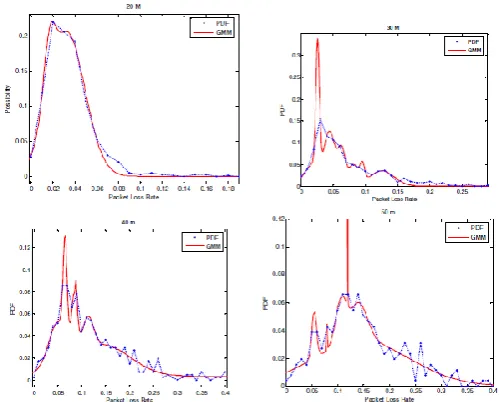
Figure 2 shows the probability density function (PDF) of packet loss rates at different distances ranging 10-20 meters, 20-30 meters, 30-40 meters, and 40-50 meters.
Figure2 GMM and PDF with distance range 10-20m,20-30m,30-40m,40-50 m
4.3 Comparison of Real-time packet loss estimation algorithm with ETX
Chandrabala Kathirvel et al, International Journal of Computer Science and Mobile Applications, Vol.2 Issue. 3, March- 2014, pg. 117-123 ISSN: 2321-8363
©2014, IJCSMA All Rights Reserved, www.ijcsma.com 121
ETX. The error rate is lesser in RPLE. So RPLE is used in estimating the packet loss rate by sending few probe packets. For example if the distance between source and destination node is 10 to 30 meters, the relative error is 30% using RPLE and when the distance is 50 meters the relative error is 45% using ETX.
TABLE1. Comparison between RPLE and ETX
4.4 Simple Additive Weighting Method (SAW) implementation
Each metric such as Received signal strength(x1),route capacity(x2), link stability(x3) and RPLE (x4:Real time packet loss estimation) are weighted based on the priority. When summing up weight of each metric is equivalent to 1. Direct specification [4] method is followed to define the weight factors. Priority factor (pf) selected by source vehicle can be represented as follows, where i is the number of metrics.
Each identified gateway node has final weight value by multiplying metric values and weight factors. In the optimized E-HWMP, RPLE parameter has been given a higher priority which improves the network reliability.
Link Expiration Time (LET) and Route Expiration Time (RET) metrics define the link stability metric. Link lifetime between vehicles is referred as LET and the lifetime of vehicle when passing the UMTS network is referred as RET.
Any source vehicle connects to the UMTS via Cluster Head. Whenever any message has been sent by source vehicle it has time to live (TTL) which informs how many hops can be used to connect gateway node by source vehicle. If neighbour vehicle is not a gateway vehicle it requests for multi hop communication by updating in optimized E-HWMP.
If RPLE is found below the threshold or RSS is found below the threshold then the process of selecting new Gateway node is been started. The process again started by identifying metric score using SAW method.
5. Simulation and Results
We have used Network Simulator (NS2) to simulate the VANET. Clustering technology was implemented by using optimum-EHWMP. All the vehicles are in the same direction and in same cluster which forms a connected network. After implementing optimum – EHWMP, the packet drop ratio and packet delivery ratio are compared with the EHWMP. If the vehicles are outside of the coverage optimum-EHWMP.
Chandrabala Kathirvel et al, International Journal of Computer Science and Mobile Applications, Vol.2 Issue. 3, March- 2014, pg. 117-123 ISSN: 2321-8363
©2014, IJCSMA All Rights Reserved, www.ijcsma.com 122
Figure 3 Packet Drop Ratio vs. various numbers of vehicles sources in VANET
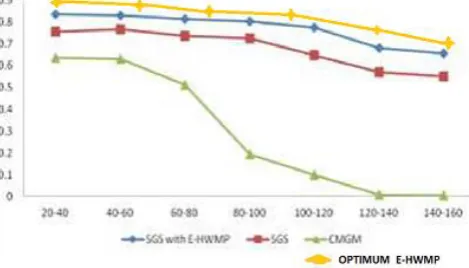
While E-HWMP shows lower performance since only received signal strength, route capacity and link stability are the only parameters that are addressed. In Figure 4, Packet Delivery Ratio is found to be increased in optimum-EHWMP after considering the reliability factor. It is proven that if higher priority factor is given for RPLE then packet delivery ratio is increased. SGS, CMGM [7] shows poor performance when traffic is not dense and vehicles are going in high speed.
6. Conclusion
An additional parameter (Real time packet loss estimation) has been added in optimizing E-HWMP, to select an efficient gateway node to send packets without loss. This is to increase the link reliability and form a multi hop VANET –UMTS network in heavy traffic. And this helps in increasing the packet delivery ratio and decreasing the packet drop ratio in the network. The performance is compared by simulating the network in NS2 and by calculating optimum-EHWMP in Matlab.
Figure 4 Packet Delivery Ratio vs. Ranges of variation in node speed in VANET
References
Chandrabala Kathirvel et al, International Journal of Computer Science and Mobile Applications, Vol.2 Issue. 3, March- 2014, pg. 117-123 ISSN: 2321-8363
©2014, IJCSMA All Rights Reserved, www.ijcsma.com 123
[2] A.Benslimane, T. Taleb, and R. Sivaraj, “Dynamic clustering-based adaptive mobile gateway management in integrated VANET - 3G heterogeneous wireless networks.” IEEE Journal on Selected Areas in Communications, vol. 29, no. 3, pp. 559–570, March 2011.
[3] Amal A. Eltahir, Rashid A. Saeed, Mahmoud A. Alawi, An Enhanced Hybrid Wireless Mesh Protocol (E-HWMP) Protocol for Multihop Vehicular Communications. Computing, Electrical and Electronics Engineering (ICCEEE), 2013 International Conference.
[4] Bai F, Stancil DD, Krishnan H, editors. Toward understanding characteristics of dedicated short range communications (DSRC) from a perspective of vehicular network engineers. Proceedings of the sixteenth annual international conference on Mobile computing and networking; 2010: ACM.
[5] Subasingha, S.; Murthi, M.N.; Andersen, S.V.; “On GMM Kalman predictive coding of LSFS for packet loss”, Acoustics, Speech and Signal Processing, 2009 , pp.4105 – 4108.
[6] Koksal c e, Jamieson k, Telatar e, et al. “Impacts of channel variability on link-level throughput in wireless networks,” Proceedings of ACM SIGMETRICS/Performance, June 26-30, 2006, Saint-Malo, France.2006.
[7] A.Benslimane, T. Taleb, and R. Sivaraj, “Dynamic clustering-based adaptive mobile gateway management in integrated VANET - 3G heterogeneous wireless networks.” IEEE Journal on Selected Areas in Communications, vol. 29, no. 3, pp. 559–570, March 2011.