COMPUTER SCIENCE & TECHNOLOGY
www.computerscijournal.org
December 2014, Vol. 7, No. (3): Pgs. 369-376 An International Open Free Access, Peer Reviewed Research Journal
Published By: Oriental Scientific Publishing Co., India.
Root to Fruit (2): An Evolutionary Approach for
Sorting Algorithms
PRAMOd KAdAM ANd SACHIN KAdAM
BVDU, IMED, Pune, India.
(Received: November 10, 2014; Accepted: December 20, 2014)
AbSTRACT
This paper continues the earlier thought of evolutionary study of sorting problem and sorting algorithms (Root to Fruit (1): An Evolutionary Study of Sorting Problem) [1]and concluded with the chronological list of early pioneers of sorting problem or algorithms. Latter in the study graphical method has been used to present an evolution of sorting problem and sorting algorithm on the time line.
Key words: Evolutionary study of sorting, History of sorting Early Sorting algorithms, list of inventors for sorting.
INTROdUCTION
In spite of plentiful literature and research in sorting algorithmic domain there is mess found in documentation as far as credential concern2. Perhaps this problem found due to lack
of coordination and unavailability of common platform or knowledge base in the same domain. Evolutionary study of sorting algorithm or sorting problem is foundation of futuristic knowledge base for sorting problem domain1. Since sorting
activity is known as pre-requisition or supportive activity (searching, Matching etc.) for the various other computer related activities3. This activity
(sorting) has a distinct place in the computing and programming domain.
It could possible and quit obvious that some of the important contributors or pioneers
name and their contribution may skipped from the study. Therefore readers have all the rights to extent this study with the valid proofs. Ultimately our objective behind this research is very much clear, that to provide strength to the evolutionary study of sorting algorithms and shift towards a good knowledge base to preserve work of our forebear for upcoming generation. Otherwise coming generation could receive hardly information about sorting problems and syllabi may restrict with some major/fundamental algorithms only4. Evolutionary
approach of sorting can make learning process alive and gives one more dimension to student for thinking4. Whereas, this thinking become a mark of
respect to all our ancestors5.
Origin of sorting problem
other side according to mathematician, for sorting there should be exist of the relationship of the total then only sorting is possible .Computing domain basically invented to deal with data or information storing where need of the sorting is like anything for the organizing and managing data .Sorting activity plays vital role in computing context it makes many questions about the easier to answers6.
In this domain, voluminous material is available however still sorting is called as unsolved problem7, which leads the evolutionary study of
sorting. While looking back in the history of sorting there were absence of evidences which can tell us about exact nativity of sorting problem or sorting algorithm.
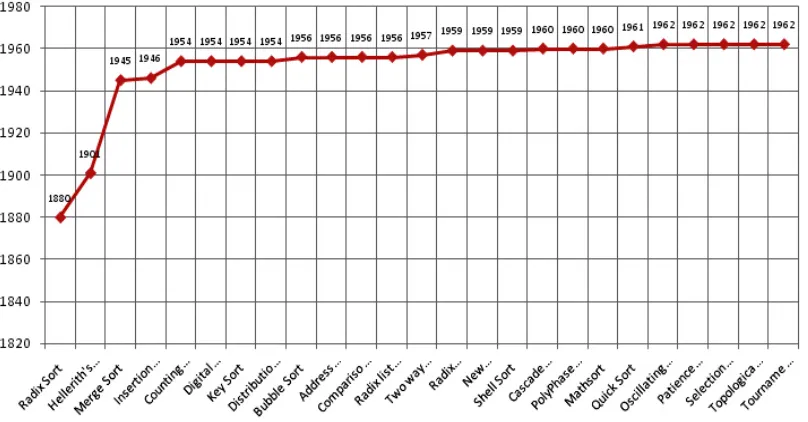
However, in the computing context from the dawn of the computer and computing programming there is involvement of the sorting has been found. First program on the sorting problem was recorded in 1945 by John Van neuman and it was histories first sorting algorithm and it was Merge sort3. Even
before merge sort in 1880, Holirith sorting machine sorting problem was solved by using radix sort therefore in the timeline study of sorting algorithms radix sort comes first3
Origin of sorting algorithms
The story of sorting algorithms starts from the radix sort .Sorting algorithm is the ultimate solution of the sorting problem. search of sorting algorithm or sorting techniques takes us back in the era when development of electronics were in the phase of paradigm shift in data storage and that to ample data comes in the mess due to heavy volume, found efficient technique for handle this data, result in to sorting and searching problem. Further more in this context of the sorting problem a strong evidences found in the mid of ninetieth century .whereas in 1880 for the processing of the large census data of United state, a machine invented by Herman Hollerith, He was an American statistician did work with census department of United state and 100 of his invented machines were used to process on the 1890 census. Hollerith machine includes punch, tabulator and sorters .this machine based on the radix sort and A key idea was that data could be encoded by the locations
of holes in a card. Hollerith determined that data punched in specified locations on a card, in the now-familiar rows and columns, could be counted or sorted mechanically3.
Contribution of Donald Knuth ,Robert Fiendler,L.j.Comrie’s and NIST website in the Computing history and sorting context is really unbeatable .Their Pedagogy, used literature and comments helps us a lot while digging the roots of the sorting algorithms.
In 1938, The idea of merging sort invented by Jame W.Bryce. A machine known as collator use to merge cards from two different stations in the one sorting operation3, 8.
Mean time computer were arrived in picture and designer and programmers of computing machines feel the need of powerful search method and sorting was intimately involved in this development .The first sorting technique was used in “EDVAC” Computer and credit of this invention goes to John Von Neuman
Germany 1945: Scientist K Zuse works independently for the computer z4 which was used for the commercial purpose .He constructed a program s seems Insertion sort.Z4 is also known as world’s first commercial computer.
To -other side a word “Algorithm” joined with the sorting technique after the mid of nineteenth. Even history of the word algorithm is equally interesting. A word algorithm first time traced in 9th
century. This terminology invented by Muhammad Bin Musa al-Khwarizmi (Persian scientist and mathematician)9
Primary concern for sorting algorithms:
By now plenty number of the sorting algorithms and their variants makes domain become rich some of them are better than other .However there is absence of the generalized sorting algorithm which can suits best in the entire or all available situation6
Sr. Sorting Algorithm Inventors Name Invention
No. Year
Radix Sort [10] Herman Hollerith 1880
1 Hellerith's Sorting Machine[3] Herman Hellerith 1901
2 Merge Sort[3] John Van Neumann 1945
3 Insertion Sort(Binary Insertion)[11] john Mauchly 1946
4 Counting Sort[11] Harold H. Seward 1954
5 Digital Sorting[12] 1954
6 Key Sort[13] 1954
7 Distribution sort [14] H.Seward 1954
8 Bubble Sort(Exchange sort) [2] Inverson 1956
9 Address calculation sorting[14] Issac and singleton 1956
10 Comparison Sort [12] E.H.Friend 1956
11 Radix list sort [15] E.H.Friend 1956
12 Two way insertion sort [16] D.J.Wheeler 1957
13 Radix Sort(Modifed)[17] P.Hildebrandt,H.Rising,J Scwartz 1959
14 New Merge Sort [18] B.K. Betz & W.C. Carter 1959
15 Shell Sort [19] Donald L Shell 1959
16 Cascade Merge Sort [20] R.L.GiIstad 1960
17 PolyPhase [20] Merge Sort/Fobinocii Sort R.L.GiIstad 1960
18 Mathsort W.Feurzeig 1960
19 Quick Sort [21](Partition Exchange sort) CAR Hoare 1961
20 Oscillating [22] Merge Sort Sheldon Sobel 1962
21 Patience [23] Sort C. L. Mallow 1962
22 Selection [2] Sort NA 1962
23 Topological Sort Kahn 1962
24 Tournament Sort(tree sort) [21] K.E..Iversion 1962
25 Tree Sort(Modified)[24] K.E..Iversion 1962
26 Shuttle [2] Sort 1963
27 Biotonic Merge sort[25] US Patent3228946(1969)K.E.Batcher 1964
28 Heap Sort [2] J.W.J Willams 1964
29 Theorm H[25] Douglas H.Hunt 1967
30 Batcher Odd-Even Merge Sort[23] Ken Batcher 1968
31 List sort/List merge sort[8] L.J.Woodrum&A.D.Woodall 1969
32 Improved Quick sort[16] Singleton 1969
33 Find:The Program[26] CAR Hoare 1971
34 Odd Even sort/Brick sort/Odd Habermann 1972
even Transport sort[23]
35 Brick sort Habermann 1972
36 Binary Merge sort [27] F.K.Hawang& S.Lin 1972
37 gyrating sort [23] R.M.Karp 1972
38 Binary Merge sort[2] F.K.Hawang& D.N. Deutsh 1973
39 Binary Merge sort[2] C.Christen 1978
40 Binary Merge sort[2] G.K.Manacher 1979
41 Comb Sort[23] W?odzimierz Dobosiewicz rediscovered 1980
by-Steph[26]en Lacey and Richard Box in 1991
42 Proxmap Sort[23] Thomas A. Standish 1980
44 B Sort[23] Wainright 1985
45 Unshuffle Sort[23] Art S. Kagel 1985
46 Qsorte [2] Wainright 1987
47 American Flag Sort[12] 1993
48 qsort7 [16] Benteley & Mcilroy 1993
49 New Efficient Radix Sort[17] Arne Anderson & Stefan Nilson 1994
50 Self Indexed sort(SIS)[28] Yingxu Wang 1996
51 Splaysort[23] Moggat, Eddy & Petersson 1996
52 Flash Sort[23] Karl-Dietrich Neubert 1997
53 Introsort David Musser 1997
54 Gnome Sort[23] Dr. Hamid Sarbazi-Azad 2000
55 Tim sort[29] Tim Peters 2002
56 Spread sort[7] Steven J. Ross 2002
57 Tim sort [2] Tim Peters 2002
58 Bead Sort[30] Joshua J. Arulanandham, Cristian S. 2002
Calude and Michael J. Dinneen
59 Burst Sort[31] Ranjan sinha 2004
60 Libarary Sort/Gapped Insertion sort[32] Michael A. Bender, Martín 2004 Farach-Colton, and Miguel Mosteiro
61 Cycle Sort [33] B.K.Haddon 2005
62 Quicker sort [12] R.S. Scowen 2005
63 Pancake sorting[23] Professor Hal Sudborough 2008
64 U Sort [34] Upendra singh aswal 2011
65 Counting Position Sort [35] Nitin Arora 2012
66 Novel Sorting Algorithm [36] R.Shriniwas & A.Raga Deepthi 2013
67 Bogo Sort(Monkey sort/ NA NA
Slow sort/Stupid Sort)[13]
68 Bucket Sort [11] NA NA
69 J Sort[23] Jason Morrison NA
70 SS06 Sort [16] K.K.Sudharajan & S.Chakraborty NA
71 Stooge Sort[23] Prof.Howard Fine and Howard NA
72 Strand Sort[23] NA NA
73 Trim Sort[23] NA NA
74 Punch Card Sorter[2] A. S. C. Ross NA
CONCLUSION
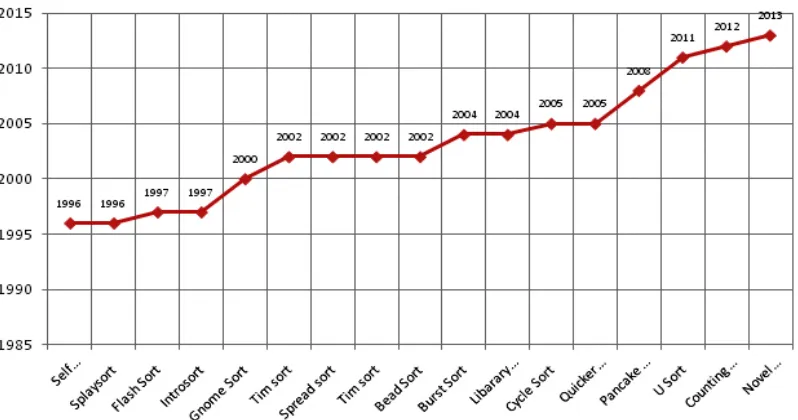
Most of the sorting algorithms were invented in the period of 1954 to 1985 and radix sort is first sorting algorithm which was used commercially in 1980 census machine which was invented by Herman Hollirith . Whereas, the search
Fig. 1: Evolutionary Graph for Sorting Algorithms
Fig. 3: Sorting Algorithms (1962-1994)
1. Kadam, P.K.a.S., Root to Fruit (1): An Evolutionary Study of Sorting Problem. Oriental Journal Of Computer Science & Technology, 7(1): p. 111-116 (2014). 2. Astrachan, O., Bubble Sort: An Archaeological
Algorithmic Analysis. 2003.
3. E.Knuth, D., The art of Computer programming Vol.3 Sorting and Searching 2ed. The art of computer programming. Vol. 3. 2006, New Delhi: Pearson Education 780.
4. Impagliazzo, J., Using History in Computing Courses, in 35th ASEE/IEEE Frontiers in Education Conference. 2005, IEEE: Indianapolis, IN.
5. LEE, J.A.N., Those Who Forget The Lessons of History, or Why I Study the History of Computing. IEEEAnnals ojthe History of
Computing, 18(2): p. 9 (1996).
6. Levintin, A., Introduction to Design and analysis of Algorithms. Second Edition ed. 2013, New Delhi: Pearson.
7. R.G.Dromy, How to solve it by computer. 8 ed. 2009, New Delhi: Pearson Education. 442.
8. H.Lorin, A guided bibliography to sorting.
IBM Sys J, 3: p. 11 (1971).
9. Wikipedia.2014
10. Seward, H.h., Information Sorting In The Application Of Electronic Digital Computers To Business Operations, In Digital Computer Laboratory 1954, Massachusetts Institute Of Technology Cambridge 39,: Massachusetts. P. 68.
11. T.Heineman, G., Sorting Algorithms, in Algorithms in a Nutshell. 2007, O Reilly. 12. C.Singleton, R., ALGORITHM 347:AN
EFFICIENT ALGORITHM FOR SORTING W I T H M I N I M A L S TO R AG E [ M 1 ] .
Communication of the ACM, 12(3): p. 3
(1969).
13. Hermann Gruber, M.H.a.O.R., Sorting the Slow Way: An Analysis of Perversely Awful Randomized Sorting Algorithms.
14. Knuth, D.E., The ar t of computer programming:Fundamental Algorithms. Third Edition ed. Vol. 1. 2002, New Delhi: Pearson Education.
15. Peter M. McIlroy , K.B., M. Douglas McIlroy, Engineering Radix Sort. Computer Science Research Group,University of California at Berkeley and AT&T Bell Laboratories: p. 15.
16. Khreisat, L., QuickSor t A Historical Perspective and Empirical Study. IJCSNS International Journal of Computer Science and Network Security, 7(12): p. 12 (2007). 17. Nilson, A.A.a.S. A new efficient Radix sort.
in 35th ANNUAL IEEE Symposium On Foundation Of Computer Scince. Sweden (1994).
18. C.Carter, B.K.B.a.W., New Merge Sorting Techniques. 14th national meeting for ACM, 1959: p. 4.
19. .Goodrich, M.T., Randomized Shellsort: A Simple Data-Oblivious Sorting Algorithm. ACM, 2011. 58(6): p. 26.
20. R.L.Gilstad, Polyphase Merge Sorting — An Advanced Technique. Computer History Museum (www.computerhistory.org), NA: p. 6.
21. Hoare, C.A.R., Algorithm 64:Quicksort. Communication of the ACM, p. 2 (1961). 22. B . G . T. L o w d e n , D i s c u s s i o n a n d
correspondence a note on the oscillating sort. The computer Journal. 20(1): p. 5. 23. Lankham, A.B.a.I., Restricted Patience
Sorting and Barred Pattern Avoidance. Formal Power Series and Algebraic Combinatorics S´eries Formelles et Combinatoire Alg´ebrique San Diego, California, 2006: p. 12.
24. Mishra, A.D., Selection of Best Sorting Algorithm for a Particular Problem, in Computer science and Engineering Department. June 2009, Thapar University: Patiala. p. 60.
25. Pieterse, P.E.B.a.V. Dictionary of algorithms and data structures. 2014 [cited 2014 15 dec 2014]; Available from: http://www.nist. gov/dads/HTML/sort.html.
26. Hoare, C.A.R., Proof of a program:Find. Communication of the ACM, 1971. 14(1): p. 7.
27. Tim Bell, B.A., Sorting Algorithms as
Special Cases of a Priority Queue Sort, in SIGCSE11. 2011, ACM: Dallas, Texas, USA. p. 6.
28. Wang, Y., A New Sort Algorithm: Self-Indexed Sort, in comunication with ACM. March 1996, Communications of ACM SIGPALN. p. 9. 29. peters, T., Tim sorting. 2002.
30. Joshua J. Arulanandham, C.S.C., Michael J. Dinneen, Bead–Sort: A Natural Sorting Algorithm. In The Bulletin of the European Association for Theoretical Computer
Science 76, p. 10 (2002).
31. Steffen Heinz, J.Z.H.E.W., Burst Tries: A Fast, Effcient Data Structure for String Keys. ACM: p. 31.
32. Mansi, J.A.a.R., An Enhancement of Major Sorting Algorithms. The International Arab
Journal of Information Technology, 7(1): p.
8 (2010).
33. B.K.Haddon, Cycle sort:A linear sorting method. The computer Journal, 33(4): p. 3 (1990).
34. Upendra Singh Aswal, K.C.P., Sujata Negi Thakur, A New Sorting Algorithm(named ‘U’ Sort). International Journal of Engineering
Science and Technology (IJEST). 3(9): p. 5
(2011).
35. NitinArora, V. Kumar, and S. Kumar, A Novel Sorting Algorithm and Comparison with Bubble sort and Insertion sort. International
Journal of Computer Applications, 45(1): p.
2 (2012).
36. R.Srinivas and A.R. Deepthi, Novel Sorting Algorithm. International Journal on Computer
Science and Engineering (IJCSE), 5(1): p. 4