S. Arun Joe Babulo et al, International Journal of Computer Science and Mobile Applications, Vol.2 Issue. 3, March- 2014, pg. 42-46 ISSN: 2321-8363
©2014, IJCSMA All Rights Reserved, www.ijcsma.com 42
Stock Market Indices Prediction with
Various Neural Network Models
S. Arun Joe Babulo
1, B. Janaki
2, C. Jeeva
31
Assistant Professor, Department of Computer Science, Sri Vijay Vidyalaya College of Arts and Science, Dharmapuri
2,3
M.Phil., Department of Computer Science, Sri Vijay Vidyalaya College of Arts and Science, Dharmapuri [email protected]
Abstract
Stock market Indices prediction is one of the most important issues in the financial field. Although many prediction models have been developed during the last decade, they suffer a poor performance because indices movement is highly non stationary and volati le dynamic process. Artificial Neural Network (ANN) is a technique that is heavily researched and widely used in stock market prediction [1][6]. However, there is no formal method to determine the optimal neural network for prediction purpose in the literature. This paper describes various Neural Network models for stock prediction. The prediction was done by, Modular Neural Network, ARIMA-based Neural Networks, Genetic Algorithm, Recurrent Network, Back propagation Network, Radial Basis Function, Branch Network, Functional Link Artificial Neural Network, Feed Forward Neural Network, Fuzzy Neural Network etc [8]. Analysis of all these Neural Network models is performed in this paper, as well as the future work.
Keywords: Stock prediction, ANN, RBF, Genetic algorithm, fuzzy
1.
Introduction
Stock price prediction is an important field of research in finance because if the market is successfully predicted then the investors may get maximum returns. The stock market or equity market is a public market where a large amount of capital is invested and traded everyday all over the world. Many researchers claim that the market is dynamic, non-linear, complicated and chaotic in nature. So it is difficult to deal with normal analytical methods like time series analysis. These chaos systems are sensitive to initial conditions. So the neural networks are effective to deal with such a non-linear system. However financial time-series are difficult to forecast because these are noisiest and non-stationary signals [Oh and Kim, (2002)]. Some common financial time-series are currency exchange rates, interest rates, stock prices etc. A number of researchers have given their view on Efficient Market Hypothesis (EMH) [Lowe and Webb, (1991)]. EMH states that the market is efficient so it cannot be predicted because when new information arises, the market corrects itself and absorbs it [Malkiel, (1999)]. There is no such information to predict the market in such a way that the investors earn greater profits from stock market. In the recent years, many researchers claimed that the EMH must be false. From the last years many researches are on this field, still it remains a big task whether the market can be correctly predicted or not. To predict the stock market accurately, various prediction algorithms and models have been proposed by many researchers in both academics and industry using Artificial Neural Network. This paper focus on various Neural Network models used for stock market indices prediction, their accuracy level and the future work to be performed to improve accuracy.
2. Neural Networks
S. Arun Joe Babulo et al, International Journal of Computer Science and Mobile Applications, Vol.2 Issue. 3, March- 2014, pg. 42-46 ISSN: 2321-8363
©2014, IJCSMA All Rights Reserved, www.ijcsma.com 43
before the estimation of the parameters is done and generally it happens that pre-specified nonlinear models may fail to observe the critical features of the complex system under study.
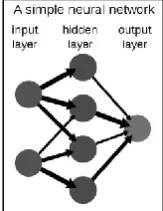
Figure 1: Simplified view of a feed forward artificial neural network
Neural networks are data driven models. Unlike, traditional time series models. The novelty of the neural network lies in their ability to discover nonlinear relationship in the input data set without a priori assumption of the knowledge of relation between the input and the output (Hagen et al., 1996), rather the input variables are mapped to the output set by squashing or transforming by a special function known as activation function. They independently learn the relationship inherent in the variables which involves modification of the network parameters from a set of labeled training example. From statistical inference neural networks are analogous to nonparametric, nonlinear, regression model. However, unlike the neural network models, the traditional statistical models have limitations in understanding the relationship between the input and the output of the system because of the complex and chaos nature of the system.
Neural Networks have a capability to adapt the network parameters to the changes in the studied system. A neural network trained to a particular input data set corresponding to a particular environment that can be easily retrained to a new environment to predict at the same level of environment. Moreover, when the system under study is non-stationary and dynamic in nature, the neural network can change its network parameters (synaptic weights) in real time.
So, neural network suits better than other models in predicting the stock market returns [2][3].
3. Various Models of Neural Networks
3.1 Modular Neural Network
Title: Stock Market Prediction System with Modular Neural Networks, Takashi Kimoto and Kazuo Asakawa[4]
It is based on Modular Neural Network. The input consists of several technical and economic indexes. It converts the technical indexes and economic indexes into a space pattern to input to the NN. For high speed learning with a large volume of data they developed method called supplementary learning.
The prediction system achieved accurate predictions and the simulation on stocks trading showed an excellent profit. The rules of stock price fluctuations were extracted by cluster analysis.
This system uses future returns to generate teaching data. A system in which a teaching data can be generated in combination with a statistical method can be developed.
3.2 ARIMA based neural Networks
Title: A Stock Market Trend Prediction Using ARIMA-based Neural Networks, Jung-Haul Wang and Jia-Yann Leu [5] They developed a ARIMA based prediction system that uses the recurrent NN and proposed modified back propagation training algorithm. ARIMA is autoregressive integrated moving average, linear non stationary model. The autocorrelation function (ACF) is used to determine whether a series stationary or non-stationary.
ARIMA based recurrent NN with 7 hidden nodes is trained results shows that the networks trained using 4-year weekly data is capable of predicting up to 6 weeks market trend with acceptable accuracy.
The prediction accuracy can be improved by adding other feature data such as trading volume, interest rates etc.
3.3 Back propagation ANN
S. Arun Joe Babulo et al, International Journal of Computer Science and Mobile Applications, Vol.2 Issue. 3, March- 2014, pg. 42-46 ISSN: 2321-8363
©2014, IJCSMA All Rights Reserved, www.ijcsma.com 44
The highest performance of the network in terms of accuracy in predicting the direction of the closing value of the index is reported at 89.65% and with an average accuracy of 69.72% over a period of 4 years.
Other macro-economic factors and other international stock market data as input variables can also be used as input variables in order to improve the accuracy of the model. Application of chaos Theory, Fractal analysis and wavelet analysis in feature selection of the input data set will also give a possibility of improvement in the performance.
3.4 Radial Basis Function
Title: Forecasting closing price indices using neural networks, P.B.Patel, T.Marwala [11][9]
This paper proposes an application, which employs artificial neural networks that could be used to assist investors in making financial decisions. The multi-layer perceptron as well as Radial Basis Function neural network architectures are implemented as classifiers. The Dow Jones Industrial average, Johannesburg Stock Exchange All Share, Nasdaq 100 and the Nikkei 225 Stock Average indices are considered.
The best and worst forecasting classification accuracies obtained were 72% and 64% respectively. These accuracy levels were attained for the Dow Jones Industrial Average and Nikkei 225 stock Average indices, respectively.
The accuracy could be improved by employing a genetic algorithm to create the optimal ANN architecture.
3.5 Multi-layer Perceptron & Recurrent Network
Title: Stock Market Value Prediction Using Neural Networks, Mahdi PakdamanNaeiniet.al,[7]
In this paper, two kinds of neural networks, a feed forward Multi-Layer Perceptron (MLP) and an Elman recurrent network, are used to predict a company’s stock value based on its stock share value history. The experimental results show that the application of MLP neural network is more promising in predicting stock value changes rather than Elman recurrent network and linear regression method. However, based on the standard measures that will be presented in the paper we find that the Elman recurrent network and linear regression can predict the direction of the changes of the stock value better than the MLP. In future works regression methods such as Support Vector Regression models which are newer in the field of machine learning researches and claimed to have good generalization ability due to application of large margin concept.
3.6 Branch Neural Networks
Title: Branch Neural Networks (MBNNs) to Stock Market Prediction, Takashi Yamashita, Kotaro Hirasawa [9]
MBNNs are constructed using multi-branches between nodes, which add additional nonlinear functions to the branches of the networks. A benefit of MBNNs is gained by the smaller network size with smaller number of hidden nodes.
The result shows that MBBNs could have better accuracy stably with fewer parameters than conventional NNs when predicting TOPIX at t+1.
Construction of dealing system- the prediction itself could be useful for dealing the stock.
3.7 Functional Link ANN
Title: Development of Improved Artificial Neural Network Model for Stock Market Prediction, Pratap Kishore Padhiary et al. [12]
The proposed trigonometric functional link artificial neural network (FLANN) model employs standard Least Mean Square (LMS) algorithm with search-then-converge scheduling which could effectively calculate learning rate parameter that changes with time and may require less experiments to train the model. The objective of this paper is to introduce a functional link single layer artificial neural network (FLANN) for long term as well as short term stock market prediction.
In future work it can be coming up with a developed forecasting model which involve less computational load, fast forecasting capability and which requires less experiments to train the model and will focus on long term prediction of stock price of stock market.
3.8 ANN and Genetic Algorithm
Title: A fusion model of HMM, ANN and GA for stock market forecasting, Md. Rafiul Hassan *, BaikunthNath, Michael Kirley
In this paper they propose and implement a fusion model by combining the Hidden Markov Model (HMM), Artificial Neural Networks (ANN) and Genetic Algorithms (GA) to forecast financial market behavior. The developed tool can be used for in depth analysis of the stock market.
S. Arun Joe Babulo et al, International Journal of Computer Science and Mobile Applications, Vol.2 Issue. 3, March- 2014, pg. 42-46 ISSN: 2321-8363
©2014, IJCSMA All Rights Reserved, www.ijcsma.com 45
of the price differences of similar patterns is obtained to prepare a forecast for the required next day. Forecasts are obtained for a number of securities in the IT sector and are compared with a conventional forecast method.
In this paper I described a novel time series forecasting tool. The fusion model combines a Hidden Markov Model (HMM), Artificial Neural Networks (ANN) and Genetic Algorithms (GA) to forecast financial market behavior. As a result we find that the performance of the fusion tool is better than that of the basic model (Hassan & Nath,2005) where only a single HMM is used in a novel approach to forecast stock price.
To evaluate the efficacy of the fusion model we compare the obtained forecast accuracy with that of a popular statistical forecasting tool. The comparison shows the forecasting ability of the fusion model is as good as that of ARIMA model. Additionally, the proposed fusion model can be used without analyzing the dataset prior to the forecast. That is users do not have to have carry out seasonality tests, regime analysis or cycle analysis before adopting the model.
However, in the proposed fusion method, to simplify the implementation we have chosen the number of states as the number attributes in the observation vectors. This may not be suitable for some instances. To solve this, we plan to employ another GA to find the best HMM architecture for a given dataset.
3.9 Machine Learning Algorithm:
Title: Stock Market Forecasting Using Machine Learning Algorithms, Shunrong Shen, Haomiao Jiang*,Tongda Zhang To predict the movement of stock market using machine learning algorithms such as support vector machine (SVM) and reinforcement learning.
We propose the use of global stock data in associate with data of other financial products as the input features to machine learning algorithms such as SVM.A new prediction algorithm that exploits the temporal correlation among global stock markets and various financial products to predict the next-day stock trend with the aid of SVM. Numerical results indicate a prediction accuracy of 74.4% in NASDAQ, 76% in S&P500 and 77.6% in DJIA. The same algorithm is also applied with different regression algorithms to trace the actual increment in the markets.
On the average, our model gains 814.6 dollars as profits for every 50 days. That is 8% return rate in 50 days. Therefore, we can reach annual interests at about 30%.
Besides high profit, our model also has the advantage of low risk. Our model seldom loses in trading period while benchmark model 1 and benchmark model 2 loses in period 3 and 5. Actually, in most cases, our model can get at least 5% profits in the 50 day long trading period.
3.10 Combinatorial Algorithm
Title: Financial Stock Market Forecast Using Data Mining Tools, K. Senthamarai Kannan, P. Sailapathi Sekar, M.Mohamed Sathik and P. Arumugam
Five methods of analyzing stocks were combined to predict if the day’s closing price would increase or decrease. These methods were Typical Price (TP), Bollinger Bands, Relative Strength Index (RSI), CMI and Moving Average (MA). This paper discussed various techniques which are able to predict with future closing stock price will increase or decrease better than level of significance.
A profitable signal for Moving average as 52.62% and comparing to it, my algorithm BSRCTB have a profitable signal of 58.25%.All the methods are being used with a sample of 400 signals. When we take Moving Average (MA), it is found that the profitable signal produced is 60%. By using Bollinger Bands we are getting a profit of84.24%. Using Chaikin Money Flow Indicator (CMI) we are getting a profit of 51.45%. The profit percentage of Relative Strength Index (RSI) method is 56.04%. The Stochastic Momentum Index produces a result of profitable signals as100%. So we can find out that the SMI and Bollinger Bands could produce more profitable signals.
3.11 k-Nearest Neighbor Algorithm
Title: Classification of stock Index Movement Using k-Nearest Neighbor Algorithm, M.V.Subha, S.Thirupparkadal nambi. The predictability of stock index movement of the popular Indian Stock Market indices BSE-SENSEX and NSE-NIFTY are investigated with the data mining tool of k-Nearest Neighbors algorithm (k-NN) by forecasting the daily movement of the indices. To evaluate the efficiency of the classification technique, the performance of k-NN algorithm is compared with that of the Logistic Regression model.
The results of k-NN forecasting model is very encouraging as the forecasting errors such as the root mean squared errors and relative absolutes errors are very small for both BSE-SENSEX and NSE-NIFTY.
S. Arun Joe Babulo et al, International Journal of Computer Science and Mobile Applications, Vol.2 Issue. 3, March- 2014, pg. 42-46 ISSN: 2321-8363
©2014, IJCSMA All Rights Reserved, www.ijcsma.com 46
4. Conclusion
The problem of stock index prediction is one of the most popular targets for various prediction methods in the area of finance and economics. In the past many Computational Intelligence techniques have been applied to this task including neural networks, fuzzy and hybrid models or genetically developed prediction rules. Despite enormous previous efforts and a wide range of methods applied to this problem, efficient stock market prediction remains a difficult task mainly due to complex and varying in time dependencies between factors affecting the price.
References
[1] Mizuno, Kosaka, Yajima and Komoda, 1998, “Application of NEURAL NETWORK to technical analysis of stock market prediction”, Vol.7, pp. 111-120
[2] Michalak, Lipinski, 2005, “Prediction of high increases in stocks price using Neural Network”, Vol.15, pp. 359-366
[3] Wong, Bodnovich, Selvi, 1997, “Neural Network application Neural Network business”,vol.19, pp 301-320
[4] Takashi Kimoto and Kazuo Asakawa, 1990, ” Stock Market Prediction System with Modular Neural Networks” (TOPIX- Tokyo Stock Exchange Prices Indexes), Proceedings of the International Joint Conference on Neural Networks
[5] Jung-Hua Wang and Jia-YannLeu, 1996 IEEE,” A Stock Market Trend Prediction Using ARIMA-based Neural Networks” [6] JacekMa´ndziuk and MarcinJaruszewicz, 2007 IEEE “ Neuro-evolutionary approach to stock market prediction”
[7] Ken-ichiKamijo and TetsujiTanigawa, 1990, “Stock price pattern reorganization: A recurrent neural network approach”, International Organization of Scientific Research (IOSR)
[8] Jose A.B. Tome and Joao Paulo Carvalho, 2002 work partially supported by FTP project, ”Market Index prediction using fuzzy Boolean Nets ”
[9] Takashi Yamashita, Kotaro Hirasawa, Jinglu Hu, 2007 IEEE, “Application of Multi-Branch Neural Networks to Stock Market Prediction”
[10] P. B. Patel, Member, IEEE and T. Marwala, ” Forecasting closing price indices using neural networks” [11] Manna Majumder, Anwar Hussain, “Forecasting of Indian Stock market Index using Artificial Neural network”