_____________________________________________________________________________________________________
*Corresponding author: E-mail: [email protected];
(Past name: British Journal of Pharmaceutical Research, PastISSN: 2231-2919, NLM ID: 101631759)
Effect of Play Therapy on Social Development: A
Randomized Controlled Trial
Malihe Masoudifard
1, Zohreh Mahmoodi
2*, Azam Bagheri
3, Mahrokh Dolatian
4and Kourosh Kabir
21Student Research Committee, Alborz University of Medical Sciences, Karaj, Iran. 2Social Determinants of Health Research Center, Alborz University of Medical Sciences, Karaj, Iran. 3Department of Midwifery, School of Nursing and Midwifery, Kashan University of Medical Science,
Kashan, Iran.
4
Midwifery and Reproductive Health Research Center, School of Nursing and Midwifery, Shahid Beheshti University of Medical Sciences, Tehran, Iran.
Authors’ contributions
This work was carried out in collaboration among all authors. Author MM designed the study, wrote the protocol and wrote the first draft of the manuscript. Author ZM performed the statistical analysis. Author AB managed the analyses of the study and performed sampling. Author AD managed the literature searches, performed sampling. Author KK managed of the study, edited the manuscript wrote the manuscript. Author ZM and MM wrote, submitting and editing manuscript. All authors read and approved the final manuscript.
Article Information
DOI: 10.9734/JPRI/2019/v29i430244 Editor(s): (1) Dr. Wenbin Zeng, Professor, Xiangya School of Pharmaceutical Sciences, Central South University, Changsha, China. Reviewers: (1) Rajathi Sakthivel, The Tamil Nadu Dr. M.G.R. Medical University, India. (2)Kim Yun Jin, Xiamen University Malaysia, Malaysia. Complete Peer review History:http://www.sdiarticle3.com/review-history/51059
Received 15 June 2019 Accepted 23 August 2019 Published 30 August 2019
ABSTRACT
Background: The early years of life are vital and sensitive for the growth and development of a child. This aimed to examine the effect of play therapy on the social development and maturity of infants aged from 12 to 24 months.
Methods: This study was a randomized controlled trial conducted on 76 eligible infants aged from 12 to 24 months referred to comprehensive health centers in Kashan city during 2017-2018. Infants who had inclusion criteria were included in the study and then randomly assigned to the two groups of intervention and control. Before the intervention and the end of the counseling sessions,
Vineland Social Maturity Test Toolkit for Children in the both groups was completed and the data were analyzed using SPSS software.
Results: There was no significant differences between the two groups regarding the social development score before the intervention (p >0.001). There was a significant difference between the mean score of social development in the two groups after the intervention, in which the mean of the total score and each area of social development increased significantly (P <0.001).
Conclusion: Considering the importance of the early years of life in the development of infants and findings of the present study, it can be said that the advisory of play therapy for improving the development of a infants can be very helpful.
Keywords: Play therapy; social development; play; randomized controlled trial.
1. INTRODUCTION
Children's health is very crucial matter for the health system, not only because today's children are the next generation, but also because the health of each child at an early age is based on the health of puberty. Therefore, investing in
children's health has beneficial effects,
particularly on the future health of a country and the future of the citizen's function in the country [1]. The effects of the first months and years of the child's life can continue throughout life [2]. The evolution and growth of humans during childhood in terms of social, emotional, cognitive
and physical development has some
characteristics making the child vulnerable to mental health [3]. Social development implies the individual's sophistication in social relations, so that he can be consistent with other people. In other words, they call a social person while it may not only be with others, but also contribute them [4].
There are several ways to strengthen and enhance the development and growth of children including providing educational environments and behavioral interventions by skilled and expert people, but these are very expensive and require specialized clinics that may not be available to everyone. However, interventions that often focus on parent-child interaction and collaboration, including play therapy can be very effective and cost-beneficial [5].
Play is the natural world for a baby. In 1989, the Office of the United Nations High Commissioner for Human Rights recognized the playing as a right for all children to achieve the desired advancement everywhere. In 2007, the American Academy of Pediatrics published an article on the importance of playing for growth of healthy children [6].There is a mediator effect between the parents and children to help the growth of the Childs’ social dimension. Playing has been
described as the basis for the personal and social differences of the children [5]. Numerous researchers have identified parent's education as the first intervention and the most effective way to provide basic services [7]. The appropriate relationship between mother and child can substantially pave the way for future maternal contributions in evolution and bring satisfactory effects on other aspects and functions of the child even in adulthood and his/her relationship with others [8].
Meanwhile, health care providers and advisers have a wide range of roles such as counseling,
education, care, support, treatment, and
research. Most of these roles are conceptualized in relation to the mother and the child.
Considering the mentioned issues, the
importance of attention to the social health and social development of children is an important and effective factor in the development of children. This study aimed to investigate the effect of therapeutic counseling on the growth and development of 12-24 months’ children
referred to the selected centers of
comprehensive health services in Kashan city.
2. METHODS
2.1 Design
This study was a randomized controlled trial carried out on children aged from 12 to 24 months referred to the selected comprehensive health centers in Kashan city in 2017-2018.
2.2 Sample Size
The sample size based on the formula was obtained using the G power software by the following parameters:
Inclusion criteria were having at least reading and writing skills of Iranian parents; children aged from 12 to 24 months whose social ages were less than the 2nd year of their calendar age according to the Vineland social maturity scale and their age (grade 8 and Lower), lack of known physical, psychological disorder, child and
parental disorders, parental consent to
participate in the study.
Exclusion criteria were mothers who were not satisfied with continuation in the study and who would not participate in the two sessions of the play therapy counseling sessions.
2.3 Data and Measures
The data were collected using Vineland social maturity scale in the two stages before and after the intervention.
The Vineland social maturity scale is one of the evolutionary scales measuring the ability of an individual to meet his/her practical needs
and being responsible. Although, this
scale includes the age range of birth up to 25 years old, and there is a separate question up to 12 years old for each year. However, about age range of 12-15, 15-18, 18-20, 20-25, and from 25 to older, it has been shown that
effectiveness of this scale is low. In each area, required information obtained through
interviews with the parents of the children. The basis of the scale is what a person can do every day. This scale has been divided into eight domains of self-help Genera, self-help in eating,
self-help in dressing, self-management,
occupation, linguistic communication,
loco-motion and socialization [9]. Validity and reliability of this questionnaire in Iran have been reviewed and verified by researchers [10]. In the present study, the reliability of this scale was re-evaluated by Cronbach's alpha test and the result was 0.99. To get the social growth score, all scores from each question summed up (Yes=1 score, Sometimes=0.5 score, and No=0 score) [10].
2.4 Procedure
First, the researcher referred to the selected center of Kashan city. The goals of the study were expressed to the participants. Then, participants according to block randomization were divided into the two groups. Allocating subjects to the study groups (intervention and
control) was done using six blocks. This was
done with WinPepi11.0 software
(http://www.brixtonhealth.com/pepi4windows.htm l). This software generates random groups.
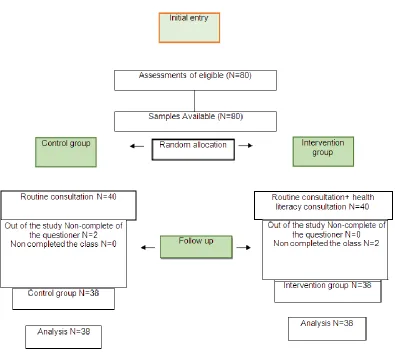
In the course of the study, 318 children aged from 12 to 24 months were enrolled in the study. Only 80 of them were eligible according to the scale of the Vineland questionnaire. The score obtained from the Vineland questionnaire before the intervention was considered as the base score for comparison. In the control group, routine child care was done.
In the control group, a training package containing all the materials presented in the intervention group, in addition to routine child care was considered. Also, 6 sessions of 30 minutes and a weekly bipartite, group therapy
counseling session were presented in
accordance with the treatment protocol of the Ministry of Health [11]. Consultations were conducted on the two separate days. During the study, 4 people due to losing one or two sessions, the failure of participating in playing games, or unwilling to use a training package were excluded from the study and eventually from both groups, information of 38 patients were included (Fig. 1).
The topics discussed in each consultation are as follows: First session: introduction, reinforcing mothers' communication skills. Second session:
strengthening child's general self-help,
strengthening child language. Third session: strengthening, self-help in eating, strengthening,
self-help in dressing Fourth session:
strengthening, self–direction, strengthening and occupation. Fifth session: strengthening the baby's movement and locomotion. Sixth session: selective games to strengthen scope of development.
Fig. 1. Consort flow chart
3. RESULTS
Intention to treat analysis (ITT) considered dealing with noncompliance and missing.
3.1 Outcomes in our RCT
In this study, the results of study on 76 children aged from 12 to 24 months who remained until the end of the study were examined in the two groups. After checking the normality distribution, the variables were analyzed by Wilcoxon, Fisher exact and Chi-square tests. Quantitative and categorical variables of children in the two groups did not show any significant difference. In other words, the two groups were homogenous in terms of variables, but there was a significant difference in terms of the variable of height at birth and head circumference while there was a significant difference between the two groups in terms of the mean height at birth and the mean duration of the study period in the control group (Table 1).
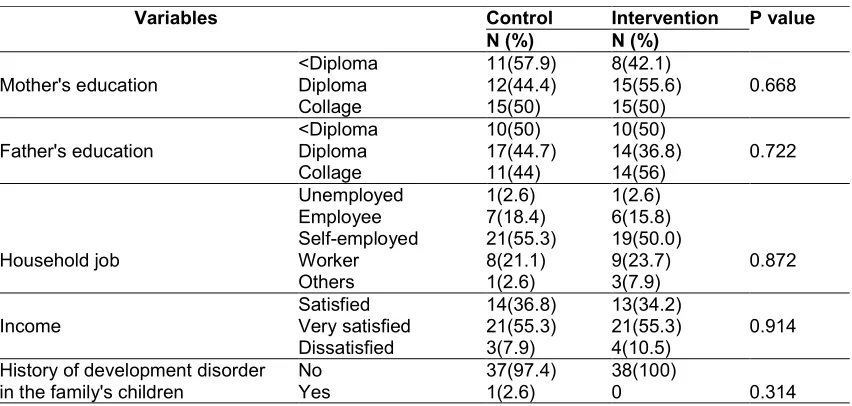
According to the Chi-square and Fisher's exact tests, the participants' demographic variables were not significantly different in the two groups, that is, the two groups were homogeneous (Table 2).
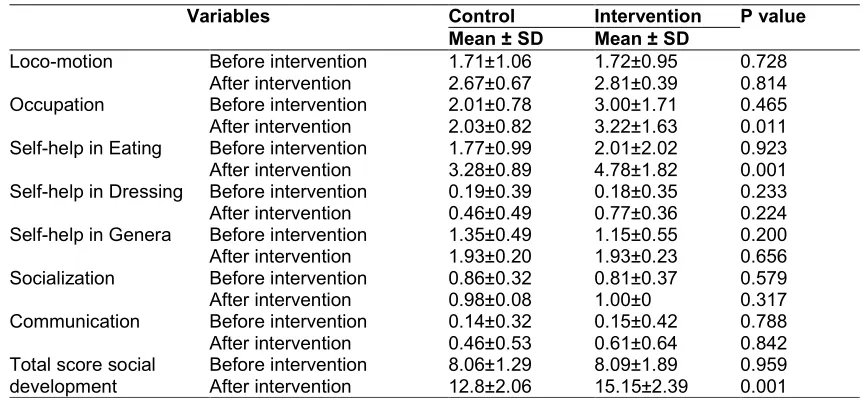
In this study, the mean scores of
social development of the children before the intervention was not significantly different in
the two groups (p = 0.911). In other words, the two groups were homogeneous in terms of
social development scores before the
intervention. Comparison of the mean score of social development after intervention was
significant in the two groups (p = 0.001), so that the mean social development score after intervention in the control group ranged
Table 1. Frequency distribution of demographic characteristics of participants
Variables Control Intervention P value
Child's gender N (%)
Male 27(71.1) 21(55.3) 0.234
Female 11(28.9) 17(44.7)
Breast feeding N (%)
<6 month 1(20) 4(80) 0.070
6-12 month 0 3(100)
12-24 month 37(54.4) 31(45.6)
Age (month) (Mean± SD) 12.84±1.40 12.15±0.43 0.15
Weight at birth (gr) (Mean± SD) 3283±344 3125±436 0.102
Length at birth (cm) (Mean± SD) 50.60±2.35 49.4±2.36 0.027
Head circumference at birth (cm) (Mean± SD) 34.63±1.08 34.30±1.20 0.180
Weight at the first of study (gr) (Mean± SD) 9788±1375 9456±1019 0.146
Length at study (cm) (Mean± SD) 76.5±3.79 75.77±2.30 0.273
Head circumference at the first of study(cm) (Mean± SD) 49.00±1.90 45.32±1.53 0.022
Table 2. Frequency distribution of demographic characteristics of participants
Variables Control Intervention P value N (%) N (%)
Mother's education
<Diploma 11(57.9) 8(42.1)
0.668
Diploma 12(44.4) 15(55.6)
Collage 15(50) 15(50)
Father's education
<Diploma 10(50) 10(50)
0.722
Diploma 17(44.7) 14(36.8)
Collage 11(44) 14(56)
Household job
Unemployed 1(2.6) 1(2.6)
0.872
Employee 7(18.4) 6(15.8)
Self-employed 21(55.3) 19(50.0)
Worker 8(21.1) 9(23.7)
Others 1(2.6) 3(7.9)
Income
Satisfied 14(36.8) 13(34.2)
0.914
Very satisfied 21(55.3) 21(55.3)
Dissatisfied 3(7.9) 4(10.5)
History of development disorder in the family's children
No 37(97.4) 38(100)
0.314
Yes 1(2.6) 0
4. DISCUSSION
The early years of life are crucial and critical years for the growth and development of a child. The elementary experience received in these years will be used as the basis for future learning [12].
According to studies, children without social development and skills are not able to perform their social interaction with others. The lack of social skills is a decisive factor for increasing the mental and emotional issues of children. These skills are acquired through the process of socialization [13]. Early intervention will have more positive impact on the development of the child's brain and the ability to learn. The process of evolving children can be sped up with appropriate, timely and high quality programs
that provide positive experiences for children and support for their parents [14].
According to the findings, there was no
significant difference between the social
development score of children before
intervention in the control and intervention groups. In other words, the two groups at the same level of social development were included in the study and this is the strength of the study. However, after the intervention there was a significant increase in the mean of total score in the intervention group compared to the control group. This increase was seen highly in occupation variablr and self-help, indicating the role training package.
Table 3. Comparison of social development score before and after the intervention in the two groups
Variables Control Intervention P value Mean ± SD Mean ± SD
Loco-motion Before intervention 1.71±1.06 1.72±0.95 0.728
After intervention 2.67±0.67 2.81±0.39 0.814
Occupation Before intervention 2.01±0.78 3.00±1.71 0.465
After intervention 2.03±0.82 3.22±1.63 0.011
Self-help in Eating Before intervention 1.77±0.99 2.01±2.02 0.923
After intervention 3.28±0.89 4.78±1.82 0.001
Self-help in Dressing Before intervention 0.19±0.39 0.18±0.35 0.233
After intervention 0.46±0.49 0.77±0.36 0.224
Self-help in Genera Before intervention 1.35±0.49 1.15±0.55 0.200
After intervention 1.93±0.20 1.93±0.23 0.656
Socialization Before intervention 0.86±0.32 0.81±0.37 0.579
After intervention 0.98±0.08 1.00±0 0.317
Communication Before intervention 0.14±0.32 0.15±0.42 0.788
After intervention 0.46±0.53 0.61±0.64 0.842
Total score social development
Before intervention 8.06±1.29 8.09±1.89 0.959
After intervention 12.8±2.06 15.15±2.39 0.001
level of active social games is needed every day. Like deprivation of sleep, deprivation of game also has unpleasant consequences. Without play, optimal learning, normal social function self-control, and other cognitive functions may not fully mature [16]. Baggerly and Parker stated that play therapy is effective in learning, self-control, responsibility, expressing feelings, respecting, accepting oneself and others, and improving social skills, self-esteem, and reducing the effects of depression and anxiety. The results of this study showed the effect of child-centered play therapy on the preoperative developmental stages and objective operations of children in the experimental group. Play therapy has a positive effect on behavior and emotions, and can act as counseling for children and treatment for adults [17].
In 2010, Cordier et al., in a study entitled "The impact of various games on the social behavior of 18-30-month-old children in ICUs in Israel," suggests that children's social behavior is affected by games, and offers may be the title of a strategy to increase the positive social interaction between peers [18]. Richard Salmon et al., in a random controlled trial of the home-based therapy counseling program for children with autism spectrum disorders, showed that play therapy intervention significantly changed the interaction of parents and children without increasing stress/depression of the parents [5]. Solomon et al., in a study showed that the play therapy counseling model has a potential value
for the evolutionary development of these children [7].
In 2013, Li WH et al in their research found that play is an important part of children's life [19]. Nijhof et al. in 2018 in their study showed that play- related interventions are very important for the healthy development of children [20].
Emarati et al., also in 2011 in their study entitled
"Effects of elementary school plays on
perceptual-motion and social development of girls aged 8-9 years as a random clinical trial", showed that primary school games can be a good program for development of perceptual-motion skills in the children. However, promoting children's social skills require structured and planned group activities [21,22]. Chinekesh et al., in a study entitled "The effect of play therapy on emotional-social skills in preschool students in a district of Tehran" showed that play therapy significantly increased the socio-emotional skills of the participants [23].
5. CONCLUSION
Accordingly, advice by an expert advisor such as a child care obstetrician can help in the development of child.
6. LIMITATION
In the present study, we tried to homogenize the participants, but there were a few possible educational materials, as well as the role of children's' age in its evolutionary development which can be from the limits of study.
CONSENT AND ETHICAL APPROVAL
After obtaining necessary licenses from
University and approval by ethic committee (Rec: 1396.136), registration in the trial Iran registry clinical trials (IRCT20160503027728N7), the present study began.
The objectives of the study were stated for parents, if they wished to participate in the study, they received written consent.
ACKNOWLEDGEMENTS
This study is part of Master's thesis on midwifery counseling. In this regard, we thank Vice-Chancellor of the Alborz Medical Sciences University who takes the financial support of project, as well as all midwife colleagues working in the prenatal clinics of Alborz and Kamali
hospitals and all pregnant women who
participated in this study.
COMPETING INTERESTS
Authors have declared that no competing interests exist.
REFERENCES
1. Anderson LM, Shinn C, Fullilove MT,
Scrimshaw SC, Fielding JE, Normand J, et al. The effectiveness of early childhood development programs: A systematic review. American Journal of Preventive Medicine. 2003;24(3):32-46.
PMID:12668197
2. Dolatian M, Mahmoodi Z, Alavi‐Majd H,
Moafi F, Ghorbani M, Mirabzadeh A. Psychosocial factors in pregnancy and birthweight: Path analysis. Journal of Obstetrics and Gynaecology Research. 2016;42(7):822-30.
DOI: 10.1111/jog.12991
3. Dolatian M, Mirabzadeh A, Forouzan AS,
Sajjadi H, Alavimajd H, Mahmoodi Z, et al.
Relationship between structural and
intermediary determinants of health and preterm delivery. Journal of Reproduction & Infertility. 2014;15(2):78.
PMCID:PMC4032973
4. Fussell JJ, Macias MM, Saylor CF. Social
skills and behavior problems in children with disabilities with and without siblings.
Child Psychiatry and Human
Development. 2005;36(2):227-41. DOI: 10.1007/s10578-005-4185-6
5. Solomon R, Van Egeren LA, Mahoney G,
Huber MSQ, Zimmerman P. Play project home consultation intervention program for young children with autism spectrum disorders: A randomized controlled trial. Journal of Developmental and Behavioral Pediatrics. 2014;35(8):475.
DOI: 10.1097/DBP.0000000000000096
6. Ginsburg KR. The importance of play in
promoting healthy child development and maintaining strong parent-child bonds. Pediatrics. 2007;119(1):182-91.
DOI: 10.1542/peds.2006- 2697
7. Solomon R, Necheles J, Ferch C,
Bruckman D. Pilot study of a parent training program for young children with
autism: The Play Project home
consultation program. Autism. 2007;
11(3):205-24.
DOI: 10.1177/1362361307076842
8. Barnard WM. Parent involvement in
elementary school and educational
attainment. Children and Youth Services Review. 2004;26(1):39-2.
DOI:org/10.1016/J.CHILDYOUTH.2003.11 .002
9. Caplan B, Kreutzer JS, DeLuca J.
Encyclopedia of clinical neuropsychology; with 199 figures and 139 Tables: Springer; 2011.
DOI: 10.1007/978-0-387-79948-3
10. Zadshir F, Stoki M, Emamipour S.
Comparison of students moral judgment and social development in student: Invendiqating the role of teaching the holy Quran by memorization in independent schools in Tehran; 2009.
11. CsHO. DMoH. Recommendations for child
development-entertainment and social- emotional activities: Ministry of Health and Medical Education; 2016.
12. Ghorbanpoor Z, Hosseini SA, Vameghi R,
caregivers at home and home adaptation on gross motor function of 15-72 months old cerebral palsy children. Modern Rehabilitation. 2014;8(1).
13. Li WH, Chung JO, Ho EK. The
effectiveness of therapeutic play, using
virtual reality computer games, in
promoting the psychological well‐being of
children hospitalised with cancer. Journal
of Clinical Nursing. 2011;20(15‐
16):2135-43.
DOI: 10.1111/j.1365- 2702.2011.03733.x
14. Hyvonen PT. Play in the school context?
The perspectives of Finnish teachers. Australian Journal of Teacher Education (Online). 2011;36(8):49.
DOI: 10.14221/ajte.2011v36n8.5
15. Goldstein J. Play in children's
development, health and well-being: Toy Industries of Europe Brussels; 2012.
16. Panksepp J. Can PLAY diminish ADHD
and facilitate the construction of the social brain? Journal of the Canadian Academy of Child and Adolescent Psychiatry. 2007; 16(2):57.
PMCID:PMC2242642
17. Baggerly J, Parker M. Child‐centered
group PLAY therapy with African American boys at the elementary school level. Journal of Counseling & Development. 2005;83(4):387-96.
DOI:org/10.1002/j.1556-6678.2005.tb00360
18. Cordier R, Bundy A, Hocking C, Einfeld S.
A model for play‐based intervention
for children with ADHD. Australian
Occupational Therapy Journal. 2009; 56(5):332-40.
DOI: 10.1111/j.1440-1630.2009.00796X
19. Li WH, Mak YW, Chan SS, Chu AK, Lee
EY, Lam T. Effectiveness of a
play-integrated primary one preparatory
programme to enhance a smooth
transition for children. Journal of Health Psychology. 2013;18(1):10-25.
DOI: 10.1177/1359105311434052
20. Nijhof SL, Vinkers CH, van Geelen SM,
Duijff SN, Achterberg EM, Van der Net J, et al. Healthy play, better coping: The importance of play for the development of
children in health and disease.
Neuroscience & Biobehavioral Reviews; 2018. (In Press)
DOI: 10.1016/j.neubiorev.2018.09.024
21. Emarati FS, Namazizadeh M, Mokhtari P,
Mohammadian F. Effects of selected
elementary school games on the
perceptual-motor ability and social growth of 8-to-9 year-old female students; 2011.
22. Valizade R, Taymoori P, Yousefi FY,
Rahimi L, Ghaderi N. The effect of puberty health education based on health belief model on health behaviors and preventive among teen boys in Marivan, North West of Iran. International Journal of Pediatrics. 2016;4(8):3271-81.
23. Chinekesh A, Kamalian M, Eltemasi M,
Chinekesh S, Alavi M. The effect of group play therapy on social-emotional skills in pre-school children. Global Journal of Health Science. 2014;6(2):163.
DOI: 10.5539/gjhs.v6n2p163
© 2019 Masoudifard et al.; This is an Open Access article distributed under the terms of the Creative Commons Attribution License (http://creativecommons.org/licenses/by/4.0), which permits unrestricted use, distribution, and reproduction in any medium, provided the original work is properly cited.
Peer-review history: