Xiao Tan1, Qiong Huang2, and Duncan S. Wong1 1
Department of Computer Science, City University of Hong Kong, China
[email protected], [email protected]
2
College of Informatics, South China Agricultural University, Guangzhou, China
Abstract. Concurrent signatures provide a way to exchange digital sig-nature among parties in an efficient and fair manner. To the best of our knowledge, all the existing solutions can only be proven secure in the ran-dom oracle model. How to build an efficient concurrent signature scheme in the standard model has remained as an open problem since its intro-duction in 2004. In this paper we answer the problem affirmatively. Base on a novel idea, we propose a new concurrent signature construction, the security of which does not rely on the random oracle assumption. Our idea stems from an attempt of achieving a strong ambiguity fea-ture that anyone should be able to produce indistinguishable ambiguous signatures by just using public information available in the system. In the multi-user setting, we prove the security of the new scheme based on Computational Diffie-Hellman (CDH) assumption, which is a rather standard and well-studied assumption in cryptography.
Keywords: fair exchange, concurrent signature, ambiguity, multi-user setting
1
Introduction
The fair exchange of digital signatures is a protocol which ensures the atomicity of signature exchange among a group of parties so that the exchange is performed in an all-or-nothing manner, either all the parties get the others’ signatures or none of them does. One of the electronic commerce applications of fair exchange is contract signing [11]. There are two main approaches for doing fair exchange. One is the timed release technique [9, 10] in which the signatures are computed as segments and exchanged in a polynomial number of rounds such that in any round, the amount of one party’s knowledge on the counter-party’s signature is nearly the same as that of the other party. This technique requires a number of communication rounds, and its fairness depends on the assumption that the parties have comparable computing power. The other technique relies on a semi-trusted offline arbitrator which only gets involved in the exchange when a dispute between the parties occurs. This type of fair exchange is referred to as Optimistic Fair Exchange (OFE) [1, 3, 12].
signaturesσAandσB, respectively. The signatures are ambiguous in a way that
no outsider can distinguish the signers of them until an extra secret called key-stone is released by A. Once the keystone is released, σA and σB will become
binding to their signers concurrently and anyone can verify the validity of σA
and σB with respect to their corresponding signers. Unlike OFE, a concurrent
signature scheme does not have a semi-trusted arbitrator. Instead, the initia-tor A and the matcherB interact in the following three phases: (1) Keystone Generation Phase:Agenerates a keystonesand the correspondingkeystone fix
f, and sendsf to B; (2)Ambiguous Signature Generation Phase:A generates and sends σA to B, then B generates and sends σB back to A after verifying
the validity of σA; and (3) Signature Authorship Binding Phase: A verifies the
validity ofσB and sendsstoB. The keystonesbinds the authorship ofσA and
σB toAandB, respectively and concurrently.
A secure concurrent signature should be unforgeable, ambiguous and fair. By Chen et al.’s model [7], unforgeability requires that when a party, say the matcherB, receives an ambiguous signatureσA,Bcan be sure thatσAmust be
generated by the initiatorA, and vice versa. Ambiguity prevents the public from telling if an ambiguous signatureσA(resp.σB) was generated byAorB before
the keystone sis released. In addition, no one including B (resp.A) should be able to convince anyone else that σA (resp.σB) was generated byA (resp.B).
Fairness requires that oncesis released, the authorship ofσAto Aand that of
σB to B should be bound concurrently. Ifs is not released, none of σA or σB
will bind to any signer.
Concurrent signature facilitates very efficient solutions to many electronic commerce applications. Generally, these applications assume thatB will receive the keystone s when B’s binding signature (s, f, σB) is to be used byA. This
assumption can be easily guaranteed by existing mechanisms or in certain sce-narios [7]. For instance,AneedsB’s signature to acquire goods or service from
B, thenB can always askAto show the keystone before providing service toA.
Motivation: Several concurrent signature schemes were proposed in the litera-ture [17, 19, 16, 13, 8, 18, 21]. These works either focus on improving the ambigu-ity model [17, 13], or fixing potential attacks against fairness [19], or extending concurrent signatures to multi-party setting [16, 18] or identity based setting [8], or balancing the capability of controlling the keystone between the initiator and the matcher [21]. However, none of the schemes are proven secure without random oracles. As we know, the random oracle model [4] is often criticized as a heuristic methodology, assuming that all the parties have oracle access to some truly random functions. Canetti et al. proved that there does not exist any equivalent function ensemble in the real world that can replace random oracles without security loss [6]. Therefore, it is more desirable to construct concurrent signatures in the standard model for reliable security.
has been done successfully. A natural scenario is, whenAandB sign a contract or coalition agreement of sensitive content, it is probably undesirable for others to know that eitherAorBare involved until the contract is validated by both of them. In this case, we need an ambiguity model to ensure that nothing about the authorship of ambiguous signatures are revealed before the keystone is released.
Contributions: Our contributions in this paper are two-fold:
– We propose a new ambiguity model for concurrent signatures that overcomes the restriction above. This model renders an arbitrarily large signer space to protect the anonymity of the corresponding parties.
– We present a concrete concurrent signature scheme in the new model, and prove its security without random oracles in the multi-user setting. It is the first concurrent signature scheme in the standard model.
1.1 Our Idea
To show the difficulty of finding a construction in the standard model, a useful observation is that most of the concurrent signatures are based on ring signatures built from Schnorr signature [15]. As a result, these schemes have to apply the forking lemma [14] to prove the unforgeability in the random oracle model.
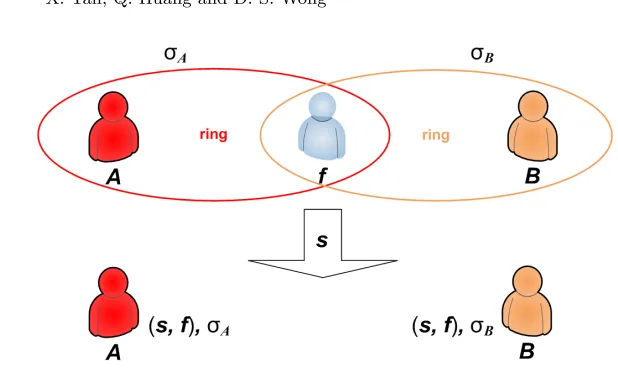
In order to get rid of this barrier, we start from an efficient two-user ring sig-nature in the standard model [5]. Instead of directly applying the ring sigsig-nature as the building block, we twist it such that the ring is formed by one of the two parties and a keystone fix which can be treated as a virtual user. More precisely, the initiator A’s ambiguous signature σA is produced upon the ring (pkA, f)
using skA, and the matcherB’s ambiguous signature σB is produced upon the
ring (pkB,f) usingskB. IfAfollows the scheme to generate the keystone fixf,
then releasing s in the binding phase will result in decomposition of the rings (pkA, f) and (pkB, f) simultaneously. That is, (s, f, σA) and (s, f, σB) become
bound toAandB respectively as two concurrent signatures. The overall idea is shown by Figure 1.
On the other hand, our construction achieves ambiguity in a flavor of anonymity which ensures that any person can produce f by another means, such that it will be capable of generating indistinguishable σA, σB as honestly computed
ones. The indistinguishability holds even against the matcherB, sayB can not identify the authorship of the received ambiguous signatureσA when running a
concurrent signature protocol. Hence, this strong ambiguity is mutually exclu-sive to the conventional unforgeability model. Fortunately, our scheme ensures that the concurrent signatures are still unforgeable after the keystone is released. In particular, σA, σB can be bound to A, B respectively only if f, σA, σB are
produced honestly by following the scheme.
2
Definitions
Fig. 1.An Illustration on the Idea of Our Concurrent Signature Construction
to verify the keystone. Formally, a concurrent signature scheme consists of the following probabilistic polynomial time (PPT) algorithms.
– Setup(1k). On input a security parameterk∈
N, it outputs a set of system parameters denoted byparamincluding the message spaceM, the keystone spaceS, the keystone fix spaceF.
– SKGen(param). On inputparam, it outputs a public key pair (pk, sk). – KFGen(param). On inputparam, it outputs a keystones∈ S and a keystone
fixf ∈ F.
– KFVer(param, f). On inputparam, a keystone fixf, it outputs 1 (accept) or 0 (reject).
– ASign(param, pki, pkj, f, m, ski). On input param, two public keyspki,pkj,
a keystone fix f, a message m ∈ M, and a private key ski, it outputs an
ambiguous signatureσi.
– AVer(param, pki, pkj, f, σi, m). On input param, pki, pkj, f, an ambiguous
signatureσi, and a messagem, it outputs 1 (accept) or 0 (reject).
– Ver(param, pki, pkj, s, f, σi, m). On inputparam,pki, pkj, f ∈ F,s∈ S, an
ambiguous signatureσi, and a messagem, it outputs 1 (accept) or 0 (reject).
Thecorrectnessrequires that for allparam←Setup(1k), any two public keys
pki, pkj where (pki, ski) ← SKGen(param), (pkj, skj)← SKGen(param), and a
message m∈ M:
1. If (s, f)←KFGen(param), thenKFVer(param, f) = 1.
2. If σi ← ASign(param, pki, pkj, f, m, ski), where (s, f) ← KFGen(param),
thenAVer(param, pki, pkj, f, σi, m) = 1, andVer(param, pki, pkj, s, f, σi, m) =
2.1 The Protocol
We now describe how the concurrent signature scheme is to be carried out be-tween two usersA andB with public keys pkA andpkB, respectively. Suppose
Ais the initiator, andB is the matcher. They run the protocol in the following three rounds:
R1 :Acomputes (s, f)←KFGen(param) andσA←ASign(param, pkA, pkB, f, m,
skA), and sendshf, σAitoB.
R2 :Bchecks ifKFVer(param, f) = 1 andAVer(param, pkA, pkB, f, σA, m) = 1. If
the verifications hold,B computesσB←ASign(param, pkB, pkA, f, m, skB),
and sendsσB to A.
R3 :Achecks ifAVer(param, pkB, pkA, f, σB, m) = 1. If the verification holds,A
sendssto B. Then, everyone can verify the concurrent signatures (s, f, σA)
and (s, f, σB) by checking ifVer(param, pkA, pkB, s, f, σA, m) = 1 andVer(
param, pkB, pkA, s, f, σB, m) = 1.
3
Security Models
We define a set of games for formalizing unforgeability, ambiguity and fairness of concurrent signatures respectively, in the multi-user setting.
3.1 Unforgeability
The unforgeability is defined in the following game between a challenger C and an adversaryA.
– Setup Phase: On input a security parameter k ∈ N, C runs param ←
Setup(1k), and generate key pairs for the participants in the system by
running (pki, ski) ← SKGen(param) of multiple times, and sends param,
P KSet={pki}to A.
– Query Phase:Acan make queries to the following oracles.
• CorruptOracle. It takes a public keypki ∈P KSet and returns the
cor-responding private keyski.
• ASignOracle. It takes two public keyspki, pkj ∈P KSet, a keystone fix
f ∈ F, a messagem∈ M, returnsσi←ASign(param, pki, pkj, f, m, ski).
– Output Phase: A outputs two public keys pki∗, pkj∗ ∈ P KSet, a mes-sage m∗ ∈ M, a keystone s∗ ∈ S, a keystone fix f∗ ∈ F, and an am-biguous signature σi∗. A wins the game if both the following conditions hold: (1)Ver(param, pki∗, pkj∗, s∗, f∗, σi∗, m) = 1; (2) A has never queried CorruptOracle(pki∗) orASignOracle(pki∗, pkj∗, f∗, m∗).
Definition 1 (Unforgeability). A concurrent signature scheme is said to be
(, t, qc, qs)-unforgeableif for any probabilistic polynomial-time adversaryAwhich
runs in timetmakingqcqueries toCorruptOracleandqs queries toASignOracle,
its probability of winning in the game above is bounded by.
Our definition of unforgeability ensures that no PPT adversaryAcan pro-duce a valid concurrent signature bound to a public keypki ifAdoes not know
ski. This formalization refers to the “unforgeability of binding signatures”, which
differs from the original unforgeability model proposed by Chen et al. [7] refer-ring to the “unforgeability of ambiguous signatures” in the view of the two corresponding parties. However, we address that our model is sufficient for most scenarios of fair exchange of signatures. The reason is, even if the ambiguous signatures are forgeable by others besides the legitimate parties, our unforge-ability model ensures that only the legitimate parties can make the ambiguous signatures become binding. Note that [21] formalizes unforgeability of concurrent signatures in a similar way as our model.
3.2 Ambiguity
Informally, the ambiguity prevents anyone from telling if two ambiguous signa-tures together with the keystone fix are generated honestly by user iand j, or merely simulated by anyone using the public information, before the keystone is released. In the formalization below, we define an algorithmASignSim called
ambiguous signature simulator, which models the capability of an outsider who outputs two simulated ambiguous signaturesσi,σj together with a keystone fix
f.
– ASignSim(param, pki, pkj, m). On input param, two public keys pki, pkj, a
messagem, the algorithm outputs a keystone fixf and two ambiguous sig-naturesσi, σj.
Note that ASignSim needs to be specified explicitly in the scheme description. The ambiguity game is defined as follows where a challenger C runs the game against an adversaryA.
– Setup Phase: The same as the setup phase in Section 3.1, except thatC
also sends the private keysSKSet={ski}of all the participants toA.
– Query Phase:Acan query the following oracles.
• KFGenOracle. It returns a keystone fixfby running (s, f)←KFGen(param).
• KSReleaseOracle. It takes a keystone fixfwhich is produced byKFGenOracle, returns the corresponding keystones.
– Challenge Phase: Asends to C two public keys pki, pkj ∈P KSet and a
messagem∈ M.C tosses a random bitb∈ {0,1}:
• Ifb= 0:Cruns (s, f)←KFGen(param), thenσi←ASign(param, pki, pkj, f,
m, ski) andσj←ASign(param, pkj, pki, f, m, skj).
ThenCresponses Awith (f, σi, σj).
– Output Phase:Acontinues querying the oracles above and outputs a guess-ingb0∈ {0,1}at the end of the game, under the restriction thatAhas never queriedKSReleaseOracle(f).Awins the game ifb0=b. The advantage ofA
is defined asAdvAMBCS ,A=|Pr[b0 =b]−1/2|.
SinceAknows all the private keys, it can produce any users’ signatures by itself. Hence,Cdoes not provide CorruptOracleandASignOraclein this game.
Definition 2 (Ambiguity).A concurrent signature scheme is said to be(, t, qf, qr)
-ambiguous if for any probabilistic polynomial-time adversary A which runs in timet makingqf queries to KFGenOracleandqr queries to KSReleaseOracle, its
probability of winning in the game above is bounded by.
In the literature, two ambiguity models were proposed for concurrent signa-tures. One is the original ambiguity model proposed by Chen et al. [7] (we denote it byAMBO), the other is the perfect ambiguity model proposed by Susilo et al.
[17, 19] (we denote it byAMBP). Below we compare these two models with our
ambiguity model which has a flavor of anonymity, denoted byAMBA.
[17, 19] has shown thatAMBP is a stronger model thanAMBO, in the sense
that it is more difficult for an adversary to identify the authorship of ambiguous signatures before the keystone is released. Given a pair of ambiguous signatures (σA, σB) on a keystone fixf,AMBP captured the following four possibilities of
the signers whileAMBO only covers the first three: (1)σAis produced byAand
σB is produced byB; (2) bothσAandσB are produced byA; (3) both σA and
σBare produced byB; (4)σAis produced byBandσB is produced byA. As we
can see, in the previous ambiguity models, the probability is at least 1/4 for an adversary to correctly guess the signers. Furthermore, bothAMBO and AMBP
leak the following information to the public: given the ambiguous signatures, at least one of the corresponding parties (A or B) must have been involved. This leaked information harms the privacy of the concerned parties before their exchange is successfully completed. On the other hand, AMBA renders an
ar-bitrarily large signer space that totally overcomes the above restriction, since everyone can use ASignSim to produce indistinguishable ambiguous signatures as generated by honest participants. Obviously, Case (1)(2)(3) above are already covered by AMBA, but it does not cover Case (4), since that when σA and σB
are produced byASignSim, the issuer of both the ambiguous signatures must be the same person. However, there seems no realistic scenario fall in Case (4). The reason is, Case (4) implies that both AandB are malicious, which contradicts with the general assumption in a cryptographic protocol that at least one par-ticipant is honest. Table 1 compares the cardinality of signer space among the existing ambiguity models.
Table 1.Comparison of Ambiguity Models
Models # Signer Space of (σA, σB) AMBO |{(A, B),(A, A),(B, B)}|= 3 AMBP |{(A, B),(A, A),(B, B),(B, A)}|= 4 AMBA |{(A, B),(X, X)}|=∞
*
Signer Space denotes the set of possible signers given the ambiguous signatures, e.g. (A,B) represents thatAsignsσAandBsignsσB. # denotes the cardinality.
Xdenotes an arbitrary person who knows the system parameters andpkA,pkB.
by honest parties. In Appendix A, we show that Nguyen’s concurrent signature scheme is not anonymous in our ambiguity model, implying that Nguyen’s model is strictly weaker than ours.
3.3 Fairness
Concurrent binding is the key security requirement toward fairness. There are two aspects to satisfy: (1) Binding after Releasing: an adversary should not be able to produce a valid ambiguous signature σi bound to the public key pki,
until s is published; and (2) Concurrency of Binding: an adversary should not be able to generate two ambiguous signaturesσiandσj such thatσiis bound to
the public keypkiwhileσjis not bound to the public keypkj, after the keystone
sis released.
The fairness game is defined as below, where a challengerC simulates the game against an adversaryA.
– Setup Phase: The same as the Setup Phase in Section 3.2. – Query Phase: The same as the Query Phase in Section 3.2.
– Output Phase:Agenerates and sends (pki∗,pkj∗,f∗,s∗,m∗,σi∗) back to
C, wherepki∗, pkj∗ ∈P KSet,f∗ ∈ F, s∗∈ S, m∗ ∈ M, andσi∗ is an am-biguous signature.Awins the game if either of the following conditions holds: (1)Ver(param, pki∗, pkj∗, s∗, f∗, σi∗, m∗) = 1 under the restriction thatf∗ is returned byKFGenOracleandAhas never queriedKSReleaseOracle(f∗); (2)
Aoutputs another ambiguous signatureσj∗, satisfying:AVer(param, pki∗, pkj∗,
f∗, σi∗, m∗) = 1,AVer(param, pkj∗, pki∗, f∗, σj∗, m∗) = 1,Ver(param, pki∗, pkj∗,
s∗, f∗, σi∗, m∗) = 1, butVer(param, pkj∗, pki∗, s∗, f∗, σj∗, m∗) = 0.
Definition 3 (Fairness).A concurrent signature scheme is said to be(, t, qf, qr)
-fair if for any probabilistic polynomial-time adversary A which runs in time t
makingqf queries to KFGenOracleandqr queries to KSReleaseOracle, its
proba-bility of winning in the game above is bounded by .
forbidAfrom winning the game in an obvious way:Aproduces a forged ambigu-ous signatureσi∗ usingski∗, then bindsσi∗topki∗by queryingKSReleaseOracle to gets∗. The condition (2) ensures that the binding of the signatures to their respective signers occurs concurrently.
4
A Concurrent Signature Scheme without Random
Oracles
In this section, we propose an efficient concurrent signature scheme and prove its security under the games we defined above. The underlying complexity as-sumptions are reviewed in Appendix B.
4.1 Proposed Scheme
Below are the details of our concurrent signature scheme.
– param←Setup(1k). The setup algorithm selects two cyclic groups
G and GT of prime order q ≥ 2k and an admissible pairing e : G×G → GT.
It also picks a generator g ∈ G and h ←R G. Set the message space M =
{0,1}∗, the keystone space S =
Zq, the keystone fix space F = G×G. LetH : {0,1}∗ → {0,1}l be a collision-resistant hash function, where the
output lengthl is given as an auxiliary input to theSetupalgorithm. Define param:= (G,GT, e, q, g, h,M,S,F, H).
– (pk, sk)←SKGen(param). The key generation algorithm picksα←R Zq and
u0,u1,u2,· · ·,ul R
←G, computesδ=gα, and outputspk= (δ, u0, u1, u2,· · ·, ul),
sk=α.
– (s, f)←KFGen(param). The keystone fix generation algorithm picks a key-stone s ←R Zq, computes ρ = hs, τ = gs
−1
, and sets the keystone-fix as
f = (ρ, τ).
– 1/0←KFVer(param, f). The keystone fix verification algorithm parsesf = (ρ, τ), and outputs 1 ifρ, τ ∈Gand the following equation holds:
e(ρ, τ) =e(g, h) Otherwise, it outputs 0.
– σi←ASign(param, pki, pkj, f, m, ski). The ambiguous signature generation
algorithm parsesf = (ρ, τ) andpki= (δi, u0i, ui1, ui2,· · · , uil), picksri R
←Zq,
computesηi=gri, Mi =H(pkikpkjkfkm),ζi=ρski(u0i
Q
t∈M˜iuit)ri where
˜
Mi is the set of indicest such that the string Mi’s t-th bit Mi[t] = 1, and
outputsσi= (ζi, ηi).
– 1/0←AVer(param, pki, pkj, f, σi, m). The ambiguous signature verification
algorithm parses f = (ρ, τ), pki = (δi, u0i, ui1, ui2,· · · , uil), σi = (ζi, ηi),
computesMi = H(pkikpkjkfkm), and outputs 1 if the following equation
holds:
e(g, ζi) =e(δi, ρ)e(ηi, u0i
Y
t∈M˜i
Otherwise, it outputs 0.
– 1/0 ←Ver(param, pki, pkj, s, f, σi, m). The signature verification algorithm
parsesf = (ρ, τ), and outputs 1 if all the following conditions hold: (1) ρ=hs andτ=gs−1;
(2) AVer(param, pki, pkj, f, σi, m) = 1.
Otherwise, it outputs 0.
The correctness of the scheme above is straightforward and therefore is omitted here. The following is the ambiguous signature simulation algorithm ASignSim which is needed in the proof of ambiguity. Let pki = (δi, u0i, ui1, ui2,· · · , uil),
pkj = (δj, u0j, uj1, uj2,· · · , ujl).
– (f, σi, σj)←ASignSim(param, pki, pkj, m). The ambiguous signature
simu-lator performs the following computations: (1) Pick s ←R Zq, compute ρ = gs, τ = hs
−1
, and set the keystone-fix as
f = (ρ, τ). (2) Pickri
R
←Zq, computeηi=gri,Mi=H(pkikpkjkfkm),ζi=δis(u0i
Q
t∈M˜iuit)
ri,
andσi= (ζi, ηi).
(3) Pickrj R
←Zq, computeηj =grj,Mj =H(pkjkpkikfkm),ζj=δjs(u0j
Q
t∈M˜
jujt)
rj,
andσj= (ζj, ηj).
(4) Outputf, σi, σj as required.
4.2 Security Proofs
We start with a brief security analysis of the proposed scheme on the high level. For unforgeability, just note that any PPT adversary can not compute (s∗, f∗, σi∗) with non-negligible probability if it does not know eitherski∗or the logarithm of h to base g, due to the hardness of CDH problem. On the other hand, the ambiguity is enforced since that the keystone can be produced in either one of two indistinguishable patterns byKFGenorASignSim. The scheme is fair because both σi∗ and σj∗ are produced on the same keystone s∗ of which the releasing leads to concurrent binding, and the DL assumption inGensures that it is infeasible to compute s∗ from f∗ with noticeable advantage for any PPT adversary.
Below we give the formal proof with respect to unforgeability (Def. 1), am-biguity (Def. 2) and fairness (Def. 3).
Theorem 1. The proposed concurrent signature scheme is(, t, qc, qs)-unforgeable,
if (0, t0)-Computational Diffie Hellman (CDH) assumption holds inG:
0 ≥
4qs(l+ 1)p(k)
, t0≥t+O(qstm(l+ 2) + (p(k) + 4qs)te),
wherep(k)denotes the number of participants in the system1,t
mandtedenote
Proof. We construct a PPT algorithm S that simulates the oracles in the un-forgeability game, and produces a valid solution for a CDH instance if there exists an (, t, qc, qs)-adversary A who successfully outputs a forgery. Let the
CDH instance be (G, q, g, A=ga, B=gb) whereg, A, B∈
Gof orderq.
Setup: At the start,S sets the parametersG, q, gas given in the CDH instance andh=A. The other parameters are set as inSetupalgorithm.S setsn= 2qs
and we assume thatn(l+ 1)< q.Sguesses a value 1≤ˆi≤p(k) thatAwill forge the concurrent signature of the useri∗= ˆi. For 1≤i≤p(k) wherei6= ˆi,S runs SKGenforp(k)−1 times to produce key pairs{(pki, ski)}for all the users except
user ˆi. To generate user ˆi’s public key,S performs the following computations: 1. Pickw←R Zl,µ0, µ1, µ2,· · ·, µl
R
←Zn, andν0, ν1, ν2,· · · , νl R
←Zq.
2. Setuˆ0i=B−nw+µ0gν0, anduˆit=B
µtgνt for 1≤t≤l.
3. Setpkˆi= (B, u
0
ˆi,· · · , uˆit).
Then S sends param and {pki} for 1 ≤ i ≤ p(k) to A, and keeps {skj} for
1≤j≤p(k),j6= ˆifor answering queries toCorruptOraclelater.
Besides,Sdefines the following functions where ˜M is the set of indicestsuch that M[t] = 1:
J(M) =µ0+X
t∈M˜
µt−nw, L(M) =ν0+
X
t∈M˜
νt
Then we have:
uˆ0i
Y
t∈M˜
uˆit=B J(M)
gL(M)
Query:S simulates theExtractOralceandASignOracleas follows:
– CorruptOracle: If the corrupted public key pki 6= pkˆi, C returns the corre-spondingski which is produced in Setup phase. Otherwise,S aborts.
– ASignOracle: If the ASign query (pki, pkj, f, m) is for pki 6= pkˆi, C runs
σi ← ASign(param, pki, pkj, f, m, ski) using ski, and returns σi. Otherwise,
ifpki=pkˆi,S performs the following computations:
1. ComputeMˆi=H(pkˆikpkjkfkm).
2. IfJ(Mˆi)6= 0 modq, parsef = (ρ, τ), randomly pick rˆi∈Zq, compute:
ζˆi=ρ
−L(Mˆi)/J(Mˆi)(u0
ˆi
Y
t∈M˜ˆ
i uˆit)
rˆi, ηˆ
i=ρ
−1/J(Mˆi)grˆi
and returnσˆi= (ζˆi, ηˆi).
3. IfJ(Mˆi) = 0 modq,S simply aborts. 1
p is a polynomial function of the security parameter k. Obviously we have qc ≤
The simulation for generatingpkˆi’s ambiguous signatures is perfect:
ζˆi=ρ
−L(Mˆi)/J(Mˆi)(u0
ˆi
Y
t∈M˜ˆi uˆit)
rˆi =Bas(BJ(Mˆi)gL(Mˆi))−as/J(Mˆi)(BJ(Mˆi)gL(Mˆi))rˆi
=ρb(BJ(Mˆi)gL(Mˆi))rˆi−as/J(Mˆi)=ρb(u0
ˆi
Y
t∈M˜ˆi uˆit)
˜
rˆi
ηˆi=ρ−1/J(Mˆi)grˆi =grˆi−as/J(Mˆi)=gr˜i
where we denotes= loghρand ˜ri=rˆi−as/J(Mˆi).
As n(l+ 1) < q, we have 0 ≤ nw < q. Hence J(Mˆi) = 0 mod q implies
J(Mˆi) = 0 modn, or equivalentlyJ(Mˆi)6= 0 modnimpliesJ(Mˆi)6= 0 mod
q. So the simulation forASignOracledoes not abort ifJ(Mˆi)6= 0 modn.
Output: Suppose the forged concurrent signature output byAisσi∗= (ζi∗, ηi∗) on (pki∗, pkj∗, f∗, s∗, m∗). Whenpki∗=pkˆ
iandJ(Mi∗) = 0 modqwhereMi∗=
H(pki∗kpkj∗kf∗km∗),S can solve the CDH instance by computinggabas:
( ζi∗
ηL(Mi∗)
i∗
)s∗ −1 = (B
as∗(u0 ˆi
Q
t∈M˜
i∗ui
∗t)ri∗
(gri∗)L(Mi∗)
)s∗ −1 = (B
as∗(gL(Mi∗))ri∗ (gri∗)L(Mi∗)
)s∗ −1 =Ba=gab
Otherwise,S aborts whenpki∗6=pkˆ
ior J(Mi∗)6= 0 modq.
Now we analyze the probability thatS outputsgabwithout abort. Note that
if all the four events below happen, there will be no abort in the simulation: (1) P∗:J(X∗) = 0 modq, where X∗=Mi∗;
(2) Pπ: J(Xπ)6= 0 modn, for any Xπ =Mˆi =H(pkˆikpkjkfkm)6=Mi∗ when (pkˆi, pkj, f, m) is queried toASignOracle1;
(3) Q∗:Y∗=pkˆi, where Y
∗=pk
i∗.
(4) Qξ:Yξ6=pkˆi, for any Yξ =pki queried toCorruptOracle.
Let qm be the number of queries made in event (2), then we have qm ≤
qs. Obviously the number of queries made in event (4) is qc. Therefore, the
probability thatS not aborting in the game is:
Pr[¬abort]≥Pr[P∗∧
qm ^
π=1
Pπ∧Q∗∧ qc ^
ξ=1
Qξ]
Note that P∗∧Vqs
π=1Pπ and Q∗∧V qc
ξ=1Qξ are independent events. Below
we separately analyze the probabilities that either of these two events happens. Since thatX∗6=X
π, the event ¬Pπ: J(Xπ) = 0 modnis independent from
P∗, thus Pr[¬P
π|P∗] = 1/n. Besides, J(X∗) = 0 modqimpliesJ(X∗) = 0 mod
n, so we have:
1 Note thatAcan not query (pk
Pr[P∗∧
qm ^
π=1
Pπ] =Pr[P∗]Pr[ qm ^
π=1
Pπ|P∗]
=Pr[J(X∗) = 0 modq∧J(X∗) = 0 modn](1−Pr[
qm _
π=1
Pπ|P∗])
≥ 1
n·
1
l+ 1·(1−
qs
n) =
1 4qs(l+ 1)
Since that it is not allowed to query the target public keypki∗to CorruptOr-acle, the event¬Qξ:Yξ =pki =pkˆi could never happen when Q∗ happens, so
Pr[¬Qξ|Q∗] = 0. And we have:
Pr[Q∗∧
qc ^
ξ=1
Qξ] =Pr[Q∗]Pr[ qc ^
ξ=1
Qξ|Q∗] =Pr[pki∗=pkˆ
i](1−Pr[ qc _
ξ=1
Qξ|Q∗])
≥ 1
p(k)(1−
qc X
ξ=1
Pr[¬Qξ|Q∗]) =
1
p(k)
Here comes the combined result:
Pr[¬abort]≥Pr[P∗∧
qs ^
π=1
Pπ]Pr[Q∗∧ qm ^
ξ=1
Qξ]≥
1 4qs(l+ 1)p(k)
Hence,Ssolves the given CDH instance with probability at least 4q
s(l+1)p(k)
when an (, t, qc, qs)-adversaryAoutputs a forgery without aborts. In the
sim-ulation, it requires 1 exponentiation for producing each key pair,l+ 2 multipli-cations and 4 exponentiations for each ASignOracle query. Therefore, the time complexity ofS is bounded byt+O(qstm(l+ 2) + (p(k) + 4qs)te). ut
Theorem 2. The proposed concurrent signature scheme is unconditionally am-biguous.
Theorem 3. The proposed concurrent signature scheme is (, t, qf, qr)-fair, if
(0, t0)-Discrete Logarithm (DL) assumption holds in G:
0≥(1−qr
qf
), t0≥t+O((2qf−1)te),
wherete denotes the time needed for one exponentiation onG.
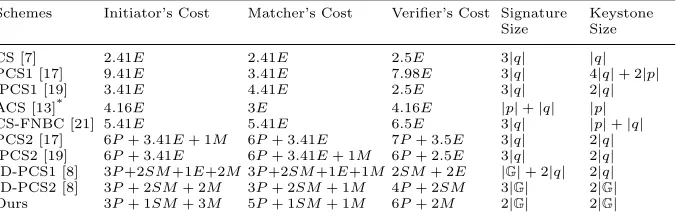
Table 2.Performance Comparison
Schemes Initiator’s Cost Matcher’s Cost Verifier’s Cost Signature Size
Keystone Size
CS [7] 2.41E 2.41E 2.5E 3|q| |q| PCS1 [17] 9.41E 3.41E 7.98E 3|q| 4|q|+ 2|p| iPCS1 [19] 3.41E 4.41E 2.5E 3|q| 2|q| ACS [13]* 4.16E 3E 4.16E |p|+|q| |p|
CS-FNBC [21] 5.41E 5.41E 6.5E 3|q| |p|+|q| PCS2 [17] 6P+ 3.41E+ 1M 6P+ 3.41E 7P+ 3.5E 3|q| 2|q| iPCS2 [19] 6P+ 3.41E 6P+ 3.41E+ 1M 6P+ 2.5E 3|q| 2|q| ID-PCS1 [8] 3P+2SM+1E+2M 3P+2SM+1E+1M 2SM+ 2E |G|+ 2|q| 2|q| ID-PCS2 [8] 3P+ 2SM+ 2M 3P+ 2SM+ 1M 4P+ 2SM 3|G| 2|G| Ours 3P+ 1SM+ 3M 5P+ 1SM+ 1M 6P+ 2M 2|G| 2|G|
* ACS defines two signing algorithms for initiator and matcher respectively. For consistency, the table only shows the signature size of initiator in ACS.
5
Performance and Comparison
Table 2 compares the performance of the proposed concurrent signature with existing schemes. In the table, “E” denotes a modular exponentiation inZ∗p or
GT of order q, “M” denotes a scalar multiplication in G, “SM” denotes a si-multaneous scalar multiplication of the formaP +bQ in G, and “P” denotes a computation of the bilinear pairing e :G×G →GT. The simultaneous
expo-nentiations of the form gx1
1 g
x2
2 and g
x1
1 g
x2
2 g
x3
3 are optimized to about 1.16 and 1.25 single exponentiation operations respectively, by the method of an expo-nent array [2]. Point additions in G and hash evaluations are not taken into account since their influence on the time complexity is negligible compared to other operations.
“Initiator’s Cost” denotes the total computational cost of the initiator A
in one session of concurrent signature protocol. Generally, it covers the cost of generating the keystone and keystone fix (s, f), producing the ambiguous sig-nature σA, and verifying σB received from B. In most of perfect concurrent
signature schemes [17, 19, 8], it also includes the cost for validatingB’s keystone fix f0 derived fromf. “Matcher’s Cost” is similarly defined for the matcher B, except that it does not necessarily cover the cost of generating keystone. “Ver-ifier’s Cost” denotes the cost for verifying the concurrent signatures (s, f, σA)
and (s, f, σB). “Signature Size” (resp. “Keystone Size”) denotes the number of
bits of an ambiguous signature (resp. of a keystone fix).
linear to the security parameterl, which is a common feature for constructions that are free of random oracles based on Waters’ approach [20].
6
Conclusion and Future Work
A novel ambiguity model that provides anonymity for concurrent signatures is proposed in this paper, together with a concrete scheme under the new model. This is the first concurrent signature scheme proven secure without random oracle heuristic.
There are two interesting open problems along this research line: (1) extend our security model of (two-party) concurrent signatures to support multiple par-ties in which the fair exchange of signatures may take place among more than two participants, and (2) construct efficient concurrent signature schemes in the extended model. We leave these topics as our future work.
References
1. Asokan, N., Shoup, V., Waidner, M.: Optimistic fair exchange of signatures. In: EUROCRYPT 1998. LNCS, vol. 1403, pp. 591–606. Springer (1998)
2. Ateniese, G.: Efficient verifiable encryption (and fair exchange) of digital signa-tures. In: CCS 1999. pp. 138–146 (1999)
3. Baum-Waidner, B., Waidner, M.: Round-optimal and abuse free optimistic multi-party contract signing. In: ICALP 2000. LNCS, vol. 1853, pp. 524–535. Springer (2000)
4. Bellare, M., Rogaway, P.: Random oracles are practical: A paradigm for designing efficient protocols. In: CCS 1993. pp. 62–73. ACM Press (1993)
5. Bender, A., Katz, J., Morselli, R.: Ring Signatures: Stronger Definitions, and Con-structions Without Random Oracles. In: TCC 2006. LNCS, vol. 3876, pp. 60–79. Springer (2006)
6. Canetti, R., Goldreich, O., Halevi, S.: The random rracle methodology, revisited. In: STOC 1998. pp. 209–218. ACM Press (1998)
7. Chen, L., Kudla, C., Paterson, K.: Concurrent signatures. In: EUROCRYPT 2004. LNCS, vol. 3027, pp. 287–305. Springer (2004)
8. Chow, S., Susilo, W.: Generic Construction of Identity-Based Perfect Concurrent Signatures. In: ICICS 2005. LNCS, vol. 3783, pp. 194–206. Springer (2005) 9. Even, S., Goldreich, O., Lempel, A.: A randomized protocol for signing contracts.
Communications of the ACM 28(6), 637–647 (1985)
10. Garay, J., Pomerance, C.: Timed Fair Exchange of Standard Signatures: [Extended Abstract]. In: FC 2003. LNCS, vol. 2742, pp. 190–207. Springer (2003)
11. Goldreich, O.: A simple protocol for signing contracts. In: CRYPTO 1983. pp. 133–136. Springer (1983)
12. Huang, Q., Yang, G.M., Wong, D.S., Susilo, W.: Ambiguous Optimistic Fair Ex-change. In: ASIACRYPT 2008. LNCS, vol. 5350, pp. 74–89. Springer (2008) 13. Nguyen, K.: Asymmetric concurrent signatures. In: ICICS 2005. LNCS, vol. 3783,
pp. 181–193. Springer (2005)
15. Schnorr, C.P.: Effcient signature generation for smart cards. Journal of Cryptology 4(3), 239–252 (1991)
16. Susilo, W., Mu, Y.: Tripartite Concurrent Signatures. In: IFIP/SEC 2005. LNCS, vol. 181, pp. 425–441. Springer (2005)
17. Susilo, W., Mu, Y., Zhang, F.: Perfect concurrent signatures schemes. In: ICICS 2004. LNCS, vol. 3269, pp. 14–26. Springer (2004)
18. Tonien, D., Susilo, W., Safavi-Naini, R.: Multi-party concurrent signatures. In: ISC 2006. LNCS, vol. 4176, pp. 131–145. Springer (2006)
19. Wang, G., Bao, F., Zhou, J.: The fairness of perfect concurrent signatures. In: ICICS 2006. LNCS, vol. 4307, pp. 435–451. Springer (2006)
20. Waters, B.: Efficient identity-based encryption without random oracles. In: EU-ROCRYPT 2005. LNCS, vol. 3494, pp. 114–127. Springer (2005)
21. Yuen, T.H., Wong, D.S., Susilo, W., Huang, Q.: Concurrent signatures with fully negotiable binding control. In: ProvSec 2011. LNCS, vol. 6980, pp. 170–187. Springer (2011)
A
Analysis of Nguyen’s scheme
Nguyen’s asymmetric concurrent signature scheme is defined by the following eight PPT algorithms, essentially the same as the formalization in [13]. Note that the scheme uses distinct ambiguous signature generation algorithms: IASignfor the initiator andMASignfor the matcher. There are no keystone generation algo-rithm in the scheme, since that the ambiguous signature generation algoalgo-rithms are also responsible for generating keystones and keystone fixes.
– param←Setup(1k). The setup algorithm selects two primespand q≥2k such thatq|(p−1), and a generatorg for the subgrouphgiinZ∗p of orderq.
The message spaceM={0,1}∗, the keystone spaceS=
Zqand the keystone
fix spaceF = hgi. Let H : {0,1}∗ →
Zq be a hash function modeled as a
random oracle. Defineparam= (p, q, g,M,S,F, H).
– (pk, sk)←SKGen(param). The key generation algorithm picksα←R Zq, and
outputspk=gα,sk=α.
– σi←IASign(param, m, ski). The initiator’s ambiguous signature generation
algorithm picksr←R Zq, computes c=H(gr, m), f =gr+c·ski, and outputs
σi = (f, c). Here f is the keystone fix for the initiator, the keystone s =
r+c·ski is implicitly defined and kept secret.
– σj ← MASign(param, m, skj). The matcher’s ambiguous signature
gener-ation algorithm picks r0 ←R Zq, computes f0 = fskj, c0 = H(gr
0
f0, m),
k1 = (r0−c0)/skj, and outputs σj = (f0, k1, c0). Here f0 is the keystone fix for the matcher.
– 1/0 ← IAVer(param, σi, pki, m). The initiator’s ambiguous signature
veri-fication algorithm parses σi = (f, c) and outputs 1 if c = H(pki−cf, m);
otherwise, it outputs 0.
– 1/0←MAVer(param, σj, pkj, m). The matcher’s ambiguous signature
verifi-cation algorithm parsesσj = (f0, k1, c0) and outputs 1 ifc0=H(gc 0
pkk1
j f0, m);
– 1/0 ← IVer(param, s, σi, pki, m). The initiator’s concurrent signature
ver-ification algorithm parses σi = (f, c) and outputs 1 if both f = gs and
IAVer(param, σi, pki, m) = 1 hold; otherwise, it outputs 0.
– 1/0←MVer(param, s, σj, pkj, m). The matcher’s concurrent signature
veri-fication algorithm parsesσj= (f0, k1, c0) and outputs 1 if bothf0=pksj and
MAVer(param, σj, pkj, m) = 1 hold; otherwise, it outputs 0.
Below we analyze Nguyen’s concurrent signature scheme in our proposed ambiguity modelAMBA.
Claim. Nguyen’s asymmetric concurrent signature is not anonymous inAMBA.
Proof. Given two ambiguous signatures (σA, σB) produced by Nguyen’s scheme,
we constructs an adversary A with the knowledge of skB, in particular, the
matcher B or who corrupted B, to win the AMBA game with advantage of
1/2−1/2q.
In the ambiguity game,Adoes not need to make any query toKFGenOracleor KSReleaseOracle. Suppose the challengerCoutputsσA= (f, c),σB = (f0, k1, c0). Note that there are two co-related keystone fixes in Nguyen’s scheme, whereB’s keystone fixf0 is derived fromA’s keystone fixf.Asimply checks iffskB =f0.
If the checking holds,Aoutputsb0 = 0; otherwise,Aoutputsb0= 1. We analyze the success probability ofAby the following two cases:
– Case 1: When (σA, σB) are honestly produced byAandB respectively, we
can see that the checking always holds, referring to theMASignalgorithm. – Case 2: Otherwise, the ambiguous signatures are produced by theASignSim
algorithm of Nguyen’s concurrent signature as below. Note that the keystone fixesf,f0 are embedded inσA,σB respectively.
(σA, σB)←ASignSim(param, pkA, pkB)
• Pickr←R Zq, computec=H(pkrA, m),f =pk r+c
A , andσA= (f, c) where
f is the keystone fix ofA.
• Pick r0, k 1
R
←Zq, compute c0 = H(gr
0
pkk1
B, m), f0 =g
r0−c0, and σ B =
(f0, k
1, c0) wheref0 is the keystone fix ofB. SoAactually verifies ifpk(r+c)skB
A =gr
0−c0
. The equation holds with proba-bility about 1/q, sincer, r0are uniformly picked fromZq andc, c0are outputs
of the random oracleH.
Therefore, the advantage ofAwinning the game is non-negligible:
|Pr[b0=b]−1
2|=|Pr[b
0 =b|b= 0]Pr[b= 0] + Pr[b0=b|b= 1]Pr[b= 1]−1 2| =|1
2+ 1 2(1−
1
q)−
1 2|=
1 2(1−
1
q)
B
Assumptions
The unforgeability and fairness of the proposed scheme are based on the hardness of the Computational Diffie-Hellman (CDH) Problem and the Discrete Loga-rithm (DL) Problem respectively. Below are the definitions of these two standard complexity assumptions. Note that CDH Assumption implies DL Assumption. Definition 4 (CDH Assumption). Let Gbe a cyclic group of prime orderq
where |q| ≥k. The CDH problem is that given g, ga, gb ∈
G, compute gab ∈G.
We say that (0, t0)-CDH assumption holds in Gif no PPT machine can solve
this problem in timet0 with probability at least0.
Definition 5 (DL Assumption). Let G be a cyclic group of prime order q
where|q| ≥k. The DL problem is that giveng, ga ∈
G, computea∈Zq. We say
that(0, t0)-DL assumption holds inGif no PPT machine can solve this problem in timet0 with probability at least 0.
C
Proof of Theorem 2
Proof. We prove that the simulated signatures and keystone fix (f, σi, σj) output
byASignSimare information-theoretically indistinguishable from that generated honestly by participants ofpki andpkj.
First, it is obvious to see that no matterCtosses a bitb= 0 or 1, the following checking always holds for the challenge (f, σi, σj): (1)KFVer(param, f) = 1; (2)
AVer(param, pki, pkj, f, σi, m) = 1; (3)AVer(param, pkj, pki, f, σj, m) = 1.
Parsef = (ρ, τ), σi = (ζi, ηi), σj = (ζj, ηj). Denote s= loghρ, s0 = loggρ.
From checking (1), we have:
e(ρ, τ) =e(hs, τ) =e(gs0, τ) =e(g, h)
Hence,g=τsandh=τs0. Thenτ=gs−1 =hs0−1. Sof could be either produced
byKFGenusing the keystonesas (hs, gs−1), or generated byASignSimusings0 as (gs0, hs0−1). Below we check the consistency off withσ
i,σj for either cases.
From checking (2), we have:
e(g, ζi) =e(gski, ρ)e(ηi, u0i
Y
t∈M˜i
uit) =e(δi, gs
0
)e(ηi, u0i
Y
t∈M˜i uit)
Denoteri=r0i= loggηi, we haveζi=ρski(u0i
Q
t∈M˜iuit)ri =δs
0
i (u0i
Q
t∈M˜iuit)r
0
i.
Soσi could be either produced byASignusingski as (ρski(u0i
Q
t∈M˜iuit)ri, gri),
or produced byASignSimusings0 as (δs0 i (u0i
Q
t∈M˜iuit)
r0i, gri0). By a similar
anal-ysis from checking (3), we have thatσj could be either produced byASignusing
skj, or produced by ASignSimusings0.
Since that a challenge (f, σi, σj) given by C is a valid output by either the
D
Proof of Theorem 3
Proof. Suppose there exists a PPT adversaryAwho (, t, qf, qr)-breaks the
fair-ness of the proposed scheme, then it wins the game either by condition (1) or condition (2). We analyze these two cases as below.
– Case 1: IfAwins by condition (1), i.e. breaking the Binding after Releasing property of the proposed scheme, we construct an adversaryBwho plays the fairness game withAand outputs the solution of a DL instance (G, q, g, A=
ga) as follows:
Setup:Bsets (G, q, g) as in the DL instance, setsh=Abwhereb←R
Zq, and
follows Setup algorithm to generate the other parameters in param. Then
B runs SKGen to produce key pairs for all the participants, and forwards (param,{(pki, ski)}) toA.
Query: At the beginning of this phase, B guesses a value 1 ≤ z ≤ qf,
initiates an empty table Tf and a counter c = 0. Then it simulates the
oracles as follows:
• KFGenOracle: On each keystone generation query,Bincrementsc=c+1. Ifc 6=z, B runs (sc, fc)←KFGen(param), inserts (sc, fc) into Tf, then
returnsfc. Ifc=z,Bsets fz= (gb, A).
The simulation forfzis perfect, since that:
gb= (gab)a−1 =ha−1=hs, A=ga=gs−1
where the keystone corresponding tofz iss=a−1.
• KSReleaseOracle. If the queried keystone fixf 6=fz,Breturnssif there
is an entry (s, f) inTf, otherwise returns⊥.Baborts iff =fz.
Output: FinallyAoutputs a binding signatureσi∗on (pki∗, pkj∗, s∗, f∗, m∗) after making a set of adaptive queries. Iff∗ 6=fz, B aborts; iff∗ =fz, B
outputsa= (s∗)−1.
When both the following events happen, B can complete the simulation without abort:
(1) Q∗:Y∗=fz, whereY∗=f∗.
(2) Qξ:Yξ 6=fz, for anyYξ=f queried toKSReleaseOracle.
Note that there are totallyqr queries made in event (2). Besides, we have
Pr[¬Qξ|Q∗] = 0 since that it is not allowed to queryf =fz to
KSReleaseO-raclewhenf∗=fz.
So the probability thatBdoes not abort is:
Pr[¬abort] = Pr[
qr ^
ξ=1
Qξ∧Q∗] = Pr[Q∗]Pr[ qr ^
ξ=1
Qξ|Q∗]
≥ qf−qr
qf
(1−
qr X
ξ=1
Pr[¬Qξ|Q∗]) = 1−
qr
qf
– Case 2: Otherwise,A breaks the Concurrency of Binding property by win-ning condition (2). SinceVer(param, pki∗, pkj∗, s∗, f∗, σi∗, m∗) = 1, we have
ρ∗=hs∗andτ∗=g(s∗)−1wheref∗= (ρ∗, τ∗). Besides, we haveAVer(param,
pkj∗, pki∗, f∗, σj∗, m∗) = 1, so Ver(param, pkj∗, pki∗, s∗, f∗, σj∗, m∗) = 1, ac-cording to the construction of the algorithmVerin Section 4.1. Hence, even assuming the adversary has unlimited computation power, this case could never happens.