Published online October 20, 2014 (http://www.sciencepublishinggroup.com/j/sjbm) doi: 10.11648/j.sjbm.s.2015030101.11
ISSN: 2331-0626 (Print); ISSN: 2331-0634 (Online)
The practice of successful mentoring in the dimension of
Hungarian organizations
Andrea Bencsik
1, Timea Juhasz
21
University of Széchenyi István, Management and Marketing Department, Győr, Hungary, J. Selye University, Komarno, Slovakia 2
Freelancer,Budapest, Hungary
Email address:
[email protected] (B. Andrea), [email protected] (J. Timea)
To cite this article:
Bencsik Andrea, Juhasz Timea. The Practice of Successful Mentoring in the Dimension of Hungarian Organizations. Science Journal of Business and Management. Special Issue: The Role of Knowledge and Management’s Tasks in the Companies.
Vol. 3, No. 1-1, 2015, pp. 1-7. doi: 10.11648/j.sjbm.s.2015030101.11
Abstract:
Positive mentoring practice being an example to be followed is one form of knowledge-management, therefore it matters a lot what mentoring protocol is being fulfilled within the organizations. The features of a successful mentoring process have been examined this year within the framework of a qualitative research in light of the practice of Hungarian organizations. The results of the research show that apart from the corporate culture built on confidence, the participants’ motivation for knowledge and for learning can also have significant effect on the positive outcome of the process as well as the way how mentoring can consistently fit into the system of corporate knowledge-management.Keywords:
Mentor, Mentored Person, Knowledge-Management1. Introduction
Mentoring as one form of knowledge-transfer raises
several questions to the researchers of
knowledge-management. This practice is not newly coined as the earliest works originate from the ancient times (Homer: Odyssey), however it is undebatable that its success is influenced by many factors, which are subject of researches. Mentoring as one form of knowledge-sharing is not yet widespread in Hungary and we have just a few organizations where well-elaborated, consistent mentoring program
operates as part of the organization’s
knowledge-management protocol.
It is especially important that positive mentoring practices can act as examples to be followed and can support the rooting of this practice both within the organization itself and both in everyday life. Moreover they can promote the
widespread practical application of this form of
knowledge-management.
This year a qualitative research has been carried out in order to get to know the Hungarian mentoring protocol practices with their specific characteristics and to reveal the reasons for their success and for their failure. In order to study these fields two-sided researches have been carried out, on one hand with organizations and on the other hand with
employers who already participated in mentoring processes as mentored persons.
The paper summarizes the experience of those in-depth interviews, which were made with the participants of the mentoring process by narrowing the investigation spectrum to the positive practices. The question is how these
employees look at mentoring as one form of
knowledge-sharing, what features they consider highly important from the aspect of the process, what roles are
identified for the participants in this two-sided
knowledge-sharing, what adaptive corporate culture is necessary to successfully fulfil the process and of course there can be other questions to be enumerated. Although the research is not representative it is able to give a view about the factors of successful mentoring from the aspect of the practice.
2. Knowledge-Management and
Mentoring in the Light of Professional
Literature
determines the operational directions of a company in the long run, and thus it defines its structure, its human resource requirements, which mean its need for knowledge capital, its applications and preservation.
Knowledge-management in the professional literature means basically the management of the already acquired knowledge in accordance with and supplemented by the system of target and tools of human resource- management. As regards the main steps of knowledge-management: defining the knowledge targets, identifying and acquiring knowledge, developing, creating, sharing, using and evaluating knowledge combining with the organization’s aims altogether secure the effective and competitive operation of the organization.
Certain authors, for example McInerney (2002) determines knowledge-management as a business practice and as a theoretical field of learning.
Prhalad and Hamel (1990) refer to the fact that competitive advantages of companies can be originated from the so-called basic competencies, which are based on the knowledge distinguishing them.
The owners of knowledge are the employees, who mean strategic values for their companies and preserving this wealth is quite a challenge for each company.
It is not by coincidence that the strategic targets of knowledge-management and human resource management have to operate together in symbiosis in order to contribute to the stabile operation and market competitiveness of the company this way. One of its main aspects is to keep the owners of the basic competencies characterizing the corporation in the company and to be able to develop them.
In one of their studies Haesli and Boxal (2005) emphasizes four pre-conditions being essential to preserve human capital, which is the source of the basic competencies and thus source of the sustainable success. These methods act as part of knowledge-management, thus it is rather about the mutual cooperation of the two fields.
The first important factor is that companies should be able to recruit and to keep the proper human sources and to be able to stick those employees together, whose knowledge and skills are valuable for the company. At the same time according to the authors of the present paper, fitting knowledge within the organization has to be complemented with its being able to fit into the system consistently and being able to link to the other knowledge elements, which means that we should avoid its representing hermetically separated knowledge-value without any interference and cooperation in the operation and value-developing process in the company.
Secondly, certain development methods have to be elaborated, with the help of which the owners of the valuable knowledge can provide better capacity. Thirdly, organizations have to exploit and acquire as big portion as they can from the results generated by this knowledge capacities.
Finally, organizations have to pay attention to their rivals not copying their knowledge, possibly moving along the advantages of the organization because of the mobilization of
the sources (for instance human resources) or also being able to mobilize.
Knowledge-based competition inspires organizations to operate their knowledge-management practice as part of the system taking those factors into consideration, according to which business environment changes permanently. While globalization establishes new challenges for the organizations, which on one hand overestimate the importance of knowledge-based products and services, and on the other hand expect fast and flexible answer-reactions from companies against the changes. In order to suit these case maps, a reasoned knowledge-management practice is necessary, which is based on trust and operates compatibly with the corporate culture (Bencsik, 2013), and one main element of it is knowledge transfer and knowledge-sharing solutions.
There are several factors affecting acquisition and transfer of knowledge. These supporting or restricting factors can be grouped into three dimensions. Therefore at the level of the individual (e.g.: to what extent an individual is open to new things, what problem-solving skills he has, how sensitive is he, etc.), in the corporate culture (e.g. the role of trust, willingness for innovation, etc.) and there are several other
organizational factors (managerial attitude,
knowledge-supporting systems and protocols, etc.), which influence them significantly (Polyákné, 2011).
The success of a learning or knowledge-transferring process necessarily depends highly on the nature of knowledge. Basically, experts divide the types of knowledge into two groups; they differentiate tacit and explicit knowledge. According to Nonaka and Takeuchi (1995) explicit knowledge can be expressed in figures, words and appear in several forms. Contrarily, tacit knowledge cannot be codified; it is built on skills based on experience and activities. This is rather a ‘more sophisticated’ knowledge, which can be acquired in so many years with observation or practice. Tacit knowledge is more tied to individuals than explicit knowledge; consequently it is not by coincidence that the acquisition and transfer of tacit knowledge is a more difficult process than that of the explicit knowledge.
However it is a fact that the base of knowledge is learning (Bates, 1998). The success of learning greatly depends on the method of knowledge-transfer. Nowadays mentoring is a type of knowledge-sharing practice within organizations. In professional literature based on the classic mentoring approach it is an activity, during which learning and supporting is realized and which is provided by a qualified leader to his mentored colleagues. (Kram, 1985). Based on this principle, the mentor can support his mentored colleague basically in his career and he also participates in his psycho-social development. Researches show that mentoring is an investment for the mentored person, for the mentor and for the organization as well. (Russel-Adams, 1997).
Mentoring has several forms. We can talk about formal or
informal process, controlled or non-controlled
Huffman, 2005). The authors also drew our attention to the fact that it is the composition of the mentor’s and mentor person’s relationship, which can be primarily linked to the organizational roles and influences the success of mentoring. Fajana and Gbajumo-Sheriff (2011) emphasized that the organizational environment also influences the mentoring process. Such as the size of the organization or whether mentoring happens in a profit or non-profit organization (these factors influence among others the corporate culture, net of trust and the communication system, etc.). The mentoring work is also determined by the personal aptitude and emotional intelligence of the mentor and the mentored person, and by the professional knowledge and his experience.
Beside success there can be failure factors as well, which can become the source of dysfunctional mentoring. For
example distrust, the lack of confidence, visible
power-difference between the mentor and his mentored person, misdirection, fooling, cheating, etc. (Scandura, 1998).
The question is the following: what pre-conditions are there and what role they play in the mentoring processes realized in Hungarian organizations. Are there specific or individual recipes to secure success? Some qualitative results
of the research will be shown in the following
3. Method of the Research
As regards mentoring practice, this year a nationwide research has been carried out, which -on one hand- analyzed the question from the organizations’ point of view, while on the other hand from the employees’ point of view it wanted to get to know both the successful and the least successful knowledge-sharing practices. The study is based on the structured in-depth interviews made with the employees and basically it summarizes the experiences of the rather favourable mentoring processes.
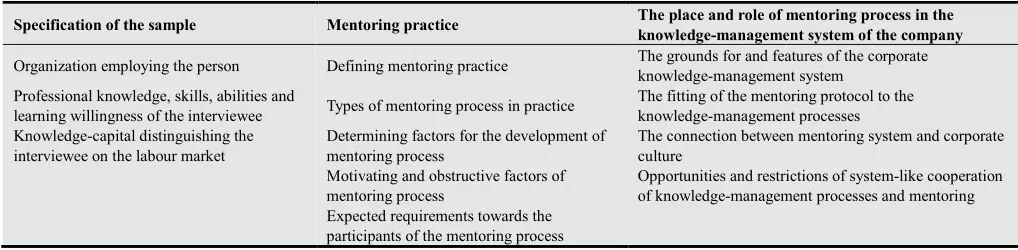
30 respondents volunteered to participate in the research, and they all were from professional circles. The selection was not unintentional as those interviewees could get into the research who already participated in successful mentoring. Each interview was made separately with the interviewees; therefore they had no chance to influence each other. Previously determined group of questions were asked from the respondents and their answer was then written down. All the comments were analyzed along the questions. The following table summarizes the groups of questions:
Table 1. The structure of the questionnaire
Specification of the sample Mentoring practice The place and role of mentoring process in the knowledge-management system of the company
Organization employing the person Defining mentoring practice The grounds for and features of the corporate
knowledge-management system Professional knowledge, skills, abilities and
learning willingness of the interviewee Types of mentoring process in practice
The fitting of the mentoring protocol to the knowledge-management processes Knowledge-capital distinguishing the
interviewee on the labour market
Determining factors for the development of mentoring process
The connection between mentoring system and corporate culture
Motivating and obstructive factors of mentoring process
Opportunities and restrictions of system-like cooperation of knowledge-management processes and mentoring Expected requirements towards the
participants of the mentoring process
In the following the review of the research happens by taking this structure of the questionnaire into consideration.
4. Introducing the Specifications of
Successful Mentoring Practice in
Hungarian Organizations
The introduction of the results starts with the specification of the sample. The participants in the research basically belong to two age-groups: 17 people in their 20’s and 10 respondents in their 30’s. The youngest respondent was 20 years old, while the eldest was 62. According to their qualification, 22 people had higher university degree, while 8 people finished secondary school studies.
The majority of the respondents (15 respondents) was employed by big organizations, which are organizations employing more than 250 people, 7 of them were employed by medium-sized companies (employing 50-249 people), and 5 people worked for small companies (employing 9-49
workers), while 3 people did not provide answer about the size of their companies.
These companies’ field of activities is quite widespread: mainly they were companies dealing with marketing and sales, IT, finance, security system, education-training, vehicle-industry, but there were representatives of the energy-sector as well.
After specifying the sample, the professional knowledge and learning willingness of the respondents was asked. The bigger part of the interviewed people also had the special knowledge their organization required. From the answers it can be seen that it was the work experience which distinguished the elder employees from the other workers, while the young employees basically emphasized their flexibility, creativity and team-working spirit as their labour-market values. One employee, who is less experienced, summarized his favourable aptitudes in the following way:
and persistent and sometimes even more skilled. I have already experienced this at the university as I graduated abroad. I am more ambitious and pushing. If I want to reach something, I will stick to it, I will fight for it until I get it. This is how I could get here as well and I could fight out to reach better position here.’
Each respondent considered the priority of knowledge, technical knowledge and experience highly important from the point of view of his employment and that is not by coincidence that the most of them stood up for the continuous and life-long learning, which they solved either with self-training or with training facilities offered by the company:
‘The organization offers many opportunities for learning and for development, it offers more than the job itself would require. The manager also takes part in the conscious career-planning; he gives information about the opportunities. There are several trainings, where we can get insight into certain fields, which are not really part of our scope of activities. The managers also help in showing us which fields should be developed and the company supports our plan in that.’
The majority of the respondents expects or would have expected form the company to be their partners in developing knowledge capital. Most of them received continuous training, but there were some employers who did not measure its importance and did not assess it as organization-specific task. However it can have additive negative effect on the
workers’ knowledge-developing and self-improving
motivation as well:
‘If I had plans for promotion at the company, I would definitely need further studies to develop my managerial skills, but within the frame of this company I cannot realize it as it is –so to say- not provided here. Previously I asked my acquaintances –who are studying at local universities- about it, but I guess it was just an idea. There was no substantive improvement in this issue, probably there is no motivation from above either; thus I am not motivated at all. I think that it is not the company’s interest to improve our knowledge, at higher levels fluctuation is rare, but at lower levels it is a
frequent phenomenon, which means anybody can
immediately be substituted as there is over-application everywhere.’
The next part of the in-depth interview, which collected the second group of questions interviews mainly concentrated on the features of mentoring practice as one form of knowledge-sharing. When mentoring had to be defined, the respondents basically meant the classical mentoring practice (the authors refer to the definition given by Kram, 1985):
‘Each and every employee would need a mentor who helps him to learn his tasks. The mentored person should trust his mentor as his future job at the company largely depends on him. The mentor helps him integrating into the company and getting to know the system there. If an entrant or a trainee joins our company, the boss assigns somebody to coach him. Of course the entrant or the trainee has to sit next to almost all the employees to acquire what he has to know and what
he needs. It is the mentor’s task to teach him everything in details. This is a longer process, it will not happen one day after the other, it might take weeks or months until the mentored person can be allowed to do his job alone.’
The fact how the elements of knowledge-management prevails between mentored and the mentored person can influence the efficiency of mentoring practice. One of the respondents phrased the successful mentoring as a widespread knowledge-sharing process the following way:
‘I think the bottom line of mentoring practice is the acquisition of knowledge, to keep it on level, to apply it and to transfer it. In case of the new fellow-workers the mentoring task is extended with other functions such as introduction of the organization, giving information on basic principles and tasks, etc. The majority of people in Hungary are sceptical in connection with the program as they are afraid of sharing their knowledge with others; they think they might lose their jobs this way. During years I could experience that it is not like that at all. Being a mentor I really enjoy working with them. Mentoring system at our company operates in a formal way with mentors appointed at different fields. Mentors possess widespread knowledge and are experienced at their own field of activates, and their task is to share their knowledge, to train colleagues helping their work and the operation of the organization with that.’
During defining the mentoring practice, no one of the respondents mentioned new type of knowledge-sharing processes, which are more than the traditional mentoring
practice in classical understanding. The so-called
reverse-mentoring was not mentioned , which means that it is not the elder an more experienced managers who train the young workers, but just the other way round; where young employees act as mentors to teach new technologies to their elder colleagues.
Furthermore, the mentoring process of a mutual learning process was not explained either for the mentor and for the mentored person as well (reciprocal mentoring), but they were talking about a rather one-way - from the mentor to the mentored person- knowledge transfer and teaching, and did not talk about the two-way knowledge-sharing or learning as
professional literature sees it.
(Harvey-McIntyre-Heames-Moeller, 2009). It is not by coincidence after all that the majority of the interviewees thought that mentoring is mainly necessary for the entrants who have no experience and consequently they explained this demand from the side of the mentored:
company.’
The success of mentoring work can be influenced by the fact whether the participants are volunteers in the knowledge-sharing process, whether there is demand for knowledge-transfer both in the mentor and in the mentored person as well. For this, the mentor and the mentored person should be aware of what the other expects from him, what information he has or misses. From the answers it can be seen that people are sometimes afraid to admit what they do not know either because they want to hide it for prestigious reasons or they simply do not know what knowledge is expected from them by their organization and environment. There is another big problem when the participants do not want to transfer knowledge to each other as employees sometimes stick to their knowledge-monopolies, which ensures to preserve their status (Fehér, 2002; Bőgel, 2005). This kind of mystery can weaken the mentoring work.
The mentor’s work influences the mentored person’s individual daily work activities. This effect is basically positive according to the majority of the respondents as the mentoring work has sense only if it gives some additive values to the mentored and thus indirectly to the organization as well. As for example Wilson and Elman (1990) explained: those employees who have mentors can learn easier and more effectively than workers who have no mentors.
The question is the following: how much independence the mentor should give to his mentored person. The steady opinion of the respondents is that the mentor should not be behind his mentored person all the time, the mentor should give him the chance to find solutions and provide ideas alone, but in case the mentored person needs help in solving tasks, then from the very beginning he should rely on his mentor’s advice and help. Finding the healthy balance can be a weak point of successful work:
‘I think employees should be allowed to evolve, they should try to work alone; otherwise it will not have a happy ending. Freedom to a certain level should be given to the mentored person and the common evaluation of the task should happen only after finishing the task. That will be the time to judge what was good and what was bad. But the most important thing is that it has to be done together. He should be supported to recognize his own mistakes, so he might not make the same mistakes again in the future.’
The interviewed people interpreted the features of mentor and mentored person according to the classical understanding: while the mentor is basically an experienced professional who is patient and has teaching skills, the mentored person is an open-minded employer who is motivated to learn and is very ambitious. One respondent gave the following portrayal of the participants in the process:
‘I think the main character of the mentored person is to be brave enough to ask and who can trust others, can listen and observe in certain cases. The mentored person has to be open to new ideas and solutions; he should be able to accept other people’s opinion and thoughts. On the contrary the mentor acts as a connector between the mentored person and the managers, doing this by being example and inspiring and
supportive. He should have good problem-solving skills and he should manage human relations well. He shows tolerance towards an entrant, helps him in integration.’
Of course the successful mentoring processes can be obstructed by several factors, which can be originated from the participants’ characteristic features just like the motivating factors- respondents concluded. These factors can be -among others- impatience, the lack of respecting others, low communication skills and low professional knowledge. But what can really ruin the relationship of a mentor and his mentored person is the lack of trust and partnership:
‘I think the key-word here is partnership: when the mentor and his mentored person mutually support each other. The same things refer to both of them: if they are impatient with each other or they do not take their relation or the program seriously. If the mentor is selfish and considers his mentored inferior, he will just exploit the common work.’
A respondent had the following idea about the role of understanding, which originates from the accepting and respecting each other:
‘Yes, we could work together. It is important that participants can discuss their problems with each other and to come up with a common decision even if they do not share the same opinion in some questions. An obstructive factor can be if one party sticks to his guns even if he is not convinced about his right. Or when the mentor forces his partner to accept his opinion- this can as well be an obstructive factor.’
Although the respondents basically understood the classical mentoring practice on mentoring, it was still a question whether this process is really a one-way knowledge-transfer and there is no mutual two-way learning process realized. From the answers it could be seen that the majority of the respondents had the experience where both parties gained knowledge from the other party; and that knowledge supported not only his development but also provided added value to the corporate knowledge (although it was not stated) and it could get into the management of the system of corporate knowledge capital as it can be seen in the following two examples:
‘So far I was lucky with my mentored employees, each of them was hard-working and interested, and they could gain knowledge rather quickly. However, the success of mentoring largely depends on the personality and attitude of the mentor and the mentored person as well. During the common work both parties can learn a lot from the other, the employer can develop in his own field, while the mentor can primarily develop socially.’
to his work. The mentor on the other hand can help the company -with his acquired knowledge- to put the suitable people to the most suitable position. Thus the managers immediately know what to do in a given situation, it does not require further energy and time to find the most suitable employer.’
In the final part of the interviews the research studied the connection between knowledge-management and mentoring. As the above mentioned example shows, the mentoring work can be part of the corporate knowledge-management processes. It can be a tool, which among others can supplement and support the continuous gathering of information (making databases), it can support the improvement of learning processes and it can secure the training of future managers at companies who possess real knowledge and are professionals. It can only be successful in the long run and mentoring can build into the corporate knowledge-management system if the mentor primarily and studiously transfers the company’s principles during his work and secondly he supplements them with his own principles, and not vice versa.
Finally it was a question, how mentoring can be a successful part of corporate culture, how it can be adapted and who can have roles in this process. The participants of the research thought that the main pre-condition is to have a corporate culture within the organization, which itself expects learning and improving, which serves the aim of mentoring, consequently the latter can be automatically part of the culture. In this culture it is an expectation from the mentored to be open-.minded and to aim to develop continuously. But at the same time the mentor has to be a person who is sure in his knowledge and is willing to share his knowledge, which means that the mentoring system can operate effectively only if it is based on trust. Consequently this knowledge-transfer should not be a forced process, but rather it should be a demand from both sides.
Adapting is also influenced by other factors than human factors, which are the following: what the size of the corporation is, what decision methods they have, how flexible and innovative the directors are, and what special expertise is needed in certain fields of operation. One of the respondents summarized the connecting points of culture and mentoring system and their determination relevant to each other the following way:
‘Mentoring activity greatly influences the profile of a company’s culture. As organizational culture is a type of socially combined system, a well-operating mentoring can maintain the necessary human and professional connections easily and more successfully within the company, which is a basic element of the organizational culture. We have to do our best to build a perfectly-operating mentoring system in the company. The mentoring system supports cooperation with others, the common work; it teaches respect and patience towards our colleagues. It helps us to accept being different, and to accept that thinking is individual. Finally, if a conflict arises, the mentor can manage that and can find solution in the root, not just giving treatment on the surface.’
5. Summary
The paper examined the success factors of and reasons for mentoring system with the results received in samples of a non-representative research, which was carried out last year.
The in-depth interviews were made with respondents who basically were participants in one or more successful mentoring processes.
The results of the research show that -in case of Hungarian organizations- this knowledge-transfer protocol is basically
organized within the framework of the classic,
organization-generated practices. The respondents
characteristically consider this type of knowledge-transfer important, and the authors’ (Bencsik-Juhász-Kovács, 2014) other previous works also justified its being advantageous. During these processes the mutual knowledge-transferring processes are also realized (mainly unintentionally), but the participants did not report about the reciprocal mentoring. The mentoring process at the same time was valued more by the participants of the research, similar to professional literature (Haynes-Ghosh, 2008, Ehigie-Okang-Ibode, 2011), than a simple knowledge-transferring process. Both participants give and get active added value during mentoring, which promote the participants ‘professional, mental and social development (Turban-Dougherty, 1994).
From the aspect of knowledge-management, the most important elements of organizational culture are: trust, communication and learning. Knowledge-sharing is just an illusion without trust (Bencsik, 2013). This can be seen also from the answers. The respondents said that the key to success is a system based on trust, which can easily fit into an organizational culture, which is flexible, open to the outside world, where authoritarian attitude is of secondary importance, but where knowledge-transfer processes get active role in its system of values. The opinions verified that in case of positive solutions the mentoring practice can easily fit into the knowledge-management system and with this they help the organizations to generate quick and effective
answers required by the global environment
(Fajana-Gbajumo-Sheriff, 2011).
Further success factor of mentoring apart from corporate culture is the corporation’s activity structure, the place and role of the participants in the process within the organization (Allen, 2004), furthermore the motivation and personality characters of the participants. Some of these features are mentioned in the article of Catling and Davies (2008); they put special emphasis on loyalty, parallel thinking and natural curiosity.
It can be seen from the interviews that the successful mentoring expects investment from the mentor, the mentored person and from the organization (Adeyemi, 2011), but because of it the process can take an active part in developing and training leaders and employees, who will own valuable knowledge, who are inspired to be loyal and who are suitable to fulfil the company’s future aims. (Haggin-Kram, 2001, Arogundade, 2011).
widespread, but can greatly colour the learning process of the participants in an organization. As knowledge-transfer (Argote and Ingram, 2000) can be determined as knowledge-sharing between individuals and groups within an organization, this activity and thus successful mentoring as well can contribute to the strengthening of the company’s competitiveness.
References
[1] A. Bencsik, “Best Practice in Building
Knowledge-Management System or Handbook for Managers on Knowledge-management,” Pearson Publishing, Harlow England, 2013.
[2] A. Bencsik, T. Juhász and Sz. Kovács, “Current issues of knowledge-transfer with special consideration of knowledge-transferring willingness and mentoring practice (based on empirical research),” pp.1-11. Under publication
[3] A. Haesli and P. Boxall, “When Knowledge Management Metts HR Strategy: An Exploration of Personalization-Retention and Codification-Recruitment Configurations,” in Journal of Human Resource Management, 16:11 November 2005 pp.1955-1975.
[4] B. O. Ehigie, G. O. Okang and F. O. Ibode, “Mentoring and Organistaional Behaviour,” in IFE PsychlogIA 2011 Supplement, pp.398-419.
[5] C. K. Prahalad and G. Hamel, “The Core Competence of the Corporation,” in Harvard Business Review (May-June), pp.79-91.
[6] C. McInerney, “KnowledgeManagement and the Dynamic Nature of Knowledge,” in Journal of the American Society for Information Science and Technology, 53 (12), pp.1009-1018.
[7] D. B. Turban and T. W. Dougherty, “Role of Protégé Personality in Receipt of Mentoring and Career Succes,” in Academy of Management Journal, 1994, pp.688-702.
[8] Gy. Bőgel, “Knowledge, money, power I.-II. parts,” in CEO, Vol. VI. No1.-2. pp.8-15., 27-33.
[9] I. Nonaka and H. Takeuchi, “The Knowledge Creating Company: How Japenese Companies Create the Dynamics of Innovations,” Oxford University Press, New York. pp.1-114.
[10] J. A. Wilson and N.S. Elman, “Organizational benefits of Mentoring,” in Academy of Management Executive, pp.88-94.
[11] J. E. Russel and D. M. Adams, “The Changing Nature of Mentoring in Organizations: an Introduction to the Special Issue on Mentoring in Organizations,” in Journal of Vocational Behavior, 51: pp.1-14.
[12] K. Kram, “Mentoring at Work,” Boston: Scott, Foresman
[13] L. Argote and P. Ingram, “Knowledge Transfer: a Basis for Competitive Advantage in Firms,” in Organizational Behavior and Human Decision, Process 82. pp.150-169.
[14] M. C. Haggin and K.E. Kram, “Reconceptualizing Mentoring at Work: A Developmental Network Perspective,” In Academy of Management Review, 2001, pp.264-288.
[15] M. Harvey, N. McIntyre, J. T. Heames and M. Moeller, “Mentoring Global Female Managers in the Global Marketplace: Traditional, Reverse and Reciprocal Mentoring,” in The International Journal of Human Resource Management, Vol. 20. No. 6. June 2009. pp.1344-1361.
[16] O. Arogundade, “Mentoring and Leadership Succesion in Industries and Organizations,” in IFE PsychlogIA 2011 Supplement, pp.180-185.
[17] R. K. Haynes and R. Ghosh, “Mentoring and Succesion Management: an Evaluative Approach to the Startegic Collaboration Model,” in Review of Business, 2008/28, pp.3-12.
[18] S. Adeyemi, “Enhancing Organizational Oerformance Through Effective Mentoring,” in IFE PsychlogIA 2011 Supplement, pp.366-378.
[19] S. Fajana and M. Gbajumo-Sheriff, “Mentoring: a Human Resource Tool for Acheiving Organisational Effectiveness,” in IFE PsychlogIA 2011 Supplement, pp.420-432.
[20] S. C. Payne and A. H. Huffman, “A Longitudinal Examintation of the Influence of Mentoring on Organizational Commitment and Turnover,” in Academy Management Journal, 2005. Vol. 48. No.1. pp.158-168.
[21] T. A. Scandura, “Dysfunctional Mentoring Relationships and Outcomes,” in Journal of Management, 1998, Vol.24. No.3. pp. 449-467.
[22] T. Catling and M. Davies, “Mentoring the Objective Support that Managers Need,” in British Journal of Adiministrative Management, 2008/ Jan/feb pp.22-23.
[23] T. D. Allen, L. T. Poteet, M. L. Lentz and L. Lima, “Career Benefits Associated with Mentoring for Proteges: A Meta-Analysis,” in Journal of Applied Psychology, pp.127-136.
[24] W. Bates, “Organizational Learning and Knowledge Technologies in a Dynamic Enviroment,” Dordecht: Kluwer Academic Publisher