SHIV SHAKTI
International Journal in Multidisciplinary and
Academic Research (SSIJMAR)
Vol. 4, No.
1, February
2015 (ISSN 2278 – 5973)
Performance Analysis Of Various Asymmetric Key
Cryptography Algorithm
Mr. S Pratap Singh Dr. M. Ekambaram Naidu
Research scholar, Professor and Principal
Rayalaseema University, Kurnool, AP, India TRRCET,PatancheruHyderabad,AP, India
[email protected] [email protected] Abstract:As we are living in the information age, and protection of information is very important. To protect the information various method of techniques have been proposed and adopted. This paper presents the performance analysis of various asymmetric-key cryptography algorithms, in terms of its behaviour in different settings like different block size of data, size keys, speed, efficiency and attacks.
Keywords:Asymmetric algorithm, RSA, DSA, Diffie-Hellman, ECC,ELGamal.
Impact Factor = 3.133 (Scientific Journal Impact Factor Value for 2012 by Inno Space Scientific Journal Impact Factor)
Global Impact Factor (2013)= 0.326 (By GIF)
Indexing:
Introduction:
As the information is an asset and communication through internet are growing fast, it is necessary to build more secure and reliable software application. Now a day, hacking of network application is becoming more common. It is necessary to protect such communication over the internet. Cryptography provides a wide variety of symmetric and asymmetric algorithms for secure communication purpose. This paper gives a very quick overview of cryptography along with a brief introduction of various compared secure encryption algorithms in order to understand them.
A. Cryptography: Overview
Cryptography is usually combination of two words as "crypto + graphy” which means asCrypto is secret,graphy is writingie secret writing[1]. Encryption is the process of converting plain text to cipher text ie "unhidden" to a coded text "hidden" to secure it against data thieves. It is represented as C=Ek(P).The reverse of it is Decryption. Decryption is the process of converting a coded text or cipher text to plain text or hidden to unhidden text [1][2] it is represented as P=Dk(C).
Fig 1: Encryption and Decryption process
B. Cryptography Goals
This section explains the main goals behind using Cryptography. Every security system must provide a bundle of security functions that can assure the secrecy of the system. These functions are usually referred to as the goals of the security system. These goals can be listed under the following main categories [1] [2] [3] Authentication,Secrecy/Confidentiality,Integrity, Non-Repudiation, Availability,Access Control.
C. Block Ciphers and Stream Ciphers
One of the main categorization methods for encryption techniques commonly used is based on the form of the input data they operate on. The two types are Block Cipher and Stream Cipher.
Block Cipher : In Block ciphers data is in the form of blocks,i.e., the plain text id divided into blocks and this block are given as an input to block ciphers to produce the cipher text. There are different block modes of operations like ECB, CBC,CFB,OFB, and CTR.
P l a i n t e x t ( P )
E n c r y p t i o n
c i p
h e r ( E )
C i p h e r t e x t ( C )
D e c r y p t i o n c i p h e r
(
D )
Key(K)C i p h e r t e x t ( C )
Stream cipher: Stream cipher is a stream of data or bit by bit or character by character are given as input for encryption/decryption algorithm. These input bit or characters are mixed with other key streamof bits or characters to generate the cipher text.
D. Encryptions techniques: Symmetric key and Asymmetric key
Data encryption procedures are mainly categorized into two categories depending on the type of security keys used to encrypt/decrypt the secured data. These two categories are: Asymmetric and Symmetric encryption techniques
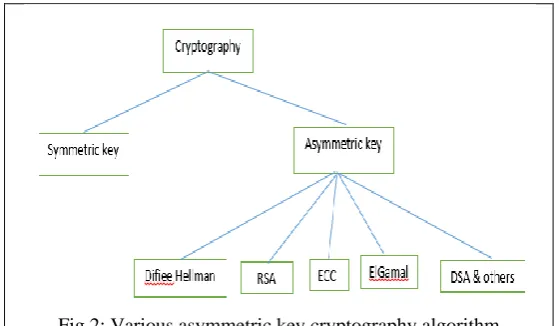
Fig 2: Various asymmetric key cryptography algorithm
Symmetric Encryption technique: In this type of encryption, the sender and the receiver agree on a secret (shared) key. Then they use this secret key to encrypt and decrypt their sent messages. The key management is done in different ways. Suppose Alice and Bob first agree on the encryption technique to be used in encryption and decryption of communicated data. Then they agree on the secret key that both of them will use in this connection. After the encryption setup finishes, Alice starts sending its data encrypted with the shared key, on the other side Bob uses the same key to decrypt the encrypted messages [2]. The main concern behind symmetric encryption is how to share the secret key securely between the two peers. If the key gets known for any reason, the whole system collapses. The key management for this type of encryption is troublesome, especially if a unique secret key is used for each peer-to-peer connection, then the total number of secret keys to be saved and managed for n-nodes will be n(n-1)/2 [1][2][3].
Asymmetric Encryptiontechnique: Asymmetric encryption is the other type of encryption where two keys are used. To explain more, what Key1 can encrypt only Key2 can decrypt, and vice versa. It is also known as Public Key Cryptography (PKC), because users tend to use two keys: public key, which is known to the public, and private key which is known only to the user. The key distribution is done in different ways. Suppose the two keys between node A and node B. After agreeing on the type of encryption to be used in the connection, node B sends its public key to node A. Node A uses the received public key to encrypt its messages. Then when the encrypted messages arrive, node B uses its private key to decrypt them. When using symmetric algorithms, both parties share the same key for en- and decryption. To provide privacy, this key needs to be kept secret. Once somebody else gets to know the key, it is not safe anymore.
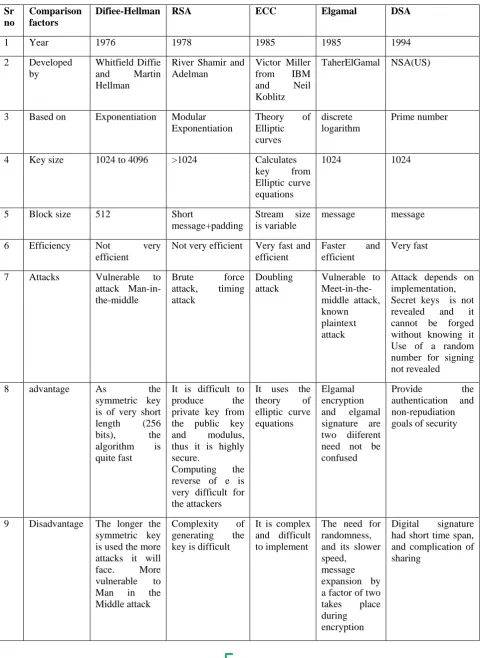
This section of paper discuss about the various asymmetric key algorithms and their comparison. The asymmetric key algorithm like RSA, DSA, Diffie-Hellman, ECC and ELGAMAL are compared.
In paper [4] the authors presents evaluation of six encryption algorithms like AES (Rijndael), DES, 3DES, RC2, Blowfish, and RC6. A comparison has been conducted for the different settings for each algorithm such as different sizes of data blocks, data types, power consumption, key size and encryption/decryption speed. The authors concluded that Blowfish has better performance than a DES in change packet size, in change of text to audio other type of files the three algorithms had low performance in terms of time consumption.
The authors in [5] analysed two symmetric algorithms DES and AES, with respect to parameters like encryption speed, power consumption and their experimental results concluded that Blowfish algorithm runs faster than DES and both the algorithms consumes almost same power.
In [6] the authors presents a new image encryption scheme based on DES algorithm and chaotic encryption. The chaotic sequence is implemented in the DES algorithm to improve the initial keys and the iterating operations, so that the chaotic encryption is combined with DES algorithm. Theory analysis and simulation results show that the presented scheme can expand the initial key space, improve the security and anti-attack ability of the algorithm effectively. It is more propitious to image information transmission as this scheme insures the security and confidentiality of image information.
In [7] the Authors compared the three most common symmetric key algorithms DES, AES, and Blowfish. The comparison takes into consideration the behaviour and performance of algorithms in different parameters like speed, block size and key size. The analysis is done on different block cipher modes like ECB, CBC, OFB and CFB. The authors implemented the algorithms in Java programming and their simulation results showed that Blowfish algorithm has a better performance than AES. The time difference between different block cipher modes is negligible.
In paper [8] the authors presents a theoretical performance analysis of DES and RSA along with their working mechanisms. Author concluded that in key distribution, DES is more suitable to the application than RSA, even though an asymmetric key cryptographic system provides high security than symmetric key algorithms. They also concluded that these algorithms are vulnerable attack as the rapid growing internet application demands.
Comparison of various Asymmetric algorithms
Table 1: Comparison table of Asymmetric algorithms
Sr no
Comparison factors
Difiee-Hellman RSA ECC Elgamal DSA
1 Year 1976 1978 1985 1985 1994
2 Developed by
Whitfield Diffie and Martin Hellman
River Shamir and Adelman
Victor Miller from IBM and Neil Koblitz
TaherElGamal NSA(US)
3 Based on Exponentiation Modular Exponentiation
Theory of Elliptic curves
discrete logarithm
Prime number
4 Key size 1024 to 4096 >1024 Calculates key from Elliptic curve equations
1024 1024
5 Block size 512 Short
message+padding
Stream size is variable
message message
6 Efficiency Not very efficient
Not very efficient Very fast and efficient
Faster and efficient
Very fast
7 Attacks Vulnerable to attack Man-in-the-middle
Brute force attack, timing attack
Doubling attack
Vulnerable to Meet-in-the-middle attack, known plaintext attack
Attack depends on implementation, Secret keys is not revealed and it cannot be forged without knowing it Use of a random number for signing not revealed
8 advantage As the symmetric key is of very short length (256 bits), the algorithm is quite fast
It is difficult to produce the private key from the public key and modulus, thus it is highly secure.
Computing the reverse of e is very difficult for the attackers
It uses the theory of elliptic curve equations
Elgamal encryption and elgamal signature are two diiferent need not be confused
Provide the authentication and non-repudiation goals of security
9 Disadvantage The longer the symmetric key is used the more attacks it will face. More vulnerable to Man in the Middle attack
Complexity of generating the key is difficult
It is complex and difficult to implement
The need for randomness, and its slower speed,
message expansion by a factor of two takes place during
Conclusion
The author in this paper gives the conclusion that each algorithm had its own advantage and disadvantage. Each of the algorithms are vulnerable to some type of attack as the advances in the technologies is increasing.As RSA and ECC algorithms are popular to some extent but later they add some drawback due to RSA complexity in generating key is more and ECC algorithms is difficult to implement. DSA and Elgamal are digital signature algorithms. DSA algorithm generated the digital signature had short time span and Elgamal is slower in speed. Finally the performance of all the algorithms varies depending upon the application they choose.
References
[1] W.Stallings, ''Cryptography and Network Security 4thEd, '' Prentice Hall , 2005,PP.
58-309
[2] Behrouz A. Forouzan “Cryptography and Network Security “ TATA Mc-Graw Hill [3] Addison Wesley 2003" Real 802.11 Security: Wi-Fi Protected Access and 802.11i ,". [4] Elminaam, D. (2008). Performance evaluation of symmetric encryption algorithms.
International Journal of Computer Networks (IJCN), 8(12), 280–286
[5] Nie, T., Song, C., & Zhi, X. (2010). Performance evaluation of DES and Blowfish
algorithms. In 2010 International Conference on Biomedical Engineering and Computer Science, ICBECS 2010.
[6] Kumar, N., Thakur, J., & Kalia, A. (2011). Performance Analysis of Symmetric Key
Cryptography Algorithms: DES, AES and Blowfish. Anu Books, 28–37.
[7] Thakur, J., & Kumar, N. (2011). DES, AES and Blowfish: Symmetric key cryptography
algorithms simulation based performance analysis. International Journal of Emerging Technology and Advanced Engineering, 1(2), 6–12.
[8] Kumar, Y., Munjal, R., & Sharma, H. (2011). Comparison of Symmetric and Asymmetric
Cryptography with Existing Vulnerabilities and Countermeasures. IJCSMS International Journal of Computer Science and Management Studies, 11(03), 2231–5268.
[9] Pratap singh,S & Ekambaram Naidu, M (2011). Impact of multiple attacks and damages