Composable & Modular Anonymous Credentials:
Definitions and Practical Constructions
Jan Camenisch1, Maria Dubovitskaya1, Kristiyan Haralambiev∗1, and Markulf Kohlweiss2
1IBM Research – Zurich 2Microsoft Research
Abstract
It takes time for theoretical advances to get used in practical schemes. Anonymous cre-dential schemes are no exception. For instance, existing schemes suited for real-world use lack formal, composable definitions, partly because they do not support straight-line extrac-tion and rely on random oracles for their security arguments.
To address this gap, we proposeunlinkable redactable signatures(URS), a new building block for privacy-enhancing protocols, which we use to construct the first efficient UC-secure anonymous credential system that supports multiple issuers, selective disclosure of attributes, and pseudonyms. Our scheme is one of the first such systems for which both the size of a credential and its presentation proof are independent of the number of attributes issued in a credential. Moreover, our new credential scheme does not rely on random oracles.
As an important intermediary step, we address the problem of building a functionality for a complex credential system that can cover many different features. Namely, we design a core building block for a single issuer that supports credential issuance and presentation with respect to pseudonyms and then show how to construct a full-fledged credential system with multiple issuers in a modular way. We expect this flexible definitional approach to be of independent interest.
Keywords: (Fully) structure preserving signatures, vector commitments, anonymous cre-dentials, universal composability, Groth-Sahai proofs.
1
Introduction
Digital signature schemes are a fundamental cryptographic primitive. Besides their use for signing digital items, they are used as building blocks in more complex cryptographic schemes, such as blind signatures [46, 6], group signatures [15, 56], direct anonymous attestation [21], electronic cash [44], voting schemes [52], adaptive oblivious transfer [33, 25], and anonymous credentials [12].
The efficient construction of such protocols, however, demands special properties of a signa-ture scheme, in particular when the protocol needs to achieve strong privacy properties. The most important such properties seem to be that the issuance of a signature and its later use in a protocol isunlinkableas well as that the scheme is able to signmultiple messages(without employing a hash function). The first signature scheme that met these requirements is a blind signature scheme by Brands [19]. The drawback of blind signatures, however, is that when using the signature later on in a higher-level protocol it must typically be revealed so that a third party can be convinced
∗
of its validity. Thus, these signatures can be used only once, which turns out to be quite limit-ing for applications such as group signatures, multi-show anonymous credentials, and compact e-cash [27].
Camenisch and Lysyanskaya [31, 32] were the first to design signature schemes (CL-signatures) overcoming these drawbacks. Their schemes are secure under the Strong RSA or theq-SDH as-sumption, respectively, and allow for an alternative approach when using a signature in a protocol: Instead of revealing the signature to a third party, the user employs zero-knowledge proofs to con-vince the third party that she possesses a valid signature from the signer. While in theory this is possible for any signature scheme, CL-signatures were the first that enabled efficient proofs using so-called generalized Schnorr proofs of knowledge. This is due to the algebraic properties of CL-signatures: in particular, no hash function is applied to the message, and the signature and message values are either exponents or group elements.
With the advent of CL-signatures, the area of privacy preserving protocols flourished consid-erably and numerous new protocols based on them have been proposed. This has also made it apparent, however, that CL-signatures still have a number of drawbacks:
(1) Random oracles.To make generalized Schnorr proofs of knowledge non-interactive (which is often required in applications), one needs to resort to the Fiat-Shamir heuristic, that is, to the random oracle model and thus looses all formal provable security guarantees when the random oracle is instantiated by a hash function [37].
(2) Straight-line extraction. When designing a protocol to be secure in the Universal Com-posability model [36] no rewinding can be used to prove security. As a result, witnesses in generalized Schnorr proofs of knowledge need to be encrypted under a public key en-coded in the common reference string (CRS). As the witnesses (messages signed with CL-signatures) are discrete logarithms, such encryption is rather expensive [11, 28] and may render the overall protocol unpractical.
(3) Linear size.When proving ownership of a CL-signature on many messages, all these mes-sages are needed for the verification of the signature and therefore the proof of possession of a signature will be linear in the number of messages.
A promising ingredient to overcome these drawbacks is the work by Groth and Sahai [50], who for the first time constructed efficient non-interactive zero-knowledge proofs (NIZK) without using random oracles, albeit for a limited set of languages. Indeed, the set of languages covered by these so-called GS-proofs does not include the ones covered by generalized Schnorr protocols and therefore many authors started to look for a compatible CL-signatures replacement, i.e., structure-preserving signature schemes [3, 4, 2]. Together with GS-proofs, these new schemes can also be used as signatures of knowledge [42] and thus are applicable in scenarios previously addressed with CL-signatures.
However, structure-preserving signatures still suffer in terms of performance when sign-ing multiple messages, i.e., drawback (3), which is a typical requirement in applications such as anonymous credentials. Indeed, like for CL-signatures, the size of proofs with structure-preserving signatures grows linearly with the number of messages. As the constant factor for GS-proofs is larger than for generalized Schnorr proofs, structure-preserving signatures loose their attractiveness as a building block for such applications.
messages grows. We view our contribution as threefold:
First, in§2, we formally define URS. We present property-based security definitions for un-linkability andunforgeability and also a UC functionality for URS. We show that what distin-guishes the strength of our property-based and functionality-based definitions is careful key man-agement. Namely, the latter requires a key registration process that allows for the extraction of signing keys. We validate our definitions by showing that an URS scheme satisfying strengthened property-based security definitions with key extraction securely implements our UC functionality. Second, in§3, we construct an efficient URS scheme from vector commitments [55, 59, 38], structure-preserving signatures [3, 4], and (a minimal dose of) non-interactive proofs of knowl-edge (NIPoK), which in practice can be instantiated by witness-indistinguishable (!) Groth-Sahai proofs [50]. As we are interested in practical efficiency, we deliberately instantiate our scheme with concrete building blocks, and rely on stronger assumptions (see§4.3).1 We show how to make use of algebraic properties in our building blocks to minimize the witness size of the NIPoK. For key management, we employ a novel cryptographic primitive,fullystructure preserving sig-natures [1]. Our main target is Groth-Sahai proofs, but we also discuss extensions for optimizing the efficiency of generalized Schnorr proofs of knowledge in case one is willing to accept random oracles.
Third, in§4, to demonstrate the versatility of our URS scheme as a CL-signature ‘replace-ment’, we employ it to design the first efficient universally composable anonymous credential system that supports multiple issuers, pseudonyms, and selective disclosure of attributes.
Anonymous credential systems usually need to support an ecosystem of different features. Therefore, a single ideal functionality providing all the features, such as pseudonyms, selective attribute disclosure, predicates over attributes, revocation, inspection, etc. would be very complex and hard to both create and use in a modular way—not to mention credible security proofs.
Nevertheless, ideal functionalities are very attractive for modeling the complexity of anony-mous credential schemes. Indeed an early seminal paper [30] attempted exactly this, but was foiled by drawback (2)—as well as by the immaturity of the UC framework at the time. To over-come this complexity, we present a flexible and modular approach for constructing UC-secure anonymous credentials. Namely, we design a core building block for a single issuer that supports credential issuance and presentation with respect to pseudonyms. We then show how to compose multiple such blocks to construct in a modular way a full-fledged credential system with multiple issuers.
Besides being composable, our system is also arguably one of the first schemes to support efficient non-interactive attribute disclosure with cost independent of the number of attributes issued without having to rely on random oracles. Even in the random oracle model this has been an elusive goal. Therefore, because of the composability and efficient selective disclose, our scheme is very attractive and quickly surpasses schemes based on blind signatures and CL-signatures [20, 32] when the number of attributes grows.
Related work. We compare our signatures and credential schemes with other related work. As there are a multitude of papers on redactable, quotable, and sanitizable signatures [51, 22, 61, 7], we focus on the most influential definitional work and the most promising approaches in terms of efficiency. Further comparison can be found in§5.
A variety of signature schemes with flexible signing capabilities and strong privacy properties have been proposed [41, 18, 8, 7, 10, 14, 35]. While these works provide a fresh definitional approach, their schemes are very inefficient, especially when redacting a message vector with a large number of attributes. Some schemes built on vector commitments [55, 58] achieve
bet-1
ter efficiency but only consider one-time-show credentials, and while the former is not defined formally, the latter involves interaction.
The first efficient multi-show anonymous credential scheme is [30]. It was extended with efficient attribute disclosure [26] and had real-world exposure [34, 21]. It can, however, only be non-interactive in the random oracle model. Non-interactive credentials in the standard model have been built from P-signatures [12, 13]. An instantiation of ourURSscheme, however, is al-most twice more efficient than [12] despite the fact that the latter does not support signing multiple messages. Izabach`ene et al. [54] extends the work of [12] with vector commitments; their scheme is, however, not secure under our definitions. In independent work, Hanser and Slamanig [62] present a credential system with efficient (independent of the number of attributes) attribute dis-closure. However, their system is only secure in the generic group model [48]. Furthermore, it uses hash function to encode attributes and thus does not enable efficient protocol design. None of these schemes is (universally) composable.
An important factor that is often neglected is the compatibility of schemes with zero-knowledge proofs to enable efficient protocol design. Because of its compatibility with Groth-Sahai proofs, efficiency and composability, immediate further applications of our URS scheme include efficient e-cash, credential-based key exchange, e-voting, auditing, and others.
2
Definitions of Unlinkable Redactable Signatures
Redactable signatures are an instance of homomorphic [7] or controlled-malleable signatures [41]. For our credentials application the most useful redaction operation is to selectively white-list or quote a subset of messages and their positions from a message vector of lengthn([7] consider the quoting of sub-sentences). We denote the message space of all valid message vectors asM. We also refer to the redacted message as a quote of the original message. To distinguish the original vector from the quote of all messages we denote the original vector asm~ = (1, m1, . . . , mn)
and a quote asm~I = (2, m01, . . . , m0n). We represent each valid quoting transformation by a set
I ⊆ [1, n]of message positions and denote quoting either byI(m~) orm~I. We denote the ith
message element either bym~[i]ormi. A quotem~Ifromm~ is of the form
~
mI[i] =m0i = (
mi i∈I ⊥ otherwise .
Note that the message itself already reveals whether it is a quote. Chase et al. [41] call such a scheme tiered and we refer to the vectorsm~ andm~Ias Tier 1 and Tier 2 vectors respectively. The
vectorm~Ican be sparse and can have a much shorter encoding thanm~.
2.1 Property-Based Definitions for Unlinkable Redactable Signatures
One can define the security of redactable signatures by instantiating controlled-malleable sig-nature definitions for simulatability, simulation unforgeability, and simulation context-hiding of Chase et al. [41] with the quoting transformation classT ={I(·)|I ⊆[1..n]}above. We prefer, however, to give our own unforgeability and unlinkability definitions that are more specific and do not rely on simulation and extraction. This makes them simpler and easier to prove, and thus more efficiently realizable. Together with key extractability they are nevertheless sufficient to realize the strong guarantees of our UC functionality.
URS.SGen(1κ)→SP. SGentakes the security parameter 1κ as input and outputs the system parametersSP.
URS.Kg(SP)→(pk,sk). Kg takes the system parametersSP as an input and outputs public verification and private signing keys(pk,sk). The verification keypk defines the message spaceM.
URS.Sign(sk, ~m)→σ. Signtakes the signing keysk and a messagem~ ∈ Mas input and pro-duces a signatureσ.
URS.Derive(pk, I, ~m, σ)→σI. Derivetakes the public keypk, a selection vectorI, a message
~
mand a signatureσ(both of Tier 1) as input. It produces a Tier 2 signatureσI form~I. URS.Verify(pk, σ, ~m)→0/1. Verifytakes the verification keypk, a signatureσ, and a message
~
mof Tier 1 or Tier 2 as input and checks the signature.
We omit theURSqualifier when it is clear from the context.
Correctness. Informally, correctness requires that for honestly generated keys, both honestly generated and honestly derived signatures must always verify.
Unforgeability. Unforgeability captures the requirement that an attacker, who is given Tier 1 and Tier 2 signatures on messages of his choice, should not be able to produce a signature on a message that is not derivable from the set of signed messages in his possession. More formally:
Definition 2(Unforgeability). LetHbe a stateful handle generator. For a redactable signature schemeURS.{SGen,Kg,Sign,Derive,Verify}, tablesQ1, Q2, Q3, and an adversaryA, consider the following game:
• Step 1.SP ←SGen(1k); (pk,sk)←−$ Kg(SP);Q1, Q2, Q3← ∅. • Step 2. (m~∗I, σ∗) ←− A$ OSign(·),ODerive(·,·),OReveal(·)(pk), where O
Sign, ODerive, and OReveal behave as follows:
OSign(m~) ODerive(h, I) OReveal(h)
h←H;σ←Sign(sk, ~m) if(h, ~m, σ)∈Q1 if(h, ~m, σ)∈Q1 add(h, ~m, σ)toQ1 σ0←Derive(pk, I, ~m, σ) addm~ toQ3
returnh addm~ItoQ2; returnσ0 returnσ
A signature schemeURSsatisfiesunforgeabilityif for all such PPT algorithmsAthere exists a negligible functionν(·)such that in the above game the probability (over the random choices of Kg,Sign,DeriveandA) thatVerify(pk, σ∗, ~m∗I) = 1and∀m~ ∈Q3, ~m∗I 6=m~I, andm~∗I ∈/Q2is less thanν(κ).
Note that we do not consider a Tier 1 signature itself as a forgery. However, if the adversary manages to produce a valid Tier 1 signature on a messagem~ without callingSign(m~)and either
Reveal(h)orDerive(h, I) on all subsetsI ⊆ [1..n]for the corresponding handleh, he can use this Tier 1 signature to break unforgeability by deriving a Tier 2 signature from it.
Unlinkability. Informally, unlinkability ensures that an adversarial signer cannot distinguish which of two Tier 1 signatures of his choosing was used to derive a Tier 2 signature. More formally:
Definition 3(Unlinkability). For the signature schemeURS.{SGen,Kg,Sign,Derive,Verify}and a stateful adversaryA, consider the following game:
• Step 2.(pk, I, ~m(0), ~m(1), σ(0), σ(1))←− A$ (SP), wherem~(0)I =m~(1)I , Verify(pk, σ(0), ~m(0)) = 1, andVerify(pk, σ(1), ~m(1)) = 1.
• Step 3. Pickb← {0,1}and formσ(b)I ←−$ Derive(pk, I, ~m(b), σ(b)).
• Step 4.b0 ←− A$ (σ(b)I ).
The signature schemeURSis unlinkable if for any polynomial time adversary Athere exists a negligible functionν(·)such thatPr[b=b0]< 1+ν(κ)2 .
Note that this definition is very strong, as the adversary can even pickpk.
2.2 Ideal Functionality for Unlinkable Redactable Signatures
We now give an alternative characterization of unlinkable redactable signatures using an ideal functionalityFURSdefined as follows:
FunctionalityFURS
The functionality maintains tablesKandQinitialized to∅and flagskgandkeyleakwhich are initially unset.
• On input (keygen, sid) from S, verify that sid = (S, sid0) for some sid0 and that flag kg
is unset. If not, then return ⊥. Else, send (initF, sid) to SIM and wait for a message
(initF, sid,SP,Kg,Sign,Derive,Verify) from SIM, where Kg, Sign, and Derive are PPT algo-rithms and Verifyis a deterministic algorithm. Then, store SP, Kg, Sign, Derive, and Verify, run
(pk,sk)←Kg(SP), set flagkg, store(pk,sk), and return(verificationKey,sid,pk)toS.
• On input(checkPK,sid,pk0)from some partyP, verify that the flagkgis set. Check whetherpk0=pk or whether(pk0,sk0)for somesk0was stored inK. In this case, return(checkedPK,sid, true). Else, if
(pk0,⊥)was stored inKreturn(checkedPK,sid, f alse). Else, send(checkPK,sid,pk0)toSIM, wait for(checkedPK,sid,sk0)fromSIM, add(pk0,sk0)toK. Ifsk0 6=⊥, return(checkedPK,sid,true)
toP. Otherwise, return(checkedPK,sid,false)toP.
• On input(leakSK, sid)fromSverify thatsid= (S, sid0)for somesid0. If not, return⊥. Else, if flag
kgis set, set flagkeyleakand return(leakSK,sid,sk).
• On input(sign,sid, ~m)fromS, verify thatsid = (S, sid0)for somesid0and that the flagkg is set. If not, return⊥. Else, runσ ← Sign(sk, ~m) and Verify(pk, σ, ~m). IfVerifyis successful, return
(signature,sid, ~m, σ)toSand addm~ toQ, otherwise return⊥.
• On input(derive,sid,pk0, I, ~m, σ) from some partyP, runDerive(pk0, I, ~m, σ)and if it fails, re-turn⊥. Otherwise, if the flag kg is set andpk = pk0 then set sktmp = sk. If there is an entry
(pk0,sk0) ∈ Krecorded, setsktmp = sk0. Ifsktmpwas set runσ0 ←Sign(sktmp,Zero(m, I~ ))and returnDerive(pk0, I,Zero(m, I~ ), σ0). Otherwise, return the output ofDerive(pk0, I, ~m, σ).
• On input(verify,sid,pk0, σ, ~mI)from some partyP, computeresult ← Verify(pk0, σ, ~mI). If the
flagkgis set, pk0 = pk, flagkeyleak is not set, and@ m~ ∈ Qsuch thatm~I = I(m~), then output
(verified,sid, ~mI,0). Otherwise, output(verified,sid, ~mI, result).
statically,(keygen, sid)will not be sent and hencekg not set and unforgeability not enforced.) Unlinkability of redacted signature is enforced byFURSas follows. It generates a fresh redacted signature only from those parts of the original message that are quoted, i.e., the hidden message parts are set to zero, and thus redacted signatures fromFURSdo not contain any information about
the hidden parts of messages. More precisely, this is enforced for the keys generated byFURS, as well as for any keys that an honest party successfully checked before generating a redacted signature. Unless mentioned otherwise, the reply of the functionality upon a failed check or ver-ification is⊥. Finally, we defineZero(m, I~ ) = (1,m˜1, . . . ,m˜n), withm˜j =mj forj ∈I and
˜
mj = 0forj /∈I. This should not be confused with the operatorI that outputs a Tier 2 message
with⊥elements on certain positions.
2.3 Key Registration and UC Realizability
We now want to construct a protocolRURSthat realizesFURSusing aURSscheme in theFCRS -hybrid model whereSP is the reference string and each call to FURSis essentially replaced by
running one of the algorithms ofURS. While this can be done (the detailed description ofRURS
is given in§A), there are a number of hurdles that need to be overcome. These hurdles are quite typical and include, e.g., that we need to be able to extract the secret keys from the adversary to be able to simulate properly. They are, however, often treated only informally in security proofs. Here we want to make them explicit and treat them formally correct. So our goal is to prove a statement (Theorem) of the form:
IfURSis correct, unforgeable, unlinkable, andXthenRURSsecurely realizesFURS in theFCRS-hybrid model.
What do we have to require fromX to make this theorem true? To prove the theorem we have to show indistinguishability between the ideal world and the real world. In the ideal world, an environmentZ interacts with the simulatorSIMand functionalityFURS. In the real world, the
environmentZinteracts with the real adversaryAand the protocolRURS.
We provide a tentative description ofSIMin the ideal world: when receiving the(initF,sid)
message fromFURS, it generates a trapdoortd(in addition toSP) and returns(initF,sid,SP, Kg,Sign,Derive,Verify). On receiving the(checkPK,sid,pk) message, is uses the trapdoor to extract the secret keysk and returnssk toFURS.
To make this work, we extendURSwith several algorithms: CheckPKis run by RURS on
receiving a message(checkPK,sid,pk). SGenT andExtractKeyare the trapdoored parameter generation and key extraction algorithm forSIM.CheckKeysis used to define what it means to extract a valid key.
URS.CheckPK(pk)→0/1. CheckPKis a deterministic algorithm that takes a public keypk as an input and checks that it is correctly formed. It outputs1ifpkis correct, and0otherwise. URS.SGenT(1κ)→(SP, td). SGenTis a system parameters generation algorithm that takes the security parameter1κ as input and outputs the system parametersSP and a trapdoortd
for the key extraction algorithm.
URS.ExtractKey(pk, td)→sk. ExtractKey is an algorithm that takes a public key pk and a trapdoortdas input. It extracts the corresponding secret keysk.
URS.CheckKeys(pk,sk)→0/1. CheckKeysis an algorithm that takes a publicpkand a private
sk keys and checks if they constitute a valid signing key pair. It outputs1if they do, and0
otherwise.
guarantees thatCheckPK(pk)holds for honest public keys.
Definition 4 (Correctness). An unlinkable redactable signature schemeURS.{SGen,Kg,Sign,
Derive,Verify}with additional algorithmCheckPKis correct if there exists a negligible function
ν(·)such that for any messagem~ ∈ MandI ⊆ [1, n] : Pr[(SP) ← SGen(1k); (sk,pk) ← Kg(SP); σ ← Sign(sk, ~m); σI ← Derive(pk, I, ~m, σ) : CheckPK(pk) = 0 ∨ Verify(pk,
σ, ~m) = 0∨Verify(pk, σI, ~mI) = 0]< ν(κ).
The additionalCheckKeysalgorithm is correct if for any message m~ ∈ MandI ⊆ [1, n]
and allpk ∈ {0,1}∗, sk ∈ {0,1}∗ there exists a negligible functionν(·) such that Pr[σ ←
Sign(sk, ~m); σI ← Derive(pk, I, ~m, σ) : CheckKeys(pk,sk) = 1∧(Verify(pk, σ, ~m) = 0∨ Verify(pk, σI, ~mI) = 0)]< ν(κ).
Parameter Indistinguishability. Informally, parameter indistinguishability ensures that theSP produced bySGenTandSGenare computationally indistinguishable. It is formally defined as follows:
Definition 5(Parameter Indistinguishability). A redactable signature schemeURS.{SGen,Kg,
Sign,Derive,Verify} with alternative parameter generation SGenTis parameter indistinguish-able if for any polynomial time adversary A there exists a negligible function ν(·) such that
Pr[(SP0, td)←SGenT(1k); SP1 ←SGen(1k); b← {0,1}; b0 ← A(SPb) :b=b0]< 1+ν(κ)2 .
Key Extractability. Informally, the key extractability ensures that if SGenT was run and if
CheckPKoutputs1, then the extraction algorithmExtractKey(pk, td)will output a valid secret keysk, i.e.CheckKeys(pk,sk) = 1.
Definition 6(Key Extractability). A redactable signature schemeURS.{SGen,Kg,Sign,Derive,
Verify}with additional algorithms(CheckPK, SGenT, CheckKeys,ExtractKey)is key extractable ifCheckKeysis correct according to Definition 4 and for any polynomial time adversaryAthere exists a negligible functionν(·)such thatPr[(SP, td) ← SGenT(1k); pk ← A(SP, td); sk ← ExtractKey(pk, td) : (CheckPK(pk) = 1∧CheckKeys(pk,sk) = 0))]< ν(κ).
Composable Unlinkability holds even when parameters in the unlinkability game are gener-ated using(SP, td) ← SGenT(1k)andAis handedtd. This allows for the use of the game in a hybrid argument when proving the security of the simulator. We note that in such an adapted unlinkability game the trapdoortdmust only enable key-extraction, and crucially does not allow the adversary to extract a Tier 1 signature from a Tier 2 signature (this would break unlinkabil-ity). In our instantiation this is achieved by splittingSP into several parts. The trapdoor is only generated for the part used for key extraction.
UC realization. We prove that if an unlinkable redactable signature URSis correct, parame-ter indistinguishable, key extractable, unforgeable, and unlinkable, thenRURS securely realizes FURS. More formally, we have the following theorem (which is proven in§A).
3
The Construction of Our Redactable Signature Scheme
As a first step toward our full solution, we will construct an unforgeable and unlinkable URS scheme without key extraction. The scheme should be of independent interest, in case univer-sal composability is not a design requirement. This isolation of key extraction, seemingly only needed for universal composition, is a nice feature of our definitions.
LetGbe a bilinear group generator that takes as an input security parameter1κ and outputs the descriptions of multiplicative groupsgrp = (p,G,G˜,Gt, e,G,G˜) whereG,G, and˜ Gtare
groups of prime orderp,eis an efficient, non-degenerating bilinear mape:G×G˜ →Gt, andG
andG˜ are generators of the groupsGandG˜, respectively.
Our construction makes use of a structure preserving signature (SPS) schemeSPS.{Kg,Sign,
Verify}and a vector commitment schemeVC.{Setup,Commit,Open,Check}. We recall that the structure-preserving property of the signature scheme requires that verification keys, messages, and signatures are group elements and the verification predicate is a conjunction of pairing product equations. The intuition behind our construction is susceptible simple: UseSPS.Kgto generate a signing key pair andVC.Setupto add commitment parameters to the public key. To sign a vector ~
m, first, commit tom~ and then sign the resulting commitmentC. To derive a quote for a subsetI of the messages, simply open the commitment to the messages inm~I. We verify a signature on a
quote by verifying both the structure-preserving signature (SPS.Verify) and checking the opening of the commitment (VC.Check).
Such a scheme has, however, several shortcomings. First, it is linkable, as the same com-mitment is reused across multiple quotes of the same message. Even if both the underlying SPS scheme and the commitment scheme are individually re-randomizable, this seems hard to avoid as the unforgeability of the SPS scheme prevents randomization of the message. Second, such a construction is only heuristically secure. Existing vector commitments do not guarantee that multiple openings cannot be combined and mauled into an opening for a different sub-vector. We call vector commitment schemes that prevent thisopening non-malleable. (Recently, [62] constructed an SPS scheme allowing for randomization within an equivalence class. However, their commitments cannot be opened to arbitrary vectors of Zp and are not provably opening
non-malleable.)
Our main design goal is to address both of these weaknesses while avoiding a large perfor-mance overhead. Our main tool for this is an efficient non-interactive proof-of-knowledge. Intu-itively, we hide the commitments and their openings, as well as a small part of the signature to achieve unlinkability. Hiding the commitment opening also helps solve the malleability problems for commitments. To achieve real-world efficiency we show how to exploit the re-randomizability of the SPS (and optionally the commitment scheme as described in§C.2).
Before describing our redactable signature scheme in more detail, we present a vector com-mitment scheme that uses a variant of polynomial comcom-mitments from [55]. While our changes are partly cosmetic, they simplify the assumption needed for opening non-malleability.
3.1 Vector Commitments Simplified
A vector of messagesm~ ∈Zn
p is committed using a polynomialf(x)that has a valuef(i) =miat
the positioni. In Lagrange form such a polynomial is a linear combinationf(x) =Pn
i=1mifi(x)
of Lagrange basis polynomialsfi(x) = Qnj=0,j6=i x−j
i−j. To batch-open a vector commitment for
a position setI ⊆ {1, . . . , n}, one uses a polynomialfI(x) = Pi∈Imifi(x). For such a
poly-nomial, it holds thatfI(i) = mifori∈I; andfI(0) = 0. (The additional root at0is necessary
equation ofCheckbelow and increases efficiency when used for the construction of bigger proto-cols such as anonymous credential.) Also, note thatf(x)−fI(x)is divisible by the polynomial
pI(x) =x·Qi∈I(x−i). We use the polynomialp(x) =x· Qn
i=1(x−i)which is divisible by
pI(x)for anyI ⊆ {1, . . . , n}to randomize commitments to make them perfectly hiding.
Construction. We reuse the notation of§2 and use Tier 1 vectorsm~ for the vectors being com-mitted and Tier 2 vectorsm~I for batch openings at positionsI. We also let grp = (p,G,G˜, Gt,e,G,G˜)be bilinear map parameters generated by a bilinear group generatorG(1κ).
VC.Setup(grp). Pickα ←Zp and compute(G1,G˜1, . . . ,Gn+1,G˜n+1), whereGi =G(α i)
and ˜
Gi = G˜(α i)
. Output parameterspp = (grp, G1,G˜1, . . . , Gn+1,G˜n+1). ValuesG1, . . . ,
Gn+1 suffice to computeGφ(α) for any polynomialφ(x)of maximum degreen+ 1(and
similarly forG˜φ(α)).
Furthermore, for the above defined fi(x), p(x), and pI(x), we implicitly define Fi =
Gfi(α),P =Gp(α),P
I =GpI(α), andP˜I = ˜GpI(α). These group elements can be computed
from the parameterspp.
VC.Commit(pp, ~m, r). OutputC=Qn i=1F
mi i Pr. VC.Open(pp, I, ~m, r). Letw(x) = f(x)−fI(x)+r·p(x)
pI(x) and compute the witnessW =G
w(α)using
parameterspp.
VC.Check(pp, C, ~mI, W). Accept ife(C,G˜) =e(W,P˜I)e(Qi∈IF mi i ,G˜).
Note thatpI(x)always has the factorx. This is essential for achieving opening non-malleability.
IfpI(x)would be1forI =∅, as in the original polynomial commitment scheme of [55], thenC
would be a valid batch opening witness for the empty set of messages.
Security analysis. We require the commitment scheme to be complete, batch binding, and
opening non-malleable. Completeness is standard for a commitment scheme follows easily from
the following equation:e(C,G˜) =e(G,G˜)f(α)+r·p(α)=e(G,P˜I)
f(α)−fI(α)+r·p(α)
pI(α) e(G,G˜)fI(α)=
e(W,P˜I)e(Qi∈IF mi i ,G˜).
Next, we define the batch binding and opening non-malleability properties:
Definition 7(Batch binding). For a vector commitment schemeVC.{Setup,Commit,Open,Check} and an adversaryAconsider the following game:
• Step 1.grp← G(1κ)andpp←VC.Setup(grp)
• Step 2.C, ~mI, W, ~m0I0, W0 ← A(pp)
Then, the commitment scheme satisfiesbatch bindingif for all such PPT algorithmsAthere exists a negligible functionν(·) such that the probability (over the choices of G,Setup, and A) that
1 =VC.Check(pp, C, ~mI, W) =VC.Check(pp, C, ~m0I0, W0)and that there existi∈I∩I0 such thatmi 6=m0iis at mostν(κ). (Note thatm~Iandm~0I0 are Tier 2 vectors, and thus encode the sets
IandI0 respectively.)
Definition 8(Opening non-malleability). For a vector commitment schemeVC.{Setup,Commit,
Open,Check}and an adversaryAconsider the following game: • Step 1.grp← G(1κ)andpp←VC.Setup(grp)
• Step 2.m, I~ ← A(pp)
• Step 3. Pick randomr, computeC←VC.Commit(pp, ~m, r), andW←VC.Open(pp, I, ~m, r). • Step 4.W0, I0 ← A(C, W)
In the following theorems we make use of then-BSDH assumption [49] and theJ-RootDH assumption which is defined next. See §F for its generic group model proof. (We note that this assumption is only required for opening non-malleability, which is ignored by most existing constructions of anonymous credentials from vector commitments.)
Definition 9 (J-RootDH Assumption). Let J be a subset of [1..n], let α, r ∈ Z∗p, and X =
(Gα·Qni=1(α−i))r, Y = (G
Q
i∈J(α−i))r. For all PPT algorithms A, the probabilityPr[A(G,G˜,
{Gαi,G˜αi}i=1n+1, X, Y) =J0, Z]such thatZ = (GQi∈J0(α−i))randJ0 ⊆[1..n]andJ0 6=J, is at
most a negligible functionν(κ).
Theorem 2. The commitment schemeVCdefined above is batch binding under the(n+ 1)-BSDH assumption.The proof is similar to that of [55] and is found in§B.3.
Theorem 3. The commitment schemeVCdefined above is opening non-malleable under theJ -RootDH assumption.The proofs can be found in§B.3.
Randomizable vector commitments. In§B.4 we consider an algorithmVC.Rand(pp, C, W, I, ρ)
for randomizing commitments and openings. It randomizes the commitment asC0=C·PIρand the witness asW0 =W ·Gρ. These elements then look random, conditioned on them satisfying theCheckequations for a particular messagem~I. We show that the relaxed versions of the above
properties that we callrandomized batch bindingandrandomized opening non-malleabilityhold under the(n+ 1)-BSDH andJ-RootDH assumptions respectively.
3.2 Non-interactive Zero-Knowledge and Witness Indistinguishable Proof Systems
LetR be an efficiently computable binary relation. For pairs(W,Stmt) ∈ R we callStmt the statement andW the witness. Let L be the language consisting of statements in R. A non-interactive zero-knowledge (NIZK) proof-of-knowledge system for a languageLconsists of the following algorithms and protocols:
Π.Setup(grp)→CRS. On inputgrp← (1κ), it outputs common parameters (a common refer-ence string)CRS for the proof system.
Π.Prove(CRS, W,Stmt)→π. On input a statementStmt and a witnessW, it generates a zero-knowledge proofπthat the witness satisfies the statement.
Π.Verify(CRS, π,Stmt)→0/1. On inputStmtandπ, it outputs1ifπis valid, and0otherwise. We explain the notation for the statementsStmt. We call extractable (non-extractable) wit-nesses that can (cannot) be extracted from the corresponding proof, respectively. To express the “extractability” property of the witnesses we use notation introduced by Camenisch et al. [29]. For the extractable witnesses we use the “knowledge” notation ( K ), and for the non-extractable witnesses we use “existence” ( E ) notation. We defineKas a set of extractable witnesses andE
as a set of non-extractable witnesses that we can only prove existence about. We only consider proofs for multi-exponentiations (for existence) and pairing products (for existence and knowl-edge) equations:
Stmt = K nYi,Y˜i ∈K on
i=1 ; E
{xj ∈E}mj=1 : ^
i
(zi = Y
j Gxj)
∧e(G,G˜) =Y
i,j
e(Yi,B˜i)·e(Ai,Y˜i)
.
We employ different proof systems that are either witness indistinguishable or zero-knowledge in terms of privacy, and either extractable or simulation-extractable in term of soundness. For the security proofs we introduce the following algorithms:
Π.ExtSetup(grp)→(CRS, tdext). On input grp, it outputs a common reference string CRS
and a trapdoortdextfor extraction of valid witnesses from valid proofs. This is for
witness-indistinguishable extractable proofs.
Π.SimSetup(grp)→(CRSsim, tdext, tdsim) It outputs a CRS and the extraction and simulation
trapdoors. This is for simulation-extraction.
Π.SimProve(CRSsim;tdsim;Stmt)→π. On input CRSsim and a trapdoortdsim, it outputs a
simulated proofπsuch thatΠ.Verify(CRSsim;π;Stmt) = 1.
Π.Extract(CRS;tdext;π;Stmt)→W. On input a proofπand a trapdoortdext, it extracts a
wit-nessW that satisfies the statementStmt of the proofπ.
For simulation-extractable NIZK proofs (that are non-malleable) we also allow an additional public input to theProveandVerifyalgorithmsΠ.Prove(CRS, W,Stmt, L), Π.Verify(CRS, π,
Stmt, L)– a message (label)L, which is non-malleably attached to the proof (i.e. the signature of knowledge is computed on this message).
3.3 Our Redactable Signature Scheme
We construct our redactable signature schemeURSfrom a structure-preserving signature scheme
SPS, a vector commitment scheme VC, and an extractable and witness-indistinguishable non-interactive proof-of-knowledge systemΠdescribed in the previous section. Some SPS and vector commitment schemes might also support randomization; we already discussed such a property for vector commitments in the last sub-section; for signatures we refer the reader to [3, 4]. We denote the randomization algorithms of commitments and signatures byVC.RandandSPS.Rand, respectively. We denote the randomizable elements of a SPS signatureΣbyψrnd(Σ)and the other elements byψwit(Σ). (For a non-randomizable SPS signatureψwit(Σ)=Σ.)
Construction. We first give a simplified construction that does not utilize the randomization algorithm of the vector commitment scheme and, therefore, is slightly less efficient.
URS.SGen(1κ). Compute grp← G(1κ), pp←VC.Setup(grp), CRS ←Π.Setup(grp), output SP = (grp,pp,CRS).
URS.Kg(SP). Obtain grp from SP, generate (pksps,sksps) ← SPS.Kg(grp), output pk =
(pksps,SP)andsk = (sksps,pk).
URS.Sign(sk, ~m). Pick r ← Zp, compute C = VC.Commit(pp, ~m, r) and Σ ← SPS.Sign(
sksps, C), and returnσ= (Σ, C, r).
URS.Derive(pk, I, ~m, σ). First, compute W = VC.Open(pp, I, ~m, r). Then, if a SPS.Rand
algorithm is present, randomize the signature asΣ0←SPS.Rand(pksps,Σ); otherwise, set
Σ0 ←Σ. And compute the proofπ ←Π.Prove(CRS;C, W, ψwit(Σ0); K C, W, ψwit(Σ0) :
SPS.Verify(pksps,Σ0, C)∧VC.Check(pp, C, ~mI, W) ).Returnσ = (ψrnd(Σ0), π)as the
signature form~I.
URS.Verify(pk, σ, ~mI). Check thatΠ.Verify CRS;π; K C, W, ψwit(Σ0) :SPS.Verify(pksps,Σ0,
C)=VC.Check(pp, C, ~mI, W) = 1.
Theorem 5. URSis an unlinkable redactable signature scheme if the proof-of-knowledge system is witness indistinguishable.The proofs is given in§C.1.
Alternative construction. If the vector commitment scheme has a randomization algorithm, we can use a slightly more efficient scheme as described in§C.2.
Strengthened scheme for an universally composable construction. To be able to satisfy the UC functionality, we require an additional key-extraction property. We thus build an augmented redactable signature schemeURSfrom a redactable signature schemeURS∗(without key extrac-tion) and a zero-knowledge non-interactive proof-of-knowledge systemΠ∗.
URS.SGen(1κ). RunSP∗←URS∗.SGen(1κ), getgrpfromSP∗
, runCRSsk ←Π∗.Setup(grp),
and outputSP = (SP∗,CRSsk).
URS.Kg(SP). ObtainSP∗ andCRSsk fromSP,(pk∗,sk∗) ← URS∗.Kg(SP∗). Compute the
proof
πsk ← Π∗.Prove(CRSsk; (sk∗, r); K sk∗ E r : (pk∗,sk∗) =URS∗.Kg(SP∗;r)).Output pk = (SP,pk∗, πsk) andsk = (sk∗,pk). We note thatURS∗.Kg(SP∗;r) denotes a key
generation algorithm with fixed randomnessr.
URS.CheckPK(SP,pk).
Check thatΠ∗.Verify(CRSsk;πsk; K sk E r : (pk,sk) =URS∗.Kg(SP∗;r)) = 1. Sign,Derive,Verifyare almost unchanged and usepk∗internally.SGenTandExtractKeyuse the extraction setup and extractor of the proof system respectively, whileCheckKeyschecks that the relationRholds forpk andsk.
Note that Groth-Sahai proofs can be used to implement key-extraction by proving a binary, orn-ary decomposition of the secret key [60]. But this comes at a huge cost of more than 61,000 group elements at 128-bit security, even if this cost is only incurred once by every user per public key. We propose instead to use fully structure-preserving signatures (FSPS) [1] such that sk consists of group elements and can be easily extracted. FSPS for signing single group elements can be as cheap as 15 elements per signature and proofs of key possession consist of just 18
elements.
Theorem 6. The strengthened scheme URSis an unforgeable, unlinkable, and key extractable redactable signature scheme, if the underlying redactable signature schemeURS∗is unforgeable and unlinkable, and the proof-of-knowledge systemΠ∗is zero-knowledge and extractable.
Unforgeability and unlinkability are simple corollaries of Theorem 4 and Theorem 5. Key-extractability follows directly from the Key-extractability of the proof system.
Signing group elements as additional parts of the message. While the presented redactable signature scheme can sign and quote a large number of values inZp very efficiently, in certain
applications, like the one presented in the next section, one might also need to sign a small number of additional group elements. In theDerivealgorithm these elements will either be part of the derived message, and given in the clear after derivation, or be treated as part of the witness, i.e., hidden from the verifier. The detailed construction and the security proofs are given in§D.
4
From Unlinkable Redactable Signatures to Anonymous
Creden-tials
users are the messages signed in Tier 1 signatures and a user can later reveal a subset of her attributes by deriving a Tier 2 signature. However, in an anonymous credential system, users also require secret keys and pseudonyms (pseudonymous public keys), on which credentials can be issued and with respect to which credentials can be presented. This allows users to prove that they possess several credentials issued from different parties on the same secret key [20, 32].
In this section, we extend the functionality ofURSin two ways: (1) we bind Tier 1 signatures to user secret keys in a way that prevents the derivation of signatures without knowledge of the secret and (2) we bind Tier 2 derived signatures to the unique context,cxt (nonce), to prevent replay attacks in which an attacker shows the same signature derived twice.
We first recall the algorithms of a multi-issuer anonymous credential system and then provide an instantiation using URS. To be modular and to simplify the analysis, we then provide an ideal functionality for a single issuer. The functionality is carefully designed to self-compose naturally into a full-fledged credential system with multiple issuers. Finally, we provide a concrete instantiation of our generic construction and analyze its efficiency.
4.1 Algorithms of Our Anonymous Credential System
Let us first introduce the parties and the algorithms of a multi-issuer anonymous credential system supporting user attributes (cf. [20, 32]). Its protagonists areusers(U),issuers(I), andverifiers
(V). Each user has a secret keyX, from which she can derive (cryptographic) pseudonymsP. To get a credential issued, a user sends to the issuer a pseudonymP together with a (non-interactive) proofπX,Pthat she is privy to the underlying secret key. The issuer will then issue her a credential Cred on P containing the attributes ~a the issuer vouches for. The user can then present the credential to a verifier under a potentially different pseudonymP0 by sending, together withP0, a (non-interactive) proofπX,Cred that she possesses a credential on the attributes~aI. Recall that
Idefines which attributes shall be revealed.
A credential systemCreddefines a set of algorithms: a system parameters generation algo-rithmSGen; an issuer setup algorithmKg; a user secret generation algorithmSecGen; algorithms for pseudonym generation and verificationNymGenandNymVerify, respectively; an algorithm to request a credentialRequestCred; an algorithm for issuing a credentialIssueCred; an algorithm to check a newly issued credential for correctnessCheckCred; an algorithm to show a credential with respect to a pseudonym (to create a credential proof)Prove; and an algorithm to verify a credential proofVerify.
Definition 10. A credential systemCredis a set of the following basic algorithms:
Cred.SGen(1κ) → SP is a system setup algorithm that generates the common system-wide parametersSP.
Cred.Kg(SP) → (pk,sk)is an issuer setup algorithm, with which the issuer generates a key pair for issuing credentials and publishes the public keypk.
Cred.SecGen(SP)→X is a secret generating algorithm that takes the common parameters as an input and outputs a fresh user secretX.
Cred.NymGen(SP,X)→(P,aux(P))is a pseudonym generating algorithm that takes system parameters, a user secret as an input and creates a pseudonym P and some auxiliary informationaux(P)forP.
Cred.NymVerify(SP,P,X,aux(P)) → 1/0 verifies that the pseudonym was generated cor-rectly w.r.t. to the user’s secret key.
Cred.RequestCred(SP,pk,X,P,aux(P)) → (πX,P,aux(Cred))takes the common
aux(Cred)for the requested credential.
Cred.IssueCred(SP,sk,P, ~a, πX,P) → Cred/⊥takes the common parametersSP, a request
for issuing a credential received from the userπX,P, the issuer key pair, and the vector of
attributes~aassigned to the user as an input, and, if the issuance token verifies, produces a credential, otherwise it outputs⊥.
Cred.CheckCred(SP,pk,X,P,aux(P),Cred,aux(Cred), ~a)→0/1verifies if a credential re-ceived from the issuer is valid.
Cred.Prove(SP,pk,X,P,aux(P),Cred,aux(Cred), ~a, I,cxt)→πX,Cred is an algorithm
ex-ecuted by the user, that takes the user secretX, a credentialCred, a pseudonymP, and a contextcxt as an input and outputs a (presentation) proof πX,Cred that reveals only a
required subsetIof the attributes~afrom the credential.
Cred.Verify(SP,pk,P, ~aI, πX,Cred,cxt) → 1/0 is an algorithm executed by the verifier, that
verifies a presentation proof provided by the user.
We instantiate these algorithms by adding support for user secrets, pseudonyms and contexts to our redactable signature scheme. Besides theURSalgorithms, we use pseudonym generation and verification algorithms based on a structure preserving commitment schemeSPCand a gap problem to generate credential specific secrets. A gap problem has a generatorKGapthat generates
(XCred, YCred) and a verification algorithm VGap, such that it is easy to verify (XCred, YCred) but hard to compute XCred from YCred. This hardness is used to prevent the mauling of the simulation-extractable presentation proofs.
Table 1 gives the construction of our credential scheme. We group the core credential algo-rithms into those used for setup, issuing and presentation. In our security definition and the proof we will make use of additional algorithms for simulation and extraction.
4.2 Ideal Functionality for Credentials
Rather than defining a credential system with a number of different issuers, we chose to first give a protocol for a single issuer only, to reduce complexity. Later, we show how to build a full-fledged credential system with multiple issuers by combining multiple instances of the protocol, one for each issuer. To this end, we support sharing pseudonyms across instances. Moreover, users should be able to use different pseudonyms for the issuance of a credential and for each proof of a credential. Thus, the functionality is parameterized by a pseudonym generation and verification scheme(SecGen,NymGen,NymVerify)which in our realization will be a commitment scheme. For compositionality we do not model unlinkability, but that presentation proofs leak nothing except their pseudonyms and the revealed attributes (modeled using simulation). We therefore, somewhat counter intuitively, do not immediately rely on pseudonyms being hiding. The hiding property, however, matters for the whole credential system. Indeed, without pseudonyms being hiding, users can be linked when they interact with the issuer or prove possession of a credential w.r.t. a pseudonym, both in the real and the ideal world.
We start with specifying an ideal functionalityFCredthat describes the security properties with
respect to a single issuer and for pseudonyms that are controlled by the environment. We then describe a protocolRCredfor a single issuer based onFCAandFCRS. Finally, we show thatRCred
indeed securely realizes FCred in the (FCA,FCRS)-hybrid model under static corruptions.2 As
the efficient integration of pseudonyms requires zero-knowledge and thus whitebox techniques,
RCred does not use RURS as a (blackbox) subroutine. We will, however, carefully align the internals ofFCredandRCredwith those ofFURSandRURSrespectively, such that we can use the
UC emulation theorem in one of the hybrid steps of our security proof.
2
Setup algorithms
Cred.SGen(1κ): ComputeSPURS ←URS.SGen(1κ); CRSX ←Π.Setup(1κ); ppSPC ←SPC.Setup(SPURS); and outputSP = (SPURS,CRSX,ppSPC).
Cred.Kg(SP): Compute(pkURS,skURS)←URS.KeyGen(SP), and output
(sk,pk) = (skURS,pkURS).
Cred.SecGen(SP) :TakeGfromSP, pick randomx←Zp,X =Gx. OutputX. Cred.NymGen(SP,X) : (P,O)←SPC(ppSPC,X). Output(P,aux(P) =O).
Cred.NymVerify(SP,X,P,aux(P)) :Parseaux(P)asO. Output the result of
SPC.Check(ppSPC,P,O).
Issuing algorithms
Cred.RequestCred(SP,pk,X,P,aux(P)) :
(XCred, YCred)←KGap; πX,P ←Π.Prove(CRSX; (X, XCred,aux(P));StmtP), where StmtP = K X, XCred,aux(P) :NymVerify(SP,X,P,aux(P)) = 1 ∧VGap(XCred, YCred) = 1
.
AddXCred, YCred,P,aux(P)toaux(Cred)andYCred toπX,P.
Cred.IssueCred(SP,sk,P, ~a, πX,P):
1. Verify the request for issuanceπX,P:
IfΠ.Verify(CRSX;πX,P;StmtP) = 0, return⊥.
2. Else, generate a credential by creating a Tier 1 signature on the vector of messages, providing the pseudonym and a gap problem challenge, and calling
σ←URS.Sign(sk,(P, YCred, ~a))and outputCred =σ.
Cred.CheckCred(SP,pk,X,P,aux(P),Cred,aux(Cred), ~a) :Output the result of
URS.Verify(pk,Cred,(P, YCred, ~a)).
Presentation algorithms
Cred.Prove(SP,pk,X,P0,aux(P)0,Cred,aux(Cred), ~a, I,cxt)→πX,Cred: 1. ObtainXCred, YCred,P,aux(P)fromaux(Cred).
2. RunσI ←URS.Derive(pk, I,(P, YCred, ~a), σ)).
3. Compute a proof of knowledge of the secret, pseudonym, and the correctness of the signature on a context:πX,Cred = Π.Prove(CRSX; (X,P,
aux(P),aux(P)0, YCred, XCred);Stmt,cxt);Stmt =
K X,P,aux(P),aux(P)0, YCred, XCred :NymVerify(SP,X,P0,aux(P)0) =
1∧NymVerify(SP,X,P,aux(P)) = 1∧URS.Verify(pk, σI,(P, YCred, ~a)I)) =
1 ∧ VGap(XCred, YCred) = 1
.
AddσItoπX,Cred as a part of the public input.
Cred.Verify(SP,pk,P0, πX,Cred, ~aI,cxt) :Output the result ofΠ.Verify(CRSX; πX,Cred;Stmt(SP,P0, σI, ~aI),cxt).
Simulation and extraction algorithms
Cred.SGenT(1κ) : (SPURS, td)←URS.SGenT(1κ);
(CRSX, tdext, tdsim)←Π.SimSetup(1κ); ppSPC←SPC.Setup(SPURS).
Output SP = (SPURS,CRSX,ppSPC), tdext= (td, tdext), tdsim
.
Cred.Extract(SP, tdext,pk,P0, πX,Cred, ~aI,cxt):
Take(X,aux(P))fromΠ.Extract(SP;tdext;πX,Cred; Stmt)).
Cred.SimProve(SP,sk, tdsim, P0, ~aI,cxt)→πX,Cred:
1. X ←SecGen(SP); (P,aux(P))←NymGen(SP,X).
2. Let~a0be a Tier 1 message restored from~aIby replacing⊥-s with0-s as if it was
derived from the original message~aby applyingZero(~a, I). 3. σ←URS.Sign(sk,(P, YCred, ~a0))
4. σI ←URS.Derive(pk, I,(P, YCred, ~a0), σ)).
5. Compute a proof of knowledge of the secret, pseudonym, and the correctness of the signature on a context:
Single issuer ideal functionality. The starting point for our credential functionality is the ideal functionality of unlinkable redactable signatures, extended in a number of ways.
Similar to FURS (and in line with other UC-functionalities such asFsig that need to output cryptographic values),FCred is handed a number of cryptographic algorithms by the simulator,
so thatFCred can produce artifacts for proofs of credential ownership and attribute disclosure, and to verify such proofs. Indeed, the functionality cannot ask the simulator for such artifact’s as sometimes done, but needs to run these algorithm itself to guarantee privacy (cf.FURS and the
UC-functionalities for blind signatures [6, 46]).
For this to work, the functionality needs to assure verifiers that all pseudonyms are related to some legitimate user. Consequently, our simulator uses a special parameter generation algorithm that also outputs extraction and simulation trapdoors: Cred.SGenT(1κ) → (SP, tdext, tdsim).
The extraction trapdoor is an input to the user secret extraction algorithmCred.Extract(SP, tdext, pk,P, πX,Cred, ~aI,cxt) → X,aux(P). This algorithm is used to ensure that a proof of
pos-session is accepted only if correctX andaux(P) (such thatNymVerifyaccepts) are extracted. Similarly, the functionality needs to give assurance to users that nothing except their pseudonyms and their attributes is leaked in a proof of possession. We model this using a simulation algo-rithm Cred.SimProve(SP,sk, tdsim,P0, ~aI,cxt) → πX,Cred that the simulator provides to the functionality. This corresponds to the simulator providing theSignalgorithm inFURS.
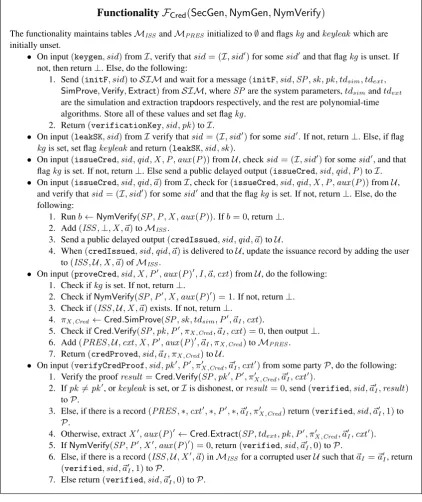
We now describe the ideal functionality and highlight the security properties it ensures.FCred
maintains some bookkeeping information (tables): MISS - for storing information about issued credentials, andMPRES - for storing information about credentials that produced presentation proofs.
First, upon receiving the(keygen,sid)message,FCredperforms a setup by asking the sim-ulator for the system parameters, keys, trapdoors, algorithms and a list of corrupted parties. It generates all cryptographic artifacts using the algorithms provided. Message(leakSK,sid) is handled in exactly the same way as for redactable signatures. Message(checkPK, . . .)used in
FURS is no longer needed, as we assume that in the real world all issuer keys are automatically checked upon registration withFCA.
Second, upon receiving the (issueCred,sid,qid,U,X,P,aux(P))message from a user,
FCred initiates credential issuing. It will, however, only proceed if the issuer specified insid = (I,sid0) is willing to issue some attributes~ato the user, and ifX,P,andaux(P)form a valid pseudonym.
Third, upon receiving a proof request in the form of a(proveCred, . . .)message, instead of creating a proof using the user secret and other credential information used during the issuance request, the functionality uses theCred.SimProvealgorithm that only takes the pseudonym, with respect to which the presentation is done, and disclosed attributes as an input, but no private or linkable information, i.e. non-disclosed attributes are already “redacted” . This guarantees that after seeing a presentation token, the issuer cannot tell to which credential the token is related (absent weaknesses in the pseudonym algorithms as discussed above).
Finally, upon receiving the(verifyCredProof, . . .)message,FCred—besides verifying the proof itself—uses theCred.Extractalgorithm and bookkeeping information to make checks that guarantee that: (1) the adversary should not be able to produce a presentation proof that verifies and that reveals attributes that were never issued to the user secret of the pseudonym; (2) for honest users that keep their user secret private the adversary should not be able to repeat a proof with a fresh context that was not seen before. Here, we consider an honest user’s secret private as long as no dishonest user received a credential for the same secret.
We describe the ideal functionality FCred for credentials in Figure 1. Note that because
FunctionalityFCred(SecGen,NymGen,NymVerify)
The functionality maintains tablesMISSandMPRESinitialized to∅and flagskgandkeyleakwhich are
initially unset.
• On input(keygen, sid)fromI, verify thatsid= (I, sid0)for somesid0and that flagkgis unset. If not, then return⊥. Else, do the following:
1. Send(initF, sid)toSIMand wait for a message(initF,sid,SP,sk,pk, tdsim, tdext, SimProve,Verify,Extract)fromSIM, whereSPare the system parameters,tdsimandtdext
are the simulation and extraction trapdoors respectively, and the rest are polynomial-time algorithms. Store all of these values and set flagkg.
2. Return(verificationKey,sid,pk)toI.
• On input(leakSK, sid)fromIverify thatsid= (I,sid0)for somesid0. If not, return⊥. Else, if flag
kgis set, set flagkeyleakand return(leakSK,sid,sk).
• On input(issueCred,sid,qid,X,P,aux(P))fromU, checksid= (I, sid0)for somesid0, and that flagkgis set. If not, return⊥. Else send a public delayed output(issueCred,sid,qid,P)toI.
• On input(issueCred,sid,qid, ~a)fromI, check for(issueCred,sid,qid,X,P,aux(P))fromU, and verify thatsid= (I, sid0)for somesid0and that the flagkgis set. If not, return⊥. Else, do the following:
1. Runb←NymVerify(SP,P,X,aux(P)). Ifb= 0, return⊥. 2. Add(ISS,⊥,X, ~a)toMISS.
3. Send a public delayed output(credIssued,sid,qid, ~a)toU.
4. When(credIssued,sid,qid, ~a)is delivered toU, update the issuance record by adding the user to(ISS,U,X, ~a)ofMISS.
• On input(proveCred,sid,X,P0,aux(P)0, I, ~a,cxt)fromU, do the following: 1. Check ifkgis set. If not, return⊥.
2. Check ifNymVerify(SP,P0,X,aux(P)0) = 1. If not, return⊥. 3. Check if(ISS,U,X, ~a)exists. If not, return⊥.
4. πX,Cred ←Cred.SimProve(SP,sk, tdsim,P0, ~aI,cxt).
5. Check ifCred.Verify(SP,pk,P0, πX,Cred, ~aI,cxt) = 0, then output⊥.
6. Add(PRES,U,cxt,X,P0,aux(P)0, ~aI, πX,Cred)toMPRES.
7. Return(credProved,sid, ~aI, πX,Cred)toU.
• On input(verifyCredProof,sid,pk0,P0, πX,Cred0 , ~a
0
I,cxt
0
)from some partyP, do the following: 1. Verify the proofresult=Cred.Verify(SP,pk0, P0, π0X,Cred, ~a
0
I,cxt
0
).
2. Ifpk 6=pk0, orkeyleakis set, orIis dishonest, orresult= 0, send(verified,sid, ~a0I,result)
toP.
3. Else, if there is a record(PRES,∗,cxt0,∗,P0,∗, ~a0I, π
0
X,Cred)return(verified,sid, ~a
0
I,1)to
P.
4. Otherwise, extractX0,aux(P)0←Cred.Extract(SP, tdext,pk,P0, π0X,Cred, ~a
0
I,cxt
0
). 5. IfNymVerify(SP,P0,X0,aux(P)0) = 0, return(verified,sid, ~a0I,0)toP.
6. Else, if there is a record(ISS,U,X0, ~a)inMISSfor a corrupted userUsuch that~aI=~a0I, return
(verified,sid, ~a0I,1)toP.
7. Else return(verified,sid, ~a0I,0)toP.
We consider a protocolRURSthat realizesFURSusing the algorithms in§4.1 in the(FCRS,FCA)
-hybrid model whereSP is the reference string and each call toFCredis essentially replaced by running one of the algorithms ofCred. The detailed description ofRCredis given below in§E.1.
Theorem 7. Let URS be the unlinkable redactable signature scheme according to Definition 1, SPC is a structure-preserving commitment scheme, Gap be a gap problem, Π be a non-interactive proof of knowledge system. ThenRCredsecurely realizesFCredin the(FCRS,FCA) -hybrid model ifURSis correct, unlinkable, unforgeable, and key extractable,SPCis binding, the non-interactive proof-of-knowledge system is zero-knowledge and simulation extractable, and the Gapproblem is hard.The proof is provided in§E.2.
Building a full-fledged credential system with multiple issuers. We now explain how to use our credential functionality to support multiple issuers using multiple sessions ofFCred, one for each issuer, and a pseudonym functionality that supports creation of user secrets and generation and verification of pseudonyms. The pseudonyms are required to be both hiding and binding to hide a user secret and prevent users from sharing credentials without also sharing their secret. Users now can generate a user secret and different pseudonyms on it and then use multiple calls toFCredinstances for different issuers to get credentials (from different issuers but bound to the
same secret). To compose a presentation proof that reveals attributes from different credentials, the user creates a pseudonym P0 and uses the corresponding FCred instances to generate the required proofs with respect to this pseudonym. Since the pseudonym is the same in different proofs and each proof guarantees the same underlying secret in the credential and the pseudonym, pulling these proofs together results in a single proof for multiple credentials. Each proof block guarantees unlinkability and unforgeability, and since the pseudonym is both binding and hiding this composed proof is also unforgeable and unlinkable with respect to the other composed proofs. The verification is done by querying the correspondingFCred instances for verification of each particular proof part.
4.3 Instantiation and Efficiency Analysis
To analyze the efficiency of our scheme we consider a concrete instantiation scenario. We in-stantiate our non-interactive construction with Groth-Sahai proofs [50], the structure-preserving commitment scheme of [5], and our unlinkable redactable signature scheme presented in§3.3. As a gap problem we pick the Computational Diffie-Hellman problem. The URS scheme is instan-tiate with the fully structure-preserving signature scheme by Abe et al. [1], Groth-Sahai proofs, and the vector commitment scheme from§3.1. The proof of Theorem 8 follows from Theorems 6-7.
Theorem 8. The credential system described above securely realizes FCred defined in §4.2 if the SXDH,J-RootDH,n-BSDH,q-SDH, XDLIN, co-CDH, and DBP assumptions hold. Consult building blocks for definitions of assumptions.
We refer to§5 for the comparison with prior work. We stress that the complexity of theProve
more efficient than the credential system of Izabach`ene et al. [54] that has credential proofs of around 8 KB, while our UC scheme has comparable proof sizes. Our scheme is much less efficient than the scheme of [62] but their scheme relies on hash functions in their construction and thus does not enable efficient protocol design.
Open questions. We leave the construction of a scheme that achieves the same functionality as ours with the efficiency of [62]—perhaps using fully structure preserving signatures of equiv-alence classes—as an interesting open problem. Other interesting questions are exploiting the lack of opening non-malleability for attacks on existing constructions and efficiently basing the opening non-malleability property of vector commitments on a more standard cryptographic as-sumption than theJ-RootDH assumption of Definition 9.
5
Detailed Comparison with Related Work
In this section we compare ourURSandCredschemes with related work and highlight the ad-vantages of our scheme. A variety of signature schemes with flexible signing capabilities and strong privacy properties have been proposed [41, 18, 10, 14]. Such schemes generalize existing privacy-preserving schemes such as group signatures, and anonymous credentials. Our work on URS is most closely related to the work of Chase et al. [41]. They define simulatable malleable signatures and show how to instantiate (a base scheme without attributes for) delegatable creden-tials. Ahn et al. [7] and Attrapadung et al. [8] consider redactable signatures but for a different redact operation that allows to quote substrings. While these works provide a fresh definitional approach (indeed our definitions of unlinkability and unforgeability are inspired by [41]), they do not aim at being directly applicable in the real world and are rather inefficient, especially when redacting a message vector with a large number of attributes. Canard and Lescuyer [35] proposed an anonymous credential system built from sanitizable signatures—a special case of malleable signatures. Apart from being less efficient than ours, their scheme is only proven secure in the random oracle model.
Our starting point for achieving practical efficiency is vector commitments [40, 59, 38], a cryptographic building block introduced by Catalano, Fiore and Messina [40]. Kate et al. [55] mention one-time-show credentials as one of the applications of their polynomial commitments scheme. Without providing any construction and security proofs, the authors suggest to build credentials by committing to the attributes, which the issuer then certifies by signing the result-ing commitment. Recently, Kohlweiss and Rial [58] built a private access control protocol with efficient selective attribute disclosure from vector commitments. Their solution, however, is still one-time-show and requires re-issuing and thus interaction. Instead, we construct a multi-show credential system and put their intuition on a formal basis.
The first efficient multi-show anonymous credential scheme is [30]. Its success led to imple-mentations [34] and related protocols are even contained in standards [21]. Many cryptographic papers on anonymous credentials often focus on a base protocol, with pseudonyms, but without attributes. A notable exception is [26], which studies an extension to the identity mixer system for efficient attribute disclosure. Their result is in the random oracle model, however. The first non-interactive anonymous credential scheme that does not rely on random oracles is [12]. P -signatures, the primitive underlying their construction is a signature scheme falling short of being structure-preserving and is engineered towards the anonymous credentials application. BothP -signatures, and also the work on delegatable credentials [47] consider a base protocol without attributes. Belenkiy et al. [13] define multi-blockP-signatures with a proof size linear in the number of messages.
13]. Our scheme is more efficient and provides UC-security only at the cost of the public key being larger by a constant factor.
UC PK size Tier 1 Signature Tier 2 signature/Proof
URS∗(SPS,[3]) – O(n)||G|| 8||G||,(n+ 1)||Zp|| 19||G||,k||Zp|| URS(SPS,[3]) + O(n+||sk||)||G|| 8||G||,(n+ 1)||Zp|| 19||G||,k||Zp|| URS(FSPS,[1]) + O(n)||G|| 16||G||,(n+ 1)||Zp|| 38||G||,k||Zp||
P-sig [12] – 4||G|| 3||G||, n= 0 34||G||, k= 0
Block P-sig [13] – O(n)||G|| 3||G||,n||Zp|| (16n+ 34)||G||+k||Zp||
Table 2: Efficiency comparison ofURSwith P-signatures. (n,kare the size of the original and quoted message,||sk||,||G||and||Zp||are the bit-lengths of the signing key, group elements and exponents, respectively. URS∗ is our basic scheme without key extraction. The proof of key possession for FSPS-basedURSconsists of 18 elements.
Extending the work of [12] in combination with vector commitments, Izabach`ene et al. [54] construct block-wise P-signatures and use them to built efficient anonymous credentials (see
§4.3 for an efficiency comparison with our credential scheme). Although their techniques are superficially similar to ours, we list some crucial differences:
Their credential scheme targets a restricted class of predicates, individual attribute release and dot-products, however, it is less efficient than the instantiation of our scheme from§4.3, and requires more communication rounds. Instead, we advocate the use of general-purpose NIZK to prove arbitrary predicates as natural extensions to our core scheme. Moreover, they do not provide replay-attack countermeasures for presentation proofs. A reuse of another user’s proof is not considered a forgery. Indeed, their definitions do not guarantee that credentials are non-malleable, implying that multiple credential proofs of true predicates may be combinable into a proof of an yet unproven, but true, predicate. This is crucial for a non-interactive credential scheme and is taken care of in this work.
Independently, Hanser and Slamanig [62] presented a credential system with efficient (inde-pendent of the number of attributes) attribute disclosure. Their scheme had security weaknesses that were subsequently fixed. However, it still does not capture opening non-malleability, and is only proven in the generic group model.
Contrary to a lot of existing work, we aim for modularity both in our constructions and proofs by formalizing the security properties of all building blocks, including vector commitments, from which we build our URS and our anonymous credential scheme. Thus, all the building blocks and UC-functionalities we define can be used for the modular design of other protocols (e-cash, group signatures, e-voting, etc.).
References
[1] M. Abe, M. Kohlweiss, M. Ohkubo, and M. Tibouchi. Fully structure-preserving signatures and shrinking commitments. InEUROCRYPT 2015, Part II, pages 35–65, 2015.
[2] M.Abe, M.Chase, B.David, M.Kohlweiss, R.Nishimaki, and M.Ohkubo. Constant-size structure-preserving signatures: Generic constructions and simple assumptions. ASI-ACRYPT 2012.
[4] M. Abe, J.Groth, K.Haralambiev, and M.Ohkubo. Optimal structure-preserving signatures in asymmetric bilinear groups. CRYPTO 2011,LNCS, pages 649–666.
[5] M.Abe, K.Haralambiev, and M.Ohkubo. Group to group commitments do not shrink. EU-ROCRYPT 2012, volume 7237 ofLNCS, pages 301–317. Springer, 2012.
[6] M.Abe and M.Ohkubo. A framework for universally composable non-committing blind signatures. ASIACRYPT 2009,LNCS, pages 435–450. Springer, 2009.
[7] J. H.Ahn, D.Boneh, J.Camenisch, S.Hohenberger, A.Shelat, and B.Waters. Computing on authenticated data. TCC 2012,LNCS, pages 1–20.
[8] N.Attrapadung, B.Libert, and T.Peters. Computing on Authenticated Data: New Privacy Definitions and Constructions.Asiacrypt 2012, volume 7658 ofLecture Notes on Computer Science. Springer, 2012.
[9] M. H.Au, W.Susilo, and Yi Mu. Constant-size dynamic k-TAA. SCN 06, volume 4116 of
LNCS, pages 111–125. Springer, 2006.
[10] M.Backes, S.Meiser, and D.Schr¨oder. Delegatable functional signatures. Cryptology ePrint Archive, Report 2013/408, 2013. http://eprint.iacr.org/.
[11] E.Bangerter, S.Krenn, A.-R.Sadeghi, T.Schneider, and J.-K.Tsay. On the design and imple-mentation of efficient zero-knowledge proofs of knowledge.SPEED-CC’09.
[12] M.Belenkiy, M.Chase, M.Kohlweiss, and A.Lysyanskaya. P-signatures and noninteractive anonymous credentials. TCC 2008,LNCS, pages 356–374. Springer,2008.
[13] M.Belenkiy, M.Chase, M.Kohlweiss, and A.Lysyanskaya. Compact e-cash and simulatable VRFs revisited. PAIRING 2009,LNCS, pages 114–131. Springer, 2009.
[14] M.Bellare and G.Fuchsbauer. Policy-based signatures. Cryptology ePrint Archive, Report 2013/413, 2013. http://eprint.iacr.org/.
[15] M.Bellare, D.Micciancio, and B.Warinschi. Foundations of group signatures: Formal defi-nitions, simplified requirements, and a construction based on general assumptions. EURO-CRYPT 2003,LNCS, pages 614–629. Springer, 2003.
[16] M.Bellare, H.Shi, and C.Zhang. Foundations of group signatures: The case of dynamic groups. CT-RSA 2005,LNCS, pages 136–153. Springer, 2005.
[17] D.Boneh and X.Boyen. Short signatures without random oracles. EUROCRYPT 2004, volume 3027 ofLNCS, pages 56–73. Springer, 2004.
[18] E.Boyle, S.Goldwasser, and I.Ivan. Functional signatures and pseudorandom functions. Cryptology ePrint Archive, Report 2013/401. http://eprint.iacr.org/.
[19] S.Brands. Untraceable off-line cash in wallets with observers (extended abstract).
CRYPTO’93, volume 773 ofLNCS, pages 302–318. Springer, 1994.
[20] S.Brands. Restrictive blinding of secret-key certificates. EUROCRYPT’95, volume 921 of
LNCS, pages 231–247. Springer, 1995.
[21] E. F. Brickell, J.Camenisch, and L.Chen. Direct anonymous attestation.ACM CCS 04, pages 132–145. ACM Press, 2004.
[22] C.Brzuska, H.Busch, ¨O.Dagdelen, M.Fischlin, M.Franz, S.Katzenbeisser, M.Manulis, C.Onete, A.Peter, B.Poettering, and D.Schr¨oder. Redactable signatures for tree-structured data: Definitions and constructions.in ACNS’10.