________________________________ Author for Correspondence:
Devikasubramaniyan.G
Department of Pharmaceutical Analysis and Quality Assurance Bomma Institute of pharmacy, Affiliated to JNTUH,
Review Article
ISSN Print 2231 – 3648 Online 2231 – 3656
Available Online at: www.ijpir.com
New analytical method development and validation for the simultaneous
estimation of tranexamic acid and mefenamic acid in pharmaceutical dosage
forms
Devikasubramaniyan.G.
1*, Rameshpetchi Rajendran, Marasakatla Aruna
Department of Pharmaceutical Analysis and Quality Assurance, Bomma Institute of pharmacy,
Affiliated to JNTUH, Allipuram, Khammam-507318. Telangana, India.
ABSTRACT
A selective and sensitive reverse phase high performance liquid chromatography (RP-HPLC) has been developed for the separation and quantification of Tranexamic acid and Mefenamic acid in tablet dosage form and validated .The determination was carried out using Thermosil C18 column (25 cm ×4.6 mm id) as a stationary phase and mobile phase comprised of Methanol: Sodium acetate buffer in proportion of 65:35(v/v) with pH adjusted to 3±0.5 by using orthophosphoricacid. The flow rate was 1.0ml/min and the eluent was monitored at 256nm.The retention time of Tranexamic acid and Mefenamic acid were 2.45 ±0.028 min and 4.31±0.018 min respectively.. The Coefficient of correlation and percentage recoveries of Tranexamic acid and Mefenamic acid were 0.9986 and 100.0l % and 0.9994 and 99.98% respectively. The method is validated for accuracy, Precision, ruggedness and Robustness. The proposed method is successfully applied for the simultaneous determination of both drugs in commercial tablet preparation. The results of the analysis have been validated statistically and by recovery studies.
Keywords
:
Tranexamic acid Mefenamic acid, Simultaneous estimation, RP-HPLC method.INTRODUCTION
Tranexamic acid ((figure1) is chemically trans-4-aminomethyl-cyclohexaecarboxylic acid [1]. It competitively inhibits activation of plasminogen, there by reducing conversion of plasminogen to plasmin, an enzyme that degrades fibrin clots, fibrinogen, & other plasma protein, including the procoagulant facture V & VIII. It is used for controlling abnormal bleeding in a number of
diseases. Tranexamic acid is official in British Pharmacopeia[2]. Mefenamic acid, chemically N-[(2, 3-dimethyl phenyl) amino] benzoic acid (Figure 1), official in USP, BP and IP [3] is a potent non-steroidal anti-inflammatory drug with analgesic and antipyretic properties. It shows preferential inhibition of cyclooxygenase-2 and there by inhibits the prostaglandin synthesis [4]. It is used in the treatment of osteoarthritis, nonarticular rheumatism, healing of wounds, sport
injuries, antichloristic, rheumatoid arthritis and other painful musculoskeletal illnesses [5]. Its oral bioavailability is very low due to poor solubility in water and insufficient dissolution rate. New tablet formulation in combination of tranexamic acid 500 mg and mefenamic acid 250 mg is commercially available in Indian market for treatment of menorrhagia during menstruation. Literature survey
revealed that few analytical methods have been reported for individual estimation of tranexamic acid and mefenamic acid.[6-17]. The present study describes a precise, accurate, specific and sensitive RP-HPLC method as per ICH guidelines for the simultaneous estimation of Tranexamic acid and Mefenamic acid in tablets as well as for application to dissolution testing of tablet formulations[18].
Figure1.Structure of Tranexamic acid and Mefenamic acid.
EXPERIMENTATION
Equipment
Chromatographic separation was performed on Waters HPLC system consist of model 2695 having PDA detector and Rheodyne injector with 20µl loop volume. Waters Empower software was applied for data collecting and processing.
Reagents and chemicals
Acetonitrile and water of HPLC grade were procured from Rankem lab ltd. working standard of tranexamic acid was provided by Orchid pharmaceuticals Chennai and Mefenamic acid was provided by Emcure Pharmaceutical Ltd, Pune. Sodium acetate and orthophosphoricacid were A.R grade from Merck chemicals Mumbai, India. Tablets two different brands were purchased from Indian market, containing 500 mg of tranexamic acid and 250 mg of mefenamic acid per tablet
Optimized chromatographic Condition
A Thermosil C18 column (25cm4.6mm, 5µ) column was used as the stationary phase. A mixture of Methanol: Sodium acetate buffer in proportion
of 65:35(v/v) was used as a mobile phase and PH 3.0 adjusted with orthophosphoric acid. It was filtered through 0.45µ membrane filter and degassed. The mobile phase was pumped at 1 ml/min. The eluents were monitored at 238nm.The injection volumes of samples and standard were 20µl.
STANDARD PREPARATION
Preparation of standard solution
Sample preparation
Twenty tablets were weighed and finely powdered. A quantity of powder equivalent to5 mg of Mefenamic acid and 10mg of Tranexamic acid was weighed and transferred to a 25 ml volumetric standard flask and added 10 ml of mobile phase. The sample was kept in an ultrasonic bath for 20 min and further diluted to 25 ml by using mobile phase to get 200µg/ml of Mefenamic acid and
400µg/ml of Tranexamic acid. Then it is filtered through 0.22µ membrane filter paper.20µl of this solution was injected in to HPLC system and chromatograms were recorded. Concentrations of Tranexamic acid and Mefenamic acid in the tablet formulation were calculated by comparing area of the sample with that of standard. The percentage assay of individual drug was calculated and presented in Table1.
Table1: Table for Assay Tablet formulation Drug Amount present
mg
Amount found* (mg/tab) % label claim*
T1 Tranexamic acid 500 499.98 99.99
Mefenamic acid 250 248.97 99.58
T2 Tranexamic acid 500 498.71 99.74
Mefenamic acid 250 249.97 99.98
T1 and T2 are two different brands of tablet formulations.*Each value is average of six determinations.
RESULTS AND DISCUSSION
The proposed HPLC method required fewer reagents and materials and it is simple and less time consuming. This method could be used in quality control test in Pharmaceutical industries. The chromatograms sample and standard solution of
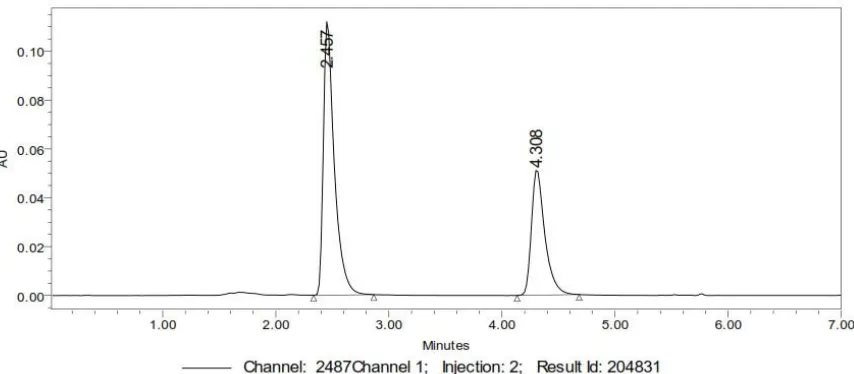
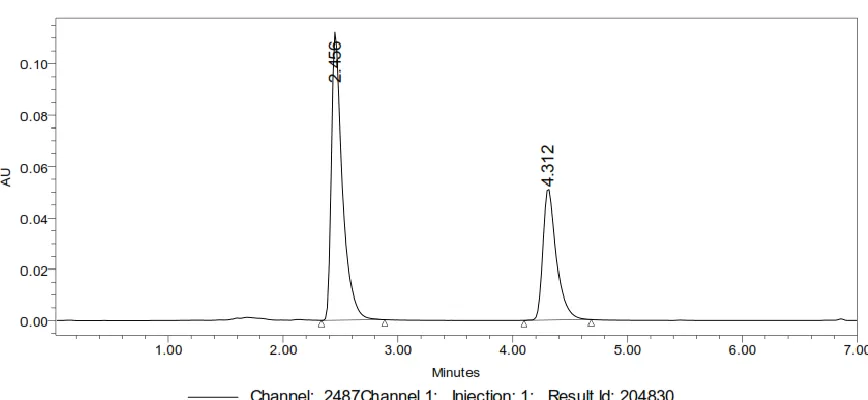
Tranexamic acid and Mefenamic acid were shown in (Figure.1) and (Figure.2). There was clear resolution between Tranexamic acid and Mefenamic acid with retention time of 2.457and4.308 minutes respectively.
VALIDATION OF THE METHOD
System suitability
Figure 2: Typical Chromatogram of sample solution of Tranexamic acid and Mefenamic acid
The column efficiency, resolution and peak symmetry were calculated for the standard solutions (Table.2). The values obtained demonstrated the suitability of the system for the analysis of this drug combination and the system suitability parameters fall with in±3% standard
deviation range during performance of the method. Here tailing factor for peaks of Tranexamic acid and Mefenamic acid was less than 2% and resolution was satisfactory. The peaks obtained for Tranexamic acid and Mefenamic acid were sharp and have clear base line separation.
TableNo2: System Suitability
S.No Parameters Tranexamic acid Mefenamic acid
1 Capacity factor 1 1
2 Theoretical plate 4233 5695
3 Asymmetry of the peak 1.2 0.69
4 Retention time (min) 2.451 4.314
5 Resolution 5.4
Linearity
The response for the detector was determined to be linear over the range of 120-320µg/ml (120,160,200,240,280,320) of Tranexamic acid and 240-640µg/ml (240,320,400,480,560,640) for Mefenamic acid. Each of this concentration was injected in six times to get reproducible response. The calibration curve was plotted as concentration
Table3: Summary of analytical method validation
S.No Parameters Acceptance criteria Tranexamic acid Mefenamic acid
1 Linearity r2=0.995 to1.0 0.9996 0.9992
2 Specificity No interference with placebo specific specific
3 Accuracy(Recovery studies) Recovery98.0-102.0% 99.98% 101.02% 4 Precision
Intraday RSD NMT 2.0% 0.1052 0.4622
Interday RSD NMT 2.0% 0.2526 0.2723
5 Robustness
Change inflow rate NMT±1% 0.3% 0.4%
Change in mobile phase ratio NMT±1% 0.2% 0.4
Change in pH NMT±1% 0.2% 0.3%
6 Limit of detection µg/ml --- 0.5µg/ml 1µg/ml Limit of Quantification µg/ml --- 1.5µg/ml 3µg/ml
Precision and Accuracy
Recovery studies were carried out by applying the standard addition method. A known amount of standard Tranexamic acid and Mefenamic acid corresponding to 80%, 100%, and 120% of the label claim was added to pre analyze sample of tablet dosage form separately. The recovery studies were carried out six times at each level of recovery. From the data obtained, recoveries of standard drugs were found to be accurate (Table.3.). The %RSD of interday and intraday precision obtained was less than2%for both the drugs. The intraday and interday precision of Tranexamic acid was 0.1052 and 0.2526 and Mefenamic acid was 0.4622and 0.2723 respectively. From the data obtained, the developed HPLC method was found to be precise and accurate.
Specificity of the method
The specificity of the method was checked for the interference of impurities in the analysis of a blank solution (without any sample) and then a drug solution of 20 μg/ml was injected into the column, under optimized chromatographic conditions, to demonstrate the separation of both Tranexamic acid
and Mefenamic acid from any of the impurities, if present. As there was no interference of impurities and also no change in the retention time, the method was found to be specific and also confirmed with the results of analysis of formulation.
LOD and LOQ
Ruggedness and Robustness
The ruggedness of the method was determined by carrying out the experiment on different instrument like Waters HPLC and Agilent HPLC by different operators using different columns of similar type like HypersilC18, ZorbaxC18 column. Robustness of the method was determined by making slight changes in the experimental conditions such as the composition of the mobile phase, pH of the mobile phase, and flow rate of the mobile phase and the chromatographic characteristics were evaluated. It was observed that there were no
marked changes in the chromatograms, which demonstrated that the RP-HPLC method developed, are rugged and robust.
CONCLUSION
The proposed RP-HPLC method for the simultaneous estimation of Tranexamic acid and Mefenamic acid in combined dosage forms is accurate, precise, linear, rugged, robust, simple and rapid. Hence the present RP-HPLC method is suitable for the quality control of the raw materials, formulations and dissolutions studies.
REFERENCES
[1]. Martindale – The Complete Drug Reference, Pharmaceutical Press, London, 29, 2002, 758, 1960. [2]. British Pharmacopeia, Her Majestry’s Stationary Office London. 1, 2004, 758 – 1960.
[3]. Dahivelkar PP, Mahajan VK, Bari SB, Shirkhedkar AA, Fursule RA, et al. Simultaneous derivative and multicomponent spectrophotometric determination of drotaverine hydrochloride and mefenamic acid in tablets. Indian J Pharm Sci . 69, 2007, 812-814.
[4]. Derle DV, Bela M, Kasliwal N In vitro and in vivo evaluation of mefenamic acid and its complexes with β- cyclodextrin and HP- β- cyclodextrin. Asian J Pharm. 2, 2008, 30-34.
[5]. Santini AO, Pezza HR, Pezza L. Development of a potentiometric mefenamate ion sensor for the determination of mefenamic acid in pharmaceuticals and human blood serum. Sensors and Actuators B: Chemical. 128, 2007, 117-123.
[6]. N. Subramanian, T. Devipriyadharshini, K. Venkateshwaran, P. Chandrasekhar. Spectrophotometric determination of tranexamic acid and mefenamic acid in tablet dosage form using derivatization technique. Int J Pharm Biomed Res 2, 2011, 26-29.
[7]. J. Bonnar and BL. Sheppard. Treatment of menorrhagia during menstruation: randomized controlled trial of ethamsylate, mefenamic acid, and tranexamic acid. BMJ. 313, 1996, 579– 582. 12.
[8]. Roshan Issarani, Kaushik Kumar Vankar, Diptish Kumar Nayak, Spectrophotometric Methods For Simultaneous Estimation Of Ethamsylate & Tranexamic Acid From Combined Tablet Dosage Form, International Journal of Chem Tech Research. 2(1), 2010, 74 – 78.
[9]. Popat B. Mohite, Shantaram G. Khanage, Vaidhun H.Bhaskar, Absorption correction method for Estimation of mefenamic acid & tranexamic acid in combined tablet dosage form, International Journal of Biomedical 7 Advance Research. 01[01], 2010.
[10]. B. G. Osborne, B. Demetriou, Detection of mefenamic acid & its metabolites in urine by thin – layer chromatography, Journal of chromatography. 90, 1974, 405-407.
[11]. L. J. Dusci, L. P. Hackett, Gas – liquid chromatography determination of mefenamic acid in human serum, Journal of chromatography. 161, 1978, 340-342.
[12]. Marc Hoylaerts, Henri Roger Lijnen, Desire Collen, Studies on the mechanism of the Antifibrinolytic Action of Tranexamic Acid, Biochimica et Biophysica Acta, 673, 1981, 75 – 85.
[13]. Paul M. Elworthy, S. A. Tsementzis, Donald Westhead, Determination of plasma Tranexamic acid using cation-exchange high – performance liquid chromatography with fluorescence detection, Journal of chromatography. 343, 1985, 109 – 117.
[14]. M. Abrahamsson, Determination of a prodrug of tranexamic acid in whole blood by reversed- phase liquid chromatography after pre-column derivatization with fluorescamine, Journal of Pharmaceutical & Biomedical Analysis. 4(3), 1986, 399 – 406.
[16]. Sabina Zommer Urbanska, Halina Bojarowicz, Spectrophotometric investigation on protolytic equilibria of mefenamic acid and determination by means of Fe (III) in methanol – aqueous media, Journal of Pharmaceutical & Biomedical Analysis. 1986; 4(4): 475 – 481.
[17]. Nina Maron, Gerry Wright, Application of photodiode array UV detection in the development of stability – indicating LC method: determination of mefenamic acid, Journal of pharmaceutical & biomedical Analysis. 1990; 8(1): 101 – 105.