Patient Preference and Adherence
Dove
press
R e v i e w
open access to scientific and medical research
Open Access Full Text Article
The optimal choice of medication administration
route regarding intravenous, intramuscular, and
subcutaneous injection
Jing-fen Jin1
Ling-ling Zhu2
Meng Chen3
Hui-min Xu3
Hua-fen wang1
Xiu-qin Feng1
Xiu-ping Zhu3
Quan Zhou3
1Division of Nursing, 2viP Care ward, Division of Nursing, 3Department of Pharmacy, The Second Affiliated Hospital, School of Medicine, Zhejiang University, Hangzhou, People’s Republic of China
Background: Intravenous (IV), intramuscular (IM), and subcutaneous (SC) are the three most frequently used injection routes in medication administration. Comparative studies of SC versus IV, IM versus IV, or IM versus SC have been sporadically conducted, and some new findings are completely different from the dosage recommendation as described in prescribing information. However, clinicians may still be ignorant of such new evidence-based findings when choosing treatment methods.
Methods: A literature search was performed using PubMed, MEDLINE, and Web of Sciences™ Core Collection to analyze the advantages and disadvantages of SC, IV, and IM administration in head-to-head comparative studies.
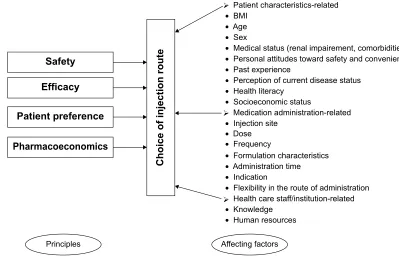
Results: “SC better than IV” involves trastuzumab, rituximab, antitumor necrosis factor medica-tions, bortezomib, amifostine, recombinant human granulocyte-macrophage colony-stimulating factor, granulocyte colony-stimulating factor, recombinant interleukin-2, immunoglobulin, epo-etin alfa, heparin, and opioids. “IV better than SC” involves ketamine, vitamin K1, and abatacept. With respect to insulin and ketamine, whether IV has advantages over SC is determined by specific clinical circumstances. “IM better than IV” involves epinephrine, hepatitis B immu-noglobulin, pegaspargase, and some antibiotics. “IV better than IM” involves ketamine, mor-phine, and antivenom. “IM better than SC” involves epinephrine. “SC better than IM” involves interferon-beta-1a, methotrexate, human chorionic gonadotropin, hepatitis B immunoglobulin, hydrocortisone, and morphine. Safety, efficacy, patient preference, and pharmacoeconomics are four principles governing the choice of injection route. Safety and efficacy must be the preferred principles to be considered (eg, epinephrine should be given intramuscularly during an episode of systemic anaphylaxis). If the safety and efficacy of two injection routes are equivalent, clini-cians should consider more about patient preference and pharmacoeconomics because patient preference will ensure optimal treatment adherence and ultimately improve patient experience or satisfaction, while pharmacoeconomic concern will help alleviate nurse shortages and reduce overall health care costs. Besides the principles, the following detailed factors might affect the decision: patient characteristics-related factors (body mass index, age, sex, medical status [eg, renal impairment, comorbidities], personal attitudes toward safety and convenience, past experi-ence, perception of current disease status, health literacy, and socioeconomic status), medica-tion administramedica-tion-related factors (anatomical site of injecmedica-tion, dose, frequency, formulamedica-tion characteristics, administration time, indication, flexibility in the route of administration), and health care staff/institution-related factors (knowledge, human resources).
Conclusion: This updated review of findings of comparative studies of different injection routes will enrich the knowledge of safe, efficacious, economic, and patient preference-oriented medi-cation administration as well as catching research opportunities in clinical nursing practice. Keywords: administration route, dosage and administration, efficacy, medication safety, patient preference, pharmacoeconomic
Correspondence: Quan Zhou Department of Pharmacy, The Second Affiliated Hospital, School of Medicine, Zhejiang University, Jiefang Road No 88, Shangcheng District, Hangzhou 310009, Zhejiang Province, People’s Republic of China
Tel +86 571 8778 4615 Fax +86 571 8702 2776
email [email protected]
Journal name: Patient Preference and Adherence Article Designation: Review
Year: 2015 Volume: 9
Running head verso: Jin et al
Running head recto: Optimally choosing injection route DOI: http://dx.doi.org/10.2147/PPA.S87271
Patient Preference and Adherence downloaded from https://www.dovepress.com/ by 118.70.13.36 on 26-Aug-2020
For personal use only.
Number of times this article has been viewed
This article was published in the following Dove Press journal: Patient Preference and Adherence
Dovepress Jin et al
Introduction
Injections are among the most common health care proce-dures throughout the world, with at least 16 billion admin-istered in developing and transitional countries each year.1
Intravenous (IV), subcutaneous (SC), and intramuscular (IM) are three most frequently used injection routes in medication administration. IV injection is the introduction of a medica-tion into the veins using a needle, and it is used when rapid absorption is called for, when fluid cannot be taken by mouth, or when the medication to be administered is too irritating to be injected into the skin or muscles. SC injection is adminis-tered as a bolus into the subcutis. IM injection is the technique used to deliver a medication deep into the muscles, allowing the medication to be absorbed into the bloodstream quickly. Prescribing information for some medications notes that they can be injected via one or more routes (eg, epinephrine can be delivered by IV, IM, or SC route), while prescribing information for the majority of injectable medications only describes one injection route.
On December 11, 2013, National Health and Family Planning Commission of the People’s Republic of China advocated a principle of rational use of medicines, that is, “Injection is not suggested for patients when oral formula-tions would be more appropriate and IV infusion is not recom-mended when IM would be possible”.2 A questionnaire-based
survey by Plumb et al in 2013 demonstrated that only 74% of junior doctors selected the correct IM route of epineph-rine in management of anaphylaxis.3 In the first half-year of
2014, The Second Affiliated Hospital of Zhejiang University (SAHZU), People’s Republic of China, experienced a fatal adverse event which was partially associated with inappro-priate injection route (ie, physician ordered SC epinephrine instead of IM epinephrine in anaphylaxis treatment, which may have delayed epinephrine absorption). SAHZU revised the standard operation procedure for anaphylaxis treatment in which IM was listed as the unique injection route of epinephrine. The epinephrine case in SAHZU together with the survey by Plumb et al has raised concerns about lack of knowledge concerning the recognition and management of anaphylaxis among front-line medical staff.
There is little literature reviewing the advantages and disadvantages of IV, IM, and SC administration. Gabriel reviewed the access of IV versus SC for palliative care patients.4 Stoner et al conducted a systematic review of
randomized controlled trials investigating patient prefer-ence for SC versus IV administration and concluded that patients preferred SC over IV delivery.5 Comparative
stud-ies of SC versus IV, IM versus IV, or IM versus SC were
sporadically reported, and many new findings cropped up. For example, Reggia et al analyzed the switch to SC admin-istration of abatacept from IV adminadmin-istration in patients with rheumatoid arthritis and observed that SC abatacept showed a risk of relapse in 27% of cases and return to the IV administration quickly reinstated disease control (ie, IV is better than SC).6 The findings of Reggia et al challenge
the viewpoint that the SC route is generally preferred over IV route because it enables at-home injection, improves quality of life, and reduces health care costs.4,5,7 Meanwhile,
some findings are completely different from the dosage recommendation in prescribing information. Clinicians may still be ignorant of such information when choosing administration route.
In this paper, we investigate this issue in-depth and present an updated review, with the intention of improving the readers’ knowledge of rational use of injectable medications.
Methods
Potentially relevant literature during 1980 to February 2015 was identified by performing searches in the PubMed, MEDLINE, and Web of Sciences™ Core Collection with an English-language filter. For PubMed, the search query was to identify each paper with the title containing “(intramuscular and intravenous)” or “(intramuscular and subcutaneous)” or “(subcutaneous and intravenous)”, with a filter of “species: human”. For Web of Sciences, the search string was “title: (intramuscular and intravenous) or title: (intramuscular and subcutaneous) or title: (subcutaneous and intravenous)”, with a document-type filter excluding proceeding papers, meeting abstracts, notes, correction, correction addition, and book review. For MEDLINE, the search string was “title: (intramuscular and intravenous) or title: (intramuscular and subcutaneous) or title: (subcutaneous and intravenous)”, refined by “MeSH headings: (humans)”.
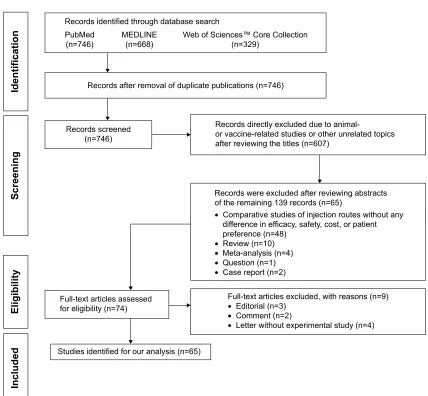
Two reviewers (MC and HMX) independently searched the literature and screened the relevant studies. The flowchart showing selection of literature is presented in Figure 1. Each reviewer was blinded to the other reviewer during the process of data extraction. In the event of disagree-ment between the two reviewers, a third reviewer (QZ) was consulted. Sixty-five original papers on the comparison of injection route were finally included based on the inclusion/ exclusion criteria. Valuable information was summarized by data interpretation.
Reviewers (MC, HMX, and QZ) listed all medications exhibiting obvious advantages of one route over the other route, and then focused on these medications and performed
Patient Preference and Adherence downloaded from https://www.dovepress.com/ by 118.70.13.36 on 26-Aug-2020
Dovepress Optimally choosing injection route
expanded literature retrieval with the search string – title/ abstract contains “(intramuscular and intravenous)” or “(intramuscular and subcutaneous)” or “(subcutaneous and intravenous)”. An additional 20 original articles were iden-tified for data mining. Prescribing information for related medications was also read by reviewer (QZ).
Results
SC versus iv
Trastuzumab
Trastuzumab is a key agent for human epidermal growth factor receptor 2 (HER2)-positive breast cancer in both the early and metastatic settings. It is given by IV infusion, with between 17 and 52 infusions in standard regimens over 1 year, as described in prescribing information for Hercep-tin® (trastuzumab; Genentech, Inc., South San Francisco,
CA, USA).8 However, IV administration of trastuzumab
requires substantial time commitments on patients and health care staff, and may cause patient discomfort. In 2013, the European Union approved a new SC formulation of tras-tuzumab for use in patients with early or metastatic breast cancer. The SC formulation is administered in 2–5 minutes rather than 30–90 minutes with the standard IV form, and it contains a recombinant human hyaluronidase (rHuPH20) that opens up channels in the extracellular matrix of the skin and enables trastuzumab to be administered via the SC route.9 In the international, randomized, two-cohort PrefHer
study, patients with HER2-positive early breast cancer were randomized to receive four adjuvant cycles of 600 mg fixed-dose SC trastuzumab followed by four cycles of standard IV trastuzumab, or vice versa. Compared with IV trastuzumab, SC trastuzumab has shown non-inferior efficacy, similar pharmacokinetic and safety profile, and higher patient prefer-ence (88.9% versus 9.6%, P,0.0001).10,11 Results from the 5HFRUGVLGHQWLILHGWKURXJKGDWDEDVHVHDUFK
5HFRUGVDIWHUUHPRYDORIGXSOLFDWHSXEOLFDWLRQVQ
5HFRUGVVFUHHQHG Q
6FUHHQLQJ
(OLJLELOLW\
,QFOXGHG
,GHQWLILFDWLRQ
)XOOWH[WDUWLFOHVDVVHVVHG IRUHOLJLELOLW\Q
6WXGLHVLGHQWLILHGIRURXUDQDO\VLVQ
)XOOWH[WDUWLFOHVH[FOXGHGZLWKUHDVRQVQ
•(GLWRULDOQ
•&RPPHQWQ
•/HWWHUZLWKRXWH[SHULPHQWDOVWXG\Q 5HFRUGVGLUHFWO\H[FOXGHGGXHWRDQLPDO
RUYDFFLQHUHODWHGVWXGLHVRURWKHUXQUHODWHGWRSLFV DIWHUUHYLHZLQJWKHWLWOHVQ
5HFRUGVZHUHH[FOXGHGDIWHUUHYLHZLQJDEVWUDFWV RIWKHUHPDLQLQJUHFRUGVQ
3XE0HG
Q 0('/,1(Q :HERI6FLHQFHV&RUH&ROOHFWLRQQ
•&RPSDUDWLYHVWXGLHVRILQMHFWLRQURXWHVZLWKRXWDQ\ GLIIHUHQFHLQHIILFDF\VDIHW\FRVWRUSDWLHQW SUHIHUHQFHQ
•5HYLHZQ
• 0HWDDQDO\VLVQ
• 4XHVWLRQQ
•&DVHUHSRUWQ
Figure 1 The flowchart of literature selection.
Patient Preference and Adherence downloaded from https://www.dovepress.com/ by 118.70.13.36 on 26-Aug-2020
Dovepress Jin et al
Phase III HannaH study also confirmed comparable efficacy and safety profile of trastuzumab for HER2-positive early breast cancer between the IV and SC groups.12
Rituximab
Rituximab is a part of standard therapy for many non-Hodgkin’s lymphoma patients. Prescribing information for Rituxan® (rituximab; Genentech, Inc.) notes that it is given
by IV infusion.13 The fixed dose of 1,400 mg SC rituximab
was confirmed to have non-inferior serum trough concen-trations relative to IV rituximab 375 mg/m2 dosing during
maintenance, with a comparable safety profile.14 Rule et al
conducted a time and motion study to investigate the staff time and costs associated with administration of SC and IV rituximab.15 Compared with IV rituximab, SC rituximab
per session was associated with reductions in active health care professional time (48.5 minutes versus 223.3 minutes), total mean staff costs, and patient time in the treatment room (70.0 minutes versus 263.8 minutes). Switching from IV to SC rituximab could increase treatment room capacity and patient throughput, as well as improving the patient experience.15
Interestingly, the effect of dose on absorption of SC ritux-imab was observed in rats. Rituxritux-imab exhibited linear kinet-ics following IV administration; however, bioavailability following SC injection was inversely related to the dose level. The bioavailability values following 1 mg/kg, 10 mg/kg, and 40 mg/kg injected at the back were approximately 70%, 31%, and 18%, respectively. Saturable binding may be a major determinant of the nonlinear absorptive transport of rituximab.16
Antitumor necrosis factor medications
Antitumor necrosis factor (anti-TNF) medications are indi-cated for the treatment of chronic inflammatory conditions such as rheumatoid arthritis, inflammatory bowel disease, and psoriasis. Anti-TNF medications include monoclonal antibodies (eg, infliximab, adalimumab, certolizumab pegol, and golimumab) and circulating receptor fusion protein such as etanercept. A Phase I, open-label trial evaluated the effects of SC or IV golimumab on inflammation markers (eg, C-reaction protein, interleukin-6, serum amyloid A, TNF receptor II, matrix metalloproteinase-3, haptoglobin, ferritin, and hepcidin) in patients with rheumatoid arthritis. Patients were randomized to receive SC golimumab 100 mg at baseline and every 4 weeks thereafter through week 20 or IV infusions of golimumab 2 mg/kg at baseline and week 12. Decreases in concentrations of these inflammatory markers
were maintained through week 24 in SC group but began to reverse after week 8 in IV group, indicating that SC route was superior to IV route in golimumab treatment of rheu-matoid arthritis.17
Sylwestrzak et al examined patient preferences regard-ing available anti-TNF agents and mode of administration options.18 Participants were asked about their use of anti-TNF
agents, locations of administration, preferences for IV or SC route, interest in anti-TNF home therapy options, and their physician’s role in their decision-making process. The SC group showed a higher preference for the injection route they were using compared with the IV group; that is, 89.9% of the SC group preferred the SC route, whereas 71.8% of the IV group preferred the IV route (P,0.001). Another question-naire survey identified the determinants of patient preferences in the choice of anti-TNF therapies for rheumatoid arthritis.19
The IV and SC routes of administration were preferred by 50.2% and 49.8%, respectively. Reasons for the choice of IV route were the safety of treatment at the hospital and the reas-suring effect of physician presence. The SC route was chosen for the convenience of treatment and in particular for home treatment. Patients who were dissatisfied with current therapy due to side effects preferred SC administration (P=0.029), whereas patients choosing the IV route had higher scores on “today pain” (P=0.047) and “articular pain” (P=0.023) of the Rheumatoid Arthritis Disease Activity Index. The questionnaire survey indicates that physician should discuss with patients about the choice of injection route because individual preference seems to be determined by personal attitudes toward safety and convenience, by past experience, and by the perception of current disease status.
Bortezomib
Bortezomib is indicated for treating relapsed multiple myeloma and mantle cell lymphoma. The two most signifi-cant bortezomib-related issues include peripheral neuropathy and the IV route required for its administration. In January 23, 2012, the US Food and Drug Administration (FDA) approved a supplemental new drug application for Velcade®
(bortezomib; Takeda Pharmaceutical Company Limited, Osaka, Japan) which had updated the label to include the SC method of administration in all approved indications. The approval was based on results from a randomized, Phase III, open-label, international, non-inferiority trial which com-pared the efficacy and safety of SC versus IV bortezomib twice weekly in patients with relapsed multiple myeloma. SC bortezomib exhibited non-inferior efficacy to IV bortezomib and was associated with a lower incidence of neuropathy
Patient Preference and Adherence downloaded from https://www.dovepress.com/ by 118.70.13.36 on 26-Aug-2020
Dovepress Optimally choosing injection route
(eg, peripheral neuropathy of any grade [38% versus 53%,
P,0.05], grade 2 or worse [24% versus 41%, P,0.05], and grade 3 or worse [6% versus 16%, P,0.05]).20 Moreau
et al revealed that SC administration resulted in equivalent bortezomib plasma exposure to IV administration and comparable blood 20S proteasome inhibition.21 An updated
survival analysis of a randomized Phase III study showed that SC bortezomib was associated with comparable efficacy regarding time to progression, progression-free survival and overall survival, and significantly lower rates of peripheral neuropathy compared with IV bortezomib.22
Barbee et al quantified the difference in efficiency practice variables and preferences regarding SC versus IV bortezomib route in patients with multiple myeloma who received at least one dose each of SC and IV administration. Compared to IV bortezomib, SC bortezomib was more time efficient for the patient and institution (eg, a 38% reduction in chair time [P,0.001] and a 27% reduction in infusion center visit time [P,0.001]) and was preferred by 68% of patients (P=0.0002).23 Interestingly, prescribing information for
Velcade® does not specify the anatomical site of SC injection,
whereas evidence has shown that SC injections of bortezomib in the abdomen cause fewer grade 2 injection site reactions than those in the thigh (1.6% versus 11.0%, P,0.001).24
In the Phase III MMY-3021 study,25 response rates were
52% and 57% with SC and IV bortezomib, respectively, in patients with creatinine clearance (CrCl) .50 mL/min, and 53% and 31% in patients with CrCl of 20–50 mL/min. Clinical benefit of bortezomib in terms of renal impairment reversal (to CrCl .60 mL/min) was reported in 30% of patients receiving SC bortezomib and 15% of patients receiv-ing IV bortezomib. Long-term outcomes were similar with SC and IV bortezomib in patients with CrCl .50 mL/min (median time to progression 9.7 months and 9.8 months) and with SC bortezomib in patients with CrCl of 20–50 mL/min (10.5 months). It indicates that SC bortezomib is more suitable than IV bortezomib for patients with renal dysfunction.
Amifostine
Amifostine is a cytoprotective agent. Prescribing information for Ethyol® (amifostine; MedImmune Pharma B.V., 6545
CG Nijmegen, The Netherlands) notes IV infusion as the administration method. The IV administration of amifostine is associated with reversible clinical hypotension, protracted emesis, and malaise in various percentages of patients.26
Bardet et al compared the compliance with and efficacy of IV and SC amifostine in patients undergoing radio-therapy for head and neck cancer. Patients were randomly
assigned to receive either IV amifostine (200 mg/m2
daily for 3 minutes, 15–30 minutes before irradiation) or SC amifostine (500 mg, two sites, 20–60 minutes before irradiation). SC amifostine was not significantly superior to IV amifostine regarding patient compliance or efficacy; however, it was associated with significantly lower acute toxicity including grade 1–2 hypotension (8% for SC versus 19% for IV, P=0.01), grade 1–2 skin rash (21% for SC versus 9% for IV, P=0.01), and local pain (8% for SC versus 0% for IV, P=0.003).27 Koukourakis et al prospectively
evalu-ated the tolerance difference between SC and IV route in patients receiving chemotherapy. Protracted vomiting or clinical hypotension was absent in SC group, and the toler-ance profile in SC group was significantly better than the IV group (P=0.001).28 The absence of hypotension with SC
administration facilitates patient monitoring and management in tumor treatment departments. Meanwhile, switching to the SC route in patients with poor tolerance to IV route allows the continuation of cytoprotection with minor side effects.29
Recombinant human granulocyte-macrophage colony-stimulating factor
Recombinant human granulocyte-macrophage colony-stimulating factor (rhGM-CSF) can stimulate the production of white blood cells and thus prevent neutropenia following chemotherapy. It can be administered via IV or SC route. Rosenfeld et al compared the toxicity and hemopoietic effects of SC and IV rhGM-CSF in patients with primary myelodys-plasia. Increases in the absolute neutrophil count exhibited a dose–response relationship and were more pronounced with SC than IV administration. Compared to a 2-hour infusion of rhGM-CSF, SC administration is more myelostimulatory without an increase in toxicity.30 Lieschke et al demonstrated
that bacterially synthesized rhGM-CSF was an ineffective stimulant of leukopoiesis when given as a bolus (0.3–3 μg/ kg/day), but it was effective when administered by 2-hour IV infusion (3–20 μg/kg/day). Moreover, IV dose of rhGM-CSF was less potent at inducing a leukocytosis than equivalent SC doses and was associated with a higher incidence of gen-eralized rash (P,0.01) and first-dose reactions (P,0.05).31
Granulocyte colony-stimulating factor
Granulocyte colony-stimulating factor (G-CSF) can stimulate the bone marrow to produce granulocytes and stem cells. It is administered to oncology patients via SC or IV routes. Paul et al conducted a randomized, open-label trial to compare IV versus SC G-CSF administration to hospitalized hemato-on-cological patients receiving chemotherapy.32 The mean time
Patient Preference and Adherence downloaded from https://www.dovepress.com/ by 118.70.13.36 on 26-Aug-2020
Dovepress Jin et al
to neutropenia resolution was longer with IV G-CSF com-pared with SC G-CSF (7.9 days versus 5.4 days, P=0.001), indicating that bolus IV G-CSF could result in longer neutropenia duration than SC administration.32 Eguchi et al
evaluated the efficacy and toxicity of recombinant human G-CSF given subcutaneously in patients with advanced lung cancer undergoing intensive chemotherapy. When G-CSF is given subcutaneously, the dose required for a comparable effect in alleviating neutropenia is 50% of that required when it is given intravenously.33
Recombinant interleukin-2
Recombinant human interleukin-2 (rIL-2) has demonstrated survival benefits over chemotherapy for the majority of patients with metastatic renal cell carcinoma (mRCC). The rIL-2 can be administered as high-dose IV bolus injection, continuous IV infusion, or SC administration in a lower dosage regimen. Hospitalization/intensive care is required throughout due to the side effects if rIL-2 is intravenously delivered.34 Geertsen et al compared the safety and efficacy
of administration by SC and continuous IV infusion of rIL-2 in patients with mRCC. Compared with continuous IV infu-sion, SC delivery of rIL-2 was associated with improved tolerability. SC administration was associated with more patients experiencing stable disease (50.5% versus 29.8%), fewer patients undergoing disease progression (35.0% versus 43.6%), lower incidence of severe adverse events (46% versus 76%, P,0.001), and fewer patients requiring dose reductions due to toxicity (20% versus 82%). There was no difference between two injection routes of rIL-2 regarding efficacy in terms of overall survival, duration of response, and response rate.35 A prospective, non-randomized study showed
that low-dose SC interleukin-2 therapy was associated with low clinical and hematologic toxicity after autologous trans-plantation, while the immunomodulation achieved was no less than that achieved with the IV route.36
immunoglobulin
A shift from IV immunoglobulin (IV-IG) to less labor-intensive SC immunoglobulin (SC-IG) has the potential to help alleviate nurse shortages and reduce overall health care costs.37 Martin et al demonstrated that rapid push home-based
SC-IG was less costly than hospital-based IV-IG for immu-noglobulin replacement therapy in adult primary immuno-deficiency patients in the Canadian context.38 A systematic
review revealed that changing IG replacement therapy from IV-IG to SC-IG may be of benefit to qualified patients with primary immunodeficiency.39 Ducruet et al revealed
the pharmacoeconomic advantages of SC-IG versus IV-IG
treatment in a Canadian pediatric center. The SC route was less costly than the IV route from either the patient perspec-tive (P,0.001) or the government perspective (P,0.001).40
Kittner et al evaluated the attitude of patients toward switch-ing to SC-IG home therapy from IV-IG therapy by a ques-tionnaire survey. Patients on SC therapy were significantly younger than those in the IV treatment group (37±9.1 years versus 51.2±14.5 years, P,0.001). Compared with the SC-treated group, more IV-SC-treated patients were afraid of being more busy with self-administration (P,0.001), being worried about severe adverse reactions at home (P,0.001), and had higher points on a Likert scale about the statement “I dislike to puncture myself” (P,0.001).41
Another study investigated the perceptions of the SC method and the perceptions of the home therapy regime among patients who already had considerable experience of this therapy. Significant correlations were found between age and perception of the lifelong treatment with SC infusion of IG for primary antibody deficiencies. The younger patients perceived the SC infusions more uncomfortable and were less determined to continue with the therapy as compared with the older patients (P,0.01). Additionally, the women were more positive concerning the SC method (P,0.05), as compared with the men.42
The primary disadvantage of SC-IG is the inherent resis-tance of the extracellular matrix, which limits the volume infusible in one site (usually 15–30 mL), and requires mul-tiple infusion sites weekly or every second week, rather than a single monthly IV infusion. Wasserman et al investigated the efficacy and tolerability of rHuPH20-facilitated SC-IG in patients with primary immunodeficiency. Eighty-seven patients with primary immunodeficiency aged $2 years received 10% IV-IG for 3 months, and then rHuPH20-facilitated SC-IG (n=83) for approximately 14–18 months at 108% of the IV-IG dose. rHuPH20-facilitated SC-IG brings together the advantages of IV-IG and SC-IG, that is, combining the once-monthly, single-site infusion of IV-IG with the option of home-based self-administration of SC-IG. The rHuPH20-facilitated SC-IG had a 20% higher bioavail-ability than SC-IG and caused fewer systemic reactions than IV infusion (8.3% versus 25.0%), while it was effective, safe, and pharmacokinetically equivalent to IV-IG.43
insulin
Bodur et al compared continuous SC insulin infusion via an insulin pump with the traditional continuous IV infusion method for tight glycemic control among patients in medi-cal intensive care unit. Although there was no significant difference in mortality and hypoglycemic events between
Patient Preference and Adherence downloaded from https://www.dovepress.com/ by 118.70.13.36 on 26-Aug-2020
Dovepress Optimally choosing injection route
the groups, the SC insulin group achieved better glycemic control and significantly lowered daily insulin bolus and infusion requirements.44
On thecontrary, IV insulin has advantages over SC insulin in some clinical circumstances. Neff et al studied the efficacy of protocol-based IV insulin delivery as compared to SC insulin prescribed individually outside of the critical care setting. Among a total of 122 who developed parenteral nutrition (PN)-associated hyperglycemia, those receiving IV insulin achieved glycemic target for more time than those on the SC regimen (62% versus 43%, P=0.008), indicating that IV insulin should therefore be considered optimum therapy for patients with PN-associated hyperglycemia in the noncritically ill inpatient setting.45 Use of perioperative
continuous IV insulin infusion in diabetic patients undergo-ing open-heart surgical procedures could significantly reduce major infectious morbidity and its associated socioeconomic costs. Compared with sliding-scale-guided intermittent SC insulin injections, continuous IV insulin infusion induced a significant reduction in perioperative blood glucose levels and significantly reduced the incidence of deep sternal wound infection (0.8% versus 2.0%, P=0.01).46
Pezzarossa et al observed that the outcome difference between SC and IV route depended on the time of insulin administration for the perioperative management of diabetic patients. During the intraoperative period, the total insulin requirement expressed as the insulin-to-glucose ratio was significantly lower in subjects receiving IV insulin (0.18±0.3 versus 0.27±0.3 in the SC group, P,0.05), whereas no difference was observed during the pre- and postoperative periods. It indicated that IV insulin administration achieved better glycemic control during the intraoperative period, whereas it did not offer advantages over the SC route during the other two periods.47
epoetin alfa
Epoetin alfa may be given either as an IV or as an SC injec-tion. Clinical and pharmacokinetic studies have shown that target hemoglobin or hematocrit levels can be maintained using a reduced epoetin dosage by switching from IV to SC administration. Wazny et al conducted a cost analysis of a conversion from IV to SC epoetin in patients receiving chronic in-center hemodialysis during a 6-month period of IV or SC usage. SC epoetin was associated with a yearly cost savings of US$1135 per patient.48 A meta-analysis by
Besarab et al concluded that the cost of epoetin was reduced substantially when administered via route of SC in compari-son to IV.49 SC epoetin is twice as efficient as IV epoetin for
the treatment of anemia in hemodialysis patients, with a dose
saving of 53% (P,0.001).50 Conversion of epoetin from SC
to IV dosing could increase the epoetin dosage requirements by 26%–32% and costs of anemia therapy.Overall, epoetin doses increased.50–54
Heparin
Patient preference for IV or SC heparin in the treatment of deep venous thrombosis (DVT) was assessed in a random-ized cross-over study. Twenty patients with venographi-cally proven DVT were randomized to receive SC or IV heparin for 3 days followed by 3 days of the other treatment. Compared with IV administration, SC treatment was associ-ated with significantly less discomfort at the injection site (P,0.001), better mobility (P,0.005), and patients’ overall preference (P,0.001).55 Assuming that the SC and IV routes
were equally effective on the basis of the medical literature, Barber and Hoffmeyer compared the cost-effectiveness of SC heparin (20,000 IU, twice daily, prefilled syringes), a continuous IV infusion of 24,000 IU heparin in 24 hours, and the IV infusion of 48,000 IU heparin as two consecutive 12-hour infusions of 24,000 IU. Incorporating the cost of human resource in vein cannulation, infusion preparation, and medication administration with the use of heparin syringes, SC heparin therapy was significantly more cost-effective than IV heparin therapy. The reduction in cost and liberation of nursing time mean that the SC route should be preferred.56
Ketamine
Ketamine can suppress hyperalgesia and allodynia. Evidence has shown that IV ketamine is more appropriate than SC ketamine in controlling postoperative analgesia. Honarmand et al evaluated the clinical efficacy of preincisional IV or SC infiltration of ketamine (0.5 mg/kg) for postoperative pain relief after appendectomy. Visual analog scale scores were not significantly different between IV group and SC group at the time of arrival in the recovery room, and at 10 minutes, 20 minutes, and 30 minutes thereafter, but were significantly lower at 12 hours, 18 hours, and 24 hours after surgery in IV group compared with SC group (P,0.05). Preincisional IV administration of low-dose ketamine provides analgesia for 24 hours after surgery without significant side effects in patients undergoing appendectomy, whereas SC ketamine at the same dose only controls analgesia within the first 6 hours after surgery.57
Ketamine is also known to have major cardiovascular side effects. It has been shown that, in some patients, ketamine may temporarily increase heart rate and blood pressure by increasing sympathetic nervous system activity. A prospec-tive randomized double-blind study compared the efficacy
Patient Preference and Adherence downloaded from https://www.dovepress.com/ by 118.70.13.36 on 26-Aug-2020
Dovepress Jin et al
of SC and IV ketamine (0.6 mg/kg) added to narcotics in patients scheduled for laparoscopic peritoneal dialysis cath-eter implantation. Results showed that SC ketamine was as effective as, but safer than, IV ketamine. There were no dif-ferences between two groups regarding pain intensity, recall rate during the surgery, and surgeon satisfaction; however, SC administration of ketamine for induction of conscious sedation is accompanied by a significantly lower rise in systolic blood pressure and rate-pressure product before skin infiltration, after insertion of the second trocar, and at the end of surgery.58
vitamin K1
The risk of bleeding complications associated with warfarin therapy increases when values of the international normal-ized ratio (INR) are .5.0. Raj et al observed the time course of reversal of anticoagulant effect of warfarin by vitamin K1 via IV or SC route.59 Twenty-two patients with
asymptom-atic prolongation of prothrombin time were prospectively randomized and treated with 1 mg IV vitamin K1 or 1 mg SC vitamin K1. Mean INR at baseline was 8.0 and 8.5 in the IV and SC groups, respectively. At 8 hours, mean INR was 4.6 in the IV group and 8.0 in the SC group (P=0.006), and mean INR was 3.1 in the IV group and 5.0 in the SC group at 24 hours (P=0.009). Mean decrease in INR 8 hours after administration of vitamin K1 was 3.4 in the IV group and 0.4 in the SC group (P=0.02). Compared with the SC route of administration, IV vitamin K1 caused a more prompt reduction in the INR. The proportion of subjects with INR values ,5 at 24 hours was 45% for the SC group and 95% for the IV group (P,0.001).60 For patients excessively
anticoagulated with warfarin, small doses of SC vitamin K1 may not correct the INR as rapidly or as effectively as IV administration, and higher doses must be considered for more rapid and complete reversal of anticoagulation by the SC route.
Ceftriaxone
SC ceftriaxone administration is approved for use in France, although IV and IM administration are currently FDA approved. Gauthier et al compared the IV administration of ceftriaxone to SC administration in patients older than 75 years. SC route seems to be preferred for fragile elderly patients, while it is not associated to an impaired effectiveness or to an increased death rate. Compared with the IV group, patients in the SC group were significantly older, more often bedridden, and more frequently had dementia.61 The reasons
for using SC administration in weaker patients include
a difficult venous access, risks related to venous access, and difficulty to maintain the venous access, especially in patients presenting with cognitive or behavioral disorders. Nevertheless, this does not justify an excessive use of SC administration, as for septic shock. Harb et al compared pharmacokinetics and safety of rHuPH20-facilitated SC ceftriaxone administration versus SC ceftriaxone preceded by SC saline placebo or IV ceftriaxone administration.62
IV ceftriaxone exhibited higher Cmax and shorter Tmax values than either SC treatment, while ceftriaxone area under the curve (AUC) did not differ significantly between the three administration routes. Compared with SC preceded by placebo, rHuPH20-facilitated SC achieved higher Cmax and shorter Tmax.
Opioids
Daoust et al assessed the impact of age, sex, and route of administration on the incidence of adverse events due to opioid administration in the emergency department. The IV route was linked with higher rates of all adverse events, the SC route with moderate rates, and the oral route with fewer overall rates. Adjusted odds ratio (OR) (95% confidence interval) of nausea/vomiting in IV and SC group relative to the oral group was 4.21 (3.12–5.67) and 2.44 (1.81–3.30), respectively. Regarding major adverse events, adjusted OR (95% confidence interval) in IV and SC group relative to the oral group was 6.10 (4.43–8.39) and 2.07 (1.48–2.89), respectively.63 Flexibility in the route of administration may
contribute to better clinical outcomes. A prospective survey evaluated parenteral morphine-prescribing patterns among inpatients with pain from advanced cancer. There were five major inpatient prescribing patterns, that is, IV to oral, IV to SC, IV only, SC only, and mixed. The IV-to-oral group had more stable pain control than the IV-to-SC group. Pain control was 100% in the mixed group, compared with 67% in IV-only group, 33% in SC-only group, 82% in IV-to-oral group, and 56%–75% in IV-to-SC group.64 Clinicians should
be knowledgeable about the appropriate and flexible use of different routes of administration for morphine and other opioids.
iM versus iv
epinephrine
Epinephrine has a pivotal role as first-line treatment for acute anaphylaxis. Campbell et al compared rates of cardiovascular adverse events and epinephrine overdoses between various routes of epinephrine administration among patients with anaphylaxis in the emergency department. Occurrence rate
Patient Preference and Adherence downloaded from https://www.dovepress.com/ by 118.70.13.36 on 26-Aug-2020
Dovepress Optimally choosing injection route
of adverse cardiovascular events associated with IV bolus epinephrine was 10% compared with IM epinephrine (1.3%) (OR 8.7, P=0.006). Similarly, overdose occurred with IV bolus epinephrine compared with IM epinephrine (13.3% versus 0%; OR 61.3, P,0.001).65 Therefore, there is a need
for extreme caution and further education about IV bolus epinephrine in anaphylaxis.
Hepatitis B immunoglobulin
Hepatitis B virus (HBV)-infected patients may receive long-term combination therapy with hepatitis B immunoglobulin (HBIG) and oral antiviral medication to prevent reinfec-tion after orthotopic liver transplantareinfec-tion (OLT). Costs of IV HBIG are extremely higher than those of IM HBIG. Faust et al studied the outcome of patients after a switch from 2,000 IU IV HBIG (Hepatect®, Biotest AG, Dreieich,
Germany) administered every 2 weeks to 2,000 IU IM HBIG (Behring®, Aventis-Behring, Marburg, Germany) given once
a month and after the patients initially treated with IM HBIG were discharged from the hospital. Long-term administra-tion of IM HBIG could save up to 60% of the usual costs for IV prophylaxis of HBV reinfection in patients after OLT. In combination with lamivudine, long-term IM HBIG therapy is as efficient as IV HBIG treatment, but its lower costs clearly favor its use in preventing HBV reinfection after OLT.66
Economic analysis showed an average cost-effectiveness ratio of combination IM HBIG plus lamivudine of US$52,600 per recurrence prevented, which was far below the cost of lamivudine monotherapy and of IV HBIG alone or in combination with lamivudine.67 IM HBIG in combination
with lamivudine offers a safe, effective, and cost-effective approach to preventing HBV recurrence after OLT.
A questionnaire evaluated the impact of HBIG prophy-laxis on the quality of life of liver transplant recipients, and the results showed that the route of HBIG administration could have a significant impact on specific health-related quality-of-life (HRQOL) domains beyond a patient’s satis-faction. In comparison with patients on IV HBIG, patients on IM HBIG reported significantly better HRQOL scores on the flexibility (P=0.01) and negative feelings scales (P=0.04), but they reported worse HRQOL scores on the side effects scale (P,0.001). There was no difference between the two routes of HBIG administration regarding satisfaction, posi-tive feelings, impact, and support scales.68
Pegaspargase
Pegaspargase, a modified version of l-asparaginase that is covalently conjugated to monomethoxypolyethylene
glycol, is important for treatment of acute lymphoblastic leukemia. The recommended dose of Oncaspar®
(Pegas-pargase, Sigma-Tau Pharmaceuticals, Inc., Gaithersburg, MD, USA) is 2,500 IU/m2 intramuscularly or intravenously.
Anaphylaxis and serious allergic reactions can occur in patients receiving Oncaspar®.69 There is a potential concern
that the IV route may result in more severe allergic reac-tions due to immediate exposure to reactive antibodies in the blood, which is delayed after IM administration. Occur-rence rate of allergic reactions was 9% in newly diagnosed patients receiving IM pegaspargase, significantly less than that (36%) in patients receiving IV pegaspargase (P=0.019), whereas the severity of reaction was not increased with IV versus IM.70 A study by Petersen et al showed an increased
incidence of allergy in children with acute lymphoblastic leukemia who received IV pegaspargase compared to IM (19.5% versus 10.7%, P=0.028) and a more rapid onset of allergic reactions to IV pegaspargase (ie, time to onset of symptoms was within 30 minutes for 96.3% of evalu-able IV patients versus 18.2% of evaluevalu-able IM patients,
P,0.001).71
Antibiotics
Generally, antibiotics available for IM injection should be considered as an economically efficient alternative to IV injections in appropriate patients. Milkovich and Piazza assessed the economic efficiencies of IM and IV admin-istration of antibiotics. Regarding cefazolin, gentamicin, penicillin, and imipenem, the IM route was found to be up to one-tenth the expense of the IV route and may facilitate early discharge and self-administration in the home.72 The
recommended dosage of imipenem–cilastatin is 250 mg to 1 g given intravenously every 6–8 hours, or IM doses of no more than 1.5 g daily, usually for 5–14 days. A study showed that the dosing of imipenem-cilastatin 750 mg given intra-muscularly every 12 hours is a more cost-effective method of drug delivery with equal efficacy and safety when compared to imipenem-cilastatin 500 mg given intravenously every 6 hours. Incorporating acquisition costs, salaries of pharma-cists and technicians for manufacturing infusion, and nursing administration costs, the mean total drug therapy costs were significantly greater for the IV group as compared to the IM group (P,0.01).73 Pharmacokinetic studies of isepamicin,
teicoplanin, and ceftriaxone following administration by IV infusion or IM injections showed complete absorption fol-lowing IM administration and the feasibility of interchange-able administration by either route without compromising clinical efficacy.74–76
Patient Preference and Adherence downloaded from https://www.dovepress.com/ by 118.70.13.36 on 26-Aug-2020
Dovepress Jin et al
Ketamine
Ketamine can be given by IV and SC route. Momeni et al compared the effect of IV ketamine (1 mg/kg) and IM ketamine (4 mg/kg) in children admitted to the emergency department. There was no significant difference in compli-cations and level of sedation in 5 minutes, 10 minutes, and 15 minutes in both groups, but sedation was longer in the IM group (P,0.05). Thus, IV ketamine may be the desirable approach for orthopedic procedures in sedating children.77
Ramaswamy et al compared the side-effect profiles of IM or IV ketamine and investigated which injection route will lead to quicker discharge from the emergency department. Total time in the emergency department (triage to discharge) between the two routes was not significantly different. How-ever, time from drug administration to patient discharge was 21 minutes shorter for IV compared with IM administration (P,0.001). Moreover, IM group was more prone to adverse events compared with IV group (P=0.01).78 Roback et al
compared adverse events, efficacy, and length of sedation of 1 mg/kg IV versus 4 mg/kg IM ketamine procedural sedation and analgesia for orthopedic procedures in the emergency department. Patients in the IM group reported significantly less pain and lower distress during the painful procedure but experienced more commonly vomiting and significantly longer length of sedation.79
Morphine
IV morphine has a more rapid and extensive initial effect compared with IM, which is supported by the findings of the pharmacokinetic study by Dale et al.80 Dale compared the time
course of morphine and metabolite concentrations in serum and cerebrospinal fluid (CSF) after IV and IM administration of morphine 10 mg after surgery. The uptake of morphine to the CSF was consistently higher after IV administration than after IM administration. The higher CSF concentration may be caused by an initially higher morphine blood/CSF gradient following IV morphine injection. Tveita et al com-pared patient safety and analgesic efficacy of a single high dose of morphine given intramuscularly or intravenously for postoperative pain management.81 The IV group experienced
a significantly faster onset of analgesic effect than the IM group (5 minutes versus 20 minutes). During 5–25 minutes after morphine administration, pain status in the IV group was significantly improved compared with the IM group. A 10 mg bolus dose of IV morphine given to patients with moderate pain after surgery can provide more rapid and better initial analgesia than 10 mg dose of IM morphine without causing severe respiratory depression. A prospective study
investigated the safety, efficacy, and complication rate of intermittent IM versus continuous IV infusion of morphine sulfate in 46 nonventilated children following major chest, abdominal, or orthopedic surgical procedures. Mean pain scores in the IV group were significantly lower than those of the IM group (P,0.01). IV infusion provided better pain relief than IM injections without respiratory depression.82
Antivenom
Redback spider antivenom can be given by IM or IV route. The manufacturer recommends IM use, with IV administra-tion reserved for life-threatening cases. Ellis et al compared the efficacy of IV versus IM antivenom in the treatment of redback spider envenoming and observed that the proportion pain-free at 24 hours in the IV group was better compared with the IM group (76% versus 21%), although redback spider antivenom was initially effective by both IM and IV routes.83 Isbister et al compared antivenom serum
concentra-tions following IV and IM administration of redback spider antivenom in ten patients.84 Antivenom could not be detected
in patients receiving one or two doses of IM antivenom at any time point but could be detected in all patients receiving IV antivenom. Thus, IM redback spider antivenom should not be recommended in the treatment of redback spider bite.
iM versus SC
epinephrine
A prospective, randomized, blinded, parallel-group study in 17 children with a history of anaphylaxis compared two injection methods (SC injection of 0.01 mL/kg epinephrine solution, maximum 0.3 mL [0.3 mg], or 0.3 mg IM epineph-rine from an autoinjector).85 In nine children who received SC
epinephrine, the mean Cmax (1,802±214 pg/mL) was achieved at a mean time of 34 minutes. However, in eight children who received IM epinephrine, Cmax (2,136±351 pg/mL) was achieved at a mean time of 8 minutes. The Tmax exhib-ited statistically significant difference between two groups (34±14 minutes for SC versus 8±2 minutes for IM, P,0.05). Only two out of the nine children receiving SC epinephrine achieved Cmax by 5 minutes, while six out of the eight children receiving IM epinephrine achieved Cmax by 5 minutes. Fatal anaphylaxis is associated with delayed epinephrine admin-istration. Therefore, the IM route of injection is preferable during an episode of systemic anaphylaxis. A retrospec-tive review in a military hospital showed that epinephrine was given largely by the SC route and no IM epinephrine was administered. Greater educational efforts and col-laboration are needed between the allergy community and
Patient Preference and Adherence downloaded from https://www.dovepress.com/ by 118.70.13.36 on 26-Aug-2020
Dovepress Optimally choosing injection route
other providers regarding the importance of administering epinephrine intramuscularly.86
The advantage of IM administration over SC admin-istration is challenged by the anatomical site of injection. Simons et al conducted a prospective, randomized, blinded, placebo-controlled, six-way cross-over study of IM versus SC injection of epinephrine (0.3 mg) in young men. Cmax values of IM epinephrine were significantly higher after injection into the thigh than after injection into the upper arm (9,722±4,801 pg/mL versus 1,821±426 pg/mL, P,0.01). An identical dose of epinephrine injected IM into the deltoid did not result in significant elevation of Cmax in comparison with endogenous epinephrine concentrations measured after saline solution injections.87 The greater absorption of epinephrine
from the vastus lateralis muscle in comparison with the del-toid muscle is most likely due to the greater blood flow in the vastus lateralis. Therefore, IM injection of epinephrine into the thigh was recommended as the preferred route and site of injection of epinephrine in the initial treatment of anaphylaxis; otherwise, the advantage of IM epinephrine versus SC epinephrine will disappear.
interferon-beta-1a
Interferon-beta-1a (IFNβ1a) is indicated for the treatment of patients with relapsing forms of multiple sclerosis to slow the accumulation of physical disability and decrease the fre-quency of clinical exacerbations. REBIF® (IFNβ1a; Merck
KGaA, Darmstadt, Germany) is formulated as a sterile solu-tion in a prefilled syringe or REBIF Rebidose autoinjector intended for SC injection, and its recommended dose is 22 μg or 44 μg three times weekly.88 AVONEX® (IFNβ1a; Biogen
Idec Inc., Berkshire, UK) is formulated as a lyophilized powder, single-use prefilled syringe, or single-use prefilled autoinjector intended for IM injection, and its recommended dose is 30 μg once a week.89
The EVIDENCE trial concluded that administering high-dose/high-frequency SC IFNβ1a was more effective in preventing relapses among patients with relapsing multiple sclerosis than low-dose weekly IM IFNβ1a after 64 weeks. SC IFNβ1a was estimated to prevent 0.50 relapses and save 23 relapse-free days per patient, resulting in greater health benefits over 4 years than IM IFNβ1a.90 Calabrese et al
compared the effects of IM IFNβ1a and SC IFNβ1a on the development of cortical lesions and cortical atrophy in patients with relapsing–remitting multiple sclerosis. After 12 months, 74% of untreated patients developed greater than or equal to one new cortical lesion (mean 1.6) compared with 64% of IM group (mean 1.2, P=0.021) and 26% of SC group
(mean 0.4, P,0.001). After 24 months, greater than or equal to one new cortical lesion was observed in 82% of untreated (mean 3.0), 72% of IM IFNβ1a-treated (mean 1.6, P,0.001), and 52% of SC IFNβ1a-treated patients (mean 0.8, P,0.001). The SC group exhibited faster and more pronounced effects in decreasing new cortical lesions development and cortical atrophy progression compared with IM group.91 However,
a retrospective administrative claims analysis showed that the once-weekly IM IFNβ1a cohort of patients with multiple sclerosis had significantly higher regression-adjusted odds of adherence compared with the three times weekly SC IFNβ1a cohort, while there were no consistent differences in persis-tence between the two cohorts. The underlying mechanism for adherence difference may be possibly attributable to IM IFNβ1a’s less frequent dosing schedule.92
Methotrexate
For the treatment of rheumatic diseases, the antimetabolite drug methotrexate (MTX) can be administered weekly by different routes: oral, SC, or IM. Studies compared the serum concentrations and the pharmacokinetics of low-dose MTX after both IM and SC injections in patients with rheumatoid arthritis. Values of the Cmax, Tmax, and AUC for IM injections were not significantly different from these values for SC injections, indicating that IM and SC are interchangeable routes. SC administration may be a more convenient and less painful way of administering low-dose MTX.93,94 Arthur et al
reported the findings of a 13-week study to compare the safety and efficacy of MTX administered by IM and SC injection. Although serum MTX levels were not significantly affected by the route of administration, seven out of eight preferred self-administration by the SC route at home. Self-administra-tion was associated with reduced hospital visits and improved patient satisfaction; therefore, parenteral MTX should be prescribed by the SC route instead of the IM route.95
Interestingly, tolerability and patient/physician satisfac-tion with SC MTX were closely related with formulasatisfac-tion characteristics. Müller-Ladner et al determined preference, satisfaction, usability, and local tolerability by patients, phy-sicians, and study nurses of two subcutaneously administered MTX formulations of different concentrations.96 MTX
treat-ment consisted of 20 mg/week administered as a medium-concentration formulation (MC) (2.0 mL of 10 mg/mL solution in prefilled syringe; separate needle) or a high- concentration formulation (HC) (0.4 mL of 50 mg/mL in pre-filled syringe; pre-attached needle). At the end of the study, 93% of the patients preferred HC over MC as further treat-ment. Overall assessment of HC was “good” or “very good”
Patient Preference and Adherence downloaded from https://www.dovepress.com/ by 118.70.13.36 on 26-Aug-2020
Dovepress Jin et al
in 90.6% versus 34.4% of MC-treated patients. Physician’s and patients’ global assessment of syringe usability showed highly statistically significant differences (P,0.0001) in favor of HC. The total smaller volume of administered drug and the improved usability of a pre-attached needle in combi-nation with a smaller prefilled syringe resulted in preference of the patients of HC over MC.
Human chorionic gonadotropin
Human chorionic gonadotropin (hCG) is used to induce final oocyte maturation and to provide luteal phase sup-port during in vitro fertilization treatment. hCG is usually given via IM route, but SC route has also been described. Stelling et al evaluated serum and follicular fluid levels of hCG after an IM or SC injection of 10,000 IU of hCG 36 hours after injection at the time of oocyte retrieval. SC administration achieves a significantly higher hCG level in serum (348.6±98 IU/L versus 259.0±115 IU/L, P=0.014) and follicular fluid (233.5±85 IU/L versus 143.4±134 IU/L,
P=0.021) compared with IM group despite of a nonsignifi-cant difference in pregnancy rates between the two groups. SC hCG obtains the desired clinical effects with less patient inconvenience.97
Obese women had markedly lower Cmax, AUC, and average concentration (Cav) of hCG as compared with normal-weight women after SC injection (all P,0.05); however, the pharmacokinetic parameters were similar for normal-weight and obese women after IM injection.98 Thus,
IM route may be more suitable for obese women who would receive hCG.
Hepatitis B immunoglobulin
Despite current protocols allow for HBIG administration either intravenously or intramuscularly, experience with the SC administration of post-transplant HBIG has been reported. Singham et al examined the efficacy and patient preference of SC administration of HBIG in maintaining anti-HBs titers .100 IU/L. It was observed that all patients preferred the SC route to the IM route and SC administra-tion of HBIG can effectively maintain anti-HBs levels above the requisite 100 IU/L while substantially reducing patient discomfort and improving patient satisfaction.99
A prospective, observational, 18-week, open-label, single-arm, multicenter study confirmed that self-administering SC HBIG at home achieved high compliance and tolerability in maintenance liver transplant patients.100 Thürmann et al
investigated pharmacokinetics and safety of a novel HBIG (Biotest AG) in healthy volunteers after a single SC or IM
dose of 30 IU/kg and observed that the two routes have comparable pharmacokinetic parameters.101 Biotest AG
launched Zutectra® as a new SC prophylaxis against HBV
reinfection in 2010.
Hydrocortisone
Hahner et al evaluated the pharmacokinetics and safety of hydrocortisone after SC and IM injection (100 mg) and after SC administration of sodium chloride (0.9%), respectively, at three different visits. Both IM and SC injections increased serum cortisol rapidly and were well tolerated. Regarding the administration route of hydrocortisone, eleven (91.7%) patients preferred SC route (P,0.01), whereas one patient did not have any preference. SC administration of 100 mg hydrocortisone shows excellent pharmacokinetics for emer-gency use with a good safety profile and is preferred by patients over IM injection.102 SC hydrocortisone may become
an important new tool to improve the self-management of patients with adrenal insufficiency in the ambulatory set-ting. Interestingly, a significantly inverse correlation was observed between BMI and Cmax, Cav, and AUC after SC administration of hydrocortisone, whereas no correlation between BMI and pharmacokinetic data was seen after IM hydrocortisone administration.102 The case indicates that
patient’s BMI should be considered while switching from IM route to SC route.
Morphine
A prospective randomized double-blind cross-over study compared intermittent IM and SC morphine boluses for postoperative analgesia. Patients received 0.15 mg/kg of morphine by SC or IM injection. The majority of patients indicated a strong preference for the SC route despite no significant differences in pain scores, respiratory rate, arte-rial oxygen saturation, heart rate, mean artearte-rial pressure, sedation, or nausea scores between IM and SC administra-tion of morphine. Postoperative analgesia by SC morphine bolus injection is as effective as IM injection with a similar side-effect profile but with greater patient acceptance and less risk.103 Double-blind, randomized, cross-over studies
compared the pharmacokinetic profiles following a single dose of 2 mg (healthy volunteers) or 5 mg (patients with advanced illness) morphine SC with 150 IU of rHuPH20, SC with 0.9% normal saline, or IV on three consecutive days. Significantly shorter mean Tmax and greater mean Cmax were achieved following SC dosing of morphine with rHuPH20 than without rHuPH20, although the extent of exposure of morphine was similar.104,105
Patient Preference and Adherence downloaded from https://www.dovepress.com/ by 118.70.13.36 on 26-Aug-2020
Dovepress Optimally choosing injection route
Discussion
Principles and detailed factors
determining the choice of injection route
Some medications have been observed with the existence of optimal injection route (Table 1). Obviously, it is inappro-priate to simply say that one injection route is overwhelm-ingly better than another route. With respect to insulin and ketamine, there seems to be conflict over whether IV is superior to SC. Statistically significant difference between SC administration and IV administration was observed in efficacy of ketamine for postoperative analgesia in the Javid et al’s study (IV . SC) and safety of ketamine for disso-ciative conscious sedation in the Honarmand et al’s study (SC . IV),57,58 indicating that the best choice of route for
ket-amine administration may vary at different clinical circum-stances. This can also partly be explained by the fact that the ketamine dose was different between two studies (0.5 mg/kg versus 0.6 mg/kg) and therefore researchers considered more about side effects (eg, rise in systolic blood pressure and rate-pressure product), given that SC ketamine was as effective as IV ketamine. The belief that insulin delivered by the IV route should act more rapidly and decrease blood glucose levels faster than the SC route has become question-able because continuous SC insulin infusion using an insulin pump seemed to control the glycemia better compared to IV insulin infusion in medical intensive care unit patients. Bodur et al explained that continuous SC insulin infusion could avoid extra problems brought by IV insulin infusions including 100-fold dilution (50 IU in 50 mL) which may bring slight variations in the preparation of the final syringe and change the concentration of insulin considerably, adsorp-tion of insulin to the surface of the syringe and the lines, and sharing the lumens of central catheters where other treatments are streamed with the potential for interference with infusion rates.44 We would like to provide an additional explanation;
that is, evidence has shown that continuous SC insulin infu-sion could significantly reduce the total daily insulin dose and achieve significantly lower incidence of hypoglycemia compared with multiple daily insulin SC injections,106 and
the studies by Bodur et al and Furnary et al used different protocols (ie, the former study compared continuous IV infu-sion with continuous SC infuinfu-sion, whereas the latter study compared continuous IV infusion with sliding-scale-guided intermittent SC insulin injections).
Safety, efficacy, patient preference, and pharmacoeco-nomics are four principles governing the choice of injection route (Figure 2). Safety and efficacy must be the preferred
principles to be considered. Firstly, clinicians should know whether there is a contraindicational route in some cases. Prescribing information for some medications has described the IV, SC, or IM route-related contraindication informa-tion. For example, calcium gluconate injection is only for IV use. SC or IM injection may cause severe necrosis and sloughing, and thus, they are contraindicational routes.107 The
preferred parenteral route of administration for promethazine hydrochloride injection is deep IM injection. SC promet-hazine is contraindicated as it may result in tissue necrosis. When used intravenously, promethazine hydrochloride injection should be given in concentration no greater than 25 mg/mL at a rate not to exceed 25 mg/min.108 The FDA
required a boxed warning for promethazine hydrochloride injection on September 16, 2009, highlighting the risk of serious tissue injury when this drug is administered incor-rectly. Norepinephrine bitartrate injection must be diluted in dextrose-containing solutions prior to infusion. Use of IM and SC is contraindicated because of poor absorption and potential local necrosis due to the vasoconstrictive action of the drug.109 For methylprednisolone sodium succinate
and hydrocortisone sodium succinate, IM administration is contraindicated for treatment of idiopathic thrombocytopenic purpura, and IV is the only injection route for this indication, although the two medications can be given intravenously or intramuscularly for other indications. Chlorpromazine hydrochloride injection is intended for deep IM use. The SC route is contraindicated for chlorpromazine administration to avoid causing skin irritation, while IV route is only for severe hiccups, surgery, and tetanus. Potassium chloride injection must be diluted and infused over a certain period of time. IV push/bolus, SC, and IM are contraindicated routes that would result in the patient receiving too much potassium too quickly.
Second, literature, rather than prescribing information, has provided good suggestions regarding safety and efficacy issue in the choice of injection route. For example, epineph-rine should be given intramuscularly during an episode of systemic anaphylaxis, IM morphine should not be given for pain management, and IM redback spider antivenom should not be recommended in the treatment of redback spider bite. If the safety and efficacy of two injection routes are equiva-lent, clinicians should consider more about patient preference and pharmacoeconomics because patient preference will ensure optimal treatment adherence and ultimately improve patient experience or satisfaction, while pharmacoeconomic concern will help alleviate nurse shortages and reduce overall health care costs.
Patient Preference and Adherence downloaded from https://www.dovepress.com/ by 118.70.13.36 on 26-Aug-2020