Atim David Asitok (Correspondence)
[email protected]
+234-8037302627This article is published under the terms of the Creative Commons Attribution License 4.0 Author(s) retain the copyright of this article. Publication rights with Alkhaer Publications. Published at: http://www.ijsciences.com/pub/issue/2017-11/
DOI: 10.18483/ijSci.1482; Online ISSN: 2305-3925; Print ISSN: 2410-4477
Selection of
Enterobacter cloacae
Strain POPE6
for Fermentative Production of Extracellular
Lipase on Palm Kernel Oil Processing Effluent
Atim Edet Iboyo
1
, Atim David Asitok
1
, Maurice George
Ekpenyong
1
, Sylvester Peter Antai
1
1Environmental Microbiology and Biotechnology Unit, Department of Microbiology, Faculty of Biological Sciences, University of Calabar, P.M.B.1115 Calabar, Nigeria
Abstract: An Enterobacter cloacae strain was isolated from palm oil processing effluent and demonstrated ability to elaborate extracellular lipase on Tween 80-minimal medium using the rapid plate assay of precipitate formation. Peak productivity of the enzyme in submerged culture occurred at 72 h with lipase concentration of 95 μg/mL. Enzyme activity, monitored using different carbon-chain lengths of p-nitrophenol (p-NP)-triacylglycerol substrates, revealed that stearate was the most suitable substrate for the lipase. Preliminary optimization of major medium variables revealed highest lipase concentration in palm kernel oil processing effluent (Carbon source; P = 2.22E-05; Time, P = 1.99E-25; P < 0.05). Ammonium nitrate (NH4NO3) emerged as best nitrogen source with
Na2HPO4/KH2PO4 (2:1) selected as phosphate combination with best buffering capacity. A fermentation medium
incorporating the selected carbon, nitrogen and phosphorus sources, and supplemented with 2% (v/v) inoculum volume containing 108 cells/mL led to the production of 147.59 μg/mL lipase within 72 h of incubation. The lipase was found to possess highest activity of 2.031 U/mL at 35°C, pH 7 within 10 min, with stearate as substrate. One unit of lipase activity was defined as the amount of enzyme required to release 1 mM of p-nitrophenol per min from
p-NP-stearate under the assay conditions of pH 7 and temperature of 35°C. The bacterium is recommended for lipase production on palm oil processing effluent as an oily waste management option.
1. Introduction
Lipases or triacylglycerol acylhydrolases: EC 3.1.1.3 are protein molecules belonging to the group of esterases that catalyze the hydrolytic cleavage and synthesis of esters from glycerol and long-chain fatty acid precursors [16, 20]. They occur naturally in plants, animals, humans and in all microbial groups namely bacteria, molds, yeasts and microscopic algae
[4, 10, 17]. However, microbial lipases have been widely exploited for sundry applications owing to their robustness, ease of production on a large scale and low cost of final product [17, 19-21].
Considering the kind of reactions catalyzed by lipases, a number of applications of the enzyme including chemical processing, dairy industries for improvement of flavour, paper industries, pharmaceuticals, synthesis of surfactants, detergent industries, leather industries and polymer synthesis are readily discernible [11, 12]. In recent times lipases have been employed as effective biocatalysts to synthesize optically pure compounds like cyclohexane [14].
Fermentative production of lipases is largely dependent on the nature of producing organism, fermentation medium composition and recovery techniques. Medium composition tilts heavily to the nature of carbon, nitrogen and phosphorus sources that are available first for cellular metabolism by the producing organism and secondly to direct the synthesis of the metabolite of interest. A number of hydrophobic organic substrates have been investigated for the provision of carbon skeleton for the producing microorganism and for lipase. Triacylglycerol substrates of different carbon chain lengths have been investigated in their pure forms
[19] and as oils or their processing wastes [2, 6, 15].
In the present study, we report the use of an uncommon bacterial species, Enterobacter cloacae
Selection of Enterobacter cloacae Strain POPE6 for Fermentative Production of Extracellular Lipase on Palm Kernel Oil Processing Effluent
http://www.ijSciences.com
Volume 6
– November
2017 (11
)
2
2. Materials and Methods
2.1 Collection of pure bacterial cultures
Bacterial cultures were isolated from 10 environmental samples comprising 6 soil and 4 water samples, by the pour plate technique on nutrient agar. Morphologically-distinct bacteria were described in terms of colonial distinctions made in terms of form, pigmentation, margin, elevation and consistency and purified by repeated quadrant streak-plate technique.
2.2 Qualitative screening of bacteria for lipase production potential
Three hundred and fifty-five morphologically-distinct bacterial colonies were screened for lipase producing ability by the rapid precipitation technique [19] on Tween 80-minimal agar medium containing (g/L) NH4Cl 1.0; CaCl2.2H2O 0.1; MgSO4.7H2O 0.5;
K2HPO4 1.0; KH2PO4 1.0; Agar-agar 15; Tween 80
1% (v/v); Distilled water 1000 mL. The medium pH was adjusted to 7.0 with 1M HCl/1M NaOH and sterilization achieved by autoclaving at 121°C for 15 min. Upon cooling and solidification in 8.5 mm Petri dishes, pure bacterial isolates were inoculated by single-line streak technique in triplicates. Plates were incubated in the ambient conditions of the laboratory, specifically room temperature (28 ± 2°C) for 36 h.
Pseudomonas fluorescens UCCM 0005 served as positive control. Formation of white insoluble crystals (precipitates) around bacterial colonies indicated positive result.
2.3 Quantitative screening of bacteria for lipase production on solid medium
Qualitatively-positive lipolytic bacteria totaling 65 were screened by the rapid precipitation technique
[19] once again on Tween 80-minimal agar medium with composition as described in section 2.3. Inoculation and incubation followed as described in the same section. Pseudomonas fluorescens UCCM 0005 served as positive control. Formation of precipitates around bacterial colonies indicated positive result. Diameters of precipitating zones were measured by means of a meter rule. Similarly, diameters of colonies of bacteria grown along the line of streak were also measured. Lipase production potentials were scored as per cent lipase using the equation by [3]
𝐿𝑃𝑃 (%) =𝑀𝑇𝑍𝐷−𝑀𝐶𝐷
𝑀𝑇𝑍𝐷 × 100 𝐸𝑞𝑛. 1
where LPP refers to lipase production potential; MTZD is the mean total zone diameter and MCD, the mean colonial diameter.
Only bacteria with precipitate-developed zone diameters greater than or equal to 20 mm were considered for further studies.
2.4 Lipase production potentials of bacteria in submerged culture
Six secondarily-selected lipase-positive bacteria were screened in submerged medium in 100 mL
Erlenmeyer flasks. Medium was Tween 80-minimal broth medium containing (g/L) NH4Cl 1.0;
MgSO4.7H2O 0.5; K2HPO4 1.0; KH2PO4 1.0; 1%
(v/v) Tween 80; Distilled water 1000 mL. Calcium chloride dihydrate (CaCl2.2H2O) was intentionally
removed from the medium because precipitation on solid medium was no longer desired. pH was adjusted to 7.0 with 1M HCl/1M NaOH and medium sterilization done by autoclaving at 121°C for 15 min. Each flask was inoculated upon cooling with an 18-h old tryptic broth culture of each of the six lipase positive bacteria at 2% (v/v). Flasks were incubated at room temperature (28 ± 2°C) on a rotary shaker agitating at 150 rpm for 72 h. Pseudomonas fluorescens UCCM 0005 served as positive control. Crude lipase solution was obtained by centrifugation of the 72 h broth at 8,000 rpm for 15 min, followed by filtrations using 4.5 μM and 0.22 μM. Sterile crude lipase solution was stored at 4°C in a refrigerator until required for further studies [7].
Triplicate protein determinations were performed on sterile crude lipase solutions by the Bradford method described in [3] with bovine serum albumin as standard protein.
2.5 Time course and bacterial productivity determination for lipase production
The experiment in section 2.4 was repeated in 250 mL Erlenmeyer flasks with two lipase-positive bacteria, POPE5 and POPE6. Medium composition, inoculation, incubation and analyses were as described in section 2.4 except that triplicate determinations of lipase concentrations were performed every 12 h. Data obtained were analyzed statistically and used to calculate bacterial productivity. Productivity was defined as amount of enzyme per unit time (μg/mL/h). Incubation at room temperature (28 ± 2°C) on a rotary shaker agitating at 150 rpm for 96 h. Crude lipase solution was obtained by centrifugation of the 96 h broth at 8,000 rpm for 15 min, followed by filtrations using 4.5 μM and 0.22 μM. Sterile crude lipase solution was stored at 4°C in a refrigerator until required for further studies [7].
Triplicate protein determinations made every 12 h. A two-way analysis of variance (ANOVA) was employed to ascertain the influences of time and nature of bacterium on lipase production. Second-order polynomial was employed to fit regression models for the specific effect of time on final lipase concentration.
2.6 Lipase assay
Lipolytic activity was determined by
spectrophotometric methods measuring the release of
Selection of Enterobacter cloacae Strain POPE6 for Fermentative Production of Extracellular Lipase on Palm Kernel Oil Processing Effluent
http://www.ijSciences.com
Volume 6
– November
2017 (11
)
3
4.5 mL of substrate mixture and 0.5 mL of the crude enzyme supernatants from the 2 bacterial isolates, POPE5 and POPE6. The standard mixture was incubated at 30°C for 5 min. Absorbance of reaction was measured with Helios-α spectrophotometer equipped with a thermostatic cell holder (Unicam, Cambridge, UK) at 405 nm wavelength using curvettes of 1 cm path length. The assay was conducted in triplicates. One unit of lipase activity was defined as the amount of enzyme required to release 1 mM of p-nitrophenol per min under the assay conditions. Activity was calculated using the equation derived from Beer-Lambert’s law as follows
𝐸𝐴 = ∆𝐴 × 𝑉 × 𝑑𝑓 ÷ 𝜀 × 𝑡
× 𝑣 𝐸𝑞𝑛. 2
where EA = enzyme activity (U/mL); ΔA = change in absorbance over time; V = total volume of reaction mixture (mL); df = dilution factor; ε = molar extinction coefficient at 405 nm (/mM/cm); t = incubation time (min); v = volume of enzyme in the assay mixture (mL). The molar coefficient of extinction (ε) of p-nitrophenol (p-NP), under the conditions described, was determined from the absorbance at λ = 405 nm of standard solutions of p -NP from 0.01 to 0.16 mM/mL as 17.85.
2.7 Identification of lipase-positive isolate POPE6
Colonial morphological characterizations including consistency, elevation, form, margin and pigmentation; microscopic morphology including cell shape, size and arrangement; physiological and biochemical characterizations [13] were employed for this purpose. The tentative identity of the isolate obtained from the tests above was confirmed by 16S rRNA sequencing.
The molecular methodology was based on PCR and Sanger sequencing analysis. DNA extraction and bio-informatic analysis of sequences performed at the Molecular Laboratory Services Division of Teddy & Thaddeus Nig. Co., Akoka, Lagos, Nigeria. Sequencing analysis was done at Inqaba Biotechnology Pty, South Africa. DNA extraction
and purification were done using ZR
Fungal/Bacterial DNA MiniPrep™50 Preps. Model D6005 (Zymo Research, California, USA).
The PCR reaction was performed on the extracted DNA samples using universal degenerate
primers 27F.1 Forward
5´AGRGTTTGATCMTGGCTCAG 3´ and 1492R reverse 5´ GGTTACCTTGTTACGACTT 3´ that amplifies the entire 16S variable region at annealing temperature of 58°C. Each PCR reaction contained 5 μL of 10 × Taq buffer, 2 mM MgCl2, 1.5 U
Super-Therm DNA Polymerase (Southern Cross), 0.25 mM dNTPs, 0.1 μM of each primer, 1 μL of extracted DNA and Nuclease Free Water (NFW)
up to the final reaction volume of 50 μL. The PCR cycle started with an initial denaturation step at 94°C for 10 min. This was followed by 30 cycles of denaturation at 94°C for 1 min, annealing at 58°C for 1 min and extension at 72°C for 1 min, and a final extension at 72°C for 5 min that was then followed by cooling to 4°C. DNA sequencing was performed by Sanger (dideoxy) sequencing technique to determine the nucleotide sequence of the specific microorganism isolated using automated PCR cycle- Sanger Sequencer™ 3730/3730XL DNA Analyzers from Applied Biosystems. Results were obtained as nucleotides. Sequence analysis from resultant nucleotide base pairs was performed by BLAST analysis using MEGA5 software. The resultant top hits with minimum E-score for the BLAST result showing species name was used to name the specific organism.
2.8 Selection of appropriate carbon source for lipase production
The carbon sources screened for lipase production by the selected bacterium included palm oil processing effluent (POPE), palm kernel oil processing effluent (PKOPE), olive oil, sunflower oil, waste frying oil (WFO) and Tween 80. Fermentation medium contained (g/L) NH4Cl 1.0 MgSO4.7H2O 0.5;
KH2PO4 1.0; K2HPO4 0.5; FeSO4.7H2O 0.01;
distilled water 1000 mL. pH was adjusted to 7.0 with 1M HCl and 1M NaOH. The medium was supplemented with each carbon source at 1% (v/v) (Ekpenyong et al., 2017). Sterility was secured by autoclaving at 121°C for 15 min. Fermentation mode was submerged in 250 mL Erlenmeyer flasks containing 1/5 reaction volume. Each flask was inoculated with 2% (v/v) 18 h-old tryptic broth culture of test bacterium, POPE6. Flasks were incubated at room temperature on a rotary shaker agitating at 150 rpm for 96 h. Periodic (every 12 h) withdrawal of 5 mL fermentation broth and centrifugation at 8,000 rpm for 15 min for determination of lipase concentration [3].
Pseudomonas fluorescens UCCM 0005 served as positive control while Coomassie brilliant blue (protein reagent) was the negative control. A two-way analysis of variance was employed to ascertain the dual influences of time and carbon source on lipase production by the isolate.
2.9 Selection of appropriate nitrogen source for lipase production
The nitrogen sources screened for lipase production by the selected bacterium included ammonium chloride, ammonium nitrate, ammonium sulphate, potassium nitrate, sodium nitrate and urea. Fermentation medium contained (g/L) MgSO4.7H2O
0.5; KH2PO4 1.0; K2HPO4 0.5; FeSO4.7H2O 0.01;
Selection of Enterobacter cloacae Strain POPE6 for Fermentative Production of Extracellular Lipase on Palm Kernel Oil Processing Effluent
http://www.ijSciences.com
Volume 6
– November
2017 (11
)
4
1M HCl and 1M NaOH. Nitrogen sources were each supplemented at 1% (w/v) before sterilization except urea. Flasks were sterilized as described earlier. Upon cooling, the flask labeled for urea-N was supplemented with filter-sterilized urea (0.2 µM Millipore) at 1% (w/v) [8]. Other conditions like inoculation, incubation, protein determination, controls and statistical analysis were as described in section 2.8.
2.10Selection of appropriate phosphate combinations for lipase production
Four phosphate combinations including
K2HPO4/KH2PO4, Na2HPO4/NaH2PO4,
Na2HPO4/KH2PO4 and K2HPO4/NaH2PO4 were
screened for appropriateness for mediating lipase biosynthesis. Medium contained (g/L) MgSO4.7H2O
0.5; FeSO4.7H2O 0.01; NH4NO3 1% (w/v); distilled
water 1000 mL. pH was adjusted to 7.0 with 1M HCl
and 1M NaOH. The different phosphate
combinations were added at 1% (w/v) to the fermentation medium. Other conditions like inoculation, incubation, protein determination, controls and statistical analysis were as described in section 2.8.
2.11Selection of appropriate inoculum size for lipase production
Medium containing (g/L) NH4NO3 1.0;
Na2HPO4/KH2PO4 1.0; MgSO4.7H2O 0.5;
FeSO4.7H2O 0.01; distilled water 1000 mL,
supplemented with palm kernel oil processing effluent (PKOPE) at 1% (v/v) was inoculated with 18 h-old Luria broth cultures of selected bacterium. Other conditions like inoculation, incubation, protein determination, controls and statistical analysis were as described in section 2.8.
2.12Determination of optimum temperature and pH for lipase activity
Enzyme assay was conducted as described in section 2.6 but at varying temperatures ranging from 30 to 50°C with 5°C increments. Substrate was p -NP-stearate (C18); pH 8.0. Stability of lipase at various temperatures was obtained by estimating enzyme activity after incubation for 2.5, 5, 7.5, 10 and 12.5 min from spectrophotometric readings taken at a wavelength of 405 nm. A two-factor analysis of variance was employed to test the significance or otherwise of dual effects of temperature and time on lipase activity. Similarly, enzyme assay was conducted at 35°C using different buffers at pH levels ranging from 3 to 12. For pH 3 to 6; sodium-phosphate buffer was used; Tris-HCl buffer was used for pH 7 to 8; potassium phosphate buffer for pH 9 to 10 and bicarbonate-phosphate (sodium) buffer for pH 11 to 12. Substrate was p-NP-stearate (C18). Stability of lipase at various pH was obtained by estimating enzyme activity after incubation of 0.2 mL of enzyme
with 1.8 mL of the substrate/buffers for 10 min. A single-factor analysis of variance was employed to test the significance or otherwise of pH effect on lipase activity.
3 Results
Results of the qualitative screening of 355 morphologically-distinct colonies of bacteria for lipase producing potentials are presented in Table 1. The results show that only 65 (18.31%) of total bacteria had such potential and that palm oil processing effluent sample had the highest percentage of lipase producing bacteria of 38.89%. Quite interestingly, higher percentages of lipase-positive bacteria occurred in lipidic samples than any other, however, analysis of variance of data revealed that there was no significant difference (P = 0.99 > 0.05) among samples in number of lipase-positive bacteria.
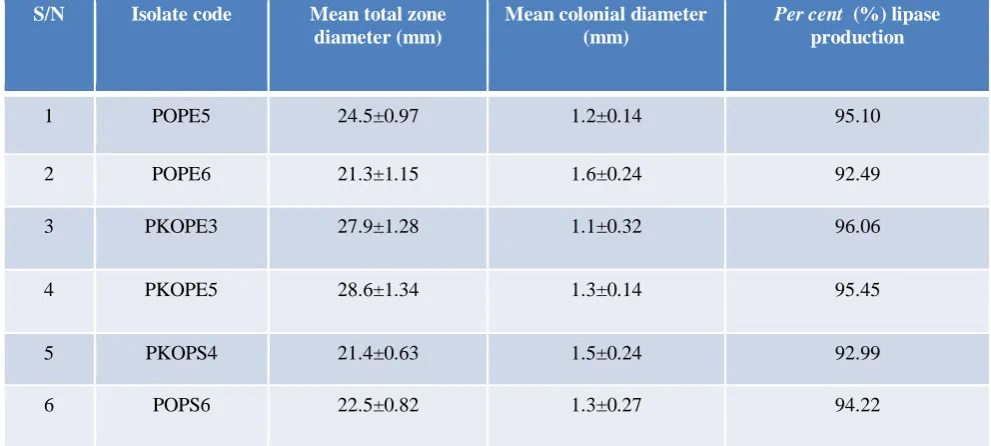
Results of quantitative screen test on solid medium revealed that only 6 isolates had ≥ 20 mm precipitate zone diameters with > 90% per cent lipase production (Table 2). However, in the submerged method, only isolates POPE5 and POPE6 could produce lipase in amounts detectable by the Bradford method of protein determination.
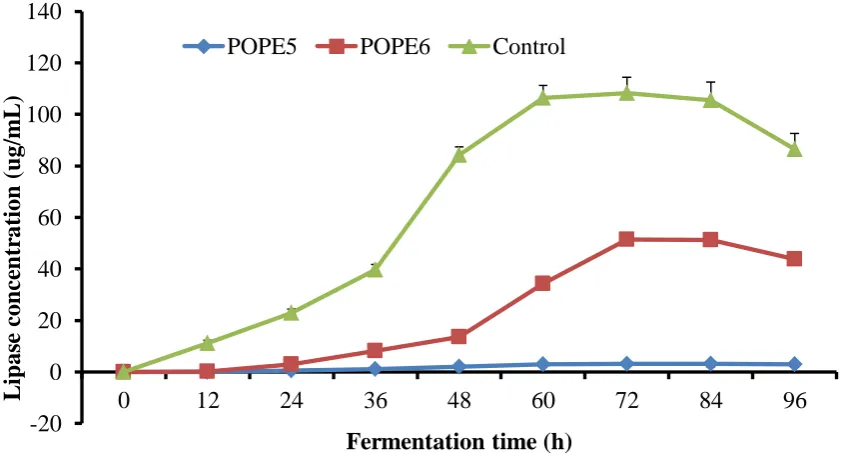
In the experiments set up to determine the time-course of lipase production and productivities of the 2 bacteria, results show that both bacteria gradually increased their lipase concentrations over time until 72 h when lipase concentration dropped. This result is presented in Figure 1. The productivity plot of lipase production by the isolates is presented as Figure 2. The more productive bacterium of the two was selected as POPE6.
Table 3 is a presentation of activity potentials of
isolates POPE5 and POPE6 using two
triacylglycerols. The table reveals that isolate POPE6 lipase had a higher activity (1.147 U/mL) than POPE5 which activity was 0.549 U/mL when stearate served as triacylglycerol.
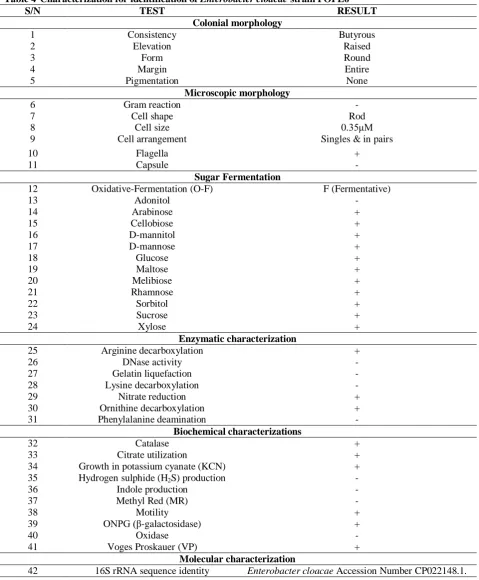
Results of the characterization and identification experiments of best lipase-producing bacterium are presented in Table 4 and reveal that isolate POPE6 was a strain of Enterobacter cloacae with a 99% sequence homology with Enterobacter cloacae,
Accession Number CP022148.1. The bacterium was defined as a catalase-positive, oxidase-negative facultatively anaerobic Gram-negative rod-shaped bacterium.
Selection of Enterobacter cloacae Strain POPE6 for Fermentative Production of Extracellular Lipase on Palm Kernel Oil Processing Effluent
http://www.ijSciences.com
Volume 6
– November
2017 (11
)
5
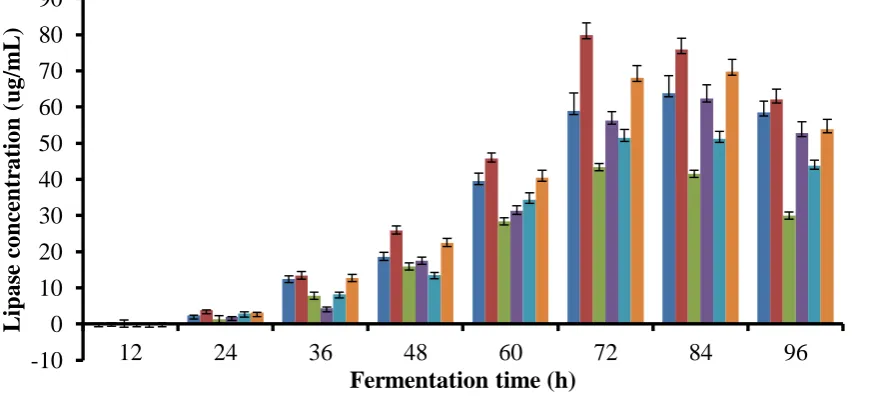
processing effluent (PKOPE) was the best carbon source as it mediated the production of 79.83 μg/mL of lipase by 72 h. Waste frying (sunflower) oil emerged second best carbon source by mediating the synthesis of 68.02 μg/mL at 72 h. A two-factor
analysis of variance revealed that nature of carbon source and fermentation time significantly influenced (Carbon source; P = 2.22E-05; Time, P = 1.99E-25;
P < 0.05) lipase concentration.
Table 1 Primary screening of bacteria for lipolytic activity
S/N Sample code
Number of distinct colonies
Number of lipase- positive bacteria
Per cent (%) lipase-positive bacteria per sample
1 ANW 52 5 9.61
2 EWDS 38 4 10.53
3 HTW 47 5 10.64
4 MWDS 42 6 14.29
5 MWSA 21 7 33.33
6 MWSB 32 8 25.00
7 PKOPE 29 9 31.03
8 PKOPS 42 7 16.67
9 POPE 18 7 38.89
10 POPS 34 7 20.59
TOTAL 355 65 18.31
Selection of Enterobacter cloacae Strain POPE6 for Fermentative Production of Extracellular Lipase on Palm Kernel Oil Processing Effluent
http://www.ijSciences.com
Volume 6
– November
2017 (11
)
6
Table 2 Quantitative screening for lipase-positive bacteria in solid medium
S/N Isolate code Mean total zone diameter (mm)
Mean colonial diameter (mm)
Per cent (%) lipase production
1 POPE5 24.5±0.97 1.2±0.14 95.10
2 POPE6 21.3±1.15 1.6±0.24 92.49
3 PKOPE3 27.9±1.28 1.1±0.32 96.06
4 PKOPE5 28.6±1.34 1.3±0.14 95.45
5 PKOPS4 21.4±0.63 1.5±0.24 92.99
6 POPS6 22.5±0.82 1.3±0.27 94.22
Selection of Enterobacter cloacae Strain POPE6 for Fermentative Production of Extracellular Lipase on Palm Kernel Oil Processing Effluent
http://www.ijSciences.com
Volume 6
– November
2017 (11
)
7
Fig.1: Time-course of lipase production by select bacteria. POPE-Palm oil processing effluent
Fig. 2: Productivity of lipase-positive bacteria. POPE-Palm oil processing effluent
-20
0
20
40
60
80
100
120
140
0
12
24
36
48
60
72
84
96
L
ip
as
e
con
ce
n
tr
at
io
n
(
u
g/
m
L
)
Fermentation time (h)
POPE5
POPE6
Control
-30
-20
-10
0
10
20
30
40
50
0
12
24
36
48
60
72
84
96
L
ip
as
e
pr
odu
ct
ivit
y
(ug/
m
L
/h
)
Fermentation time (h)
Selection of Enterobacter cloacae Strain POPE6 for Fermentative Production of Extracellular Lipase on Palm Kernel Oil Processing Effluent
http://www.ijSciences.com
Volume 6
– November
2017 (11
)
8
Table 3 Activities of bacterial lipases on palmitate and stearate
S/N Substrates Absorbance (405 nm) Activity (U/mL)
POPE5 POPE6 POPE5 POPE6
1 Palmitate (C16) 1.197 (±0.31) 1.845 (±0.32) 0.593 (±0.02) 0.956 (±0.08)
2 Stearate (C18) 1.118 (±0.18) 2.185 (±0.42) 0.549 (±0.01) 1.147 (±0.11)
3 Blank 0.138 (±0.01)
Selection of Enterobacter cloacae Strain POPE6 for Fermentative Production of Extracellular Lipase on Palm Kernel Oil Processing Effluent
http://www.ijSciences.com
Volume 6
– November
2017 (11
)
9
Table 4 Characterization for identification of Enterobacter cloacae strain POPE6
S/N TEST RESULT
Colonial morphology
1 Consistency Butyrous
2 Elevation Raised
3 Form Round
4 Margin Entire
5 Pigmentation None
Microscopic morphology
6 Gram reaction -
7 Cell shape Rod
8 Cell size 0.35μM
9 Cell arrangement Singles & in pairs
10 Flagella +
11 Capsule -
Sugar Fermentation
12 Oxidative-Fermentation (O-F) F (Fermentative)
13 Adonitol -
14 Arabinose +
15 Cellobiose +
16 D-mannitol +
17 D-mannose +
18 Glucose +
19 Maltose +
20 Melibiose +
21 Rhamnose +
22 Sorbitol +
23 Sucrose +
24 Xylose +
Enzymatic characterization
25 Arginine decarboxylation +
26 DNase activity -
27 Gelatin liquefaction -
28 Lysine decarboxylation -
29 Nitrate reduction +
30 Ornithine decarboxylation +
31 Phenylalanine deamination -
Biochemical characterizations
32 Catalase +
33 Citrate utilization +
34 Growth in potassium cyanate (KCN) +
35 Hydrogen sulphide (H2S) production -
36 Indole production -
37 Methyl Red (MR) -
38 Motility +
39 ONPG (β-galactosidase) +
40 Oxidase -
41 Voges Proskauer (VP) +
Molecular characterization
42 16S rRNA sequence identity Enterobacter cloacae Accession Number CP022148.1.
Results of the experiments for the selection of appropriate nitrogen for lipase productions are presented as Figure 4. The figure shows that ammonium nitrate was the most appropriate nitrogen source for lipase production by Enterobacter cloacae
strain POPE6 by releasing 95.86 μg/mL at 72 h. This was followed by 81.83 μg/mL, 79.83 μg/mL and
Selection of Enterobacter cloacae Strain POPE6 for Fermentative Production of Extracellular Lipase on Palm Kernel Oil Processing Effluent
http://www.ijSciences.com
Volume 6
– November
2017 (11
)
10
Figure 5 presents the results of experiments for selecting appropriate phosphorus source for lipase production by the test bacterium. The phosphorus sources were also to serve as buffers during the fermentation. The results presented show that 102.53 μg/mL was the highest amount of lipase attained and this occurred at 72 h when Na2HPO4/KH2PO4 served
as phosphorus source and buffer. Performances of other phosphate combinations were (in descending order) K2HPO4/KH2PO4-95.86 μg/mL>
Na2HPO4/NaH2PO4-84.67 μg/mL>
K2HPO4/NaH2PO4-79.43 μg/mL. Analysis of
variance of data revealed that both phosphorus source and fermentation time were respectively significant (Phosphorus source, P = 5.01E-05; Time, 7.45E-22 < 0.05) in their influences on lipase concentration.
The results of experiments for selecting appropriate inoculum size for fermentative lipase production are presented in Figure 6. The figure reveals that for maximum lipase concentration of 147.59 μg/mL achieved at 72 h, the starting inoculum size was 108 cells/mL. Performances of other inoculum sizes were
(in descending order) 107 cells/mL-119.04 μg/mL>106
cells/mL-88.48 μg/mL>105 cells/mL-83.23 μg/mL>109
cells/mL-67.83 μg/mL. Analysis of variance of data revealed that both inoculums size and fermentation time were respectively significant (Inoculum size, P = 0.0039; Time, 2.2E-13 < 0.05) in their influences on lipase concentration.
Results of influences of temperature and pH on lipase activity are presented in Figures 7 and 8. Figure 7 reveals that optimal temperature for lipase activity from Enterobacter cloacae strain POPE6 was 35°C where lipase activity was 2.024 U/mL at 10 min. Lipase activities at other temperatures were (in descending order) 40°C-1.703 U/mL in 5 min>30°C-1.622 U/mL in 10 min>50°C-1.578 U/mL in 7.5 min>45°C-1.414 U/mL in 7.5 min. A two-factor analysis of variance of data revealed significant (P = 0.039 <0.05) influence of temperature but a non-significant (P = 0.277 > 0.05) influence of time on lipase activity. Figure 8 reveals that optimum pH for test bacterial lipase activity was 7.0 with an activity
of 2.031 U/mL at 35°C for 10 min.
Fig.3 Effect of carbon source on lipase production
-10
0
10
20
30
40
50
60
70
80
90
12
24
36
48
60
72
84
96
L
ip
as
e
con
ce
n
tr
at
ion
(
u
g/m
L
)
Fermentation time (h)
Selection of Enterobacter cloacae Strain POPE6 for Fermentative Production of Extracellular Lipase on Palm Kernel Oil Processing Effluent
http://www.ijSciences.com
Volume 6
– November
2017 (11
)
11
Fig.4 Effect of nitrogen source on lipase production
PKOPE-Palm kernel oil processing effluent; POPE-Palm oil processing effluent
Fig.5 Effect of phosphate combinations on lipase production
-20
0
20
40
60
80
100
120
12
24
36
48
60
72
84
96
L
ip
as
e
con
ce
n
tr
at
ion
(
u
g/m
L
)
Fermentation time (h)
KNO3
NaNO3
NH4Cl
NH4NO3
(NH4)2SO4
Urea
-20
0
20
40
60
80
100
120
12
24
36
48
60
72
84
96
L
ip
as
e
con
ce
n
tr
at
io
n
(
u
g/
m
L
)
Fermentation time (h)
Selection of Enterobacter cloacae Strain POPE6 for Fermentative Production of Extracellular Lipase on Palm Kernel Oil Processing Effluent
http://www.ijSciences.com
Volume 6
– November
2017 (11
)
12
Fig.6 Effect of inoculum size on lipase production .
-20
0
20
40
60
80
100
120
140
160
180
12
24
36
48
60
72
84
96
L
ip
as
e
con
ce
n
tr
at
io
n
(
u
g/
m
L
)
Fermentation time (h)
Selection of Enterobacter cloacae Strain POPE6 for Fermentative Production of Extracellular Lipase on Palm Kernel Oil Processing Effluent
http://www.ijSciences.com
Volume 6
– November
2017 (11
)
13
Discussion
A major concern of a biotechnological venture is production economics and pivotal to the economics of production is the producing organism. Of special interest to the biotechnologist is the quantity of metabolite produced per unit time (productivity). Because of the economic and legal complexities arising from use of genetically-engineered microorganisms in production, microbial biotechnologists hold bio-prospecting exercises in high regard. A large number of microorganisms from diverse groups, especially, bacteria and actinomycetes, yeasts and molds, pooled from
different samples and environments are usually screened using high through-put techniques with the singular objective of selecting only those with demonstrable industrial potentials.
In this study, 18.31% of total bacteria isolated from all samples demonstrated abilities to produce lipase on solid medium. Significantly, the sample with lowest number of morphologically-distinct colonies was palm oil processing effluent (18 isolates), yet 38.89% of these were lipolytic. This underlines the concept of natural genetic engineering in which
0
0.5
1
1.5
2
2.5
2.5
5
7.5
10
12.5
L
ip
as
e
ac
tivi
ty
(U/m
L
)
Incubation time (min)
30°C
35°C
40°C
45°C
50°C
0.000
0.500
1.000
1.500
2.000
2.500
2
3
4
5
6
7
8
9
10
11
12
L
ip
as
e
ac
tivi
ty
(U/m
L
)
Selection of Enterobacter cloacae Strain POPE6 for Fermentative Production of Extracellular Lipase on Palm Kernel Oil Processing Effluent
http://www.ijSciences.com
Volume 6
– November
2017 (11
)
14
microorganisms adapt, over time, to environments chronically impacted with specific substrates as source of carbon and energy. Lipidic substrates naturally induce synthesis of lipolytic enzymes; esterases or lipases; therefore the result presented in this section was not at all surprising. Although six isolates made it out of the secondary screening on solid medium, only two could demonstrate lipase production in submerged culture. This supposes that these two bacteria produced lipase in amounts large enough to be detected by the Bradford method of protein determination, indicating that their concentrations were so large that their dilute solutions left sufficient amounts capable of driving the needed catalysis of triacylglycerol hydrolytic cleavage. Abilities of bacteria that did not meet the cut-off to be considered for submerged culture screening were nevertheless tested in the submerged method. As expected, none of these isolates could produce lipase in sufficient micro amounts to be detected by the method adopted in this study.
A consideration of the productivities of the isolates revealed that the amount of lipase per unit time varied between the bacteria. Productivity studies are conducted to guide the selection of a feasible duration of fermentation for a particular metabolite by a specific microorganism. The productivity plot (Figure 2) revealed that peak lipase productivity by isolate POPE6 occurred at 60 h as compared to the 48 h of the control bacterium. This suggests that (i) production of lipase decreases after this period (ii) degradation of already produced lipase begins (iii) Fermentation time for lipase production by this isolate is 60 h under the study conditions.
Enzyme concentration is not nearly as important to the microbial biotechnologist as its activity. The concentration of an active enzyme is always a better consideration even though the activity increases with concentration until all binding sites on substrate have been saturated. The activities of lipases produced by the test isolates were evaluated using two different substrates; palmitate (C16) and stearate (C18). Short
chain fatty acids including acetate (C2) and butyrate
(C4) were also included in the assay (data not shown)
to establish that the triacylglycerol hydrolase so produced was actually a lipase and not an esterase
[21]. The results showed that enzymes from the two isolates were lipases and not esterases (Table 3). The substrate preferences of the lipases could be explained by the phenomenon of induced-fit-model which claims that the substrate has the ability to cause substantial transformation in the three-dimensional link of the amino acids at the active site of the enzyme and these transformations in protein structure, directed by the substrate, will bring the
catalytic groups of the enzyme into an orientation suitable for reaction [16].
The bacterium was identified as a strain of
Enterobacter cloacae commonly involved in nosocomial infections like bacteremia, lower respiratory tract, urinary tract, skin and soft-tissue infections a well as endocarditis and meningitis. This would presuppose that the bacterium is not an industrial organism because, although isolated from palm oil processing effluent in this study, the bacterium has its origin commonly in feces of animals and man, and in sewage. The pathogenic status of most strains of this bacterium combined with the documented natural habitats understandably cast doubt on its suitability; in terms of safety during fermentation operations; for industrial production of lipase. Results of this study indicate that lipase is an important virulence factor of this strain of
Enterobacter cloacae which might be involved in the breakdown of lipid membrane barriers between cells/tissues and the environment. In spite of the presumed pathogenicity status of species of this genus, [18] studied the production of lipase by a strain of Enterobacter aerogenes and obtained commendable results. Our study bacterium could therefore be given the benefit of the doubt, at least until further studies on it and the safety of its lipase are concluded.
Selection of Enterobacter cloacae Strain POPE6 for Fermentative Production of Extracellular Lipase on Palm Kernel Oil Processing Effluent
http://www.ijSciences.com
Volume 6
– November
2017 (11
)
15
The single-factor-at-a-time approach for the selection of appropriate nitrogen source revealed that ammonium nitrate was the best carbon source. This confirms the result of characterization test (Table 3) that the bacterial strain is a nitrate reducer. Reduction of nitrate increases the amount of available nitrogen in the system leading to increased protein synthesis and cellular metabolism that drives significant increase in lipase production.
The search for appropriate phosphorus source led to
the selection of disodium hydrogen
phosphate/potassium dihydrogen phosphate. Ekpenyong et al. [8] observed that the combination of Na2HPO4/KH2PO4 (2:1) was most appropriate for
biosurfactant production; a metabolite very similar in activity with lipases, particularly emulsion formation. They theorized that there could be a requirement for sodium ions (Na+) either for metabolite formation or their release. Moreover, a better buffering activity might be provided by the combination than with others following increased cellular metabolism which could have led to drastic changes in pH, perhaps towards acidity, with resultant impairment of lipase activity.
Microbial metabolite biosynthesis depends a whole lot on the starting inoculum size. Very often, this parameter is confused with inoculum volume in literature. While inoculum size concerns itself with the number of actively dividing (viable) cells per unit volume of inoculum [8], inoculum volume refers to the specific volume of an inoculum size used in a fermentation experiment and is often expressed as % (v/v) relative to the reaction volume in the reaction vessel. A 2% (v/v) inoculum volume containing inoculum size of say 2.34 x 10⁴cells/mL and that containing 2.34 x 10⁸ cells/mL are not the same if the fermentation vessels and the final reaction volumes are the same. Understandably, the vessel with the higher inoculum concentration is the one with the larger inoculum size. In the final analysis, the driving force in fermentation is the inoculum concentration which is akin to the quorum of cells required to initiate many microbial biosynthetic processes including antibiotic and biosurfactant synthesis, bioluminescence, sporulation and synthesis of virulence factors required for microbial invasions during pathogenesis. The higher the inoculum concentration, the earlier a metabolite biosynthesis commences and the shorter the overall fermentation time. In this study, results showed that inoculum size significantly influenced lipase production by the bacterium. An inoculum size of 108 cells/mL was selected as best inoculum size for lipase production
by Enterobacter cloacae strain POPE6 using palm kernel oil processing effluent as carbon source, NH4NO3 as nitrogen source and Na2HPO4/KH2PO4
(2:1) as phosphorus source and buffer. A similar inoculum size was observed by Ekpenyong et al. [8]
in their biosurfactant study. The authors suggested that too little an initial cell population would delay biosurfactant production until such a time that its density reached the desired quorum. They also argued that too large an initial cell population might arrest production too early by reason of ineffective collisions between the bacterial cells (catalysts) and the substrates for want of space in a saturated system.
Two important environmental factors that influence enzyme activity include temperature and pH [14] and their effects were investigated in this study. Our results showed that duration of exposure was an important modulator at any particular temperature. Exposure of an enzyme to high temperatures usually results in the denaturation of the enzyme by breakage of peptide bonds and destabilization of intermolecular interactions that facilitated the formation of the protein. Increased denaturation and destabilization result if the exposure to such damaging temperature is prolonged. Selection of 35°C as optimal temperature for activity implies that at this temperature, Enterobacter cloacae strain POPE6 lipase attains maximal and prolonged catalytic activity on stearate (C18) for 10 min. The
preference of this enzyme for long chain fatty acids (C8-C18) confirms it as a true lipase [20]. [19]
reported, in their research on lipolytic enzymes, that the effect of temperature on lipase activity is substrate-specific. The present study had earlier screened lipidic substrates for lipase activity and found stearate to be most suitable for test lipase action. Effect of temperature and pH on lipase activity was accordingly conducted solely on this substrate and the influence of exposure time on activity, as anticipated, became a major issue. Effect of pH on the activity of the test lipase was only conducted at the optimum temperature and time already established. It is possible that all four factors could interact to bring about an influence on the activity of the enzyme. A response surface methodology has therefore been set up in our laboratory to study the effects of these four variables and their possible interactions on lipase activity. The optimal pH for Enterobacter cloacae lipase in this study was 7.0 with an activity of 2.031 U/mL at 35°C for 10 min. This is in agreement with earlier reports on lipase activity studies as bacterial lipases frequently show high activities at neutral or alkaline pH [1, 9]
Selection of Enterobacter cloacae Strain POPE6 for Fermentative Production of Extracellular Lipase on Palm Kernel Oil Processing Effluent
http://www.ijSciences.com
Volume 6
– November
2017 (11
)
16
This research identified a rare lipolytic bacterium,
Enterobacter cloacae strain POPE6 with the uncommon ability to use palm kernel oil processing effluent as substrate. The conversion of this waste into lipase is an important approach to solving waste pollution problems. This research also identifies lipase as one of the major virulence factors of the bacterium since it is generally known to be involved in nosocomial infections. However, the ability of the bacterium to use palm kernel oil processing effluent as carbon source for fermentative lipase production could be exploited as a waste management option.
References
1. Amoozegar, M. A., Salehghamari, E., Khajeh, K., Kabiri, M. & Naddaf, S. (2008). Production of an extracellular thermophilic lipase from a moderately halophilic bacterium, Salinivibrio sp. strain SA-2.
Journal of Basic Microbiology, 48: 160– 167.
https://doi.org/10.1002/jobm.200700361 2. Andualema, B. & Gessesse, A. (2012).
Microbial lipases and their industrial applications: review. Biotechnology, 11 (3): 100-118.
https://doi.org/10.3923/biotech.2012.100.11 8
3. Asitok, A. D., Antai, S. P. & Ekpenyong, M. G. (2017). Water soluble fraction of crude oil uncouples protease biosynthesis and activity in hydrocarbonoclastic bacteria; implications for natural attenuation.
International Journal of Sciences, 6 (7) 5-21. http://doi.org/10.18483/ijSci.1344 4. Bornscheuer, U. T. (2002). Microbial
carboxyl esterases: classification, properties and application in biocatalysis. FEMS Microbiology Reviews, 26: 73–81.
https://doi.org/10.1111/j.1574-6976.2002.tb00599.x
5. Cutchins, E. C., Raymond N. Doetsch, R. N. & Pelczar, M. J., Jr. (1951). The influence of medium composition on the production of bacterial lipase. Journal of Bacteriology, 63: 269-272
6. Dhiman, A. & Chapadgaonkar, S. S. (2013). Optimization of lipase production medium for a bacterial isolate. International Journal of Chemical Technology Research, 5 (6): 2837-2843.
7. Ekpenyong, M. G., Antai, S. P. & Asitok, A. D. (2016). A Pseudomonas aeruginosa
strain IKW1 produces an unusual polymeric surface-active compound in waste frying oil-minimal medium. International Journal of Sciences, 5 (6): 108-123. https://doi.org/10.18483/ijSci.1064
8. Ekpenyong, M., Antai, S., Asitok, A. & Ekpo, B. (2017). Response surface modeling and optimization of major medium variables
for glycolipopeptide production.
Biocatalysis and Agricultural Biotechnology, 10: 113-121. https://doi.org/10.1016/j.bcab.2017.02.015 9. Guncheva, M. & Zhiryakova, D. (2011).
Catalytic properties and potential applications of Bacillus lipases. Journal of Molecular Catalyst B: Enzymology, 68: 1– 21.
https://doi.org/10.1016/j.molcatb.2010.09.00 2
10. Gupta, R., Kumari, A., Syal, P. & Singh, Y. (2015). Molecular and functional diversity of yeast and fungal lipases: their role in vio-technology and cellular physiology. Progress in Lipid Research, 57: 40–54. https://doi.org/10.1016/j.plipres.2014.12.001 11. Gurung, N., Ray, S., Bose, S. & Rai, V. (2013). A broader view: Microbial enzymes and their relevance in industries, medicine
and beyond. BioMed Research
International.
http://doi.org/10.1155/2013/329121 12. Hasan, F., Shah, A. A., Hameed, A. (2006).
Industrial applications of microbial lipases.
Enzyme Microbial Technology, 39: 235-251. https://doi.org/10.1016/j.enzmictec.2005.10. 016
13. Holt, J. G., Krieg, N. R., Sneath, P. H. A., Staley, J. T. & Williams, S. T. (1994).
Bergey’s Manual of Determinative Bacteriology, Hensyl, W. R. (ed.) 9th edition. Maryland: Williams and Williams. 14. Kiran, S, Arshada, Z., Nosheenb, S. Kamala,
S. Gulzara, T., Majeeda, M. S. Jannata, M. Rafiquec, M. A. (2016). Microbial Lipases: Production and Applications: A Review.
Journal of Biochemistry, Biotechnology and Biomaterials, 1 (2): 7-20.
15. Kishan, G., Gopalakannan, P.,
Muthukumaran, C., Thirumalai
Muthukumaresan, K., Dharmendira Kumar, M. & Tamilarasan, K. (2013). Optimization of critical medium components for lipase production from Yarrowia lipolytica (MTCC 35). Journal of Genetic Engineering and Biotechnology, 11: 111–116. http://doi.org/10.1016/j.jgeb.2013.06.001 16. Koshland, D. E. (1958). Application of a
theory of enzyme specificity to protein synthesis. Proceedings of the National Academy and Science, 44: 98–104. https://doi.org/10.1073/pnas.44.2.98
17. Kulkarni, S., Sadichha, P. & Satpute, S. (2013). Microbial esterases: an overview.
Selection of Enterobacter cloacae Strain POPE6 for Fermentative Production of Extracellular Lipase on Palm Kernel Oil Processing Effluent
http://www.ijSciences.com
Volume 6
– November
2017 (11
)
17
Microbiology and Applied Sciences, 2: 135– 146.
18. Kumari, A., Mahapatra, P. & Banerjee R. (2009). Statistical optimization of culture conditions by response surface methodology for synthesis of lipase with Enterobacter aerogenes. Brazilian Archives of Biological Technology, 52:1349–1356
https://doi.org/10.1590/S1516-89132009000600005
19. Ramnath, 1., Sithole, B. & Govinden, R. (2017). Identification of lipolytic enzymes isolated from bacteria indigenous to Eucalyptus wood species for application in the pulping industry. Biotechnology Reports,
15: 114-124.
http://doi.org/10.1016/j.btre.2017.07.004
20. Rhee, J. K., Ahn, D. G. Kim, Y. G. & Oh, J. W. (2005). New thermophilic and thermostable esterase with sequence similarity to the hormone-sensitive lipase family clones from a metagenomic library.
Applied and Environmental Microbiology,
71: 817–825.
https://doi.org/10.1128/AEM.71.2.817-825.2005