A Thesis
Submitted to the Faculty of
Drexel University by
Raymond J. Canzanese, Jr. in partial fulfillment of the requirements for the degree
of
Doctor of Philosophy May 2015
Dedications
To Madison,
without whose support and companionship this would have been a far less rewarding and enjoyable experience.
Acknowledgments
Throughout the course of writing this thesis, I was surrounded by an outstanding community who provided the support, inspiration, encouragement, and distraction necessary for its completion. To my advisers, Moshe Kam and Spiros Mancoridis, and committee, Naga Kandasamy, Ko Nishino, Harish Sethu, and Steven Weber, I am most thankful. It was their insights, guidance, feedback, and support that made this thesis possible. I cannot overstate the depth and breadth of the lessons I have learned from them, which have shaped not only this thesis, but my general approach to problem solving, my outlook on life, and my ambitions.
That my advisers managed to find the time, energy, and patience to meet with me regularly to discuss my successes and failures confounds me. Watching them advance in their careers while remaining so humble and grounded has been truly inspiring. I also had the great fortune to learn from a number of other faculty members here at Drexel who have helped shape and inspire this work, including Kapil Dandekar, John Walsh, Tom Chmielewski, Ali Shokoufandeh, and Marcello Balduccini.
My friends and colleagues here at Drexel, especially those members of the Data Fusion Lab and Software Engineering Research Group, have also served to educate, motivate, and inspire me. Among these are Bradford Boyle, Jeff Wildman, Chris Lester, Sayandeep Acharya, Gus Anderson, Dave Dorsey, Pramod Abichandani, Rich Primerano, George Sworo, Alex Fridman, DJ Bucci, Yifei Xu, Feiyu Xiong, Ji Wang, Cole Gindhart, Arjun Rajasekar, Maxim Shevertalov, Ed Stehle, Rob Lange, Kevin Lynch, Bill Mongan, Bander Alsulamy, Matt Ping, and Alex Duff.
I am grateful for the years of support and assistance provided by the ECE staff, especially Chad Morris, Kathy Bryant, Tanita Chapelle, Phyllis D. Watson, Sean Clark, Taif Choudhury, and Wade Kirkpatrick.
I am especially grateful to the KEYSPOT Network, The City of Philadelphia’s Office of Inno-vation and Technology (OIT), The Mayor’s Commission on Literacy, and the Department of Parks
and Recreation (PPR) for their support of their research. Thank you to the KEYSPOT Executive Committee – Judith R´enyi, Patrick Morgan, Andrew Buss, and Joann Ferroni – for their support. Thank you also to Jennifer Kobrin, Maria Walker, Adena Klem, and all of those who helped make the KEYSPOT collaboration possible. None of this would have been possible without the selfless work of Andy Stutzman who facilitated this collaboration. Thank you to the People’s Emergency Center, especially Tan Vu and Desmond Hinkle, and the Dornsife Center for Neighborhood Partner-ships, especially Sarah Steltz and Kevin Williams, for their support and participation. Thank you also to Paul Dougherty and George Lauro, who afforded me the opportunity to share my work with a much wider audience than would have otherwise been possible.
Finally, thank you to my friends and family, without whose love, support, encouragement, en-thusiasm, and distraction, none of this would have been possible.
This research is sponsored by a Secure and Trustworthy Cyberspace (SaTC) award from the National Science Foundation (NSF), under grant CNS-1228847.
Table of Contents
List of Tables . . . ix List of Figures . . . x List of Acronyms . . . xi Abstract . . . xiv 1. Introduction . . . 1 1.1 Malware . . . 1 1.1.1 Malware naming . . . 31.1.2 Malware delivery mechanisms . . . 5
1.1.3 Malware motivations . . . 6
1.1.4 Malware defenses . . . 6
1.1.5 Recent malware trends . . . 7
1.2 Behavioral malware analysis . . . 8
1.3 System call tracing . . . 10
1.4 Detecting and classifying unknown malware samples . . . 13
1.5 The importance of empirical evaluation . . . 14
1.6 Research contributions and thesis outline . . . 15
2. Related Work . . . 17
2.1 Malware detection . . . 17
2.1.1 Static analysis techniques . . . 17
2.1.2 Dynamic analysis techniques . . . 18
2.1.3 System call analysis . . . 18
2.2 Malware classification . . . 21
2.2.1 Static analysis techniques . . . 21
2.3 Novelty of this thesis . . . 23
2.3.1 Addressing conflicting claims . . . 23
2.3.2 Detector performance at low false positive rates (FPRs) . . . 24
2.3.3 Online detection . . . 24
2.3.4 Sequential detection . . . 24
2.3.5 Experimental evaluation . . . 25
2.3.6 Online classification . . . 25
3. Experimental Setup . . . 26
3.1 System Call Service (SCS) . . . 26
3.1.1 Memory and computational overhead . . . 29
3.2 Production data collection . . . 32
3.3 Malware testbed . . . 34
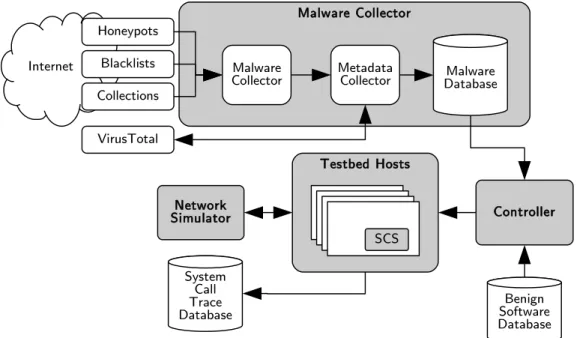
3.3.1 Malware collector . . . 35
3.3.2 Controller and virtual machine hosts . . . 36
3.3.3 Network simulator . . . 38
3.4 Malware samples . . . 39
3.5 Ground truth labeling . . . 41
3.6 Conclusions . . . 42 4. Feature Extraction . . . 44 4.1 Information retrieval . . . 45 4.2 Feature selection . . . 48 4.3 Feature scaling . . . 51 4.3.1 TF-IDF transformation . . . 51 4.3.2 Unit-magnitude scaling . . . 53 4.4 Feature reduction . . . 53
4.4.1 Truncated singular value decomposition (SVD) . . . 53
4.4.2 Linear discriminant analysis (LDA) . . . 55
4.5 Feature extraction evaluation . . . 56
5. Malicious Process Detection . . . 58
5.1 Malware detection algorithms . . . 58
5.1.1 Signature-based detector . . . 59
5.1.2 Multinomial log-likelihood ratio test (LLRT) . . . 60
5.1.3 Linear support vector machines (SVMs) . . . 62
5.1.4 Logistic regression (LR) . . . 64
5.2 Sequential malware detection . . . 65
5.2.1 Wald’s sequential probability ratio test (SPRT) . . . 65
5.2.2 Page’s cumulative sum (CUSUM) test . . . 67
5.3 Malware detector evaluation . . . 68
5.3.1 Detector performance measures . . . 68
5.3.2 Cross-validation . . . 70
5.4 Experimental results . . . 71
5.4.1 Detector, n-gram length, and trace length comparison . . . 71
5.4.2 Feature extraction comparison . . . 76
5.4.3 Feature selection . . . 78
5.4.4 Regularization . . . 81
5.4.5 Block-wise detection performance . . . 81
5.4.6 Effects of drift . . . 83
5.4.7 Error analysis . . . 85
5.4.8 Malware comparison . . . 87
5.5 Case study . . . 89
5.6 Sequential detection results . . . 90
5.7 Conclusions . . . 91
6. Malware Classification . . . 93
6.1 Malware classification algorithms . . . 93
6.1.1 Multi-class logistic regression (LR) . . . 94
6.1.2 Na¨ıve Bayes . . . 94
6.1.3 Random forests . . . 95
6.1.4 Nearest neighbors . . . 97
6.1.5 Nearest centroid . . . 97
6.2 Malware classifier evaluation . . . 98
6.2.1 Precision . . . 98
6.2.2 Recall . . . 99
6.2.3 F1 score . . . 99
6.2.4 Cohen’sκstatistic . . . 100
6.3 Experimental classification results . . . 101
6.3.1 Ground truth comparison . . . 101
6.3.2 Classifier comparison . . . 103
6.3.3 Category-level classification results . . . 105
6.3.4 Family-level classification results . . . 107
6.3.5 Feature selection . . . 109
6.4 Conclusions . . . 110
7. Conclusions. . . 111
7.1 System design . . . 111
7.2 Summary of system operation . . . 113
7.3 Discussions . . . 114
Bibliography . . . 118
List of Tables
1.1 Names assigned to two malware samples by five antivirus (AV) vendors . . . 4
2.1 Summary of related work in system call-based malware detection . . . 19
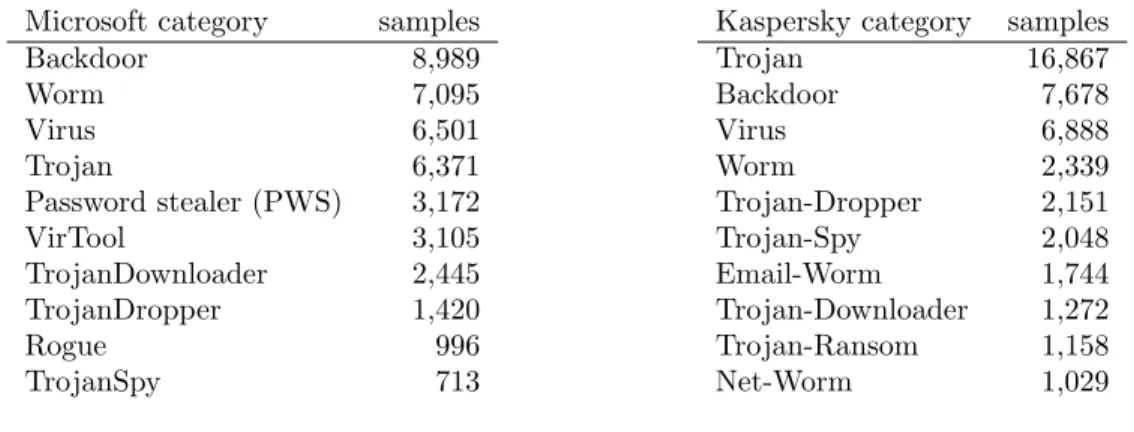
3.1 Most common malware categories used in this study . . . 40
3.2 Most common malware families used in this study . . . 41
4.1 Ordered and unordered 2-gram representation of a system call trace . . . 46
5.1 System calls present in the selected feature set of 4,000 3-grams . . . 79
5.2 ESET family labels of false negatives . . . 86
5.3 Per-family malware detector performance . . . 88
5.4 Sequential detection results for Page’s CUSUM test and Wald’s SPRT . . . 91
6.1 Classification ground truth performance comparison for the LR classifier . . . 102
6.2 Classifier and feature extraction comparison . . . 104
List of Figures
1.1 Example system call trace of web browser process . . . 12
1.2 Block diagram of malware detection and classification system . . . 16
3.1 System Call Service block diagram . . . 27
3.2 Kernel trace using Event Tracing for Windows (ETW) . . . 28
3.4 System Call Service production deployment . . . 33
3.5 Malware testbed block diagram . . . 34
4.1 The feature extraction process . . . 45
5.1 Comparison of the LR, SVM, SIG, and LLRT detectors . . . 73
5.2 Detector ngram length analysis . . . 75
5.3 Detector feature extraction comparison . . . 77
5.4 Feature selection analysis . . . 78
5.5 SVM and LR detector regularization analysis . . . 81
5.6 Block-wise detection analysis and the effects of ignoring the first 100 system calls . . . . 82
5.7 Detector drift analysis . . . 84
6.1 Classifier confusion matrix for Microsoft category ground truth labels . . . 105
6.2 Effects of feature selection on classification accuracy . . . 109
7.1 Block diagram of malware detection and classification system . . . 112
7.2 Flow chart showing specifics of detector and classifier operation . . . 113
List of Acronyms
ADD average detection delay
API application programming interface APT advanced persistent threat
AUC area under the curve AV antivirus
CART classification and regression trees CUSUMcumulative sum
DDoS distributed denial of service DoS denial of service
ETW Event Tracing for Windows FPR false positive rate
i.i.d. independent, identically distributed I/O input/output
IDF inverse document frequency IDS intrusion detection system LDA linear discriminant analysis LLRT log-likelihood ratio test LPC local procedure call LR logistic regression LSA latent semantic analysis
NIDS network intrusion detection system OS operating system
OVA one-versus-all
PCA principal component analysis PE portable executable
PID process identifier PWS password stealer r.v. random variable
RFE recursive feature elimination ROC receiver operating characteristic SCS System Call Service
SEM standard error of the mean SGD stochastic gradient descent SPRT sequential probability ratio test SSDT system service descriptor table SVD singular value decomposition SVM support vector machine TF term frequency
TF-IDF term frequency – inverse document frequency TID thread identifier
TPR true positive rate ULS ultra large scale VM virtual machine
VMM virtual machine manager
List of Notation
{·} An unordered set h·i An ordered sequence
[·] A matrix or column vector k · k The norm of a vector card(·) The cardinality of a set
Hadamard element-wise matrix product
pX(x) The probability distribution function of a random variableX K Number of malware classes
N Number of training samples l System call trace length n Length of system calln-gram
Ck The set of all malware samples belonging to thekth class y A vector of binary labels
ˆ
x The feature vector of a system call trace output by the feature extractor X The set of all training data
XB The set of all training data collected from benign processes XM The set of all training data collected from malicious processes
X A matrix formed by horizontally concatenating all training vectors Λ The decision statistic of a detector
λ The decision threshold of a detector
w Vector of feature weights used by a detector µ Sample mean
σ2 Sample standard deviation σ Sample variance
Abstract
Detection and Classification of Malicious Processes Using System Call Analysis Raymond J. Canzanese, Jr.
Moshe Kam, Ph.D. and Spiros Mancoridis, Ph.D.
Despite efforts to mitigate the malware threat, the proliferation of malware continues, with record-setting numbers of malware samples being discovered each quarter. Malware are any intentionally malicious software, including software designed for extortion, sabotage, and espionage. Traditional malware defenses are primarily signature-based and heuristic-based, and include firewalls, intrusion detection systems, and antivirus software. Such defenses are reactive, performing well against known threats but struggling against new malware variants and zero-day threats. Together, the reactive nature of traditional defenses and the continuing spread of malware motivate the development of new techniques to detect such threats. One promising set of techniques uses features extracted from system call traces to infer malicious behaviors.
This thesis studies the problem of detecting and classifying malicious processes using system call trace analysis. The goal of this study is to identify techniques that are ‘lightweight’ enough and exhibit a low enough false positive rate to be deployed in production environments. The major contributions of this work are (1) a study of the effects of feature extraction strategy on malware detection performance; (2) the comparison of signature-based and statistical analysis techniques for malware detection and classification; (3) the use of sequential detection techniques to identify malicious behaviors as quickly as possible; (4) a study of malware detection performance at very low false positive rates; and (5) an extensive empirical evaluation, wherein the performance of the malware detection and classification systems are evaluated against data collected from production hosts and from the execution of recently discovered malware samples. The outcome of this study is a proof-of-concept system that detects the execution of malicious processes in production environments and classifies them according to their similarity to known malware.
Chapter 1: Introduction
Malware, short for ‘malicious software’, are any software with an intentionally malicious function. Malware are used for espionage, extortion, and sabotage, and used to perform other unauthorized tasks. Such tasks include sending unwanted email messages (spam) and participating in distributed denial of service (DDoS) attacks. Malware exist in various forms, including embedded malware, mobile malware, malicious scripts, and malicious bytecode. This study seeks to identify the execu-tion of standalone binary executable malware files (i.e., malware samples) in traditional computing environments (e.g., servers, workstations, laptops, and notebooks). A computer host is considered ‘infected’ if it has executed any known malware samples. Otherwise, it is considered ‘clean’.
In this chapter, Section 1.1 provides a summary of common malware functions and delivery mechanisms, taditional malware defenses, and recent malware trends. Sections 1.2–1.3 introduce behavioral malware analysis and system call tracing. Section 1.4 describes the motivations for and challenges in performing behavioral malware analysis online, and Section 1.5 emphasizes the importance of empirical evaluation. Section 1.6 summarizes the research contributions of this thesis.
1.1
Malware
Malware are traditionally characterized by their malicious functions, delivery mechanisms, and au-thorship or heritage. The following categories describe common malicious functions.
Backdoors
Backdoors provide clandestine remote access to an infected host, typically bypassing normal authentication and security mechanisms.
Bots
Bots enable remote control of a host. The infected hosts are typically part of a network of infected hosts, referred to as a botnet. Bots are used for performing distributed operations, such as sending spam, mining crypto-currency, or performing DDoS attacks [1, 2].
Downloaders and droppers
Downloaders and droppers install additional malware on infected hosts. Downloaders download additional malware from remote servers, while droppers are bundled with additional malware.
Ransomware
Ransomware restrict access to a host, by disabling or hiding normal functions, or by encrypting or hiding data. Ransomware are typically used to extort money from affected users [3]. Rootkits
Rootkits covertly provide persistent and privileged access to a host. Rootkits typically hide processes, hide files, and interfere with security software to evade detection.
Scareware
Scareware use fear to sell a typically useless product. For example, rogue antivirus (AV) software erroneously report malware infections and are used to sell the service removing the reported infections [4].
Spyware
Spyware steal private user information, such as financial data, browsing habits, license keys, and login credentials. Spyware typically transmit the stolen information to a remote server.
Malware are also characterized by their delivery mechanisms, the methods by which they spread to and infect new hosts. The following malware categories describe common delivery mechanisms [5]. Exploits
Exploits take advantage of software vulnerabilities to enable privileged execution of malware. Logic bombs
Logic bombs are malicious functions embedded in otherwise benign software.
Trojan horses
Trojan horses, also known as Trojans, are malware disguised as legitimate software, used to trick users into unknowingly installing malware.
Viruses
Viruses are self-replicating malware that insert code into other programs, files, or locations on an infected host.
Worms
Worms are self-replicating malware that spread to other hosts, typically over a computer network.
To maximize their effectiveness and evade defenses, malware samples typically include multiple malicious functions and use multiple delivery mechanisms. As such, malware samples typically exhibit characteristics of multiple categories.
1.1.1
Malware naming
No single, universal malware taxonomy or naming scheme exists. Instead, multiple naming schemes have been developed by major security companies to identify malware samples. Such naming schemes typically include amalware category label, which indicates the primary delivery mechanism and/or malicious function of a malware sample, and amalware family label, which indicates specific shared function, authorship, or heritage. Examples of malware families include Zeus/Zbot, Flame, Stuxnet, Duqu, MyDoom, and Sality. Often, naming systems include asub-family orvariant label, indicated by an alphanumeric identifier. Naming systems may also specify the target platform of a malware sample or the language in which it is written.
The existence of malware samples that use multiple delivery mechanisms and perform multiple malicious functions complicate the malware naming process. Although the functions and delivery mechanisms listed in Section 1.1 are not mutually exclusive, malware naming schemes typically indicate only the primary function or delivery mechanism of a sample. Existing malware naming schemes suffer from two major drawbacks: incompleteness and inconsistency [6]. The naming schemes are incomplete because there are known malware samples missing from each scheme. The major challenges to creating a complete naming schemes are the number of existing malware samples and frequency at which new malware samples are discovered. More than 50 million new malware
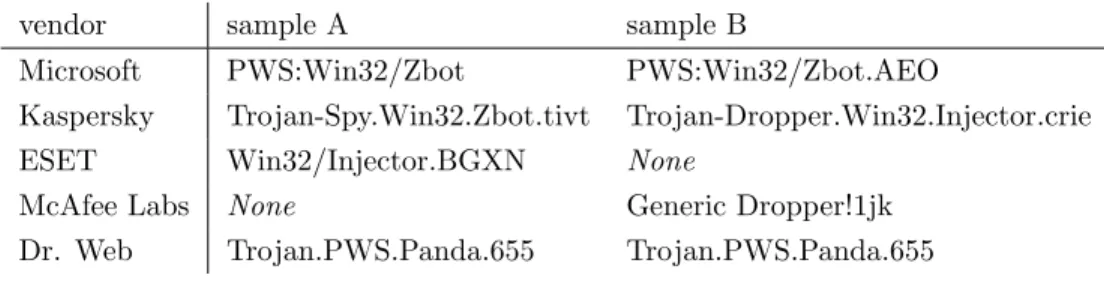
Table 1.1: Names assigned to two malware samples by five antivirus (AV) vendors
vendor sample A sample B
Microsoft PWS:Win32/Zbot PWS:Win32/Zbot.AEO
Kaspersky Trojan-Spy.Win32.Zbot.tivt Trojan-Dropper.Win32.Injector.crie ESET Win32/Injector.BGXN None
McAfee Labs None Generic Dropper!1jk Dr. Web Trojan.PWS.Panda.655 Trojan.PWS.Panda.655
samples were discovered in the fourth quarter of 2014 alone, an average of 6 new malware samples every second. McAfee Labs projects to have more than 500 million total samples in their collection by the end of 2015 [7].
Existing malware naming systems are inconsistent because different naming schemes do not place malware samples consistently in the same category or family. One of the major challenges to achieving consistent malware naming is the overlap in malware functions and delivery mechanisms. Furthermore, malware samples are often composed of code derived from multiple different sources, complicating the problem of establishing malware authorship or heritage. Finally, malware samples are typically designed to complicate the types of analyses used to reveal their functions, delivery mechanisms, authorship, and heritage. Techniques used by malware authors to complicate such analyses include obfuscation, packing, encryption, debugging, disassembly, and other anti-analysis techniques [8].
The inconsistency and incompleteness of malware naming schemes are demonstrated in Table 1.1 The table shows the names assigned to two malware samples by five different AV vendors, Microsoft1, Kaspersky2, ESET3, McAfee4, and Dr. Web5. The names are presented in the formats provided by the vendor. The incompleteness of the naming schemes is demonstrated by the missing name for sample A from McAfee and the missing name for sample B from ESET. The inconsistency of the naming schemes is demonstrated through a comparison of the labels assigned by each vendor. For example, Microsoft identifies both samples as distinct variants belonging to the password stealer
1Microsoft Malware Protection Center (MMPC),http://www.microsoft.com/security/portal/mmpc/ 2Kaspersky Lab,
www.kaspersky.com
3ESET NOD32,www.eset.com 4McAfee Labs,http://www.mcafee.com 5Dr. Web,www.drweb.com
(PWS) category and Zeus/Zbot family. Dr. Web similarly identifies the samples as being members of the PWS category and from the same family, but does not differentiate between the two samples. Kaspersky identifies the samples as belonging to two distinct categories, Spy and Trojan-Dropper, and two distinct families, Zbot/Zeus and Injector.
1.1.2
Malware delivery mechanisms
Malware primarily infect hosts through the exploitation of security vulnerabilities, through the ex-ploitation of lax security practices, and through social engineering. Security vulnerabilities are used by malware authors to enable privileged malware execution. These include input validation, code in-jection, buffer overflow, privilege escalation, and cross-site scripting vulnerabilities [9]. While many vulnerabilities are discovered and patched by the authors of affected software, others are discovered and exploited by an attacker before the vulnerabilities are known. Such vulnerabilities, known as
zero-day vulnerabilities, are particularly worrisome for commonly used software, as they enable mal-ware authors to successfully infect many vulnerable hosts. Furthermore, malmal-ware exploiting zero day vulnerabilities can spread largely unchecked until the exploited vulnerabilities are discovered and patched.
Malware targeting hosts with lax security typically seek easy targets, such as hosts with weak passwords. For example, some malware scan computer networks for hosts running common network services. The malware attempt to access the discovered services by performing dictionary attacks with common username and password combinations.
Social engineering is the use of disguises, ploys, or tricks to convince a user to unknowingly assist an attacker in infecting a host [10]. One common social engineering tactic is the use of Trojan horses to trick users into downloading and installing malware. For example, the Zeus/Zbot malware family has been used in targeted email campaigns, sent to potential victims as electronic greeting cards from the White House, Federal Trade Commission complaints, and shipping invoices.
Of these three delivery mechanisms, the exploitation of security vulnerabilities is comparatively rare. This is largely due to the engineering effort required to identify exploitable security vulnera-bilities. When vulnerabilities are discovered, they are typically sold on the black market to be used
in cyber-attacks [11]. Furthermore, exploits are only useful as long as the targeted vulnerabilities remain open [12]. Conversely, social engineering requires only a sufficiently convincing ploy to trick targeted users, and the discovery of computer hosts with lax security is easily automated.
1.1.3
Malware motivations
Malware authors are motivated by a number of factors, including politics, ideologies, and mone-tary gain. Politically and ideologically motivated malware are increasingly being used as parts of sophisticated, targeted attacks known as advanced persistent threats (APTs) [11]. APTs typically use multiple delivery mechanisms to gain access to a target’s computer systems. Examples of APTs include Stuxnet, used for sabotage at an Iranian nuclear facility [13], and Operation Aurora, used for corporate espionage [14].
Malware are also particularly useful as profit source. Some malware, such as Zeus/Zbot, are sold in the form of crimeware kits used for creating customized malware samples [15]. Malware authors also sell access to botnets, which are typically used to provide phishing and spam services, to mine crypto-currency, and to perform DDoS attacks [16]. Spyware are used to steal sensitive data, such as user credentials and financial data, which are sold in the black market [17]. Ransomware and scareware are used to extort money from the users of infected hosts [4].
1.1.4
Malware defenses
Traditional defenses against malware include the adoption of secure computing practices, the design of more secure systems, and the use of security-related software tools. Secure computing practices include
• keeping software up-to-date to mitigate the chance of known vulnerabilities being exploited [4];
• safeguarding private information against casual reconnaissance; and
• adopting security policies to reduce the number of possible attack vectors on a host.
Teaching secure computing practices to end-users is an especially important step in preventing intrusions enabled by lax security practices, slowing the proliferation of Trojan horses, reducing the success of phishing attempts, and thwarting other attempts at social engineering [18, 19].
There has also been a considerable effort to design computing systems with security in mind, a field known as trusted computing [20]. Techniques used in trusted computing include protecting sensitive information at the hardware-level and signing code so users can verify whether it comes from a trusted source. Recent malware trends indicate that malware authors have begun digitally signing their malware to avoid detection by such mechanisms. McAfee reports nearly 16 million distinct signed malware samples have been discovered through the beginning of 2015 [7].
Software tools used to protect against malware infections include intrusion detection systems (IDSs) and AV software. IDSs are used to detect malware and other malicious intrusions. Host IDSs detect intrusions at the host-level, by monitoring operating system (OS) interaction, file access, and audit data [21, 22]. Network intrusion detection systems (NIDSs) detect intrusions at the network level, by monitoring network traffic. IDSs can be signature-based, detecting intrusions based on patterns of known attacks [23], or anomaly-based, detecting intrusions by identifying deviations from normal behavior [24, 25].
AV software typically identify files as either benign or malicious by comparing them against a database of byte signatures of known malware [5]. The strengths of AV software are that they provide a low false positive rate (FPR) and have easily provable and quantifiable performance against known malware samples. However, the weakness of signature-based AV software is that they are reactive, typically requiring new malware to be discovered and analyzed prior to detection. Furthermore, AV software to fail to detect new malware variants that have been modified just enough to not match any existing signatures. In response, AV software incorporate heuristic techniques to identify common types of malware, and signatures are designed to detect as many variants of a malware sample as possible. Techniques for streamlining malware analysis and reducing the number of required signatures are of particular interest to AV vendors [7, 26].
1.1.5
Recent malware trends
To evade detection by AV software, malware authors generate new malware variants by reordering, encrypting, recompiling, compressing, padding, or otherwise changing malware samples without altering their function [8]. Such changes can be applied automatically using specialized software,
such as encrypters and packers. Certain types of malware modify themselves automatically as they propagate. Polymorphic viruses mutate by re-encrypting critical parts of themselves, while metamorphic viruses mutate by changing their own code structure as they propagate [27, 28]. As malware authors have become more savvy at creating new malware variants, the burden on AV vendors to create signatures to detect all of the variants has increased. The time it takes for AV software to detect a new malware sample varies from a few days to many months [29].
New malware variants can be released over the course of many months or years. For example, the Zeus/Zbot malware family was first discovered in 2007. In 2010, more than 90,000 new, distinct variants were discovered [11]. More than 8 years after its introduction, new variants of Zeus/Zbot continue to be discovered. Another popular technique for releasing malware variants is the variant flood attack. In a variant flood attack, tens of thousands of variants are released in rapid succession. The goal of such an attack is to overwhelm AV vendors, who struggle to quickly analyze and generate signatures for all of the variants [30].
Computing infrastructure continues to grow in both size and complexity, as illustrated by recent trends such as the emergence of cloud computing and ultra large scale (ULS) systems [31]. This increase in complexity introduces new security vulnerabilities, while simultaneously complicating the detection of malware-based cyber-attacks. The combined effects of the increasing prevalence and sophistication of malware, the vulnerability of traditional AV software to malware variants, and the increasing complexity of computing infrastructure, motivate the development of techniques to detect the malware samples that evade traditional defenses. Among the most promising techniques are those from behavioral malware analysis, described in the following section.
1.2
Behavioral malware analysis
Among the techniques proposed to address the weaknesses of traditional malware detection methods are those based ondynamic analysis orbehavioral analysis. In behavioral analysis, observed charac-teristics of executing software are used to detect the presence of malware. Behavioral characcharac-teristics are a desirable source of information, since they are typically unaffected by the obfuscations used to evade traditional AV software. One of the major challenges in designing a behavioral malware Chapter 1: Introduction 1.2 Behavioral malware analysis
detector is to determine a set of behavioral characteristics that
• can be used to differentiate between malware and benign software;
• can be used to differentiate among different families and categories of malware;
• are robust to differences in benign functions, configurations, workloads, and usage patterns;
• are difficult for malware authors to obfuscate; and
• are easily observable in the target environment.
The first two criteria focus on the discriminability afforded by the characteristics,i.e., whether they contain enough information to detect and classify malware. Not only must the characteristics provide dicrimination, they must must also afford high detection rates at very low false positive rates (FPRs) [32]. The FPR of a malware detector is especially important because of the relatively low incidence of malware infections when compared to the number of events that a malware detector observes. How the FPR of a detector is characterized depends on the type of detector. For AV software, the FPR might be characterized as the fraction of all benign files that are incorrectly identified as malware [33]. For an IDS, the FPR might be characterized as the fraction of observed events misclassified as malicious. The FPR of a detector can also be characterized as the average time between false positives.
The third criterion focuses on the robustness of the chosen characteristics. To be applicable to a wide variety use-cases, the characteristics should be unaffected by differences among benign systems, such as host and software configurations. The chosen characteristics should also be unaffected by benign changes in workload or usage patterns.
The fourth criterion focuses on the robustness of the characteristics in terms of the estimated level of effort required for obfuscation. In the case of static signature-based detection, the required level of effort is low. Malware authors employ an automated process of generating new variants and comparing them against the latest available AV signatures. Variants that are undetected are deemed suitable for deployment. If appropriate behavioral characteristics are chosen for detection, there is no longer a simple, well-defined obfuscation process to evade detection. The challenge for malware Chapter 1: Introduction 1.2 Behavioral malware analysis
authors changes from the relatively easy changing of the structure of a static file to evade detection, to the comparatively more difficult altering of the behavioral characteristics of a program while maintaining its malicious function. The most successful type of attack against a behavioral malware detector would likely be amimicry attack. In a mimicry attack, malware samples are designed to behave more like benign software to evade detection [34]. Shadow attacks are another possible type of attack, wherein malicious behaviors are divided among multiple processes [35]. Such attacks are successful against process-level system call signature detectors when crafted to obfuscate specific detection signatures. The selected behavioral characteristics must be difficult for malware authors to obfuscate while maintaining malicious functionality.
The final criterion concerns the observability of the chosen characteristics on the target platform. First, observation of the chosen characteristics must be feasible on the target platform to even be considered. For example, the entire control flow graph of software program may be useful for characterizing software function and detecting malware. However, such information is difficult to reliably extract, limiting its practical applicability [36]. Second, the desired characteristics may be observable, but the costs associated with extracting the required information may be prohibitive. For example, an accounting of all of information flow through a host may be useful for identifying privacy-breaching malware. However, the overhead introduced by monitoring the information flow is very high, precluding its use in complex production systems [37]. The problem of selecting the appropriate characteristics to use for behavioral malware detection is addressed in Chapter 4.
1.3
System call tracing
One particularly promising source of behavioral characteristics for malware detection are system call traces. A system call trace is a detailed accounting of the system calls occurring on a host. System calls are a mechanism used by software programs to request OS services. In the Microsoft Windows family of OSs, the set of all 465 system calls (although not officially documented) can be partitioned into the following categories [38],
• atoms (for string manipulation),
• boot configuration,
• debugging,
• device driver control,
• environment settings,
• error handling,
• files and general input/output (I/O),
• jobs,
• local procedure calls (LPCs),
• memory management,
• miscellaneous,
• object management,
• plug and play,
• power management,
• process and thread management,
• processor information,
• registry access,
• security functions,
• synchronization, and
• timers.
System call traces are of interest for malware detection because they provide information about how executing software interact with a host OS. In particular, system call-based malware detection works under the assumption that the function of a program can be coarsely determined by observing its system call trace [39]. This assumption applies to malware because their malicious functions (described in Section 1.1) require the use of OS services. A major challenge in system-call based malware detection is the determination of feature set to extract from system call traces that satisfies the criteria described in Section 1.2.
The relative ease of obtaining system call traces also makes them a desirable source of information for malware detection. Traces can be obtained using thestraceprogram orauditd framework in Linux, or the Event Tracing for Windows (ETW) framework in Windows. A system call trace is typically a log of two types of events, system call enters and system call exits. System call enter events typically include information about the processor from which a system call originates and the data passed as input to the call. System call exit events typically include the data returned by a system call. The rate of system calls on a host varies based on processor speed, number of
NtQueryPerformanceCounter NtProtectVirtualMemory NtProtectVirtualMemory NtQueryInformationProcess NtProtectVirtualMemory NtQueryInformationProcess NtQueryInformationProcess NtQueryInformationProcess NtQueryInformationProcess NtQuerySystemInformation NtQuerySystemInformation NtAllocateVirtualMemory NtFreeVirtualMemory NtAllocateVirtualMemory NtQuerySystemInformation NtFreeVirtualMemory NtOpenDirectoryObject NtOpenDirectoryObject NtOpenSymbolicLinkObject NtQuerySymbolicLinkObject NtClose NtAllocateVirtualMemory NtQueryVirtualMemory NtOpenFile NtQueryVolumeInformationFile NtQueryAttributesFile NtOpenFile NtCreateSection NtMapViewOfSection NtQuerySection
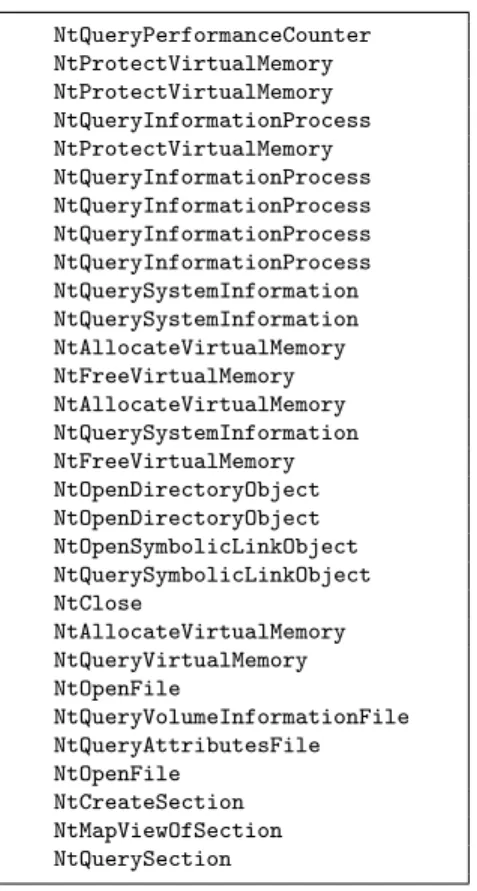
Figure 1.1: Example system call trace showing the first 30 calls made by a web browser process
processor cores, and type and intensity of computational load. On the hosts used in this study, the rate at which system calls are made ranged from hundreds of system calls per second to hundreds of thousands of system calls per second.
Another advantage to using system call tracing for malware detection is that system call traces can be collected in real-time on production hosts. By logging only a subset of the data – e.g., by ignoring input arguments, ignoring returned data, sampling the data, or aggregating the data – the memory, processing, and storage overhead required for system call tracing can be tuned to enable live data collection and processing.
Figure 1.1 shows an example system call trace in the format used for this study. It is a process-level trace of a web browser, beginning when the web browser process was created. It shows the system calls made by the web browser process in the order in which the corresponding system call enter events were observed. Only the first thirty system calls of the trace are presented for brevity.
This system call format is advantageous because the sequence of system calls depicted in Figure 1.1 can be concisely encoded and stored for later analysis. Such system call traces can be collected at multiple different levels, including the host, application, process, and thread levels.
1.4
Detecting and classifying unknown malware samples
Section 1.1.4 identified two types of malware against which traditional defenses struggle, i.e., new malware samples and new variants of existing malware samples. Such malware are typically free to perform their malicious tasks until they are discovered. Even if the security vulnerabilities or lapses that led to the infection are corrected, or the processes where the infection originated are terminated, the malware samples typically have already gained privileged access to the host and will remain active. Such samples are discovered by users or administrators who observe abnormal behavior that can be attributed to the malware infection. The discovery of such malware infections is not straightforward, as many malware samples are designed to hide their presence.
Historically, malware infections were identifiable through obvious indicators, such as degradation of system performance, excessive network traffic, excessive hard drive access, or frequent crashes. As malware become more sophisticated and focused on stealth, characteristics traditionally associated with malware infection have become less pronounced. For example, three malware families – Stuxnet, Flame, and Duqu – ran undetected in production environments for over a year before they were discovered [13, 40–42]. Such malware samples serve as motivating examples for this study.
The goal of this study is to establish a set of techniques for identifying malicious processes, especially those resulting from the execution of new malware samples and malware variants that evade traditional defenses. Furthermore, the goal is to detect such infections as quickly as possible, to limit the adverse effects of the malware. The three primary components of this thesis are the study of the problems of feature extraction, malware detection, and malware classification.
Feature extraction
The objective of feature extraction is to identify a set of features that can be extracted from system call traces and that satisfy the criteria described in Section 1.2. The extraction of the selected
features must be simple enough that it can be performed in real-time on production hosts. This study uses frequency information about localized patterns of system calls as its primary feature set. The data are extracted using information retrieval techniques inspired by document classification. This study also seeks to identify the smallest set of features to use for detection. Using the smallest possible set of features serves to reduce the memory and computational overhead of the system and to avoid the adverse effects of detector and classifier overfitting.
Malware detection
The objective of malware detection is to establish a set of techniques for detecting malware exe-cution in real-time on production hosts. This work compares the empirical detection performance of signature-based and statistical anomaly-based detection techniques that are ‘lightweight’ enough to be used in production environments. The techniques are evaluated against system call traces collected from production environments and from the execution of recently discovered malware sam-ples. Emphasis is placed on characterizing detector performance at very low FPRs and on performing detection as quickly as possible using sequential detection techniques.
Malware classification
The goal of the malware classification is to establish a set of techniques to classify new malware samples based on their behavioral similarity to known malware. Classification results provide insight into the damage caused by detected malware samples and possible paths for mitigation. The focus of this study is on classification techniques that use the same behavioral features as the detector. The techniques studied in this thesis can be applied to classify malware samples immediately as they are detected, without requiring any additional data collection.
1.5
The importance of empirical evaluation
To be useful in production environments, a malware detection system must exhibit a high detection rate at an acceptably low FPR [32]. Furthermore, detection performance must be quantified in environments representative of those in which the system is likely to be deployed, or preferably quantified using data collected from the target environments [43].
The requirement to evaluate proposed detection and classification results in representative en-vironments precludes the use of specialized sandbox enen-vironments. Sandbox enen-vironments provide detailed information about software execution, including filesystem, registry, process, and system call activity [44]. However, sandbox environments typically limit execution paths and provide a limited view of software function [45]. Thus, data collected from such environments are typically not representative of data collected from production environments.
A major component of this thesis is the empirical evaluation and comparison of the described feature extraction, malware detection, and malware classification techniques. This study used a custom host-agent to collect system call traces from production hosts running 32-bit and 64-bit versions of Windows 7 and 8, and Windows Server 2008 (R2) and 2012 (R2). A custom malware testbed was used to inject recently discovered malware samples onto live hosts. The empirical evaluation considered more than 55,000 malware samples first discovered between January 2012 and March 2015 and 4 million system call traces collected from 43 hosts. In total, more than 1,000 host-days of data collected between October 2014 and March 2015 were used for the experimental evaluation of the described techniques.
1.6
Research contributions and thesis outline
The preceding sections introduced three key challenges in behavioral malware detection and classi-fication, including
• feature extraction from system call traces,
• rapid detection of malicious processes at a low FPR, and
• classification of detected malware using only the features available at detection time.
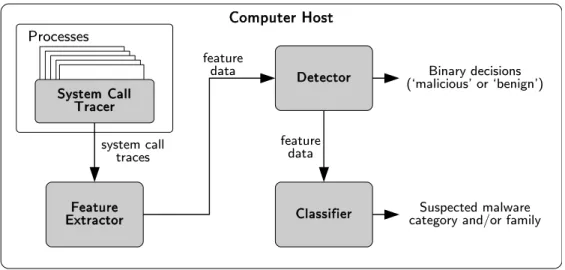
The remaining chapters of this thesis address these three challenges, describing a system for detecting the execution of malicious processes on production computer hosts. The system, depicted in the block diagram in Figure 1.2, uses a custom host-agent to track the system call traces of every process executing on a host. From the traces, it extracts numerical feature data that are used by the detector to provide binary decisions indicating whether a process is benign or malicious. If Chapter 1: Introduction 1.6 Research contributions and thesis outline
Computer Host Processes Feature Extractor Detector Classifier system call traces feature data feature data System Call Tracer Binary decisions (`malicious' or `benign') Suspected malware category and/or family
Figure 1.2: Block diagram of malware detection and classification system
the detector identifies suspected malware, the classifier determines the most likely category and/or family to which the malware belong. The specific configuration of the system is determined through experimental evaluation of multiple feature extraction, detection, and classification strategies.
The primary differences between this work and the related literature are presented in Chapter 2. Chapter 3 describes the design and deployment of the data collection host-agent. Chapter 4 provides a detailed overview of the feature extraction process. Chapter 5 examines the performance afforded by four detection techniques. Sequential detection techniques are also explored to provide a continuous monitoring scheme for malware detection and to provide more rapid detection results than are afforded by fixed sample-size tests. Through experimental evaluation, the feature extraction strategies, detection algorithms, and sequential detection strategies that provide the best detection performance are identified. The selected strategies are used in a case study to test the detection system’s performance against an independent data set collected from public computer laboratories. Chapter 6 describes five classification strategies for identifying the category and family of detected malware samples based on their behavioral similarity to known malware. It compares the accuracy of the classifiers using 27 ground truth labeling schemes derived from AV labels. Chapter 7 concludes with a summary and discussion of the experimental results, the resulting design of a behavioral malware detection and classification system, and the implications of this study.
Chapter 2: Related Work
This chapter presents a review of the related work in malware detection and classification, with a focus on behavioral analysis techniques developed to address the shortcomings of traditional defenses. Additional related work can be found in surveys by Idika and Mathur [46], and by Egele, Scholte, Kirda, and Kruegel [44]. A detailed discussion and comparison of commercial antivirus (AV) software can be found in a survey by Sukwong, Kim, and Hoe [29].
2.1
Malware detection
The related work in malware detection seeks to identify techniques that are more robust than existing byte signature and heuristic techniques popular among AV software. The proposed techniques include static analysis techniques, in which features are extracted from static files, and dynamic analysis techniques, in which features are extracted from executing software.
2.1.1
Static analysis techniques
Static analysis techniques use features of static files to identify potential malware. Early work in static analysis focused on byte code analysis, using data mining and machine learning instead of tra-ditional signature generation techniques [47]. Entropy-based byte code analysis techniques have also been proposed to detect packed, encrypted, or embedded malware [48]. Other useful static features include the strings, file headers, imported libraries, and calls to external application programming interface (API) functions present in a static executable file [49–51]. Even the approximate authorship dates of the functions composing a program are useful features for malware detection [52].
Control flow information is also useful for malware detection. For example, formal semantics can be used to describe common malicious behaviors in terms of their control flow, and the resulting models can be used to detect semantically equivalent code [53, 54]. Other approaches use control flow information to detect computer worms [55], web browser spyware [56], and metamorphic mal-ware [57–59]. However, techniques for detecting semantically equivalent code have demonstrated to
be effective only against specific obfuscations [60]. Furthermore, static analysis techniques relying on relatively high-level features – such as control flow graphs – are limited by the difficulty of ex-tracting the required information. Such techniques typically require malware first be unpacked and disassembled [61]. Unfortunately, malware are often encrypted, compressed, or otherwise designed specifically to complicate such analyses [36].
2.1.2
Dynamic analysis techniques
Dynamic analysis techniques have been widely studied as a means of addressing the shortcomings of static analysis techniques. One such technique, taint analysis, identifies malicious behaviors by tracking information flow [45, 62–66]. Taint analysis is particularly useful for identifying privacy-breaching malware. It works by monitoring access to sensitive data and identifying potentially malicious use of such data. However, its computational overhead, high false positive rate (FPR), and vulnerability to relatively simple countermeasures limit its practical applicability [37, 67].
Other dynamic analysis techniques use data collected from hardware performance counters, which provide information about processor usage, such as cache misses and branch predictions [68, 69]. Software performance monitors, such as those that report CPU, memory, network, and application-specific resource usage information, are also useful features for malware detection [70–72]. Sensors specific to the Java Virtual Machine have also been used to detect the execution of malicious Java code [73]. Other techniques mine audit data [74] or monitor registry and filesystem operations [75] for indicators of malware infections.
2.1.3
System call analysis
System call traces (described in Section 1.3) have been a popular source of information for dynamic malware detection. The use of system call traces for malware detection originated in intrusion detec-tion, where abnormal system call sequences were flagged as evidence of potential intrusions [22, 39]. System call-based malware detection has been approached using both signature-based and statisti-cal techniques. Signature-based techniques seek to identify system statisti-call patterns unique to malware samples, while statistical techniques seek models to describe benign and malicious behaviors.
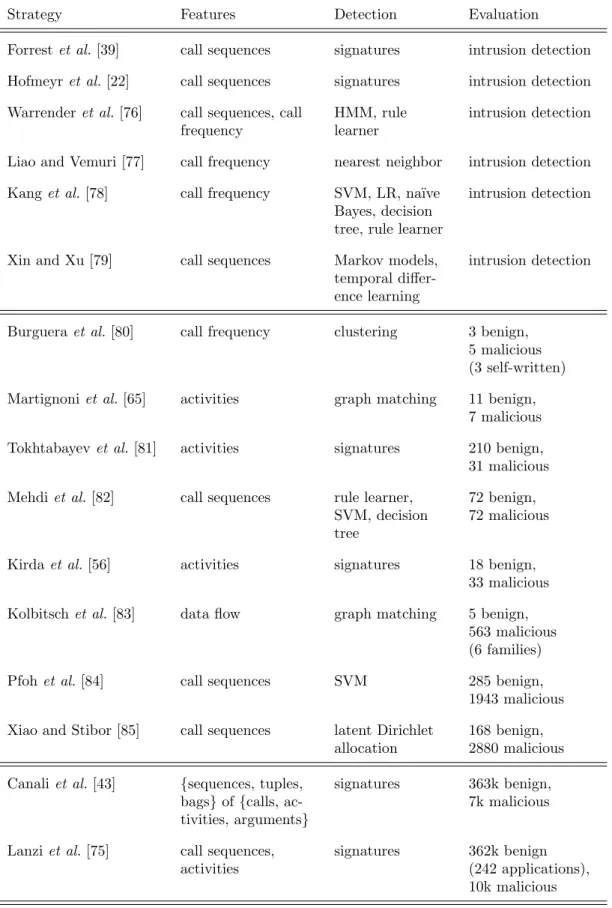
Table 2.1: Summary of related work in system call-based malware detection
Strategy Features Detection Evaluation
Forrestet al.[39] call sequences signatures intrusion detection Hofmeyret al.[22] call sequences signatures intrusion detection Warrenderet al.[76] call sequences, call
frequency
HMM, rule learner
intrusion detection
Liao and Vemuri [77] call frequency nearest neighbor intrusion detection Kanget al.[78] call frequency SVM, LR, na¨ıve
Bayes, decision tree, rule learner
intrusion detection
Xin and Xu [79] call sequences Markov models, temporal differ-ence learning
intrusion detection
Burguera et al.[80] call frequency clustering 3 benign, 5 malicious (3 self-written) Martignoniet al.[65] activities graph matching 11 benign,
7 malicious Tokhtabayev et al.[81] activities signatures 210 benign, 31 malicious Mehdiet al.[82] call sequences rule learner,
SVM, decision tree
72 benign, 72 malicious
Kirda et al.[56] activities signatures 18 benign, 33 malicious Kolbitschet al.[83] data flow graph matching 5 benign,
563 malicious (6 families)
Pfohet al.[84] call sequences SVM 285 benign,
1943 malicious Xiao and Stibor [85] call sequences latent Dirichlet
allocation
168 benign, 2880 malicious Canali et al.[43] {sequences, tuples,
bags}of{calls, ac-tivities, arguments}
signatures 363k benign, 7k malicious
Lanziet al.[75] call sequences, activities
signatures 362k benign (242 applications), 10k malicious
A summary of the related work in system call analysis for malware detection is provided in Table 2.1. The table presents the primary feature sets and detection algorithms used in each study, along with a concise summary of the data used for experimental evaluation. The majority of the works use system call sequences and frequencies as feature sets. Others argue system calls to be too low-level, instead considering high-level activities extracted from system call traces. Such activities included filesystem and registry changes, library interactions, and process creation and deletion events. For detection, signature-based approaches are popular due to their white-box models and low computational complexity during detection. Other approaches include the use of machine learning and graph matching algorithms. Graph matching algorithms are used to compare the control flow or data flow of a program to models of known benign and malicious behaviors. Such techniques are intended to address the shortcomings of signature-based techniques, namely that they do not generalize well to detecting unknown malware.
The approaches presented in Table 2.1 are partitioned into three groups, indicated by the hori-zontal lines in the table. The studies in the first group [22, 39, 76–79] use system call trace data for intrusion detection. These studies focus primarily on system call sequences and system call frequen-cies as feature sets, using machine learning algorithms for detection. The techniques are evaluated against system call traces of a small collection of Unix program, obtained under normal operating conditions and during suspected intrusions.
The studies in the second group [56, 65, 80–85] use system call trace data for malware detection. Like the intrusion detection work in the first group, a subset of these techniques use system call sequences and frequencies for detection. Other feature sets derived from system call traces are also considered, including models of malicious and benign activities [56], and data flow among system calls [83]. The table indicates the quantity of benign and malicious software samples used for the experimental evaluation of these techniques.
The studies in the third group [43, 75] also use system call trade data for malware detection. The two studies in this group are set apart by their experimental evaluation. Whereas the studies in the second group consider only a few malware samples or benign programs, the studies in the third group
consider thousands of malware samples and hundreds of thousands of traces of benign programs from multiple hosts. Lanzi et al. [75] use system call signatures for detection, concluding that such an approach is inadequate for malware detection. Instead, they present a system-centric approach that uses models of filesystem and registry activities for detection. Canaliet al.[43] take a signature-based approach, using system calls, their arguments, and derived activities for malware detection. The authors explore the use of contiguous sequences (sequences), non-contiguous sequences (tuples), and unordered occurrences (bags) of calls and activities for detection. The results of this work indicate that there is no closed form expression to describe the effects of model selectivity or specificity on detection accuracy, underscoring the importance of experimental evaluation.
2.2
Malware classification
Malware classification is the process of determining to which class a particular malware sample be-longs. Classes can be malware categories, families, subfamilies, or any other malware groupings. Automatic classification can help guide malware analysis by providing information about the ori-gin, authorship, or function of a malware sample. In live environments, classification is useful for determining appropriate mitigation strategies and guiding post-mortem analysis. A large portion of related work in malware classification focuses primarily on systems designed for off-line analysis. Such work is motivated in part by the need to expedite the analysis of and signature creation for newly discovered malware samples. The related work in malware classification includes both static and dynamic analysis techniques.
2.2.1
Static analysis techniques
The feature sets used for static classification mirror those used in static detection, including • strings, byte sequences, and program structure [47, 86, 87];
• API imports, calls, and call sequences [88]; and
• control flow information [89–91].
The classification algorithms used for static malware classification are primarily machine learning techniques. Commonly used classification algorithms include
• na¨ıve Bayes, decision trees, and support vector machines (SVMs) [47, 87];
• image classification techniques [86];
• hierarchical clustering analysis [88]; and
• graph matching and clustering algorithms [89–91].
2.2.2
Dynamic analysis techniques
Dynamic classification techniques typically require malware samples be executed in a specialized analysis environment. Such environments, including Anubis [92] and cwsandbox [93], provide reports that include information about loaded libraries and other resources; file and registry activities (files and keys created, read, written, and deleted); memory activities (regions read and written); and system call traces. Nearest neighbor techniques have been used to classify malware based on such reports [93–95], with one study focusing on the problem of determining the best distance measure to assess similarity [96]. Alternate machine learning algorithms have also been explored, including na¨ıve Bayes, SVM, decision trees, and neural networks [95]. Hierarchical clustering analysis based on file, registry, and process activity have also demonstrated promise [6]. Techniques have been described for classifying specific subsets of malware, including malware that communicate over a network [97, 98] and certain rootkits that use API hooks [99].
As with malware detection, a subset of the classification techniques also focus primarily on system call analysis. For example, system call traces extracted using cwsandbox and nearest neighbor techniques have demonstrated success in classifying malware [100, 101]. Other techniques have used activities derived from system call traces and clustering algorithms to perform classification [102].
Two recent studies combined static and dynamic analysis techniques for malware classification. Neugschwandtner et al. [26] use static analysis based on a variety of features – including byte sequences, program structure, program headers, and AV labels – to cluster malware according to predicted behaviors. Then, they use dynamic analysis to analyze malware behaviors and generate
mitigation procedures. Anderson et al. [103] use SVMs and multiple static and dynamic data sources – including byte sequences, op-codes, control flow graphs, instruction traces, and system call sequences – for classification. These two studies leverage the strengths of static analysis (ease of feature extraction) and dynamic analysis (richness of datasets) to perform malware classification.
2.3
Novelty of this thesis
This chapter explored the related work in malware analysis, describing feature sets and algorithms used for malware detection and classification. Despite their differences, these techniques all exhibited promising empirical accuracy against their respective datasets. This thesis seeks to address two perceived shortcomings of the related work. First, the related work contains conflicting claims regarding the effectiveness of feature sets, detection, and classification techniques. Second, the related work lacks a study of detector performance at very low FPRs. This thesis also contributes the design of an online detection system for malicious processes, a study of sequential detection techniques for rapid malware detection, an extensive experimental evaluation, and the design of an online classification system for malicious processes.
2.3.1
Addressing conflicting claims
Published results in malware detection contain conflicting claims. For example, signatures of system call sequences have been declared both effective [39, 101] and ineffective [6, 75] for detecting malware. Similarly, system call frequencies [78, 80] have been found effective for malware detection, while other works advocate for more complex feature sets [79, 85]. These conflicting claims are at least partially rooted in the use of different datasets for evaluation. Accordingly, this study compares the usefulness of different types of features, including system call frequencies, ordered sequences of system calls, and unordered tuples of system calls. This study also compares signature-based techniques and statistical machine learning techniques for malware detection and classification. The techniques are evaluated against a single set of system call traces collected from live computer hosts and recent malware samples to ensure fair comparisons.
2.3.2
Detector performance at low FPRs
For malware detectors to be practically useful, they must demonstrate high detection rates at very low FPRs [32]. For the majority of the related work, few claims regarding detection accuracy at very low FPRs or the general applicatbility of the proposed technuques can be made. This is due to the relatively small sample sizes considered for experimental evaluation. The two exceptional cases in the related work were from Canaliet al.[43] and Lanziet al. [75], who used in excess of 100,000 benign traces in their evaluation. Canali et al. [43] provided a characterization of detection rate at a FPR of 10−2, and characterized certain models at lower FPRs (∼ 10−3). The experimental evaluation presented in this thesis focuses on the detection accuracy achieved at a FPR of 10−5.
2.3.3
Online detection
The goal of this study is to detect and classify the malware that evade traditional defenses and execute on production hosts. Particularly, this study focuses on techniques that are ‘lightweight’ enough to be deployed online in production environments. In this way, this study is similar to related work in intrusion detection (see Section 2.1.3), but with a singular focus on malware detection. This work intends to identify techniques for malware detection that will be useful in identifying other types of intrusions as well.
2.3.4
Sequential detection
A major concern in online malware detection is detecting malware quickly enough to mitigate their damaging effects. To address this concern, this thesis studies the application of sequential detection techniques to malware detection. A subset of the related work applies sequential detection tech-niques to network data for the detection of worms and other network-based attacks [25, 104–106] and for the detection of multi-stage cyberattacks [79]. In contrast, this work focuses on the appli-cation of sequential detection techniques at the process level. Here, processes undergo continuous monitoring, wherein successive detector outputs are combined to provide accurate detection results while minimizing the delay between infection and detection.
2.3.5
Experimental evaluation
In the related work, the source of the system call traces used for experimental evaluation varied. A common theme was the use of malware traces collected from specialized analysis environments. Such sandbox environments limit execution paths, thereby offering a limited view of software func-tionality [45]. Sandbox environments typically track only a fraction of the system calls available in recent versions of Microsoft Windows. Another common theme was the use of benign process traces collected using API hooking and system service descriptor table (SSDT) hooking in Microsoft Windows XP [43, 75, 84, 85].
In contrast, this thesis focuses exclusively on system call traces obtained from live production hosts. This includes the execution of recently discovered malware samples on live hosts configured like those found in production environments. Executing malware on live hosts enables the malware to behave more closely to how they would in a real-world environment. Furthermore, doing so reduces the risk of biasing results by using traces collected from different environments. This thesis studies the problem of malware detection in recent versions of Windows, including Windows 7, 8, Server 2008 (R2), and Server 2012 (R2). The techniques used for system call tracing in this study are more robust than the techniques of API hooking and SSDT hooking used in the related work.
2.3.6
Online classification
The related work in behavioral malware detection focused primarily on classification of malware based on rich feature sets extracted using specialized environments. This study seeks to use a more limited dataset, namely only those system call features used by the described malware detector. The classifier uses the information already available when malware samples are detected on production hosts to provide immediate classification results. The motivation for online classification is to provide information for mitigation and postmortem analysis. Prior information about similar threats can be used to suggest possible mitigations, and classification results can be used to guide the use of more rigorous static and dynamic analysis tools. Thus, the goal of this study is not to outperform more rigorous techniques, but rather to achieve comparable classification accuracy in production environments with a more limited feature set.
Chapter 3: Experimental Setup
Experimental evaluation is essential for determining the effectiveness of malware detection and classification systems [32, 43]. To evaluate the effectiveness of the techniques studied in this thesis, system call traces were collected from benign and malicious software samples over a six-month period. The traces were collected in home, research laboratory, and public computer laboratory settings, and on a custom testbed, where recently discovered malware samples were executed. To collect the traces, a custom host agent known as the System Call Service (SCS) was created. The main benefits of the SCS are that it is low-overhead, transparent to the user, and can be deployed on any host running a recent version of Microsoft Windows. This chapter describes the design and function of the SCS. It also describes the datasets collected using the SCS, which are used to evaluate the feature extraction, malware detection, and malware classification techniques described in Chapters 4-6.
3.1
System Call Service (SCS)
The SCS was created for two reasons. First, the specialized analysis tools used in the related work to collect system calls offer a limited view of software functionality and exhibit high enough overhead to preclude their usefulness in production environments. Second, alternative techniques used in the related work rely primarily on application programming interface (API) hooking or system service descriptor table (SSDT) hooking. The former technique requires the modification of running software to intercept function calls, while the latter requires the overwriting of a kernel data structure to intercept system calls. Both techniques affect the stability and reliability of the systems on which they are deployed, and their usefulness is limited in recent versions of Windows. In contrast to traditional system call analysis tools, the SCS
• uses built-in kernel logging functions available in recent versions of Windows;
• monitors access to every system call that is part of the core operating system (OS) kernel;
User Mode Kernel Mode
Applications Services
Windows API
System call interface
OS kernel ETW
System Call Service (SCS)
Device drivers
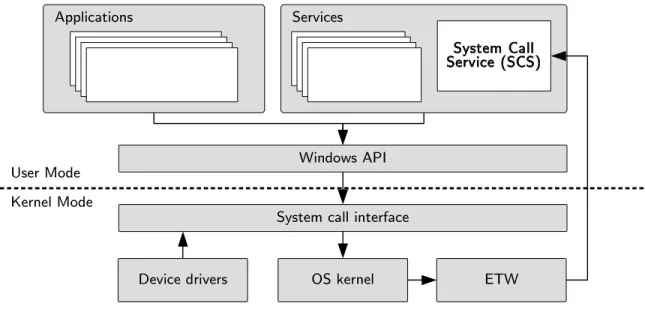
Figure 3.1: System Call Service (SCS) block diagram, showing how system calls originating from all processes, including applications, services and drivers, are captured by the SCS using the Event Tracing for Windows (ETW) framework
• exhibits low enough computational and memory overhead for deployment in production envi-ronments.
The block diagram presented in Figure 3.1 illustrates the function of the SCS. The arrows indicate the flow of system calls from applications, services, and drivers to the SCS where they are logged. System calls are made in user-mode by applications and services through the Windows API and in kernel-mode by device drivers and other code running at the kernel-level. The system calls are handled by the system call interface, and the functions requested by the system calls are executed by the OS kernel. The Windows kernel contains built-in kernel tracing functions provided by the Event Tracing for Windows (ETW) framework. The SCS runs as a service application on the monitored host.
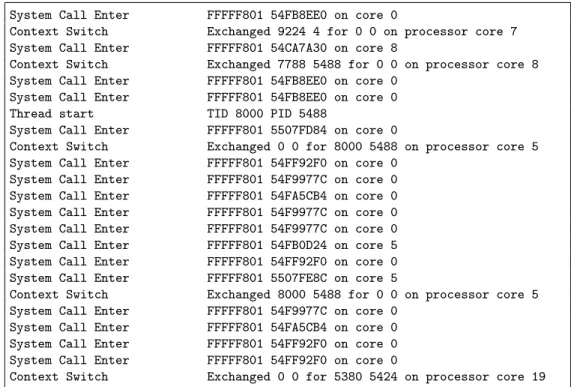
The ETW framework is an event-driven framework. The events reported by the kernel tracer include process creation and deletion, thread creation and deletion, system call enters and exits, and context switches. The SCS tracks all of these events to attribute each system call to the process and thread from which it originated. An example of the kernel tracer events and their metadata is provided in Figure 3.2, which shows all of the system call enter, context switch, and thread start Chapter 3: Experimental Setup 3.1 System Call Service (SCS)
System Call Enter FFFFF801 54FB8EE0 on core 0
Context Switch Exchanged 9224 4 for 0 0 on processor core 7 System Call Enter FFFFF801 54CA7A30 on core 8
Context Switch Exchanged 7788 5488 for 0 0 on processor core 8 System Call Enter FFFFF801 54FB8EE0 on core 0
System Call Enter FFFFF801 54FB8EE0 on core 0 Thread start TID 8000 PID 5488
System Call Enter FFFFF801 5507FD84 on core 0
Context Switch Exchanged 0 0 for 8000 5488 on processor core 5 System Call Enter FFFFF801 54FF92F0 on core 0
System Call Enter FFFFF801 54F9977C on core 0 System Call Enter FFFFF801 54FA5CB4 on core 0 System Call Enter FFFFF801 54F9977C on core 0 System Call Enter FFFFF801 54F9977C on core 0 System Call Enter FFFFF801 54FB0D24 on core 5 System Call Enter FFFFF801 54FF92F0 on core 0 System Call Enter FFFFF801 5507F