
Scalable Approximate Bayesian Inference for Outlier
Detection under Informative Sampling
Terrance D. Savitsky [email protected]
U. S. Bureau of Labor Statistics
Office of Survey Methods Research
Washington, DC 20212, USA
Editor: Kevin Murphy
Abstract
Key words: survey sampling, hierarchical dirichlet process, clustering, bayesian
1. Introduction
1.1 Outlier Detection and Informative Sampling
The U.S. Bureau of Labor Statistics (BLS) administers the Current Employment Statistics
(CES) survey to over 350000 non-farm, public and private business establishments across
the U.S. on a monthly basis, receiving approximately 270000 submitted responses in each
month. Estimated total employment is published for local, state and national geographies
in the U.S., as well as for domains defined by establishment size and industry categories
within each geography. The BLS conducts a quality check to discover and correct
es-tablishment submission errors, particularly among those eses-tablishments whose entries are
influential in the overall published domain-level estimates. Of the 270000 submissions,
approximately 100000−150000 of those include employment changes from the prior to the
current submission month. The CES maintains a short lag time of approximately 7 days
between receipt of establishment submissions at the end of a month and subsequent
publi-cation of employment estimates for that month, such that investigations of submission data
quality must be done quickly. The relatively large number of submissions with non-zero
changes in employment levels, coupled with the rapid publication schedule, require use of
quick-executing, automated data analysis tools that output a relatively small, outlying set
of the submissions for further investigation and correction by BLS analysts.
The CES survey utilizes a stratified sampling design with strata constructed by
combi-nations of state, broad industry grouping, and employment size (divided into 8 categories).
Business establishments are sampled by their unique unemployment insurance (UI) tax
identification numbers, which may contain a cluster of multiple individual sites. If a
busi-ness establishment is selected for inclusion at the UI level, all of the associated sites in
that cluster are also included. Stratum-indexed inclusion probabilities are set to be
done because larger establishments compose a higher percentage of the published
employ-ment statistics. The correlation between establishemploy-ment employemploy-ment levels and inclusion
probabilities induces informativeness into the sampling design, meaning that the
probabil-ities of inclusion are correlated with the response variable of interest. The distribution for
the resulting observed sample will be different from that for the population (because the
sample emphasizes relatively larger establishments), such that inference made (e.g. about
outliers) with the former distribution will be biased for the latter.
1.2 Methodologies for Outlier Detection
The Dirichlet process (DP) (Blackwell and MacQueen 1973) and more generally, species
sampling formulations (Ishwaran and James 2003), induce a prior over partitions due to
their almost surely discrete construction. Convolving a discrete distribution under a DP
prior with a continuous likelihood in a mixture formulation is increasingly used for outlier
detection (Quintana and Iglesias 2003), where one supposes that each observation is realized
from one of multiple generation processes (Shotwell and Slate 2011). Each cluster collects
an ellipse cloud of observations that are centered on the cluster mean.
In this article, we improve and extend sequential, penalized partition (clustering)
algo-rithms of Kulis and Jordan (2011); Broderick et al. (2012), that each approximately
esti-mate a maximum a posteriori (MAP) partition and associated cluster centers or means, to
account for data acquired under an informative sampling design under which the
distribu-tion for the observed sample is different from that for the populadistribu-tion (Bonnry et al. 2012).
We incorporate first order sampling weights into our model for partitions that “undo” the
sampling design so that our application nominates outliers with respect to the population
generating (mixture) distribution. The algorithm of Kulis and Jordan (2011) is of a class of
an approximation for the MAP from a mixture of DPs posterior distribution (where the
(unknown) mixing measure over the parameters that define the data likelihood is drawn
from a DP).
We follow Kulis and Jordan (2011) and straightforwardly extend our formulation from
a DP prior imposed on the mixing distribution to a hierachical Dirichlet process (HDP)
prior (Teh et al. 2006), which allows our estimation of a distinct “local” partition (set of
clusters) for each subset of establishments in the CES binned to one of J = 24 industry
groupings. The local clusters of the industry-indexed partitions may share cluster centers
(means) from a global clustering partition. The hierarchical construction of local clusters
that draw from or share global cluster means permits the estimation of a dependence
structure among the local partitions and encourages a parsimonious discovery of global
clusters as compared to running separate global clustering models on each industry group.
We refer to this model as hierarchical clustering.
We apply our (sampling-weighted) global and hierarchical clustering models, derived
from the MAP approximations, for the nomination of outliers based on identification of
the subset of clusters that together collect relatively few observations (with “few” defined
heuristically). Quintana and Iglesias (2003) implement a mixture of DPs, for the purpose of
outlier detection, where a partition is sampled at each step of an MCMC under an algorithm
that minimizes a loss function. The loss function penalizes the size of the partition (or total
number of clusters discovered), which will tend to assign most observations into relatively
few clusters, while only a small number of observations will lie outside these clusters, a
useful feature for outlier detection. We extend small variance asymptotic result of Broderick
et al. (2012) for our global and hierarchical clustering formulations to produce objective
functions that penalize the number of estimated clusters. We further devise a new “merge”
Both the penalized likelihood and the merge step encourage parsimony in the number of
clusters discovered.
We next derive our sampling-weighted global and hierarchical clustering algorithms in
Section 2, followed by a simulation study that demonstrates the importance of correcting
estimation for an informative sampling design for outlier detection in Section 3. The
simulation study also demonstrates the efficacy of outlier detection performance for the
sampling-weighted hierarchical formulation estimated on synthetic data generated in a
nested fashion that is similar to the structure of CES survey data. We apply the
sampling-weighted hierarchical algorithm to discover local, by-industry partitions and to nominate
observations for outliers for our CES survey application in Section 4. We conclude the
paper with a discussion in Section 5.
2. Estimation of Partitions from Asymptotic Non-parametric Mixtures
We begin by specifying a Dirichlet process mixtures of Gaussians model to which we apply
small variance asymptotics to derive a penalized K− means optimization expression and
an associated fast-computing estimation algorithm. We include the sampling weights in
our mixture formulation that asymptotically corrects for an informative sampling design
(Savitsky and Toth 2015). We continue and extend this MAP approximation approach
to a hierarchical Dirichlet process mixtures of Gaussians model to a achieve a hard, point
estimate sampling-weighted hierarchical clustering algorithm that permits specification of
a set of local, industry indexed, clusters linked to a common set of global clusters.
We implement both algorithms we present, below, in the growclusters package for
2.1 Asymptotic Sampling-weighted Mixtures of Dirichlet Processes
We specify a probability model for a mixture of Kmax allowed components to introduce
Bayesian estimation of partitions of observations into clusters and the associated cluster
centers. The mixtures of DPs will be achieved in the limit of this probability model as
Kmax increases to infinity.
d×1
xi |si,M= (µ1, . . . ,µKmax)
0
, σ2,w˜i ind∼ Nd µsi, σ
2
Id
w˜i
(1a)
si|τ iid
∼ M(1, τ1, . . . , τKmax) (1b)
µp|G0 iid
∼G0 :=Nd 0, ρ2Id
(1c)
τ1, . . . , τKmax ∼ D(α/Kmax, . . . , α/Kmax), (1d)
for i = 1, . . . , n sample establishments and p = 1, . . . , Kmax allowable clusters. Each
cluster candidate, p, indexes a unique value for the associated cluster center, µp. The set
of cluster assignments of observations together compose a partition of observations, where
partitions are indexed by s= (s1, . . . , sn), for si ∈(1, . . . , K). The prior distributions for
the cluster centers and assignments induce a random distribution prior, G, for drawing a
mean value for eachxi fori= 1, . . . , n, by sampling unique values in the support ofGfrom
G0 and assigning the mean value (that we interpret as a cluster) for each observation by
drawing from the set of unique values with probabilities, τ, which are, in turn, randomly
drawn from a Dirichlet distribution. As Kmax ↑ ∞ in Equation 1d, such that number of
possible clusters are countably infinite, this construction converges to a (non-parametric)
mixture of Dirichlet processes (Neal 2000). We also note that α influences the number of
clusters discovered. For any givenKmax, larger values forα will produce draws forτ that
assign larger probabilities to more of the p∈(1, . . . , Kmax) clusters, such that it is highly
The likelihood contribution for each observation, i∈(1, . . . , n), in Equation 1a is
up-lifted by a sampling weight, ˜wi =n×wi/Pin=1wiforwi ∝1/πi, constructed to be inversely
proportional to the known inclusion probability in the sample. This formulation for the
sampling weight assigns importance for that observation likelihood based on the amount
of information in the finite population represented by that observation. The weights sum
to the sample size,n, so that an observation with a low inclusion probability in the sample
will have a weight greater than 1, meaning that it “represents” more than a single unit in
a re-balanced sample. The weighting serves to “undo” the sampling design by re-balancing
the information in the observed sample to approximate that in the population. The sum
of the weights directly impacts the estimation of posterior uncertainty such that the
sum-mation tonexpresses the asymptotic amount of information in the observed sample. This
construction is known as a “pseudo” likelihood because the distribution for the population
is approximated by weighting each observation back to the population. Savitsky and Toth
(2015) provide three conditions that define a class of sampling designs under which the
pseudo posterior (defined from the pseudo likelihood) is guaranteed to contract in L1 on
the unknown true generating distribution, P0. The first condition states that the
inclu-sion probability, πi, for each unit in the finite population,i∈(1, . . . , N), must be strictly
greater than 0. This condition ensures that no portion of the population may be
system-atically excluded from the sample. The second condition on the sampling design requires
the second order inclusion dependence for any two units, i, j ∈ (1, . . . , N), be globally
bounded from above by a constant; for example, a two-stage design in which units within
selected clusters are sampled without replacement is within this class to the extent that
the number of population units within each cluster asymptotically increases. The third
condition requires the sampling fraction,n/N, to converge to a constant as the population
Samples may be drawn from the joint posterior distribution under Equation 1 using
Markov chain Monte Carlo (MCMC), though the computation will not scale well with
in-creasing sample size as a partition is formed through sequential assignments of observations
to clusters (including to possibly new, unpopulated clusters) on each MCMC iteration. We,
instead, derive an optimization expression that allows for scalable approximation of the
sin-gle MAP partition by taking the limit of the joint posterior distribution as the likelihood
variance, σ2↓0.
We marginalize out τ from the joint prior, f(s,τ|α) = f(s|τ)f(τ|α), by using the
P´olya urn scheme of Blackwell and MacQueen (1973), which produces,
f(s1, . . . , sn|α) =αK
Γ (α+ 1) Γ (α+n)
K
Y
p=1
(np−1)!,
where np = Pni=11(si =p) is the number of observations (e.g. establishments) assigned
to cluster, p and K denotes the number of estimated clusters. We generally follow
Brod-erick et al. (2012) and derive our optimization expression from the joint pseudo posterior
distribution,
f(s,M|X,w˜)∝f(X,s,M|w˜) =
K
Y
p=1 Y
i:si=p
Nd xi|µp, σ2Id
w˜i
αKΓ (α+ 1) Γ (α+n)
K
Y
p=1
(np−1)!
K
Y
p=1
Nd µp|0, ρ2Id
.
(2)
Broderick et al. (2012) point out that if one limitsσ2↓0 in Equation 2, each observation will be allocated to its own cluster since the prior allows a countably infinite number of clusters.
produces α ↓ 0 as σ2 ↓ 0. This functional form for α achieves the result and avoids the degenerate outcome, where the λhyperparameter controls the size of the partition as
σ2 ↓ 0. Commonly-used approaches that also specify an approximate MAP of a mixture
of DPs also restrictα; Shotwell and Slate (2011) fix the value forαand Wang and Dunson
(2011) restrict the values of α to a discrete grid. Plugging in this expression for α into
Equation 2, and taking−1 times the logarithm of both sides results in,
−logf(X,s,M,w˜) =
K
X
p=1 X
i:si=p
O logσ2+ w˜i
2σ2kxi−µpk 2
+K λ
2σ2 +O(1)
+O(1),
(3)
where the expression in the first line derives from the log-kernel of a multivariate Gaussian
distribution and f(σ2) = O(h(σ2)) denotes that there exist constants, c1, c2 > 0, such
that |f(σ2)| ≤ c
1|h(σ2)|, for σ2 < c2. Multiplying both sides of Equation 3 by 2σ2 and
taking the limit asσ2 ↓0 results in the asymptotically equivalent sampling-weighted global clustering optimization problem,
argmin
K,s,M
K
X
p=1 X
i:si=p ˜
wikxi−µpk2+Kλ, (4)
whose solution is a MAP approximation for the sample-adjusted mixtures of DPs of
Equa-tion 1. We minimize a sampling-weighted distance in EquaEqua-tion 4, which will approximate
a MAP partition and associated cluster centers with respect to the distribution for the
population, which is our interest, rather than that for the realized sample.
Although we derive the sampling-weighted approximate MAP by letting the variance
the distribution over the space of partitions for a particular data set expresses a low or
high variance. Our purpose is to extract a hard, point estimate that computationally
scales to a large number of multivariate observations (that we employ for the purpose of
nominating outliers). To the extent that computational considerations allow, one would
obtain richer inference on both an asymptotically exact MAP of the marginal distribution
over the space of partitions and an associated measure of uncertainty by using the fully
Bayesian nonparametric mixture model.
Shotwell and Slate (2011) note that employing a MAP approximation (which selects
the partition assigned the largest approximated value for the posterior mass) implicitly
uses a 0−1 loss function. While other choices for the loss function may produce useful
results, we prefer use of the MAP approximation as we would expect concentration of the
estimated joint posterior distribution from the model of Equation 1 around the MAP due
to the large sample sizes for our CES application.
2.2 Sampling-weighted Global Clustering Algorithm
We specify an estimation algorithm for MAP approximation, below, which is guaranteed
to converge to a local optimum, since each step reduces (or doesn’t increase) the objective
function of Equation 4 and there are only a finite number of possible partitions. The
algorithm operates, sequentially, on the observations and specifies successive assignment
and cluster center estimation steps.
We introduce a new merge step, that tests all unique cluster pairs for merging and
conducts a merge of any pair of clusters if such reduces the objective function, which
reduces the sensitivity of the estimated partition to the specified values of the penalty
The observations are each weighted using the sampling weights in the computations
of distances to cluster centers and the computation of cluster centers. Observations with
higher weights contribute relatively more information to the computation of cluster centers.
We demonstrate in the simulation study to follow that this procedure produces nearly
unbiased population estimates for cluster centers, conditioned on the generation of the finite
population from disjoint clusters. Since lower-weighted observations (less representative
of the population from which they were drawn) contribute relatively less to the objective
function, the weighting will also impact the number of clustered discovered and assignment
of the multivariate observations to those clusters.
The algorithm for estimating a MAP partition and associated cluster centers is specified
with,
1. Input: n×ddata matrix,X;n×1 vector of sampling weights,w˜, for observed units and cluster penalty parameter,λ.
2. Output: K×d matrix of cluster centers, M = (µ1, . . . ,µK)
0
, and n×1 vector of cluster assignments,s, wheresi∈(1, . . . , K) for units,i= 1, . . . , n.
3. Initialize: si = 1, ∀i. d×1 cluster center, µ1 =Pin=1(xiw˜i)/Pni=1w˜i.
4. Repeat the following steps until convergence (when the decrease in energy is below
e←
K
X
p=1 X
i∈{i:si=p}
wikxi−µpk2+λK
a set threshold).
5. Assign units to clusters for each unit, i= 1, . . . , n:
(a) Compute distance,dip= ˜wikxi−µpk2 forp= 1, . . . , K.
(b) If minpdip> λ, create new cluster to which unitiis assigned; K←K+ 1, si←
K, µK←xi; elsesi ←argminpdip.
6. Re-compute centers for clusters, p = 1, . . . , K: Let Sp = {i : si = p} and µp=Pi∈Sp(xiwi)/
P
7. Assess merge of unique cluster pairs, (p∈(1, . . . , K), p0 ∈(1, . . . , K)):
(a) Perform test merge of each pair of clusters:
(b) Set matrix of cluster centers for virtual step, M∗ =M.
(c) Compose index set of observations assigned to clusters p0 or p; S∗p ={i :si =
p or si=p
0
}.
(d) Compute (weighted average) merged cluster centers,µ∗p =P
i∈S∗ pxiw˜i
/P
i∈S∗ pw˜i and set rowsp and p0 of M∗ equal to this value.
(e) Compute energy under the tested move, e∗ ← PK
p=1 P
i∈S∗ pw˜i
xi−µ∗p
2
+
λ(K−1). If e∗ < e, execute a merge ofp and p0:
(f) Re-assign units linked top0 top,si:s
i=p0 ←p.
(g) Re-set cluster labels, p ins to be contiguous after removing p0, such that p← p−1, ∀p > p0, leaving si ∈ (1, . . . , K−1). Delete row, p
0
, from M∗ and set
M←M∗.
2.3 Asymptotic Sampling-weighted Mixtures of Hierarchical Dirichlet
Processes
The CES survey is administered to establishments across a diverse group of industries
that comprise the U.S. economy. CES survey analysts examine month-over-month
report-ing changes in the average employment and production worker variables within each of
24 NAICS industry categories (outlined in Section 4 that analyzes a data set of CES
re-sponses). The by-industry focus reflects the experience that both reporting patterns and
establishment processes tend to express more similarity within than between industries.
Yet, there are also commonalities in the reporting processes and types of reporting errors
committed among the establishments due to overlapping skill sets of reporting analysts,
similarities in organization structures, as well as the use of a single BLS-suggested reporting
process.
So we want to perform separate estimations of partitions within each industry group,
use the result of Kulis and Jordan (2011) that generalizes the approximate MAP algorithm
obtained from mixtures of Dirichlet processes to mixtures of hierarchical Dirichlet processes.
The hierarchical Dirichlet process (HDP) of Teh et al. (2006) specifies a DP partition for
each industry that we refer to as a local (to industry) partition or clustering. These local
partitions draw their cluster center values from a set of “global” clusters, such that local
clusters may be connected across industry partitions by their sharing of common global
cluster centers (from a single global partition) in a hierarchical manner.
We next specify a hierarchical mixture model that will converge to a sampling-weighted
mixtures of HDPs in the limit of theallowable maximum number of global and local clusters
as a generalization of our earlier DP specification,
d×1
xji |sji,M= (µ1, . . . ,µKmax)
0
, σ2,w˜iind∼ Nd
µsj
i, σ
2
Id
w˜i
, i= 1, . . . , nj (5a)
vcj|τ iid∼ M(1, τ1, . . . , τKmax), c= 1, . . . , Lmax (5b) zji|πj ind∼ M1, π1j, . . . , πLj
max
(5c)
sji =vj
zij (5d)
µp|G0 iid
∼G0 :=Nd 0, ρ2Id
(5e)
τ1, . . . , τKmax ∼ D(α/Kmax, . . . , α/Kmax) (5f) πj1, . . . , πLj
max ∼ D(γ/Lmax, . . . , γ/Lmax), (5g)
for each industry partition, j= 1, . . . ,(J = 24), whereKmaxdenotes the allowable number
of global clusters and Lmax denotes the maximum allowable number of local clusters over
all J partitions. An nj ×ddata matrix, Xj, includes the d×1 responses, (xji), for
estab-lishments in industry, j. TheLmax×1, vector, vj, indexes the global cluster assignment
for each local cluster, c ∈ (1, . . . , L) for industry, j. The nj×1 vector, zj, assigns each
the local cluster assignment for establishment, i, in industry, j and vjc indexes the global
assignment for all of the establishments assigned to local cluster, c, in industry, j. We
may chain together the local cluster assignment for observation, i, and the global cluster
assignment for the local cluster containing i to produce the nj ×1 index, sj, that holds
the global cluster assignment for each establishment in industry, j. The vectors of
proba-bilities for local cluster assignments of establishments, πj
j=1,...,J, and for global cluster
assignments of local clusters, τ, are random probability vectors drawn from Dirichlet
dis-tributions. As before, Equation 5 converges to a sampling-weighted mixture of HDPs in
the limit to infinity ofKmax and Lmax (Teh et al. 2006).
We achieve the following optimization algorithm by following a similar asymptotic
derivation in the limit of σ2 ↓0, as earlier,
argmin
K,s,M
K
X
p=1 J
X
j=1 X
i:sji=p
˜
wjikxji −µpk2+KλK+LλL, (6)
where L =PJ
j=1Lj denotes the total number of estimated local clusters and Lj denotes
the number local clusters estimated for data set, j = 1, . . . , J. As before, K denotes the
number of estimated global clusters.
2.4 Sampling-weighted Hierarchical Clustering Algorithm
We sketch a summary overview of the MAP approximation algorithm derived from
sampling-weighted mixtures of HDPs. A more detailed, step-by-step, enumeration of the algorithm
is offered in Appendix A. As with the sampling-weighted global clustering estimation, the
algorithm will return a K ×dmatrix of global cluster centers, M, and a vector for each
industry, sj, j∈(1, . . . , J), that holds the global cluster assignments, sji ∈(1, . . . , K), for
about the local partitions of the hierarchical clustering. The estimation algorithm allows
a distinct number of local clusters,Lj, to be discovered for each industry. The number of
unique global cluster values,p∈(1, . . . , K), that are assigned across all the establishments
in industry j defines the structure - number of local clusters and establishments assigned
to each cluster - of the local partition for that industry.
The algorithm contains an assignment step to directly assign each establishment,i, in
industry, j, to a global cluster, as with the mixtures of DPs algorithm. For a new global
and local cluster to be created, however, the minimum distance to the global cluster centers
must be greater than the sum of local and global cluster penalty parameters, λL+λK.
An observation is assigned to a global cluster by first assigning it to a local cluster that
is, in turn, next assigned to that global cluster. A new local cluster will be created if an
observation in an industry is assigned to a global cluster,p, that is not currently assigned
to any local cluster for that industry. It is typical for only a subset of theK global clusters
to be used in each local partition across the J industries. To the extent that the industry
partitions share global clusters, thenK <PJ
j=1Lj, and there will be a dependence among
those partitions.
A second assignment step performs assignments to global clusters for groups of
es-tablishments in industry, j, who are assigned to the same local cluster, c. All of the
establishments in local cluster,c, in industry, j, may have their assignments changed from
global cluster, p, to global cluster, p0. This group assignment of establishments to global
clusters contrasts with only changing global cluster assignments for establishments on an
individual basis. This is a feature of the HDP and helps mitigate order dependence in
the estimation of the MAP approximation. We specify a new “shed” step (that is not
global clusters that may not be linked to any local clusters across the J industries after
this second assignment step of local-to-global clusters.
We continue to employ a merge step that tests each unique pair of global clusters for
merging. We find in runs performed on synthetic data that the merge step helps reduce
(but does not eliminate) the sensitivity (in number of clusters formed) to specifications of
(λK, λL). The number of merges increase under lower values for these penalty parameters.
If global cluster, p0, is merged intop and deleted, then so are the local clusters,c, assigned
top0 across theJ industries and establishments that were previously assigned to eachc∈c
are now re-assigned to existing local clusters linked to global cluster, p.
3. Simulation Study
We conduct a two-part Monte Carlo simulation study that assesses the effectiveness to
detect an outlying cluster with respect to the population from an informative sample,
where an outlying cluster is defined to contain a small percentage of the total number of
establishments. Both parts of the simulation study generate a synthetic finite “population”
from which repeated samples are drawn under a sampling design where the probabilities of
selecting each establishment are a function of their response values, such that we produce
informative samples. The informative samples are presented to the partition estimation
models. The first part of the simulation study compares the accuracy of outlier detection
under inclusion of sampling weights, used to correct for informativeness, versus excluding
the sampling weights (where both employ the global (hard) clustering model using the
estimation algorithm specified in Section 2.2. The sampling weights are set to a vector
of 1’s in the case that excludes sampling weights). The second part of the simulation
study compares the outlier estimation performance between the sampling-weighted global
on the other hand, for data generated from local partitions that share global cluster centers.
We first devise an approach to select the penalty parameters for our estimation models,
which determine the number of clusters discovered, that we will need for our two-part
study.
3.1 Selection of Penalty Parameters
It is difficult to find a principled way to specify the penalty parameter, λ, for the global
clustering model or (λL, λK), for the hierarchical clustering model. Their specification
is critical because these penalty parameters determine the number of discovered clusters.
Relatively larger values estimate fewer clusters. Both cross-validation and randomly
sep-arating the data into distinct training and test sets (in the case the analyst possesses a
sufficient number of observations) tends towards assignment of each observation to its own
cluster by selecting nearly 0 values for the penalty parameters as poor fit overwhelms the
penalty.
We demonstrate this tendency with a simulation study using the sampling-weighted
hierarchical clustering model. We generate a population withJ = 3 data sets, each of size
Nj = 15000, with the local partition structure in each data set composed of Lj = 5, j =
1, . . . , J clusters randomly selecting fromK = 7 global cluster centers. Establishments are
randomly assigned to theLj = 5 local clusters for each data set under a skewed distribution
of (0.6,0.25,0.1,0.025,0.025) to roughly mimic the structure we find in the CES data set
analysed in Section 4. Data observations are generated from a multivariate Gaussian,
d×1
xji ind∼ Ndµsj i
, σ2Id
centered on the local cluster mean of each observation and σ is set equal to 1.5 times the
average over the J = 3 data sets,Nj = 15000 establishments andd= 15 dimensions of the
assignment-weighted centers,Msj,1:d, the mean values of Xj.
We next take a sample of nj = 2250 from each of the J = 3 data sets under a fixed
sample size, proportional-to-size design where inclusion probabilities are set to be
propor-tional to the variances of the (d= 15)×1,{xi}, inducing informativeness. The taking of an
informative sample addresses the class of data in which we are interested and mimics our
motivating CES data application. Observations are next randomly allocated into two sets
of equal size; one used to train the model and the other to evaluate the resultant energy.
The training sample is presented to the sampling-weighted hierarchical clustering model.
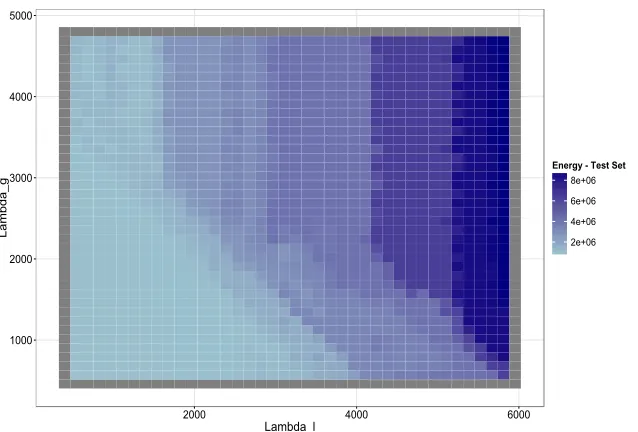
Figure 1 displays the sampling-weighted hierarchical objective function (energy) values,
evaluated on the test set, over a grid of global and local cluster penalty parameters. We
observe that the energy doesn’t reach a balanced optimum, but decreases along with values
of the penalty parameters. The rate of decrease declines for these synthetic data, possibly
suggesting the identification of an “elbow” for selecting penalty parameters, though there
is little-to-no sensitivity in the values for the global penalty parameter,λK, which prevents
precise identification of a value. The rate of decrease in energy on the CES data does not
decline, however. We see a similar result under 10−fold cross-validation.
As an alternative, we employ penalty parameter selection statistics that combine
mea-sures of cohesion within clusters and separation between clusters to select the number of
clusters. We devise a sampling-weighted version of the Calinski Harabasz (C) criterion,
sum-of-1000 2000 3000 4000 5000
2000 4000 6000
Lambda_l
Lambda_g
2e+06 4e+06 6e+06 8e+06
Energy - Test Set
Figure 1: Heat map of (energy) values under the sampling-weighted hierarchical clustering model over grid of global and local cluster penalty parameters. The vertical axis represents the global cluster penalty, λK, and the horizontal axis, the local cluster penalty, λL. The
squares (BGSS),
W GSS =
K
X
p=1 X
i:sv i=k
˜
wikxi−µpk2
BGSS =
K
X
p=1
npkµp−µGk2,
wheresv = s1, . . . ,sJ 0
stacks the set ofJ,{sJ}into a vector, which retains information on
the local partitions (based on the co-clustering relationships). The weighted total number
of establishments linked to each cluster, p ∈ (1, . . . , K) is denoted by np = Pi:si=pw˜i
and µG =
Pn
i=1w˜ixi
Pn
i=1w˜i . The C criterion is then formed as, C =
n−K K−1
BGSS
W GSS, where K is
determined by the number of unique values in sv, which is equal to the number of rows
in the K×d, M=µ01, . . . ,µ0K(and ddenotes the dimension of each observation, xi).
1000 2000 3000 4000
1000 2000 3000 4000 5000
Lambda_l
Lambda_g 4000
8000 12000 Calinski_Harabasz
Figure 2: Heat map of Calinski Harabasz (C) index values under the mixtures of HDP model over grid of global and local cluster penalty parameters. The vertical axis represents the global cluster penalty, λK, and the horizontal axis, the local cluster penalty, λL. The
Our proposed procedure estimates a clustering on the sampled data over a grid of (local,
global) penalty parameter values, where we compute the C statistic for each (λL, λK) in the
grid, selecting that clustering which maximizes the C statistic. (Ourgrowclusterspackage uses the farthest-first algorithm to convert user-specified minimum and maximum number
of global and local clusters to the associated penalty parameters. The farthest first is a
rough heuristic, so we are conservative in the specified range of 1≥λK ≤30, 1≥λL≤20).
We perform estimation using the sampling-weighted hierarchical clustering algorithm over a
5×15 grid of global and local clustering penalty parameters, respectively, on the full sample
ofnj = 2250 for theJ = 3 data sets. Figure 2 suggests selection of penalty parameters from
the upper left-quadrant of the grid. We chose the values of (λL= 1232, λK = 2254) that
maximized the C index for our sampling-weighted hierarchical clustering model. Figure 3
presents the resulting estimated distribution of the nj (informative sample) observations
within clusters of each local partition (that index the J = 3 datasets), where the
sup-port of each local distribution indicates to which global cluster center each local cluster
is linked. We note that the correct number (K = 7) of global clusters and local clusters
(Lj = 5) is returned and that the skewed distribution of establishments within each local
partition mimics that of the population (which is estimated from our informative sample).
We use the Rand statistic ∈(0,1), which measures the concordance of pairwise clustering
assignments, to compare the true partition assigned in the the population versus the
esti-mated partition, where the latter is estiesti-mated from the observed informative sample, rather
than the population, itself. The computed Rand value is 1, indicating perfect agreement
between the true and estimated partitions in their pairwise clustering assignments. (See
Shotwell (2013) for a discussion of alternative statistics, including the Rand, for comparing
dataset_1 dataset_2 dataset_3
0 500 1000 1500 2000
1 2 3 4 5 6 7 1 2 3 4 5 6 7 1 2 3 4 5 6 7
Global Cluster
Number of Obser
v
ations
Figure 3: Estimated distribution of establishments in J = 3 local cluster partitions. The support of each distribution indicates the global cluster to which each local cluster is linked.
We additionally compute a sampling-weighted version of the silhouette index, hi =
ai−bi
max(ai,bi), whereai is the average distance to observations co-clustered withiand bi is the average distance to other observations in the nearest cluster to that holding i. The total
index, hK =
Pn
i=1w˜ihi
Pn
i=1w˜i ∈(0,1) and, like the C index, prefers partitions where the clusters are compact and well-separated. These two indices select the same penalty parameter
val-ues from the grid of valval-ues evaluated on both the simulation and CES data. We prefer our
sampling-weighted C since the computation is more scalable to a large number of
observa-tions. The C index was used to select the penalty parameters for all implementations of
the mixtures of DPs and HDPs models.
Lastly, our procedure for selecting (λL, λK) by evaluating the Calinski Harabasz statistic
over a grid generally selects the same clustering under inclusion or exclusion of the merge
each run on the grid of penalty parameter values in the case we include the merge step,
and reveals that the number of merges increases at relatively low values of the penalty
parameters. In this case, and in others we tested on synthetic data, the merges took place
outside of the range of nearly optimum penalty parameter values, though one may imagine
the possibility of merges taking place in this range on a real dataset. There would be a
reduction in the sensitivity for the number of clusters estimated to the values of the penalty
parameter, which may have the effect of increasing the sub-space of nearly optimal penalty
parameters (that produce the same clustering results). While we recommend and employ
our selection procedure for penalty parameters in our simulations and application to follow,
further simulations (not shown) demonstrate that inclusion of the merge step produces
estimated clusters that are consistently closer to the truth as compared to excluding the
merge step when the penalty parameters are specified by a heuristic procedure, like the
1000 2000 3000 4000
1000 2000 3000 4000 5000
Lambda_l
Lambda_g
0.0 0.5 1.0 1.5 2.0 num_merges
Figure 4: Heat map of the number of merges that took place under the mixtures of HDP estimation model over grid of global and local cluster penalty parameters. The vertical axis represents the global cluster penalty, λK, and the horizontal axis, the local cluster
Our selection procedure that computes the Calinski Harabasz statistic over a range of
global and local cluster penalty parameters defined on a grid and selects that clustering
which produces the maximum value of this statistic will be used for every estimation run
of the global and hierarchical clustering algorithms in the sequel.
3.2 Outlier Estimation Under Informative Sampling
Our next simulation study compares the outlier detection power when accounting for,
versus ignoring, the informativeness in the observed sample by generating data under a
simple, non-hierarchical global partition. We construct a set of K = 5 global cluster
centers, each of dimensions, d= 15. Each cluster center expresses a distinct pattern over
thed= 15 dimensions,
(d=15)×1
µ1 = (1,1.5,2.0, . . . ,7.5,8)
µ2 = (8,7.5, . . . ,1)
µ3 = (1, . . . ,7,8,7, . . . ,1)
µ4 = Sampling from (1, . . . ,8) under equal probability with replacement, d= 15 times
µ5 = Sampling from (−2, . . . ,6) under equal probability with replacement, d= 15 times,
to generate M = (µ1, . . . ,µ5) 0
. Without loss of generality, the last cluster, µ5, is defined
as the outlier cluster and includes negative values, though there is overlap with the support
of the other four clusters for values>0. We create the (N = 25000)×1 cluster assignment
vector,s, by randomly assigning establishments in the (finite) population to clusters (with
equal probabilities) such that the first 4 clusters are assigned equal numbers of observations,
while the last (outlying) cluster (with meanµ5 is assigned 150 observations, according with
We then generate ourN×dmatrix of population response values,X, from the multivariate
Gaussian distribution,
d×1 xi
ind
∼ Nd µsi, σ
2
Id
,
where the standard deviation, σ, is set equal to 1.5 times the average over theN = 25000
establishments andd= 15 dimensions of the assignment-weighted matrix,Ms,1:d, the mean
values of X. We may think of this process for generating a finite population as taking a
census of all establishments in the population. Establishments who report values in any
of the first 4 clusters are drawn from the true population generating distribution, while
those establishments who report values from cluster 5 commit errors such that the reported
values are from a different (shifted) distribution that generates the population of errors.
Our inferential interest is to uncover outlying values with respect to the population, rather
than the sample, as an observation may not be outlying relative to the sample, but may
relative to the population (or vice versa).
We assign the population establishments, evenly, to one ofH= 10 strata, so there are
Nh = 2500 establishments assigned to each stratum. Our sampling design employs
sim-ple random sampling of establishments within each of the H strata. The sample size
taken from each stratum is set proportionally to the average of the by-establishment
variances of the (d = 15)×1, {xi} for establishments, i = 1, . . . , Nh, assigned to each
stratum, h = 1, . . . , H. Each generated sample produces the by-stratum sample sizes,
n = (45,90,136,181,227,272,318,363,409,459), ordered according to variance quantile,
from left-to-right, for a total sample size of n = PH
h=1nh = 2500. This sampling design
assigns higher probabilities to larger variance strata (and all establishments in each
stra-tum have an equal probability of selection), which is often done, in practice, because there
The population of establishments are assigned to clusters based on the mean values of
xi, not the associated variances (as the variances in each cluster are roughly equal). We
conversely use the variance of each xi, rather than the mean, in order to construct our
sampling design with the goal to produce sampling inclusion probabilities that are nearly
independent from the probabilities of assignment to the population clusters. So our model
formulation doesn’t (inadvertently) parameterize the sampling design, which is the most
general set-up.
We generate a population and subsequently draw B = 100 samples under our
infor-mative single stage, stratified sampling design with inclusion probabilities of each stratum
proportional to the average of the variances of member establishment response values
(across thed= 15 dimensions), as described above. We run our sampling-weighted global
clustering algorithm on each sample under two alternative configurations: 1. excluding the
sampling weights, so that we do not correct for the informative sampling design; 2.
includ-ing the samplinclud-ing weights, such that we estimate outliers and cluster centers with respect to
the clustering parameters for the population, asymptotically, conditioned on the generation
of the finite population from disjoint clusters. We include two methods as comparators;
firstly, we utilize the model-based clustering (MBC) algorithm of Fraley and Raftery (2002)
that defines a finite mixture of Gaussians model of similar form as our (penalized) mixtures
of DPs construction. Fraley and Raftery (2002) employ the EM algorithm to solve their
mixture model (initialized by a hierarchical agglomeration algorithm) and select the
num-ber of clusters, K, using the Bayesian information criterion (BIC); secondly, we include
the trimmed means method of Fritz et al. (2012), which intends to robustify the
K-means algorithm by removing outlying data points that may induce mis-estimation of the
partition. The authors note that these outlying points may be used to nominate outliers.
sampling. We also considered to include the algorithm of Shotwell and Slate (2011), but it
did not computationally scale to the size of data we contemplate for our CES application.
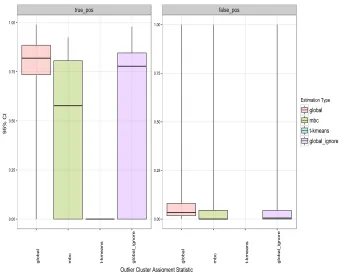
The left-hand set of box plots in Figure 5 displays the distributions (within 95%
confi-dence intervals under repeated sampling) of the true positive rate for identifying outlying
observations, constructed as the number of true outliers discovered divided by the total
number of true outliers, estimated on each Monte Carlo iteration for our three comparator
models. The right-hand set of box plots display the false positive rate, which we define
as the number of false discoveries divided by the total number of observations nominated
as outliers. The inclusion of false positives permits assessment of the efficiency to detect
outliers. Each set of box plots compares estimation under the global clustering algorithm
includingsampling weights, on the one hand, to a version of the global clustering algorithm,
the MBC,and trimmed K-means, on the other hand, that allexclude the sampling weights.
Outliers were detected in each simulation iteration,b= 1, . . . , B, based on selecting those
clusters whose total observations (among the selected clusters) cumulatively summed to
less thanC= 1.1 times the total number of true outliers in the informative sample, which
is how we would select outlying clusters on a real dataset where we don’t know the truth.
(We experimented with different values of C ∈[1,1.5] and realized the same comparative
results, as presented below).
Figure 5 reveals that failure to account for the informative sampling design induces a
true_pos false_pos
0.00 0.25 0.50 0.75 1.00
0.00 0.25 0.50 0.75 1.00
global mbc t-kmeans global_ignore global mbc t-kmeans global_ignore
Outlier Cluster Assigment Statistic
95% CI
Estimation Type
global mbc t-kmeans global_ignore
Figure 5: Accuracy of outlier detection under informative sampling: The left-hand plot panel presents the distributions of the true positive rates, and the right-hand panel presents the distribution for the false positive rates, both within 95% confidence intervals estimated fromB = 100 Monte Carlo draws of informative samples. Each sample is of size,n= 2500, from a population of size,N = 25000, with a population cluster of outliers of size,N5= 250.
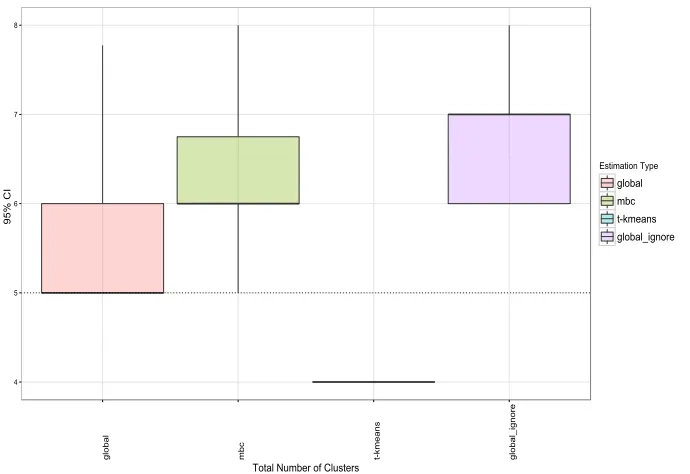
Figure 6 presents the distribution over the number of discovered clusters for each of
the three comparator models: 1. global clustering model, including sampling weights; 2.
MBC, excluding sampling weights; 3. Trimmed K-means, excluding sampling weights; 4.
global clustering model, excluding sampling weights. The dashed line at K = 5 clusters
is the correct generating value. While the the models excluding the sampling weights
(except for the trimmed K-means) estimate a higher number of clusters, such is not the
primary reason for their reduced outlier detection accuracy, as we observe from Figure 5
that the false positive rates are slightly lower for these two models compared to the model
that includes the sampling weights. The reduced accuracy is primarily driven by biased
estimation of the d×1 cluster centers, {µp}p=1,...,K, (relative to the population), whose
estimation is performed together with assignment to clusters in a single iteration of the
algorithm. We examine this bias in the next simulation study.
The trimmed K-means does relatively well in capturing the number of true clusters,
absent the outlying cluster. The trimming is not isolating these points as outliers, however,
but collapsing them into a larger cluster; hence, the trimmed k-means does not nominate
4 5 6 7 8
global mbc t-kmeans global_ignore
Total Number of Clusters
95% CI
Estimation Type global mbc t-kmeans global_ignore
3.3 Comparison of Outlier Estimation between Hierarchical and Global
Clustering under Informative Sampling
We now generate a set of local partitions hierarchically linked to a collection of global cluster
centers. We generate J = 8 local populations, Xjj=1,...,J, each of size Nj = 25000, and
associated local partitions, sj
j=1,...,J, where each local partition contains,Lj = 2 clusters,
including one that is composed of 150 outliers. The set of J local partitions randomly
select their local cluster centers from the same K = 5 global cluster centers that we
earlier introduced, which induces a dependence structure among the set of local partitions.
We conduct B = 100 Monte Carlo draws, where we take an informative sample within
each of the J = 8 datasets on each draw, using the same stratified sampling informative
design, described above. Estimation is conducted on the set of J informative samples
produced in each draw using both the sampling-weighted global clustering algorithm and
the hierarchical clustering algorithm outlined in Section 2.4. Our goal is to uncover the
global cluster center for the outlier cluster and the set of observations in each local dataset
that are assigned to the outlier cluster. We concatenate the set of informative samples
generated over the J datasets when conducting estimation using the global clustering
algorithm because our primary interest is in outlier detection, rather than inference on
the local partitions. (The performance of the global clustering algorithm relative to the
hierarchical clustering algorithm is worse than shown in the case we separately estimate a
global clustering on each dataset).
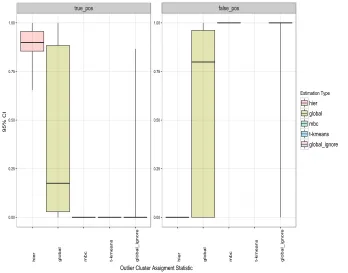
Figure 7 is of the same format as Figure 5, with two panels displaying distributions
over true positive and false positive rates, respectively, for our choice of models. The set
of five box plots compare the following models: 1. hierarchical clustering model, including
the sampling weights to both estimate global partitions linked to a global partition and
control for informative sampling; 3. model-based clustering, excluding sampling weights;
4. trimmed K-means robust clustering, excluding sampling weights; 5. global clustering
model, excluding sampling weights. Results for the hierarchical clustering model, shown
in the left-hand box plot of each panel, outperforms the global clustering model, where
both include sampling weights, because the hierarchical model additionally estimates the
dependent set of local clusters. The hierarchical clustering algorithm appears to do a better
job of borrowing estimation information among the J = 8 local partitions.
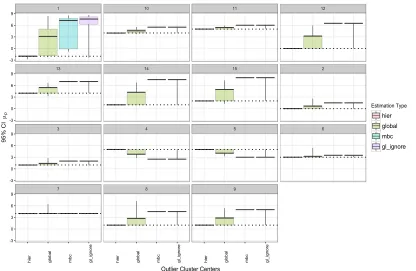
Figure 8 presents distributions for each dimension, d= 1, . . . ,15, of the outlier cluster
center, µ5, under four of the five comparison models (excluding the trimmed K-means)
in the same order as displayed in Figure 7. The sampling-weighted hierarchical clustering
model produces perfectlyunbiased estimates for the population values of the global outlier
cluster center, while the other 3 models (excluding the trimmed K-means) induce bias in
proportion to their outlier detection performances. Unbiased estimation of the outlying
cluster center as compared to the other clusters is important to detect an outlying cluster
because the cluster centers encode the degree of separation of the outlying cluster(s) from
the others. We see that the true positive detection rates across the methods shown in
Figure 7 are roughly proportional to the levels of bias estimated in the dimensions of
the outlying cluster center displayed in Figure 8. Since the trimmed K-means does not
true_pos false_pos
0.00 0.25 0.50 0.75 1.00
0.00 0.25 0.50 0.75 1.00
hier global mbc t-kmeans global_ignore hier global mbc t-kmeans global_ignore Outlier Cluster Assigment Statistic
95% CI
Estimation Type hier global mbc t-kmeans global_ignore
Figure 7: Accuracy of outlier detection under informative sampling for global vs hierarchical clustering model: The left-hand plot panel presents the distributions of the true positive rate, and the right-hand panel presents the distributions for the false positive rate, both within 95% confidence intervals estimated fromB= 100 Monte Carlo draws of informative samples from each of J = 8 local populations. Each sample is of size, nj = 2500, j =
1, . . . ,8, from a population of size, Nj = 25000, with a cluster of outliers of size, Nj,5 =
1 10 11 12
13 14 15 2
3 4 5 6
7 8 9
-3 0 3 6 9
-3 0 3 6 9
-3 0 3 6 9
-3 0 3 6 9
hier global mbc gl_ignore hier global mbc gl_ignore hier global mbc gl_ignore
Outlier Cluster Centers
95% CI
mp
Estimation Type
hier global mbc gl_ignore
We also examined the effect of excluding the merge move for the hierarchical clustering
algorithm in this simulation study. While excluding the merge move induced an
over-estimation of the the number of clusters (6 instead of the true 5), the outlier detection
accuracy wasn’t notably impacted, likely because employment of the C algorithm for
se-lection of the number of local and global clustering penalty parameters protected against a
large magnitude misestimation of the number of global and local clusters. We find a larger
discrepancy between employment or not of the merge move for asingle run of the
cluster-ing algorithm where the penalty parameters are set in an ad hoc fashion (e.g., through use
of the farthest-first algorithm as in Kulis and Jordan (2011), a procedure that we do not
recommend).
4. Application
We apply our hierarchical clustering algorithm to a data set of one month changes in CES
survey responses for estimation of industry-indexed (local) partitions that may express
a dependence structure across industries by potentially sharing global clusters. Outliers
are nominated by selecting all establishment observations in any local cluster that holds
a small percentage of observations (e.g. < 1%). Our CES survey application focuses
on the set of 108017 establishments whose reported employment statistics differ between
November and December, 2009 as a typical illustration. We are interested to flag those
establishments whose responses express unusually large changes in employment statistics
between November to December, relative to their November employment levels. So we
normalize the observed statistics to,
δijt=
xijt
xij(t−1)
which has support on the positive real line that we, in turn, cluster. The distribution ofδijt
is highly right-skewed for all dimensions, j ∈ (1, . . . , d), so we use a logarithm transform
of the statistic to perform clustering in order to conform to the mixtures of Gaussians
assumptions in Equation 5a. Alternatively, we could replace the squared Euclidean distance
in Equation 6 with the Bregman divergence (which is uniquely specified for exponential
family distributions) and replace the mixtures of Gaussian distributions with Exponential
distributions, as suggested by Jiang et al. (2012) (which produces the same results on these
data).
We focus on four employment variables of particular importance to CES (that also
express high response rates); 1. “ae”, which is the total employment for each reporting
establishment; 2. “pw”, which is production worker employment for each establishment; 3.
“npr”, which is the total payroll dollars expended for employees of each establishment; 4.
“nhr”, which is the average weekly hours worked for each establishment. So the dimension
of our CES survey application is d= 4.
We select penalty parameters from the range, (9≤λL≤829,17≤λK≤187), on a
15 ×20 grid, using the Calinski Harabasz and silhouette statistics, which both choose
(λL= 19, λK = 145) from this grid. The selected penalty parameters did not change when
including or excluding the merge step. Nevertheless, the number of clusters estimated
with-out inclusion of the merge step wasK = 10, whileK = 9 was estimated when including the
merge step. The resulting inference on the nomination of outliers, however, was unchanged
so that we prefer the parsimonious model (in terms of number of clusters selected). The
selected penalty parameters and resulting estimated clustering also did not change when
we employed a finer grid. Results from inclusion of the merge step are presented in Table 1,
where we discover K = 9 global clusters shared among the J = 23 local partitions, and
the results for one of the K = 9 global clusters, from left-to-right in descending order
of the number of establishments assigned to each global cluster. The first four rows
(la-beled “ae ratio’,“pw ratio”,“npr ratio”, “nhr ratio”) present the estimated global cluster
centers, µp, for change ratio in ae, pw, npr, and nhr respectively, after reversing the
loga-rithm transform. The fourth through final rows present the by-industry, local partitions,
sj, and their links to the global cluster centers. Scanning each of the columns, we see that
all of the K = 9 global clusters are shared among the local partitions, indicating a high
degree of dependence among them.
The fifth row (labeled “ae avg”) averages the total employment, ae, over all
establish-ments in all industries linked to the associated global cluster as reported for the month of
November. The second column from the right represents a cluster whose centers indicate
unusually large increases in reported employment and payroll from November-to-December.
The establishments linked to this cluster are of generally small-sized, with an average of
20 reported employees in November. Establishments with a relatively small number of
employees will receive high sampling weights due to their low inclusion probabilities, such
that their high magnitude shifts in reported employment levels may be influential in the
estimation of the sampling-weighted total employment estimates for November and
De-cember. It might, however, be expected that the retail (and associated wholesale) hiring
might dramatically increase in anticipation of holiday shopping. So we would nominate
the remaining 470 establishments linked to this global cluster as outliers for further
ana-lyst investigation by the BLS. Previous analysis conducted within the BLS suggests that
smaller establishments generally tend to commit submission errors at a higher rate. The
result excluding the merge step splits this cluster into two in a manner that doesn’t change
The smallest-size (right-most) cluster has a mean of 0.01 in the monthly change ratio
for the variable “npr”, indicating an unusually large magnitude decrease in the number
of employees (and payroll dollars) reported from November-to-December. This cluster
contains 113 relatively large-sized establishments with an average of 278 reported
employ-ers in November. The moderate-to-large size of establishments in this cluster will tend
to receive smaller sampling weights, however, (because they have higher sample inclusion
probabilities), and so are less influential. So BLS would generally place a lower priority for
investigation on this cluster than the previous discussed. The small number of
establish-ments in this cluster, coupled with the large magnitude decreases in reported employment
variables, however, would likely prompt an investigation of the submissions for all
estab-lishments in this cluster. The two Retail industries show 17 estabestab-lishments in this cluster
of establishments expressing a large decrease in employment. The seasonal hiring in this
industry, mentioned above, may suggest to place an especially high priority on investigation
of these establishments.
5. Discussion
The BLS seeks to maintain a short lead time for the CES survey between receipt of monthly
establishment responses and publication of estimates. Retaining estimation quality
re-quires investigation of establishment responses for errors, which may prove influential in
published estimates (by region and industry, for example). BLS analysts, therefore, require
an automated, fast-computing tool that nominates as outliers for further investigation a
small subset of the over 100000 establishments whose responses reflect month-over-month
changes in employment levels.
We have extended the MAP approximation algorithm of Kulis and Jordan (2011) and
appli-Table 1: CES Mixtures of HDPs: Global cluster centers and local partitions
Variable Values, by cluster
ae ratio 0.961 0.98 1.157 0.829 0.657 2.008 0.156 19.212 0.093
pw ratio 0.951 0.973 1.199 0.797 0.596 2.586 0.189 11.95 0.146
npr ratio 0.939 0.963 1.283 0.423 0.465 4.106 0.143 16.617 0.010
nhr ratio 0.944 0.979 1.213 0.639 0.547 2.469 0.182 20.37 0.109
Average Employment Count, by cluster
ae avg (November) 168 205 104 154 125 182 258 20 278
Units in Super Sector Clusters
Agriculture 0 81 0 0 16 0 0 0 0
Mining 379 0 118 0 105 0 20 10 3
Utilities 0 405 0 0 0 0 4 2 1
Construction 2977 0 1111 0 1008 174 125 34 9
Manufacturing(31) 1015 0 254 0 0 0 28 6 6
Manufacturing(32) 1229 0 272 0 131 30 19 5 3
Manufacturing(33) 0 2117 494 169 0 46 34 16 3
Wholesale 1828 0 486 0 161 47 26 23 3
Retail(44) 0 14648 4484 915 0 160 168 33 7
Retail(45) 0 9381 5243 996 0 132 58 17 10
Transportation(48) 1266 0 346 155 0 41 26 16 4
Transportation(49) 0 1149 703 101 0 64 39 11 14
Information 1852 0 456 198 0 30 22 30 1
Finance 4947 0 1894 476 0 138 51 111 6
Real Estate 1409 0 981 0 159 0 18 15 0
Professional Services 2999 0 1151 349 0 149 70 47 5
Management of Companies 0 881 185 64 0 0 6 6 1
Waste Mgmt 3674 0 1301 0 602 144 103 40 11
Education 666 0 229 0 0 23 19 6 0
Health Care 0 6437 1068 368 0 126 63 23 14
Arts-Entertainment 953 0 308 0 213 0 42 25 2
Accommodation 11757 0 2541 822 0 181 100 49 7
Other Services 1499 0 433 0 158 51 11 18 3
cations where the observations were acquired under an informative sampling design. We
replace the usual likelihood in estimation of the joint posterior over partitions and
asso-ciated cluster centers with a pseudo-likelihood that incorporates the first order sampling
weights that serve to undo the sampling design. The resulting estimated parameters of
the approximate MAP objective function are asymptotically unbiased with respect to the
population, conditioned on the generation of the finite population from disjoint clusters.
Our simulation study demonstrated that failure to correct for informative sampling reduces
the outlier detection accuracy by inducing biased estimation of the cluster centers.
Our use of sampling-weighted partition estimation algorithms focuses on outlier
de-tection, so we incorporated a new merge step, which may increase robustness against
estimation of local optima and encourage discovery of clusters containing large numbers
of observations, which may be a feature for outlier detection where we nominate as
out-liers those observations in clusters containing relatively few observations. We additionally
constructed the sampling-weighted C statistic that our simulation study demonstrated was
very effective for selection of the local and global cluster penalty parameters, (λL, λK),
that together determine the numbers of local and global clusters.
The sampling-weighted hierarchical clustering algorithm permitted our estimation of
industry-indexed local clusters, which fits well into the BLS view that industry groupings
tend to collect establishments with similar employment patterns and reporting processes.
We saw that all of the estimatedK= 9 global clusters for percentage change in employment
from November to December, 2009 were shared among the local by-industry clusters, which
served to both sharpen estimation of the local partitions and global cluster centers and to
discover small global clusters of potentially outlying observations.
The authors wish to thank Julie Gershunskaya, a Mathematical Statistician colleague at the
Bureau of Labor Statistics, for her clever insights and thoughtful comments that improved
the preparation of this paper.
References
D. Blackwell and J. B. MacQueen. Ferguson distributions via P´olya urn schemes. The
Annals of Statistics, 1:353–355, 1973.
Daniel Bonnry, F. Jay Breidt, and Franois Coquet. Uniform convergence of the empirical
cumulative distribution function under informative selection from a finite population.
Bernoulli, 18(4):1361–1385, 11 2012. doi: 10.3150/11-BEJ369. URL http://dx.doi.
org/10.3150/11-BEJ369.
T. Broderick, B. Kulis, and M. I. Jordan. MAD-Bayes: MAP-based Asymptotic Derivations
from Bayes. ArXiv e-prints, December 2012.
Chris Fraley and Adrian E. Raftery. Model-based clustering, discriminant analysis, and
density estimation. Journal of the American Statistical Association, 97(458):611–631,
2002.
Heinrich Fritz, Luis A. Garc´ıa-Escudero, and Agust´ın Mayo-Iscar. tclust: An R package
for a trimming approach to cluster analysis.Journal of Statistical Software, 47(12):1–26,
2012. URLhttp://www.jstatsoft.org/v47/i12/.
Hemant Ishwaran and Lancelot F. James. Generalized weighted Chinese restaurant
pro-cesses for species sampling mixture models. Statistica Sinica, 13(4):1211–1235, 2003.
Ke Jiang, Brian Kulis, and Michael I. Jordan. Small-variance asymptotics for exponential
K.Q. Weinberger, editors, Advances in Neural Information Processing Systems 25,
pages 3158–3166. Curran Associates, Inc., 2012. URLhttp://papers.nips.cc/paper/
4853-small-variance-asymptotics-for-exponential-family-dirichlet-process-mixture-models. pdf.
Brian Kulis and Michael I. Jordan. Revisiting k-means: New algorithms via bayesian
nonparametrics.CoRR, abs/1111.0352, 2011. URLhttp://arxiv.org/abs/1111.0352.
R. M. Neal. Markov chain sampling methods for Dirichlet process mixture models.Journal
of Computational and Graphical Statistics, 9(2):249–265, 2000.
Fernando A. Quintana and Pilar L. Iglesias. Bayesian clustering and product partition
models. Journal of the Royal Statistical Society, Series B: Statistical Methodology, 65
(2):557–574, 2003.
RCore Team. R: A Language and Environment for Statistical Computing. R Foundation
for Statistical Computing, Vienna, Austria, 2014. URLhttp://www.R-project.org/.
Terrance Savitsky and Daniell Toth. Convergence of pseudo posterior distributions under
informative sampling. 2015. URLhttp://arxiv.org/abs/1507.07050.
Matthew S. Shotwell. Profdpm: An R package for MAP estimation in a class of conjugate
product partition models. Journal of Statistical Software, 53(8):1–18, 2013.
Matthew S. Shotwell and Elizabeth H. Slate. Bayesian outlier detection with Dirichlet
process mixtures. Bayesian Analysis, 6(4):665–690, 2011.
Yee Whye Teh, Michael I. Jordan, Matthew J. Beal, and David M. Blei. Hierarchical
Dirichlet processes.Journal of the American Statistical Association, 101(476):1566–1581,
Lianming Wang and D. B. Dunson. Fast bayesian inference in dirichlet process mixture
Appendix A. Hierarchical Clustering Algorithm
Loop over algorithm blocks, A.2 and A.3 until convergence.
Algorithm A.1:Initialize local and global cluster objects
Input: Set ofnj×ddata matrices,{Xj}j=1,...,J, where each holds 1×dobservations fornj
units in local dataset,j. Set ofnj×1 vectors,{w˜j}of sampling weights fornj units
in local dataset,j. λL, local cluster penalty parameter. λK, global cluster penalty
parameter.
Output: K×d, M= (µ1, . . . ,µK)
0
, a matrix of 1×dglobal cluster centers for
p= 1, . . . , K global clusters. A set ofnj×1 vectors,{sj}j=1,...,J, where sji ∈(1,2, . . . , K), linking units in each dataset,Xj, to a global cluster,
p∈(1, . . . , K). The number of unique values insj, denoted by L
j, specifies the
local partition structure for dataset,Xj. 1 Initialize: Initialize number of global clusters,K= 1.
2 forj ←1toJ do
3 Lj×1, vj records link of each local cluster, c∈(1, . . . , Lj), to global cluster, p∈(1, . . . , K). InitializeLj= 1 andv
j
Lj = 1.
4 nj×1, zj, records link of each unit,iin dataset,j, to alocal cluster,c∈(1, . . . , Lj).
Initializezji = 1, ∀i.
5 nj×1, sj records link of each unit, i, in dataset,j to aglobal cluster, p∈(1, . . . , K).
Initializesji ←vj
zij, ∀i.
6 Setd×1 cluster center, µ1←
PJ
j=1
Pnj
i=1w˜
j
ix
j i
/PJ
j=1
Pnj
i=1w˜
j i
.
7 Compute energy,
e←PK
p=1
PJ
j=1
P
i∈{i:sji=p}w˜
j i X j
i−µp
2
+λKK+λLL, whereL=P J



![3 Methoxy 2 [2 ({[6 (trifluoromethyl)pyridin 2 yl]oxy}methyl)phenyl]prop 2 enoic acid](data:image/gif;base64,R0lGODlhAQABAIAAAP///wAAACH5BAEAAAAALAAAAAABAAEAAAICRAEAOw==)