69
Elevating Job Performance Through Job Characteristics and Work
Involvement
Johanim Johari
1, Tan Fee Yean
2, Khulida Kirana Yahya
3and Zurina Adnan
4School of Business Management, College of Business, University Utara Malaysia
Article Information
Abstract
Keywords
Job characteristics, Work involvement, Job performance, Public servants, Malaysia
The primary objective of this study is to assess the predicting role of job characteristics on job performance. Dimensions in the job characteristics construct are skill variety, task identity, task significance, autonomy, and feedback. Further, work involvement is tested as a mediator in the hypothesized link. A total of 151 public servants reported on their job characteristics and work involvement while supervisory-ratings were used to assess their level of job performance in terms of task performance and organizational citizenship behavior (OCB). SPSS version 14 and Smart PLS 2.0 were used for statistical analyses of the data. The findings revealed that feedback significantly and indirectly influence job performance and the relationships were mediated by work involvement. Overall, this study has managed to substantiate a marginal support for the Job Characteristics Theory.
INTRODUCTION
Creating a band of excellent workers, who are capable of delivering the expectations of both the management and precisely the clients, remains as one of the idealisms dreamt by many leaders of corporate and public organizations. The process of achieving it is no fewer complexes that justify, in many cases, yet another prolonging journey. In the process, there are many converging factors that form the thrust of being excellent performers. To be excellent, one has to possess the required level of exemplary competency, which normally is measured in terms of knowledge, skills, ability, attitude, and behaviors (Borman, 2004a; Borman, & Motowidlo, 1997; Organ, 1997). Contextual factors, such as leadership, job design, physical facilities, and technology, are of equal importance in ensuring high performance level is in place (Campbell et al., 1990). Both factors (i.e. personal and contextual) are dynamic in nature and complementarily compounding. Accordingly, literature (e.g. Campbell, 1990; Williams, 2002) has documented that there are two major determinants of performance, which are „person factors‟ and „system factors‟. The former refers to motivation and ability that an individual has and it is determined solely by the criteria of an individual. „System factors‟, on the other hand, are the aspects that the organizational environment has to offer, such as job design, organizational structure, work culture, and so forth that may affect individual performance (Williams, 2002). Job characteristics can be considered as the „system factors‟ that may influence employees‟ behavioral outcome (Campbell, 1990; Williams, 2002).
70
positive attitudinal outcomes. This state determines the incumbents‟ way of behaving that is reflected in their behavioural outcomes, including job performance. In further understanding the theory, Langfred and Moye (2004) noted that mediating variable in the Job Characteristics Theory is useful by incorporating other attitudinal constructs (Fried & Ferris, 1987; Langfred & Moye, 2004). In light of these assertions, this study tests the theory by integrating work involvement as a mediating factor to better explain the theorized link between job characteristics and job performance among public servants. As such, the main objective of this study is to analyse the predicting role of job characteristics on job performance and the mediating role of work involvement in the hypothesized link.
LITERATURE REVIEW
Job Characteristics and Its Underlying Theory
Based on the literature (e.g. Hackman & Oldham, 1975; Hackman & Oldham, 1980), the first version of job characteristics definition and measurement were broad. According to Morgeson and Campion (2003), the earliest concept of the job characteristics dimensions was introduced by Turner and Lawrence (1965), which included the aspects of dealing with others and friendship opportunities. However, these two dimensions were later omitted because they are not centrally related to the job characteristics construct and too vague to be operationalised as part of job design (Morgeson & Campion, 2003). Basically, Job Characteristics Theory by Hackman and Oldham (1975) posits that enriched and motivating job characteristics would bring about positive cognitive, psychological, and emotional conditions for the job incumbent. The theory also purports that a positive cognitive state would result in a positive affective or attitudinal state, such as job satisfaction, motivation, and affective commitment (Hackman & Oldham, 1975). Ultimately, positive affective and attitudinal condition promotes desirable workplace behaviour, such as a high level of job performance, demonstrated through task and contextual performance. In other words, effective job characteristics produce positive workplace attitudes, which inevitably encourage employees to engage in positive behaviours at work.
The Job Characteristics Theory (Hackman & Oldham, 1975) also purports that job characteristics could improve the motivational level of employee by developing three psychological conditions. Hackman and Oldham (1975) theorized that a high motivation level is related to experiencing three psychological states whilst working, which are meaningfulness of work, responsibility, and feedback or knowledge of outcomes. Meaningfulness of work is considered as the main source for intrinsic motivation. It is hypothesized that motivation can be achieved when a job allows employees to use a variety of skills in performing the job. The theory also posits that task identity concerns the ability to identify with the work at hand as more holistic and complete. As such, the job incumbent would have more pride in the outcome of the job that he or she has performed. Another factor to ensure the state of meaningfulness of work is task significance. This dimension is highly associated with the identification of the job done as something big for the organization (Gomez-Mejia et al., 2007; Hackman & Lawler, 1971; Hackman & Oldham, 1975). Additionally, responsibility is derived from autonomy. The theory purports that without being given enough freedom of self-decision, it is not possible for an incumbent to succeed (Gomez-Mejia et al., 2007; Hackman & Lawler, 1971; Hackman & Oldham 1975; Hackman & Oldham 1980). Finally, feedback is the crucial element that creates knowledge of outcomes of the job done, such as the production figures and customer satisfaction scores (Gomez-Mejia et al., 2007; Hackman & Lawler, 1971; Hackman & Oldham, 1975; Hackman & Oldham, 1980). This is because feedback offers information that once employees know, they can use to do things differently if they wish in order to improve their performance level from time to time (Gomez-Mejia et al., 2007; Hackman & Lawler, 1971; Hackman & Oldham, 1975; Hackman & Oldham, 1980).
71
Work InvolvementWork involvement has been defined as the extent to which employees are normally interested in, identified with, and are preoccupied with their work in relative to other aspects of their life (Kanungo, 1982a). In terms of motivational approach, the concepts of alienation and involvement are viewed as opposite ends of a continuum of the same phenomenon (Kanungo, 1982b). This state is considered as an attitudinal condition that reflects the one-dimensional cognitive response of an individual employee. Although work involvement and job involvement are two distinct constructs, the terms have been used interchangeably resulting in confusion in the literature on their actual definition (Kanungo, 1982a). As such, it is crucial to clearly distinguish the two constructs.
Work involvement is also a normative belief about the value of work in an incumbent‟s life and this attitudinal state is a result of his or her previous cultural and socialization activities (Kanungo, 1982a). Based on Rottenbery and Moberg (2007), the work involvement concept can be used in assessing employees‟ level of involvement across jobs while job involvement is limited to a specific job. In fact, the job involvement construct should be operationalized based on the type of occupation that respondents have in a particular study (Rottenbery & Moberg, 2007). Accordingly, an empirical work by Elloy and Terpening (1992) concurs with Kanungo‟s (1982a) proposition on the orthogonality or distinctiveness of work involvement and job involvement. Specifically, a causal model tested by Elloy and Terpening (1992) demonstrates the theoretical distinction between the said constructs based on the data collected. Given the conceptual assertion and empirical evidence, it can be summed up that job involvement and work involvement are two distinct constructs.
Work involvement has been theorized as a significant predictor of various workplace outcomes (Elloy & Terpening, 1992; Kanungo, 1982a; Kanungo, 1982b; Kanungo, 1990; Rotenberry & Moberg, 2007). Nevertheless, limited evidence and equivocal results on work involvement-behavioral outcomes association are due to several reasons. One of the reasons is researchers are more interested in testing other attitudinal conditions, such as motivation and commitment, as the antecedent to the behavioral outcomes (Bozionelos, 2004; Carmeli, 2005; Carmeli & Freund, 2004; Newton & Keenan, 1983; Rotenberry & Moberg, 2007). This is because these attitudinal factors have been widely used and theorized as strong predictors of job performance (Langfred & Moye, 2004).
This study incorporates work involvement as a mediator in explaining job characteristics and job performance link. Langfred and Moye (2004) and Fried and Ferris (1987) noted that mediating variable in the Job Characteristics Theory are not limited to motivational aspects. In fact, studies should look into other cognitive and attitudinal responses in articulating the theory. Taking into account this assertion, this study further tests the theory by adding in work involvement as a mediating factor to better explain the theorized link between job characteristics and job performance among public servants.
Job Performance
72
In relation to different conceptualizations of job performance, the main issue raised by scholars, such as Campbell et al. (1990) and Borman (2004a), is which employees‟ behaviours at work constitute job performance. Traditionally, job performance is limited to the core task activities that were based solely on job analysis (Campbell 1990; Jex & Britt 2008). The construct has, however, expanded into behavioural aspects related directly to the core tasks and other behaviours that support the core task performance. Scholars (e.g. Borman, 2004a; Borman & Motowidlo, 1993; Campbell, 1990; Jex & Britt, 2008; Motowidlo & Van Scotter, 1994) asserted that job performance should be measured in terms of task performance and contextual performance in order to fully grasp a holistic concept of the latent construct. This is because contextual performance is the behaviours that support the core task performance in enhancing organizational effectiveness (Motowidlo & Van Scotter, 1994). In essence, task performance is concerned with behaviours that are required to complete job tasks while contextual performance is needed to safeguard and upgrade the organizational, social, and psychological environment in the organization (Jex & Britt, 2008; LePine, Hanson, Borman & Motowidlo, 2000; Van Dyne, Graham & Dienesch, 1994; Van Scotter & Motowidlo, 1996). Both aspects of performance are crucial to achieve organizational objectives (Black & Porter, 1991; Jahangir et al., 2004).
HYPOTHESES OF THE STUDY
Job Characteristics and Job Performance
Hackman and Oldham (1975) theorized that a high motivation level is related to experiencing three psychological states whilst working, which are meaningfulness of work, responsibility, and feedback or knowledge of outcomes. Meaningfulness of work is considered as the main source for intrinsic motivation. It is hypothesized that motivation can be achieved when a job allows employees to use a variety of skills in performing the job. The theory also proposes that task identity concerns the ability to identify with the work at hand as more holistic and complete. As such, the job incumbent would have more pride in the outcome of the job that he or she has performed. Another factor to ensure the state of meaningfulness of work is task significance. This dimension is highly associated with the identification of the job done as something big for the organization (Gomez-Mejia et al., 2007; Hackman & Lawler, 1971; Hackman & Oldham, 1975). Responsibility is derived from autonomy. The theory purports that without being given enough freedom of self-decision, it is not possible for an incumbent to succeed (Gomez-Mejia et al., 2007; Hackman & Lawler, 1971; Hackman & Oldham, 1975; Hackman & Oldham, 1980). Finally, feedback is the crucial element that creates knowledge of outcomes of the job done (Gomez-Mejia et al., 2007; Hackman & Lawler, 1971; Hackman & Oldham, 1975; Hackman & Oldham, 1980). This is because feedback offers information that once employees know, they may choose to do things differently if they wish to in order to improve their performance level from time to time (Gomez-Mejia et al., 2007; Hackman & Lawler, 1971; Hackman & Oldham, 1975; Hackman & Oldham, 1980).
An abundance of empirical investigations (see for example Anderson, 1984; Bhuian et al., 1996; Bhuian et al., 2001; Bhuian & Menguc, 2002; Butler et al., 2005; Chang & Lee, 2006; Dodd & Ganster, 1996; Dunham, 1977b; Fang, 1996; Glisson & Durick, 1988; Goris et al., 2000; Harris et al., 1993; Jonge et al. 2001; Liden, 2000; Mannheim & Schiffrin,1984; Marchese, 1998; Mierlo et al., 2007; Morrison, 1996; Panatik et al., 2009; Pollock et al., 2000; Rentsch & Steel, 1996; Schneider, 2003; Singh, 1998; Thomas et al., 2004; Ting, 1997) have recapitulated that enriched and motivating job design provides employees the opportunity to use different skills and talents to perform tasks, associate or identify themselves closely with the task completed, feel empowered in performing the job through autonomy obtained from the job, and get adequate feedback from the job done. In essence, enriched and complex jobs are associated with positive attitudinal outcomes. Taken together, this study hypothesizes that:
H1: Skill variety exerts a positive influence on work involvement. H2: Task identity exerts a positive influence on work involvement. H3: Task significance exerts a positive influence on work involvement. H4: Autonomy exerts a positive influence on work involvement. H5: Feedback exerts a positive influence on work involvement.
The Mediating Role of Work Involvement
73
Hackman and Oldham (1975), Kanungo (1979, 1982a), Motowidlo (2003), and Organ (1988a), attitudinal state is theorized as the main antecedent to various behavioral outcomes.
Likewise, Job Characteristics Theory by Hackman and Oldham (1975) demonstrates that job characteristics lead to a certain cognitive or psychological state, followed by a job relevant attitude and behaviour, depending on the level of meaningfulness, responsibilities, and knowledge of feedback. Rotenberry and Moberg (2007), for instance, reported that employees who are highly involved in their work will put forth an extra amount of effort in order to achieve organizational objective. By doing so, highly involved employees would be more likely to engage in productive work activities, resulting in improvement of task performance and OCB levels (Rotenberry & Moberg, 2007). In parallel fashion, Chiu and Chen (2005), Carmeli and Freund (2004), Edwards et al. (2008), Hechanove et al. (2006), Hunter and Thatcher (2007), Jones (2006), Murphy et al. (2002), Rifai (2005), and Van Dyne and Pierce (2004) reported a significant mediating role of attitudinal aspects in predicting task performance and OCB. As such, this study hypothesizes that:
H6: Work involvement mediates the relationship between skill variety and job performance.
H6a: Work involvement mediates the relationship between skill variety and task performance. H6b: Work involvement mediates the relationship between skill variety and OCB.
H7: Work involvement mediates the relationship between task identity and job performance.
H7a: Work involvement mediates the relationship between task identity and task performance. H7b: Work involvement mediates the relationship between task identity and OCB.
H8: Work involvement mediates the relationship between task significance and job performance. H8a: Work involvement mediates the relationship between task significance and task performance.
H8b: Work involvement mediates the relationship between task significance and OCB. H9: Work involvement mediates the relationship between autonomy and job performance.
H9a: Work involvement mediates the relationship between autonomy and task performance. H9b: Work involvement mediates the relationship between autonomy and OCB.
H10: Work involvement mediates the relationship between feedback and job performance.
H10a: Work involvement mediates the relationship between feedback and task performance. H10b: Work involvement mediates the relationship between feedback and OCB.
FRAMEWORK OF THE STUDY
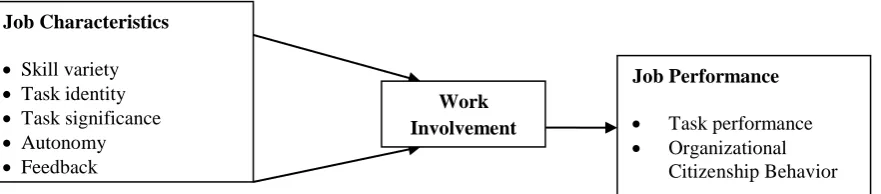
Building upon the literature review, this study proposes a theoretical model that mergers job characteristics, work involvement, and job performance. A complete description of the model is shown in Figure 1. The job characteristics dimensions are integrated as the predictors of job performance, and the association is theorized to be mediated by work involvement.
FIGURE I THE RESEARCH MODEL
METHODOLOGY
Sampling, Procedures, and Measure
In the initial stage of data collection, letters asking for permission to conduct a survey was sent to each Human Resource Department of the public service departments and agencies in the northern region of Peninsular Malaysia. In the letter, the research objectives and methodology of this study were briefly explained. Only nine
Job Characteristics
Skill variety
Task identity
Task significance
Autonomy
Feedback
Work Involvement
Job Performance
Task performance
74
departments and agencies responded and indicated their willingness to participate in the survey. Based on the number of departments and agencies responded, this study employed a stratified sampling method.
Self-administered questionnaires were distributed to public servants in the respective departments and agencies and they were asked to respond to the items by indicating their level of agreement using a seven-point Likert scale (i.e. 1= strongly disagree, 7= strongly agree). The questionnaires encompassed items measuring job characteristics, work involvement, and job performance. The Job Diagnostic Survey (JDS) by Hackman and Oldham (1975) is employed to measure job characteristics. This variable consists of five dimensions: skill variety, task identity, task significance, autonomy, and feedback. This brings to the total of 15 items, which were used to evaluate the job characteristics construct. Three items were utilized to measure each dimension and sample items are “this job is quite difficult and it involves no repetitiveness”, “this job is arranged so that I can do an entire piece of work from beginning to the end”, “this job itself is very significant and important in the broader scheme of things”, and “the job gives me the chance to use my personal initiative and judgment in carrying out work”. Work involvement is a one-dimensional construct measured by five items, which were adopted from Kanungo (1982b, 1990). Sample items for work involvement are “Doing my job well gives me the feeling that I have accomplished something worthwhile” and “In my job, I am willing to put a great deal of effort beyond what is normally expected”.
This study used a supervisory-rating of job performance. There were two dimensions of job performance construct: task performance and OCB. Task performance was measured by seven items adapted from Williams and Anderson (1991) while 18 items adapted from Morrison and Phelps (1999), Podsakoff, MacKenzie, Moorman, and Fetter (1990), and Van Dyne and Le Pine (1998) were used to gauge OCB among respondents. Sample items for this supervisory ratings measure include “He/she neglects aspects of the job that he/she is obliged to perform”, “He/she keeps up to date with changes in the organization”, and “He/she tries to adopt the improved procedures for this department”. A total of 300 questionnaires were distributed and 156 were returned. However, only 151 questionnaires were usable for data analysis.
RESULTS
Demographic Profiles of the Respondents
The sample comprised of 53.64 per cent male and 46.36 per cent female. The majority of respondents, i.e. 33.80 per cent, were below 30 years old while 14.3 percent were above 50 years old. Given the fact that Malaysian public service departments and agencies were predominantly Malay-populated, 98.7 per cent of the respondents were Malays. Only 1.3 percent was Chinese. The majority of respondents, 56.7 per cent were secondary-school certificate holders and 29.30 per cent were diploma holders. The rest of the respondents or 13.7 per cent were bachelor and masters degree holders. A total of 72.9 per cent of the respondents had worked in the organization for less than 10 years while 27.20 per cent had worked for more than 10 years. A total of 102 respondents or 67.5 per cent had been in the current job position for less than 10 years while the rest were more than 10 years. Finally, a vast majority of the respondents or 67.50 per cent were support staffs and only 32.50 per cent were professional and management staff.
Validity and reliability
75
\FIGURE IIMEASUREMENT MODEL
As indicated in Table 1, the value of CR for skill variety, task identity, task significance, autonomy, feedback, work involvement, task performance, and organizational citizenship behaviour is 0.914, 0.905, 0.910, 0.895, 0.821, 0.876, 0.844 and 0.886 respectively, which are above the acceptable value of 0.7 (Hair et al. 2010). In addition, to fulfil convergence validity, AVE for all constructs should be greater than 0.50 as suggested by Barclay et al. (1995). AVE values of all constructs were above the cut-off values of 0.50. Thus, all the measures used in this study have sufficient convergent validity.
TABLE I
RESULTS OF MEASUREMENT MODEL
Model construct CR AVE R2
Skill variety 0.914 0.842
Task identity 0.905 0.827
Task significance 0.910 0.835
Autonomy 0.895 0.741
Feedback 0.821 0.609
Work involvement 0.876 0.585 20.1
Task performance 0.844 0.525 0.313
Organizational citizenship behaviour 0.886 0.614 0.185
Note: CR = Composite reliability; AVE = Average variance extracted (AVE); α = Cronbach‟s alpha; R2 = R square.
76
suggesting that there is no multicollinearity of items in representing their hypothesized latent factors. As such, it can be concluded that all measurements in this study are valid and reliable.
TABLE II
DISCRIMINANT VALIDITY OF CONSTRUCTS
Constructs 1 2 3 4 5 6 7 8
1. Skill variety 0.918
2. Task identity 0.436 0.909
3. Task significance
4. Autonomy
5. Feedback
6. Work involvement
7. Task performance
8. Organizational citizenship
behavior
0.396
0.386
0.409
0.217
0.347
0.337
0.610
0.347
0.552
0.233
0.421
0.224
0.914
0.247
0.575
0.264
0.382
0.279
0.861
0.447
0.114
0.241
0.274
0.780
0.434
0.540
0.409
0.765
0.558
0.430
0.725
0.574 0.784
Note: Diagonals (in bold) represent the square root of AVE while the other entries represent the correlation coefficients
Besides that, the proposed model shows that 20.1% of the variance in work involvement was explained by skill variety, task identity, task significance, autonomy and feedback. Meanwhile, 31.1% and 18.5% of the variance in task performance and organizational citizenship behaviour were explained by work involvement respectively.
Test of Hypotheses: Direct Effect
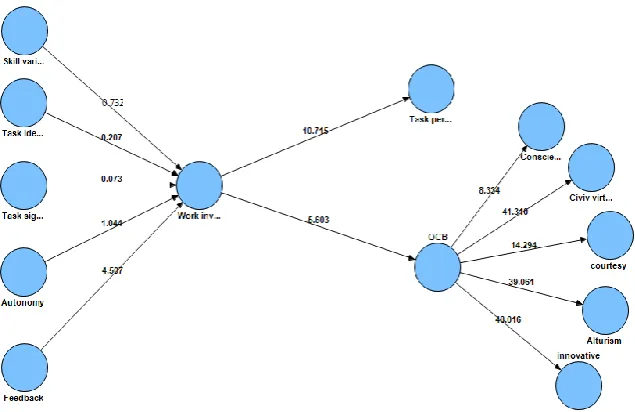
Figure 3 depicts the structural model derived from the partial least squares (PLS) analysis and Table 3 and 4 present the results of the PLS analysis. The results of the study showed that only feedback had a significant and positive influence on work involvement (β = 0.460, p < 0.01). In a parallel fashion, work involvement was also found to have a substantial impact on task performance (β = 0.558, p < 0.01) and organizational citizenship behaviour (β = 0.430, p < 0.01).
FIGURE 3
77
TABLE 3PATH COEFFICIENTS AND HYPOTHESES TESTING (DIRECT EFFECT)
Hypothesized relationship Coefficient t value
Skill variety → work involvement 0.079 0.732
Task identity → work involvement -0.021 0.207
Task significance → work involvement
Autonomy → work involvement
Feedback → work involvement
Work involvement → task performance
Work involvement → organizational citizenship behaviour
0.009
-0.118
0.460
0.558
0.430
0.073
1.044
4.507**
10.715**
5.603**
Note: t-value > 2.33 = significant at **p<0.01
Test of Hypotheses: Mediating Effect
To test whether work involvement significantly mediate the relationship between the dimension of job characteristics (i.e., skill variety, task identity, task significance, autonomy, and feedback), task performance and organizational citizenship behaviour, bootstrapping, a nonparametric re-sampling procedure that does not impose the assumption of normality on the sampling distribution was used (Preacher & Hayes, 2008). Thus, bootstrapping (500 resample) was used to generate standard errors (SE) and t-statistics with the percentile bootstrap 95% confidence interval. If the confidence interval for a mediation hypothesis does not contain zero, it means that the indirect effect between independent and dependent variables is supported. The bootstrapping analysis found that work involvement only mediate the influence of feedback on task performance (indirect effect = 0.257; SE = 0.068; t-value = 3.775) and organizational citizenship behaviour (indirect effect = 0.198; SE = 0.059; t-value=3.353).
TABLE 4
PATH COEFFICIENTS AND HYPOTHESES TESTING (MEDIATION EFFECT)
Proposed relationship Indirect
effect
t value Percentile bootstrap
95% confidence interval
Lower Upper
Skill variety → work involvement → task performance
0.044 0.723 -0.075 0.164
Task identity → work involvement → task performance
-0.012 -0.209 -0.121 0.098
Task significance → work involvement → task performance
0.005 0.069 -0.138 0.148
Autonomy → work involvement → task performance
-0.066 -1.013 -0.193 0.062
Feedback → work involvement → task performance
0.257 3.775** 0.123 0.390
78
organizational citizenship behaviourTask identity → work involvement → organizational citizenship behaviour
-0.009 -0.210 -0.093 0.075
Task significance → work involvement → organizational citizenship behaviour
0.004 0.069 -0.106 0.114
Autonomy → work involvement → organizational citizenship behaviour
-0.051 -1.015 -0.149 0.047
Feedback → work involvement → organizational citizenship behaviour
0.198 3.353** 0.082 0.313
Note: t value > 1.645 = significant at *p<0.05; t value > 2.33 = significant at **p<0.01;
DISCUSSIONS,IMPLICATIONS,AND RECOMMENDATIONS FOR FUTURE RESEARCH
This study attempted to provide empirical support for the purported relationships. The study also looked into work involvement as a plausible attitudinal condition that mediated the relationships between job characteristics and job performance. Only one of the five job characteristics factors have significantly influenced work involvement, which in turn influenced task performance and OCB. The structural equation modeling results indicated that the path coefficient estimates of feedback had a significant influence on work involvement. In other words, work involvement served as a mediating factor for the relationships between feedback and task performance and OCB. In essence, jobs that provide adequate feedback would give the public servants necessary information to upgrade the quality of work done. Feedback also allows the public servants to be aware of their performance level in executing their jobs. Based on the job feedback, public servants would be highly involved in their work and continuously exert efforts to improve their job performance, be it in terms of task performance or OCB. The results were in accordance to Hackman and Oldham‟s (1975) supposition that the higher the work involvement level of the incumbent, the more likely for them to become high performers.
Importantly, this study has provided a theoretical implication by giving additional empirical evidence in the domain of Job Characteristics Theory. The results suggested that feedback is very important in elevating work involvement and job performance among public servants. In terms of practical ramifications, focus should be given on developing a more enriching and fulfilling type of job with high level of feedback. This could be a useful basis for HR practitioners in the public sector so as to enhance public servants‟ work involvement as well as job performance.
This study has also paved several directions for future research. First, a longitudinal study would be of greater value to infer causal associations of job characteristics and job performance of public servants. Second, the theoretical model of this study should be replicated in other settings, such as the private sector, particularly in the manufacturing and service industries. The different nature of the private sector in terms of job design would perhaps elicit different results in relation to employees‟ job performance. A comparative study between the public and private sectors would be very insightful in understanding factors related to job performance of employees in different work environments.
REFERENCES
Ang, S., Van Dyne, L., & Begley, T. M. (2003). The employment relationships of foreign workers versus local employees: a field study of organizational justice, job satisfaction, performance, & OCB. Journal of Organizational Behavior, 24(2), 561-583.
Bhuain, S. N., Al-Shammari, E. S., & Jefri, O. A. (1996). Organizational commitment, job satisfaction, & job characteristics: an empirical study of expatriates in Saudi Arabia. International Journal of Commerce and Management (6)3, 57-79.
Bhuain, S. N., Al-Shammari, E. S., & Jefri, O. A. (2001). Work-related attitudes & job characteristics of expatriates in Saudi Arabia. Thunderbird International Business Review, 43(1), 21-31.
79
Black, J. S., & Porter, L. W. (1991). Managerial behaviors & job performance: a successful manager in Los Angeles may not succeed in Hong Kong. Journal of International Business Studies, 22(1), 99-113. Bohlander, G. & Snell, S. (2010). Principles of human resource management. Cincinnati, OH: South-Western
College Publishing.
Bolino, M. C., Turnley, W. H. & Bloodgood, J. M. (2002). Citizenship behavior & the creation of social capital in organizations. Academy of Management Review, 27(3), 256-277.
Borman W. C. (2004a). Introduction to the special issue: personality & the prediction of job performance: more than the big five. Human Performance, 17(3), 267-269.
Borman, W. C. (2004b). The concept of organizational citizenship. American Psychological Society 13(6), 238-241.
Borman, W. C., & Motowidlo, S. J. (1993). Exploring the criterion domain to include elements of contextual performance in Schmitt, N. & Borman, W. C. (Eds.). Personnel Selection in Organization. San Francisco, CA: Jossey Bass.
Borman, W. C., & Motowidlo, S. J. (1997). Organizational citizenship behavior & contextual performance. Human Performance, 10(2), 67-70.
Bowler, W. M. (2006). Organizational goals versus the dominant coalition: a critical review of the value of organizational citizenship behavior. Institute of Behavioral & Applied Management.
Bozeman, B. 2000. Bureaucracy & red tape. Upper Saddle River, NJ: Prentice-Hall.
Brief, A. P. & Aldag, R. J. 1975. Employee reactions to job characteristics: A constructive replication. Journal of Applied Psychology 60(2): 182-186.
Byrne, B. M. 2001. Structural equation modeling with AMOS. Mahwah, NJ: Lawrence Erlbaum Associates. Caiden, G. E. 1994. Excessive bureaucratization: The J-Curve of theory of bureaucracy & Max Weber through
the looking glass in Farazmand &, A. (Ed.). Handbook of Bureaucracy. New York, NY: Marcel Dekker, 29-40.
Campbell, J. P. 1990. Modelling the performance prediction problem in industrial & organizational psychology in Dunette, M. D. & Houghs, L. M. (Eds.). Handbook of Industrial & Organizational Psychology. Palo Alto, CA: Consulting Psychologists Press 687-732.
Campbell, J. P., McHenry, J. J. & Wise, L. L. (1990). Modelling job performance in a population of jobs. Personnel Psychology, 43(2), 313-333.
Chiu, S. & Chen, H. (2005). Relationship between job characteristics & organizational citizenship behavior: the mediational role of job satisfaction. Social Behavior & Personality 33(6), 523-540.
Christen, M., Iyer, G., & Soberman, D. (2006). Job satisfaction, job performance, & effort: A reexamination using agency theory. Journal of Marketing, 70(1), 137-150.
Dann, S. (1996). Public sector reform & the long-term public servant. International Journal of Public Sector Management, 9(2), 28-35.
Dodd, N. G., & Ganster, D. C. (1996). The interactive effects of variety, autonomy, & feedbacks on attitudes & performance. Journal of Organizational Behavior, 17(4), 329-347.
Denhardt, R. B. 2000. Theories of public organization. Orlando, FL: Harcourt Brace & Company.
Dixon, J. (1996). Reinventing civil servants: public management development & education to meet the managerialist challenge in Australia. Journal of Management Development, 1(7), 62-82.
Dunham, R. B. (1977). Reactions to job characteristics: Moderating effects of the organization. Academy of Management Journal, 20(1), 42-65.
Faturochman (1997). The job characteristics theory: a review. Buletin Psikologi, 5(2), 1-13.
Fishbein, M. & Ajzen, I. (1975), Belief, attitude, intention, & behavior: an introduction to theory & research, Addison-Wesley: Reading, MA.
Fisher, G. B., & Hartel, C. E. (2004). Evidence for cross-vergence in the perception of task & contextual performance: a study of western expatriates working in Thailand. Cross Cultural Management, 11(2), 3-15.
Fried, Y., & Ferris, G. R. (1987). The validity of the job characteristics model: a review & meta-analysis. Personnel Psychology, 40(1), 287-322.
George, B. P., & Hegde, P. G. (2004). Employee attitude towards customers and customer care challenges in banks. International Journal of Bank Marketing, 22(6), 390-406.
Givan, R. K. (2005). Seeing stars: human resources performance indicators in the National Health Service. Personnel Review, 34(6), 634-647.
Gomez-Mejia, L. R., Balkin, D. B. & Cardy, R. L. (2007). Managing human resources, Upper Saddle River, NJ: Pearson Education International.
Grant, A. M. (2008). The significance of task significance: job performance effects, relational mechanisms, and boundary conditions. Journal of Applied Psychology, 93(1), 108-124.
80
Hackman, J. R. & Oldham, G. R. (1975). Development of the job diagnostic survey. Journal of Applied Psychology 60, 159-170.
Hamid, T. (1995). Government in transition: building a culture of success- the Malaysian experience. Public Administration & Development, 15, 267-269.
Hair, J. F., Black, W. C., Babin, B. J., & Anderson, R. E. & Tatham, R. L. (2006). Multivariate data analysis (6th ed.) Uppersaddle River, NJ Pearson Prentice Hall.
Hall, R. H. (1991). Organizations: Structures, processes, and outcomes Prentice Hall: Englewood Cliffs, NJ. Hondeghem, A. & Vandermeulen, F. (2000). Competency management in the Flemish and Dutch civil service.
International Journal of Public Sector Management, 13(4), 342-353.
Horton, S. (2000). Competency management in the British civil service. International Journal of Public Sector Management, 13(4), 354-368.
Horton, S. (2006). New public management: its impact on public servant‟s identity. International Journal of Public Sector Management, 196, 533-542.
Jabroun, N., & Balakrishnan, V. (2000). The participation & job performance in the Malaysian public service department. International Journal of Commerce & Management, 10(3), 56-66.
Jahangir, N., Akbar, M. M. & Haq, M. (2004). Organizational citizenship behavior: its nature & antecedents. BRAC University Journal, 1(2), 75-85.
Jex, S. M. & Britt, T. W. (2008). Organizational psychology: a scientist-practitioner approach. Hoboken, NJ: John-Wiley & Sons.
Johnson, J. W. (2001). The relative importance of task & contextual performance dimensions of supervisory judgments of overall performance. Journal of Applied Psychology, 86(5), 984-996.
Kamoche, K. (1997). Competence-creation in the African public sector. International Journal of Public Sector Management, 10(4), 268-78.
Kanter, R. M. (1988). When a thousand flowers bloom: structural, collective, & social conditions for innovation in organizations. Research in Organizational Behavior, 10, 169-211.
Kanungo, R.N. (1979). The concept of alienation & involvement revisited. Psychological Bulletin 86(1), 119-138.
Kanungo, R.N. (1982a). Measurement of job and work involvement. Journal of Applied Psychology 67(2), 341-49.
Kanungo, R.N. (1982b). Work alienation: an integrative approach. New York, NY: Praeger Publications. Kanungo, R. N. (1990). Culture & work alienation: western model & eastern realities. International Journal of
Psychology, 25(1), 795-812.
Kanungo, R. N. (1992). Alienation and empowerment: some ethical imperatives in business. Journal of Business Ethics, 11(6), 413-422.
Katz, D. & Kahn, R. L. (1978). The social psychology of organizations. New York, NY: Wiley
Kim, S. 2006. Public service motivation and organizational citizenship behavior. International Journal of Manpower 27(8), 722-740.
Langfred, C. W. & Moye, N. A. (2004). Effects of task autonomy on performance: an extended model considering motivational, informational, and structural mechanisms. Journal of Applied Psychology 89(6): 934-945.
Leach, D. J., Wall, T. D., Rogelberg, S. G., & Jackson, P. R. (2005). Team autonomy, performance, and member job strain: uncovering the teamwork KSA link. Applied Psychology: an International Review 54(1): 1-24.
Lee, Y., Nam, J., Park, D. & Lee, K. (2006).What factors influence customer-oriented prosocial behavior of customer-contact employees? Journal of Services Marketing, 20(4), 251-264.
LePine, J. A., Hanson, M. A., Borman, W. C., & Motowidlo, S. J. (2000). Contextual performance & teamwork: implications for staffing. Research in Personnel & Human Resources Management, 19, 53-90.
Luo, Z., Shi, K., Li, W., & Miao, D. (2008). Construct of job performance: evidence from Chinese military soldiers. Asian Journal of Social Psychology, 11, 222-231.
MacKinnon, D. P. (2008). Introduction to statistical mediation analysis, New York, NY: Lawrence Erlbaum Associates.
MacKinnon, D. P., Fairchild, A. J., & Fritz, M. S. (2007). Mediation analysis. Annual Review of Psychology 58, 593-614.
Malek, S. (2006, August 21). Transforming human capital for public service excellence in the 21st century. Speech presented for the 11th Civil, Service Conference, National Institute of Public Administration, Bukit Kiara, Kuala Lumpur.
Maruyama, G. M. (1998). Basics of structural equation modeling Thousand Oaks CA: Sage Publications. Mohd Najib, A. R. (2006, August 21). Developing human capital: Towards achieving service beyond the
81
Moideenkutty, U. (2005). Organizational citizenship behavior and developmental experiences: doo role definitions moderate the relationship? Journal of Behavioral and Applied Management, 6(2), 91-108. Moore, C. (1996). Human resource management in the public sector in Towers, B. (Ed.). The handbook of
human resource management, Cambridge, MA: Blackwell Publishers 353-372.
Morgeson, F. P., Delaney-Klinger, K. & Hemingway, M. A. (2005). The importance of job autonomy, cognitive ability, and job-related skill for predicting role breadth & job performance. Journal of Applied Psychology, 90(2), 399-406.
Morrison, E. W. & Phelps, C. C. (1999). Taking charge at work: Extra role efforts to initiate work change. Academy of Management Journal, 42(4), 403-419.
Motowidlo, S. J. (2003). Job performance in Borman, W. C., Ilgen, D. R. & R. J. Klimoski (Eds.), Handbook of psychology: industrial and organizational psychology, Hoboken, NJ: John Wiley & Sons, 39-53. Moynihan, D. P., & Pandey, S. K. (2007). The role of organizations in fostering public service motivation.
Public Administration Review (January/February), 40-53.
Mwita, J. I. (2000). Performance management model: a system based approach to public service quality. International Journal of Public Sector Management 13(1), 19-37.
Ng, K. C. (1997). Service targets & methods of redress: the impact of accountability in Malaysia. Public Administration & Development, 17, 175-180.
O‟Connors, E. J., Peter, L. H., Rudolf, C. J. & Pooyan, A. (1982). Situational constraints & employee affective reactions: a partial field replication. Group & Organization Studies, 7(4), 418-427.
Organ, D. W. (1997). Organizational citizenship behavior: it‟s construct cleanup time. Human Performance 10, 85-97.
Osman, Z., Goon, C. A. & Wan-Aris, W. H. (1998). Quality services: policies & practices in Malaysia. Library Management 19(7), 426-433.
Pandey S. K. & Rainey, H. G. (2006). Public managers‟ perception of organizational goal ambiguity: analyzing alternative models. International Public Management Journal, 9(2), 85-112.
Pandey, S. K. & Welch, E. W. (2005). Beyond stereotypes: a multistage model of managerial perceptions of red tape. Administration and Society, 37(5), 542-575.
Parker, S. K., Axtell, C. M. & Turner, N. (2001). Designing a safer workplace: importance of job autonomy, communication quality, & supportive supervisors. Journal of Occupational Health Psychology, 6(3), 211-228.
Parys, M. (2003). Staff participation in the Belgian public sector reform. International Journal of Public Sector Management, 16(6), 446-458.
Podsakoff, P. M., MacKenzie, S. B., Moorman, R. H. & Fetter, R. (1990). Transformational leadership behaviors & their effect on followers‟ trust in leader, satisfaction, & OCB. Leadership Quarterly, 1(2), 107-142.
Pollock, T.G., Whitbred, R.C. & Contractor, N. (2000). Social information processing & job characteristics: a simultaneous test of two theories with implications for job satisfaction. Human Communication Research 26(2), 292-330.
Rentsch, J., R. & Steel, R. P. (1998). Testing the durability of job characteristics as predictors of absenteeism over a six-year period. Personnel Psychology, 51(1), 165-190.
Sackett, P. R., Berry, C. M., Wiemann, S. A. & Laczo, R. M. (2006). Citizenship and counterproductive behavior: clarifying relations between the two domains. Human Performance 19(4): 441-464.
Sanderson, I. (1996). Evaluation, learning, and the effectiveness of public services. International Journal of Public Sector Management, 5/6, 90-108.
Sarker, A. E. (2006). New public management in developing countries: an analysis of success & failure with particular reference to Singapore & Bangladesh. International Journal of Public Sector Management 19(2), 180-203.
Sarminah, S. (2005). Unraveling the organizational commitment & job performance relationship: Exploring the moderating effect of job satisfaction. The Business Review, Cambridge, 4(20), 79-84.
Schmitt, N. & Chan, D. (1998). Personnel selection: a theoretical approach Thousand Oaks, CA: Sage Publications.
Schumacker, R. E. & Lomax, R. G. (2004). A beginner‟s guide to structural equation model. Mahwah, NJ: Lawrence Erlbaum Associates.
Shing, K. L., Hsiao, C. L. & Sung, Y. H. (2007). The mediating effects of leader-member exchange quality to influence the relationship between paternalistic leadership and organizational citizenship behavior. Journal of American Academy of Business Cambridge, 10(2), 127-137.
Siddiquee, N. A. (2006). Public management reform in Malaysia. International Journal of Public Sector Management Journal, 19(4), 339-358.
82
Thakor, M. V. & Joshi, A. W. (2005). Motivating salesperson customer orientation: insights from the job characteristics model. Journal of Business Research, 58, 584-592.
Thomas, A., Buboltz, W. C. & Winkelspecht, C. S. (2004). Job satisfaction & personality as predictors of job satisfaction. Organizational Analysis, 12(2), 205-218.
Ting, Y. (1997). Determinants of job satisfaction of federal government employees. Public Personnel Management, 26(3), 313-334.
Valle, M. & Perrewe, P. L. (2000). Do politics perceptions relate to political behaviors? Tests of an implicit assumption and expanded model. Human Relations, 53(3), 359-386.
Van Dyne, L., Graham, J. W. & Dienesch, R. M. (1994). Organizational citizenship behavior: Construct redefinition, measurement, and validation. Academy of Management Journal 37(4): 756-802.
Van Scotter, J. R. & Motowidlo, S. J. (1996). Interpersonal facilitation & job dedication as separate facets of contextual performance. Journal of Applied Psychology, 81 (5), 525-531.
Vigoda-Gadot, E. (2000). Internal politics in public administration systems: an empirical examination of its relationship with job congruence, organizational citizenship behavior, and in-role performance. Public Personnel Management, 29(2), 185-210.
Vigoda-Gadot, E., Vinerski-Peretz, H. & Ben-Zion, E. (2003). Politics and image in the organizational landscape: an empirical examination among public sector employees. Journal of Managerial Psychology 18(8), 764-787.
Wall, T. D., Michie, J., Patterson, M., Wood, S. J., Sheehan, M., Clegg, C. W. & West, M. (2004). On the validity of subjective measures of company performance, Personnel Psychology (57), 95-118.
Wat, D. & Shaffer, M. A. (2004). Equity and relationship quality influences on organizational citizenship behaviors. Personnel Review, 34(4), 406-422.
Williams, R. S. (2002). Managing employee performance: Design and implementation in organizations, London, UK: Thompson Learning.
Williams, L. J. & Anderson, S. E. (1991). Job satisfaction and organizational commitment as predictors of organizational citizenship behavior and in-role behaviors. Journal of Management, 17(1), 601-617. Wisniewski, M. & Olafsson, S. (2004). Developing balanced scorecard in local authorities: a comparison of